Category Archives: Movies Based on Novels

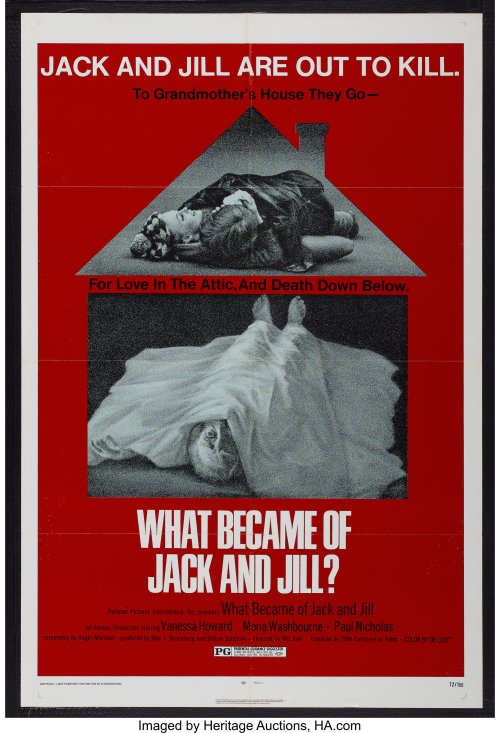
What Became of Jack and Jill? (1972)

jack2

By Richard Winters

My Rating: 7 out of 10

4-Word Review: Greedy couple learns lesson.

Johnnie (Paul Nicholas) lives with his elderly grandmother Alice (Mona Washbourne). He has no motivation to get a job and hopes that by staying in her good graces he can inherit her small fortune and house when she passes away. Johnnie’s girlfriend Jill (Vanessa Howard) becomes impatient waiting for the old lady to die and hopes to hasten it by hatching a plan with Johnnie where Alice will think that a youth movement has occurred where those under 30 rebel against the older generation, particularly those over 75, by taking them away to prison camps, or killing them outright. Johnnie manipulates Alice into believing that this movement has pegged her as their next victim and even stages a protest outside her home to convince her that they’re coming for her. Succumbed with fear Alice drops over with a heart attack, and the couple believe they now can get their hands on her money, but at the reading of her will they find that Alice has placed a stipulation that they weren’t expecting.

The filmed was produced by Amicus Productions, which was a British film studio that specialized in horror movies, mainly those of the Gothic variety. To keep up with changing tastes they decided to dabble in the grindhouse genre and picked this story, which was based on a novel called ‘The Ruthless Ones’ by Laurence Moody, as their first venture. They were so impressed with Vanessa Howard’s creepy performance in Mumsy, Nanny, Sonny and Girly that they signed her on as the star hoping to make her their next ‘scream queen’. Howard, who was upset at how the previous film she was in fell into obscurity, that she was happy to take on a new project that would be financed by a well know studio, which she felt would guarantee that the picture would receive strong box office appeal. Unfortunately, once the project was finished Amicus studio heads were aghast at the dark subject matter and decided not to release it causing this movie to become as obscure as Howard’s other one, which in-turn disillusioned her wit the business and causing her to retire.

The story does have its share of faults. There’s no explanation for what happened to Johnnie’s parents, or what their take is on his living situation. His ability to fool the grandmother into believing such an outrageous conspiracy theory happens too easily and is hard to believe, but the dark story elements, despite the slow pace, still holds adequate intrigue. A lot of credit goes to the performances. Howard is quite nasty, but in a different way than she was in her other movie where she behaved like she was in a trance, but here is knowingly devious while also shockingly callous. Washbourne is also terrific causing you to gain sympathy for her character and what she goes through.

The twist is good, but not a complete surprise and it takes too long to get there. My biggest gripe is that once the story shifts it doesn’t explore enough of the wrinkles that it creates. There’s a whole array of different plot threads it could’ve taken, but instead settles for the most obvious one culminating in a climax that peters itself out instead of inviting in even more twists and characters to it.

Spoiler Alert!

The stabbing scene is problematic in that the victim clothes get stained with blood, but there’s no rip in the clothing to represent where the knife was able to get through. A person can’t bleed unless a sharp object touches their skin and for that to happen it needs to be able to cut through the fabric on top of it, so to have a shot where the victim is ‘bleeding’ into their clothing, but clothing itself  isn’t ripped is illogical. Also, having the police continue to stand outside the home and politely knock on the door to be let in, after they become aware of what Johnnie has done, while he remains inside refusing to open it, got overdone. At some point the police are going to have to break down the door if the suspect refuses to come out and this should’ve been shown.

End of Spoiler Alert!

Overall I still enjoyed it especially the music played over the opening and closing credits and during the club scenes. I don’t know what the name of the band was, but it has a great punk band-like sound that’s distinct and hard edged. If the movie itself won’t get the proper Blu-ray release that it deserves then the soundtrack at least should.

My Rating: 7 out of 10

Released: June 16, 1972

Runtime: 1 Hour 33 Minutes

Rated PG

Director: Bill Bain

Studio: 20th Century Fox

Available: None

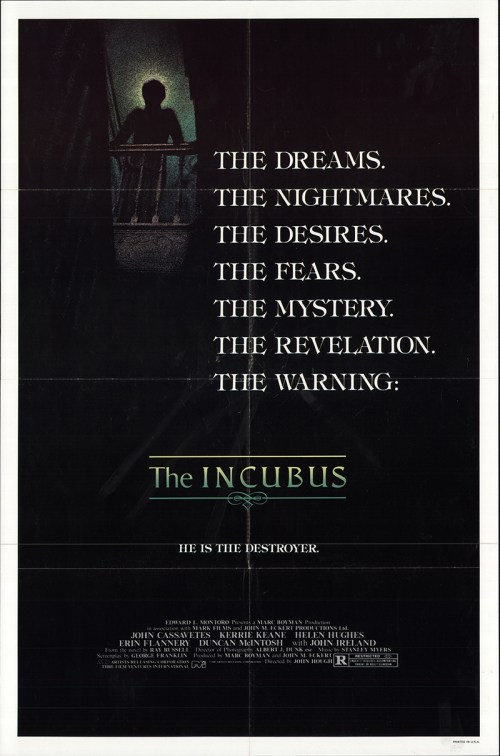
Incubus (1982)

incubus1

By Richard Winters

My Rating: 5 out of 10

4-Word Review: Demon being rapes women.

In a small Wisconsin town known as Galen the women are being sexually assaulted by a mysterious being with super human strength. When the victims are taken to the hospital they are seen by Dr. Sam Cordell (John Cassavetes) who notices an extraordinary amount of semen deposited that is reddish in color and doesn’t seem left by a human. Sam argues with the local sheriff Hank (John Ireland) about whether it’s a gang of men doing these crimes, or just one person. The two team-up with Laura (Kerrie Keane), a local reporter who has just moved into town and shares a striking resemblance to Sam’s former girlfriend who’s now deceased, to find the culprit. They begin to think it may be Tim (Duncan McIntosh) a young man who’s still living with his adopted mother (Helen Hughes) and has been dating Sam’s daughter Jenny (Erin Noble). Tim complains about having weird, vivid dreams and every time he wakes up a new crime has been reported, which makes Sam fear that Jenny may be the next victim.

This film approaches things differently from the conventional horror, especially those done in the 70’s, where there’s no character build-up and just jumps right into the attacks, but this doesn’t work because we have no idea who these people are nor care what happens to them making the viewer sit through the whole first half in a rather apathetic manner to what’s going on. The film also makes the mistake of not showing, with the exception of a brief second where we do see the creature’s hairy arm, of who this entity is until the very end though it should’ve been done sooner. Having some mystery is good, but a film has to keep upping the ante otherwise it will get tedious and seeing the attacks get done over and over in virtually the same manner without any new information or twists added soon becomes quite boring.

Listening to Sam and Hank perpetually argue who the culprit is for almost the entire film without much  clues being added in becomes tiresome too. The film though is helped immensely by John Hough’s direction who adds a lot of visual style including a cool tracking shot done from underneath a wheelchair.

I was unhappy though that it wasn’t actually filmed in Wisconsin, but instead Guelph, Ontario, which has homes and buildings that resemble more of a colonial style that you would find in the northeast versus the Midwest. Having movies filmed on-location that’s specific to the story can help give it an added ambiance and sometimes even work as a third character, but since this movie cheats on this we don’t get that here.

Casting Cassavetes, who is better known for directing groundbreaking, independent movies, in the lead was a novel move. His hawk-like facial features I always felt would’ve made him a good bad guy, but his unique acting approach does at least keep his scenes interesting though his relationship with his daughter does border on cringey. One shot has him viewing his naked daughter, who is 17, through a  mirror as she gets out of the shower, which seems to imply, though it never gets played-out, that he may have a perverse sexual interest in her. There’s another scene where he introduces her to Laura as simply being ‘a woman I live with’, which is a very weird way for a father to describe a daughter.

The supporting characters aren’t captivating at all. Laura, who’s supposed to be an aggressive journalist type, breaks down too easily after receiving minor blow back from the sheriff over her reporting, which made her seem too sensitive. If she’s truly the ‘fearless reporter’ as portrayed then she’d have to have a thicker skin and even expect some criticism when it comes. The Tim character is also a bore as we see him in only one emotional state, perplexed and confused, which makes him too one-dimensional.

Spoiler Alert!

The ending is where things get messed-up. For one thing it tries to squeeze an elaborate explanation for what’s going-on into the final three minutes, which is too short of a time period for the viewer to digest it all, or have it make sense. What really got me though is that we find out that the incubus was actually Laura, and the film ends with Sam seeing her kill his daughter, but we never see how Sam responds, or if he’s able to defeat her, which is frustrating. So much time gets spent on the boring investigation only to then abruptly end once we finally get a pay-off.

By having Laura be the ultimate villain also goes against the film’s title. According to mythology an incubus is a male demon that tries to have sex with a female human, but a succubus is a female demon, so hence the title of the movie, the way I see it, should’ve been, when given the way it turns out, Succubus.

My Rating: 5 out of 10

Released: August 27, 1982

Runtime: 1 Hour 33 Minutes

Rated R

Director: John Hough

Studio: Kings Road Entertainment

Available: DVD, Blu-ray, Pluto TV, Plex, Tubi, YouTube

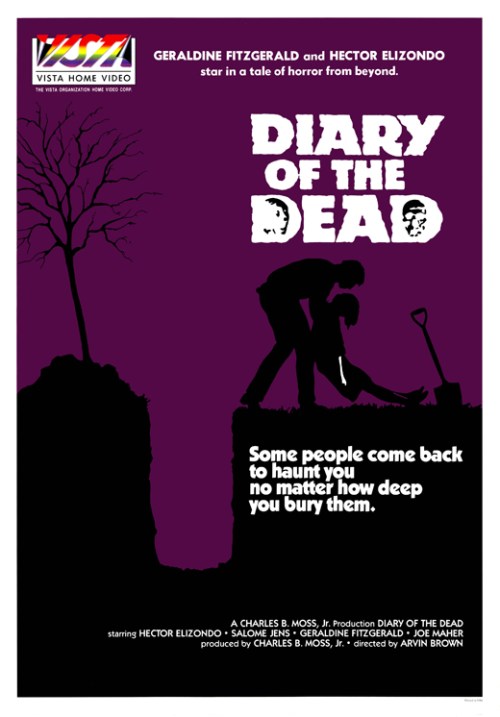
Diary of the Dead (1976)

diary2

By Richard Winters

My Rating: 5 out of 10

4-Word Review: Two dead old ladies.

Stan (Hector Elizondo) is married to Vera (Salome Jens) while living in a house that’s owned by Vera’s mother Maud (Geraldine Fitzgerald). Maud and Stan do not get along and she uses the fact that Stan can’t find regular employment as a means to belittle him.  She also tries to convince Vera to leave him. Stan is aware of this, but can’t seem to do much about it. Then one day Maud’s friend Ethel (Kate Wilkinson) comes for a visit. She arrives while Maud is upstairs taking a nap, and is greeted by Stan, but since she had to walk all the way from the bus station to the house and suffers from high blood pressure, she promptly collapses once she gets inside. Stand decides to use this as an opportunity to get rid of Maud by claiming to the attending physician (Austin Pendleton) that the dead body is his mother-in-law, so when Ethel is taken away for cremation everyone thinks it’s Maud instead. Stan then buries Maud’s body, who he has killed on his own, in his backyard, but this catches the eye of his nosy neighbor Walter (Joseph Maher) who had always gotten along well with Maud and feels Stan’s explanation of what happened doesn’t add-up.

The story is based on the 1971 novel ‘One Across, Two Down’ by Ruth Rendell and while the plot has a sufficient amount of twists the direction, by first timer Arvin Brown, is lacking. It’s not liked it’s bad direction, but it has no finesse and seems meant of TV.  It’s no surprise that Brown ended up doing projects exclusively for TV after this one as nothing here is cinematic and approached in such a sterile way visually that it actually detracts from the proceedings.

Elizondo gives a feisty performance that perfectly captures a bitter man going through life with a chip-on-his-shoulder. His arguments and confrontations with Maud lend for some colorful dialogue, but a meddling, cantankerous mother-in-law is nothing new and if anything seems cliched making the material come-off as second-rate and formulaic.

The crime itself isn’t elaborate. In the ‘Columbo’ TV mysteries we’d see the bad-guy pull-off the murder in a way that was carefully thought-out, so the viewer becomes intrigued trying to figure out what flaw the killer overlooked that Columbo will jump on, but here it works in reverse. The crime is spur-of-the moment with a bunch of things that could easily go wrong that will instantly get Stan caught, which isn’t as interesting. Stan is also not a pleasant person, so the viewer is not emotionally invested in him escaping the clutches of the authorities,  If anything you remain ambivalent to what happens, which are ingredients that don’t make the movie interesting.

The film does feature a twist ending, but it’s not something one couldn’t have seen coming as it goes overboard telegraphing it. As an episode of ‘Alfred Hitchcock Presents’ it would’ve worked better, but it gets stretched too thin for feature length. The should also not be confused with the George A. Romero film of the same name that came out 30 yeas later.

My Rating: 5 out of 10

Released: July 20, 1976

Runtime: 1 Hour 33 Minutes

Rated PG

Director: Arvin Brown

Studio: B.S. Moss Enterprises

Available: None

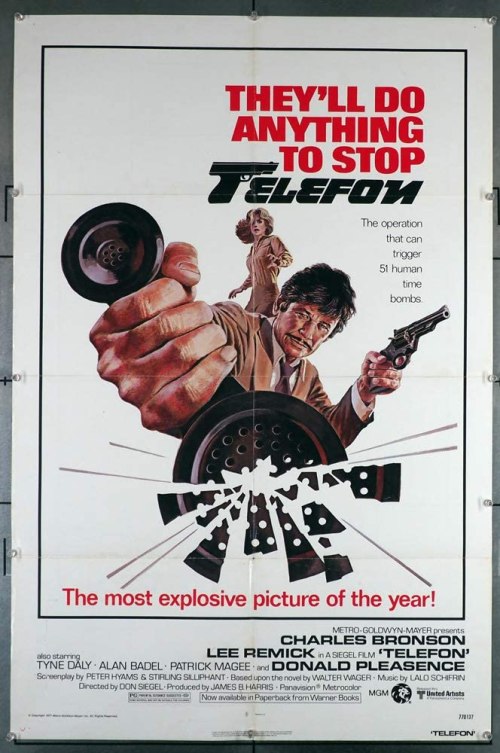
Telefon (1977)

telefon1

By Richard Winters

My Rating: 6 out of 10

4-Word Review: Spies hypnotized to kill.

Grigori (Charles Bronson) is a KGB agent ordered to investigate a rash of terrorist activities being done inside the US. All of the crimes are being committed by Russian sleeper agents who are hypnotized to carry-out acts via a call on a telephone where they are read a line from a Robert Frost poem, which  triggers them to act upon preordained instructions. The calls are made by a rogue agent named Nickolai Dalchimsky (Donald Pleasence) and it’s up to Grigori to stop him before it becomes an international incident. While in the US Grigori works with lady agent named Barbara (Lee Remick), who Grigori thinks is on his side, but she’s a double-agent ordered to kill Grigori once the mission is completed.

While Leonard Maltin in his review describes the plot, which is based on the novel of the same name by Walter Wager, as being ‘ingenious’ many others felt it was far-fetched. There actually has been one case in the history of crime, which occurred on March 29, 1951 in Copenhagen,  Denmark, where a man by the name of Palle Hardrup was apparently hypnotized by Schouw Nielsen to carry-out a bank robbery and this lead to two people getting killed. Both men were later convicted and the story was made into a 2018 movie called Murderous Trance. Since then though there has been no other cases on record of this type of thing occurring and many experts in the hypnotic field insist that it couldn’t making what transpires here highly speculative at best.

The issue of Grigori having a photographic memory and able to memorize the names and personal details of all the sleeper agents is questionable too. Many researchers say that this type of phenomenon is only temporary and cannot be retained over a long period. There are others that say the photographic memory is a myth altogether and like with the hypnosis angle, forces the viewer to complete shut off their skeptical side right from the get-go in order to have even a chance of enjoying the movie at all.

The only interesting aspect is Lee Remick and Bronson learning to deal with each other’s contrasting personalities, which makes great use of Chuck’s gruff and brash manner, but I felt Remick as an agent wasn’t believable. When she’s ordered to kill one of the sleeper agents inside a hospital by injecting him with a drug she gets quite nervous, but if she’s killed before, then I’d think it would be like second-nature to her and she’d be cool and calm under pressure. I also felt the film should’ve showed her fully carrying-out the killing instead of cutting away without ever seeing the actual injection.

I didn’t get why she would’ve fallen in love with Bronson as the two had nothing in common and really didn’t get along. The film seems to act off the theory that putting a man and woman together will automatically elicit romance and sexual tensions, but members of the opposite sex work together on jobs sometimes for many years where sex and romance never occurs, so having these two end up getting the hots for each other seemed forced and mechanical. Also, the fact that Remick is a double-agent and Bronson becomes aware of this would make me believe that he, being a professional spy, would never trust her enough to let down his guard to expose his softer side to begin with.

I was disappointed too that several scenes are supposed to take place in Texas, including the city of Houston, and yet ultimately all of  these get shot in either California, at the Hyatt Regency Hotel in San Francisco, which was the same one used in High Anxiety, or on a studio sound stage. Yet there are plenty of other scenes that were shot on-location like New Mexico , Montana, and even Finland, so if they could make it to those places then why not to Texas too?

The climactic sequence, which takes place in a backwoods bar and features a humorous performance by Helen Page Camp, as the wife of the bar owner, gets wrapped-up in too tidy of a way and doesn’t take full advantage of Pleasence, who has been very creepy in his other villainous roles, but here doesn’t make much of an impression. While the film is entertaining on a non-think level it compares poorly to other movies in the spy genre and certainly does not come close to matching many of the better ones.

My Rating: 6 out of 10

Released: December 16, 1977

Runtime: 1 Hour 42 Minutes

Rated PG

Director: Don Siegel

Studio: MGM

Available: DVD-R (Warner Archive)

Hustle (1975)

hustle2

By Richard Winters

My Rating: 6 out of 10

4-Word Review: Father searches for killer.

Phil (Burt Reynolds) is a police lieutenant who’s in love with a beautiful French prostitute named Nicole (Catherine Deneuve) and the two live together in Phil’s swanky hilltop Malibu home. Unfortunately Phil can’t handle that Nicole continues her business practice even as the two are in a relationship and this threatens their love affair. As this goes on Phil also gets embroiled in a police investigation when a group of school children find a dead body of a 20-year-old woman washed up on the beach. The victim’s father (Ben Johnson) insists it was murder even after the autopsy says it’s a suicide. Phil and his partner Louis (Paul Winfield) are ready to close the case, but when the father starts his own investigation the two  decide to pursue it further, which leads them to many unsettling conclusions including that the daughter starred in several porno films financed by the sleazy Leo Sellers (Eddie Albert) a rich older man who also happens to be a client of Nicole’s.

This film was the second collaboration between Reynolds and director Robert Aldrich as the two had just completed the highly successful The Longest Yard a year earlier. While that film met with critical acclaim this one received only a so-so reception. There were certain elements that I liked, but I did find Reynolds’ presence to be a detriment. His boyish looks where he doesn’t have the mustache or the wavy hair, which always made him look like he was wearing a wig, is a plus, but his character is too detached. It’s only after repeated cajoling by the father that he even agrees to look into the case more and the movie would’ve been more compelling had it revolved around the father from the very beginning.

Reynolds’ relationship with Deneuve is boring and the scenes between them aren’t sexy or provocative as intended. We should’ve seen how they became a couple from the start as their attachment brings out all sorts of questions that never get answered. For instance, where did they first meet? Was it during a sexual rendezvous where Burt paid for her services, or possibly a cop raid? Why did she fall for Burt as this woman had been with a lot of men, so what made him special over the others and why would a cop think getting serious with a woman who routinely sleeps with other men be a good idea, or even work?

The movie tries to be chic by creating a character who’s initially ‘open-minded’ about prostitution, but then contradicts itself by having him turn around and demand she must give it up. If this were truly a modern thinking guy he would’ve liked the fact that she was financially independent and slept with other men because she gave herself for free to him while she made the others pay. He might even get-off watching her having sex with others, as there are some husbands/boyfriends who do, and the fact that the film doesn’t think to go into this area makes it far less ‘hip’ than it thinks it is.

There’s also a very violent moment where Reynolds refuses to let her leave, physically slaps her, and even refers to her as a ‘bitch’ several times. He then pins her to the bed and forces himself onto her. While she initially resists he continues to do it until she finally gives-in and acts like she’s enjoying it. Today’s audiences will be rightly turned-off by this and it will make Reynolds, the intended ‘good guy’, look much more like an abuser. It also might allow some men to think that being violent with women is ‘okay’ as they’ll ultimately give in and ‘learn to enjoy it’, which is the wrong message to be sending.

As mentioned earlier Ben Johnson’s character is the only thing that keeps it interesting. The scene where his eyes tear-up after watching his daughter, played by real-life adult film actress Colleen Brennan, perform in a porn film is similar to the one in Hardcorebut far more impactful here. I was amused why he even took the part as he had complained about being in The Last Picture Show, which is the film he won the Oscar for as Best Supporting Actor, because of the ‘foul language’, but then he ends up swearing quite a bit in this one. In either case I’m glad he took it as his presence raises the storyline above its otherwise seedy level and even helps give it a few memorable bits.

My Rating: 6 out of 10

Released: December 25, 1975

Runtime: 2 Hours

Rated R

Director: Robert Aldrich

Studio: Paramount

Available: DVD, Amazon Video, YouTube

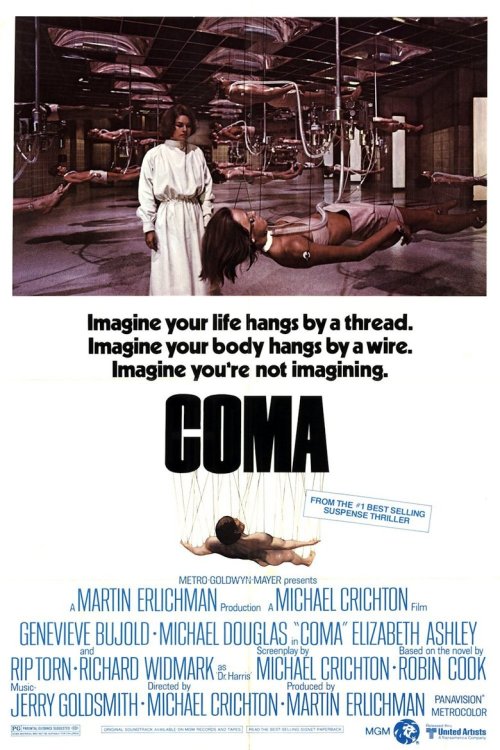
Coma (1978)

coma2

By Richard Winters

My Rating: 7 out of 10

4-Word Review: Who’s killing the patients?

Susan Wheeler (Genevieve Bujold) is a Dr. working as a surgeon at Boston Memorial Hospital, who learns that her best friend Nancy (Lois Chiles) fell into a coma at the hospital while having routine surgery. Susan is convinced that there must be an answer to what went wrong as Nancy was young and had no underlying health conditions. While reviewing the hospital records she finds that a high number of other patients at the hospital ended up having the same fate and all were of a similar age and body type as Nancy. Susan also notices that the patients had surgery in the same operating room and once they became comatose their bodies where shipped off to a remote facility known as The Jefferson Institute.  Susan’s boyfriend Mark (Michael Douglas), who also works at the hospital, tries to convince her it’s all a coincidence, but the more Susan investigates the more determined she is to uncover the truth even if it means putting her job and even her life on the line.

The film is based on the novel of the same name written by Robin Cook. Cook, a physician, decided to dabble in writing on his off-hours and in 1973 got his first novel, ‘The Year of the Intern’, published but it was a financial failure. While that book had been more of a drama he came to realize that thrillers was the genre that had the most commercial success. He studied how, in his words, ‘the reader was manipulated by the writer’, in the thriller novels that he had enjoyed and then listed these techniques on index cards and made sure to use them in ‘Coma’, which lead to that book being a best-seller. Michael Crichton, who had met Cook while he was working on a post doctorate at La Jolla’s Salk Institute, agreed to sign on as the director where he hoped to create a film that would delve into people’s fear of hospitals the way Jaws had connected to people’s phobias about sharks and swimming.

The result is a nice compact thriller that moves along at a brisk pace and takes advantage of both the director’s and author’s medical background to help keep the scenario both realistic and enlightening to the inner-workings of a hospital. There’s a couple of cool foot chase scenes with one occurring between Bujold and actor Lance LeGault inside the hospital while another happens at the ominous looking Jefferson Institute with both being quite intense.

Bujold, despite being different than the protagonist in the novel, who was described as blonde and 23 while Bujold is brunette and 35 at the time of filming, was still a perfect casting choice. I loved her French Canadian accent, which gives her character distinction, but she does appear at times to have reddish nose and cheeks making her seem like she had a rash or cold. What I didn’t like was that the feminist angle of the character, which had been so prominent in the novel, gets played-down here. In the book Susan did not know Nancy and simply took on the case through her own personal initiative to prove herself in an otherwise ‘man’s world’, which was more compelling than the pedestrian way here where she investigates the case simply because she’s heartbroken over the loss of a friend.

It also didn’t make sense to me why she was the only one upset over the deaths of these patients. The patients most likely had family and friends, so why weren’t any of them demanding answers to what happened? We live in a sue-happy culture and medical malpractices are the most prevalent lawsuits out there making me believe this racket wouldn’t have been able to survive too long as lawyers and private investigators, who would’ve been hired by the grieved family members, would’ve been on the case demanding answers from the hospital long before Susan ever even got involved.

The Susan character has the same issues as James Coburn’s did in The Carey Treatment where we have a medical professional with no background in investigating suddenly showing amazing instinct on-the-spot that you’d only expect from a seasoned detective. Having a group of people, like the grieved relatives, working together to solve the case would’ve had more interesting banter and camaraderie, which is missing here. While seeing an individual take down a mighty criminal system is emotionally gratifying it usually takes a strong team of people working in tandem to accomplish that.

Spoiler Alert!

I did find the film’s climax where Susan goes under the knife and risks being another comatose victim, to be quite suspenseful, but I found it strange why this woman, who had done all the legwork to uncover the crime, would then just hand-it-over to the creepy hospital administrator, played by Richard Widmark, to finish the job instead of her going to the police with her findings. The Widmark character displayed a lot of red flags from the start, which is obvious to the viewer, so why is Susan, who had been so super savvy the rest of the time, so dumb at the end and trust a creep like him to do the right thing?

My Rating: 7 out of 10

Released: January 6, 1978

Runtime: 1 Hour 53 Minutes

Rated PG

Director: Michael Crichton

Studio: MGM

Available: DVD, Blu-ray, Amazon Video, YouTube, HBOMax

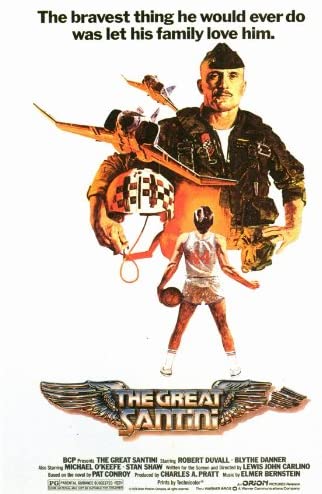
The Great Santini (1979)

great santini

By Richard Winters

My Rating: 4 out of 10

4-Word Review: Warrior without a war.

Bull Meachum (Robert Duvall) is a Lieutenant Colonel pilot in the marines, who enjoys much camaraderie and respect amongst his colleagues, who affectionately call him ‘The Great Santini’.  However, his home-life is a different story as Bull treats his family the same way he does those under him in the service. His wife Lil (Blythe Danner) has learned to adjust to it, but his oldest son Ben (Michael O’Keefe), who is ready to turn 18, rebels and this causes much friction between the two, which eventually boils over to the rest of the children just as the family gets ready to move into a new residence in the deep south.

The film is based on the novel of the same name by Pat Conroy, who in-turn based it on his real-life relationship with his strict, militant father Donald Conroy who gave himself the nickname from a magician that he had seen as a child. While the two had a rocky relationship, much like the son and father do in the movie, the film did help the two mend some fences and his father would routinely accompany his son on book signings and they were even in attendance on the set as the movie was being shot.

While the book was well received I felt that the movie came off disjointed and had a wide-array of tonal issues. The scenes with Santini in the military are quite funny, in a raucous sort of way, but when it shifts to focus on the family life it becomes more of a hackneyed drama. There’s also a long-drawn out segment dealing with a stuttering black man named Toomer (Stan Shaw) and his late-night confrontation with a white racist (played by David Keith in his film debut) that gets quite ugly and doesn’t have either Duvall or O’Keefe in the scene and seems like something for a completely different movie. Maybe in the book, which I have not read, this all came together better, but here it’s like a movie searching desperately for its center and never finding it.

Both Duvall and O’Keefe are excellent and both got nominated for the Academy Award for their efforts, but Danner as the wife is badly miscast. For one thing she looks too young for be O’Keefe’s mother and she speaks in a weird accent where it seems like she’s trying to affect a southern dialect, but it doesn’t sound authentic and wavers throughout. I also didn’t understand why her character married Santini as the two had little in common and for the most part seems to resent his bullish behavior much like the rest of the kids do. Why does she stick with him and what did she see in him to have her fall in love with him in the first place as these things just aren’t clear at all.

Lisa Jane Persky, who also makes her film debut as the oldest daughter Mary Anne, is an odd-piece of casting as well. Her performance is okay, but she certainly does not come-off like a child dominated by a supposedly abusive, controlling parent as she routinely teases and mocks Santini right to his face and at one point the teasing gets so bad it chases him away, which hurts the film’s credibility as it makes him seem far less of a tyrant and making O’Keefe’s dealings with him seem overrated. After all if a teen girl can get the old guy to run from her why can’t he do the same?

On the technical end the movie is okay and it’s fun seeing Julie Ann Haddock, best known for playing Cindy in the first season of ‘Facts of Life’ TV-Show, playing Santini’s younger daughter Karen. Unfortunately the film is too much of a mish-mash. Has some good moments here-and-there, but overall fails to deliver any type of sustained emotional impact.

My Rating: 4 out of 10

Released: October 26, 1979

Runtime: 1 Hour 55 Minutes

Rated PG

Director: Lewis John Carlino

Studio: Orion Pictures

Available: DVD, DVD-R (Warner Archive), Amazon Video, YouTube

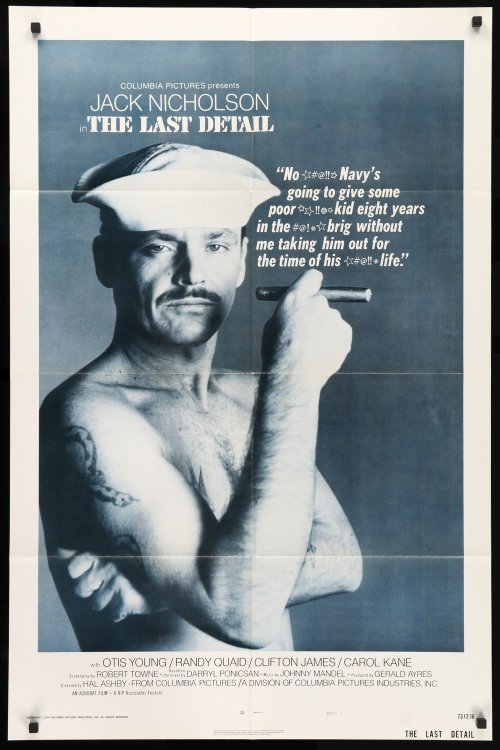
The Last Detail (1973)

lastdetail

By Richard Winters

My Rating: 8 out of 10

4-Word Review: Seaman escorted to prison.

Billy Buddusky (Jack Nicholson) and Richard Mulhall (Otis Young) are two navy lifers assigned the task of escorting an 18 year-old seamen named Larry Meadows (Randy Quaid) to prison. Meadows had been caught lifting $40 from a charity fund run by a wife of a senior officer. In return he got court-martialed and given an 8-year sentence in the brig. Buddusky and Mulhall feel the sentence is too harsh and immediately take a liking to the soft-spoken young man who despite his tall height seems harmless and mile-mannered. During the trip, which is expected to take a week, the two men decide to show Meadows a ‘good time’ by taking him on many side-trips including a whorehouse where the young virgin has sex with a prostitute (Carol Kane). As the time grows near for them to turn their prisoner over to the authorities they start to feel reluctant about doing so, but the fear of being kicked out of the navy and losing all of their pay and benefits keeps them grounded in their responsibility even as Meadows tries several times to escape.

It may seem amazing to believe now, but this film, which has won over almost universal appeal both from the critics and film viewers almost didn’t get made due to the fear from the studio that the word ‘fuck’ was spoken in it too many times. Screenwriter Robert Towne, who adapted the story from the novel of the same name by Daryl Poniscan, was pressured to take most of the uses of the profanity out of the script and in fact production was delayed while both sides had a ‘stand-off’ about it with Towne insisting that “this is the way people talk when they’re powerless to act; they bitch.” Eventually the script got green-lit with all the ‘fucks’ intact, which at the time was a record 65 of them. In retrospect I’m glad Towne held his ground as without the F-word being used, or some silly lesser profanity substituted in, would’ve given the film a dated feel when being watched by today’s standards where the word is said hundreds of times on social media and sometimes even in commercials where it’s only slightly bleeped-out. This is a problem when watching other films from the late 60’s and early 70’s where goofy slang gets thrown in to compensate for the lack of the F-word, which in turn hurts the film’s grittiness and edge, which thankfully got avoided here.

The story was a problem too as many studio execs considered it too ‘non-eventful’ to make for an interesting movie, but this is the whole reason why the movie is so special as it doesn’t try to throw in the cheap antics other Hollywood films might to make it ‘more entertaining’. The film remains low-key and fully believable throughout and may remind others, as it did me, of one’s own coming-of-age experiences when they were 18 and hanging out with others who were older and more worldly-wise. Cinematographer Michael Chapman, who appears briefly as a cab driver, insistence at using natural lighting only also helps heighten the realism.

The story takes many amusing side turns that manages to be both poignant and funny including a brawl that the three have with a group of marines inside a Grand Central Station restroom, though I did wish some of the other segments had been strung out a bit more. One is when the three men attend a group encounter, which features Gilda Radner in her film debut, to a bunch of chanting Buddhists. I felt it was weird that the men just stood in the background and didn’t assimilate with the group during the meeting and begin chanting alongside the others, which would’ve been funny. The scene inside the hotel room where Buddusky can’t get his roll-out cot to fold-out right and forcing him to sleep in a uncomfortable position should’ve been played-out more too. Are we to believe that he slept that way the whole night?

Of course it’s the acting that makes this movie so special. While I never pictured Nicholson with his over-the-top persona as being someone who would be a part of the regimented culture such as the navy I ended up loving him in it and felt this was the performance he should’ve won the Oscar for. I especially got a kick out of the way he would get all fidgety when outside in the cold, which I don’t think was acting at all as it was filmed on-location in the Northeast during the very late autumn/early winter and I believe he was really freezing as he was saying his lines.

While his character is not as flashy, Otis Young is every bit as excellent as it takes a good straight-man, which is what he essentially is, to make for a good funny man. The part was originally meant for Rupert Crouse, who unfortunately got diagnosed with cancer just as the production began forcing the producers to bring in Young as a last minute replacement, but he manages to deliver particularly in the scene on the train where he loudly castigates Buddusky for his misbehavior. Quaid is quite good too even though he goes against the physical characteristics of the character, who in the novel was described as being ‘a helpless little guy’, but director Hal Ashby, who can be seen briefly during a barroom scene, choose to cast against type by bringing in a tall, hefty fellow who looked like he could defend himself if he had to, but is just too sheltered to know how.

The ending is the one segment where I wished it had been a little more emotionally upbeat. It’s still a big improvement over the one in the book where Buddusky dies, which fortunately doesn’t happen here, but it still isn’t too memorable either. The film though overall does a good job of conveying the underlining theme of how the navy men where just as imprisoned as Meadows, at least psychologically, and unable to consider life outside of the navy box that they had spent their entire lives in and where thus locked-in more so than Meadows, whose sentence in jail would only last 8-years versus a lifetime like with Buddusky and Mulhall.

My Rating: 8 out of 10

Released: December 12, 1973

Runtime: 1 Hour 44 Minutes

Rated R

Director: Hal Ashby

Studio: Columbia Pictures

Available: DVD, Blu-ray, Amazon Video, YouTube

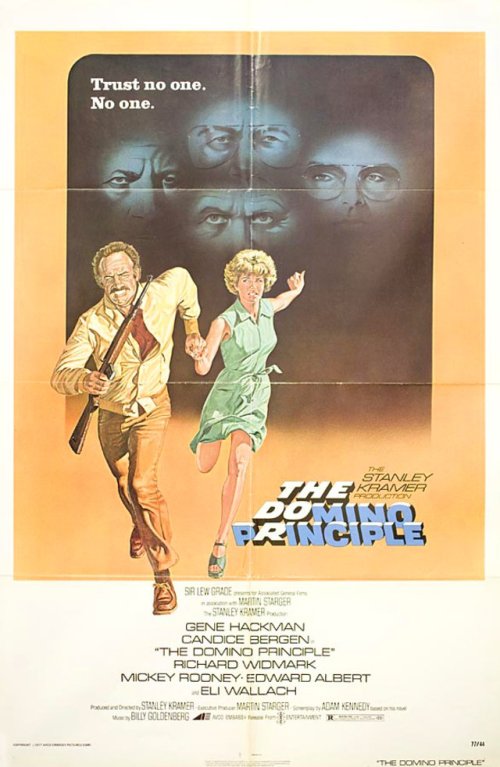
The Domino Principle (1977)

domino

By Richard Winters

My Rating: 6 out of 10

4-Word Review: Hired for secret mission.

Roy Tucker (Gene Hackman) is in prison for the murder of his wife’s first husband, but gets approached by Tagge (Richard Widmark), who works for a secret organization and who offers to get both Roy and his cellmate Spiventa (Mickey Rooney) out of jail where they can have their freedom again, but with one hitch; he must carry out a mysterious mission that they themselves don’t yet know the details to yet. Roy is suspicious of the group’s intent, but longs to see his wife Ellie (Candace Bergen), so he agrees to go along with it. After getting out of prison through an elaborate escape plan that the secret group hatches Roy is then able to travel to Costa Rica using a passport that the group made for him. It is there that he spends a relaxing week with Ellie, but then Tagge and his men (Eli Wallach, Edward Albert) return and remind him of his commitment, which turns out to being the assassination of an important political figure. Once Roy realizes this he tries to back out, but soon realizes that he jeopardizes the life of his wife, who the group insists they will kidnap an kill, if he does.

The film is based on the novel of the same name written by Adam Kennedy, who also wrote the screenplay and at one time was an actor before eventually turning to writing. While the novel got great reviews the movie didn’t with many critics panning it including Leonard Maltin, who described it as a ‘muddled thriller’. Both Hackman and Bergen, in later interviews, have called it ‘terrible’ and even director Stanley Kramer wrote in his memoirs that he’d like to disown it. Much of the problem could be blamed on the different runtimes with a heavily edited 88-minute cut being completely confusing, but this version that I saw, which ran a full 101 minutes, I found to be captivating, at least through the first 90-minutes.

The real problem I had stemmed around Hackman, who gives a one-dimensional performance. There is one moment where he assaults the Edward Albert character after he refuses to let him see his wife, which I felt was justified and entertaining to watch, but he remains surly too much of the time and it would’ve been nice to have seen some other emotions seep through, if even for a few random moments. Bergin is totally miscast as the middle-aged wife and even wears a brunette wig in an effort to make herself seem older. She stated in interviews that she took the part so she could play an ‘ordinary person for once’ instead of a beautiful, glamourous person like she usually did, but I didn’t understand why she was even offered the role as there were plenty of actresses more Hackman’s age that would’ve been a better fit.

Spoiler Alert!

While I did enjoy the movie for the most part especially its scenic location shooting including one scene that takes place directly underneath the Golden Gate Bridge I did find the twist ending to be extremely dumb. This includes having Roy deciding not to shoot the intended victim by intentionally aiming his shots short in order to miss his human target only to find that his former cellmate Spiventa was also hired for the same mission, but without Roy knowing, and he kills the person while shooting at him from a different angle. The problem is that the viewer thinks Spiventa is already dead as we see him get shot by the mysterious group while underneath the bridge. Why Spiventa would fake his own death, or not tell Roy that he was in on the plan since the two had been quite close, is ever explained. It also doesn’t make sense why Roy would decide at the last second to pull back his shots and not kill the person he was assigned to assassinate. Sure, for moral reasons he probably felt bad about it, but he knew that his wife would be killed if he didn’t follow through, so how he was expecting to save the life of his target while also somehow keeping his wife alive after the group finds out Roy didn’t do what he was supposed to?

The final shot shows Roy, with gun in hand, walking along a beach, apparently intent on hunting down whoever was the behind-the-scenes man from the group who was giving out all the orders, which we the viewer never see. Keeping some elements of the organization a mystery is fine, but what annoyed me is that we see a rifle pointed right at Roy as he walks the beach, but then the film ends without us ever knowing if Roy got shot first, or if he survived to kill the head of the group. Some sort of resolution in this area should’ve been shown and leaving it so wide-open is not intriguing and instead quite frustrating.

My Rating: 6 out of 10

Released: March 23, 1977

Runtime: 1 Hour 41 Minutes

Rated R

Director: Stanley Kramer

Studio: AVCO Embassy Pictures

Available: DVD, Amazon Video, Shout Factory TV, Tubi, YouTube

The Blockhouse (1973)

blockhouse2

By Richard Winters

My Rating: 6 out of 10

4-Word Review: There’s no way out.

On D-Day a group of war prisoners on an island that’s run by German soldiers seek shelter from an allied air attack by finding refuge in an underground German bunker, but once inside, they realize to their horror that the shelling outside has blocked-off both the entrance and exit, which essentially traps them in permanently. They are fortunate enough to find a supply room full of enough food and wine to keep them fed for a long time, but as the days wear into weeks and then months and even years they grow tired and despondent about their situation. They try to find ways to break through the cement walls, but their attempts prove futile, which leads all of them into a mental and emotional breakdown.

The film is best known as being one of Peter Seller’s rare dramatic turns where he plays a character that is not funny or colorful. Normally his performances are quite flamboyant and over-the-top and he tends to dominate the spotlight, but here he blends in with the rest of the performers with a rare low-key portrayal that is quite impressive when given how he normally acts. This was yet another project he got involved in during the early 70’s when his career was on the down side and he was desperately taking just about any offer that came along, no matter what the quality, in an effort to bring in money. While some of those movies that he starred in during that period were truly awful (i.e. Where Does it Hurt?) this one, despite its grim theme, is unique and worth checking out particularly for those who enjoy experimental cinema.

The film was directed by Clive Rees, whose only other cinematic directorial effort was When the Wales Came, which had a similar theme about an eccentric man living an isolated existence on an island. While Rees is not as well known as Stanley Kubrick, Sellers insisted in interviews, that he was ‘every bit as good’.  While this statement may seem like an exaggeration I was quite taken aback by the gritty realism and the way the viewer feels just as trapped as the victims. The actors give all-around great performances and you see their character’s ultimate mental decline happen right before your eyes, which is both vivid and gut-wrenching. The story also looks at all aspects of their deterioration where they start to do things they had never done before including conveying certain homo-erotic elements. While none of this gets shown I was still impressed that it at least got lightly touched-on as I feared due to the period and heavy UK censorship, where this film was made, that would be one facet that couldn’t get introduced, but ultimately in a soft way it does.

If you’re looking for an entertaining crowd pleaser than this movie won’t be it. As Sellers rightly stated in his interview it’s meant for serious ‘connoisseur’s of cinema’ only. TV Guide complained that the film in their review ‘goes nowhere’ and it doesn’t reveal a ‘metaphysical reason’ for the character’s predicament, but I really didn’t think one was needed. Sometimes shit just happens and people must learn to adapt to their new harsh reality, or fall apart and in that vein I felt the movie does an excellent job and goes much further into this dark, murky psychological realm than most others would dare.

Spoiler Alert!

The story is based on the 1955 novel of the same name by Jean-Paul Clebert, who also coincidentally lived an isolated existence for many years in an abandoned village. The novel is loosely based on the actual incident that occurred on June 25, 1951 when two German soldiers in Poland were rescued from an underground shelter that they had been trapped in for 6 years. The difference is that in the movie we never see the rescue as it ends with the remaining two survivors stuck in total darkness when the last of their candles goes out. I felt it would’ve worked better had the rescue been shown as well as a better build-up where we would’ve gotten to the know the men better in the prison camp before they were forced underground, which would’ve made their mental declines even more interesting.

My Rating: 6 out of 10

Released: June 1, 1973

Runtime: 1 Hour 33 Minutes

Rated R

Director: Clive Rees

Studio: MGM

Available: DVD, Amazon Video, Tubi