Category Archives: Foreign Films

Bye Bye Brazil (1980)

By Richard Winters

My Rating: 6 out of 10

4-Word Review: Entertainers traveling throughout Brazil.

This movie is a slightly surreal comedy-drama detailing a caravan of five entertainers who travel the Brazilian countryside putting on vaudeville like shows underneath a makeshift tent.  The film works in a vignette style as it analyzes the many scenarios and difficulties that the group encounters as well as making a very strong statement to the poverty and hardships befallen on the townspeople that they meet. In fact if there is one lasting image that the film gives it is that one.

The story is pretty much character driven and the characters are all by and large highly amoral. They reflect the desperation of their audiences, which they quietly hope someday to rise above, but never do.  There are a few fleeting moments where they amazingly and surprisingly decide ‘to do the right thing’, which ends up being the film’s most memorable scenes, but most of the time they are ‘rough around the edges’ and the viewer is forced to appreciate them with all their frailties brightly exposed.

Jose Wilker plays Lorde Cigano who is the leader of the group and a lifelong con-man. He closely resembles character actor Stuart Margolin, who was famous for playing the character of Angel on the classic 70’s series The Rockford Files where he was always trying one amusing scheme after another and the character here works in much the same way. He has a few good lines as well as a funny running gag where he displays obscene toys to attractive woman he meets in order to ‘turn them on’.

Betty Faria plays Salome who does erotic dances during their performances.  She lies and cheats as much as Lorde and is more than willing to fall back to being a prostitute whenever the group is in need of money. Although she does have a few nude scenes she is really not all that attractive, or young, as she was already hitting 40 at the time that the film was made.  However, her worn looking face does help accentuate the hardened lifestyle of the character. Her best scene is when she is ‘servicing’ one of her clients who is a fat, balding middle-aged man who expounds the entire time they are having sex about the many virtues of his wife.

Fabio Junior plays Cico the young man who joins the group because he feels it is a chance to escape the sad existence of a peasant farmer only to find that life on the road can be in many ways just as grueling and thankless. Junior is a famous singer in Brazil and his chiseled, boyish good looks didn’t seem to be a realistic fit for the impoverished farm family that his character came from in the movie.  He shows no concern for his pregnant wife and spends the entire time trying to seduce Salome, which makes him irritating and unlikable.  I did though like the fact that he was the one character who evolved and became introspective at the end.

The character of Daso, which is played by actress Zaira Zambelli and is Fabio’s wife, was a bit frustrating. The film makes it clear that she is aware that Fabio is fooling around with Salome and she doesn’t seem to care. She also excitedly jumps into becoming a prostitute at her husband’s insisting when the group falls on hard times. However, I wanted more explanation, or history given to the character to help understand this, but the story does not supply any.

I was also disappointed with the handling of the Swallow character who performs feats of strength during their productions as well as acting as the group’s driver. Swallow is mute, but easily is the most likable and durable, but he runs away half-way through the picture and never returns. I would have liked the character to have stayed during the entire duration as he helped give balance to the others, or at the very least some detail to his eventual fate.

The film becomes almost a like a Brazilian travelogue as the viewer encounters everything from the small dessert towns, to the exotic rain forests. However, the budget was clearly low and I didn’t feel the cinematography captured the majestic essence of the landscape as much as it could’ve, or as I had expected. The story and situations are not all that unique, or creative, but it stays nicely amiable throughout.  The funniest part of the whole film may actually be the lyrics of the song that is sung at the very end during the closing credits. This is not a great movie, but not a bad one either.

My Rating: 6 out of 10

Released: February 9, 1980

Runtime: 1Hour 40Minutes

Rated R

Director: Carlos Diegues

Studio: Carnaval Unifilm

Available: VHS, DVD

Entertaining Mr. Sloane (1970)

By Richard Winters

My Rating: 3 out of 10

4-Word Review: The first gay marriage.

Based on the Joe Orton play of the same name, this film deals with a handsome young stranger named Sloane (Peter McEnery) who becomes a lodger at an isolated household in the English countryside. He is on the run from a murder he committed and feels this will be a safe haven due to the only other inhabitants being a quirky old lady name Katherine (Beryl Reid) and her equally quirky father Kemp (Alan Webb).  Katherine, or Kath, takes a sexual interest in Sloane despite their wide age difference, which Sloane doesn’t mind as he uses this to manipulate her. When Kath’s brother Ed (Harry Andrews) arrives and takes an amorous interest in Sloane as well, he does the same thing to him. Then Kemp recognizes Sloane as the killer and Sloane is forced to kill him, which culminates with ironic results.

Playwright Orton was years ahead of his time. His plays always had a dark, sexual, even explicit nature to them and his characters were always perverse and amoral in a darkly hilarious way. It is unfortunate that he was bludgeoned to death in 1967 by his jealous gay lover and his career was cut short. However, this adaptation done by screenwriter Clive Exton seems to miss the mark. The dialogue is endless with very little action. The other adaptation of Orton’s work that was made into a film, Loot, was much more lively and full of a lot of campy, zany humor as well as quick edits and imaginative camerawork. This film is visually dull and all the action is jammed into a cramped, dark house with bland decorations. It never really gets going until the final 15 minutes when you get to see the world’s very first gay marriage performed, but by then it is much too late.

For 1970 this film does seem edgy and even controversial in certain parts. The gay erotic subtext is quite strong especially the way the camera scans Sloane’s tan, half naked body. There is also Ed’s pink Cadillac that he drives around, which I got a real kick out of. I liked the way it squeaked as he drove it and was constantly bouncing up and down.  There is also his very provocative hood ornament of a naked man that the camera hones in on. The best part comes when Ed washes his car and is more focused on the ornament, which he lovingly caresses with his towel, than the rest of the vehicle.

However, 40 years later this stuff seems pretty tame and there are too many segments where nothing happens and is handled too conventionally.  It seemed like director Douglas Hickox really didn’t get, or appreciate the material enough, or interpret it in some interesting way because the final result is nothing more than a filmed stage play. The music that is used is terrible and almost enough to get you to turn off the film. It also gets overused and played over scenes when it isn’t needed and hurts the film’s mood in the process.

The biggest problem with the film may actually be with actress Reid herself. Don’t get me wrong this is a wonderfully unique actress who has done some memorable work. I especially liked her in The Killing of Sister George, and she is quite good here as well. However, I do have two issues. The first is a small one. It involves the fact that the character wears dentures. In one scene Sloane supposedly knocks them out and breaks them, but then Reid turns around and screams and you can see that she still has teeth in her mouth.  The other, much more serious issue is the fact that near the beginning of the film she is seen walking through a cemetery in broad daylight wearing a see through blouse. Now with some woman this can be quite sexy and I certainly wouldn’t complain, but when they are 60 and looking more like 70 this is a bad idea, even for perversely comical purposes as it is here it is still a bad idea. What is even worse is when she turns around and a gust of wind blows up her skirt and you can see her entire bare backside, which might be enough to make some viewers sick.

Now, before anyone accuses me of ageism let me relate an interesting experience that happened to me. Back in 2003 I was home from work and decided to take in a movie. I was living in Chicago at the time and I went to the neighborhood theater to see the interesting French mystery Swimming Pool starring Ludivine Sagnier and Charlotte Rampling.  It was a Tuesday and little did I know that it was senior discount day and the place was packed, literally, with people all looking well over the age of 70. The lady that sat beside me looked to be at least 80 and came in using a walker. The film featured an abundance of nudity from the young and attractive Sagnier, which I thought might shock and offend the seniors, but no one reacted to it and everyone went on enjoying the film. Then, towards the end of the movie, 58 year-old actress Rampling starts to take off her clothes and this indeed elicited a nervous response from the crowd. The lady next to me even said ‘oh dear’. In all fairness Rampling didn’t look all that bad naked, but it still hits home the point that even old people don’t want to see other old people naked.

My Rating: 3 out of 10

Released: July 27, 1970

Runtime: 1Hour 34Minutes

Rated R

Director: Douglas Hickox

Studio: Continental Distributing

Available: VHS, DVD (Region 2)

Privilege (1967)

By Richard Winters

My Rating: 5 out of 10

4-Word Review: Teen idol is pawn.

A British pop singer by the name of Steven Shorter (Paul Jones) becomes a major hit with the young teen audience of the day and his managers realize they have a powerful and influential weapon on their hands.  They assign him to do an ad for apples and soon everyone is eating apples. They then use him as an example to support God and Country by making him sing a rock rendition of ‘Onward Christian Soldiers’.  With the help of some high-ranking church leaders they get him to introduce a Nazi type salute to everyone in order for them to show their allegiance.  Steven is aware of how he is being manipulated and is unhappy with it, but can’t seem to find a way out it.

This reminded me a lot of the Fonzi character on the old ‘Happy Days’ TV-show from the 70’s, a character with a rebel image who eventually became benign and unrealistic when the producers tried to turn him into a role model for his young audience. The film’s message is certainly a good one and as pertinent today as ever.   Unfortunately it is done in an extremely heavy-handed way that made this viewer feel like he was being hit over-the-head.

I became a fan of director Peter Watkins after seeing the pseudo-documentary Punishment Park where a group of hippies are thrown into the dessert and forced by the military to play a brutal game of survival.  That film featured some emotionally charged scenes that were amazing and the execution was so flawless that it seemed almost authentic.  This film takes the same documentary approach, but it is not as consistent with it nor as effective.  The result is a weird mishmash between the surreal and allegorical to the dramatic and satirical and it never comes together as a whole. It does contain a few moments of funny humor, but there needed to be more of it and most of it comes in film’s first half. The drama is awkward and at times clumsy. It ended up leaving me alienated with it.

I had equally mixed feelings with the lead character.  He was played by Paul Jones better known as the lead singer to the 60’s group Manfred Mann who did such hits as ‘Do-Wah Diddy’ and ‘Mighty Quinn’.  He certainly had the chiseled, boyish good looks that one would expect from a teen idol and resembled Jim Morrison from The Doors.  However, he seems passive to extreme with no ability to ever stand up for himself.  Although looks are certainly one element, a rock star also needs to have some charisma and this guy had none and I would think the public would quickly see that.  He allows his managers to almost completely dominate him and the constant shots of his pained and unhappy facial expressions become, like everything else in the film, way over-done.  I could never understand why a singer with millions of adoring fans would feel so powerless. I would think he would have a healthy ego and sense of empowerment and if was unhappy with his managers then he would simply fire them, which happens all the time in the music world.

I did think that the camera work and cinematography were excellent and probably has a lot to do with director Watkins background.  The scene at the assembly where there is a giant picture of Steven and then the actual Steven stands in front of it making it look like he is being devoured by his own image was effective symbolism.

The points that the film makes in regards to conformity, those in position of power, and the superficiality of pop idols are all right on target.  I just wished that the narrative and storyline were done in a little more sophisticated way and that the characters were more fleshed out. The works of British director Lindsay Anderson came to mind as I watched this film. A lot of his films had the same types of themes like If, Britannia Hospital, and O Lucky Man. However, those films were more cerebral and layered and the wit was more consistent and biting.

My Rating: 5 out of 10

Released: February 28, 1967

Runtime: 1Hour 43Minutes

Rated NR (Not Rated)

Director: Peter Watkins

Studio: Universal

Available: DVD

Tetsuo, The Iron Man (1989)

tetsuo2

By Richard Winters

My Rating: 6 out of 10

4-Word Review: Man turns into metal.

This is one of the most bizarre and fascinating films ever made. It reminded me a lot of David Lynch’s Eraserhead, but with a little more linear storyline and engaging tongue and cheek humor.  It all depends on one’s tolerance as to how much they will enjoy it. Some will find it weird and alienating while others will insist it’s brilliant.

The story centers on a very strange man, played by the film’s director Shinya Tsukamoto, who has a freakish compulsion to stick scraps of metal inside his body.  He cuts his leg open and crams a metal pipe inside of it, which causes him excruciating pain.  He runs through the streets screaming and is hit by a car driven by a man (Tomorowo Taguchi) who is never given any name.  The driver and his girlfriend think that they have killed him and decide to dump the body along a riverbank and then make love in front of it. The next day the man notices while shaving that a metal nail is protruding out of his cheek. Soon metal parts start to grow from every part of his body until he is completely unrecognizable.

Despite being made over twenty years ago I found the special effects to be awesome and able to stand-up to today’s standards. The opening part where the man stuffs a metal pipe into his cut open leg appears so real that it made me cringe. The amount of metal growing out of the main character’s body becomes almost mind boggling and has to be seen to be believed.  The immense metal suit that the actor ends up wearing and having to walk around in is massive and I wasn’t sure how he could even move in it as it looked incredibly heavy.  The stop-action photography is fluid and watching the metal metamorphose in different and imaginative ways is fun. I found the grainy black and white photography to be highly effective and it helps accentuate the nightmarish vision of the story.

The story also features dreamlike segments while although not always making sense and sometimes jarring to the story, still are memorable. The scene where the main character is chased through the catacombs of an isolated train station by a woman who has turned into a robotic mass of metal is cool.  There are a few kinky elements that are shocking, tasteless, and hilarious all at the same time. They include the man’s girlfriend with a mesmerizing stare who becomes a zombie during one of these visions and rapes him with a metal pipe that has sprouted out of her vagina.  Then, a few scenes later, he turns around and rapes her with his penis that has turned into a giant whirring drill.

Although I applauded the film’s no-holds-barred creativity that seemed years ahead of its time, I did feel that it was confusing and disconcerting.  There are too many jump cuts and wild images thrown at the viewer without any explanation. It does finally come together at the end, which is good, but I would have liked a better set-up. I wanted to see more character development, which basically is none and some explanation for why all of this was happening.  A little more conventional narrative could have gone a long way. I also felt that it became too one-dimensional. Metal grows into more metal that grows into yet even more metal until it becomes almost boring. Although the running time for the picture is only 64 minutes I felt that this was actually too long and I would have wanted it shortened even more as the story seems to play itself out and have nowhere to go.

(Spoiler Alert)

Fortunately it is saved by a very satisfying over-the-top ending that nicely brings it all together.  The strange man inexplicably comes back to life and the two duel things out in the vacant city streets. The apocalyptic over-tones here are terrific and the last sequence where the two fuse together to form one giant metal mountain has to be one of the most extraordinary images ever to be put on celluloid.  Their final conversation is insanely funny.

(End of Spoiler Alert)

Again, as I stated before, this is not going to be for everyone. There is a real underground look and feel here that is going to offend some while amaze others. Nonetheless it has justifiably acquired a large cult following that seems to never stop growing and it has spawned several sequels that have all been done by the same director. This one though is still the best of the series. I recommend it to those with perverse, offbeat tastes and an extremely dark sense of humor.

My Rating: 6 out of 10

Released: July 1, 1989

Runtime: 1Hour 7Minutes

Rated NR (Intense Imagery, Rape, Graphic Violence, Language)

Director: Shin’ya Tsukamoto

Studio: K2 Spirit

Available: VHS, DVD (Special Edition)

Deep End (1970)

deep

By Richard Winters

My Rating: 7 out of 10

4-Word Review: He will have her.

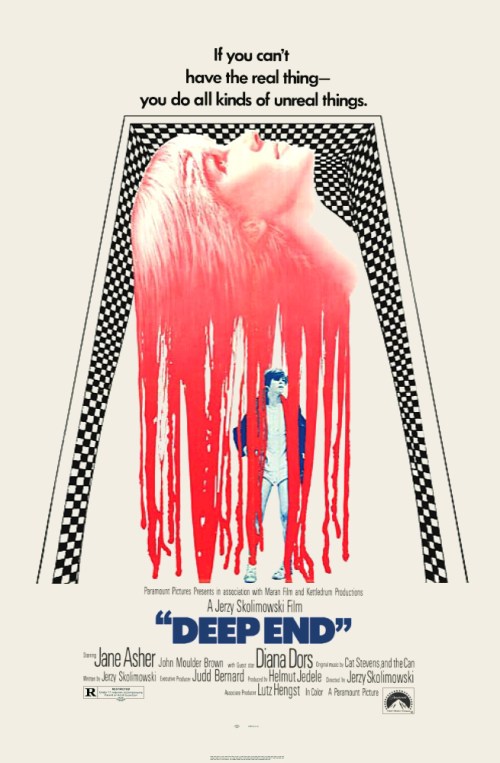
This is a moody drama detailing the story of a 15 year old boy named Mike (John Moulder-Brown) who goes to work at a public bath in London.  There he meets an alluring red-headed woman named Sue (Jane Asher).  She begins flirting with him, which causes him to become infatuated with her.  He starts following her around and even tries to scare off her two boyfriends as she is seeing both a man her own age as well as an older, married one.  Sue, who seems to enjoy manipulating all the men in her life, treats it all like it’s a silly game that ultimately ends with tragic results.

One of the things that really helps this film stand-out is the believability of the Mike character.  It was fascinating seeing all the different sides to his personality and I felt each one rang true for a boy his age.  There are times when he seems streetwise and even savvy and then there are other moments when he is immature, irresponsible, and emotionally out-of-control.  Although his obsession with Sue borders on being frightening I did like how he comes up with clever ways to help her like the ingenious way he finds her diamond that fell from her ring and into the snow.  I also liked how he becomes shocked at seeing a semi-nude poster of Sue outside a club, as she works as a stripper part-time, and how he steals it away in order to ‘protect her honor’.

Sue on the other hand seems almost all bad with very little good traits, but still equally believable.  She is mean and catty with everyone, abuses animals, and comes up emotionally hollow at every turn.  However, I could see how a young man of his age could become trapped by her seductive ways and perceived ‘maturity’, which makes the obsession itself as intriguing as their personalities.

Acclaimed writer/director Jerzy Skolimowski seems very much in control here and what buttons to press and when to do it.  I liked the color schemes especially his use of the color red. Having Cat Stevens do the music score gives the soundtrack and nice distinction.  I also liked how he foreshadows the film’s final shot several times during the movie.

I did end up having a few qualms with the film.  I wanted Mike’s initial interactions with Sue to be a little more extended than just the brief flirting that is shown.  The film takes place in buildings that are all old, rundown, and murky, which in some ways is good because it helps reflect the murky personalities of the characters.  Yet I wasn’t sure if this was all intentional or just the result of working on a low budget.  I would have liked a few scenes done against a more appealing background just to allow for  more visual variety.

The ending, especially the final shot, is very provocative and perverse.  It reminded me in a way of Nicholas Roeg’s excellent film Bad Timing: A Sensual Obsession (1980). Everything gets played out in such an odd way that it keeps you guessing until the final second as to what happens, which ends up staying with you long after the film is over.

Diana Dors, who was a popular British actress during the 50’s and 60’s and even considered a sex symbol for a time, gets a great cameo bit here that has to be seen to really be appreciated.  She plays a sexually frustrated middle-aged woman who rents a room at the public bath and then tricks Mike into coming into the room with her. She grabs his hair and shakes his head while describing a sexual fantasy that she has going on in her head.  When she is done she throws him back to the floor and says “You can go now, I don’t need you anymore.”

My Rating: 7 out of 10

Released: September 1, 1970

Runtime: 1Hour 33Minutes

Rated R (Sexual Situations, Adult Theme, Brief Nudity)

Director: Jerzy Skolimowski

Studio: Paramount

Available: DVD, Blu-ray (Import)

Closely Watched Trains (1966)

closely watched trains

By Richard Winters

My Rating: 7 out of 10

4-Word Review: Boy loses his virginity.

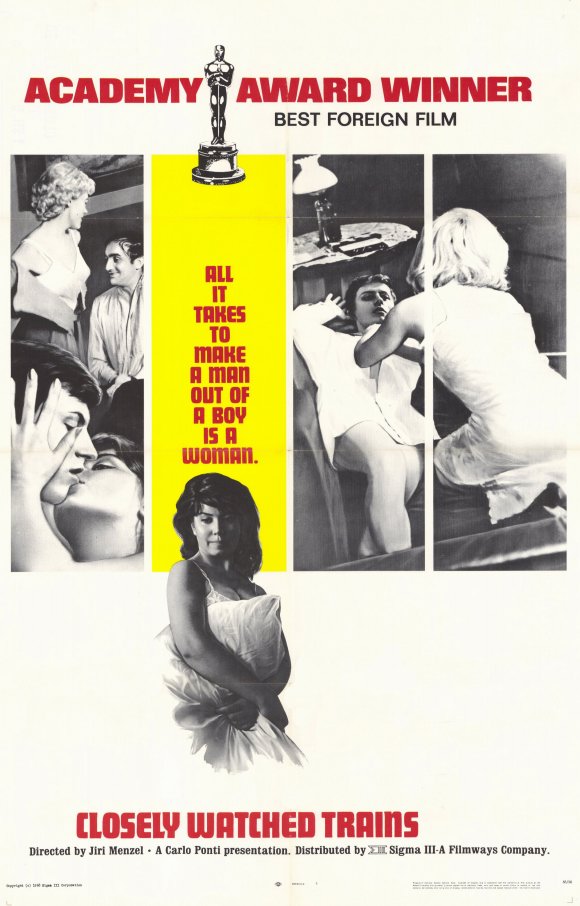
This is an engaging, amiable Czechoslovakian import that won the Academy Award for best foreign film of 1966. The story pertains to a young man named Milos (Vaclav Neckar) who follows in his father’s footsteps and gets a job at the local railway company during World War II. He almost immediately becomes bored with it and gets preoccupied with a beautiful young train conductor named Messa (Jitka Scoffin). The two have a sexual tryst, but Milos is unable to ‘rise to the occasion’.  He becomes despondent and even tries to commit suicide, but is saved at the last minute. While he is recuperating in the hospital the Dr. informs him that he suffers from premature ejaculation.  Milos then spends the rest of the time scouring the village for some prostitutes that he can ‘practice on’ so that he can learn to control his condition and become a ‘real man’.  A subplot involves plans to blow-up a German train carrying some high level ammunition.

Despite the fact that it is very leisurely paced and everything happens at one not very exciting location I still found the film to be immensely enjoyable. I had the feeling that director Jiri Menzel spoke straight from the heart with this one. The bleakness of the characters situation and the poor, hopeless conditions of their country is vivid and yet the ingenuity and perseverance of the human spirit never fades. Anyone who has dealt with an oppressive situation will most assuredly relate. The fact that this film stays so highly amusing and touching despite the depressing elements is what makes this a winner.

In a lot of ways this was years ahead of its time. The very liberal sexual attitudes and provocative scenes were stuff not yet seen in most movies and didn’t really become the norm, even for European films, until the 70’s and 80’s. Although not extreme there is indeed some lingering eroticism and even nudity. One segment involves Milos’s very amorous co-worker Hubicka (Josef Somr) rubber stamping the naked rear of Zdenka (Jitka Zelenohorska) who works as the station’s secretary. When her shocked mother finds out about this she parades her daughter all around town, exposing her rear to everyone, so that they can witness the ‘outrageous crime’ while the amused Zdenka finds it a turn-on.  There is also another scene, which another reviewer considered to be the most unique scene ever put on film that involves an old woman and a goose. I’ll agree it is very different, but I am not exactly sure what she was doing with it, or if I want to know, or if it is even legal, but it does indeed catch your attention.

Of course the drawback to this is the fact that the character’s attitudes seem far too modernistic for the era. At no time did I feel like I was really being transported back into the 1940’s.  There was also a little too much preoccupation with the sex angle and I felt there needed to be a little more balance with the actual war.

The Milos character is a bit too wide-eyed. He looks literally like a ‘deer-in-headlights’ through the entire progression of the movie. He seems overtly naïve for someone of 18. I know it was done for comical purposes, but having his mother dress him for his first day of work was going over the top. For the first half of the film he has hardly any dialogue and it is difficult for the viewer to relate to him, or get inside his head. Things do even out at the end when he ‘transforms into a man’, which I liked, but the opening half paints him too much as a caricature.

If there was one thing that really rubbed me the wrong way it would be the downbeat ending. I didn’t think it was necessary and tended to go against the film’s theme, which was human survival and coping. Still, it’s a good film with a great message. The budget was clearly very low, but it’s entertainment value high.

My Rating: 7 out of 10

Released: November 18, 1966

Runtime: 1Hour 33Minutes

Rated NR (Not Rated)

Director: Jiri Menzel

Studio: Filmove

Available: VHS, DVD (The Criterion Collection)

The Innocents (1961)

innocents 1

By Richard Winters

My Rating: 6 out of 10

4-Word Review: Children frighten their governess.

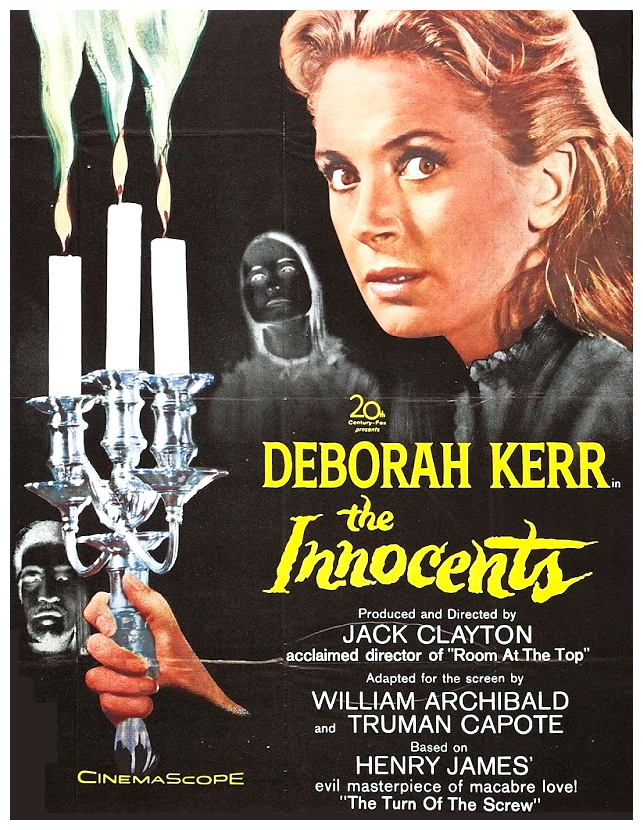
Legendary British actress Deborah Kerr plays Miss Giddens, the governess hired to care for two children at a sprawling English estate. However, the children are not exactly as they seem. Strange occurrences and behaviors begin to manifest as well as several ghostly sightings, which leads Miss Giddens into believing that the children may actually be possessed.

The film is based on the Henry James novel The Turn of the Screw. I have not read the book, but those that have feel this is a pretty satisfying adaptation. I did like the slow, methodical pacing. It helps to build the tension as well as enhance the mystery. Things are revealed in deliberate layers, which kept me intrigued throughout.

Director Jack Clayton shows a marvelous handle on the material.  The estate that they chose for the setting is perfect and captured well in glorious black and white by famed cinematographer Freddie Francis.  There is a lot of spooky imagery throughout including a creepy nightmare sequence in the middle.  The garden with its hulking, strange statues is used quite effectively especially in the haunting finale.  The music also grabs your attention right from the start with a very eerie song that is played before you see a single image on the screen. The song is similar to the one used in Rosemary’s Baby.  In fact there are several things here that reminded me of that film as well as The Shining.

Kerr was a good choice for the increasingly frightened governess.  I loved that scared expression on her face, which becomes progressively more frequent. Yet she is also effective when the character decides to become proactive by taking matters into her own hands and singlehandedly trying to ‘cure’ the children herself.  This also helps make both the character and the story a more multifaceted because you are never sure if this stuff is really happening or all just inside her head.

What really impressed me the most though was the performances of the two children especially Martin Stephens who plays Miles the young boy. His character shifts through many different moods, playing an innocuous child one minute and then a menacing, volatile one the next. He does each one flawlessly and becomes practically mesmerizing in the process.  Pamela Franklin is also fine in the role of Flora. This was her film debut. Eight years later her career would peak playing her signature role as Maggie Smith’s nemesis in The Prime of Miss Jean Brodie.

Another thing that I liked about the children is that they are initially portrayed as being normal and even engaging.  This is unlike other films with a similar theme like Children of the Damned or Children of the Corn where the kids are given creepy features right from the start. Here it works better and is more chilling to the viewer because the children’s dark side is unsuspected.

Unfortunately, despite the film’s impeccable technical quality, I still went away feeling unsatisfied. Part of the problem is that nothing really happens.  The ghosts appear but then do nothing but just stand there, which quickly becomes tiresome. One scene in particular has the camera constantly cutting back to the lady ghost standing across the lake until she starts to look like a mannequin, which I suspect she was.  The buildup is good, but I would have liked more of a payoff.  The ending is much too vague and gives no explanation as to why this was happening, if it was happening, or whatever became of the main character.

I couldn’t help but feel that this story would have worked better as an episode from one of the old horror anthology series like The Alfred Hitchcock Hour or even The Twilight Zone where it could have all been compacted into an hour. A hundred minutes seems like much too long for such little to happen. It is also interesting to note that in 1972 a film came out entitled The Nightcomers starring Marlon Brando that attempts to speculate what happened to the children before the main character of the governess arrives and before James’s original story begins.

My Rating: 6 out of 10

Released: December 25, 1961

Runtime: 1Hour 40Minutes

Rated NR (Not Rated)

Director: Jack Clayton

Studio: 20th Century Fox

Available: VHS, DVD