Category Archives: Foreign Films

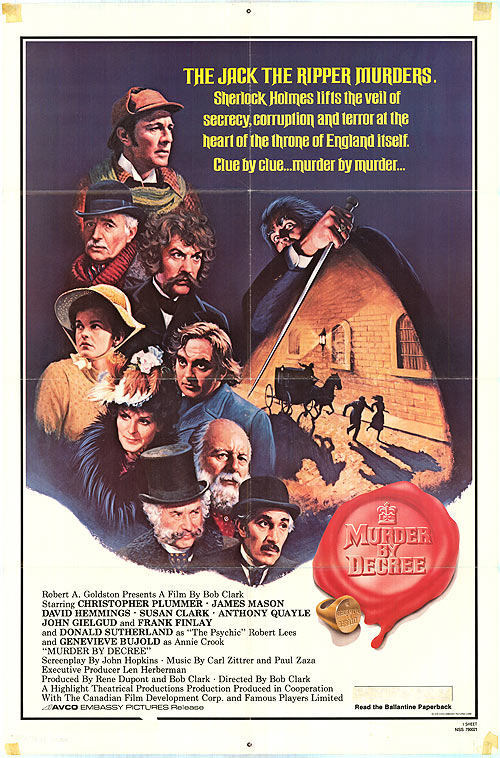
Murder By Decree (1979)

By Richard Winters

My Rating: 6 out of 10

4-Word Review: Jack the Ripper exposed.

Sherlock Holmes (Christopher Plummer) is asked to investigate the killings of prostitutes by Jack the Ripper and the clues lead to a massive conspiracy that goes all the way up to the British Royalty.

This rendition of the Holmes versus Ripper theme is fun and handsomely produced. My favorite element was the recreation of the dark, dingy, atmospheric streets of old London. The fog, lighting, and sounds of carriages going over the cobblestone streets is perfect and I wanted to see even more of it. The killings are surprisingly graphic, the strangulation of a woman near the beginning looks  quite realistic as does the stabbing of another man in which you can see, from the side, a sword going right through him.

The supporting cast is a treat and includes an almost unrecognizable Anthony Quayle in a beard and a wig, as well as John Gielgud, David Hemmings, Genvieve Bujold, Donald Sutherland, Frank Finley, and Susan Clark. Clark gives the strongest performance in the crucial role of Mary Kelly. She speaks with a believable British accent despite the fact that she was not a native. Sutherland is the only one that is wasted as his character is dull and his screen-time limited.

Both Plummer and James Mason in the role of Dr. Watson are terrific actors, but I don’t know if I was completely sold with them in these parts. Plummer is too polished, handsome, and always displaying a sneering type of grin that I never pictured Holmes having. I would have wanted the character to be just a bit more aloof, awkward, and detached.  Mason is fine, but the chemistry between the two doesn’t seem genuine. I expected more comic interplay. There is some, but not enough. The best moment is the pea scene, which is a howl and written by Mason.

The case is elaborate and well thought out. Normally I find with these types of stories that if you aren’t paying careful attention, or miss one line of dialogue that you become lost and confused, which fortunately did not happen here.  It stays intriguing and the logic is sound for the most part. The wrap-up at the end in which Holmes explains the case and solves the mystery while discussing it in front of the Prime Minister (Gielgud) is satisfying and complete. However, I got a real kick out of the fact that when Holmes starts his dissertation he has a cut on the side of his face from an altercation that he had with Ripper the day before, but in the fifteen minutes it takes him to delivery his speech it turns into a scar before your very eyes.

SPOILER WARNING!

The few misgivings that I had here was that it does not stand out from the myriad of other films that have been done on the same subject.  The mystery and conspiracy angle is interesting, but speculative with no bearing on the actual case. The fact that they turn the Ripper character into being just a couple of idiots who didn’t know what they were doing is clever in one way, but disappointing in a other because it destroys the mystique that has become the Ripper legend and becomes anti-climactic in the process.

My Rating: 6 out of 10

Released: February 9, 1979

Runtime: 2Hours 4Minutes

Rated PG

Director: Bob Clark

Studio: AVCO Embassy Pictures

Available: VHS, DVD

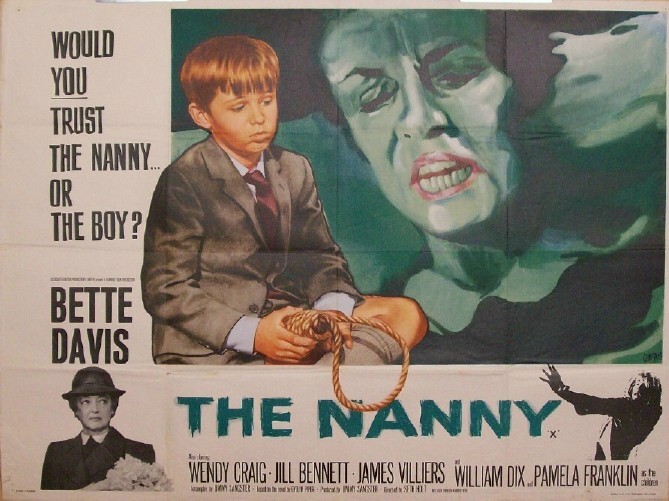
The Nanny (1965)

By Richard Winters

My Rating: 5 out of 10

4-Word Review: Kid doesn’t like nanny.

            Bette Davis plays a nanny to an upper-class British family whose oldest son Joey (William Dix) is accused of accidently killing his younger sister. Joey, who is only 10, is sent away to a home for disturbed children. When he returns he accuses the nanny as the one who did the killing and a psychological game of cat-and-mouse ensues.

Davis is sensational. She plays a type of character that she has never done before and the results are fascinating. She is much more subdued and evasive than usual and she falls into the role of the unassuming nanny in a seamless fashion. The different setting works well for her and I commend her tenacity for taking on a project that was not glamorous. She even puts on some thick eyebrows for her part and at times, especially at the beginning, she starts to resemble her most hated rival Joan Crawford.

Dix is amazingly good as the kid and it is a shame that he did only one other picture after this one. I liked the independent nature of the character and he plays off Davis quite well and showed no signs of being intimated by her. Making the adversaries have such extreme age difference and personalities gives the story an interesting edge that helps carry the picture.

The evocative black and white photography helps accentuate the dark-tone. The British setting along with the expected formalities of that culture, particularly that from the father character Bill (James Villers) give the film some distinction.

The first act though goes on way too long. We are given the general premise right up front and then have to spend the whole first hour going through the scenario that Joey doesn’t like his nanny and is suspicious of her again and again until it becomes derivative. When the second act does finally come about it seems too late. The revelation isn’t all that clever or creative and the climactic sequence desperately needed more action and punch. The final result is unsatisfying. The viewer is given an intriguing premise that it can’t sustain to the end ultimately making this a misfire despite the outstanding presence of Davis and some high production values.

There is also the issue of the three-year-old girl who is adorable and an absolute scene stealer and yet right up front you are made aware that she is killed, which makes the proceedings rather depressing. Having to then watch her actual death is disturbing and, for its time period, rather vivid and startling.

My Rating: 5 out of 10

Released: October 27, 1965

Runtime: 1Hour 31Minutes

Rated: NR (Not Rated)

Director: Seth Holt

Studio: Hammer Productions

Available: DVD

The Little Girl Who Lives Down the Lane (1976)

By Richard Winters

My Rating: 3 out of 10

4-Word Review: She is all alone.

Rynn (Jodie Foster) is a 13-year-old girl living alone in a big house in the countryside. Her father has leased the place for three years from nosy landlady Mrs. Hallet (Alexis Smith) and her adult son Frank (Martin Sheen) who continually makes lecherous advances towards Rynn. No one has seen her father and when anyone asks for him she comes up with excuses, which starts to make everyone in town suspicious. She meets fellow teen Mario (Scott Jacoby) who she lets in on her secret and the two devise a plan that will rid them of the meddlesome Hallets.

Although she has stated in interviews that this is the least favorite out of all the movies that she has done I can’t think of anyone more perfect for the part of an independent headstrong young woman than Foster, who has always carried that persona. Despite the vast age difference she easily carries the picture from her older co-stars. There is even a nude scene involving her character although it was done by her older sister Connie working as a body double. This was done despite her adamant protests as was a scene where she goes to bed with Jacoby, which she has said made her extremely uncomfortable and probably explains her dislike for the film.

Sheen is menacing as the perverted Frank, who enjoys ‘younger girls’ and his ongoing banter and advances with Rynn is consistently creepy and tense. Alexis Smith is excellent as the mother and her worn face and attitude gives her a witchy presence and it is too bad she couldn’t have remained for the entire movie. I also found Jacoby engaging and amiable and I really enjoyed his character, which I found a bit surprising since he is best known for playing dark, sinister characters in Rivals and the TV-movie Bad Ronald.

The on-location shooting, which was done in both the Canadian province of Quebec and in Maine, is excellent and gives one a nice taste of small town life on the east coast. There is some nice synthesized music that gives the film a dark tone. The premise is offbeat and to some extent, at least during the first half, it is enough to keep you intrigued.

My main issue with the film is the fact that not enough happens. Almost all the action takes place in the main room of the house, which eventually becomes dull, especially visually. There are no scares, or shocks and the twists aren’t all that clever, or surprising. In fact the final twist I saw coming long before it happens. There are times when cutaways would have been helpful and spiced things up particularly when Rynn talks about a visit from her mother and her ‘long red finger nails’, which we never see and is just described. The conclusion leaves A LOT of unanswered questions making this thing empty and incomplete. The final shot is one very long take of a close-up of Foster staring at a subject while the credits role by, which eventually becomes annoying and it would have been better had they done a freeze-frame instead of forcing her to sit and stare at something way longer than humanely possible. Also, composer Mort Shulman is badly miscast as the policeman. His acting abilities are clearly limited and he shows no presence or authority and makes the scenes he is in weak.

It is hard to know what genre to put this in. It is really not scary and the mystery angle has too many loopholes to being taken seriously. The story, based on a novel by Laird Koenig, seems rather tame despite some dark elements and geared more for teens, or young adults.

My Rating: 3 out of 10

Released: December 25, 1976

Runtime: 1Hour 40Minutes

Rated PG (Brief Nudity, Mild Cursing)

Director: Nicholas Gessner

Studio: American International

Available:  VHS, DVD, Netflix Streaming

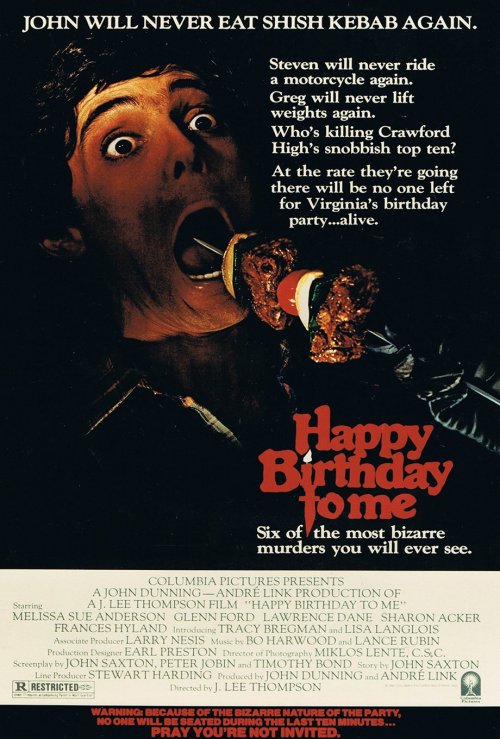
Happy Birthday to Me (1981)

happy2

By Richard Winters

My Rating: 3 out of 10

4-Word Review: This birthday isn’t happy.

            Virignia Wainwright (Melissa Sue Anderson) attends a private school where she is a part of a snotty clique whose members start getting killed off just before her 18th birthday. Due to a freak accident suffered years before she has blackouts causing suspicions that she may be the culprit. With the help of her psychiatrist Dr. David Faraday (Glenn Ford) they try to come up with some answers.

Despite being listed as a slasher film and having gained a loyal cult following I found the gore factor to be disappointing. The killings are quite brief and the camera quickly cuts away before much blood, or anything else is shown. The famous shish kebab murder that is captured on the film’s poster is poorly executed. Apparently there was more footage of the killings, but in order to get an R-rating director J. Lee Thompson was forced to cut a lot of it out. However, it would be nice to get a director’s cut version as I am sure today’s horror fans may feel cheated otherwise. The grossest sequence for me wasn’t the killings at all, but instead the scene where Virginia undergoes brain surgery and her skull is vividly cut open and one can see the brain pulsating and expanding inside. The deaths really didn’t seem all that creative and clever despite the film’s reputation and if anything my favorite death scene didn’t involve one of the killings but instead was the part where Virginia and her mother are riding in a car that goes off a bridge and then fills up with water, which is surprisingly intense.

I also had some major issues with the film’s opening murder that features a young girl getting strangled while inside her car. For one thing the killer’s hands didn’t seem to be all that tight around her neck and when the girl manages to escape there are no marks around her neck even though realistically there should be. Also, when she escapes she runs for only a few feet and then stops behind a nearby parked car and acts like she is now ‘safe’ even though most people would run several blocks and probably wouldn’t stop until they found someone else that could help, or the police. The victim also speaks, but if someone has been strangled as severely as she has her voice would have to be effected by it and she might not be able to say anything, or at least speak in a very raspy tone, which is not the case here.

For the most part I found the film to be boring and predictable. I never once got scared, or even all that intrigued. The movie is jammed with every cheesy 80’s horror movie cliché that you can think of. Normally film’s from this genre run no more than 90 minutes and sometimes even less. Going 110 minutes as this one does is much too long for a plot that is paper-thin.  However, the very macabre ending is excellent and almost makes up for it. The surprise twist isn’t bad either although a bit implausible.

Anderson, best known as Mary Ingals from the long running TV-show ‘Little House on the Prairie’, isn’t bad. A shot of her at the end where she is carrying a birthday cake and looks up and smiles is both chilling and sexy and quite possibly the film’s pinnacle. There is no nudity although director Thompson teases the viewer by having her undress to get into the shower, but the camera never gets past her bra and panties.

Hollywood icon Ford is wasted and his tired appearance is almost sad. His wardrobe features him wearing an open shirt showing his bare chest and it looks ridiculous for a man his age. There is another scene where the police dig up a skull on the school’s grounds and the Ford character asks to take a look at it and the police promptly hand it over to him, which I found to be equally ridiculous as that is a crucial piece of evidence that would only be handled by a forensic expert.

If anything Sharon Acker as Virginia’s alcoholic mother Estelle gives the best performance.  Her overwrought slightly hammy scene near the end gives the film some much needed energy.

There were a few other loopholes and inconsistencies that irritated me enough to be mentioned here. One is that years earlier Virginia had a birthday party and all her friend’s snubbed her and didn’t show up, so they could instead go to a party held by a girl who was more wealthy and popular, which made me wonder why then would Virginia want to remain friends with them like she did.  Another part involves a member of their clique named Alfred (Jack Blum) who the girls initially think is storing the severed head of one of their murdered friends. They later realize that this was simply a realistic looking plastic mold that he had made to resemble her, which makes them feel ‘relieved’ enough to continue to socialize with him. However, anyone who makes plastic molds of heads from someone they know that has just been killed seems just as creepy to me and enough to make most normal people concerned, which the characters here are not. There is also no explanation at the end for how the killer, whose identity I will not divulge, was able to come up with such an elaborate and realistic disguise. The gory effects are also not convincing and could have used Tom Savini’s help

Like I said I found the film’s ending to be pretty cool and enough for me to suggest this film to horror fans, but only if they are willing to stick around for it.

My Rating: 3 out of 10

Released: May 15, 1981

Runtime: 1Hour 50Minutes

Rated R (Violence, Language, Adult Theme)

Director: J. Lee Thompson

Studio: Columbia

Available: VHS, DVD, Amazon Instant Video

Seance on a Wet Afternoon (1964)

seance on a wet afternoon

By Richard Winters

My Rating: 6 out of 10

4-Word Review: Psychic is a phoney.

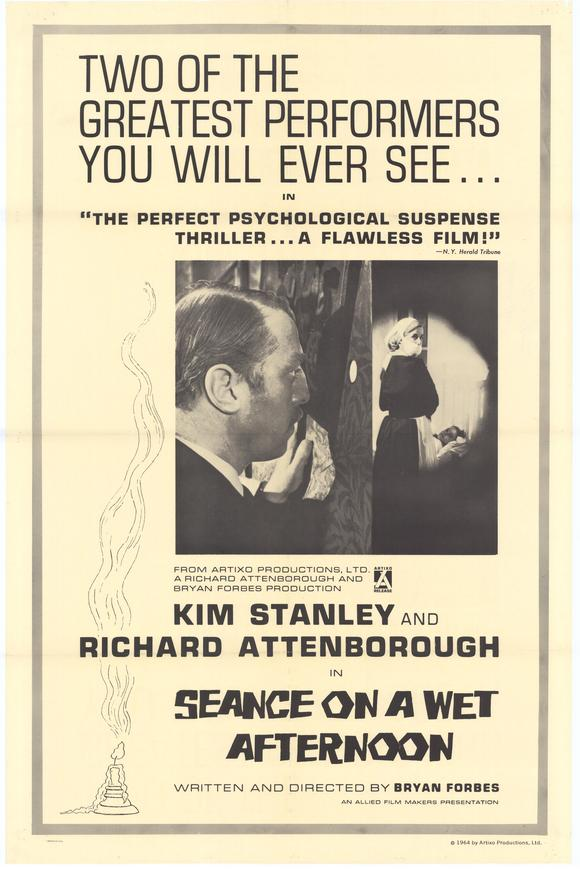
Myra Savage (Kim Stanley) is an emotionally unbalanced woman and failed psychic who comes up with an idea that she hopes will revive her career. The plan is for her husband Billy (Richard Attenborough) to kidnap Amanda Clayton (Judith Donner) who is the young daughter of a rich businessman. They will then place her at a strategic location and hold a public séance at which time Myra will ‘miraculously’ predict her whereabouts. This will then, they hope, make her famous and world renowned, but of course things don’t work out as expected.

This is indeed a unique and unusual film that taps into some rare qualities. First and foremost is the black and white cinematography. Every camera shot and angle has a certain evocative flair that is well captured and vivid. The on-location shots pick up just the right amount of ambiance and lighting with each setting. The music score is great and helps create excellent tension. You also will love the little girl that they kidnap. She is adorable without it being forced. Her matter-of-fact sensibilities are a great contrast to Attenborough and Stanley whose characters are child-like and pathetic.

Yet the film doesn’t completely work. The story is handled in a plodding and methodical way without any twists or surprises. There is very little action, some definite slow spots and the conclusion is limp.

If you watch it for the performances then you will be more intrigued. Stage actress Stanley gives a rare film appearance here. It is easy to see why she took the role even though she was known to dislike doing films. The takes are long and give almost unlimited possibilities in creating a character, which is what all stage actors enjoy. She does well and at times may remind one of another legendary actress Geraldine Page who would have also been perfect for the part. Attenborough proves almost her equal. His expressions of shock and worry are memorable. The interplay between the two is fun especially towards the end when this otherwise passive man stands up to the domineering woman.

Overall there are some unique moments, but it is just not suspenseful enough and results in being only slightly above average.

My Rating: 6 out of 10

Released: November 5, 1964

Runtime: 1Hour 55Minutes

Rating: NR (Not Rated)

Director: Bryan Forbes

Studio: Artixo Productions

Available: VHS, DVD (Region 1 & 2)

The Bliss of Mrs. Blossom (1968)

By Richard Winters

My Rating: 6 out of 10

4-Word Review: Lover in the attic.

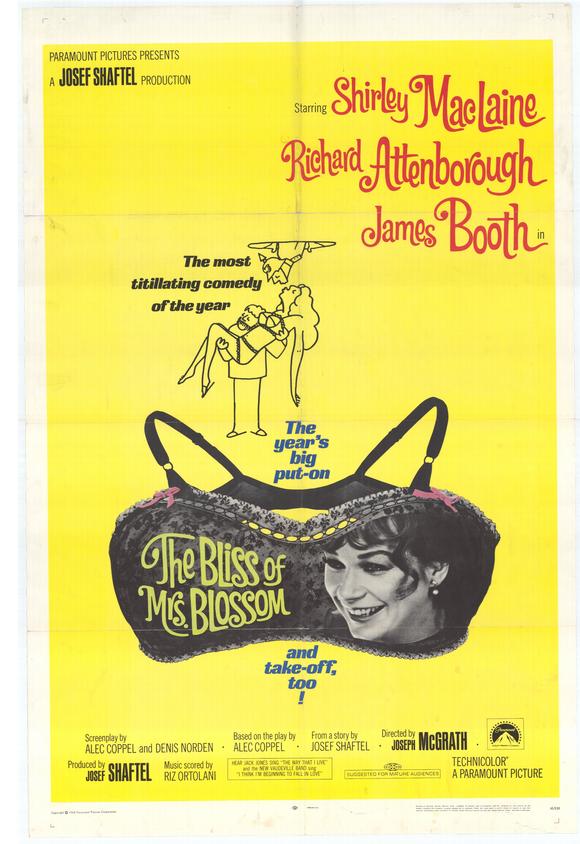
This wacky film nicely exudes the mod, experimental wave of filmmaking that permeated the era of the late 60’s. The story takes place in London and is about a clothing manufacturer’s wife named Harriet Blossom (Shirley MacLaine) who one day calls her husband Robert (Richard Attenborough) while he is at work to tell him that her sewing machine has broken down. Robert sends his lowly assistant Ambrose Tuttle (James Booth) over to their house to help her fix it. Harriet is a bit bored with life and feels neglected by her husband, so she not so subtly seduces Ambrose and then hides him in the attic where he soon takes up residence.  He comes out only when Robert is away, but the unexplained strange noises that Robert hears and the many close calls make him think he is going insane and leads him to a nervous breakdown.

Director Joseph McGrath’s highly visual style is the real star. The lighting, editing, camera angles, set design, and costumes are creative and imaginative.  The home that was chosen for the setting has a nice architectural flair especially the attic and billiards room, which seems to be draped by a large stain glass window. Certain film professors show this movie to their classes as an example of how stylish direction can help accentuate a story as well as deftly define its era. I was disappointed to see that although McGrath is still alive he hasn’t done a film since 1984, which is a shame as it is obvious from this that he is quite gifted and I would have liked to see him doing more.

This is generally considered a vehicle for MacLaine, but to me her performance isn’t interesting. I think she is a first rate actress, but her character here is the only normal one in the film and she acts more like an anchor trying to corral the craziness around her. Booth, as her lover, goes to the other extreme, but doesn’t fare any better. He is too clownish and is always wearing various disguises and going through different personas, which makes the character unrealistic and cartoonish. If anything, out of the three main leads, it is actually Attenborough who does the best. His nervous and confused facial expressions are priceless. The scenes were he comes home from work and to ‘unwind’ pretends to be a conductor of a large orchestra while listening to a loud record, is amusing.

The colorful supporting cast though, full of legendary British Pros, is what steals the film. Some of them appear just briefly, but they still make a memorable and funny impression. Barry Humphries, playing a male character and not Dame Edna, is good as an art dealer. John Cleese, in one of his very first roles, is engaging as an argumentative postal clerk.  The best however is far and away Freddie Jones as the snippy, suspicious, relentless detective that will leave no stone unturned in his pursuit of Ambrose, who once he moves into Harriet’s attic proceeds to completely drop of society and disappear.

Although generally entertaining the plot doesn’t go anywhere and is simply a set-up for a lot of absurdity. What is worse is the fact that this based on a true story that in its own right was very intriguing.  In the real-life incident that took place in 1913 a 33 year old woman by the name of Dolly Oesterreich met a 17 year old named Otto Sanhuber. She, like the character in the movie, was a bored wife of a wealthy textile manufacturer, and took in the young man as her ‘sex slave’, which he readily accepted. To avoid possible suspicion she had him move into their attic, where he remained for five years and despite some close calls was never caught.  When the Oesterreich’s moved to Los Angeles in 1918 Dolly made sure that their new home had an attic as well and Otto then took up residence there and the deception continued until 1920 when Otto finally ended up killing the husband.

Of course none of that happens here. In fact Ambrose is fond of the husband and considers the three to be one big happy ‘family’, which is offbeat for sure, but not particularly satisfying. Again, this film does have some funny moments. I thought the scene where Robert invents the world’s first inflatable bra only to have the system go awry during an exhibition, which forces the model’s breasts to grow to unbelievable proportions before they go floating in the air, to be hilarious.  Still the end result of this production can best be described as cinematic soufflé.

My Rating: 6 out of 10

Released: September 11, 1968

Runtime: 1Hour 33Minutes

Rating: NR (Not Rated)

Director: Joseph McGrath

Studio: Paramount

Available: VHS
Venom (1982)

By Richard Winters

My Rating: 3 out of 10

4-Word Review: Kidnappers versus deadly snake.

            Phillip Hopkins (Lance Holcomb) is an 8-year old boy and son of a wealthy couple. When his parents leave for a trip the family’s maid and chauffeur (Susan George, Oliver Reed) conspire to kidnap the boy and hold him for a ransom with the help of a ruthless gunman (Klaus Kinski).  Unbeknownst to any of them the boy has mistakenly acquired a black mamba snake that escapes from his cage. As the culprits try to pull off their crime they become trapped in the house by the deadly reptile that starts to attack them one-by-one.

For starters the cast is one of a kind. Besides the performers listed above the film also has Sarah Miles as a Dr. with a serum to help fight the snake’s poisonous venom. Nicol Williamson appears as the police negotiator and Sterling Hayden, in his last film role, plays the boy’s grandfather.  How anyone could manage to direct a cast with such legendarily huge egos and eccentric personalities seems hard to fathom and probably explains why original director Tobe Hooper left the production after only ten days of shooting and was replaced by Piers Haggard. Supposedly Reed and Kinski were at odds with each other during the entire production and their animosity clearly shows on screen. For the most part the talents of the cast is wasted with a script that is limited and filled with characterizations that allow for no range.

I did like Hayden in the scene where he is forced to go searching for the snake in a darkened room and armed with nothing more than a lamp and a makeshift weapon. George is also fun playing a duplicitous character for a change and I was disappointed that she gets killed off so soon. However, she does make the most of it with a very theatrical death scene. Probably the best performance in the whole film is that of the boy. He has a very sweet, young looking face and the widest most innocent pair of blue eyes you’ll ever see and the kind that most casting directors would kill for. The kid plays the frightened part well and does an effective asthma attack. He hasn’t done much since, but I am sure that if he wrote a book dealing with his experiences on the set and his interactions with that cast that if would most assuredly be a best-seller.

The set-up is good and I found myself riveted to it for the first half-hour. I liked the idea that an actual mamba snake was used. There is a part where the snake is slithering towards the camera and opens its wide, black mouth and hisses straight at the camera, which could be enough to get most viewers to jump out of their seat. Director Haggard uses the novel idea of shooting scenes from the snake’s point-of-view and he does it through a fuzzy and slightly distorted lens to help replicate the snake’s vision. The only problem I had in this area is that the snake is seen slithering throughout the picture inside the home’s venting system, which is shown to be very clean and spotless, which didn’t make sense to me since the home was old making me think that the metal piping would be more corroded and rusted.

Despite the excellent concept the film’s second hour is quite boring. The characters don’t have enough to do and spend most of the time standing around. The interplay between Kinski and Williamson brings no tension. There is one cringe inducing scene where the snake crawls up Reed’s pant leg, but overall the scares are quite sparse. The climatic sequence is too convenient and becomes more of a disappointment then a shock. It is hard to say if the film would have been better if Hooper had stayed on or not. Reportedly none of the footage that he shot is in the final cut. The film is based on a novel by Alan Scholefield, which I suspect is probably more intriguing and after watching this makes me interested in reading it.

My Rating: 3 out of 10

Released: January 29, 1982

Runtime: 1Hour 33Minutes

Rated R (Mature Theme, Violence, Language) 

Studio: Paramount

Director: Piers Haggard

Available: DVD

Dona Flor and Her Two Husbands (1976)

dona1

By Richard Winters

My Rating: 6 out of 10

4-Word Review: One is not enough.

This is an oddly structured Brazilian film that became a world-wide hit due to its explicit, edgy storyline.  It details the account of a woman named Dona Flor (Sonia Braga) whose first husband Valdomiro (Jose Wilker), was a bit on the wild side. After gambling away all of their money he dies. She becomes determined not to make the same mistake twice, so she remarries another man who is a doctor (Mauro Mendonca) and a much more responsible mate, but also stiff and boring. Problems ensue when the first husband, who she misses because he was more erotic and exciting in bed, comes back in the form of a ghost who only she can see.

The movie on a whole is well made. The characters are all likable and the theme music, which is played throughout the film, is appealing. The on location shooting is also quite distinctive. It really gives you a genuine, rare flavor of a small Brazil village and the people who inhabit them.

My main complaint with the film is that it takes the entire first hour just too illustrate her marriage with her first husband and the second hour to show her mourning and eventual remarriage. It’s not until the FINAL FIFTEEN MINUTES that the scenario the whole film is based on actually happens. When it does it is lively and funny, but the majority of the movie is surprisingly low key and melodramatic. The highly touted sex scenes are overrated. They are too brief and spread out very thinly.

Braga does well in her star making vehicle. She is able to convey both a simple, sweet nature as well as a sultry, sensual one. She has a pretty face and really does look great naked.

My Rating: 6 out of 10

Released: November 22, 1976

Runtime: 1Hour 50Minutes

Rated R

Director: Bruno Barreto

Studio: Embrafilme

Available: VHS, DVD (Director’s Cut)

Bye Bye Brazil (1980)

By Richard Winters

My Rating: 6 out of 10

4-Word Review: Entertainers traveling throughout Brazil.

This movie is a slightly surreal comedy-drama detailing a caravan of five entertainers who travel the Brazilian countryside putting on vaudeville like shows underneath a makeshift tent.  The film works in a vignette style as it analyzes the many scenarios and difficulties that the group encounters as well as making a very strong statement to the poverty and hardships befallen on the townspeople that they meet. In fact if there is one lasting image that the film gives it is that one.

The story is pretty much character driven and the characters are all by and large highly amoral. They reflect the desperation of their audiences, which they quietly hope someday to rise above, but never do.  There are a few fleeting moments where they amazingly and surprisingly decide ‘to do the right thing’, which ends up being the film’s most memorable scenes, but most of the time they are ‘rough around the edges’ and the viewer is forced to appreciate them with all their frailties brightly exposed.

Jose Wilker plays Lorde Cigano who is the leader of the group and a lifelong con-man. He closely resembles character actor Stuart Margolin, who was famous for playing the character of Angel on the classic 70’s series The Rockford Files where he was always trying one amusing scheme after another and the character here works in much the same way. He has a few good lines as well as a funny running gag where he displays obscene toys to attractive woman he meets in order to ‘turn them on’.

Betty Faria plays Salome who does erotic dances during their performances.  She lies and cheats as much as Lorde and is more than willing to fall back to being a prostitute whenever the group is in need of money. Although she does have a few nude scenes she is really not all that attractive, or young, as she was already hitting 40 at the time that the film was made.  However, her worn looking face does help accentuate the hardened lifestyle of the character. Her best scene is when she is ‘servicing’ one of her clients who is a fat, balding middle-aged man who expounds the entire time they are having sex about the many virtues of his wife.

Fabio Junior plays Cico the young man who joins the group because he feels it is a chance to escape the sad existence of a peasant farmer only to find that life on the road can be in many ways just as grueling and thankless. Junior is a famous singer in Brazil and his chiseled, boyish good looks didn’t seem to be a realistic fit for the impoverished farm family that his character came from in the movie.  He shows no concern for his pregnant wife and spends the entire time trying to seduce Salome, which makes him irritating and unlikable.  I did though like the fact that he was the one character who evolved and became introspective at the end.

The character of Daso, which is played by actress Zaira Zambelli and is Fabio’s wife, was a bit frustrating. The film makes it clear that she is aware that Fabio is fooling around with Salome and she doesn’t seem to care. She also excitedly jumps into becoming a prostitute at her husband’s insisting when the group falls on hard times. However, I wanted more explanation, or history given to the character to help understand this, but the story does not supply any.

I was also disappointed with the handling of the Swallow character who performs feats of strength during their productions as well as acting as the group’s driver. Swallow is mute, but easily is the most likable and durable, but he runs away half-way through the picture and never returns. I would have liked the character to have stayed during the entire duration as he helped give balance to the others, or at the very least some detail to his eventual fate.

The film becomes almost a like a Brazilian travelogue as the viewer encounters everything from the small dessert towns, to the exotic rain forests. However, the budget was clearly low and I didn’t feel the cinematography captured the majestic essence of the landscape as much as it could’ve, or as I had expected. The story and situations are not all that unique, or creative, but it stays nicely amiable throughout.  The funniest part of the whole film may actually be the lyrics of the song that is sung at the very end during the closing credits. This is not a great movie, but not a bad one either.

My Rating: 6 out of 10

Released: February 9, 1980

Runtime: 1Hour 40Minutes

Rated R

Director: Carlos Diegues

Studio: Carnaval Unifilm

Available: VHS, DVD

Entertaining Mr. Sloane (1970)

By Richard Winters

My Rating: 3 out of 10

4-Word Review: The first gay marriage.

Based on the Joe Orton play of the same name, this film deals with a handsome young stranger named Sloane (Peter McEnery) who becomes a lodger at an isolated household in the English countryside. He is on the run from a murder he committed and feels this will be a safe haven due to the only other inhabitants being a quirky old lady name Katherine (Beryl Reid) and her equally quirky father Kemp (Alan Webb).  Katherine, or Kath, takes a sexual interest in Sloane despite their wide age difference, which Sloane doesn’t mind as he uses this to manipulate her. When Kath’s brother Ed (Harry Andrews) arrives and takes an amorous interest in Sloane as well, he does the same thing to him. Then Kemp recognizes Sloane as the killer and Sloane is forced to kill him, which culminates with ironic results.

Playwright Orton was years ahead of his time. His plays always had a dark, sexual, even explicit nature to them and his characters were always perverse and amoral in a darkly hilarious way. It is unfortunate that he was bludgeoned to death in 1967 by his jealous gay lover and his career was cut short. However, this adaptation done by screenwriter Clive Exton seems to miss the mark. The dialogue is endless with very little action. The other adaptation of Orton’s work that was made into a film, Loot, was much more lively and full of a lot of campy, zany humor as well as quick edits and imaginative camerawork. This film is visually dull and all the action is jammed into a cramped, dark house with bland decorations. It never really gets going until the final 15 minutes when you get to see the world’s very first gay marriage performed, but by then it is much too late.

For 1970 this film does seem edgy and even controversial in certain parts. The gay erotic subtext is quite strong especially the way the camera scans Sloane’s tan, half naked body. There is also Ed’s pink Cadillac that he drives around, which I got a real kick out of. I liked the way it squeaked as he drove it and was constantly bouncing up and down.  There is also his very provocative hood ornament of a naked man that the camera hones in on. The best part comes when Ed washes his car and is more focused on the ornament, which he lovingly caresses with his towel, than the rest of the vehicle.

However, 40 years later this stuff seems pretty tame and there are too many segments where nothing happens and is handled too conventionally.  It seemed like director Douglas Hickox really didn’t get, or appreciate the material enough, or interpret it in some interesting way because the final result is nothing more than a filmed stage play. The music that is used is terrible and almost enough to get you to turn off the film. It also gets overused and played over scenes when it isn’t needed and hurts the film’s mood in the process.

The biggest problem with the film may actually be with actress Reid herself. Don’t get me wrong this is a wonderfully unique actress who has done some memorable work. I especially liked her in The Killing of Sister George, and she is quite good here as well. However, I do have two issues. The first is a small one. It involves the fact that the character wears dentures. In one scene Sloane supposedly knocks them out and breaks them, but then Reid turns around and screams and you can see that she still has teeth in her mouth.  The other, much more serious issue is the fact that near the beginning of the film she is seen walking through a cemetery in broad daylight wearing a see through blouse. Now with some woman this can be quite sexy and I certainly wouldn’t complain, but when they are 60 and looking more like 70 this is a bad idea, even for perversely comical purposes as it is here it is still a bad idea. What is even worse is when she turns around and a gust of wind blows up her skirt and you can see her entire bare backside, which might be enough to make some viewers sick.

Now, before anyone accuses me of ageism let me relate an interesting experience that happened to me. Back in 2003 I was home from work and decided to take in a movie. I was living in Chicago at the time and I went to the neighborhood theater to see the interesting French mystery Swimming Pool starring Ludivine Sagnier and Charlotte Rampling.  It was a Tuesday and little did I know that it was senior discount day and the place was packed, literally, with people all looking well over the age of 70. The lady that sat beside me looked to be at least 80 and came in using a walker. The film featured an abundance of nudity from the young and attractive Sagnier, which I thought might shock and offend the seniors, but no one reacted to it and everyone went on enjoying the film. Then, towards the end of the movie, 58 year-old actress Rampling starts to take off her clothes and this indeed elicited a nervous response from the crowd. The lady next to me even said ‘oh dear’. In all fairness Rampling didn’t look all that bad naked, but it still hits home the point that even old people don’t want to see other old people naked.

My Rating: 3 out of 10

Released: July 27, 1970

Runtime: 1Hour 34Minutes

Rated R

Director: Douglas Hickox

Studio: Continental Distributing

Available: VHS, DVD (Region 2)