Category Archives: Foreign Films

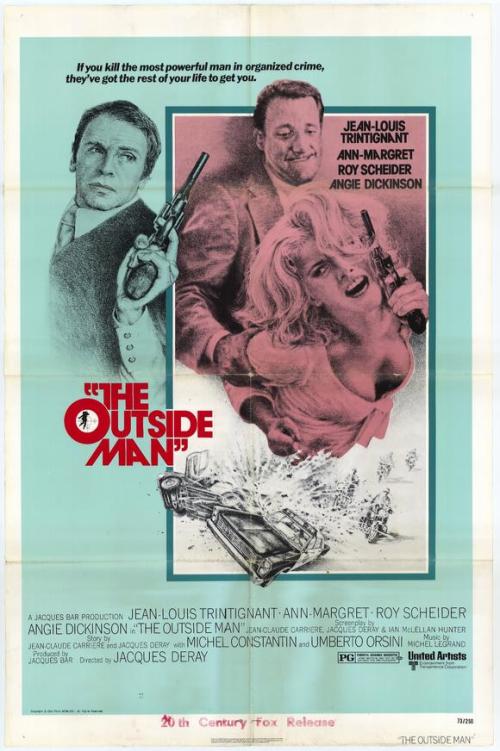
The Outside Man (1973)

outside man 2

By Richard Winters

My Rating: 7 out of 10

4-Word Review: Hit man is marked.

Lucien (Jean-Louise Trintignant) is a French hit man hired by an American family to assassinate a mob boss (Ted de Corsia) who’s living in Los Angeles. He’s able to pull off the job relatively easily, but then after it’s over he finds that he’s been targeted by another hit man (Roy Scheider) who is relentless and chases Lucien all over the city. Nancy (Ann-Margret) is the stripper who comes to Lucien’s aid by getting her boyfriend to create a passport for him so he can return to France, but just as he is about to board the plane he decides instead to stay in the states and turn-the-tables on the man who’s chasing him while finding who is behind the double-cross.

The film, which was done by a French production company, but filmed on-location in the states, is a lot of fun. The many offbeat touches and various stabs at dry humor keep it interesting and original while still remaining suspenseful and exciting. Some of the best moments include a hitchhiker (Edward Greenberg) who tries to convert Lucien to ‘Jesus’ as well the funeral, which eventually turns into a wild shootout amongst the various mob factions and has a corpse embalmed in a sitting position with a cigar in hand.

I also liked the way director Jacques Deray captures Los Angeles. Usually when a film is done in the City of Angels we always get shown shots of the Hollywood Walk of Fame, movie star homes, the beachfront and of course the great Hollywood sign, but here we see none of that. Instead the film captures the city’s less glamorous side including the rundown neighborhoods and even a shootout that takes place in abandoned buildings from an amusement park, which all helps to give the movie a unique vision as well as allowing the viewer to appreciate a side to the city that they may have not known even existed.

Trintignant is terrific and his perpetual look of confusion as he gets faced with one unexpected surprise after another is memorable and helps carry the film. Ann-Margret is solid as the streetwise, but kindly stripper and Scheider is quite good as the steely killer. Georgia Engel, who later became famous for playing Georgette on the ‘Mary Tyler Moore Show’ is funny as a spacy housewife who comes into contact with Lucien as he is trying to run from his killer. I especially liked the way that when a gun is pointed in her face she doesn’t scream or panic, but instead responds with silence and a deer-in-headlights look. This is also a great chance to see a young Jackie Earle Haley in his film debut as her precocious 10-year-old son.

The film’s only real downfall is its ending, which is too downbeat and ambiguous. It’s almost like they spent so much time coming up with creative concepts for the rest of it that by the time they came to the end they just plain rang out of ideas, which is a disappointment, but as a whole it’s still a gem.

My Rating: 7 out of 10

Released: January 18, 1973

Runtime: 1Hour 44Minutes

Rated PG

Director: Jacques Deray

Studio: United Artists

Available: DVD (MGM Limited Edition Collection), Amazon Instant Video
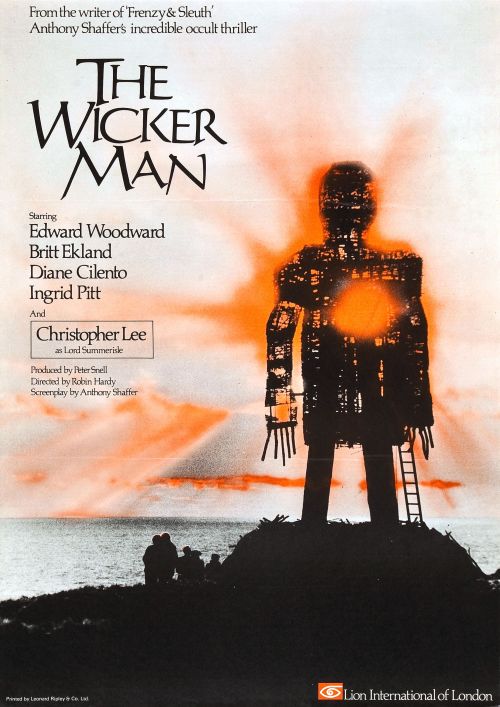
The Wicker Man (1973)

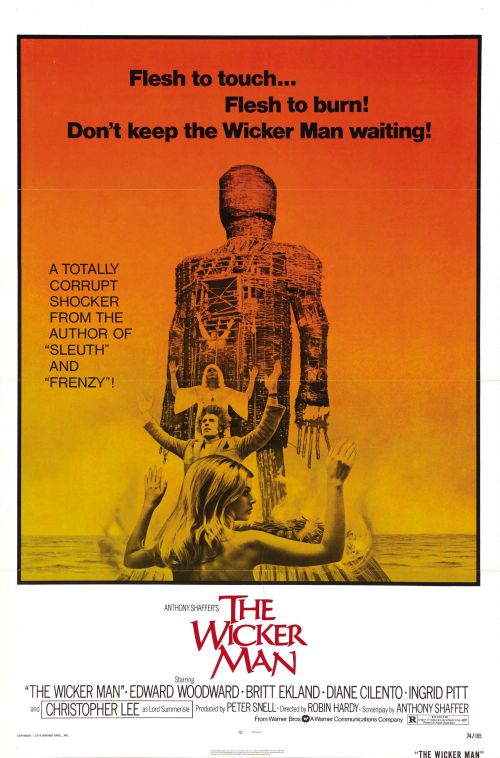
the wicker man 1

By Richard Winters

My Rating: 8 out of 10

4-Word Review: Pagans on an island.

Police sergeant Howie (Edward Woodward) receives a letter stating that their daughter named Rowan Morrison (Gerry Cowper) has disappeared and it compels him to travel by plane to an obscure island village off the coast of Scotland to find her. Once he arrives he finds nothing but resistance from the people and everyone denying that she even exists. He also learns that the people practice a pagan type of religion and begins to suspect that the girl’s disappearance may have something to do with the upcoming harvest celebration and decides to infiltrate the proceedings in order to weed-out the culprits and find the girl.

The film, which was inspired by the 1967 novel ‘Ritual’ by David Pinner, manages to be quite intriguing despite being material better suited for a short story. The whole concept is woven around the big twist that occurs at the end and everything that occurs beforehand is simply a lead up to that, which could’ve been a stretch for feature length but director Robin Hardy’s tight editing and deft use of atmosphere keeps things permanently lodged in the creepy and compelling even though I did figure out at around the 60 minute mark where it ultimately was headed. The film’s original length is supposedly longer than the 1Hour 28Minute release that is currently available, but to be honest I felt this was a perfect runtime for this type of story and stretching it out further would’ve simply been diluting it.

Edward Woodward, who later became familiar to American audiences with his starring role in the TV-show ‘The Equalizer’, is terrific in the lead and I liked that fact that the character wasn’t a completely ‘nice guy’ either, but instead rigidly entrenched in his Christian religious beliefs and arrogantly convinced that his spirituality was superior to anyone else’s. Christopher Lee again makes a good nemesis even though his mod hair style looks a bit goofy. Britt Ekland is on hand as well singing a weird song and even doing a provocative dance although the nude scenes of her from the waist down were done by a body double.

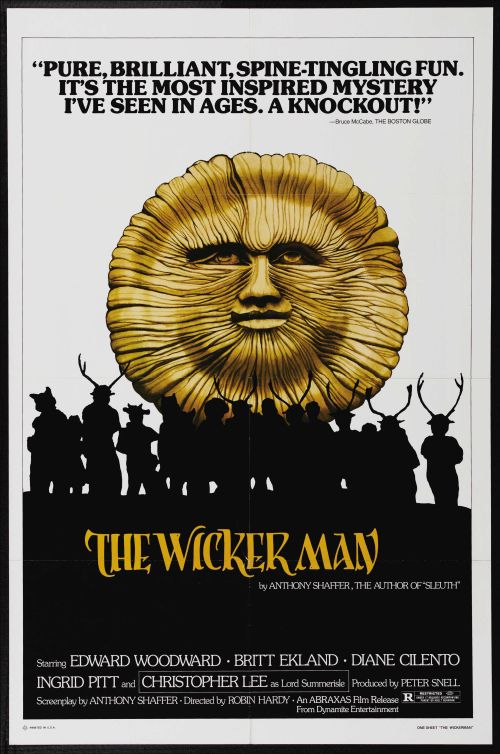
the wicker man 2

The only issue that I had with Anthony Shaffer’s script is the fact that the sergeant must go back to the mainland to get more men from the force to help him search for the girl, which to me was a bit of a loophole because I would think he could’ve just gotten on a phone and called in for more backup without arduously having to travel back. The facts that no one else knows where he is seemed a little implausible as well as most people working on the force have a supervisor that they must report to and who is at least somewhat aware of what case they are working on and where they are traveling to do it.

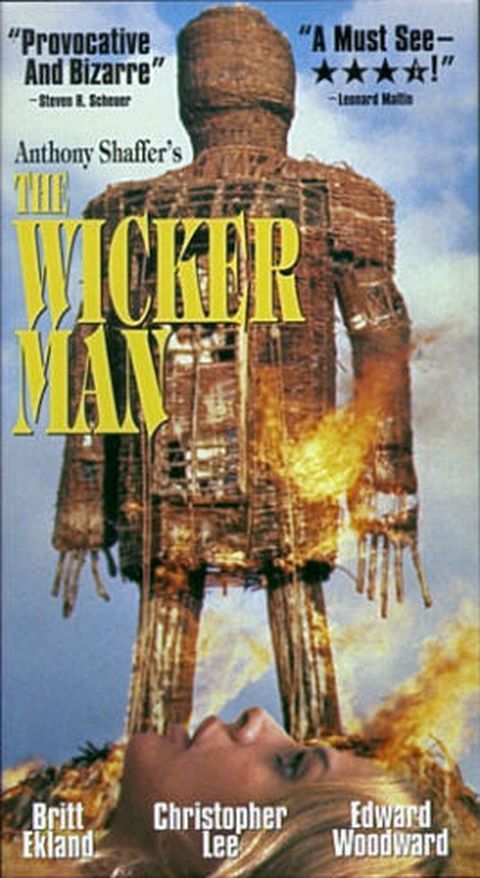
The ending though, which features an actual giant wicker man made of wood is an amazing site. When it gets set on fire with the victim and even some animals trapped inside of it is quite exciting and I liked how the point-of-view shifts between the people who view it from the ground as well as the victim seeing the people on the ground from inside the burning structure.

I remember seeing the 2006 remake starring Nicholas Cage in the theaters. While the details of it are vague I do recollect coming away from it finding grossly inferior in literally every way to this one and something that should be avoided at all costs.

the wicker man 3

the wicker man 4

My Rating: 8 out of 10

Released: December 10, 1973

Runtime: 1Hour 28Minutes

Rated R

Director: Robin Hardy

Studio: British Lion Film Corporation

Available: DVD, Blu-ray, Amazon Instant Video, YouTube

The Picture Show Man (1977)

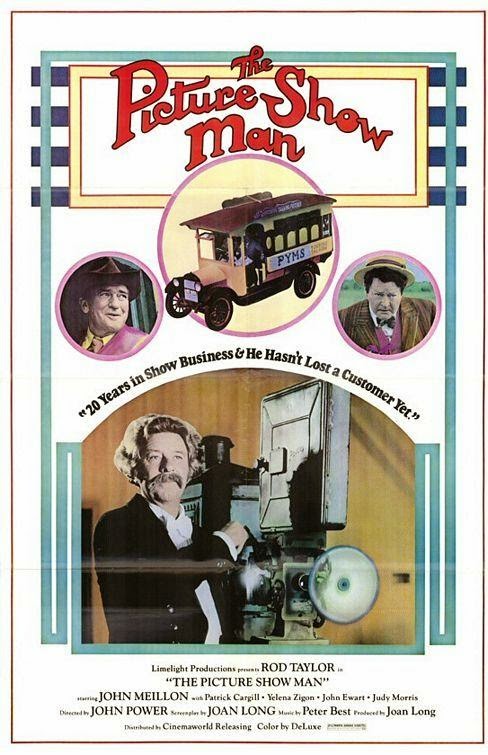
picture show man

By Richard Winters

My Rating: 4 out of 10

4-Word Review: They show silent movies.

During the 1910’s Pym (John Meillon) travels the Australian countryside with his son and piano player (John Ewert) while renting out the local theaters in the small towns that they come upon and showing silent movies to the townsfolk. He makes just enough to survive and keeps all of his money in his pocket as he doesn’t trust the banks. His biggest problem is the advent of talking pictures as well as competition from Palmer (Rod Taylor) a man who Pym personally trained in the business, but now seems to be making more of a splash.

What should’ve been a nice slice-of-life period piece turns out to be meandering and pointless instead with a script that lacks a plot and everything broken up into vignettes that are just barely passable. The film would’ve done better with a more centralized character and point-of-view as well as adding in some conflict and drama. It also should’ve stayed more focused on the silent movie theme instead of veering into other directions including romance and even horse racing, which are just not as interesting.

Upon his death last year at the age of 85 many obituaries listed this film as being Rod Taylor’s last major role, but it really isn’t. He appears only sporadically and seems to have almost a mystical presence about him. His confrontations with Pym are contrived and his character adds very little.

The only mildly interesting aspect of the movie is the addition of Major Lockhart and his wife (Don Crosby, Judy Morris) who come onboard with Pym to do fake psychic readings during the intermission of his movies. The couples constant bickering is amusing and the scene where the husband catches his wife making out with Pym in the projection room and proceeds to attack them with an ax and sets fire to the film while the customers sit on the other side of the wall singing a song and completely oblivious to what is going on behind them is pretty funny.

I also got a kick out of the shot showing the faces of the people who are completely mesmerized to the screen as they take in hearing dialogue for the first time in a movie. The dialogue itself is banal and even corny, but the fact that the people remain so compelled to it makes it without a doubt the best moment in the movie.

I also found Leonard Maltin’s review of this movie to be pretty amusing as well. In the 1991 edition of his Movie Guide he gives this film three-and-a-half-stars while calling it “Funny and moving” and “A must for buffs”. Then in his 2013 edition he gives this same movie only two stars and describes it as meandering and lacking in energy.

My Rating: 4 out of 10

Released: May 5, 1977

Runtime: 1Hour 39Minutes

Rated PG

Director: John Power

Studio: Roadshow Distributors

Available: DVD

The Lady in the Car with Glasses and a Gun (1970)

lady in the car

By Richard Winters

My Rating: 5 out of 10

4-Word Review: Dead body in trunk.

Dany (Samantha Eggar) works as a secretary for Michael (Oliver Reed) who asks her to come to his place one evening to help him type an urgent report that needs to go out the next day. She agrees and then spends the night in his guest bedroom. The next morning she travels with his family to the airport where they board a plane for a vacation while she is instructed to drive their car back home, but along the way she takes a wrong turn and begins to come upon people who say they’ve seen her before even though she can’t remember them. Then she finds a dead body in the trunk and things get really bizarre.

The film, which is based on the novel by Sebastien Jasprisot and remade in 1992 and then again in 2015, has a certain appeal as the story is offbeat enough to keep you intrigued and manages to give a logical, or at least an attempted one, explanation at the end for why everything that occurs to Dany happened and the reason behind it. Unfortunately Anatole Litvak’s direction is bland despite a colorful opening montage and Reed, with his hair dyed gray, is miscast as a stuffy businessman.

One of the biggest issues though is the main character who behaves in ways that make little sense. Going to her boss’s place after work hours to write a report and even be instructed to drive his car back from the airport seems to be going well beyond the normal duties of an ordinary secretary and one that most likely would be met with resistance by anyone else and yet Dany obliges to his demands without question like she is a robot. Later a strange man (John McEnery) enters her car and makes an aggressive pass at her. Instead of leaving or running for help she instead gets into the car with him and takes him back to her hotel and goes to bed with him before she even knows what his first name is.

Spoiler Alert!

At the end we find out that Dany’s boss has set the whole thing up to make it look like Dany shot the man, whose dead body was in the trunk, in order to cover up for his wife (Stephane Audran) who was the one who really did it. Apparently she had been having affairs with many different men and shot this one when he refused to continue to see her. The husband was aware of all of these transgressions and would pay off the men to quit seeing her and when he found out that his wife had killed this one he concocts an elaborate scheme to get her off the hook, but why? Most men would not feel the need to come to the defense of an unfaithful wife especially one that continues to do it over and over again, which makes the whole storyline quite weak since it’s completely off-the-mark in terms of realistic human behavior.

End of Spoiler Alert!

My Rating: 5 out of 10

Released: October 22, 1970

Runtime: 1Hour 38Minutes

Rated R

Director: Anatole Litvak

Studio: Columbia Pictures

Available: None at this time.

Nobody Waved Goodbye (1964)

nobody waved goodbye 1

By Richard Winters

My Rating: 8 out of 10

4-Word Review: Teen learns hard lesson.

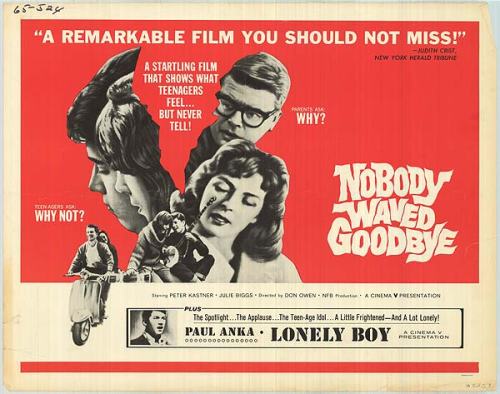
Peter (Peter Kastner) is 18 and looking to spread-his-wings, but doesn’t like what he sees in the adult world. Everyone seems trapped by their dull jobs and mundane routines, which is something he doesn’t want to fall into. He has big dreams. He wants to run away with his girlfriend Julie (Julie Biggs) and live a life based completely on his own whims while never becoming a slave-to-the-system like everyone else. Then he gets in a fight with his parents and they kick him out and after struggling to find work without even a high school diploma his attitude quickly changes.

If you can get past the wretched opening song, which is sung by Kastner and played over the credits, then this film really hits-the-mark. I was impressed with the camera work especially during the dinner time conversations amongst the family members where director Don Owen shoots it with a hand-held camera and zooms in and out on the person’s face as they are speaking. This is something that is quite common today especially on TV-shows, but back then was rarely if ever used, which makes this well ahead-of-its-time and even groundbreaking. I also enjoyed the conversational quality of the dialogue and having two conversations going on at the same time, which again didn’t come into vogue until years later when Robert Altman did it in M*A*S*H.

The film also clearly allows for ad-libbing amongst its actors. There is a scene in which Peter and Julie go paddle boating and come upon a large sofa submerged in the water and then comment on it. Clearly the filmmakers didn’t put the sofa into the lake simply to film the short scene that has nothing to do with the rest of the story, but it still helps set the tone for keeping things fresh and real.

Kastner is great and it’s refreshing to have a protagonist in a film that you like at some points and feel like wringing-his-neck at other times. Too many movies today, especially Hollywood ones, create lead characters that are politically correct caricatures while this movie instead has real human beings that are not tailored made to conform to the likings of any particular demographic.

It’s a shame to say that a movie that came out over 50 years ago is still considered cutting-edge, but compared to the tired, formulaic glop coming out today it really is. The script is uncompromised and holds-no-punches while keeping things gritty and stark and making profound, universal points along the way. I also found it fun that the main character here, who was clearly a baby boomer, displays the same anti-establishment, anti-work attitude that now gets placed squarely onto the ‘dreaded millennials’ and yet it seems the boomers were just as reluctant to get into the rat race as all the generations that have followed them and therefore shouldn’t be waiving their finger at anyone.

nobody waved goodbye 2

My Rating: 8 out of 10

Released: August 13, 1964

Runtime: 1Hour 20Minutes

Not Rated

Director: Don Owen

Studio: National Film Board of Canada

Available: None at this time.

Rosalie Goes Shopping (1989)

rosalie goes shopping

By Richard Winters

My Rating: 4 out of 10

4-Word Review: Shopaholic turns to crime.

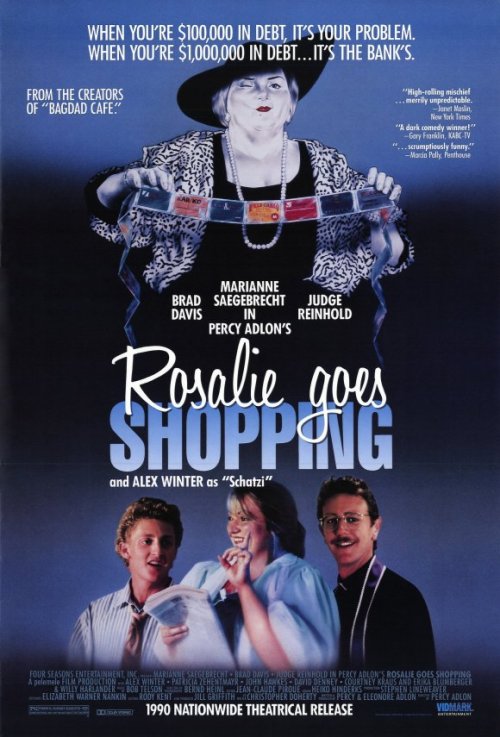
Rosalie (Marianne Sagebrecht) is a German immigrant who has married an American crop duster (Brad Davis) and moved onto a small ranch just outside of Stuttgart, Arkansas. There they raise a large family while also becoming obsessed with American consumerism by recording all the TV-shows on their VCR, but only so they can watch the commercials. Rosalie becomes a particularly obsessive shopper buying things that she really doesn’t need even when her money and credit become tapped out. She then figures out a way to hack into the accounts other people and companies via her home computer, which allows her to continue to pay for all her items by embezzling it from others.

This marks the fourth teaming of director Percy Adlon and star Sagebrecht and straight after their big success in the cult classic Bagdad Café. The film was made on-location in Arkansas, but financed by a German production company. I’m not sure what camera lens was used or the film stock, but the color contrast is quite unique and gives the whole thing an Avant-garde appearance. The storyline is original as well and veers off into unpredictable ways while making a great point, which is that unbridled capitalism can be just as dangerous and oppressive as any other form of government.

Sagebrecht is a delight and the moment where tears trickle down her checks as she becomes homesick for her native land while watching home movies taken in Germany is touching. Judge Reinhold is funny as the priest who becomes aware of Rosalie’s shenanigans through hearing them during confession, but completely exasperated about what to do about it. Brad Davis, a highly underrated actor who died too young, plays a rugged country man that’s completely against type from his more famous roles in the homoerotic films Midnight Express and Querelle.

Unfortunately the script, which was co-written by Adlon and his wife Eleonore veers too far into the whimsical and shows too much of a naiveté in regards to cyber technology. The idea that Rosalie could somehow ‘guess’ what everybody’s password was even those used by big companies and major banks is too farfetched and even if she did somehow figure them out all they’d have to do is change them once they realized their accounts had been hacked, which would’ve ended Rosalie’s cybercrimes right there.

The fact that she is able to cover up her crimes by doing even more outrageous ones and never, ever having to face the consequences of her actions is far too fanciful. It also makes light of a genuinely serious issue where the poor and lower middle-class do not have the same resources to get out of their financial predicaments as the rich do. They also do not have the convenience to magically cheat-the-system like the character here and those that do will almost always have it catch up with them where they will ultimately face harsh repercussions no matter how ‘justified’ they may have felt they were in doing it.

Some may argue that this was just a wish-fulfillment comedy, but even then there still needs to be some realm of possibility to it for it to be satisfying and this has none and it also makes the so-called clever twists lose their edge once you realize that none of it is plausible.

My Rating: 4 out of 10

Released: May 19, 1989

Runtime: 1Hour 34Minutes

Rated PG

Director: Percy Adlon

Studio: Pelemele Film

Available: VHS, DVD (Region 2), Amazon Instant Video

Young Einstein (1988)

young einstein

By Richard Winters

My Rating: 4 out of 10

4-Word Review: The first rock star.

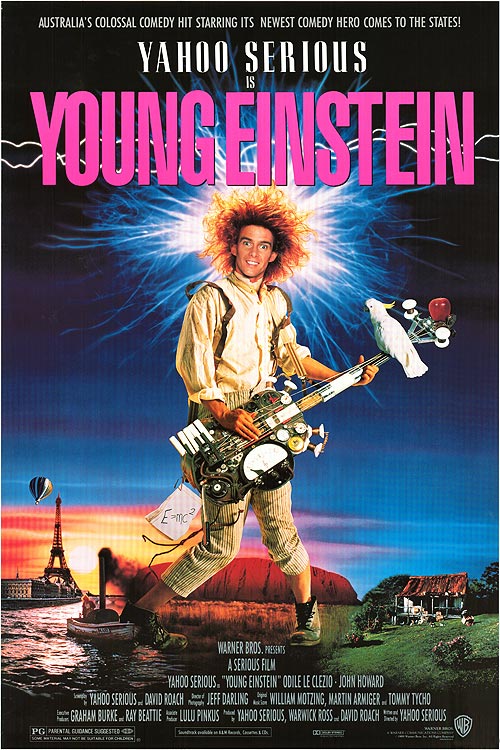
Forget all those things that you’ve read in the history books because they’re all wrong. Albert Einstein was never born in Germany instead he was the son of an apple farmer in Tasmania who grew up to not only invent the theory of relativity, but also rock ‘n’ roll, the electric guitar, bubbles in beer and even surfing. He also had a bad haircut that looked just like Carrot Top’s.

The term one-hit-wonder gets used a lot in the music business to describe a band or singer that comes out of nowhere, gets a chart topping hit and then proceeds back to obscurity. Normally it’s never used in movie jargon, but if it was this would be a perfect example. Writer/director/star/composer Yahoo Serious, whose birth name was Greg Pead until he had it legally changed in 1980, seemed to be the next creative prodigy when he concocted this thing after spending years making educational documentaries. It was a huge success in Australia, which was enough to get Warner Brothers to pick it up as they thought they had another Crocodile Dundee on their hands and spent $8 million promoting it only for it to fail dismally at the box office and in effect so did Serious’ career as he has not made a movie, or even been in one since 2000.

To some extent I was initially surprised at how well directed it was and how Serious showed an astute eye for detail. I loved how he captured the majestic Australian landscape and the music score is quite distinctive and cool. The humor is funny, but mostly when it involves a visual device that has nothing to do with the action. For instance there is a homeless man in one scene carrying a sign stating ‘The end is near’, but instead of spelling ‘near’ in the conventional way it gets spelled as ‘nigh’ to replicate his Aussie accent.

Unfortunately the comedy stays too much at an innocuous level, which is why I believe it didn’t catch on here, or become a cult hit despite its potential. Everything is geared exclusively to a preteen audience, who may love it, but for it to appeal to adults or a more discriminating viewer it needed to have a darker edge, or some attempts at satire instead of just complete, non-stop silliness.

Serious is only so-so as the lead. He certainly does have the chiseled, boyish good looks that could make the young teen girls swoon, but he had too much of a laid-back, mellow persona and seemingly unable to convey any other type of emotion. His radical, punk-like hairstyle starts to become a distraction to the point where you find yourself looking at it even when you don’t want to.

Originally the script was called ‘The Great Galute’ and was a story about some ordinary fella who invented the electric guitar and the Einstein angle was only added in after Serious took a boat ride down the Amazon and noticed a kid wearing an Albert Einstein T-shirt. In a lot ways the film would’ve been better had it stayed with its initial concept as it’s a bit disrespectful to the actual person and it’s never even remotely funny that this guy with a perpetual surfer dude mentality could’ve really been a super genius.

The ridiculous plot proceeds to get dumber as it goes along until it becomes just downright embarrassing by the end. The romantic side-story and the film’s villain (John Howard) are pointless, boring additions that add nothing and should’ve been scrapped. The film would’ve been more successful had it done away with a conventional narrative completely and instead taken the Jacques Tati approach where all emphasis was placed on visual non-sequiturs as this was the only time that I found the film to be even slightly engaging.

My Rating: 4 out of 10

Released: December 15, 1988

Runtime: 1Hour 31Minutes

Rated PG

Director: Yahoo Serious

Studio: Warner Brothers

Available: DVD, Amazon Instant Video, YouTube

Nicholas and Alexandra (1971)

nicholasandalexandra1

By Richard Winters

My Rating: 9 out of 10

4-Word Review: The last Russian Tsar.

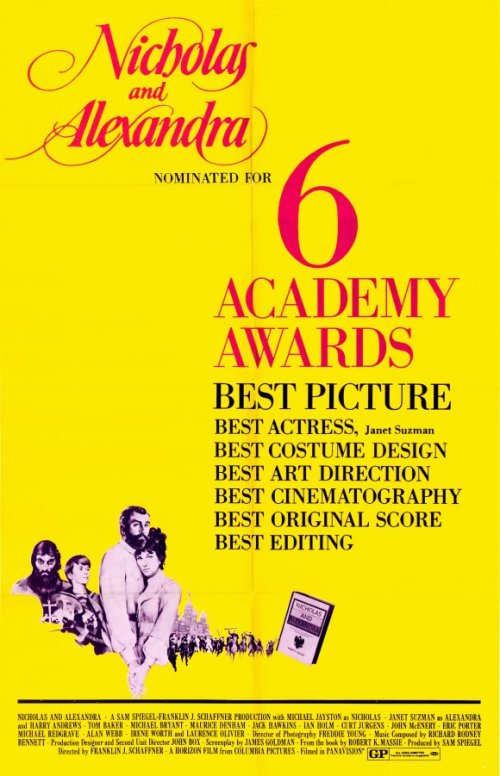
This film chronicles the life of Tsar Nicholas II (Michael Jayston) of Russia and his marriage to Alexandria (Janet Suzman). Based on the novel by Robert K. Massie it examines the height of his power and his apathy to the poverty of his people and his reluctance to listen to their needs, or consider a more democratic form of government. It also looks at his personal life including the birth of his son Alexei (Roderic Noble) who is diagnosed with hemophilia and his wife’s over-reliance on Grigori Rasputin (Tom Baker) a man pretending to have divine connections who ultimately uses his influence on Alexandra to take control over her political affairs when her husband is away. The film also portrays Russia’s involvement during WWI as well as the Tsar’s downfall and eventual exile in Siberia with his family.

The film is basically split up into three parts with the first hour looking at Nicholas’ family life while intercutting with scenes showing the discontent of the Russia people and the efforts of Vladimir Lenin (Michael Bryant) to create a revolutionary form of government. The second hour examines Russia’s war involvement and the many warnings that Nicholas is given not to get involved in it, but foolishly decides to anyways, which ultimately creates massive upheaval. The third hour looks at his abdication of power and the family’s exile and virtual imprisonment at the Ipatiev House in Yekaterinburg where they nervously await their fate.

Initially I thought the third hour would be the weakest as we all know they get shot and killed execution style, but to my surprise it is actually the strongest part of the film. To an extent tearing the characters away from their plush surroundings and forcing them to exist in bleak, squalor-like conditions actually humanizes them and allows the viewer to empathize with them particularly the four daughters who had nothing to do with their father’s harsh policies and just wanted a chance to grow up and live a normal life. The scene where the family is herded into the basement of the home in the early morning hours and forced to sit silently while awaiting their executioners is quite possibly one of the most intense moments ever captured on film.

The performances are uniformly strong particularly Suzman’s as well as Baker as the evil Rasputin who’s drawn out death scene may be one of the longest in movie history. Laurence Olivier in a small, but pivotal bit as the Prime Minister gets two commanding moments including his speech after the Bloody Sunday massacre and later his strong misgivings about the country’s war involvement.

The film is full of brilliant cinematography, direction, costumes and set pieces and is certainly something that must be watched on the big screen to be fully appreciated. I enjoyed the lavish interiors of the Winter Palace especially their walks down the elegant hallways that are lined with Royal guards, but found it equally interesting when Nicholas returns there after the war and forced to walk down these same hallways, which are now darkened and rundown. The many long distance shots of the flat and majestic landscape is also impressive particularly a view of a rolling sunflower field.

Although this film has never attained the well-known classic status of Doctor Zhivago, and in fact this was producer Sam Spiegal’s answer to that film when he was blocked from working on it, I still found it to be every bit as compelling and well directed.

My Rating: 9 out of 10

Released: December 13, 1971

Runtime: 3Hours 8Minutes

Rated GP

Director: Franklin J. Schaffner

Studio: Columbia Pictures

Available: DVD, Blu-ray, Amazon Instant Video


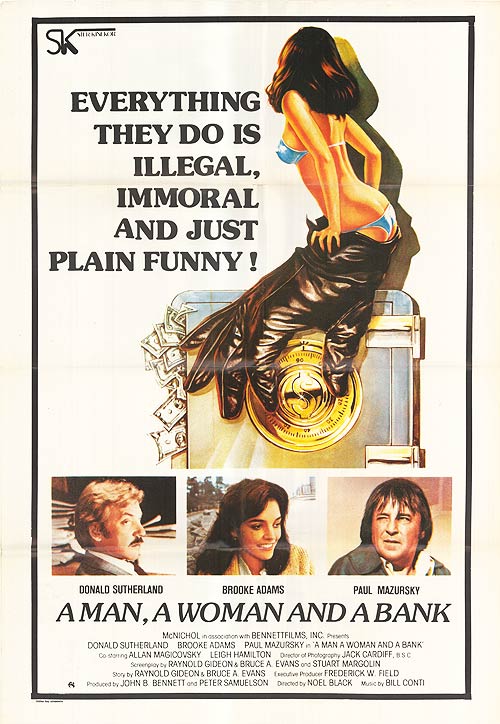
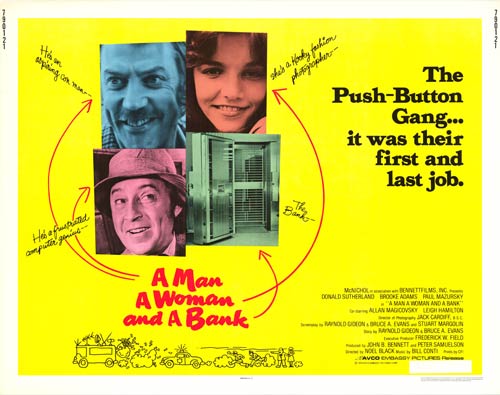
A Man, A Woman and a Bank (1979)

man a woman and a bank 2

By Richard Winters

My Rating: 3 out of 10

4-Word Review: A very large withdrawal.

Small-time crook Reese (Donald Sutherland) teams up with his computer expert friend Norman (Paul Mazursky) to pull of what they hope will be the perfect crime. Their plan is to reprogram the alarm system of a bank while the building is still under construction. Then when it finally gets completed they’ll break into the vault undetected and walk away with a cool 50 million dollars. Things though get off to a rocky start when commercial photographer Stacey (Brooke Adams) snaps of picture of Reese as he is stealing the blueprints of the building. In an effort to get the negatives back he tracks her down, but ends up falling in love with her instead putting their elaborate plan at risk.

There’s been a million and one bank robbery films done and many of them can be quite entertaining, but this one misses the mark from the very beginning. For one thing it gives us no backstory to the characters, or how they were able to come up with the idea in the first place. Giving a compelling reason for the viewer to become emotionally attached to the characters and their quest helps and this film fails to give it. The plan itself seems too easy and full of a lot of potential pitfalls that the script conveniently overlooks. The idea that the Norman character would be able to break into the bank’s security system by simply feeding the computer with a lot of useless usernames until it finally breaks down and starts spitting out the secret information is in itself quite questionable.

The pacing is poor and the story meanders onto several different story threads that have nothing to do with the crime. Analyzing Norman’s marriage difficulties and Stacey’s troubles with her possessive boyfriend (Allan Kolman) seems like material for a whole different movie and does nothing to help keep the interest going in this one. In fact the movie spends so much time on these other tangents that the robbery begins to seem almost like a side-story.

Stars Sutherland and Adams reunite after starring in Invasion of the Body Snatchers just a year earlier. The two share a good chemistry, but Sutherland is too laid back in the role and Adams’ hyper energy helps only so much. The film’s best performance and ultimate scene stealer is Mazursky who is completely on-the-mark as the nervous friend and gets quite a few good lines.

The film does have a couple of unique scenes that I liked including a collection of candles made to look like well-known game show hosts and a security guard who does jumping jack exercises only to light up a cigarette the minute he sits back down. The crime though is boring and does not offer enough tension. I was almost hoping they’d end up getting caught as they are able to pull it off too easily with a plan that I don’t think would ever work in real-life.

man a woman and a bank

My Rating: 3 out of 10

Released: September 8, 1979

Runtime: 1Hour 41Minutes

Rated PG

Director: Noel Black

Studio: AVCO Embassy Pictures

Available: DVD

And Hope to Die (1972)

and hope to die

By Richard Winters

My Rating: 7 out of 10

4-Word Review: Kidnapping a dead girl.

Tony (Jean-Louis Trintignant) is on the run from a gypsy group out for revenge and as he is being chased by them he encounters another group of criminals headed by Charley (Robert Ryan) who after some conflict take him into their fold and gives him the nickname of Froggy. Their plan is to kidnap a teen girl who is set to be the star witness at a trial of a major head of a criminal organization. Unfortunately she commits suicide before they can get to her, so they pretend that she is still alive and go through the motions of the kidnapping so as to be able to collect the payout by the organization that hired them.

This is the second of director Rene Clement’s trilogy dealing with the theme of kidnapping. The first was The Deadly Trap and the third being Scar Tissue. Of the three this one is the best mainly because of its many offbeat touches. The wry sense of humor, which is deftly interwoven into an already intricate plot, is terrific and helps make the entire thing engaging from beginning to end. My favorite parts include a contest that Froggy plays with Charley where he can stand three cigarettes on end straight into the air, which he can do with ease while Charley can’t despite his repeated efforts. The eulogy that Charley gives during a makeshift burial of one of their cohorts is priceless and the action isn’t bad either including an exciting sequence in which the group walks across a thin ladder hundreds of feet in the air that connects one skyscraper to another.

The characterizations are well done and played to the hilt. Trintignant plays another one of his outsider-looking-in roles and the way he manages to mesh himself into the group that is initially reluctant to have him is quite amusing. Aldo Ray is a scene stealer playing the gang’s resident bonehead and Tisa Farrow, who is Mia’s younger sister and looks almost like she could be her twin, is appealing in her role as a volatile young lady who knows how to use a gun and not afraid to shoot it whenever she gets the least bit riled.

The actual kidnapping, which is based on the novel ‘Black Friday’ by David Goodis, doesn’t occur until the final thirty minutes with the first hour dealing exclusively with Froggy’s assimilation into the group, which may sound boring, but really isn’t. In fact there is very little about this movie that I didn’t like and my only complaint would be the lackluster ending that doesn’t offer much of a payoff. Otherwise I feel this is a great example of how to mix humor with action, but still managing to keep things believable, fresh and inventive.

My Rating: 7 out of 10

Released: September 15, 1972

Runtime: 1Hour 39Minutes

Rated PG

Director: Rene Clement

Studio: 20th Century Fox

Available: DVD (Region 2)