Category Archives: Farce

The Last Remake of Beau Geste (1979)

beaugeste

By Richard Winters

My Rating: 4 out of 10

4-Word Review: Brothers join the army.

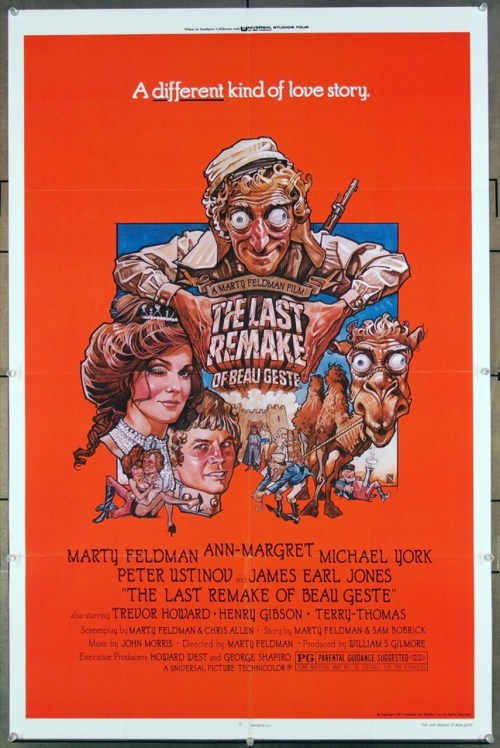
Sir Hector Geste (Trevor Howard) decides to adopt a son to be his rightful heir and carry on the family name. He goes to an orphanage where he spots Beau (Michael York) a dashing young boy who shows immense prowess. Hector immediately decides he wants him, but it comes with the caveat that he must also take on Beau’s twin bother Digby (Marty Feldman) who’s not nearly as handsome, or brave. After bringing both boys home Hector then gets married to Flavia (Ann-Margret) a much younger woman who’s more in-love with the Blue Sapphire diamond that’s in Hector’s possession than Hector himself. In order to keep Flavia from absconding with it Beau decides to take it out of the family home and bringing it along with him to Africa where he joins the French Foreign Legion. Digby eventually joins and they go on to have many adventures, but Flavia catches up with them determined to get the diamond using any means necessary.

The film is based on the 1924 novel of the same name written by P.C. Wren that had already been made into a movie three other times: in 1926 starring Ronald Coleman, 1939 starring Gary Cooper, and finally in 1966 starring Guy Stockwell. In 1976 when Marty Feldman signed a 5-picture deal with Universal to write, direct, and star in any film project he choose he decided to do a parody on a film he had seen growing up. He mistakenly thought it was Beau Geste, but came to realize once he watched the movie that it was really The Four Feathers that had a similar storyline and came out around the same time. He eventually went with doing this version since he felt ‘The Last Remake of the Four Feathers’ didn’t sound right.

The production, which was filmed in both Ireland and Spain, was met with many obstacles, including having Feldman getting sick during the shoot and putting the production on-hold for many weeks. It eventually went over budget and over schedule and the studio was not happy with Feldman’s final cut and determined to re-edit it while giving Feldman a 2-week vacation under the guise of letting him rest and recuperate. When Feldman returned and found out what the studio had done he became irate, so the studio heads decided to make him a deal; they would show both versions to a test audiences and which ever one rated better would be the one that would be released. Feldman agreed to this and to the studios shock Marty’s cut got much higher ratings, but the studio then went back on their word and released their version instead, which did not fare well with either the critics, or public. To this day Marty’s version has never been seen, but by only a few people even though those that have viewed say it’s much funnier and efforts have been made to find it and give it a proper Blu-ray issue though this has never come to fruition as of yet.

As for this version it’s okay, but it starts out better than it ends. There’s some funny gags here and there, but the humor tends to be quite broad and many of the jokes fall flat especially after the midway point. The best moment comes when Feldman splices his character into the 1939 film version and we see his character speaking to Gary Cooper and they even share a scene together, which I found to be quite innovative for the time period. Everything else though is hit-or-miss and suffers from not enough people being familiar with the source novel and thus the in-jokes involving the story will most likely go over  most viewer’s heads it also makes many changes from the original plot with the biggest one being that in this movie there’s only 2-brothers, but in the book there was 3.

The array of famous faces making cameo appearances is fun for awhile though I felt Peter Ustinov camps it up too much as the evil General Markov and the part would’ve been better served had it been played by Roy Kinnear who instead gets wasted as Markov’s assistant. Howard is quite amusing as the elderly father and I wished he was in it more, but ultimately his character gets confined to his bed for the second and third act. Ann-Margret offers some sexiness, but really has nothing to say or do that’s funny until the very end when she tries to challenge a guy to a fist-fight, which should’ve been played-out more. Terry-Thomas gets some work before his Parkinson’s condition, which is very obvious here with his trembling left hand, became so severe that it forced him out of acting and into a retirement home not more than a year after this was filmed.

Feldman himself is quite good, but I felt he needed to be seen more, which is the biggest problem with the movie in that it’s neither character nor plot driven. Too much nuttiness and wackiness for its own good. If the comedy had been better disciplined and a smaller cast it would’ve worked better, but the barrage of constant craziness all in the name humor eventually gets overblown.

My Rating: 4 out of 10

Released: July 15, 1977

Runtime: 1 Hour 25 Minutes

Rated PG

Director: Marty Feldman

Studio: Universal

Available: DVD-R (Universal Vault Series), Blu-ray
The Twelve Chairs (1970)

twelve

By Richard Winters

My Rating: 7 out of 10

4-Word Review: Which chair has fortune?

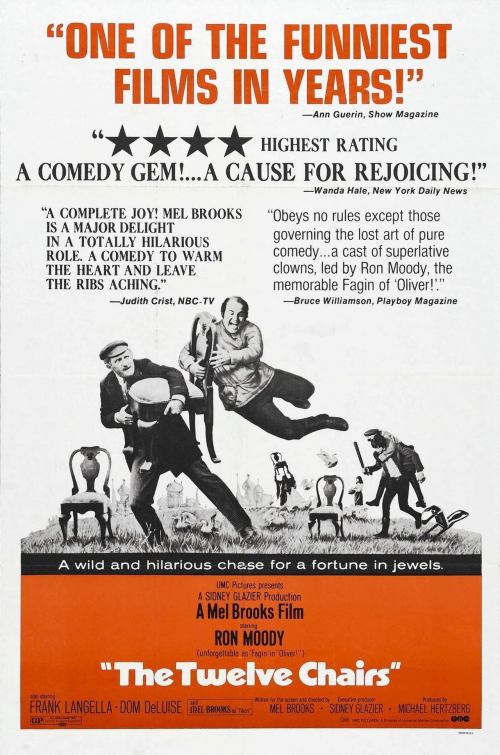
Vorobyaninov (Ron Moody), an poor man living in 1920’s Russia, is summoned to the deathbed of his mother-in-law. She confides in him that there’s a stash of priceless jewels sewn into the seat cushions of one of the twelve chairs from the family’s dinning room set. Unfortunately the newly formed Russian state has appropriated all private property and it’s up to Vorobyaninov to track them down. He teams up with Ostop (Frank Langella) a local con-man to help him, but they have competition. Father Fyodor (Dom DeLuise), a priest, also becomes aware of the jewels when he goes to the mother-in-law’s home to give her the last rites. All three go on a mad dash to retrieve the jewels, but the more chairs they manage to find the more frustrated they become.

The film is based on the 1928 Russian novel of the same name by Ilf and Petrov a famous duo who were quite popular during the early soviet period and wrote not only many satirical novels, including this one and its sequel ‘A Little Golden Calf’, but also several short stories, articles, theatrical plays, and even screenplays. The Twelve Chairs novel though was their most popular and has been made into a movie 18 different times. It had already been done 6 times before Mel Brooks did his with the first version being in 1933 and the most recent rendition of it done in 2013 in Italy.

This version is the most popular and a bit of stretch from Brooks’ other films, which relied on a lot of gags and slapstick. This one has its fair share of those though the first act is quite talky and not too much going on. Brooks himself appears as a character, but he can’t really enliven it. It’s not until the men finally come upon the chairs and start tearing them up one-by-one that it really starts to get funny. The chair thing could’ve gotten redundant as the men rip open the seat cushions in pretty much the same quick way, but Brooks manages to approach each of these scenes in a creative way, so instead of becoming monotonous it remains fresh and comical. My favorite of these is when Ron Moody and Frank Langella chase Dom, who has one of the chairs, through an open field that’s done in stop-action.

The film’s detraction though is the casting of the two main characters. Langella is a terrific actor, but not in comedy. He did appear in the dark comedy Diary of a Mad Housewife, where he was very good, but that took advantage of his glib demeanor and pouty expression and his character there was meant to be unlikable. Here though he has nothing amusing to say and remains a complete jerk the whole way. There is one point where he and Moody are in a row boat and Moody states that he’s cold and Langella gives him a jacket to wear, which I guess was Brooks’ attempt to make him likable, but it’s not enough and the movie is really hurt by spending so much time focused on a guy who’s one-dimensionally cold and responds to antics around him in the same sneering way. He was recommended to Brooks by his wife Anne Bancroft who had performed with Langella in a Broadway play that had a short run, but I felt this is one time when he shouldn’t have listened to her.

Ron Moody, a talented actor as well, has the same issue. The character is meant to be dim-witted, but it doesn’t come-off in a natural way. His banter with Langella is flat and annoying with the bickering doing nothing but slowing up the pacing. Without question DeLuise is the funniest. He’s just as conniving and greedy as the other two, but for whatever reason it doesn’t seem as ingratiating. His character’s ineptness had me laughing and he should’ve been the star while Langella and Moody could’ve been shown only sporadically as the occasional nemesis.

Spoiler Alert!

The ending is much different than the one in the book. In the novel version Vorobyaninov kills Ostap by slitting his throat with a razor in order to keep the loot for himself only to find that it’s not there, so he then goes insane. In the movie Vorobyaninov and Ostap team up to become beggars on the street by pretending Vorobyaninov has an epileptic condition and requesting people throw money at him to help him. Wikipedia, in a line that has since been deleted, stated that this was a ‘happier’ ending though trying to make a living being a street beggar all day can’t be all that fun.

What amused me though is that in both versions the jewels are never recovered by the two men. In the movie the jewels were found first by someone else who used it to build a clubhouse for pompous old men making it seem like greed was inevitable. In the book though the money gets used to build a recreational center that can be used by the entire community and thus giving it more of a pro-communist bent.

My Rating: 7 out of 10

Released: October 28, 1970

Runtime: 1 Hour 33 Minutes

Rated G

Director: Mel Brooks

Studio: UMC Pictures

Available: DVD

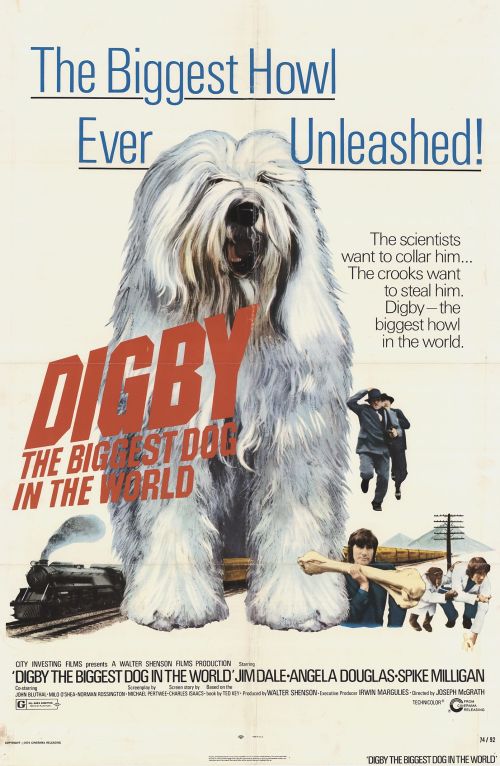
Digby: The Biggest Dog in the World (1973)

digby2

By Richard Winters

My Rating: 2 out of 10

4-Word Review: Dog grows really big.

Billy (Richard Beaumont) is a young boy who buys an Old English Sheepdog from a local dog home manager ( Victor Maddern). However, when he brings the dog home his grandfather (Edward Underdown) doesn’t want it in the house, so his mother (Angela Douglas) tells him to give the pet to someone else. He then leaves him at the home of Jeff (Jim Dale), a researcher who works at a defense lab that is experimenting in growth formulas. Jeff is smitten with Billy’s mother, but too shy to ask her out. He ultimately agrees to take the dog as an excuse to be around the mother more. Things though turn chaotic when Jeff decides to borrow some of the growth formula at his lab, in order to feed it to his tomato plants, but instead it gets accidentally given to the dog, who then grows to gigantic proportions.

This is the type of movie that’s clearly meant for kids, but kids today, with the advanced computerized special effects seen in modern films, will quickly be turned-off by the cheesy effects here. The attempt to make the dog seem bigger by placing him in a miniaturized kitchen doesn’t exactly work. Other segments where he’s seen outdoors and at a circus don’t work either because it’s obvious that the animal was simply put in front of a green screen. The segment that has Jeff sneaking the dog outside while having him wear an outfit meant for a horse is stupid too because a horse’s head is shaped differently than a dog’s, so there would be no way it would fit over the dog like it does.

The only inspired effect is when Billy crawls into the dog’s giant mouth in order to feed it a formula that will supposedly get the animal to shrink back to normal size. The recreation of the dog’s mouth to a large size is impressive though a dog’s tongue is thinner and longer than a person’s and yet the tongue in this mouth is styled much more like a human’s. Having the kid command the dog not to swallow, as if he did it would’ve sucked the boy down the throat, is dumb because swallowing is a natural reflex when liquid is poured in, so I’m not sure it could’ve been prevented, or that the dog would’ve understood what the command ‘don’t swallow’ would’ve even meant.

The story is based on the novel by Ted Key, who besides creating the comic strip ‘Hazel’ also wrote the screenplays for Gusabout a mule who kicks field goals, The Million Dollar Duckabout a duck who lays golden eggs, and The Cat from Outer SpaceThose movies fared a bit better as they were more imaginative and had better character development. Outside of a circus scene, which features an elderly and near-sighted knife thrower played by Bob Todd, there is nothing that is funny, or even slightly amusing.

A good story should have a protagonist that the audience can root for and and a clear antagonist that the audience hates, or at least fears. This film though doesn’t have that.  Jim Dale is a likable enough, but a scientist nerd who’s awkward around women is a tired stereotype that isn’t interesting. The kid had more appeal and could’ve easily been the hero without the Jeff character even being present. The supporting cast is essentially the same person; deluded, wacky folks who are lost in their own little worlds and clueless about what is really going-on. It’s okay to have one dumb character, but when everybody is goofy it gets tiring fast. There’s no bad guy either just a bunch of buffoons running around saying buffonish things and getting into cartoonish predicaments. If that’s your idea of entertainment then have-at-it, but most will find this to be a dated and silly though those that remember watching as a kid may for nostalgic purposes like it a bit more.

My Rating: 2 out of 10

Released: December 6, 1973

Runtime: 1 Hour 25 Minutes

Rated G

Director: Joseph McGrath

Studio: 20th Century Fox

Available: DVD (Region 2)

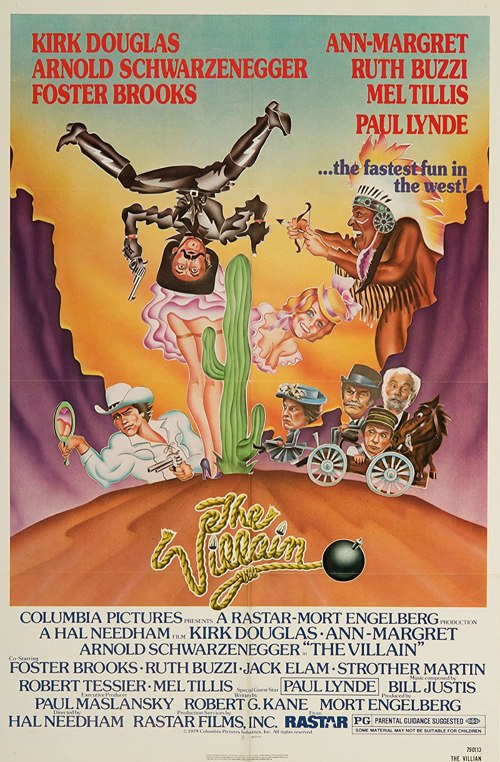
The Villain (1979)

villain

By Richard Winters

My Rating: 2 out of 10

4-Word Review: An inept western robber.

Cactus Jack (Kirk Douglas) is an aging western outlaw who’s hired by Avery Simpson (Jack Elam) to commit a robbery. Charming Jones (Ann-Margaret) is a beautiful, young woman who’s being escorted west by Handsome Stranger (Arnold Schwarzenegger) and is also carrying a large sum of money. Cactus Jack sets up an array of elaborate traps to try and rob them, but fails each time, so he enlists the help of a local Indian tribe headed by Nervous Elk (Paul Lynde) to assist him.

After the box office success of Smokey and the Bandit and Hooper executives at Columbia Pictures were apparently convinced that stunt man-turned-director Hal Needham could do no wrong and thus gave him a ton of money to direct a movie of his choice. Needham decided to do a send-up of the Road Runner cartoons, but as a live-action. The result though isn’t amusing, or lively with not enough stunt work and what you do see had already been shown many times before in other movies. The script by Robert G. Kane, who was a former joke writer for Dean Martin, is unimaginative and gets stuck in a one-dimensional gear where Cactus Jack continually tries to rob the two, but fails, which takes over 90-minutes to play-out while the old Road Runner cartoons where able to do it in less than 5.

There’s also quasi-surreal moments where Jack paints a tunnel opening onto the side of a mountain with black paint and yet Arnold and Ann are able to drive through it like it were a real tunnel. There’s another segment where Jack pours glue onto some train tracks, which Arnold and Ann are able to drive over without getting stuck while Jack does, but why? I realize this is supposed to be a silly movie and logic should not be demanded, but it just shows how lame it is where the director and writer do not challenge themselves to come-up with a clever way, that works within the realm of reality, for the protagonist to get out of their jam and instead lowers the bar to such an extent that they throw-out anything stupid and figure it will suffice.

Kirk for his part has a lot of fun. Some may feel he took it because his career was waning, but Needham had been the stunt coordinator on many of his movies back in the 60’s, so the two were friends and Douglas eagerly accepted the offer. At age 61 he looks great and did many of his own stunts, which is even more impressive, but no matter what the pratfall his character never gets injured. Despite the common belief many cartoons do at times show the antagonist like Wily E. Coyote getting banged-up and wearing bandages, bruises, and even walk with a crutch, so having Jack get that way and yet still determined to commit the crime would’ve been funnier.

Schwarzenegger is funny too simply for being this big, brawny guy who’s painfully naive though why someone would be walking around in the old west speaking with an Austrian accent needed to be questioned. Mel Tillis does mention at one point that he ‘talks funny’, but I felt that should’ve been a running joke where all the characters mention it when they meet him. It also would’ve been nice to have seen his character evolve and not remain so clueless by upping-the-ante with an exciting climactic battle/gunfight between he and Kirk at the end, which doesn’t happen.

Famous character actors like Strother Martin, Ruth Buzzi, and Foster Brooks are completely wasted. Mel Tillis does his stuttering routine (twice), which I’ve never found amusing though he also does the soundtrack and his singing is great. Initially I thought Ann-Margaret was miscast as she was too old for the part, but they make her look convincingly young and by the end I appreciated her presence.

The best by far is Paul Lynde as Indian Chief Nervous Elk, or as he says it N-e-e-e-e-rvous Elk. Today’s more sensitive audiences may not like a white guy playing a Native American, nor wearing an Indian styled head dress. I don’t know this for sure, but I suspect it’s the reason why the movie has never received an official studio DVD/Blu-ray release nor is it available on streaming, which is unfortunate. Yes, it’s political incorrect, but it’s done in such a goofy, campy way that it manages to become stupid funny and the only part that had me chuckling.

Everything else borders on being pathetic and all it succeeds at doing is getting you wanting to watch an actual cartoon, which will be far more sophisticated and entertaining than anything you’ll see here.

villain2

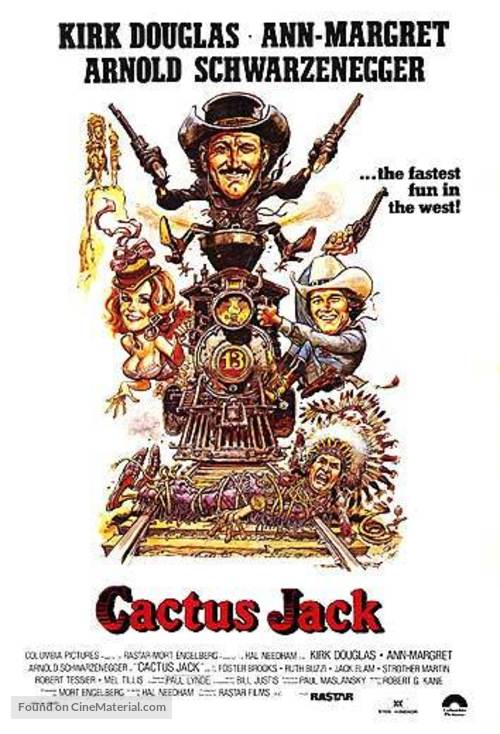
Alternate Title: Cactus Jack

My Rating: 2 out of 10

Released: July 20, 1979

Runtime: 1 Hour 29 Minutes

Rated PG

Director: Hal Needham

Studio: Columbia Pictures

Available: DVD-R

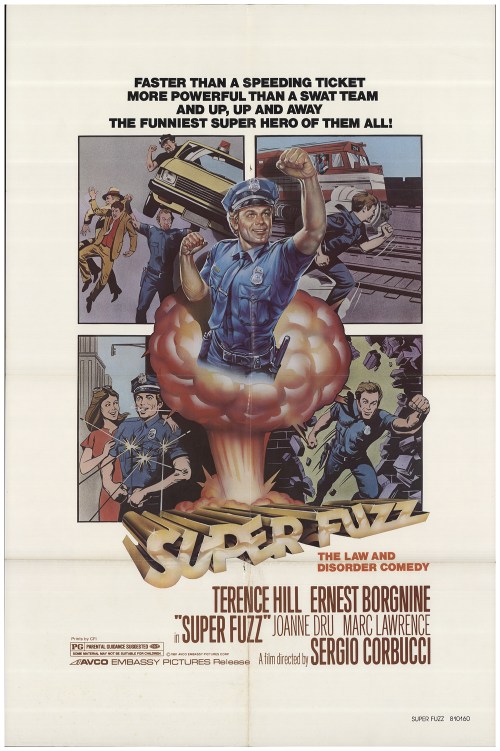
Super Fuzz (1980)

super fuzz1

By Richard Winters

My Rating: 2 out of 10

4-Word Review: Cop acquires super powers.

Dave (Terence Hill) is a newly hired policeman sent to do tasks non of the other officers want to do, which is why he’s given the assignment to deliver a speeding ticket to a remote Native American village deep within the Florida Everglades. Once he arrives he finds the place evacuated due to a secret nuclear missile test being done that he wasn’t aware of. When the bomb goes off and he becomes exposed to the radiation he begins to have various super powers including: super human strength, speed, telekinesis, psychic ability, and even hypnotism. He puts these new found abilities to use during his police work even though his partner, longtime cop Bill Dunlop (Ernest Borgnine), is skeptical about it at first. While the powers come in handy in their efforts to thwart a local counterfeit ring Dave soon realizes that there’s one hitch; if he sees the color red, which was the same color as the plutonium explosion, his powers will temporarily cease.

This was the third and final attempt to make Hill, who’s quite legendary in Italy especially in films where he teamed with Bud Spencer, into an American star. The first two attempts that he did here, Mr. Billion, March or Diewere flops and this effort, which was aimed solely at the kiddie crowd, wasn’t much better and its dismal failure both critically and financially sent Hill back to Europe permanently. Many adults who grow up in the 80’s will remember seeing it on Pay-TV where it was in heavy rotation. I recollect catching bits and pieces of it on Showtime, but the only thing that stood out for me was its cheesy soundtrack that had a chorus singing: ‘Super, Super, Sup-eee-rrr’ every time Dave did one of his tricks.

The film’s biggest downfall are the special effects that amounts to a lot of tacky, fast-action photography that can be seen in a wide assortment of other mindless low budget fare and is nothing special. There’s also just not enough trickery, too much dim witted dialogue, and lame humor in a plot that evolves too slowly to hold the interest of either a child or adult.

Having Dave acquire all these powers after being exposed to nuclear energy instead of getting terminal cancer like anyone else would makes no sense. The story would’ve been helped somewhat by reeling-in the powers aspect and giving him only one special ability instead of allowing him to do virtually anything making him almost like superman. Entering in more limitations than just the color red would’ve, if done right, brought in some tension and creativity, which is otherwise lacking.

While it’s sad in some ways to see a legendary, Academy Award winning star like Borgnine in such mindless tripe he is the best thing in it as he provides much needed energy, which help contrast Hill’s overly laid-back demeanor. Watching the tubby guy dance on top of a giant balloon, or try to dance with Joanne Dru is funny as are his overreactions, which would be considered cartoonish in any other movie, but here only helps to lift it up from its simplistic foundation. It’s also a great chance to see Dru, her first movie appearance in 15 years and also her last, ham it up as the villainous of which she’s pretty good.

The ending though, where Hill is somehow able from a tiny piece of gum to form this gigantic bubble is where the thing, which wasn’t floating too well to begin with, really sinks. How can Dave’s super powers get a piece of gum to expand far more than it should and since bubbles from bubble gum are very flimsy and can easily pop why doesn’t this one end up doing the same? You can also clearly see the seam of the sewn fabric on the bubble, which an actual bubble would never have.

While the movie was notoriously ridiculed by the critics at the time of its release, some critics today have taken more of a softer stance. Maybe it’s because they remember growing up watching it on TV, but feelings of nostalgia doesn’t make it any less stupid. This isn’t even good for kids who I believe are more discerning than adults think and will right away recognize the dated quality, tacky effects and won’t be impressed. 

Alternate Title: Super Snooper

My Rating: 2 out of 10

Released: September 18, 1980

Runtime: 1 Hour 37 Minutes

Rated PG

Director: Sergio Corbucci

Studio: AVCO Embassy Pictures

Available: DVD, Amazon Video

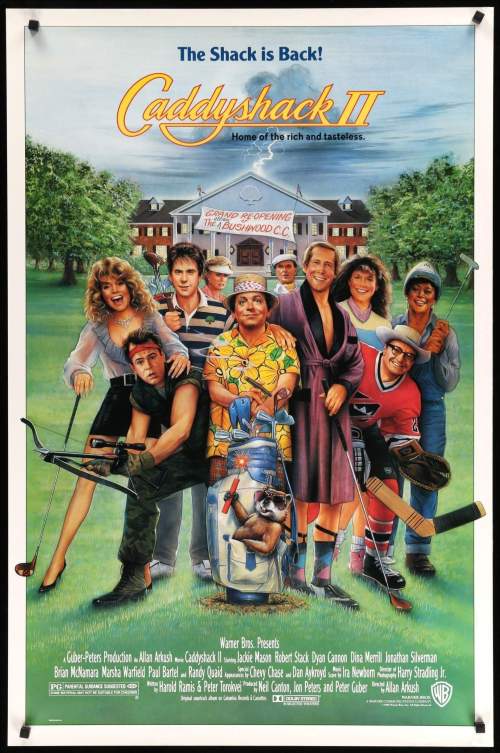
Caddyshack II (1988)

caddyshack2

By Richard Winters

My Rating: 1 out of 10

4-Word Review: A very bad sequel.

Kate (Jessica Lundy) is looking to fit-in with fashionable society by becoming friends with snooty Miffy (Chynna Phillips) whose parents (Robert Stack, Dina Merrill) run the affluent Bushwood Gold Club. Miffy tries to get Kate and Kate’s father Jack (Jackie Mason) to join the club. Kate, wanting to move-up the social ladder, convinces her father to send in an application and since Jack is financially well-off he’s quickly accepted. However, once Jack arrives his oafish personality and gaudy attire make him a turn-off to the other members. Miffy’s parents also don’t like him since he wants to build low income housing in their ritzy neighborhood. Jack is soon kicked-out of the club and told never to return, which causes Jack to buy the course and turn it into an amusement park and the only way Miffy’s family can win it back is if they challenge him to a golf game.

This is another sequel that had no business being made since the original had a perfect ending and no need for any continuation. Harold Ramis, who directed the first one and gets onscreen credit for co-writing this script, was not interested in making it, but eventually decided to dive in at the insistence of Rodney Dangerfield, who had figured prominently in the first film and wanted to take part in another one. Unfortunately Rodney became displeased with the quality of the scripts that were sent to him and eventually bowed out, which caused Ramis to leave the project as well. Bill Murray didn’t want to recreate his role and neither did Michael O’Keefe, while Ted Knight had already passed away leaving only Chevy Chase to return unless you count the gopher who figures more prominently here. Chase, who later regretted being in this, is the only funny thing about it, and seems for the most part to be ad-libbing his lines as it went along.

The biggest problem is that many of the performers add nothing to the story. This is especially true for Dyan Cannon, who at 50 looks great and would be considered these days as a ‘MILF’, but her character serves no other function other than to fall in love with Mason and appears only sporadically. Jonathan Silverman, who fills-in for the role played in the original by Michael O’Keefe, is barely seen and could’ve easily been cut-out. The normally reliable Dan Akroyd, who plays the part that Bill Murray would’ve, is wasted while speaking in a high-pitched voice that is more annoying than funny.

What I found most irritating is the presence of Robert Stack, who is stiff and pale and looking like an old guy with too much plastic surgery. Ted Knight, who played the role in the original at least had a colorful way of conveying his lines, but Stack speaks his lines like an over-rehearsed robot, which makes his presence quickly forgettable. I was also dismayed that he took over the antagonist role from Dina Merrill, as it initially seemed like she’d be the one to be Jackie Mason’s nemesis, which is a shame as a strong, powerful, yet ruthless woman going up against a putzy guy like Mason could’ve brought out some interesting dynamics that gets lost when it’s just between two aging men.

I was also confused why Randy Quaid is in this as he plays Mason’s obnoxious lawyer, but says things that Mason’s character could’ve easily said himself. I suppose in an attempt to make Mason more likable the writer’s decided to give the more edgy lines to Quaid, but the result is throwing in another character that really isn’t necessary. Apparently had Dangerfield agreed to be in it then his friend Sam Kinison would’ve played this role, who would’ve been better.

The film also fails to recreate the day-in-the-life feel of a country club, which is what had made the first one so engaging. In fact there are a lot of scenes that don’t even take place at the golf club. I also couldn’t stand how Mason renovated the place into a tacky miniature gold-like course, which seemed like a desecration and made me actually want Robert Stack to win the final match, so that he, even as much of a jerk that he and his wife were, could’ve turned the place back into a sensible looking golf course that it should’ve been.

My Rating: 1 out of 10

Released: July 22, 1988

Runtime: 1 Hour 38 Minutes

Rated PG

Director: Allan Arkush

Studio: Warner Brothers

Available: DVD, Hulu, Amazon Video, YouTube

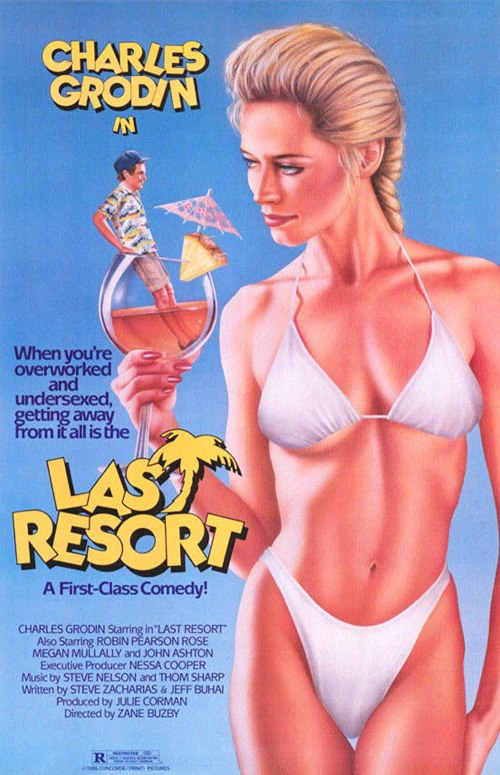
Last Resort (1986)

lastresort1

By Richard Winters

My Rating: 2 out of 10

4-Word Review: Family takes nightmarish vacation.

George (Charles Grodin) is a Chicago salesmen who loses a major client when he calls him fat, which in-turn costs him his job. Feeling the need to get away from the cold Chicago winter and reassess things he decides to take his family to a tropical island for some much needed r-and-r, but finds the place run by crazy people who house everybody in tiny little cabins. The island is also surrounded by a barbed wire fence due to a civil war going on, which soon has George stuck in the middle of it.

This film was directed by Zane Buzby, who appears here as a abusive summer camp counselor and who has since left the directing profession and devoted her life to brining aid to last surviving members of the Holocaust in Eastern Europe, which is a far better way to spend her time than making films like these, which isn’t funny and lacks any type of visual style. Much of the blame for this is the low budget, which makes the movie look cheap right from the start with its stock footage of a Chicago blizzard, the generic music score, and every indoor shot looking quite shadowy as if they weren’t able to afford enough spotlights to give it the properly lighted look. The island setting is bad too looking nothing like an actual island, but instead the brown, sun scorched landscape of a studio backlot.

The story is built around a lot of gags the majority of which aren’t funny, or even slightly original. The concept is the reverse of a National Lampoon’s Family Vacation where Chevy Chase plays the inept father who bungles everything while everyone else around him is normal. Here the father is the normal one and all the other people are nuts, but this doesn’t work as well as the folks behave in such an extremely absurd and obnoxious way that they have no bearing at all to real people and for satire to work it still needs to have some semblance to reality and this thing has none. It’s just insanity for the sake of goofiness with no point to it, which gets old fast.

I’m a big fan of Grodin, but his dry humored, deadpan observations are not put to good use and he ends up getting drowned out by all of the foolishness. I did though at least start to understand why Howard Stern always would accuse him of wearing a wig. To me I never thought he did wear one and Grodin, who disliked Stern immensely as he felt the shock-jock’s humor was too vulgar, would hotly dispute these accusations and even had one segment on his own short-lived talk show during the late 90’s where guests were allowed to tug on his hair just to prove it was natural and wouldn’t come off. However, here for whatever reason it really does appear like some rug plopped onto his skull that doesn’t even fit the dimensions of his head right.

Some of the supporting cast, which consists mainly of yet-to-be-famous, up-and-coming-stars does help a bit. This though does not include Megan Mullally, who plays Grodin’s daughter Jessica, who puts-on a high pitched, squeaky voice that I found really irritating. I did though find Jon Lovitz somewhat amusing as a bartender that can supposedly speak English, but can’t understand anything that Grodin says. Phil Hartman, wearing a blond wig, is a riot as a French gay guy named Jean-Michel who comes-onto Grodin, but my favorite was Mario Van Peebles as a flaming gay man who’s also one the tour guides. Some viewers may complain that his portrayal is too over-the-top and stereotypical, but it’s still campy fun especially at the end when he rips off his wig and suddenly turns into a macho guerrilla soldier freedom fighter.

My Rating: 2 out of 10

Released: May 9, 1986

Runtime: 1 Hour 24 Minutes

Rated R

Director: Zane Buzby

Studio: Concorde Pictures

Available: DVD, Amazon Video, Shout Factory TV, Pluto TV, Tubi

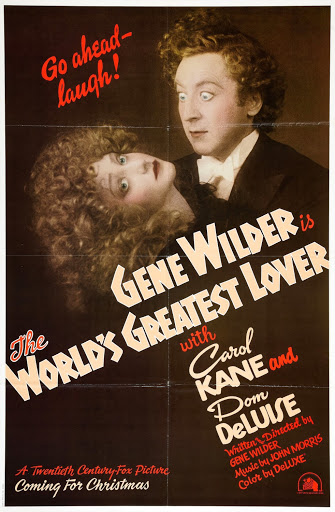
The World’s Greatest Lover (1977)

By Richard Winters

My Rating: 7 out of 10

4-Word Review: Seeking silent film stardom.

Adolph Zitz (Dom DeLuise) is upset that Rainbow Studios, which he heads, is not making as much of a profit as his rival and figures it’s because they don’t have silent film star Rudolph Valentino. He decides, after a meeting with his yes men who constantly surround him, to put out a national search for the world’s greatest lover who will come to Hollywood for a screen test to then become the next big star to rival that of Valentino. Rudy (Gene Wilder) is a hapless baker recently fired from his job who figures that entering this contest could be his ticket out of his penniless doldrums and travels to Hollywood for a screen test. However, once they get there his wife (Carol Kane) breaks away from him and sneaks off to the rival studio in order to try and have a chance encounter with her screen idol Rudolph Valentino (Matt Collins).

While the film did well at the box office bringing in a profit of $21 million off of a $4.8 million budget it flopped badly with the critics who ravaged both Wilder’s screenplay and direction. In a lot of ways they had valid points as the script veers off from the main theme quite a bit and seeming more like a collection of broad gags than a story. The comic bits take a long time to play out becoming almost like skits within a movie. The period atmosphere is poor and you never feel like you’re being transported back to a different era, or that there was even much thought or effort in this area to be authentic. Wilder’s character is problematic too. He can be great when he’s in an exasperated, frantic state and shouting at the top of his lungs, but he goes to this well too often making his character come-off as abrasive.

The one thing that saves it is that it’s surprisingly quite funny. I found myself laugh- out-out-loud at a lot of the bits no matter how meandering they became and really enjoyed the reaction shots from the supporting players. My favorite segment is when Wilder and Kane stay at a hotel with a sunken living room, which accidently gets filled up with water and then Wilder goes swimming in it and pretends it’s a pool when some family members of his come to visit. I also liked how it ultimately drains out onto some guests below who are ordering dinner. I even found the running joke dealing with DeLuise and his man servant barber (played by Michael Huddleston the son of character actor David Huddleston who also appears in the movie) and how he eventually learns to trust his business advice after always beating him up about it first.

The film manages to also make some interesting observations about people although this too borders a bit on getting botched particularly the scene where Kane goes into a tent to meet with what she thinks is Valentino, but really Wilder wearing a veil over the bottom of his face. However, it is clear to the audience just by looking at his eyes, which are very distinct, that it’s Wilder, so if it’s obvious to us it should be obvious to her since she’s been living with him for many years, but it isn’t. I did do like the point that the scene makes where she never enjoyed the sex with her hubby, but when she thought her hubby was somebody else suddenly the sex was ‘great’, which shows how much fantasy works into love making and a fundamental part of its enjoyment.

Wilder’s screen tests are quite amusing too and overall I found myself laughing consistently all the way through. If you’re looking for something light and comical that’s even a bit romantic then this should do the trick.

My Rating: 7 out of 10

Released: December 16, 1977

Runtime: 1 Hour 29 Minutes

Rated PG

Director: Gene Wilder

Studio: 20th Century Fox

Available: DVD

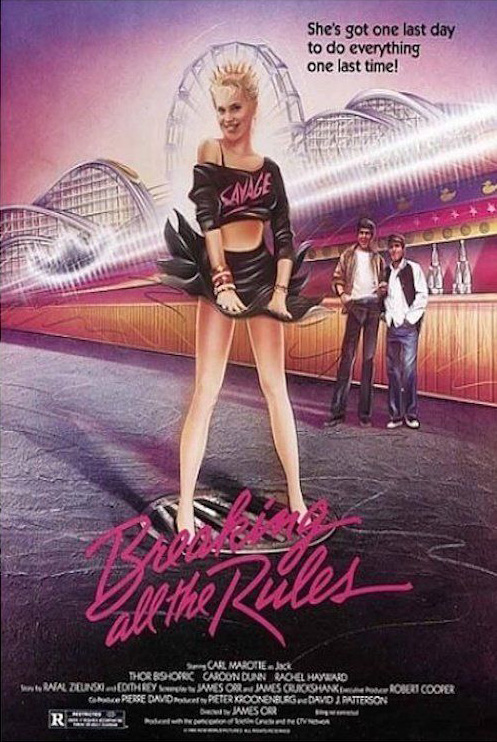
Breaking All the Rules (1985)

By Richard Winters

My Rating: 2 out of 10

4-Word Review: Shenanigans at amusement park.

It’s the last day of summer and Jack (Carl Marotte) plans to spend it a an amusement park with his friend David (Thor Bishopric). On the bus ride there they are spotted by Debbie (Carolyn Dunn) and Angie (Rachel Hayward) two best friends who immediately take a liking to the boys. The teen foursome then spend a romantic, even sexy time, at the park, but are unaware that three criminals (Michael Rudder, Pierre-Andre LaRoque, Papusha Demitro) have stolen a diamond and hidden it inside one of the stuffed animals inside the park. When Debbie inadvertently receives the stuffed animal as a prize the crooks stalk the four in order to get the diamond back.

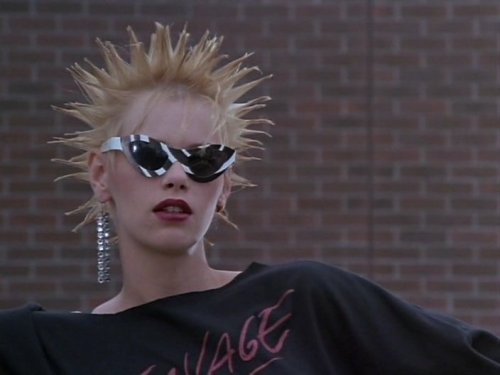
The best thing about the film is Carolyn Dunn, who retired from acting in 2009 and now works as a holistic therapist, and who is drop dead gorgeous especially at the start when she has a normal hairstyle, but even after she gets the ill-advised punk look she’s still a super hottie, which if you’re a male at least, should be good enough to get you through the rest of the pic, which doesn’t have much else going for it. Of course it’s Dunn’s extreme beauty that in some ways actually hurts it since she immediately falls for the very average looking Jack at first glance, which made no sense. This is the type of chick that would have guys flocking all around her and the privilege of choosing the pick-of-the-litter, so why go ga-ga over a dweeb? If dweebs are her thing then fine, but that’s something that needs to be established right up front, but isn’t, so seeing the immediate sparks fly as they do is not believable.

Angie’s romance with David is equally problematic as Angie is almost as hot as Debbie, so why is she falling for a kid that looks like he hasn’t even reached puberty? Seeing them stand side-by-side makes their physical differences even more apparent as Angie looks like she could be 20 and more David’s babysitter than his girlfriend. Had the film cast average looking women that weren’t used to getting a lot of attention from guys and therefore accepting of any dope that came along then it would’ve been more realistic, or simply hired better looking male talent to match the looks of the females.

While I did find the Jack character to be initially amusing, which includes a fantasy segment that he has near the start that is probably the only real funny moment in the movie, he does become increasingly problematic as it goes along especially for modern audiences. Some of the comments he makes, while considered possibly innocuous at the time, will be perceived as controversial today including when he says ‘when a woman says no she really means yes’ or when he states that a women is ‘just dying to get laid’ simply based off of what she’s wearing. There is also a segment where he goes on a rollercoaster ride with Angie and takes advantage of her frightened state by putting his hands underneath her dress and groping her breasts without her permission.

Even if you can get past these issues the plot itself is dumb. The three crooks look like they’re almost the same age as the four teens and older actors should’ve been cast in the bad guy roles simply to give the film a better balance. The crooks also play-off of a mafia-like stereotype complete with affected accents, which is cliched and not funny.

The logic is flimsy too including having Jack become the prime suspect of the stolen diamond simply because his fingerprints were found on the glass case that housed it, but he had been employed part-time at the amusement park, so it would’ve been expected that his prints might’ve innocuously gotten on it when he worked there. The script also shows little understanding between the differences of love and lust. For instance Jack says he ‘fell in-love’ with Debbie the second he saw her, but in reality he just got highly aroused at seeing her half-exposed ass when the wind lifted up her skirt.

I didn’t understand how the film’s title worked into the storyline either. There’s no rule-breaking going on particularly from the four leads who are all boringly transparent and not rebellious at all.

My Rating: 2 out of 10

Released: April 15, 1985

Runtime: 1 Hour 31 Minutes

Rated R

Director: James Orr

Studio: New World Pictures

Available: DVD

The Toy (1982)

By Richard Winters

My Rating: 1 out of 10

4-Word Review: Becoming a child’s pawn.

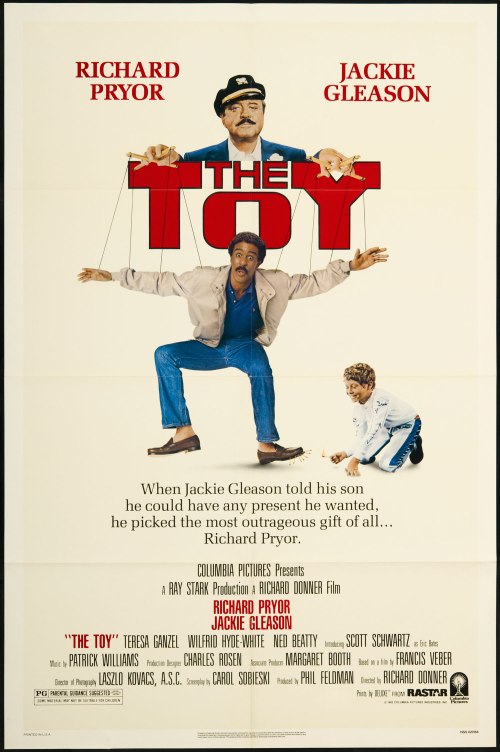
Jack Brown (Richard Pryor) is unable to find stable employment and at risk of being evicted from his home. In desperation he takes a job as a night janitor at a local toy store. It is there that he gets spotted by Eric (Scott Schwartz) the young son of business mogul Ulysses (Jackie Gleason). Eric is used to getting what he wants so when Jack inadvertently makes him laugh he decides to ‘buy’ him and turn him into his own personal ‘toy’. Jack is initially reluctant to agree to this, but when he’s offered a lot of money he eventually goes along with it. Initially the relationship between the two is quite awkward, but eventually they form a bond and Jack manages to teach Eric many important life lessons while also getting Eric’s father to realize that money can’t buy a son’s love.

When compared to the original French version this thing is painful to watch. Much of the problem stems around the fact that the satirical point-of-view from the first one gets watered down here. The French film took a lot of calculated potshots at capitalism and corporate hierarchy, but apparently Hollywood was afraid they’d be considered ‘unamerican’ if they took that route, so instead of sharp humorous insights we get tired formula dealing with a rich kid trying desperately to get his father’s attention whose selfish personality needs fixing.

Because the message is so muddled it becomes confusing what point it wants to take, so to make up for it,  they throw in all sorts of cringey life lessons crap like Pryor teaching Eric about the importance of friendship and even a a bit about ‘the-bird’s-and-the-bees’. After awhile it doesn’t seem like a comedy at all, but more like a tacky after school special your parents made you watch when you were in the third grade.

The humor that does get thrown-in gets equally botched. In the French version every comic bit that occurred fit into the film’s main them. Here though any gag that has the potential of getting a cheap laugh gets used whether it actually works with the main story or not. Many of which are tired, overused gags where you already know what the payoff will be before the set-up barely gets going.

Pryor’s casting was a bit controversial at the time due to him being black and then used as a ‘servant’ to a white kid, but the truth is Pryor is the only thing that saves it. He’s not exactly hilarious here, but his onscreen charisma is enough to at least keep it engaging. Gleason on the other hand, who was already in his mid-60’s at the time, seemed too old for the part although with the use of a wig he manages to camouflage it pretty well.

Schwartz, who is better known as the kid who gets his tongue frozen to a flagpole in A Christmas Story, and for his later career in adult movies, is annoying. In the French film I liked the kid, but the child character here is poorly fleshed-out having him go back-and-forth in irritating fashion from spoiled brat to emotionally needy tyke.

Ned Beatty makes the most of his small role, keeping his scenes funny when they could’ve easily been overlooked. Elderly character actor Wilford Hyde-White is amusing too and so is Teresa Ganzel as Gleason’s busty girlfriend, but virtually everything else falls flat. This includes an unnecessary side-story involving the Klu Klux Klan, which was not in the original film, and just extends this already excessive mess far longer than it needed to be.

My Rating: 1 out of 10

Released: December 10, 1982

Runtime: 1 Hour 42 Minutes

Rated PG

Director: Richard Donner

Studio: Columbia Pictures

Available: DVD, Blu-ray, Amazon Video, YouTube