Category Archives: Drama

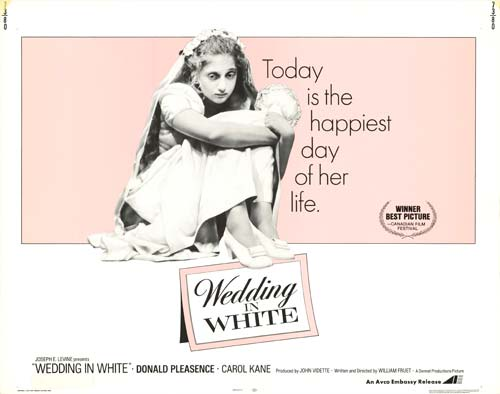
Wedding in White (1972)

wedding in white 1

By Richard Winters

My Rating: 8 out of 10

4-Word Review: Ending is a kicker.

Jeannie (Carol Kane) is a shy 16-year-old girl living in a small, bleak Canadian town just after the war who is raped by her older brother’s army buddy. Her parents (Donald Pleasance, Doris Petrie) respond as if it is her fault and resort to some extreme even shocking measures in order to ‘save the family honor’.

This is a solid little drama with good scene construction. The pacing is deliberate and an ending that really packs a wallop. The sets and location look authentic for the period and the characters are believable. Jeannie’s friend Sara (Christine Thomas) seems like a very typical teenager no matter what time period and her interactions with Jeannie show the realities of teenage friendships and makes for an interesting sidelight from the main story.

Kane is impressive acting in a style I’ve never seen from her before. Pleasance is solid as usual and his Canadian accent sounds almost authentic, but it is a bit overdone. Petrie is also quite good as the mother. She really brings to surface a character that is so cloistered she is unable to make any clear decision for herself.

The story itself is the real strong point. It is convincing, insightful, and well-crafted and brings out a sort of darkness and ‘evil’ that can come from ‘wholesome small towns’ and ‘God fearing people’. It shows how having a rigid morality can sometimes create a sort of immorality and also brings to light the lies people wish to live by and how at times it can cloud their better judgment, but most of all it’s a study at  how easily sensitive, fragile people can get sucked away and how sadly common it is.

This is a film designed to leave you feeling shocked, angered, saddened, and maybe even a little repulsed. This is quality viewing that deserves more attention.

My Rating: 8 out of 10

Released: October 20, 1972

Runtime: 1Hour 43Minutes

Rated R

Director: William Fruet

Studio: Cinepix

Available: DVD

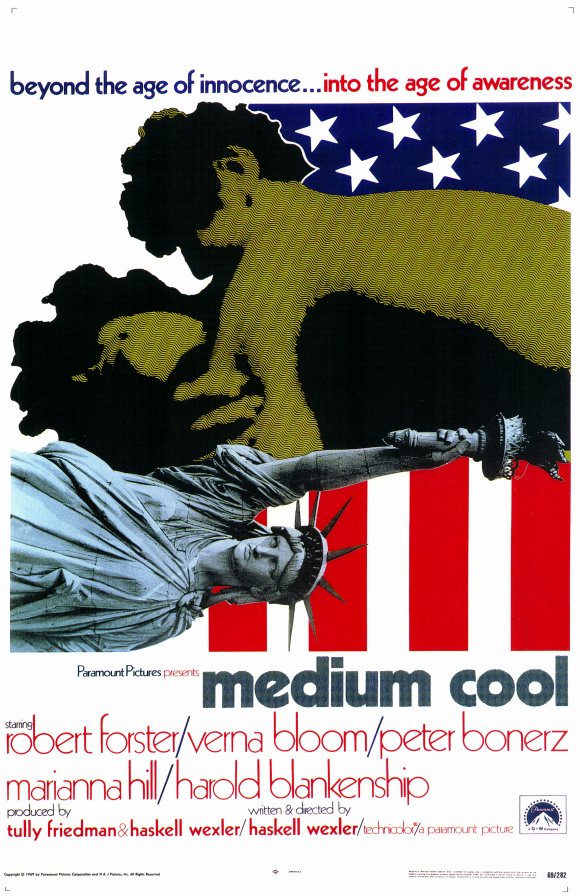
Medium Cool (1969)

medium cool 1

By Richard Winters

My Rating: 9 out of 10

4-Word Review: The 60’s up close.

If you ever wanted to travel back in time and take part in the events of the tumultuous 60’s this film comes about as close to that as you can get. Watching this isn’t like viewing a movie, but more like an experience in itself. Acclaimed cinematographer Haskell Wexler who had previously worked in the documentary field heard that demonstrators were going to march at the 1968 Democratic convention in Chicago so he decided to hire a few actors and throw them into the fray while building a thin plot around it and creating a pseudo-reality effect. The story deals with news cameraman John Cassellis (Robert Forster) who meets and starts to date Eileen (Verna Bloom) who has just moved to Chicago from West Virginia with her 11-year-old son Harold (Harold Blankenship). As the convention and protests begin and John begins to cover it Harold runs away from home and Eileen goes into all the chaos to find him.

The scenes from the riots leave a major impact and even though I had already seen this film several times before I was amazed at how compelling it still was. Everything still seemed fresh with a clarity that makes you feel you are right there and a vividness that seems like it was filmed just yesterday. Watching the National Guard with their rifles raised marching down the streets of Chicago threatening crowds of people is incredible as is the sight of army tanks rolling down Michigan Avenue.  The people in the crowds are not actors and you see them getting clubbed by the police only a few feet from the camera. Watching them take the park benches in Grant Park and use them to build a shield from the police is exciting as are actual sound bites of reporters describing the action and at certain points being roughed up by the patrol as well. The look of fear and confusion on Bloom’s face at what she finds herself in the middle of it is authentic and helps build the tension.

Of course these scenes only make up the final fifteen minutes of the film, but the movie is filled with a variety of other unique moments that are all captured with the same vivid style and are equally memorable. The part where John and Eileen go to a roller derby and watch actual female players beat each other up with some even using their fists gets quite vicious. The scene showing hundreds of caged pigeons being set free and flying off in a giant flock that fills the sky is eloquent. There is even some effective erotica as a naked John chases his naked girlfriend Ruth (Marianna Hill) around his apartment before lifting her up by her legs and spinning her around in a circle.

The film also takes a great critical look at television news and the people who cover it. It shows how reporters and cameramen are very detached from the events and people that they are covering and how their need to capture that ‘great’ image or sound bite supersedes the human element.

Forster is perfect for the lead role. I loved his aggressive, blue collar, tough-guy attitude that perfectly reflects the Windy City. Peter Bonerz who plays Gus his sound man is great, but in the opposite way. His character is much more timid and wants to avoid confrontation at every turn and finds it difficult dealing with some black people who make him feel uncomfortable when he visits their apartment and even some young children when they start to climb on his car.

The only negative is that the song ‘Merry-Go-Round’ by Wild Man Fischer is not included in the most recent Criterion Collection DVD/Blu-ray release. The song was in the original release shown in theaters as well as the film’s first VHS version, which I saw. Unfortunately the song’s copyright holders sued Paramount stating that a VHS/DVD release is not the same as a theatrical/television broadcast, which they were under contract for to use and therefore could not include it in any later reissues, which is a real shame. The song has to be one of the strangest things you will ever hear and done by an eccentric one-of-a-kind artist. It has a weird alluring quality to it that gives personality and an extra edge to the film and in later versions gets replaced with ‘Sweet Georgia Brown’ better known as the theme for The Harlem Globetrotters, which is just not as effective.

My Rating: 9 out of 10

Released: August 27, 1969

Runtime: 1Hour 11Minutes

Rated R

Director: Haskell Wexler

Studio: Paramount

Available: VHS, DVD, Blu-ray (The Criterion Collection)

The Fool Killer (1965)

fool killer

By Richard Winters

My Rating: 6 out of 10

4-Word Review: Kid roams the countryside.

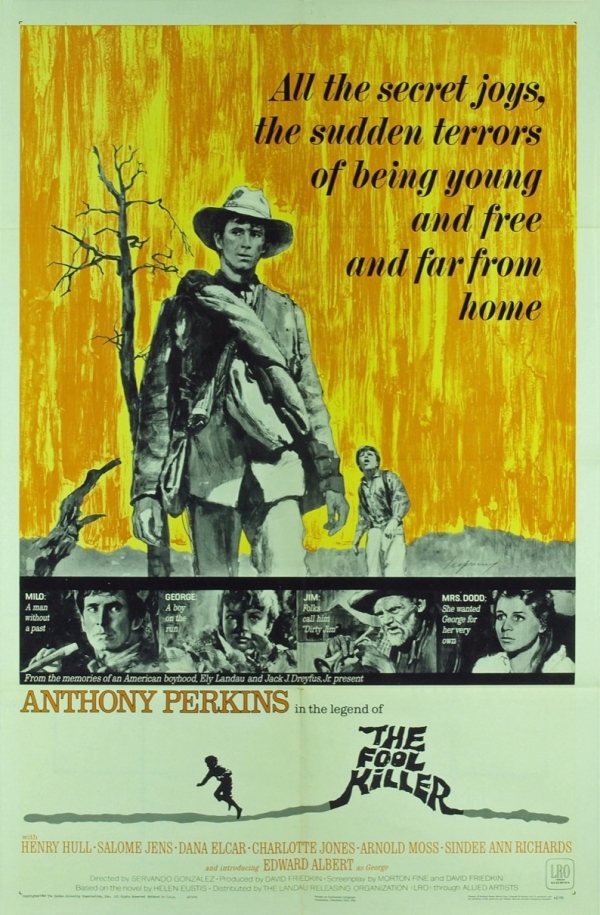
George Mellish (Edward Albert) is a 12-year-old boy who runs away from home after a particularly harsh beating at the hands of his foster parents. As he roams the Tennessee countryside he meets Dirty Jim (Henry Hull) an old man who takes him into his rundown home and fills his head with all sorts of stories about an eight foot ax-wielding man who kills people he deems to be foolish. After a bout of illness George runs away from Jim and late one night meets Milo (Anthony Perkins) a loner who carries an ax and acts strangely. Initially George thinks that he is ‘the fool killer’ Jim described, but the two soon become friends even though strange ax murders begin to occur everywhere they go.

Servando Gonzalez’s direction is excellent and the one thing that keeps this otherwise thin story intriguing. This was his only English language film and he uses a variety of different camera angles and editing styles to create a sort of hypnotic effect. The on-location shooting is vivid and their ability to recreate the look and feel of the late 1800’s is solid including having the characters occasionally speak with poor grammar, which helps with the authenticity.

The only thing about Gonzalez’s direction that I did not like is where they have a nighttime scene that was clearly filmed in the daytime, but done with a darkened lens to ‘fool’ the viewer into thinking it is night. This process has been done many times in the past, but it never works. Even with the dark lens the sky is too bright and you are unable to see any stars. I remember this done a few times on the old ‘Brady Bunch’ TV-show and I always found it disconcerting. The reason is usually because by law child performers are not allowed to work past a certain late hour, so if the script calls for a nighttime scene they try to compensate using this trick, but it always looks tacky. My solution would be to get the parent’s permission to allow the young performer to work late for one night or alter the script to have the scene done in the daytime.

Despite some good production values and an interesting narrative the story itself, based on a novel by Helen Eustis, is limp and doesn’t have enough action. The middle section, which features a lot of conversations between Milo and George, gets boring and the pace comes to a screeching halt. The George character also gets a bit annoying. I realize he is a young and the story takes place in a more innocent era, but the kid falls too easily for anything and everything he is told and seems to have no center, which eventually becomes off-putting.

For what it is worth Albert is good in the lead in what was his film debut and so is Perkins although with this he was risking getting typecast. I thought Henry Hull in one of his last roles was highly engaging and I also really liked Arnold Moss as a bombastic preacher giving a fiery sermon under a tent during a religious revival. Since the movie otherwise does not have much happening this scene tends to be pretty electrifying and vivid particularly the looks on the people’s faces as he preaches to them.

There is a sort-of surprise ending, but it is not that big of a deal and most viewers will probably see it coming long before it happens and they might also say to themselves ‘I sat through two hours of this just for that!’ as well. If the story had been a little richer with more twists or a subplot this might have been memorable, but as it is the final result is empty.

My Rating: 6 out of 10

Released: April 28, 1965

Runtime: 1Hour 39Minutes

Not Rated

Director: Servando Gonzalez

Studio: Allied Artists Pictures

Available: VHS

King of the Gypsies (1978)

king of the gypsies

By Richard Winters

My Rating: 5 out of 10

4-Word Review: Daddy is a psycho

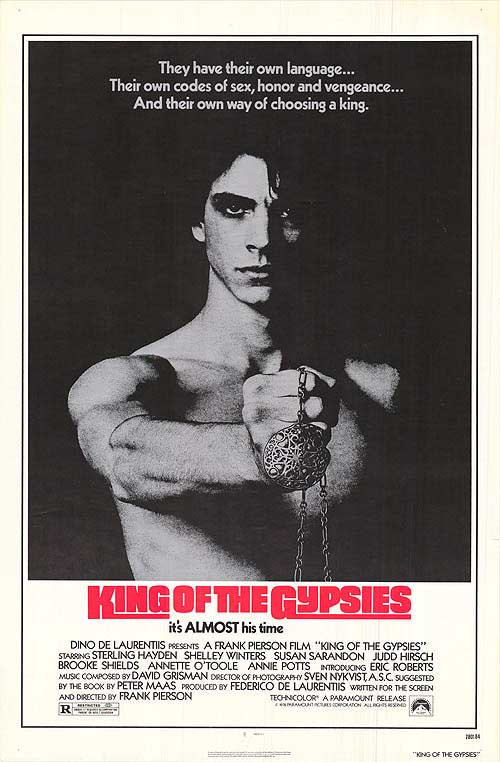
Dave (Eric Roberts) is the rebellious son of Groffo (Jud Hirsch) who no longer wants to be a part of the gypsy clan that he was raised in and instead a part of the American dream. However, when Dave’s grandfather Zharko (Sterling Hayden) lies dying in his hospital bed he gives the coveted medallion to Dave making him the new king of the gypsies. This sends Groffo into a jealous rage and orders two men to go out and kill Dave who now must elude them while trying to get his life together and help get his younger sister Tita (Brooke Shields) out of the clan as well.

Although far from being a complete success the film does manage to have a few unique and even memorable moments. The best is when a young Dave is used as a decoy in an attempt to rob a jewelry store. His mother Rose (Susan Sarandon) pretends to be a customer looking over some diamonds. When Dave creates a ruckus she tries to calm him down by having him drink a glass of water while also having him swallow a diamond that she has discreetly lifted from the display table. They are then able to walk out of the store when the merchants are unable to prove that they stole it only to have Rose later retrieve the jewel when Dave poops it out. Having Groffo put a 10-year-old Dave behind a wheel of a car and drive it down a busy Brooklyn Street is about as nerve-wracking as any car chase I’ve seen. The scene where Groffo tries to physically force Dave to have sex with his own mother is also incredibly startling.

However, despite these few interesting moments the film overall never really gels. The first half showing how the gypsy people live seems a bit clichéd and the way they openly cheat other people in order to make a living makes them unlikable and uninteresting. The only time it ever gets half way compelling is when it shows Dave struggling to survive on the mean streets of New York after he runs away from his psychotic father. Unfortunately this gets ruined when it constantly brings his family and past coming back to haunt him. The cat and mouse game that he plays with his father is not original and Hirsch makes for a very boring villain. He is unable to convey a menacing quality and thus there is never any real tension. The violin soundtrack compliments the gypsy tradition, but eventually becomes annoying.

Roberts is solid in his film debut. His voice-over narration coupled with his raw delivery is effective. Had the film focused solely on him and left out the silly gypsy sub-plot it would have worked much better.

Sarandon gives it some energy and she has the most effective accent. Shields is pretty much wasted and appears in only a handful of scenes. The biggest irony here is that the two played a mother and daughter before in Pretty Baby, which came out just 7 months before this one.

Hayden really seems to be having fun as the bombastic self-proclaimed King Gypsy. Watching him feud at the beginning with Michael V. Gazzo who plays the head of another gypsy clan is somewhat diverting. It is also interesting to see Shelly Winters in a part that has less than three speaking lines. This woman never seemed to ever want to shut up both on-screen and in interviews, so seeing her in a part that allows for so little dialogue is quite a novelty, but she still succeeds with it particularly in the part where she grieves over her dead family members.

It is fun to see a young Danielle Brisebois as well as Matthew Labyoreaux who later went on to play Albert in ‘Little House on the Prairie’. Annie Potts is good in a brief part and Patti LuPone makes her film debut in an uncredited bit.

My Rating: 5 out of 10

Released: December 20, 1978

Runtime: 1Hour 52Minutes

Rated R

Director: Frank Pierson

Studio: Paramount

Available: VHS, DVD, Amazon Instant Video

A Child is Waiting (1963)

a child is waiting

By Richard Winters

My Rating: 7 out of 10

4-Word Review: Help for retarded children.

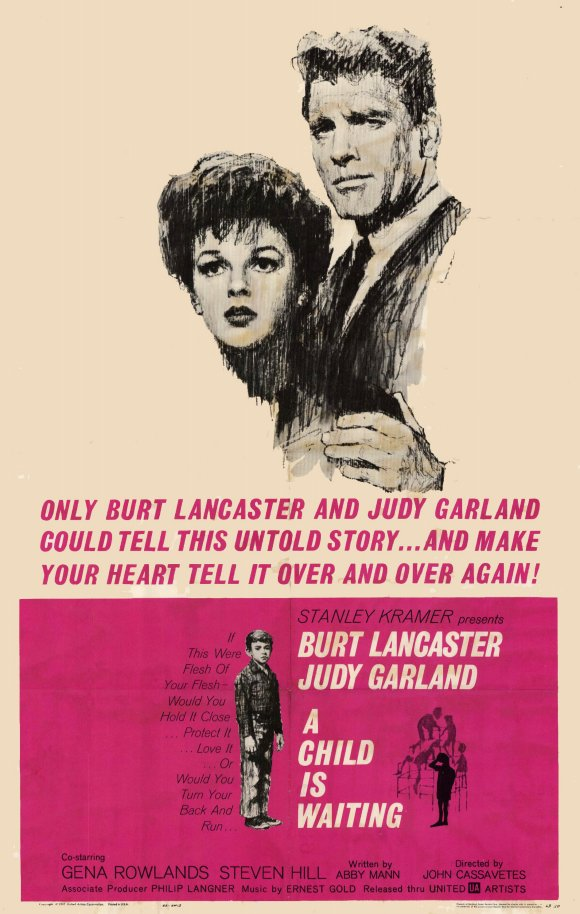
Jean Hanson (Judy Garland) is a woman looking for direction in her life. She takes a job with Dr. Matthew Clark (Burt Lancaster) who runs a school for children with mental handicaps. She finds the work to be more taxing than expected, but also forms a strong attachment to one of the boys named Reuben Widdicombe (Bruce Ritchey).  Dr. Clark notices this bonding and considers it to be a potential problem so his has Jean moved to another building, which causes Reuben to become very upset and displays his anger in all sorts of anti-social ways.

This film is raw and compelling and offering a refreshingly vivid non-sanitized look into work with the mentally handicapped. Director John Cassavetes and screenwriter Abby Mann take off all of the Hollywood gloss and shows things in a real and uncompromising way. The majority of the children are disabled and not actors. Their responses and behaviors are genuine. Some of the best moments are when Cassavetes turns on the camera and then just let things happen particularly when Garland and Lancaster visit a hospital for mentally handicapped adults as well as when they put on a play celebrating Thanksgiving with the children as the performers.

The film is tastefully done and avoids showing some of the cruelties people with these disabilities go through and instead only talks about them lightly. What I really liked though was that it shows things from the adult perspective particularly those of the parents and the difficult adjustment they have as well as the array of emotions. The meeting between a group of doctors discussing which schools for which handicapped children should be given more money and which one of them had a better potential to being more self-sufficient was equally interesting. The movie also makes great use of silence to help propel the emotion and thankfully keeps the music to a minimum.

Garland was a good choice simply for her perpetual look of concern on her face, which remains throughout. However, she has a very worn and haggard appearance and looking much older than the forty years that she was and by looking at her here it should come as no surprise that a mere seven years after filming this she would be dead.

Lancaster is splendid and this may be one of his best roles of his already illustrious career. His soothing and calm voice is perfect for the part and his best moment comes when he patiently tries to teach the children how to correctly annunciate certain words.

Ritchey is good as the child and has a face that is very cute and full of expression. However, he seems to suffer from a severe speech impediment that makes it difficult to understand what he is saying. I wasn’t sure if he suffered from this in real-life, or it was just done for the part, but since he never appeared in any other film role makes me believe that he did.

Steven Hill is also superb playing Reuben’s father a man who turned his back on his son and virtually abandoned him when he was diagnosed as being mentally handicapped only to at the very end have a change of heart.

My Rating: 7 out of 10

Released: January 14, 1963

Runtime: 1Hour 42Minutes

Not Rated

Director: John Cassavetes

Studio: United Artists

Available: VHS

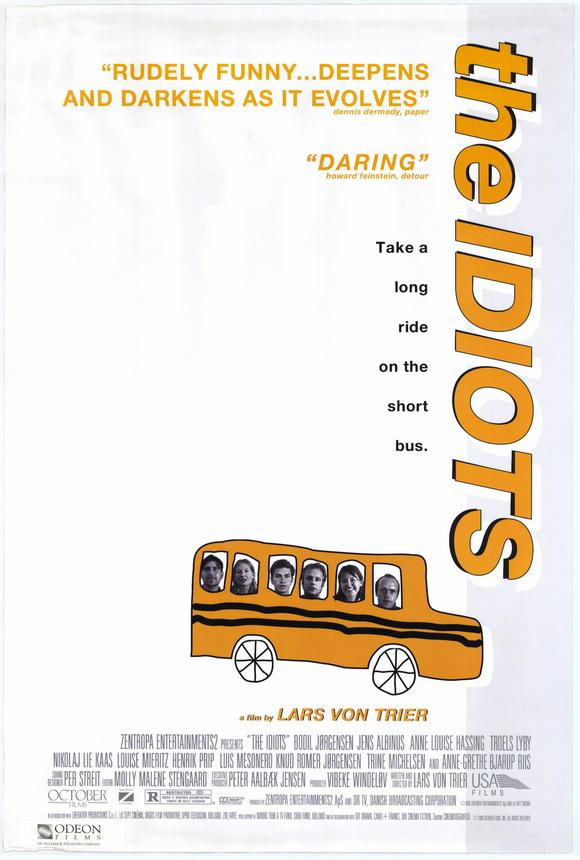
The Idiots (1998)

the idiots 2

By Richard Winters 

My Rating: 7 out of 10

4-Word Review: This is so retarded.

The Idiots is another shocking, controversial, and highly original work from filmmaking maverick Lars Von Trier.  This one involves a group of disenchanted people in their 20’s and 30’s, who decided to rebel from society by acting like they are mentally retarded.

Although certainly not in the best of taste, there are some funny bits here. The comedy works well because amidst all of the outrageousness it is also very revealing about human nature. One of the best segments involves an affluent couple who wish to purchase a large, upscale home.  As they are touring the place they are informed that a group of ‘retards’ live next door. The couple put on the politically correct facade by saying that wouldn’t be a problem even though their facial expressions say otherwise.  When the group pretending to be retarded pays them a visit the couple quickly runs off.  Another funny part, which may actually be the most outlandish of the whole film, involves a group of tough, tattooed bikers who help in very graphic fashion one of the group members pretending to be mentally handicapped go to the bathroom. The group’s visit to a factory is also hilarious.

The majority of the film though is actually quite serious and yes, even thought provoking. Von Trier does a good job of analyzing things from different angles while supplying no easy answers. It was interesting how the group mocks society for all of their rules and customs and yet when one of their own members starts to act erratic they tie him to a bed and refuse to free him until he ‘settles down’, thus proving that even they themselves need certain rules of behavior in order to function even if they don’t want to admit it.  Some other strong dramatic scenes involve the father of one of the members who tries taking his daughter from the group and back home with him.  There is also a revealing segment involving one of the members who decides to ‘drop back into society’ and return to his job as a college professor despite the protests from the other members.  The group also comes into direct contact with people who are actually mentally handicapped and how each of them responds to this is fascinating.

The characters are nicely fleshed out.  All of them show distinct personalities and evolve in interesting ways as the film progresses. Karen (Bodil Jorgenson) acts as they catalyst.  She comes upon the group by chance and acts as a sort of ‘conscience’ for the film.  Initially she is shocked and confused by the group’s behavior, but because she is stuck in an unhappy relationship and grieving the recent death of her son, she decides to tag along. Eventually she starts to see the benefits of ‘spassing out’ which is the group’s term for ‘finding your inner idiot’.

I liked how the film challenges the concept of true rebellion and shows how complex the fabric of society really is. Everyone would like to ‘drop-out’ at certain times and there is even a need for it, but finding the right place can be complicated. I have often felt that the true nonconformist is either living on the streets, is in prison, or a mental institution and the film pretty much comes to this same conclusion, but without advocating ‘fitting-in’ with the establishment as the answer either.

My complaints for the film centers mainly on the over use of the hand-held camera, which tends to get distracting after a while and gives the film a needless amateurish feel. I know with Von Trier’s ‘Dogma 95′ manifesto the hand-held camera is a major factor, but I think he could back off a little with it. There is also a ‘gross-out’ segment at the end where the group member’s start to drool out their chewed up food, which I found completely disgusting especially the way the camera captures it in close-up. The pacing is pretty good, but it does drag a little at times and I felt the film went on about twenty-five minutes too long.

Obviously this is a film that will not appeal to everyone and in fact I would say that the majority of people may find it off-putting.  That doesn’t mean it is a bad film because I think it is a pretty good one and I liked it overall.  However, what makes it a good film is the fact that it works off of its own vision and makes no compromises in doing so.  For most viewers especially American audiences who are used to a ‘mass-appeal’ approach to film-making, this type of concept may not connect. 

the idiots 3

My Rating: 8 out of 10

Released: May 20, 1998

Runtime: 1Hour 57Minutes

Rated R

Director: Lars Von Trier

Studio: Zentropa Entertainments

Available: VHS, DVD

The Morning After (1986)

the morning after

By Richard Winters

My Rating: 5 out of 10

4-Word Review: She can’t remember anything.

Alex (Jane Fonda) is an out of work actress and alcoholic who is prone to black outs. One morning she wakes up to the find that the man lying beside her has been murdered. She isn’t sure if she did it or not as she can’t remember anything. She cleans up the place and then by chance meets Turner (Jeff Bridges) a former cop who tries to help her prove her innocence.

Starting out right away with her waking up to find the dead body doesn’t work. Some background to the character would have been better as without it the viewer doesn’t particularly care about the character’s predicament. It took me a long while before I could get into it and even then it was only at a lukewarm level. The laid-back and melodic jazz soundtrack doesn’t help. For a thriller it is completely out-of-place and as good as a director as Sidney Lumet is he seems to have problem in that area as the musical score selected for Family Business another film that he did was also a terrible choice.

The film has one interesting twist near the middle, but the pacing is so slow that whatever intrigue it gave me quickly subsided, which is the film’s biggest problem. It doesn’t know if it wants to be a thriller, mystery, drama, or love story. Too much time is spent dealing with Alex’s budding relationship with Turner, which isn’t interesting. By the time they do get back to the mystery you really don’t care anymore. There are also not enough suspects and I had figured out who the culprit was long before the revelation comes about.

Fonda is competent particularly in a teary-eyed emotional sequence where she tries to somehow justify her pathetic self-destructive existence. The character though is unappealing and it may take a while for the viewer to warm up to her if at all. I did like her in the blonde, puffy 80’s hairstyle, but at the half way mark she changes back to her more natural brunette look, which I felt made her look older.

Bridges character helps stabilize Fonda’s and in that regards his presence is helpful, but having them meet by complete chance and then having him get so involved in her quandary seemed implausible. It would have been better and made more sense had he been a longtime friend who she turned to in her time of crisis. Although Raul Julia has a less screen time he still adds a lot more energy than Bridges.

Kathy Bates, Bruce Vilanch, and Frances Bergen (Candice’s Mom) can all be seen in brief bits. I also want to mention Richard Foronjy who nails the caricature of a streetwise big city cop perfectly.

Although the film is now 27 years old it really isn’t too dated. Only two issues in this area come to mind. One is when Alex can’t get any money out of the bank because it is closed due to a holiday and there doesn’t seem to be any such thing as ATM machines. Another occurs when a police investigator asks the Raul Julia character if he is gay by using a derogatory term, which wouldn’t go over today. However, Julia’s comeback line “How bad do you want to know?” is a good one.

My Rating: 5 out of 10

Released: December 25, 1986

Runtime: 1Hour 43Minutes

Rated R

Director: Sidney Lumet

Studio: Lorimar Productions

Available: DVD, Amazon Instant Video

The Luck of Ginger Coffey (1964)

the luck of ginger coffey

By Richard Winters

My Rating: 7 out of 10

4-Word Review: He needs a job.

Ginger Coffey (Robert Shaw) is a middle-aged man living in Montreal whose dreams and ambitions far outweigh his grim predicament. He moves from one low paying job to another convinced that his lot in life will improve. His wife Vera (Mary Ure) decides to leave him and Ginger tries to win her back while juggling two jobs and hoping to get a promotion in one that never seems to come.

As a vivid look at the daily lives of the everyday working class this film hits a solid bullseye. The conversations between the co-workers and the monotonous and sometimes demeaning job interview process and Ginger’s on-going arguments with his wife and daughter are all true to form. There is no pretension and director Irvin Kershner keeps everything at a bare-bones minimum giving it almost a documentary style and making the viewer feel immersed in the bleak environment. The outdoor shots of the city are unexciting and cinematically unappealing, but help reflect the grim level. Watching Ginger get kicked out of his apartment and have to carry what is left of his belongings and then place them on the outside sidewalk while he goes in to visit his daughter in her school is quietly powerful.

Robert Shaw is excellent. This is a man who had by all accounts had a very dominating and proud personality in real-life and usually played characters with the same traits, so seeing him play against type and succeed is interesting. What is really effective is that he makes the character very human and likable despite his constant goof-ups, which keeps the viewer compelled to his situation.

Ure, who at the time was married to Shaw in real-life, gives an equally outstanding performance. Her perplexed facial expressions are perfect and the fact that we see her character grow and become more confident is good.

I also must mention Liam Redmond as Ginger’s cantankerous boss, who is nicknamed by his employees as ‘Hitler’. Ginger’s rushed job interview that he has with him is one of the film’s highpoints as is the moment when Ginger dashes away from him when he is caught making a personal phone call.

The only real complaint I have with the film is the ending, which is for the most part non-existent. I have seen vague wide-open endings in my movie viewing lifetime, but this thing is a cop-out and really boring one at that. I think when a viewer has spent nearly two hours empathizing with his difficult  and precarious situation that they deserve some sort of finality, or at least a hint of what became of him and whether he ever did find that ‘luck’ that he was so convinced was out there.

My Rating: 7 out of 10

Released: September 21, 1964

Runtime: 1Hour 40Minutes

Not Rated

Director: Irvin Kershner

Studio: Continental Distributing

Available: YouTube

Thief of Hearts (1984)

thief of hearts

By Richard Winters

My Rating: 3 out of 10

4-Word Review: He knows her secrets.

Scott, who is played by actor Steven Bauer looking more like a heartthrob than a common criminal, robs the house of an affluent couple. He takes the diaries of the wife Mickey (Barbara Williams) and begins to read them. He starts to obsess over her and decides to try to woo her by using the knowledge of her ‘secret fantasies’ that he has learned.

Overall this is a draggy, one-dimensional film that is too programmed to the female viewer and eventually becomes like a soap opera. Exploring one’s fantasy world could have been interesting, but this thing barely touches the surface especially since her ‘fantasies’ are so ordinary and predictable that they hardly seem like a secret at all.

The characters are standard and unappealing. There is Janie (Christine Ebersole) the nosy co-worker who always seems ‘horny’. There is also the self- absorbed husband Ray (John Getz) who is such a doofus you wonder how they ever got married in the first place. Mickey our heroine is supposed to be the sensitive and conscientious one. Her perpetually worried and uncomfortable expression is intended to signify this. Yet she surrenders to Scott and his very obvious courting with little or no resistance. She makes her marriage look like it was meaningless and her morals quite dubious. Most viewers probably won’t sympathize with her especially since her marriage really wasn’t that bad and was simply suffering from the typical growing pains.

The sex scenes are a bore and not even worth five cents at a peep show. The music is bland and the songs (by Melissa Manchester) forgettable. The resolution- like ending is too protracted. The film is also humorless, but does have one unintentionally funny scene involving Mickey’s very hooky redecorating of Scott’s otherwise cool looking pad that supposedly makes it look better, but really doesn’t.

The only good thing about this film is David Caruso. He looks different and much younger here. He plays his sleazy rat-like character to the hilt and gives this dud a real boost of energy and should be mandatory viewing for any Caruso fan.

My Rating: 3 out of 10

Released: October 19, 1984

Runtime: 1Hour 40Minutes

Rated R

Director: Douglas Day Stewart

Studio: Paramount

Available: VHS, DVD, Amazon Instant Video

All Fall Down (1962)

all fall down

By Richard Winters

My Rating: 7 out of 10

4-Word Review: Don’t idolize older brother.

Berry-Berry (Warren Beatty) is the malcontent son of Annabell and Ralph Willart (Angela Lansbury, Karl Malden) who is unable to hold down a steady job, is in constant brushes with the law, and beats up his girlfriends. Yet women seem attracted to his rugged good looks, his parents continue to dote on him and overlook his flaws and his younger brother Clinton (Brandon De Wilde) idolizes him. All that changes when Echo (Eva Marie Saint) comes to visit. Clinton falls for her, but when she meets Berry-Berry she instead goes for him. When he mistreats her Clinton finally sees his brother for who he is and decides to take matters into his own hands.

Although overall this is a great production one of the biggest problems I had with it is the name for the leading character. Who names their kid Berry-Berry? I have never heard of that name before and it sounds corny and silly even annoying every time it comes out of one of the character’s mouths. I was almost surprised that the actors didn’t crack-up every time they had to say it. I felt there should have been an explanation for it, but none ever comes. In my mind giving a kid that stupid name is probably the whole reason he became so troubled and difficult in his adult life.

As for the character itself I wanted more of a history to see why he became the way he did. There is no backstory and in that regard the film seems weak and even frustrating. Despite being billed as the star Beatty is not really seen all that much especially during the first hour and in some ways the film comes off more like an ensemble drama. Also, having women fall for him after literally just setting their eyes on him seemed exaggerated and overdone.

Beatty has all the necessary leading man qualities, but in this instance I don’t think he was right for the part. His performance is too reserved and aloof. I didn’t see him conveying the deep seated anger that the part demanded. In many ways it is De Wilde who gives a far stronger performance and steals the film. His boyish face and charm makes for a fantastic contrast to Beatty’s.

Lansbury is sensational. She was only in her thirties at the time, but plays a woman in her fifties and does so convincingly as well as putting on a good accent. Two of her best moments come when her husband brings home three homeless men for the holidays and she insists they only want money and not the comfort of human companionship that her husband believes and the way she proves it is amusing. The part near the end where she defends her eldest son despite all his ugly flaws is brief, but strong and one of the film’s defining moments.

Saint is also excellent in support and so is Madame Spivy. She was a bar owner in real life and plays one here. She had a masculine build and a very no-nonsense demeanor, which comes out when she throws the under aged Clinton out of her establishment.

Director John Frankenheimer does well with the material. The on-locations shooting done in Key West, Florida is striking particularly at the beginning. His use of a rain storm makes a particularly strong dramatic sequence even stronger. However, the screenplay was written by William Inge and based on a novel by James Leo Herlihy. Inge was a noted playwright and the script seems more suited for the stage as it is quite talky and lacking in cinematic elements.

My Rating: 7 out of 10

Released: March 28, 1962

Runtime: 1Hour 51Minutes

Not Rated

Director: John Frankenheimer

Studio: MGM

Available: DVD (Warner Archive), Amazon Instant Video