Category Archives: Drama

Chastity (1969)

chasity 1

By Richard Winters

My Rating: 6 out of 10

4-Word Review: Hardships of a runaway.

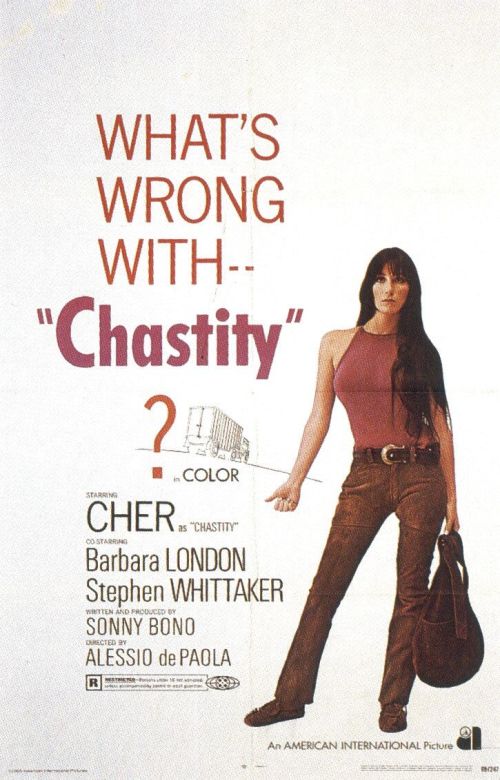
Chastity (Cher), in an attempt to escape her troubled past, runs away from home. She initially hitches a ride with a truck driver (Elmer Valentine) who seems to have only one thing on his mind, so she leaves him and meets up with a younger man named Eddie (Steve Whittaker) who she takes a liking to. He brings her back to his place and she spends the night there, but then worries that things may be moving too fast, so she leaves him. She then treks down to Mexico where she gets a job at a whorehouse. The woman (Barbara London) who runs the place becomes sexually attracted to Chastity and makes an attempt to start a lesbian relationship with her, but Chastity is uncomfortable with this and runs away again. She then meets back up with Eddie hoping to restart their relationship, but her demons from the past catch up with her and make that impossible.

The film was written and directed by Sonny Bono and I got to admit I was surprised at how genuinely riveting this was. The dialogue is sharp with a definite cinema vertite feel. There’s little or no action, but like with a Jim Jarmusch film you still find yourself glued to it and interested in picking up any little nuance that happens. The subject matter is frank and uncompromised and there’s even a little bit of nudity as we see Cher naked from both the top and backside.

The plot is unstructured and works more as a portrait to the tough situations most runaways fall into than in actually telling any type of story with a beginning, middle and end. However, it flows pretty well and has some memorable scenes including Chastity’s attempts to change the oil in a stranger’s car, her visit to a church and most especially her stay at the whorehouse and the way she successfully fleeces money out of a shy and unsuspecting teenage boy customer (Tom Nolan).

Cher is outstanding and the main reason to why this thing is so compelling. Apparently she was unhappy with her performance and refused to do another film until 13 years after this one, which is a shame as she shows definite signs of being a star-in-the-making and she looks so young that she seems almost like a different person than the one we’ve become so accustomed to seeing.

My only quibble is the fact that we get very little insight to the character’s past or why she’s running away. At the very end we do start to hear some voices, which are apparently going on inside her head and that of her parents, but it was too late to bring that up and should’ve been introduced earlier. The ending is vague and leaves the viewer in-the-dark as to what the ultimate fate of the character is, which is frustrating.

My Rating: 6 out of 10

Released: June 24, 1969

Runtime: 1Hour 25Minutes

Director: Alessio de Paola (Sonny Bono)

Rated R

Studio: American International Pictures

Available: DVD

Wanda (1970)

wanda 1

By Richard Winters

My Rating: 8 out of 10

4-Word Review:  How the poor survive.

There is a scene near the beginning that shows our main character played by Barbara Loden from a distance walking through mounds of coal to get to her father so that she can ask him for some money. The shot stays on her for what seems like several minutes with the camera slowly panning forward as she progresses. Some may say this is boring or the work of an amateur that doesn’t know when to cut. Yet this shot becomes the essence to the plight of the character and what this film is all about. In life she is constantly moving unable to fully grasp the true dissolution of her existence she searches for something, anything while becoming a victim to life’s cruel riddle that has no answer.

This may be one of the saddest movies you will ever see because Wanda’s condition is not unique and makes up more of what the working poor go through than we care to think. It helps clarify the desperation that people in these circumstances feel while also explaining why they get into bad situations and at times make such misguided choices.

Here drifter Wanda meets up with a two-bit crook named Norman Dennis (Michael Higgins). The two create an odd relationship, which proves to be beneficial for both. She brings out his long dormant tenderness, while he, in one truly touching moment, actually gives her some confidence. Of course it doesn’t last, but it is an inspiring scene and shows that even the most pathetic of people in the bleakest of situations can still transcend themselves.

This is a powerful film with a stark, home movie-like look that is actually an asset. No stylized interpretations here. The dingy bars, restaurants, homes, hotels, and factories are all very real and the viewer feels as trapped in the grayness as the characters in a film that is far more emotionally taxing than one might initially expect.

My Rating: 8 out of 10

Released: September 2, 1970

Runtime: 1Hour 42Minutes

Rated GP

Director: Barbara Loden

Studio: Bardene International

Available: DVD

Portnoy’s Complaint (1972)

portnoys complaint 1

By Richard Winters

My Rating: 4 out of 10

4-Word Review: Jewish man digs prostitute.

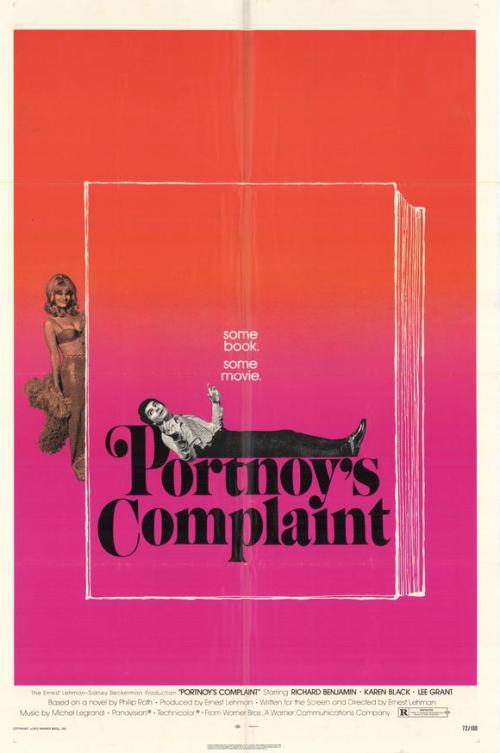
Alexander Portnoy (Richard Benjamin) is a man who no longer believes in a God or any of the other conventional ways of life taught to him by his old-fashioned Jewish parents (Jack Somack, Lee Grant). He enjoys the ‘art’ of masturbation and will routinely find excuses to go do it when his parents aren’t looking. As he grows older he finds that his sexual appetite broadens in a way that regular women won’t be able to fulfill. Then he meets Mary Jane (Karen Black). She’s a prostitute nicknamed ‘The Monkey’ due to all the wild positions that she can get her body into during sex. The two enjoy a lot of kinky times, but then she ends up falling in love with him and wanting to get married, but Portnoy resists as he considers her to be intellectually inferior and fears she’ll become an embarrassment to him with his other friends.

Philip Roth’s landmark and controversial novel comes to the big screen with only lukewarm results although it does start out funny. I laughed-out-loud at the scene where Portnoy pretends to have a bout of diarrhea just so he can sneak into the bathroom to get-off and his parents misinterpret his moans of ecstasy as being that of gaseous agony. The dream segment where Portnoy finds that his penis has fallen off and onto the kitchen floor while his parents come into to inspect it is pretty good as is the bit where Jeannie Berlin tries to give Portnoy a hand-job.

Unfortunately the film shifts too much in tone. It starts out as this quirky, dark-humored, sex-laden comedy only to end up being a brooding drama. The novel was written as a continuous monologue spoken by Portnoy while talking to his therapist, which doesn’t effectively come off here. We see a few scenes in his therapist’s office, but they are brief and I didn’t like the fact that his therapist never speaks a word of dialogue, which seemed weird and unnatural.

Screenwriter Ernest Lehman, in his one and only foray behind the camera, implements too much of a slow pace to the proceedings. Many scenes go on far longer than they should and at certain points the camera gets nailed to the ground giving it a static presence. He also hired Michel Legrand to do the film score, which is beautiful and majestic, but the lush tones are better suited for a romantic flick, which this definitely isn’t.

Karen Black gives an outstanding performance as ‘The Monkey’, but her character is too one-dimensionally dumb almost to the point that she seems mentally handicapped, which I don’t think was the intention. Either way it is never funny, touching, or even real while bordering into the stereotype that all prostitutes ‘must be really stupid’.

One of the most annoying elements of the film is that it keeps cutting back to a matted image of Black jumping from a skyscraper and towards the viewer while she screams. The image looks very hooky while giving the film a real amateurish feel. I also didn’t like how at the very end we spot Black walking amongst a crowd of people from a bird’s eye perspective. The supposed demise of the character was meant to be murky as she threatens to jump from a building and Portnoy leaves her without ever knowing if she ended up doing it or not, which then causes him a major source of guilt afterwards. By having her suddenly appear at the very end ruins the mystery and brings up far more questions than answers.

Roth’s novel was very much ahead-of-its-time and deserved a film that could match it, but Lehman’s staid approach doesn’t do it justice.

My Rating: 4 out of 10

Released: June 19, 1972

Runtime: 1Hour 41Minutes

Rated R

Director: Ernest Lehman

Studio: Warner Brothers

Available: DVD (Warner Archive), YouTube

Angel, Angel, Down We Go (1969)

angel angel 1

By Richard Winters

My Rating: 4 out of 10

4-Word Review: Singer manipulates rich family.

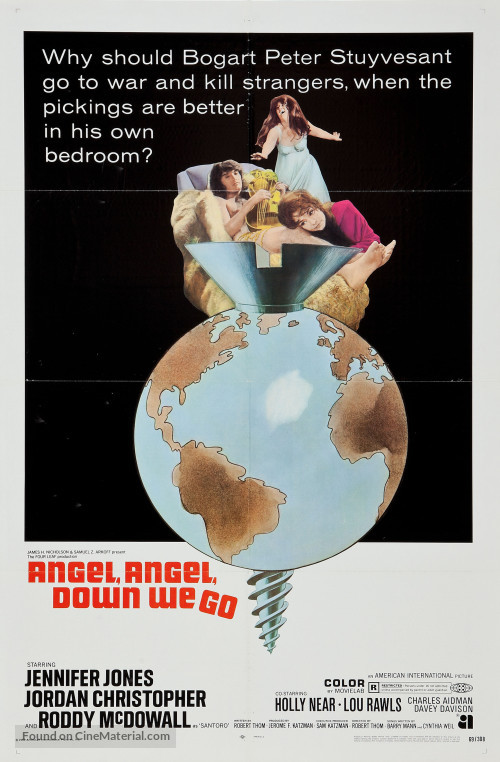
Tara (Holly Near) is an overweight teen who feels like a social outcast. Her family is rich, but empty on love. Her mother (Jennifer Jones) is a former star of stag films and boozes it up on the bottle, but still manages to look quite attractive, even better than her daughter, which she constantly reminds her of. Her father (Charles Aidman) is a closet homosexual who routinely brings in male lovers for entertainment. When a rock group with a dashing lead singer (Jordan Christopher) arrives at her sprawling family home to help host a party Tara doesn’t hesitate to fall into his open arms. At first he seems to be the answer to her loneliness, but after a while she realizes he has a plan of his own as he not only seduces the mother, but her father as well before manipulating his way into the family fortune.

The main reason to watch this film, if not the only one, is for the performance of Jones in this her second-to-last cinematic appearance. She gives an incredibly strong, multi-faceted portrayal of a middle-aged woman on the emotional edge who realizes she’s being used, but allows it to happen simply so she can still feel desirable. Her presence lifts the sleazy material to watchable heights and comes just a year after she herself tried to commit suicide after hearing of the death of a close friend in real-life.

Near, who has later become a well-known folk singer, gives an effectively sensitive portrayal of a troubled teen, which allows her to be the one character that the viewer has any sympathy for. The rest of the cast though, which includes Roddy McDowall and Lou Rawls as Christopher’s band mates, are essentially wasted although you will get a full view of McDowall’s bare bottom for those few who are interested.

The garishly colorful collages done by Shirley Kaplan are visually alluring, but writer/director Robert Thom goes back to them too often. The aerial skydiving footage is excellent, even breathtaking, but the script as a whole, despite its lurid and even groundbreaking subject matter, falls flat. A lot of the reason for this is the fact that it’s poorly paced with too much time given to Christopher who sings a total of five songs, which does nothing but slow the proceedings down to a screeching halt. The ending is vague and aloof, which only helps to cements this as a misfire and good only as a curio.

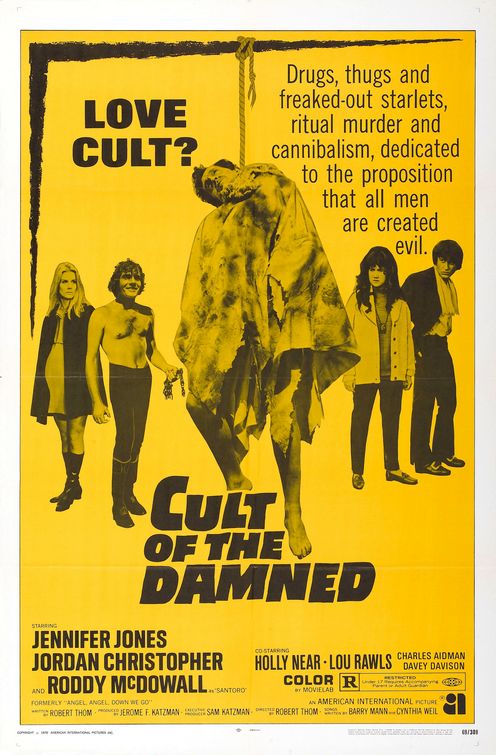
The film did quite poorly upon its initial release, so it was reissued under another a title called Cult of the Damned in hopes that it could cash in on the hysteria of the Manson murders that had occurred around the same time, even though the story doesn’t have anything to do with a religious cult and the movie still fared no better at the box office.

angel angel 2

Alternate Title: Cult of the Damned

My Rating: 4 out of 10

Released: August 19, 1969

Runtime: 1Hour 29Minutes

Rated R

Director: Robert Thom

Studio: American International Pictures

Available: DVD, Blu-ray, Amazon Instant Video

Hard Contract (1969)

hard contract

By Richard Winters

My Rating: 3 out of 10

4-Word Review: Hit man becomes humanized.

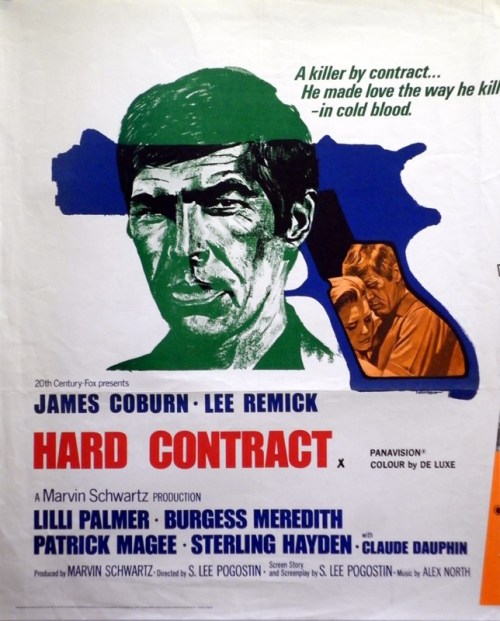
John Cunningham (James Coburn) is a professional hit man hired by Ramsey Williams (Burgess Meredith) to do one last ‘big score’ by rubbing out Michael (Sterling Hayden) of which Ramsey suffers a large financial debt to. John has done many of these jobs before and travels to Europe with the expectation that this one will be as routine as the others, but then he has an encounter with call-girl Sheila (Lee Remick) who plagues him with self-doubt and forces him to question his purpose in life.

This film was written and directed by S. Lee Pogostin a long time TV writer who finally at the age of 55 got his big break to do an actual feature film. Unfortunately for him his script is excessively heavy with dialogue and little to no action. There is only one brief segment where we see John actually doing his job and offing someone and it comes in the form of watching him drop a large trunk with a dead body inside of it out of an airplane, which is kind of a cool visually, but that is about it and the rest of the film consists of nothing but talk and long winded, flowing conversations dealing with theories and philosophies that regular people, particularly those in the crime and prostitution business, just don’t have.

Coburn and Remick are both excellent, but the scenario that their characters are placed in is ludicrous. The idea that a high paid prostitute would suddenly fall for one of her clients is quite doubtful. Had the Coburn character been somehow kind or gentle towards her then maybe, but instead he is cold and distant and treats her more like an animal than a person, so why, especially after all of the other men she has already presumably slept with, would she get so worked up over this guy? It just makes no sense and the same thing goes for the Coburn character. He’s slept with hundreds of prostitutes before and even brags about it, so why would this one stand out?

The conversation that Coburn has with Hayden, amidst a large wheat field and while sitting on a tractor, is pretty good and the most engrossing moment in the film. The scene where he drives a car speedily down a winding road, which gets the other passengers quite nervous, isn’t bad either. The European locations are scenic and the supporting cast all give strong performances especially Karen Black as a talkative hooker arguing with Coburn over political candidates. However, the script tries too hard to make a statement and comes off more like a protracted concept than a story with a pretentious flair that just doesn’t work.

hard contract 2

My Rating: 3 out of 10

Released: April 30, 1969

Runtime: 1Hour 47Minutes

Rated R

Director: S. Lee Pogostin

Studio: 20th Century Fox

Available: None at this time.

The Clan of the Cave Bear (1986)

clan of the cave bear

By Richard Winters

My Rating: 5 out of 10

4-Word Review: Girl gets new tribe.

After her mother is killed in an earthquake and escaping from the clutches of a hungry lion a very young Ayala (Daryl Hannah) gets taken in by a tribe of Neanderthals. Her addition causes strife amongst the other members particularly Broud (Thomas G. Waites) who feels she doesn’t conform enough to the subservient female role. When it is found that she has taught herself to hunt by using weapons that the women were forbidden to touch she is kicked out of the tribe and forced to survive on her own.

I realize that this film has been almost universally lambasted by movie goers and critics alike, but overall I found it to be watchable. The biggest issue in many ways were the action sequences. The opening earthquake bit as well as the lion attack comes off as stagy and phony and even border on being unintentionally funny. Later on when Ayala saves a young child from a wolf the movie reverts to slow motion, which gives it too much of an over-the-top Hollywood feel. There is also another segment where the cavemen torment a grizzly bear as part of an ancient tribal ceremony. Some of the men get torn up and killed by the bear, which to me was just fine as they should’ve left him alone in the first place!

Hannah is the perfect choice for this type of role, but for whatever reason her performance seemed a bit off and not as effective as it could’ve been. She was also probably too tall for the part as people back then was much shorter than they are now.

The movie has a little too much melodrama and eventually resembles just another cheesy Hollywood drama. The authenticity is questionable and the grittiness from the more popular Quest for Fire is definitely missing. I also wasn’t too crazy about the outdoor shots, which includes the opening one, that shows sunlight filtering through the tree leaves in a haze-like fog that gives it too much of a fairy tale-like look.

The part where Ayala is forced to survive on her own goes by too quickly and hardly seems as brutal as it should’ve been and I was also confused about how she was able to come upon this fur shawl to wear that protected her from the cold because when the tribe kicked her out she left with nothing but the flimsy outfit that she had on.

Yet despite all this I still found it to be reasonably compelling. Maybe it’s just the idea of seeing an individual learn to survive on her own, standing up to unjust authority and learning to find independence that manages to connect us no matter what the time period, but in either case it’s an okay time filler if you don’t think about it too much.

My Rating: 5 out of 10

Released: January 17, 1986

Runtime: 1Hour 38Minutes

Rated R

Director: Michael Chapman

Studio: Warner Brothers

Available: DVD (Warner Archive), Amazon Instant Video, YouTube

Steaming (1985)

steaming

By Richard Winters

My Rating: 2 out of 10

4-Word Review: Saving a steam room.

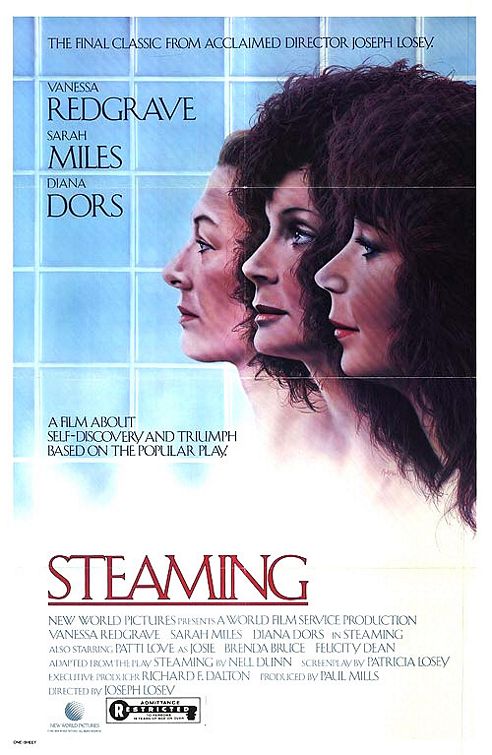
Three women (Vanessa Redgrave, Sarah Miles, Patti Love) congregate at a London steam room designed like a Turkish bathhouse. Despite their lifestyle differences they become good friends as they divulge their problems to one another and learn to lean on each other to help them cope with life’s difficulties. Then one day Violet (Diana Dors), who is the bath house owner, informs them that the place is set for demolition, which causes everyone to go on a mission to try and save it.

The film is based on the Nell Dunn play, which was highly regarded at the time, but makes for a very poor transfer to film. It starts out flat and never recovers. The dialogue has too much of a conversational quality that is not interesting and the problems that they discuss are not compelling, or original. The humor from the play is missing and the dry, somber tone only makes things even more boring. The only time it gains any traction is when it’s announced that the place is closing, but everything gets resolved in such a sitcom-styled way that it hardly seems worth the effort to watch.

The entire cast is made up of women and there is an abundance of nudity particularly from Miles, which doesn’t seem like a big deal these days. The biggest issue though is the fact that everything takes place from inside the bath house, which is gray, grimy, and rundown. The film should’ve had some segments shot from different locales if to only allow for some visual variety and to help the viewer understand the characters better by seeing how they react in different social settings.

Miles and Redgrave are wasted in drab roles and this goes likewise for Dors whose last film role this was. Love is the only one that shows any liveliness and although her character is a bit annoying she at least has an emotional breakdown near the middle, which adds some mild dramatic tension.

Joseph Losey was a competent director who made many interesting films, so it’s a shame that his career had to end with such a dud. He was already sick with cancer while he filmed this and like with Dors died a year before it was released. The disease may have sapped his creative energy and explain why this production is so ponderously sterile. It’s certainly a far cry from his other works as well as the Bruce Jay Friedman play Steambath, which had a similar setting, but a much more imaginative plotline.

My Rating: 2 out of 10

Released: September 28, 1985

Runtime: 1Hour 31Minutes

Rated R

Director: Joseph Losey

Studio: New World Pictures

Available: DVD (Region 2)

Who Killed Mary Whats’ername? (1971)

who killed mary 2

By Richard Winters

My Rating: 3 out of 10

4-Word Review: Who killed the prostitute?

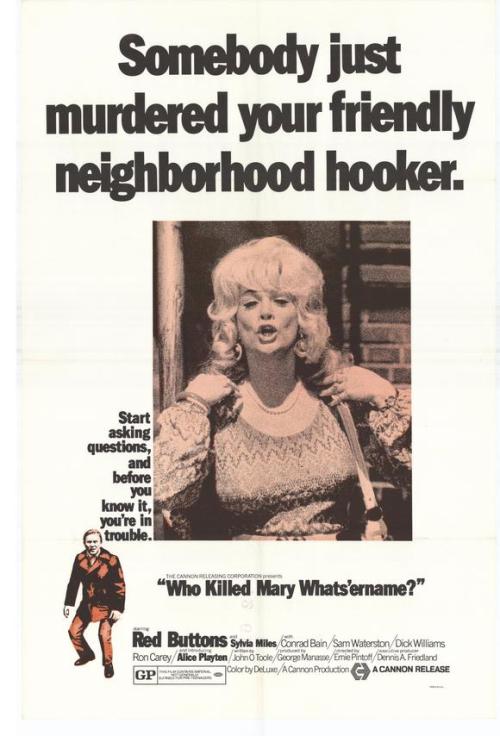
Mickey (Red Buttons) is a retired diabetic boxer who is appalled to learn that a prostitute was killed in her apartment and no one seems to care. He decides to do the investigation himself and even moves in to her old place. He inquiries about her amongst the locals and begins to get a few leads including that of a young filmmaker named Alex (Sam Waterson) who may have inadvertently filmed her leaving with her eventual killer. Soon Mickey’s grown daughter Della (Alice Playten) and Val (Conrad Bain), a man he meets at a bar, are helping him in his quest, but the things they learn only reinforce how unpleasant and dangerous a hooker’s life can be.

I commend the attempt at taking a gritty look at a seedy lifestyle and its open-minded approach to the women who are in it, but the film’s poor execution makes the whole thing come off as quite amateurish and even laughable. Why a man in his 50’s would become so obsessed with finding the killer of a woman he has never known and only reads about in a newspaper is quite hard to fathom. There are probably hundreds of prostitutes that share similarly sad fates, so why get so revved up about this one? The fact that he is able to get his grown daughter and another man he meets randomly at a bar to help him investigate seems equally unbelievable and the way they are conveniently able to find clues and connect-the-dots before solving the case comes off as too easy.

The action sequences, especially the opening one in which we see the prostitute getting killed, are poorly staged and filled with chopping editing that makes it hard-to-follow and phony looking. When the 50-year-old Buttons takes on a gang of young bikers, which are led by Earl Hindman who later became famous for playing the neighbor on ‘Home Improvement’ whose face was always obscured by a fence, it becomes downright silly. Sure the Buttons character has a background in boxing, but that still doesn’t mean he can take on four guys who are twice his size and the sound effects used for the punches are overdone and cartoon-like.

A similar issue occurs when Buttons saves a prostitute from an abusive pimp while Alex films it. The first time this occurs it is mildly diverting, but then when he saves another one, who is being beaten up by some of the old ladies in the neighborhood, it becomes redundant and corny.

The resolution, in which the killer turns out to be someone no one suspected, is flat and forgettable. It is also poorly thought out as he admits to the Buttons character that he killed the two women because he didn’t want any potential witnesses, but then doesn’t bother to kill Buttons or at least make sure he is dead even after he divulges his secret to him. The killer then just casually walks away without ever allowing the viewer to know if he was caught and charged with the crimes.

My Rating: 3 out of 10

Released: November 12, 1971

Runtime: 1Hour 30Minutes

Rated GP

Director: Ernest Pintoff

Studio: Cannon Film Distributors

Available: None at this time.

Boom! (1968)

boom

By Richard Winters

My Rating: 4 out of 10

4-Word Review: Bitchy lady rules island.

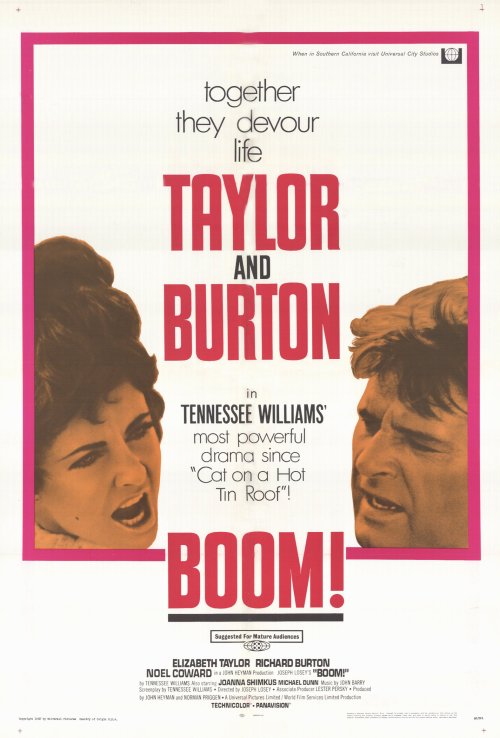
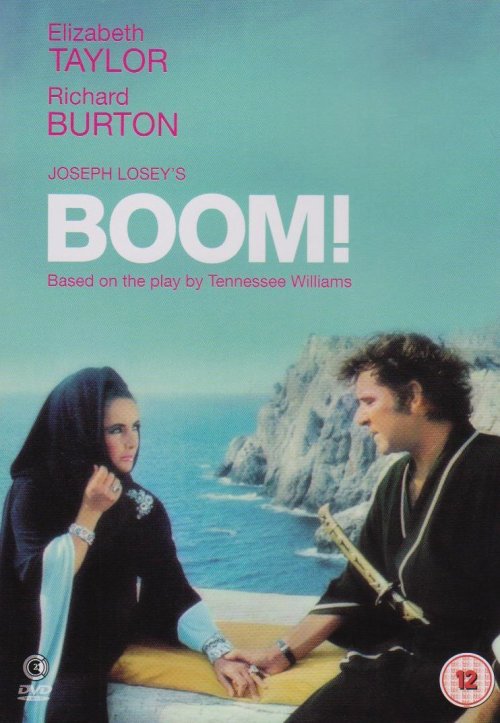
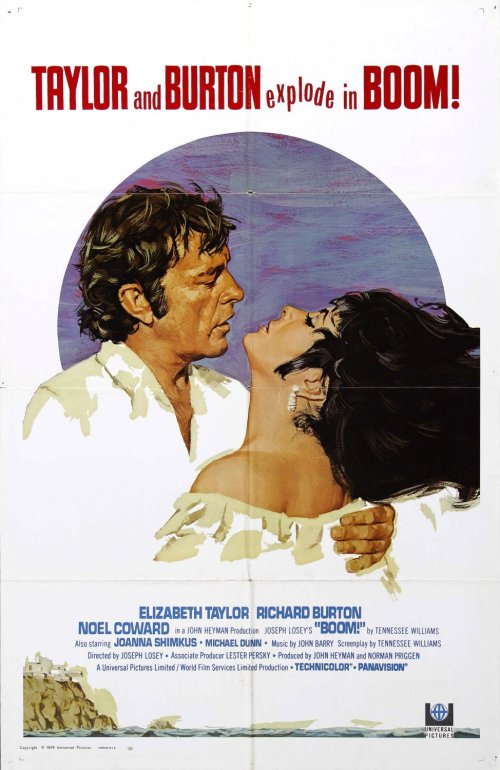
Flora ‘Sissy’ Goforth (Elizabeth Taylor) lives on a secluded island in a large mansion and surrounded by servants who cater to her every whim. She has alienated most everyone she has come into contact with and relies on her secretary Miss Black (Joanna Shimkus) to write down her autobiography that she dictates to her indiscriminately throughout the day. In comes Chris Flanders (Richard Burton) a nomadic poet living on the skids who infiltrates her palace and her oppressed sexual desires with his ruggedness and mystery. Will Sissy fall under his seductive spell, or does this mysterious stranger have even darker intentions?

The film was directed by Joseph Losey who is one of the more inventive and groundbreaking directors who ever lived and sadly doesn’t get enough recognition. Unfortunately he was going through a bout of depression when he made this film, which caused him to abuse alcohol and seriously affected the film’s final result although it still manages to be a fascinating visual excursion nonetheless. The location shooting, which was done almost entirely on the island of Sardinia, is dazzling. The shots of the steep cliffs and crystal blue water, which are literally a part of Sissy’s backyard, are breathtaking. The modernistic mansion that she lives in is equally sumptuous particularly with its myriad collection of art paintings and wet bars that seem to pop-up every few feet in whatever room or patio the characters are in.

The acting is also outstanding as Taylor eats up the scenery with her over-the-top bitchiness and unexplained anxiety attacks, which she takes to an unprecedented campy level. The outrageous hat that she wears to her dinner date is quite possibly one of the most bizarre things ever to be put on top of a human head.

boom4

The normally commanding Burton unfortunately comes off as weak in comparison and overall looks uncomfortable in his role. The script originally called for a young man in his 20’s for the part and thus casting Burton, who was already 42 at the time, seemed misguided.

Dwarf actor Michael Dunn is excellent in support. His character utters only three words, but still makes his presence known with the way he shows complete control over his attack dogs while playing of all things Sissy’s bodyguard. Playwright Noel Coward appears in a fun bit as one of Sissy’s friends who she invites over for dinner. The friends secretly disdain each other in private, but put on a superficial friendship when together and apparently this is also how the two performers behaved with each other behind-the-scenes as well.

Unfortunately the script, which was written by Tennessee Williams and based on his play ‘The Milk Train Doesn’t Stop Here Anymore’ leaves much to be desired. The plot meanders on to an unsatisfying conclusion while rehashing old themes that had already been used in his earlier and better known works.

boom2

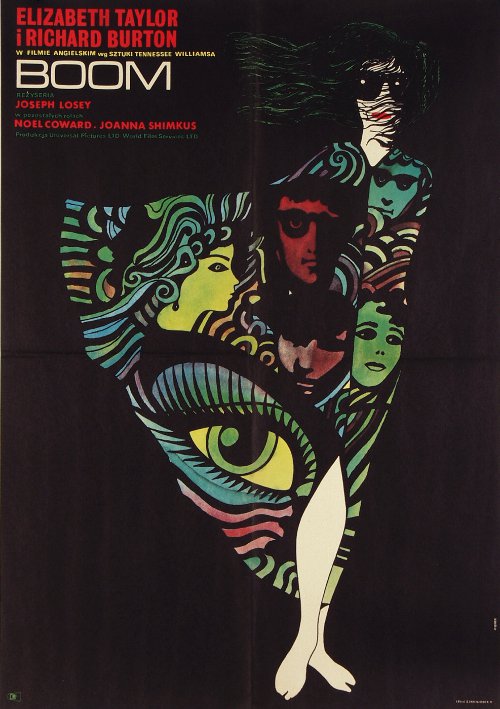
Polish Poster

My Rating: 4 out of 10

Released: May 26, 1968

Runtime: 1Hour 52Minutes

Rated PG

Director: Joseph Losey

Studio: Universal

Available: DVD (Region 2)

Independence Day (1983)

independence day 2

By Richard Winters

My Rating: 3 out of 10

4-Word Review: Getting out of Texas.

Mary Ann Taylor (Kathleen Quinlan) works as a waitress at her father’s café, but dreams of leaving her sleepy Texas town and going to school in California to study photography. Her mother (Frances Sternhagen) though is in declining health and her current boyfriend Jack (David Keith) wants her to stay which makes her decision to leave all the more difficult.

Shot on-location in Anson, Texas the film is a pleasant time-filler that fortunately doesn’t go overboard with Texas stereotypes, but it’s also rather bland and predictable. Feeling trapped in a small town is by no means a unique feeling and the film doesn’t go far enough with that theme and for the most part just touches the surface. Adding in a second storyline dealing with Jack’s sister (Dianne Weist) being abused by her husband (Cliff De Young) is a bit jarring and doesn’t really fit as there are long periods where Mary Ann is not seen at all and it would’ve made more sense had it been her sister that was being abused and not Jack’s and thus giving her more screen time.

The dramatic arcs are a bit too obvious as well and at times even bordering on being corny. For one thing the abuse issue gets introduced by having Jack visit his sister and asking her husband to borrow some money and then for no reason the husband begins throwing lit matches at his wife while right in front of Jack. Abusive people can certainly be cruel, but they’re not stupid and hurting a woman while her well-built brother sits right there is most assuredly going to get the husband into trouble, so why do it? Having Jack find out about the abuse by coming to the home one day unannounced and hearing shouting and maybe looking into a window and seeing the husband hit her would’ve made far more sense.

Having Mary Ann’s mother, who otherwise looks and acts quite healthy, suddenly fall over with fainting spells and suffering from some disease that never gets explained seemed too manufactured. Mary Ann’s arguments with Jack over whether she should go to school or stay in Texas is equally transparent especially since the two really didn’t have all that much in common and could’ve easily found other dating partners quite quickly.

Having one of the official’s from the photography school drive out to her rural home and personally offer her a full scholarship while telling her she was one of the greatest photographers he had even seen was pretty loopy too. All she did was take pictures of the town’s buildings and people’s faces, so what this guy managed to see that was so ‘brilliant’ and ‘special’ from that is hard to figure.

Quinlan and Wiest give great performances, but the movie is nothing more than lightweight drama that fails to distinguish itself from all the other B-dramas out there.

My Rating: 3 out of 10

Released: January 21, 1983

Runtime: 1Hour 50Minutes

Rated R

Director: Robert Mandel

Studio: Warner Brothers

Available: DVD (Warner Archive)