Category Archives: Cult

Deadly Weapon (1989)

deadly weapon1

By Richard Winters

My Rating: 5 out of 10

4-Word Review: Geek acquires lethal laser.

Zeke (Rodney Eastman) is a high school student frequently picked-on by his jock classmates as well as an abusive alcoholic father. As a refuge he imagines that he’s secretly an alien from another planet and writes stories about it. One day he comes upon a military weapon in a river bed near his home that landed there when the train it was being carried on crashed. He takes it home and begins using it to scare away all of those who harassed him and this catches the attention of Traci (Kim Walker) who used to date the jocks, but now finds Zeke and his newfound laser gun far more interesting. However, Lieutenant Dalton (Gary Frank) is the military official assign to retrieve the weapon and he’ll stoop to any low ball tactic to get it back.

This was another Charles Band production who was notorious for making a lot of low budget sci-fi/action flicks during the 80’s/90’s that were of a dubious quality. This was originally intended to be a sequel to Laserblast, a much maligned bottom-of-the-barrel stinker from the 70’s, but budgetary reasons caused them to pull back on that idea and turn it into a separate story. For what it’s worth this is far better than that one and surprisingly has enough of a budget to mask its shortcomings and even comes-off like it could’ve been Hollywood studio produced. There are though some over-the-top moments like a one-eyed vice principal who beats Zeke with a paddle inside his office and a cliched drunken father who acts like a stereotypical hayseed straight out of the local trailer park that made it seem like it either wanted to be a campy comedy, or unintentionally funny, but it’s hard to tell which one.

The script isn’t realistic as the kid is able to open up the crate that houses the gun with his bare hands without having to use a crowbar even though you’d think such a dangerous weapon like this would be packaged more securely and not so easily accessible to just anyone. Zeke is also able to figure out how to operate it much too quickly. Again, such a dangerous weapon should have a safety feature to make it difficult for unauthorized personal to use, such as having to put in a secret code before it’s operational.

The segment where Zeke and Tracy force four men into the trunk of their car and drive around with them as hostages is kind of funny, but the two able to open the trunk door from the outside too easily. If the men are truly locked into the trunk then a key must be placed into the keyhole to open it, but instead they’re able to raise the door open with their hands and not having to bother to unlock it, which means the men inside should then be able to easily kick the door open and escape.

The film is mostly known for the two stars who are more famous for their appearances in two other cult hits. For Eastman his best remembered for playing Joey in the Nightmare on Elm Street series while Walker’s signature role is that of the snotty Heather Chandler in HeathersWalker is the more interesting of the two as she performs her role in a duplicitous fashion where you’re not sure if she’s a genuinely nice person trying to help Zeke, or just a narcissistic brat looking for attention and escape. Her character though is poorly fleshed-out as she sees Zeke blow-up a building with his gun, which scares off the other jocks, one of whom she is dating, but she then invites Zeke into her car, but how would know she could trust him and he wouldn’t use the gun on her? Why too would this beautiful teen be into a geek like Zeke anyways? To have it make more sense she should’ve been a nerd, who had been bullied by the cool kids and now connected with Zeke’s need to ‘get back’ at them.

Spoiler Alert!

The film’s best moment is the ending, which has a surprisingly surreal vibe as Zeke sees the lights of the military vehicles and thinks it’s from the mother ship of some outer space aliens and goes towards it like they’re going to ‘take him home’ and away from earth where he doesn’t feel he belongs. While this intriguing theme has strong similarities to Liquid Sky and Shirley Thompson versus the Aliens it doesn’t fully gel. Had it been approached with a better realized manner of what genre it wanted to be (satire/sci-fi/action/dark comedy) then it might’ve succeeded, but trying to juggle all four genres together gives it a convoluted feel that’s not quite able to cross the finish line and be fully satisfying.

My Rating: 5 out of 10

Released: August 15, 1989

Runtime: 1 Hour 29 Minutes

Rated PG-13

Director: Michael Miner

Studio: Empire Pictures

Available: dvdlady

Fandango (1985)

fandango

By Richard Winters

My Rating: 6 out of 10

4-Word Review: The privileges of youth.

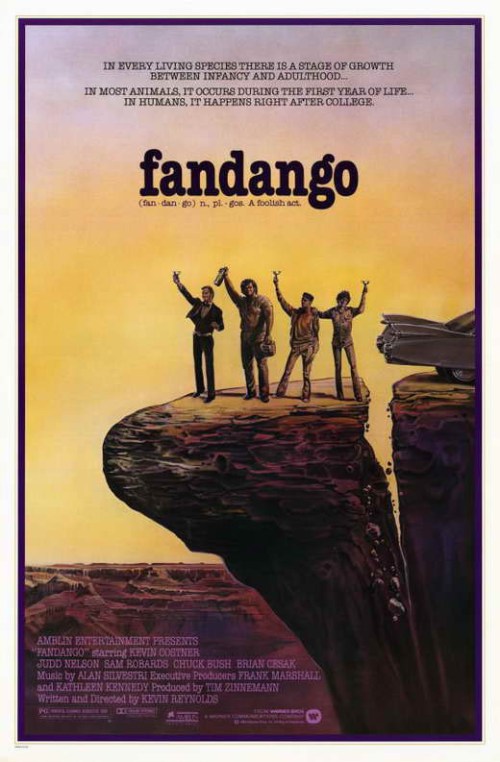
Gardner (Kevin Costner), Phil (Judd Nelson), Kenneth (Sam Robards), Dorman (Chuck Bush) and Lester (Brian Cesak) are five college friends from the University of Texas in 1971, who are getting ready to celebrate their impending graduations when Kenneth announces that he’s been drafted into the Vietnam War and Gardner has too. To help lighten the mood the boys decide to take an impulsive road trip where they travel to unique areas of Texas, including searching for buried treasure in the Rio Grande, sleeping under the stars at the old filming site of Giant, and even taking part in parachute jump near Pecos.

This film is based on a 24-minute film that Kevin Reynolds directed while attending the USC film school. In that movie the boys were all from Baylor University and traveled to Pecos, Texas in order to test the courage of their most frightened member and use the help of eccentric flight instructor Truman Sparks, played by Marvin J. McIntyre, who reprises his role in this one, to teach and train the young man on how to jump from a plane. The student film managed to catch the attention of Steven Spielberg, who was so impressed with it that he offered Reynolds the chance to turn it into a full-length movie. Unfortunately once it was completed Spielberg for whatever reason disliked it and had his name removed from the credits while also refusing to help distribute it forcing the film to suffer a limited engagement though in recent years its cultivated a cult following.

The movie does have many funny moments including the opening bit where Phil’s parents (Stanley Grover, Jane A. Johnston) visit his frat house during one of their raucous parties. The sky diving sequence, which gets copied shot-for-shot from the original is quite engaging as is their attempts to hook their disabled car up to a speeding train. Costner is also very amusing, he had actually auditioned for the student film, but lost out, but when he found out it was going to be remade into a feature film he re-auditioned. I’m so used to seeing him play serious roles that I didn’t realize he had such great comedic timing, but for the most part, he’s the life of the movie.

Where the film fails is that it’s too unfocused. The setting is supposedly 1971, but you’d hardly know it and very little effort is made to give it a feel of that era. Even the opening song sung by Elton John that gets played by over the credits was released 2 years after the events in the movie supposedly took place, so to keep it accurate with the time setting only songs that came out in 1971, or before should’ve been used.

The side-story involving Gardner having dated Kenneth’s fiancee, played by Suzy Amis, seems unneeded and really doesn’t go anywhere. Normally, in most real-life friendships, having a friend date and ultimately marry one’s former girlfriend could be a deal-breaker that would lead to a lot of jealousy and potential anger. I’m sure there’s a minority of friendships where the participants would be mature enough to overcome this issue, like here, though this isn’t interesting, so why bother introducing this wrinkle if its dramatic elements aren’t going to get explored?

The part where it really jumps-the-shark is during the planning of the wedding, which is too full of logic loopholes to be able to buy into even on a whimsical level. It features Gardner and Phil being able to pull off his massive wedding ceremony in the town’s square on very short notice by conning too old guys sitting on a nearby park bench into agreeing to help out, which leads to more people getting involved until the whole town, even the mayor, takes part in a wedding ceremony, and its preparation, of people they don’t even know. If anyone can show me an example in the whole history of the world of when this has ever happened in reality then I’ll take it back, but otherwise I found it ridiculous.

The ending is way too abrupt. The whole reason Phil agreed to go on the parachute jump was for Kenneth and Gardner to agree to not dodge the draft, but whether they withhold their end of the bargain is never shown. Everyone just basically wanders off like they have better things to do, which is how the viewer, despite some fun moments, ends up feeling about the movie, which would’ve had more impact had it chucked the whimsy and had a little more serious drama.

My Rating: 6 out of 10

Released: January 25, 1985

Runtime: 1 Hour 31 Minutes

Rated PG

Director: Kevin Reynolds

Studio: Warner Brothers

Available: DVD, Amazon Video, YouTube

The Whole Shootin’ Match (1978)

whole1

By Richard Winters

My Rating: 7 out of 10

4-Word Review: Trying to get rich.

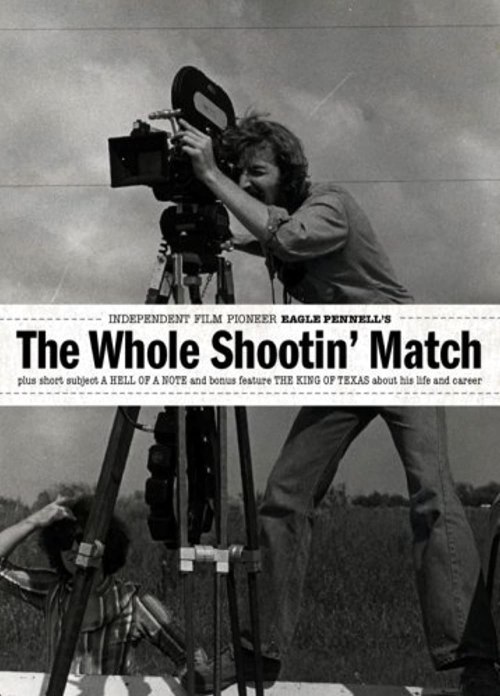
Frank (Sonny Carl Davis) and Lloyd (Lou Perryman) are lifelong pals who’ve never been able to get over the financial hump. Both harbor starry-eyed ideas of getting rich, but Lloyd’s inventions never attract the interest of any investors. Then one day while driving his car through the local car wash Lloyd is inspired to create a type of mop that he coins the ‘Kitchen Wizard’. They’re able to sell the rights  and make a thousand dollars with the promise that more money will be on the way, but when the patent gets stolen by an unscrupulous company it sends the normally stoic Frank over-the-edge in which he begins to ponder suicide as the only answer to his despondency.

This film, produced on a minuscule budget where the cast and crew agreed to work for free, became the forerunner of the modern-day indie film movement that not only inspired cult director Richard Linklater to get into movie-making, but also gave Robert Redford the motivation to start-up the Sundance Film Festival. Director Eagle Pennell, who was born as Glenn Irwin Pinnell, even attracted the attention of Hollywood studios after the film’s release, which lead to him getting a development deal with Universal, but when this failed to get any of his movie ideas produced he came back to the Lone Star State feeling as disillusioned as the characters in this movie. Eventually it lead to alcoholism and homelessness where he ultimately died while living on the streets of Houston at the age of 49.

This movie works much like Jim Jarmusch’s 1984 indie hit Stranger Than Paradise, which was also filmed entirely in black-and-white and featured mainly static shots of people having extended conversations. While some of the scenes are funny there are also a few dramatic ones particularly Frank’s dealings with his wife Paulette, played by Doris Hargrave. There are also some moments that don’t work at all. The one featuring Frank and Lloyd conversing while supposedly riding inside a pick-up is particularly problematic as it’s quite clear to the viewer, despite Pinnell’s attempts to camouflage it by editing in shots of traffic, that the vehicle is stationary. The dream sequence where Frank has a nightmare about going back to the company that stole their mop idea is interesting, but then ultimately gets defeated by repeating it almost exactly in real-life, which gets redundant and the music becomes intrusive as we’re unable to hear what anyone is saying as they confront each other.

The characters are not appealing especially Frank who’s quite controlling and possessive towards his wife despite cheating on her. The two lead’s personalities flip-flop near the end where Lloyd, the perpetual optimist, suddenly turns dour while Frank manifests into Mr. positive, which to me didn’t seemed earned, or believable.

For patient viewers the third act is a payoff as it takes place in the Texas Hill Country where the foliage of the forests are quite different than those in the Midwest with trees unique only to central Texas and thus giving the sequence a surreal vibe like the two have traveled off to a strange and exotic place. I also liked the fact that the phony sound effects used in most other movies are non-existent here. This comes into play when a crotchety old man, played by James N. Harrell, shoots at the two from his porch with a rifle, but instead of a loud cannon sound like in most films, it’s more of a realistic fire cracker noise. The fight inside a bar works the same way as there’s not that annoying loud smacking sound when the punches hit their target making this tussle seem more organic.

This also marked only the second movie to be filmed in Austin, Texas with the first one being Outlaw Blueswhich was released 2 years earlier. If you’re an Austinite, such as myself, living in the city now you’ll not recognize the old Austin that gets shown here. No tall buildings, or cosmopolitan look. In fact after watching it you’d be convinced Austin was just a back woods cow town without even a hint of the bustling metropolis that its become.

My Rating: 7 out of 10

Released: March 19, 1978

Runtime: 1 Hour 49 Minutes

Not Rated

Director: Eagle Pennell

Available: DVD, Fandor

The Mutilator (1984)

mutilator1

By Richard Winters

My Rating: 2 out of 10

4-Word Review: Father harbors a vendetta.

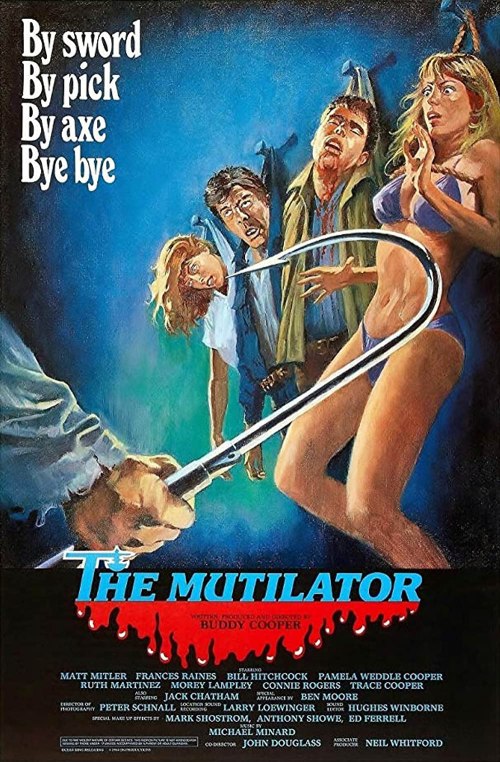
As a child Ed (Trace Cooper) accidentally kills his mother (Pamela Weddle Cooper) while cleaning his dad’s rifle. His father (Jack Chatham) becomes distraught at seeing his wife killed and his relationship with his son is irrevocably destroyed. When Ed (Matt Mittler) grows up to go to college his father asks him to help close up the family’s summer home in Atlantic Beach, North Carolina. Having nothing better to do, and on fall break, he and his college clique decide to head over to the place where they hope to use it to hang-out and party. Unbeknownst to them is that the father is hiding on the premises planning to kill Ed once he gets there, but his friends get in the way, so he starts killing them off as well one-by-one.

Even for a low budget 80’s slasher this is shockingly cardboard with the only thing going for being the special effects, at least I presume that’s why it’s gotten a cult following as I cannot figure out any other reason. While some of the effects are quite graphic others fall flat. The scene where the father fantasizes about slashing his young son’s throat gets botched because you can clearly see that there’s a blood pack patched onto the child’s neck and underneath some clay-like skin. The drowning of one victim, played by Frances Rains, doesn’t work either. The original idea was to have her killed by a spear gun underwater, which would’ve been better, but they couldn’t get the effect to work, so they simply had the killer swim underwater and reach up with his hands and force her under, but I found it hard to believe that this couple being all alone in this otherwise empty room, and the only two people in a clear water pool wouldn’t be able to detect someone else getting in. The scene would’ve been improved had the viewer seen things from the victim’s boyfriend’s point-of-view, where he thinks she’s still alive and gotten out of the pool on her own while leaving a trail of clothes leading to a vacant shack where he presume she’s awaiting to have a sexual tryst only for the guy to get a shock of his life when he opens up the door of the shack and sees the killer, which would’ve also been a jolt to the audience had the director not already made us aware of what was coming.

The opening flashback scene is gets messed-up too. It’s intended to show the kid accidentally killing the mom and the father getting angry when he come home and sees it, but personally I saw it differently. To me it seemed like the kid intentionally wanted her dead as he looks out the door to make sure she’s standing by the counter in the kitchen and then quietly closes it to clean the gun, which he perfectly aims at the door. When the mom falls to the ground he doesn’t cry or shed a tear and when the father arrives he pours himself a drink almost like he’s relieved that she’s gone. I thought the two had some sort of sick pact that the kid would kill the mom for the father as his birthday present, but stage it to look like an accident. Then years later the twist would be that the kid now grown up would intentionally bring his friends to the beachfront for his father to kill, as the two shared a weird blood lust and enjoyed seeing each other slaughter people, which would’ve been a lot more of interesting twist than what we do get, which is nothing at all.

Like with most of slasher films it starts with a lot talky scenes, but unlike those others, the tension doesn’t grow once the killings start. Instead we only get an intermittent few minutes of killings here-and-there and then it goes back to drawn-out talky moments with no attempt to quicken the pace and thus there’s no tension at all and since we already know who the killer is and what motivates him there’s no mystery or intrigue either. It all adds up to a dud of a movie though those that are simply into gory effects may still like it, but even in that category I’ve seen better.

Alternate Title: Fall Break

Released: October 5, 1984

Runtime: 1 Hour 26 Minutes

Rated R

Director: Buddy Cooper

Studio: Ocean King Releasing

Available: DVD, Blu-ray, Amazon Video, Tubi, AMC+

Bloodsucking Freaks (1976)

bloodsucking2

By Richard Winters

My Rating: 4 out of 10

4-Word Review: Women forced into slavery.

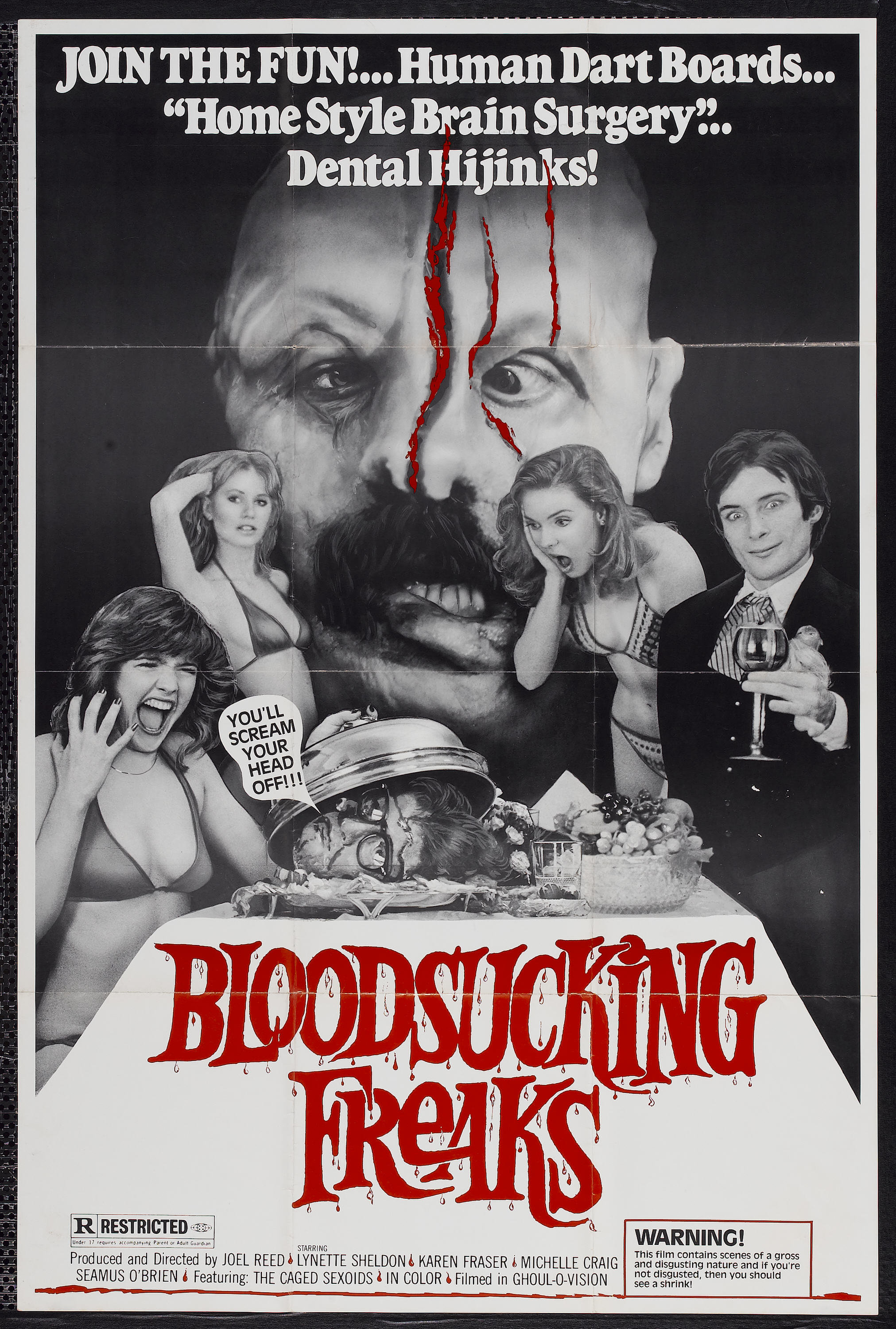
Sardu (Seamus O’Brien) runs an underground theater in the SoHo District of New York where they put on live stage shows that feature naked women tortured and mutilated all to the delight of a paying audience. The members of the public who come to see it believe it’s all an act, but in reality the women are kidnapped and forced to do things against their will through hypnosis. When a theater critic named Creasy Silo (Alan Dellay) refuses to write a positive review about the place in his newspaper Sardu summons his dwarf assistant Ralphus (Luis De Jesus) to kidnap him where he is then chained in the basement of the theater and tortured like the others. Sardu also has famous ballet dance Natasha (Viju Krem) kidnapped where she eventually, through the power  of hypnosis, puts on a perverse dance, but Natasha’s boyfriend Tom (Niles McMaster) doesn’t believe she’s doing it willingly, so he calls on police detective John Tucci (Dan Fauci) to investigate. The problem is that Tucci is corrupt and secretly agrees to do nothing about Sardu’s crimes as long as he gets bribe money. 

Out of all of the exploitative films that came out during the 70’s this one still holds the top prize of being the most notorious and rightly so, as what it shows went far beyond many other provocative films of that decade that promised sensationalism, but delivered little. This one definitely delivers to the extent that writer/director Joel M. Reed professed to losing many of his longtime friends after they watched it. While intended as a dark comedy, a very dark one, how much one enjoys will be dependent on how twisted their sense of humor is with some finding it entertaining, even darkly inventive, while others will be downright shocked and appalled. 

The effects are done from a campy perspective and have not aged well though still potent. The two that took me aback a bit was when a young woman, played by Illa Howe, gets put on a guillotine and has her head chopped-off. The severed head then is taken out of the basket it was dropped in and it really does resemble her face and not that of a mannequin’s like you’d expect. The infamous brain sucking scene, which became the inspiration for the film’s title, where a sadistic Dr., played by soap star Ernie Pysher, drills a hole into a women’s head, played by Lynette Sheldon, who has since gone on to become a well renown acting teacher, and then sucks her brains out through a straw is pretty grisly too.

The film was picketed by women’s groups, including women against pornography, outside of theaters that showed it. Many labeled it misogynistic and I’d have to agree as all the women characters have no discernible personality other than jut running around naked while allowing themselves to be tortured, beaten and even mutilated as passive victims with no resistance. The premise explains this is because of ‘hypnosis’, but that pushes that concept far beyond believability making it more like a twisted male fantasy than a movie.

The film has also gained notoriety for the violent deaths of its two stars with O’Brien becoming a homicide victim of a home invasion less than a year after its released while six years later Krem perished from an accidental shooting while on a hunting trip. Personally I found Fauci, who is the founder of The Actor’s Institute and has been the acting coach of such notables as Fisher Stevens and Marisa Tomei, to be the funniest. He plays the caricature of a corrupt cop, but does it in such an amusing way that every time he utters a line it’s highly entertaining.

Special mention must also go to dwarf actor De Jesus, who came to fame 5 years earlier in the porn flick The Anal Dwarf, where he attempted to have sex with a regular sized woman as apparently not every part of his body was small. Here, I found his facial expressions and overall energy to be engaging and had he and Fauci been the stars, playing adversaries, the film would’ve been funnier.

On the technical end the remastered blu-ray has a faded color and a spotty sound, making it look like it was captured on cheap, vastly inferior equipment from the get-go. Of course for those that came to see the explicit sadomasochism these other issues won’t matter.

bloodsucking3

Alternate Title: The Incredible Torture Show

Released: November 3, 1976

Runtime: 1 Hour 30 Minutes

Rated R

Director: Joel M. Reed

Studio: American Film Distributing Corporation

Available: DVD, Blu-ray, Amazon Video, YouTube

Slumber Party Massacre II (1987)

slumberII

By Richard Winters

My Rating: 1 out of 10

4-Word Review: Singer haunts teen survivor.

Courtney (Crystal Bernard), who along with her older sister Valerie (Cindy Eilbacher) survived the slumber party attack from 5 years earlier, is now a senior in high school, while Valerie, unable to deal with the trauma that she went through, is locked away in a asylum. Courtney tries to convince her mother (Jennifer Rhodes) to let her go to a slumber party at her friend’s place that is part of some new condominiums that have just been built and after some reluctance her mother agrees, but once there Courtney begins seeing strange visions of a rock star (Atanas Ilitch) with a drill on the end of his guitar that he threatens her with. Initially her other friends don’t see him, but eventually he comes to life and begins killing them off one-by-one.

This is an in-name only sequel that barely has any connection to the first installment other than the Courtney and Valerie characters, but even this is botched because the parts are played by different actors, which wouldn’t have been as much of a problem except Crystal speaks with a southern accent. Many viewers will recognize her from the 90’s TV-series ‘Wings’, but I remember her better as a contestant on the 80’s game show ‘$25,000 Pyramid’ where she was supposed to give clues to her partner in order to have them guess what the secret word was, but she was unable to do this because she didn’t know what the word, which was ‘buoy’, meant. In either case the Courtney character from the first film never had a southern accent, so why then would she have one now?

The rest of the cast is okay and looks more age appropriate than in the first film though the nudity is much less. The humor though is missing, which is a big problem. The script tries to make up for it by giving the characters names that are connected to people from other horror films, but this ends up being too obvious and not as cute and inspired as the filmmakers clearly thought it was. The only amusing bit is Sally, played by Heidi Kozak, who obsesses over pimples on her face even when none are visible and yet still puts on acne treatment, but the real kicker is when Courtney, having one of her weird visions, visualizes Sally’s entire face turning into a giant zit and then having it pop out a long stream of puss, which is genuinely funny.

The rest of it though doesn’t click mainly because there’s no clear understanding for why any of this is happening. Who the hell is this Elvis-like rock star and why is he haunting Courtney and her sister? Some people have said this was the killer from the original film, but why then does he get reincarnated as a singer? Unlike Nightmare on Elm Streetwhich this is clearly trying to emulate, there’s no blueprint to the rules. In the Freddy movies he could only terrorize his victims in their sleep, but here the killer jumps out of the dreams and becomes real, but how? Having a killer, whose tacky get-up makes him resemble Vinny Barberino from ‘Welcome Back Kotter’ or the 50’s revival group Sha Na-Na, able to virtually do anything isn’t interesting. There needed to be some limitations and rules, but the film fails to supply any and seems content to just make things up as it goes, ultimately causing the whole thing to be quite inane and pointless.

My Rating: 1 out of 10

Released: October 16, 1987

Runtime: 1 Hour 17 Minutes

Rated R

Director: Deborah Navarra-Brock

Studio: Concorde Pictures

Available: DVD, Blu-ray, PlutoTV, Tubi, Amazon Video

The Slumber Party Massacre (1982)

slumber2

By Richard Winters

My Rating: 7 out of 10

4-Word Review: Escaped killer crashes sleepover.

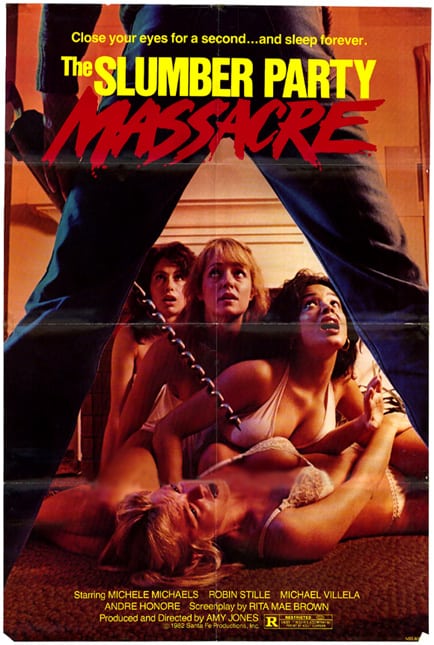
Trish (Michelle Michaels) is a high school senior who decides to hold a slumber party at her place while her parents are away. She invites Kim (Debra Deliso), Jackie (Andree Honore), and Diane (Gina Mari). She tries to invite Valerie (Robin Stille), who lives right next door to her, but she declines after overhearing the other girls talk about her in a catty way while in the locker room. As the girls prepare for the party they get harassed by Neil (Joseph Alan Johnson) and Jeff (David Millbern) who try to scare them by fiddling with the fuse box and turning the power in the home off, but none of them are aware that a real killer named Russ Thorn (Michael Villella), who has escaped from prison, and his quietly stalking them while using an electrical drill as his weapon.

The script was written by feminist writer Rita Mae Brown, who intended for it to be a parody, but when producer Roger Corman read it he saw as a conventional slasher and hired Amy Holden Jones, who had worked for his company for many years as a film editor, to direct it. While some will complain that the parody concept should’ve been left in I actually think it works better and in some ways is even funnier to have genuine scares and gore mixed in with the laughs. Too many other horror comedies try too hard to be funny, like with Pandemonium, where so much effort gets put into the humor that there’s no scares to be had, which will alienate a true horror fan, but here audiences who like a little of both should enjoy it.

I’ll admit that the movie does start out rocky. While I liked the organ soundtrack everything else comes-off as painfully amateurish.  Having one of the students, played by Brinke Stevens, run back into the school that is closing to retrieve a book from her locker is dumb. For one thing the building was completely locked up, so how did the killer get inside? Chaining the doors shut from the inside such as here isn’t done and illegal as it’s considered fire hazard. The victim is also too passive as the killer drills a small hole through the door of the room that she’s hiding in, but he’d have to drill many, many more holes for him to break down the door, which should’ve given her, albeit injured, but still mobile, plenty of time to figure another way out like crashing through a window, but instead she screams and essentially gives up.

Some critics complained about the gratuitous nudity especially for a film directed by a woman though it does try to equalize this by also showing the naked backside of a man while two of the girls, Valerie and her kid sister Courtney, page through an old issue of Playgirl, which I found amusing. What bugged me though was that the women looked too old to be playing high school students and appear to be far like 25, or even older. They also have terrific figures, like models in a soft core porn flick, and for the sake of balance there should’ve been at least one that was heavy-set, perhaps Valerie, and this could’ve explained why she was rejected and not invited to the party because she wasn’t ‘pretty enough’ to be in their clique.

The second and third act I found, much to my surprise, to be highly entertaining and even clever particularly the scene where Valerie watches a scary movie on TV even as a real horror, unbeknownst to her, is occurring just outside her door. There’s also some really funny lines that were clearly leftover from Brown’s original script and completely hits the target. It also features a nifty emasculation moment, which has all helped to give this a huge and well-deserved cult following. Followed 5 years later by a sequel, which we’ll review tomorrow.

My Rating: 7 out of 10

Released: March 12, 1982

Runtime: 1 Hour 17 Minutes

Rated R

Director: Amy Holden Jones

Studio: New World Pictures

Available: DVD, Blu-ray, Plex, PlutoTV, Tubi, Shout Factory TV, Amazon Video

Mumsy, Nanny, Sonny & Girly (1970)

girly1

By Richard Winters

My Rating: 3 out of 10

4-Word Review: Family plays weird games.

Sonny (Howard Trevor) and Girly (Vanessa Howard) are brother and sister who live with their mother (Ursala Howells) and nanny (Pat Heywood) in a large stately mansion in rural England. Despite both being adolescents they still sleep in cribs and behave as if they’re only 5. They enjoy playing what they call ‘The Game’, which is bringing home strangers, usually homeless men that they’ve met at a park, and forcing them to dress in a schoolboy’s outfit and compelled to behave like a child. If they refuse they are then ‘sent to the angels’.

The film was a product of famed British cinematographer Freddie Francis who wanted to make a movie inside the Oakley Court, which is a castle built in 1859 that overlooks the River Thames. He commissioned his friend Brian Comport to write the screenplay with the only condition being that the action had to take place on the Oakley Court property. Comport decided to revolve the plot around a play called ‘Happy Family’ written by Maisie Mosco, which dealt with a family that got involved with role playing games. Both Francis and Comport disliked the play, but were intrigued with the concept and decided to turn it into the genesis for a horror movie.

The film can best be described as experimental and has an intriguing quality to it, which holds your interest for the first 30-minutes, or so. One of the best elements is the alluring performance of Vanessa Howard, who’s able to mix her beauty with that of an evil mischievous nature. In fact the entire cast does an exceptionally fine job despite the material not offering much in the way of characterizations. The cast gives off an energetic zeal that keeps you compelled even as very little else happens. I kept thinking how sad it was that these actors put so much effort into a movie that fell into obscurity almost right away and this it turns out was the very reason why Howard left the profession just a few years later.

Outside of the acting there’s little else to recommend as the flimsy plot gets stretched far more than it should. There’s also no normal character that the viewer can relate to. Initially I thought it would be Michael Bryant, who plays a middle-aged male prostitute that they bring back to their place as one of their ‘new friends’, but he ends up behaving almost as weirdly as the rest. There should’ve been some outside force that intervened like a police inspector that would come to the castle to investigate the disappearance of one of the prostitute’s female clients, played by Imogen Hassall, that he and the two teens kill when they push her off a slide, which could’ve added tension and nuance that is otherwise lacking.

The film is also too skittish with the shocks. It’s supposed to be a horror movie, but there’s barely anything in it that’s all that disturbing. Sure, it does imply some dark things, but it doesn’t show any of it. The victims die too easily to the point that the death scenes aren’t any fun to watch. The part where a woman falls from a children’s slide at a playground and dies instantly is ridiculous as it wasn’t a high enough for the fall to have been fatal.  Another scene is the discovery of a severed head inside a boiling pot of water, but it never  gets shown, which comes-off as a total cop-out. I realize this was made in the 60’s in England where the culture was quite prudish to gore and violence, hence the creation of the infamous ‘video nasties’, which was a list of banned horror movies that came out about a decade later, but if you’re going to create a story that is dark and edgy, such as this one, then you should have the balls to push-the-envelope in order to give it a payoff, which this thing is ultimately devoid of.

Alternate Title: Girly

Released: February 12, 1970

Runtime: 1 Hour 47 Minutes

Rated R

Director: Freddie Francis

Studio: Cinerama Releasing Corporations

Available: DVD, Amazon Video

The Toolbox Murders (1978)

toolbox

By Richard Winters

My Rating: 5 out of 10

4-Word Review: Handyman targets female tenants.

A man, haunted by memories of the death of his young daughter in a car accident years earlier, begins systematically killing-off women residing in an apartment complex who he believes are living sinful lifestyles. Laurie (Pamelyn Ferdin) is a teen who lives in the same complex just a few doors down from where the murders occurred. One evening while alone the killer sneaks into her place and kidnaps her. Since she resembles his deceased daughter he does not kill her, but instead ties her up to a bed where he talks to her as if she’s his daughter come back to life. As she remains imprisoned her brother Joey (Nicolas Beauvy), unhappy with the sloppy job done by the police, decides to do the investigating of his own with the help of Kent (Wesley Eure) who’s he nephew of Vance (Cameron Mitchell) who owns the building where the murders have been happening. Joey unearths clues, which leads him to believe he knows who’s responsible, but finds opposition in Kent, who wants to block him from finding out who the culprit is.

This film was just about the final word in graphic exploitation fare that permeated the era where every horror film competes to see how they could be gorier and more explicit than the others. This one is unusual in that it starts out right away with the killings, but then during the second and third act it slows way down and becomes a talk-feast with very little gore at all. I did though find it interesting where instead of intense, creepy music that usually gets played when a killer stalks his victim we instead hear laid-back country songs, which would’ve been even more inspired had they not all been by the same artist.

The identity of the killer is given away early, which is also different from other slashers that try to keep it a secret until the end. In a lot ways this makes it less intriguing though Mitchell’s performance still keeps it interesting. What I didn’t like was the stupid police inspector, which is poorly played by Tim Donnelly who was the brother of the film’s director, and his inept ability to figure out who the killer might be even though the viewer and other characters catch-on very quickly. I know some policemen aren’t always the smartest, but even the dumbest would’ve been able to pick up on the obvious clues that this one unbelievably overlooks.

The fact that none of the women scream, at least not during the first act, was rather bizarre especially when one of them (Evelyn Guerrero) walks into the crime scene sees her friend (Marciee Drake) lies in a bloody mess, but she doesn’t respond in a shocked way and just stares as if gazing at a picture on the wall. Having the police interview the neighbors directly over the nude, dead bodies of the victims, was a bit ridiculous too as the victims in most any other crime scene would’ve been covered in a blanket and taken away to a coroner and the scene secured before anyone else could be let in that could potentially tamper with the evidence.

The biggest thing that bugged me was that it’s never shown how the killer is able to so easily get into the apartments. I realize it’s because he has a master key, but that actually needs to be shown with a shot of a key going into the lock. The film though never does this, so instead we just see the door knob turning like these people have been dumb enough to leave their doors unlocked even as a killer lurks about.

The performances are the one thing that holds it together. I especially liked Ferdin and the genuine look of fright in her eyes and tears rolling down her face as she’s been held hostage. Her sincere expression of terror connects with the viewer and makes them even more concerned for her welfare. I’m also friends with her on Facebook and she’s posted about the final scene where she’s wandering around a parking lot barefoot and in her nighty, which was apparently shot in cold temperatures, so having her dressed like that in such freezing conditions and remain professional is commendable too. It’s also entertaining seeing Wesley Eure, best known for his work in the TV-show ‘Land of the Lost’, playing a psycho, of which he’s surprisingly effective.

While the denouncement states that this was based on actual events it really wasn’t. It was loosely inspired by some cases of serial killers using tools to kill their victims, but the characters and overall scenario was largely made-up. The story was remade in 2004, but much of the violence and explicitness of this one was taken-out and toned down while also making major changes to the plot.

My Rating: 5 out of 10

Released: March 3, 1978

Runtime: 1 Hour 34 Minutes

Rated R

Director: Dennis Donnelly

Studio: Cal-Am Productions

Available: DVD, Blu-ray, Amazon Video, Tubi, YouTube

Victims (1982)

victims1

By Richard Winters

My Rating: 4 out of 10

4-Word Reviews: Haunted by childhood memories.

Paul (Tony Vorno) is plagued by inner-demons including voices and repressed childhood memories that cause him to go through life having violent outbursts, which he mainly takes out on various women both prostitutes and those he meets at random. He goes to Dr. Russo (Jerome Guardino) who specializes in hyno therapy in hopes that if put under hypnosis his rages can be controlled. As the Dr. analyzes Paul’s case, both he and his assistant Marian (Lenore Stevens), find that Paul’s difficult childhood where he was raised by a prostitute mother (Lois Adams) and witnessed the abuse she took from her violent pimp may be what’s causing Paul’s psychological torment now.

This film, which was written and directed by the lead actor who made a career of either directing, producing, or acting in exploitative films all through the 60’s and 70’s, was made in 1976, but languished in obscurity for years only to finally be given a video release 6 years later. Recently the film has acquired a cult following mainly because of the similarities with that of Maniacwhich starred Joe Spinell. That movie was structured as a conventional slasher/horror while this one is more of a drama where the rapist is portrayed as someone to sympathize with due his psychological scars that he can’t seem to overcome.

The movie though lacks the violence and gore one has come to expect with these types of films. The sexual assaults happen too quickly, many times last only a few seconds, or sometimes are created to be false flags that done’t lead anywhere including the time Paul stalks a young child, which you think is because he wants to attack her, but instead it’s to save her from a speeding car. While the film turns out to be much less exploitative then it originally sounds, it’s also frustrating as very little happens and the set-ups don’t manifest into any type of shocks, or scares. You start to wonder if there is going to be any pay-off to it especially with the grainy looking production that is quite cheap and amateurish otherwise.

The scenes dealing with Paul’s childhood memories don’t work because we never see the child, only his point-of-view, and includes Vorno speaking in a child’s voice off-camera, which isn’t convincing and kind of pathetic. To get the full intended impact  a child’s innocent face gazing at the horrors around him needed to be seen. Even if it meant splicing in shots of  a child’s face later, so the young performer wouldn’t have to have been on the set to witness the adult dialogue and action, would’ve worked, but either way the visual is the thing that propels movies and needs to be implemented and not compromised as much as possible.

The film’s final few minutes are disturbing and almost makes sitting through the rest of it worth it, but this could still be tough going for viewers expecting a conventional horror flick, which this isn’t. The flashbacks seen at the beginning, which gives away what happens at the end, weren’t needed and hurts the climactic effect though it still remains a dark and ugly journey nonetheless.

My Rating: 4 out of 10

Released: July, 1982 (Video Release Only)

Runtime: 1 Hour 22 Minutes

Rated R

Director: Tony Vorno

Studio: Paulie Productions

Available: None