Category Archives: Comedy/Drama

The Landlord (1970)

By Richard Winters

My Rating: 8 out of 10

4-Word Review: In over his head.

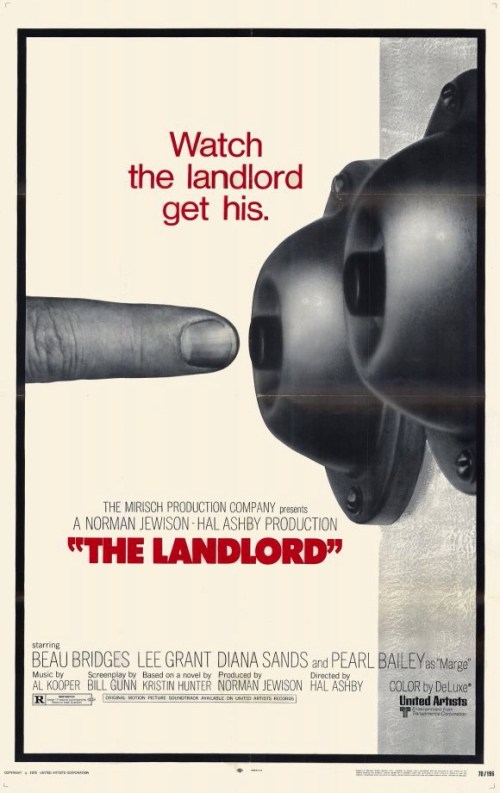
Elgar Enders (Beau Bridges) is a spoiled 29 year-old from a wealthy family who is still living at home with his parents in an affluent suburb of New York.  He decides it is time to ‘make his mark’ by purchasing a rundown building housing black tenants in inner-city Brooklyn.  He plans to evict the people and have the structure renovated into a posh flat.  He starts having second thoughts though as he gets to know the people and learns of their struggles.  He begins a relationship with one of the women (Diana Sands) and soon he is working to upgrade the building as well as trying to enlighten his racist, snobbish parents (Walter Brooke, Lee Grant) to embrace the black movement.

The Enders character is a perfect microcosm to the 70’s period where idealism and efforts to improve inner-city life, as well as some of the harsh realities that came with it, where at an all-time high.  Director Hal Ashby’s first film is full of strong gritty visuals from the rundown, graffiti-laden buildings to the garbage strewn lawns. Everything was filmed on-location and you get a vivid taste of the black experience. It is boosted even more by the detailed cinematography of Gordon Willis, which makes the most of the natural lighting and making you feel like you are right there.   The honest no-holes-barred approach is terrific. It perfectly captures the mood and feel of its era. I was surprised for a first time director, even a really good one like Ashby,  how well-constructed and technically sharp this was, which could have some link to the fact that it was produced by another great director, Norman Jewison, whom I’m sure lent a lot of input.

Initially I found the Elgar character to be off-putting, but that could’ve been intentional.  We first see him sitting on his lawn chair being served a drink by a black servant while talking about his great plan and looking like a spoiled, snot- nosed kid who has been coddled all his life.  The one scene that I remembered from this film when I first saw it over 20 years ago is when he  gets out of his Volkswagen bug to look at the building while wearing a tacky looking Pat Boone white dress suit.  When some of the black men sitting on the building’s front steps tease him a little, he immediately panics and runs eight blocks down the street in terror even though no one was chasing him.  However, he does start to grow on you as the film progresses.  I liked the fact that he faces adversity and is not scared away.  He learns to persist and adapt.  He genuinely starts to care about the people and backs-up what he says to the extent that he single-handedly carries new toilets one-by-one from the hardware store to the apartment building when the plumbing breaks down in an amusing vignette.  He isn’t afraid to tell off his arrogant parents when he needs too and his definition of NAACP is pretty funny.  It is satisfying to see him mature, learning that instituting change is not easy and things are the way they are for a reason.  He eventually is forced to confront his own limitations, but becomes a stronger person for it. This is without a doubt Bridges best performance to date.

There are other great performances as well.  Pearl Bailey is a gem as one of the building’s feisty, older women tenants who is the first to befriend Elgar.  Her awkward visit with Elgar’s equally feisty mother is considered the film’s highlight by many viewers and critics. I also loved the look she gives Elgar at the very end when he tries to wave goodbye to her.  The gorgeous Diana Sands is outstanding playing the role of Francine who has an ill-fated affair with Elgar. She shows just the right balance of sexiness and seriousness and it was a shame that just a few years after this film was made she ended up dying of cancer at the young age of 39. Susan Anspach is fun in one of her early roles as Elgar’s pot smoking sister.  The performance though that leaves the strongest impression is that of Lee Grant who is hilariously hammy as Elgar’s priggish mother.

When I first saw this film I came away thinking that it was uneven and a bit bipolar. It runs most of the way as a gentle, quirky satire filled with goofy cutaways, but then ends with a very stark and frightening scene with Elgar being chased down the grimy hallways of the building by Francine’s angry ax-waving husband (Louis Gossett Jr.) when he finds out that Elgar has gotten his wife pregnant.  The scene is ugly and intense and a far cry from the rest of the film’s gentle tone. Yet upon second viewing I think this scene works and was necessary. It makes a good statement at how volatile temperaments can be of those that are forced to leave in squalor as well showing how easily people, even with the best intentions, can get in over-their-heads when they don’t fully appreciate, or understand the situation that they are getting into it.

The side story involving a mulatto women (Marki Bey) who falls in love with Elgar is solid as well and gives the viewer a keen insight as to how difficult it is for someone who can’t seem to be accepted by either race. The language and conversations are tough and vulgar, but always laced with realism.

The only complaint I have with the film is the portrayal of the white characters who are buffoonish and overly idiotic even for satire.  I thought the idea of having them still use black servants was over-done, but then when one of them shows up at a party wearing blackface it was overkill. I thought it was unfair and unrealistic in the way that the film worked so hard to give depth to its black characters, but then turns around and, with the exception of Elgar, paints the whites as nothing more than broad caricatures.

The Landlord has finally been released on DVD through MGM’s Limited Edition Collection. I would suggest this film for anyone who enjoys an intelligent comedy-drama with something to say. It is also a great chance to see young up-and-coming actors. This includes Hector Elizondo as well as comedian Robert Klein. You can also get a very quick glimpse of Samuel L. Jackson who appears briefly in an uncredited role as a minister near the end.

My Rating: 8 out of 10

Released: May 20, 1970

Runtime: 1Hour 52Minutes

Rated R

Director: Hal Ashby

Studio: United Artists

Available: VHS, DVD

All the Marbles (1981)

By Richard Winters

My Rating: 5 out of 10

4-Word Review: These wrestlers are hot.

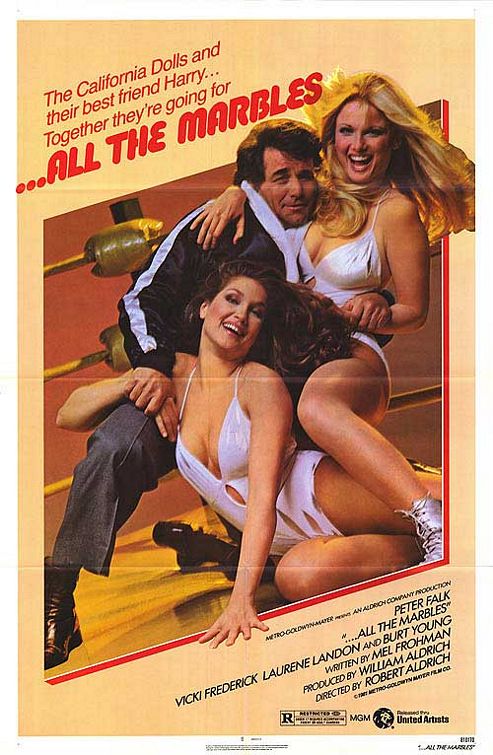
Peter Falk does another terrific job playing a lovable, but eccentric character. Here he takes on the role of a con-man type manager of two lady wrestlers (Laurene Landon, Vicki Frederick).

This film marked the final project by director Robert Aldrich who did such classics as Whatever Happened to Baby Jane, The Dirty Dozen, and Kiss Me Deadly. Although it didn’t do too much on its initial release, it has since acquired a small, but fervent following. These people insist this is the best movie about wrestling and some even go as far to say it is the best sports-themed movie ever. Warner Brothers has become aware of the attention and has now added it to its special-order DVD collection that can be purchased for twenty-five dollars from its archive website.

I remember when this film was released and after seeing the previews I was convinced it was just a mindless T&A picture, but I have read about enough people who have liked it that I decided I needed to give it a view. However, I came away from the film unimpressed with the majority of it. The main problem is that, although labeled a comedy, they stick in some awkward drama in order to show the downside of the wrestling profession. It doesn’t work because the two women playing the wrestlers can’t act. Landon in particular is a problem. She plays the blonde half and has an annoying monotone quality to her voice making her sound like she is simply reading her lines straight off of the script. Both lady characters seem to react to everything in predictable ways and thus become boring. The scenarios and conversations are soap opera like and end up bogging the whole thing down.

I like the attempt at showing the gritty side of the business and even inserting some realism, but this could have been down in a satirical form while still keeping it consistently funny.  A film like Smile from 1975 made some trenchant comments about the beauty pageant business, but remained funny and clever throughout without any of the strained drama like here.

Now with that said, I can still see why this film has attracted some fans and that is based solely on the wrestling scenes, which are excellent. The two actresses were trained by Mildred Burke a famous female wrestler from the 30’s and 40’s.  The techniques they use are true to form and look very authentic and, at times, even painful. Aldrich captures the action from different angles and it is fast and furious. I am no wrestling fan, but found myself caught up in it. The wrestling scenes are without question the best part of the film and there should have been more of them. The climatic match closely resembles the Rocky formula and it is a lot of fun. The highlight here comes when the two women attack and beat-up the crooked referee (played by Richard Jaeckel).

I must also mention that I like Burt Young as the heavy. He gives off one of the creepiest, weirdest laughs you will ever hear.  It was alsogreat to see legendary Los Angeles Lakers announcer Chick Hearn as the ringside announcer during the final match. He even ends up saying the film’s title.

If you don’t like wrestling than this otherwise obscure film is not worth checking out. If you do like wrestling than this film may be worth it however, I would suggest just fast-forwarding to those scenes and skipping the rest.

My Rating: 5 out of 10

Released: October 16, 1981

Runtime: 1Hour 53Minutes

Director: Robert Aldrich

Studio: MGM

Available: DVD (Warner Archive), Amazon Instant Video