Category Archives: Comedy

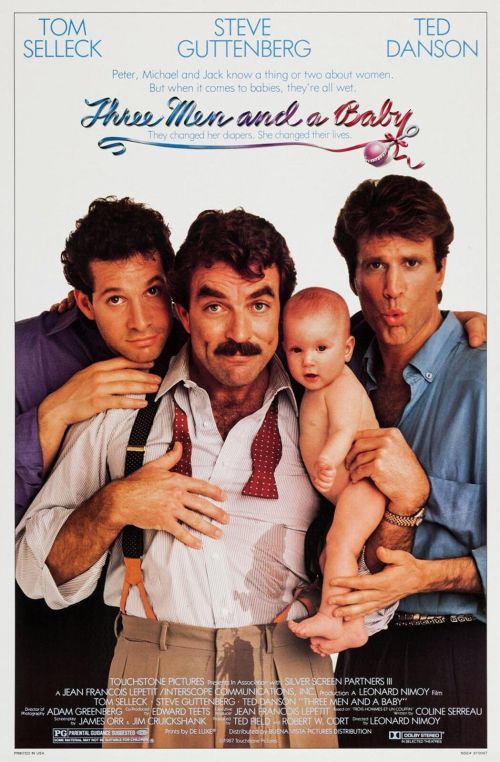
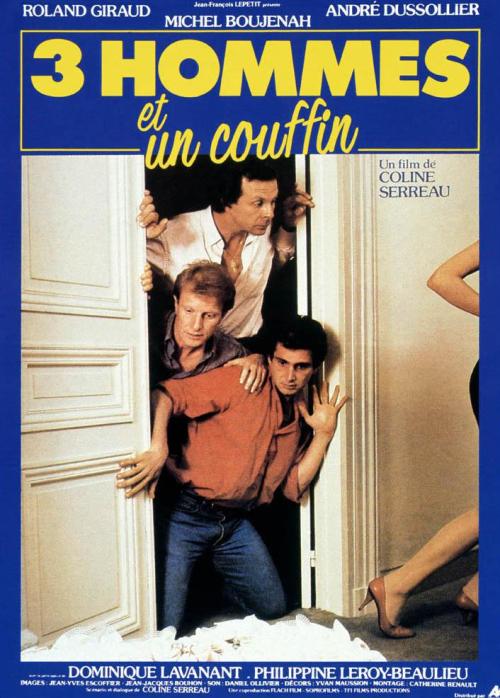
Three Men and a Cradle (1985)

threemencradle

By Richard Winters

My Rating: 7 out of 10

4-Word Review: Stuck with a baby.

Pierre (Roland Giraud), Michel (Michel Boujenah), and Jacques (Andre Dussollier) are three bachelors living in a swanky apartment who routinely bed hot women and throw wild parties. During a party one of Jacques’ friends informs him that he has a package and wants to have it delivered to their apartment for safe keeping. Jacques agrees and then goes flying off to Japan for a month as an airline steward. Pierre and Michel then find a baby at their doorstep that gets left by Jacques former girlfriend. Thinking this is ‘the package’ they begrudgingly bring her in and try caring for her despite having no idea what they’re doing. Meanwhile the actual package also gets delivered, which is a small box secretly full of heroin, which they think nothing of until the dealers arrive looking to pick it up and mistakenly take the baby instead.

A highly insightful look at bachelors and their ineptness and downright ignorance at infant care is brought splendidly to screen, at least with the first act. There’s many keen moments as they run around to pharmacies not knowing what sized diapers to get the kid, or the type of baby food, thinking it’s ‘all the same’ and needing to constantly go back and speak to the female druggist for clarity.  In fact the first 30-minutes are probably the funniest and could’ve just kept it at that theme and been a success though having Jacques away so much starts to make it seem like the title should’ve just been ‘2 Bachelors and a Cradle’ since the third one is little seen until much later on.

I also really adored the kid who is able to somehow cry on cue. Most infants are understandably hard to control, but this one reacts to the scene and situations perfectly and is in it surprisingly a lot. In most other films dealing with babies they usually get only shown in a crib for a few seconds here and there, with these shots spliced in, but here she’s like a genuine character that’s in it almost as much as the main ones. We also see her grow where at the end she’s doing her first walk and it’s cool that the ‘music’ done over the closing credits amounts to recordings of her baby blabbering.

Where the film starts to fall-off a bit is with the drug dealer side-story. I think the baby chores that the men had to go through could’ve been enough to carry it and adding in the crime thing made it seem unnecessarily exaggerated. It’s also ridiculous that the dealers tear up the entire apartment, and I mean they literally ransack the place cutting up and breaking all the furniture to the point that’s it’s an extraordinary mess. Then suddenly a little later it all goes back to normal, but how could they find the time to clean it all up while also taking care of the kid? This clean-up would’ve quite frankly taken many weeks and buying all new stuff, so this should’ve at least been shown, but instead it gets portrayed like they’re genies who can seemingly turn a trashed place into a clean one with a snap-of-a-finger.

The characterizations are rather weak as Pierre and Michel respond to things too much the same way and have very little distinction between them and could’ve easily morphed into being one person. The idea that these guys could just call off from work for not only days, but weeks at a time without even giving an excuse as to why and not lose their jobs for it seemed implausible. Granted the French culture isn’t a workaholic one like in America, but it’s pushing the bar to the extreme here and might’ve been more amusing seeing the guys taking the baby to their work and trying to somehow still get things done.

Spoiler Alert!

My biggest beef though comes with the girlfriend named Sylvia, played by Philippine Leroy-Beaulieu, who has the audacity to leave a helpless infant on somebody’s doorstep, walks away, and doesn’t think anything of it. What’s to say some stranger couldn’t come along and snatch the kid up before the occupiers of the apartment find it? What’s to guarantee that the guys in the apartment are even going to want to take the baby in, or if they do won’t inadvertently harm the child since they have no training on how to handle it? The fact that she returns months later with this bright beaming smile demanding to see her baby immediately like she’s some loving mother entitled to her kid whenever she pleases makes her seem even more outrageous. In most jurisdictions her behavior would’ve been considered reckless child abandonment and her parenting privileges taken away. Instead of handing over the baby she should’ve received a very stern lecture

Granted the film tries to make-up for this by having her return to the apartment saying she can’t keep up with the mothering duties and agrees to hand the baby over to the men. She also gets shown lying in the baby’s crib in a fetal position in order to symbolize that she’s immature, but still for a playful comedy this has some serious undertones that it glosses over, but are still readily there if you think about it.

My Rating: 7 out of 10

Released: September 18, 1985

Runtime: 1 Hour 46 Minutes

Rated PG-13

Director: Coline Serreau

Studio: Soprofilms

Available: DVD

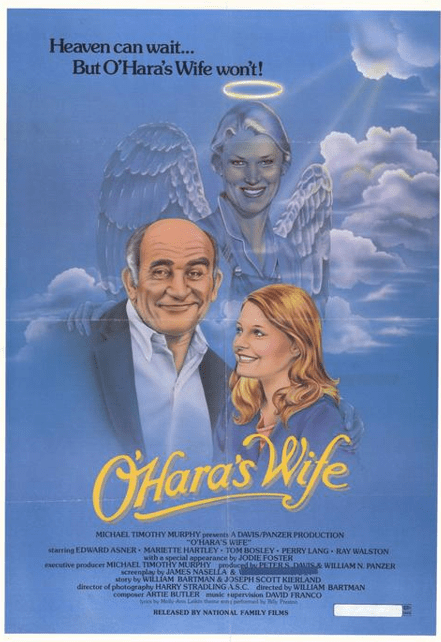
O’Hara’s Wife (1982)

ohara2

By Richard Winters

My Rating: 0 out of 10

4-Word Review: Wife turns into ghost.

Bob (Ed Asner) and Harriet (Mariette Hartley), whom he affectionately calls ‘Harry’, share a special bond and have been in a marriage for over 20 years that has produced two children, Rob (Perry Lang) and Barbara (Jodie Foster). They plan for a second honeymoon, but just before they’re ready to leave Harry suddenly dies. The grief-stricken Bob feels he can’t go on, but manages to stay focused due to the love and support of his children. Then one day, about a month after he death, she suddenly reappears in the form of a ghost. At first Bob runs away from her thinking he’s gone crazy, but then eventually settles to the idea that she’s going to be around wherever she goes and in return she helps him to understand that life is about more than just working hard and if he doesn’t learn to relax he too will soon be dying as well.

Feeble attempt at a ghost comedy, which has been done many times before in a far better way in such classics as A Ghost and Mrs. Muir and Topper just to name a couple. Right off the bat though this thing falls flat with a long drawn out song segment sung by Billy Preston, Billy’s a good singer, but just not here, that happens not once, but twice. A movie should not slow-up the pace with a droony song especially when that’s just ‘telling us’ through its lyrics what we already know is happening to the characters visually.

The second thing where this movie really gets dumb is when the wife just falls over dead for no apparent reason. One second she’s perfectly healthy and joking around with her hubby and then in the next instant she just literally falls over dead in the corniest way possible. The doctors diagnose it as a brain hemorrhage of some sort, but normally healthy, middle-aged people don’t just ‘fall over dead’. A better, more gripping and believable way would be to have her die in a car accident, or have her diagnosed with something early on, or at least complain about certain symptoms that will eventually lead to her demise, but to just croak instantaneously without any warning or set-up is about as stupid as it gets.

The ghost angle is just as poorly thought-out. I realize having ghosts appear and disappear and go through walls may seem cliched, but at least that had a logic to it and this thing doesn’t. Here we have her opening and closing doors to get through them as if she’s a regular person. Her husband can also feel and touch her and she can even use her body to stop his movement, but if she’s just a spirit then shouldn’t she be a vision only and not able to do those other things? She also panics when she sees her husband’s medical chart and realizes he has a serious heart condition and may die, but since her ghostly existence proves there’s essentially ‘life after death’ then why should she care? She acts like death is some sort of ‘end’ even though her appearance literally proves the opposite, so why not celebrate his impending doom as that will mean they’ll be in a ghostly existence forever and thus death will be a happy ending and not a sad one like her character seems to believe.

Hartley is certainly perky, she always seems perky no matter what she’s in, but her character is one-dimensionally nice, and not fleshed-out enough to be interesting in any way. Asner has some funny bits particularly when he must deal with this ghost wife when someone else is around who can’t see her and thus making his behavior look pretty weird, but overall he’s a bit too old for her, almost like he could’ve been her father, and a younger actor more age appropriate to Hartley would’ve been better. Mary Jo Catlett, as Asner’s much put upon secretary as some endearing moments, but ultimately it’s Foster, who gets billed as having a ‘special appearance’ though she’s in a good chunk of it, that comes off best though I didn’t initially recognize her as she has darker hair here and on a bit of the chubby side  and I could only tell who she was at first by the sound of her voice.

I did like how it attempts to tackle family drama and how as children age and become adults may not see things eye-to-eye not only with their parents, but siblings as well. This becomes especially apparent with Rob who doesn’t agree with his father quitting his job and the two share a couple of raw moments, which is good because these things do occur in real-life families, but then the film glosses over this issue by having the two magically reconcile a little bit later, which like with everything else in the movie is too shallow.

My Rating: 0 out of 10

Released: December 3, 1982

Runtime: 1 Hour 27 Minutes

Rated PG

Director: William Bartman

Studio: O’Hara Cinema Group

Available: DVD-R

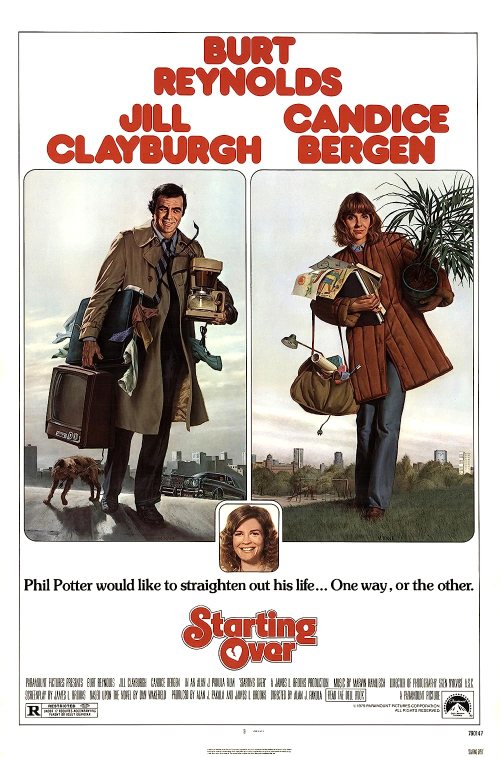
Starting Over (1979)

starting1

By Richard Winters

My Rating: 7 out of 10

4-Word Review: Can’t get over ex.

Phil (Burt Reynolds) gets a divorce from Jessica (Candice Bergen), a successful songwriter, when he finds out she’s been having an affair. He then moves to Boston where his brother Mickey (Charles Durning) and sister-in-law Marva (Frances Sternhagen) set him up with Marilyn (Jill Clayburgh) a nursery school teacher. They don’t initially hit-it-off, so he instead goes out with Marie (Mary Kay Place), but that doesn’t go over well either, so he again calls up Marilyn and this time she relents. Despite the usual ups-and-downs things between them begin to gel and soon they decide to move in together only to have Jessica reappear wanting to get back with Phil and Phil becoming torn as to what he should do.

Based on the novel of the same name by Dan Wakefield with a screenplay by James L. Brooks best known for producing the classic TV-show ‘Mary Tyler Moore Show’. Like with that show the story focuses heavily on the pitfalls of dating life with much of it on-target though it does have a serious out-of-touch quality that’s no longer in-tune with today’s generation. The big one is that they meet on their first date inside the women’s apartments, which because of safety concerns doesn’t happen much now and usually it’s always advised to meet in a public setting and not give out personal addresses until you really get to know the person better. There’s also a scene where Jessica, who wears a highly revealing outfit, meet in Marilyn’s apartment and have what we’re told is a civil three hour conversation though in this day and age it’s hard to believe two women, knowing that the other one is clearly after ‘their man’, could be that composed and most likely a fight would break-out and I’m kind of surprised knowing how emotional Marilyn was and wearing her insecurities on her sleeve, that one didn’t happen here.

On the flip side there’s some terrifically funny moments.  One is when Marilyn and Phil initially get off the bus together, before they’ve officially met, and she thinks he’s a stalker, which has a good true-to-life feel. Another great scene is when Phil and Marilyn briefly break-up and he goes to her school, where they’re having a dunk-a-teacher water party and he manages to hit the bullseye with the ball he’s throwing and she’s goes into the water repeatedly before eventually losing her cool and swearing. Phil’s anxiety attack inside a department store is memorable too as his Jessica’s call to Phil at his apartment while he’s serving Thanksgiving dinner to Marilyn and his guests, which creates quite the awkward moment. Phil’s first date with the aggressive Marie is a terrific bit too.

The acting is top notch especially Clayburgh who creates the perfect composite of single women during the 70’s who desperately wants to get into a relationship, but many times allow her fears and anxieties to get in the way. Reynolds is excellent playing against type. Normally he’s a brash womanizer, but here he’s far more reserved and indecisive.  This is also the last movie where he didn’t have his patented mustache and I felt he looked way better and younger without it. Even Bergen, in a much smaller role, is memorable particularly with her off-key renditions of the songs her character has written.

Overall I consider this one of the best romantic movies made. I will admit a modern remake would give the story a more timely update, but the situations nicely reflect the dating conundrums that affect us all.  My only complaint would be with the Clayburgh character, who seemed too insecure to be able to get into a healthy relationship. Most guys would be scared off with her constant emotional outbursts and accusations and I didn’t see why Phil stuck with it. This is one instance, especially since Phil was pretty much a hunk, that I felt the woman he fell for should’ve been better looking, or at least equal to the Jessica character that he left. I just couldn’t understand exactly why, being that there were a lot of women who could easily get into him, he’d choose, or settle for, Marilyn over all the others. Had they had more in common then maybe, but she came-off like a woman who would eventually become a cat lady and too emotionally needy to be someone you could have a long term relationship with.

My Rating: 7 out of 10

Released: October 5, 1979

Runtime: 1 Hour 45 Minutes

Rated R

Director: Alan J. Pakula

Studio: Paramount Pictures

Available: DVD-R, Amazon Video, YouTube

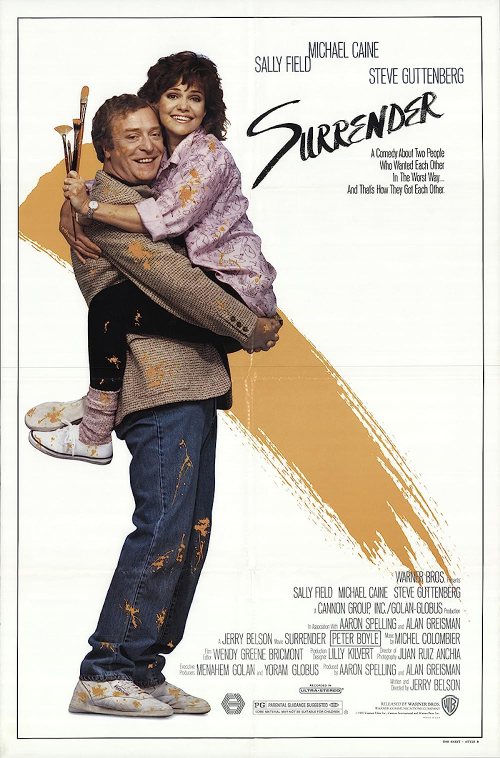
Surrender (1987)

surrender

By Richard Winters

My Rating: 1 out of 10

4-Word Review: Pretending to be poor.

Sean Stein (Michael Caine) is a successful novelist, who after suffering through two contentious divorces, has decided that women are only after him for his money and considers them off-limits. Daisy (Sally Field) is a struggling artist, who is in a relationship with Marty (Steve Guttenberg), a successful attorney with no interest in making a long term commitment. While attending a charity ball that gets overrun by gunmen who rob the place, Sean and Daisy, find themselves tied-up together and despite the stressfulness of the situation slowly get to know each other. The next day, after they ultimately get freed, Sean asks Daisy for a date, but decides to pretend that he’s poor to make sure she loves him for who he is rather than because of his money.

While Jerry Belson wrote several successful comedies during the 70’s and based this story loosely on his own life experiences where he proudly stated that everything that happened to Sean in this movie happened to him in real-life, the pacing and basic comedy scenarios really don’t work. It starts out alright  as they’re several flashbacks showing Sean with his attorney, played by Peter Boyle, battling his ex-wives in court. The different hairstyles that they have as they go through the years is funny and the most creative thing in the movie. I was though disappointed that the two women who play the ex-wives, Louise Lasser and Iman, are never give a single word of dialogue, which wastes the talents of these well-known actresses.

After the first ten minutes though things quickly fall apart. Having armed thieves crash the party that the two are at is particularly troubling as there is no forewarning for why this is happening. People who attending posh parties usually don’t find themselves at gunpoint, so why are they here? Had there been even a fleeting mention of a group of criminals crashing area get togethers then maybe, but here we get no explanation either before, or after giving the plot a haphazard quality like the filmmakers are happy to throw in any crap they want whether it makes sense, or not. The characters respond to what most would consider to be a traumatic experience like it’s just a ‘run-of-the-mill thing’ and by the next day barely remember it, even though many people would have genuine PTSD after it was over.

Caine’s attempts to woo Sally would in most cases have the woman thinking he was a potential stalker. First he comes to her house six hours before their date saying that he couldn’t wait that long to see her and wanted to spend every waking minute with her that he could, which for any sane woman would be a serious red flag. He then kisses her without her consent and begs for immediate sex, or he might not be able to control himself and instead of calling 9-1-1 she gives him a pity fuck. Not only is this unfunny and stupid, but an insult to the viewer’s intelligence that they would find any of this to be a normal, well-adjusted way to start a healthy relationship.

I also thought Caine, who was a raving misogynist who even had signs on the front gate of his home banning women from entering, came around to liking Sally too quickly. Sure she was kind to him when they were tied-up, but an avowed women-hater doesn’t just change his ways overnight, but in this movie that’s exactly what happens, which isn’t realistic. If anything it should’ve been Sally chasing after Caine, who might’ve liked her a little at first, but so set in his ways would still decide to avoid her and only after an extended period of time, and continual prodding by Sally, would he eventually relent.

The pretending to be poor thing isn’t handled well either. I was expecting there to be a lot of comic moments dealing with Caine trying to desperately hide his wealth and background, but that never gets played out. He isn’t even forced to rent himself a seedy, little apartment in order to hide the fact that he lives in a mansion as Sally was apparently never curious about seeing his place, but how many serious relationships are there where they always go to one partner’s home and never the other?

The third act gets even more ridiculous as it has Caine insisting that Field needs to sign a prenup agreement. She’s resistant at first, and even insulted, but then eventually signs it without ever bothering to read it, which is idiotic. She also goes to Vegas and wins 2 million dollars at the slot machine her very first time playing it, which is beating insurmountable odds.

I did like the scene where Caine hands Sally a manuscript he has written, which was published into a book though he doesn’t tell her this and then becomes insecure when she doesn’t immediately like it, which being a budding screenwriter myself, I found funny and despite all the other absurdity in the film, a bit true to life. I was hoping the movie would explore this situation more, but it doesn’t making the rest of it a sore disappointment.

I was surprised why either of these big name stars agreed to do it. I know Caine was willing to be in almost anything for the money, but I’m not sure what Sally’s excuse was and if you ask me I’d find the old reruns of her TV-show ‘The Flying Nun’ to be more entertaining. It’s easy to see why this dumb thing, despite the star quality, has never gotten a DVD or Blu-ray release and nobody’s been clamoring for it either. It bombed badly at the box office too managing to recoup only $5 million of it’s $15 million budget.

My Rating: 1 out of 10

Released: October 9, 1987

Runtime: 1 Hour 34 Minutes

Rated PG

Director: Jerry Belson

Studio: Warner Brothers

Available: VHS, Tubi

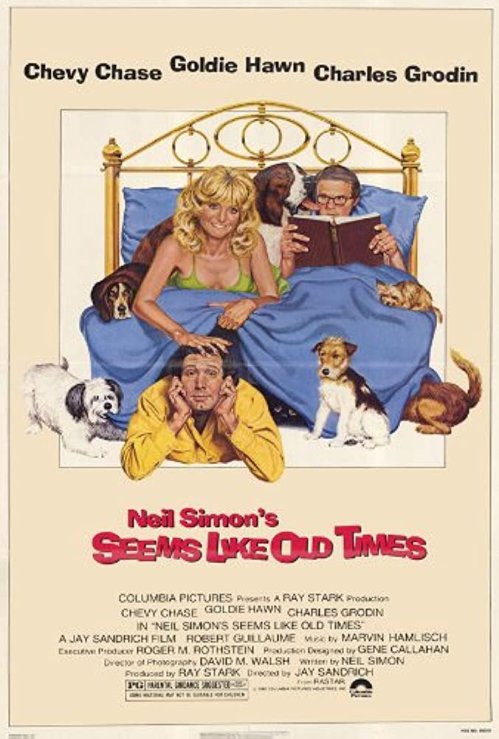
Seems Like Old Times (1980)

seems

By Richard Winters

My Rating: 7 out of 10

4-Word Review: Ex on-the-run.

Nick (Chevy Chase) is a lonely writer working on his novel at a remote seaside cabin, which he hopes will give him the isolation that he needs to allow his creative juices to flow. Unfortunately for him two bank robbers (Judd Omen, Marc Alaimo) stake-out the place and kidnap him and then force him at gunpoint to rob a nearby bank. Nick gets seen on the security camera and a warrant for his arrest is issued. He seeks help from his ex-wife Glenda (Goldie Hawn) a public defender who has remarried to Ira (Charles Grodin) who’s running for attorney general and fears that the notoriety of having his wife’s ex-husband on-the-run from the law could hurt his chances of getting elected. Glenda decides to help Nick by letting him stay in an unused bedroom above their garage while trying to keep him hidden, so Ira won’t find out. This scheme leads to many close calls and misunderstandings while also reigniting Glenda’s feelings for Nick, which she thought she had gotten over a long time ago.

While it may seem hard to believe now screenwriter Neil Simon was at the time, having just come-off his success with the hit The Goodbye Girl , considered chic with young adults particularly on the romance end and this film was the peak of that period as after this his material became increasingly more nostalgic. This works mostly because it remains focused on Simon’s patented one-liners and funny conversational quality, which is quite amusing though it would’ve been nice had it attempted to branch out into other forms of comedy like when Chase and Grodin have a physical fight that is never shown and instead we just hear the noise of it from inside the kitchen while the camera stays stationary in the other room. The visual gags and pratfalls from a funny fight could’ve helped add another dimension to the humor and thus I found this moment to be a missed opportunity.

The acting is uniformly wonderful particularly Chase in a role that takes full advantage of his glib, sardonic delivery probably better than any other film role he’s been in and this most likely was a result of Simon doing a 2-week rehearsal period where he observed the stars interacting with each other and made changes to the script based on the personalities of the performers. It’s good to see Hawn in a more mature role. Before this she played spacey-blondes who were young and on the fringe of society, but here she falls comfortably into a middle-aged setting of a career woman maintaining both a job, home, and marriage and showing the juggling act that this type of lifestyle requires. She’s also not the sole source of humor, but instead reacts to the zaniness around her with funny facial reactions. The supporting cast such as Yvonne Wilder as the heavy-accented Latina maid and T.K. Carter as the wise-cracking chauffeur who hasn’t fully gotten rid of his old ex-con ways are quite amusing too as are the pack of dogs that Hawn owns and proceed to run all over the house at all times.

Grodin was the only character that doesn’t really fit. I found it strange why someone who doesn’t like dogs and can’t stand the way they sleep on the bed that he shares with Hawn would want to marry a woman who was so into them. Outside of the fact that they were both lawyers I didn’t see what else connected them and it seemed like a mismatched marriage. On the other-hand I found it interesting he wasn’t portrayed as a jerk. In most romances were the old partner comes back into the picture the new guy is played-up in a way that makes the viewer dislike them and where you want to see the woman going back to her old flame instead of staying with the cad, but here that’s not the case, which works to some degree, but also hurts it.

Spoiler Alert!

The issue with the second husband really comes into play at the very end when it becomes painfully obvious that Simon couldn’t think up a way to resolve the dilemma and comes-up with one of the dumbest finales imaginable where Hawn and Grodin go driving into the wilderness during a rain storm, have a car accident in which Grodin gets injured and she treks off into the woods only to find an isolated cabin with Chase inside. The movie stops with a freeze-frame of Hawn’s face revealing a broad smile once she sees Chase opening the door making it seem like the two spent a cozy, romantic night in the cabin while Grodin remained suffering inside his stranded car, which wasn’t exactly humane.

Personally if I had written the script I would’ve done it differently, which I realize might’ve been considered ‘too edgy’ for 1980. However, since Chase’s character had been in a Mexican prison for awhile I would’ve had the experience bring out the dormant gay side of him. This could’ve helped explained why the two criminals came to his place to force him into a bank robbery was because they were guys he knew, or former lovers, from jail and they figured out where he lived and hence tracked him down to be a part of their scheme. This would help explain the opening as having them stake out such an extremely isolated place, which didn’t seem to even have any roads leading into it, just to find a willing victim never really made much sense otherwise. The Grodin character could also have some dormant gay desires, which would explain why his sex life with Hawn wasn’t so great. Chase could then take-up permanent residence in the room above the garage where he could, at different times, ‘service’ both Hawn and Grodin and the three could share a happy alternative lifestyle, which being that the story takes place in coastal California wouldn’t have been all that outrageous or unusual.

Another possibility would be to have Grodin played-up as being more into his political career than his marriage and thus pushing Hawn away, or he could just become sick and tired of all the dogs in the bed at night and decide to leave her, which would be understandable as I wouldn’t like sleeping with dogs either. In either case Hawn would be free to run back to Chase and the audience wouldn’t have had any problem with it.

The worse scenario though is how it ends here with Hawn selfishly getting it on with Chase, or at least implying this, while the man she’s married to remains stuck in pain inside a cold, damp car for who knows how long. At some point she’s going to have to decide which guy she wants more, or if she’ll just remain hopping between the two, but some finality needed to be given instead what amounts to a pathetic cop-out by a writer who clearly didn’t want the challenge of having to figure it out.

If anything I would’ve had her with a different facial expression. During the movie she was constantly hyperventilating with this shocked look every time she’d see Chase drop-in and that’s what we should’ve seen as the film’s final image.

My Rating: 7 out of 10

Released: December 19, 1980

Runtime: 1 Hour 40 Minutes

Rated PG

Director: Jay Sandrich

Studio: Columbia Pictures

Available: DVD, Amazon Video

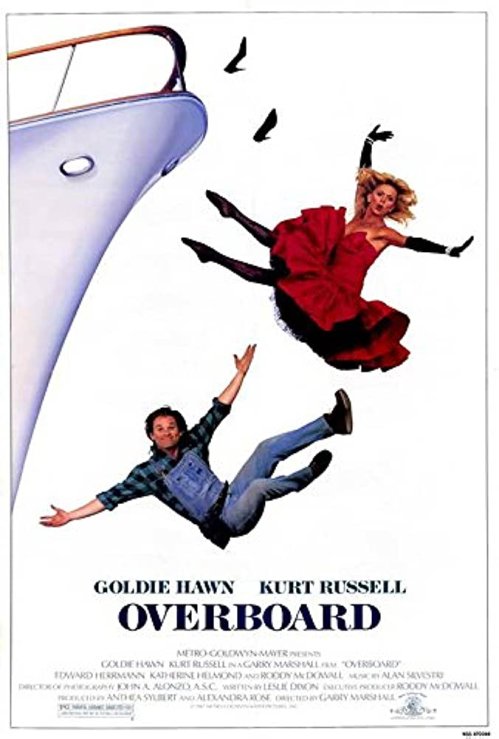
Overboard (1987)

overboard

By Richard Winters

My Rating: 1 out of 10

4-Word Review: Rich bitch loses memory.

Heiress Joanna (Goldie Hawn) is a wealthy and snobby woman who hires Dean (Kurt Russell), a carpenter, to remodel the closet that she has on her yacht. Since Dean is a widowed father of four boys (Mike Hagerty, Jared Rushton, Jeffrey Wiseman, Brian Price) he’s more than happy to take on the job in order to bring in extra money, but Joanna, treats Dean poorly, is unsatisfied with his work and refuses to pay him. She ends up throwing him overboard with his tools. Later that night while still on the yacht she goes on deck to retrieve a lost ear ring and falls overboard causing her to hit her head and lose her memory. She is rescued and taken to a local hospital. News shows report on the incident along with pictures of Joanna asking if anyone knows who she is. Dean, who is with friends at a bowling alley, sees the report and concocts a scheme to take advantage of her amnesia by pretending she is his wife and bringing her to his home to do chores and take care of his kids in order to repay her debt to him. The  plan starts out seamlessly, but eventually she begins to bond with both the kids and Dean and then her real husband, Grant (Edward Herrmann) arrives at Dean’s residence in order to take her back with him.

Russell and Hawn began their real-life relationship while working on Swing Shift and wanted to do another picture together. This uninspired script, which was written by Leslie Dixon who had better success with Outrageous Fortuneis a misguided hybrid between Houseboat, a 50’s romantic comedy that starred Cary Grant and Sophia Loren, and Swept Away, a classic 70’s Italian film involving a rich, snotty woman stranded on an island with a working-class man. Unfortunately all nuance gets thrown overboard (pun intended) and we get left with the most extreme caricatures possible. While Hawn is certainly a fine actress her over-the-top character is too cliched and heavy-handed to be even remotely interesting or believable and the film falls hopelessly apart before it even gets going.

The basic premise is full of loopholes. The idea that just anyone could show up at a hospital and insist that some woman is his wife when that women shows no recollection of him and he’s able to bring her home without showing any type of documentation, marriage license, or photograph of the two together is beyond ridiculous. Just saying he recognizes a tattoo on her rear end wouldn’t be enough; maybe the two had a one-night-stand, but it wouldn’t be proof positive that he was married to her and yet for this hospital staff it was. Also, it’s very unlikely that Grant, Joanna’s real husband, would be able to get away with denying her existence as long as he does. He pretends he doesn’t recognize her when he goes to the hospital, so he can then bring young women onto his yacht to fool around with, but his friends and most certainly Joanna’s meddlesome mother, played by Katherine Helmond, would’ve seen the news reports too and gotten on him to go retrieve her, but for some reason in this movie rich people don’t watch the news only the poor folks.

Russell seems to enjoy his part, but like with Hawn his character is a tired caricature that’s not remotely original, or unique in any way. While the movie tries hard to get you to like him I still felt what he does with Joanna by tricking her into thinking she’s his wife was highly exploitive and not forgivable even when factoring in the poor way she had treated him.

The four boys are yet another issue. With the exception of the one who talks in Pee Wee Herman’s voice, which was apparently ad-libbed and not a part of the script, there was no distinction between any of them and they all could’ve been combined into just one. It’s also hard to believe that they’d all agree to play along with Dean and pretend she was their mother when they really knew she wasn’t as most kids are notorious for not be able to keep a secret. I was surprised too that the kids would all accept this new woman into their life and forget that their real mother ever even existed. These kids, or at least one of them, would’ve had some bonding with the real one and been reluctant to just let that go and welcome in her ‘replacement’. The kids were also used to having no rules and doing what they wanted while their dad was away at work, so having a new person come in out of nowhere and start enforcing discipline would most likely caused a rebellion instead of them all embracing this newfound orderly lifestyle.

Had the characters and comedy been more subtle like perhaps having the Hawn character not being a super rich heiress, but just a suburbanite living in a better part of town who has a slight disagreement with Russell when he comes to her house to do some work, then this idea might’ve had potential. However, as it is, the caricatures are too silly and overblown for any viewer with discernable tastes to get into. Also, for such slight and predictable material it takes way too damn long to play-out. Should’ve only been 80 minutes not almost 2-hours.

My Rating: 1 out of 10

Released: December 16, 1987

Runtime:  1-Hour, 52 Minutes

Rated PG

Director: Gary Marshall

Studio: MGM

Available: DVD, Blu-ray, Amazon Video

Foul Play (1978)

foul

By Richard Winters

My Rating: 7 out of 10

4-Word Review: Beware of the dwarf.

Gloria (Goldie Hawn) is a recent divorcee who takes a car trip along the San Francisco coast where she comes upon a stranded motorist (Bruce Solomon). Since she is looking to meet new people she decides to give him a ride. The man says his name is Scotty and that he’s looking to give up smoking and gives her his pack of cigarettes in an effort to stay away from them. Unbeknownst to Gloria the pack holds a microfilm that a secret organization is after. That evening the two meet-up at a theater to watch a movie, but Scotty, who has already been stabbed, dies while sitting in his seat. Gloria runs to notify the theater manager (Chuck McCann), but when they return the body is gone. Later that night Gloria gets attacked in her apartment by a man (Don Calfa) with a facial scare. She stabs him with her knitting needles and he falls over dead, at least she thinks so, before she herself passes-out. When the she comes to two policemen are in her place, but with no evidence of a body. One of the officers (Brian Dennehy) thinks she may be nutty, but the other one (Chevy Chase) finds her attractive and therefore makes an effort to research her story and while Gloria and he work together to investigate the case they begin a romantic relationship.

While Leonard Maltin, in his review, or whoever wrote if for him, describes this film as ‘Hitchcock plagiarism’ I found it similar to High Anxiety that came out a year before, and more of a homage. Many other films that try to replicate Hitch’s style usually fail because they go overboard with the theatrics, or too much parody, but this one has a nice balance that is both intriguing and funny.  Another great quality of the film is the way it lovingly photographs the city and landscape of Frisco Bay from its beautiful shore line, to row houses, to the scenic boat houses where the Chase character resides. It’s almost enough to compel one to move there if only a person who wasn’t super rich could afford to live there.

The supporting cast is delightful and everyone of them has some really laugh-out-loud moments. Dudley Moore is the best, in a part written specifically for Tim Conway who shockingly turned it down, as a sex starved bachelor who brings Gloria to his pad filled with blow-up sex dolls thinking the two will have sex only to learn that’s the last thing on her mind. Marilyn Sokol as Gloria’s fiercely feminist friend is quite amusing as is dwarf actor Billy Barty as a bible salesmen who Gloria mistakes as being the killer. Burgess Meredith, as Gloria’s kindly old landlord, doesn’t come-off as well and gets upstaged by his pet python. It also would’ve been good had his character brought-up his judo skills earlier in the story instead of having it introduced later on when they must confront the bad guys, which was just a little too convenient though the karate match that he has with Rachel Roberts is quite entertaining and something I wished had gone on longer.

I did though have some issues withe the two leads. Goldie is as enjoyable as ever, but her character makes what I felt were grossly misguided decisions. One is picking-up a stranded male stranger on an isolated road, which from a simple common sense perspective is a major no-no. She also later-on blithely walks into her apartment even after she becomes aware that the front door has been broken into. In another scene she’s given mace and a pair of brass knuckles from her friend Stella to use for protection and Gloria is able to escape from a locked room and knock-out the bad guy with the help of these items, but then she throws them away before running out, but any logical person would hold onto them in-case they were needed again.

Chase playing a police detective was something that I just couldn’t buy into. He initially comes-off, when Gloria first meets him at a party, as a lecherous lounge lizard looking to hit on hot babes and not serious about much else. He’s also seen as being highly klutzy, so having this clownish womanizer suddenly turn into a dedicated cop doesn’t jive and seemed more like two completely different people. Brian Dennehy gives a far more realistic portrayal of a policeman and is actually funnier in his exasperated responses to Gloria’s crazy story, so he should’ve been the sole investigator and Chase could’ve been this ordinary doofus that she meets and because he has the hots for her he agrees to ‘humor her’ and help her out on the case. The story and romance could’ve remained the same, but casting Chase as a regular Joe, which he’s far better playing at, would’ve made better sense.

The story does become strained at the end with a speeding car sequence that’s more nerve-wracking than fun, though the elderly Asian couple that can speak no English and sit in the back seat of the speeding limo are amusing. The whole reason behind the crime and attempted assassination of the Pope is hooky and it would’ve been better had no explanation been given at all than explaining it away the way they do. However, the climactic sequence done during a performance of ‘The Mikado’ at the San Francisco Opera House, is terrific and a nice finish to what is otherwise perfect escapism.

My Rating: 7 out of 10

Released: July 14, 1978

Runtime: 1 Hour 56 Minutes

Rated R

Director: Colin Higgins

Studio: Paramount

Available: DVD. Blu-ray

Vasectomy: A Delicate Matter (1986)

vasectomy1

By Richard Winters

My Rating: 0 out of 10

4-Word Review: Father considers male sterilization.

Gino (Paul Sorvino) is a proud Italian man who has fathered eight children, but now his wife Anna (Cassandra Edwards) doesn’t want anymore kids and pressures him to get a vasectomy. Gino fears the procedure, but eventually agrees only to have an angry confrontation with the doctor (William Marshall), which sends him running away from the operating room. Anna insists that he still must go through with it, or he won’t be allowed back into bed with her until he does. Meanwhile Gino must also worry about his greedy relatives, who’ve concocted an elaborate plan to steal money from the bank he works at and put it out of business.

I don’t know if I’ve ever seen a movie quite this bad. It’s not so much for any technical miscues. No shaky camera, boom mikes getting into the screen, atrocious lighting, schlocky sets, or bad acting. In fact all of those things are okay. What really reeks is the bland script that is poorly paced and not funny. The film starts out really slow and never gains traction. For a comedy there needs to be a lively plot and quick edits, but this thing dies out before it even has a chance to get started. 18-minutes in and I was still waiting for the first laugh and became genuinely confused whether this was meant to be a comedy at all. 

The main plotline is so weak that the inane crooked loan scheme is added jut to pad the runtime. The living situation of the family is rather unrealistic as well. Of course since it was the 80’s, the height of capitalism, the question of whether a family could actually afford 8 kids is never addressed, but most people, even those working at a bank, might find that situation financially challenging. The home looks too well maintained for having all those kids too who would most likely be running around and disorganizing everything. The mother is never shown having to deal with them either. In fact she comes-off as an affluent suburbanite who’s fully in-control of her life and able to out with her lady friends without the typical struggles of having to juggle her personal life with child rearing demands. All 8 kids end up being boys, but what are the odds of that? They’re also all around the same age like she popped them all out simultaneously and all of them get crammed into the same bedroom even though the house they resided in looked big enough that that shouldn’t have been necessary.

Paul Sorvino manages to be solid even though with his rotund belly he does look a bit pathetic during the scenes where he wears a baseball uniform. He does though sing the national anthem surprisingly well, apparently he sang opera to the crew between takes, and the segment where he goes in to the operation and babbles incessantly, is actually kind of amusing. I was not impressed though with Edwards as she looked too young to be his wife like she was still in her 20’s while he was already in his late 40’s. 

While I’m not a violent person I would consider, if I ever met the director of this, Robert Burge, to punching him as I honestly felt like he maliciously stole 90-minutes of my life and I don’t understand what the purpose was for it. 33,000 scripts get submitted yearly, but only 1 percent of those ever gets sold or produced, so how the hell did this one sneak through? Even a crew member from the film stated in his IMDb review that he’d give this a negative rating if he could. Maybe the director was a guy that had enough funds he was able to produce it himself and therefore didn’t feel the need to answer to anybody. If that were the case then this would’ve been an instance where having never made a movie would be better than living with the embarrassment of your name being attached to this mess for all those unfortunate enough to see it.

My Rating: 0 out of 10

Released: September 26, 1986

Runtime: 1 Hour 30 Minutes

Rated PG-13

Director: Robert Burge

Studio: Vandom International Pictures

Available: VHS, DVD-R (dvdlady.com)


The Duchess and the Dirtwater Fox (1976)

duchess2

By Richard Winters

My Rating: 5 out of 10

4-Word Review: She steals stolen money.

Amanda (Goldie Hawn), who goes by the nickname Bluebird, works as a dance hall girl in the old west, but dislikes having to entertain the leering male clientele and looks for an opportunity that will allow her to live the ‘easy life’. She finally finds it in the form of a rich Mormon family from Utah who are looking for a nanny to watch after their large brood. In order to disguise herself as being one she’ll need to buy herself a suitable outfit, but she has no money. Then Charlie (George Segal), who goes by the nickname Dirtwater Fox, and who has just absconded with over $40,000 of stolen loot from the infamous Bloodworth Gang, walks into the saloon where Bluebird works and immediately starts flirting with her as she performs a dance routine on-stage. Bluebird finds him annoying, but agrees to go up to his hotel room as a prostitute performing a sexual service in order to get the money for her nanny outfit. However, once up there, Dirtwater refuses to pay her, so she drugs his drink, which knocks him out, and steals the briefcase with the stolen money. When Dirtwater wakes-up he goes after her and the two eventually meet back up, but find despite their mutual dislike that they must work together in order to avoid the vengeful clutches of the Bloodworth Gang who are hot-on- their-trail. 

The film was directed by Melvin Frank with a screenplay by Jack Rose, two men whose career peaks was during the 40’s and 50’s, but by the 70’s their senses of humor were quite dated and story ideas placid. After finding inexplicable success with the highly overrated A Touch of Classwhich starred Segal and Glenda Jackson, director Frank became convinced that he had a winning chemistry and wanted to re-team the two in a western romantic comedy. Jackson though rejected the offer and was replaced by Hawn, who quite honestly is the only good thing about the movie. She had been up to this time known for her dumb blonde, ditzy persona, but here goes against type by playing a sharp-tongued, no nonsense lady who takes little crap from anyone. She plays the part perfectly and in the process grows as an actress. Her use of different accents is fun as well as being spot-on and the song and dance routines that she does despite Leonard Maltin calling them in his review ‘misplaced’ are actually quite entertaining and deliciously bawdy. 

Segal though is the film’s detriment. His acting is weak and a good example of this is when he’s caught cheating at a card game and strung up by a noose by an angry mob and yet even as the rope is put around his neck he remains cool and calm when anyone else in that situation would be panicked and struggling to get away. His character is totally unlikable and never grows on the viewer. It should’ve been a signal when Jackson backed-out to have Segal replaced with a younger charismatic actor who was more Hawn’s age instead of forcing her character to fall for someone who was 12 years her junior.

For a western the action is light and fleeting and there’s several scenes including the extended one with the two inside the hotel room where the pace slows up to a complete halt and becomes visually stagnant making it seem almost like a filmed stage play. The film does not play-up the character’s relationship, or illustrate how it grows. When the stagecoach they were riding in goes off a cliff, which they were able to jump out of it in time, they must climb down a steep ravine to get to it in order to retrieve the briefcase of money that was still on it. Instead of filming the scene showing the two helping each other navigate the rocky terrain, which could’ve been both amusing and romantic, the film just immediately cuts to them already there without ever showing how they were able to make it down.

Spoiler Alert!

The most annoying aspect, at least story-wise, comes at the end when Dirtwater and Bluebird find the Bloodworth Gang’s hideout. Dirtwater sneaks into it and immediately detects a loose floorboard, which signaled a hidden trap door leading to where the money was stored, which came-off as too easy. What’s the point of attempting to hide the loot if some stranger can just walk in and in a matter of seconds detect where it’s located? It’s also unrealistic to expect that the money would still be in the bag as most likely the gang members would’ve already split-up the loot amongst themselves.

There’s also the issue of Segal getting shot several times at the end by the gang as does his horse. The horse then collapses to the ground and seemingly dies only to mysteriously, after laying motionless for quite awhile, get up and magically comes back to life without any explanation. Segal on the other-hand is ‘kept alive’ by being coaxed to keep crawling after the money bag, which Goldie holds-out in front of him, but are we to believe that he’s going to manage to continue to crawl hundreds of miles through the desolate wilderness in a bullet-riddled body before they’re able to find medical help?

The idea that Goldie would even want to keep the schmuck alive is dingy. The guy refused to give up the money even as he lay dying and no longer had any use for it instead of just handing it over to someone he supposedly ‘loved’. Anyone else in that same situation would’ve been incensed at his selfishness and just grabbed the money out of his hands and been on their merry way while letting the son-of-a-bitch rot where he was. 

My Rating: 5 out of 10

Released: April 1, 1976

Runtime: 1 Hour 43 Minutes

Rated PG

Director: Melvin Frank

Studio: 20th Century Fox

Available: DVD-R (20th Century Fox Cinema Archives)


Off Beat (1986)

offbeat1

By Richard Winters

My Rating: 4 out of 10

4-Word Review: Not really a cop.

Joe (Judge Reinhold) works in the basement of a library. While he doesn’t hate his job he’s still looking for direction in life and feels he has missed his calling though he’s not really sure what that is. He’s friend with Abe (Cleavant Derricks) who is a New York City cop. One day Joe inadvertently messes-up a criminal sting that Abe was working on and in an effort to make it up to him Joe agrees to volunteer for a charity event that will require him to do ballet. It’s part of a city wide effort to get one policeman from each precinct to take part and Abe was chosen by his supervisor, but he has no interest, so he gets Joe to take his place while Joe pretends that he’s a cop in order to qualify for the audition. Joe is convinced he won’t make the cut, but when he meets the beautiful Rachel (Meg Tilly), who’s a cop that’s also trying out for the performance, he decides to press-on with it and in-turn finds that dancing gives him the interesting challenge that was otherwise missing in his life as well as a romantic relationship with Rachel. 

One of the things that really hurts the film right from the start is the totally wacky premise that seems to stretch all credibility. I found it very hard to buy into the idea that a policeman would be obligated, and in some ways almost forced, to get involved in a charity event that would take-up so much of his free time and require an extraordinary amount of rigorous training for no pay. Asking some cops to spend a few hours on one weekend at a soup kitchen passing out meals to the homeless is more reasonable, but pushing people into ballet that have no skills, or business in doing is just plain far-fetched. I felt too it was testing the friendship to obligate Joe in what turns out to being a very time consuming endeavor. Granted he learns to enjoy it, but upfront I can’t expect anyone to go that out of their way, even for a friend, over some simple mistake that the made earlier. Originally, and I can’t remember where I read this, the premise was for the characters to be prisoners and getting involved in the dance charity event would allow them the potential of getting their sentences shorten, which made much more sense, but the producers wanted to take advantage of the spate of comical cop movies that were popular at the time and therefore changed the characters into cops, but this just makes it dumb. 

The attempted comedy doesn’t gel either. It starts out at a park with undercover cops secretly listening into a conversation of two people, which seemed to have been taken right out of the opening scene in the far better movie The Conversation. It’s not made clear if that was meant to be an attempted parody of that one, but it doesn’t work either way and it’s best not to imitate a classic if you can’t improve on it as it ends up reminding one of that movie and how much more entertaining it was than this one. Later on there’s a bank robbery segment, which again seemed strikingly similar to another 70’s classic Dog Day Afternoonand again it’s not clear if this was intentionally stealing from that one in an effort to be amusing, but it doesn’t click either way. 

Reinhold shows why his Hollywood leading man career never lasted. He’s just not funny and all he seems good at is having that wide-eyed deer-in-headlights look and not much else. Other talented actors like Joe Mantegna, as Reinhold’s dance rival, and John Turturro, as Reinhold’s obnoxious boss, don’t get enough screen time and the friction that their characters create isn’t played-up enough, or results in any interesting confrontation. I did though really like Meg Tilly, who plays against type, as she’s usually cast as soft-spoken, flighty characters, but here plays someone who is tough and outspoken and does quite well.

The script, which was written by Mark Medoff, who had better success penning stageplays like Children of a Lesser God and When You Comin’ Back, Red Ryder?, does have a few heartfelt moments and having a main character feeling lost and directionless in this confusing world will be easily relatable to many, but there are just too many segments where the comedy misses-the-mark. The scenes where Reinhold is forced to try and chase down a thief and another moment where he has to arrest someone, but because he’s not a trained cop he doesn’t really know what he’s doing, could’ve been comical gold, but the film doesn’t play it out enough to be effectively hilarious. It peters-out with a fizzle by the end making it a definite misfire that didn’t do well with either the critics, or at the box office. 

My Rating: 4 out of 10

Released: April 11, 1986

Runtime: 1 Hour 32 Minutes

Rated PG

Director: Michael Dinner

Studio: Touchstone Pictures

Available: VHS, DVD (Region 2)