Category Archives: Campy Comedy

Back to the Beach (1987)

By Richard Winters

My Rating: 3 out of 10

4-Word Review: Couple revisits surfing culture.

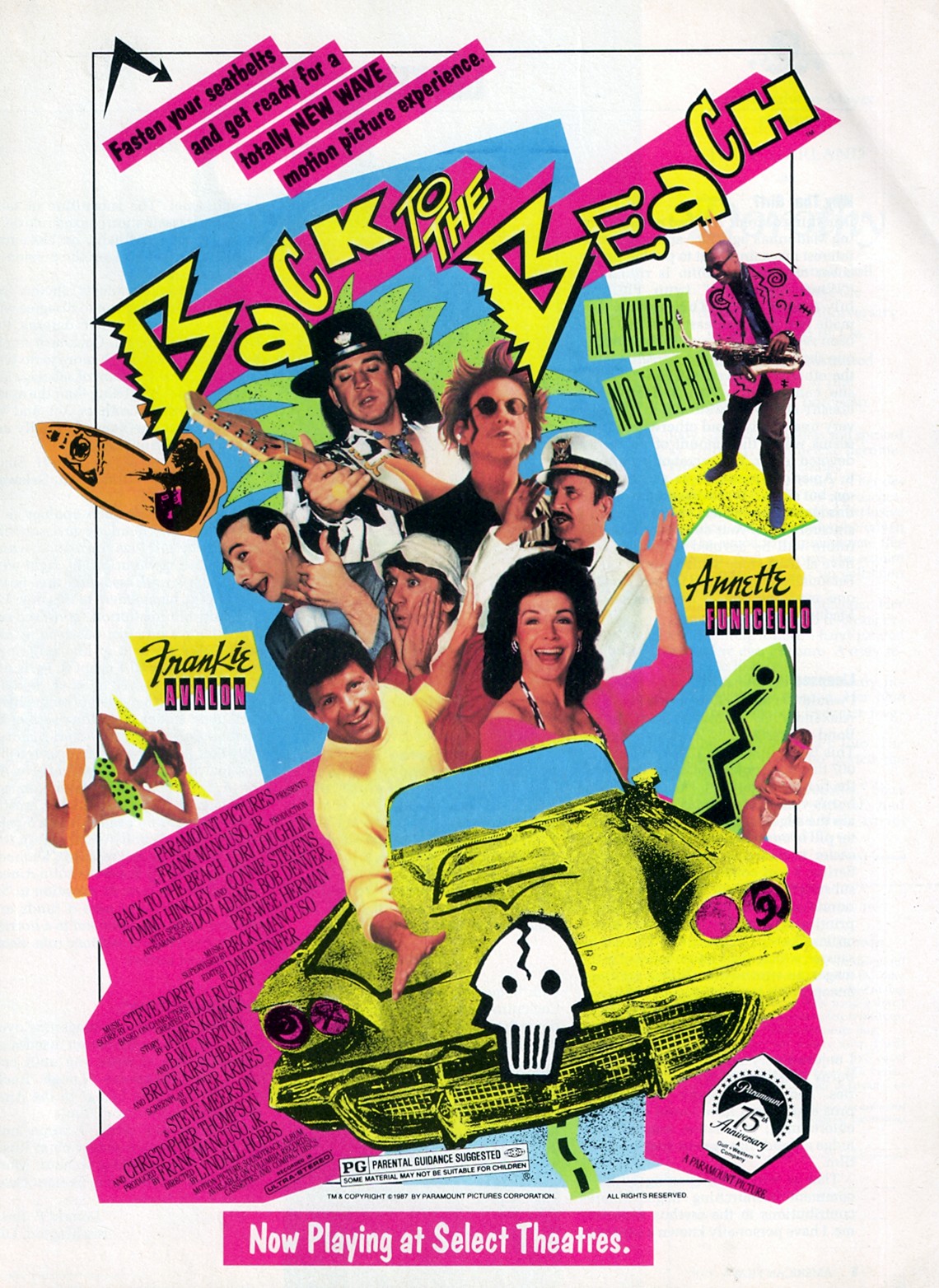
25 years ago, Frankie (Frankie Avalon), was a hot shot surfer known as the ‘Big Kahuna’, but now he’s a middle-aged, frustrated car salesman living in Ohio.  His wife Annette (Annette Funicello) was also a part of the surfing culture and that’s where the two first met, but now she’s a suburban housewife raising a rebellious kid named Bobby (Demien Slade). Frankie longs to revisit his old stomping ground, so the family takes a trip to California to visit their daughter Sandi (Lori Laughlin) not knowing that she’s living on the beach with her boyfriend Michael (Tommy Hinkley). Frankie also runs into Connie (Connie Stevens) his old sweetheart that still has a crush on him. Annette becomes jealous of all the attention Connie gives him causing a rift between the two, so they spend the rest of their vacation doing things on their own. Annette then catches the eye of Troy (John Calvin) who chases after her while Tommy gets in with a group of punk surfers who try to take over the beach prompting Frankie to challenge their leader to a surfing contest.

The film came out at a time when many 60’s shows and movies were getting revisited usually with the same cast members, or at least those that were still alive. Frankie had been shopping around the script for many years before finally finding a taker though the studio had insisted on more campy approach, but producer/writer James Komack resisted insisting that having it a light comedy dealing with the travails of growing into middle age and being a modern-day parent was enough.

It starts out almost like Airplane!, with visual sketch-like comedy, but then meanders into being almost all talk with not a lot happening. More confrontations or dilemmas, even the comic variety, would’ve helped, but instead the second half stagnates. Frankie and Annette ‘breaking up’ is a good example as the minute after having their spat they secretly long to get back together. It would’ve been a more intriguing story had the two genuinely went their separate ways only to decide at the very end that being a part wasn’t worth it and then make an attempt to reconcile, so there would at least be some dramatic tension, which is otherwise totally lacking.

Frankie is amusing and looks almost like he hadn’t aged a day and the potshots at his ‘perfect hair’, which looks suspiciously like a hair piece, are fun. Connie enlivens things as the beach blonde bimbo and Bob Denver is fun playing off his Gilligan persona, this time as a bartender known as ‘little buddy’. Some of the other cameos don’t work as well including Don Adams as The Harbormaster who initially seems like he’s going to ruin the festivities but gets neutered away too easily making his presence seem rather pointless. Having the son Bobby dressing and acting like a punk right from the start is off-putting and not funny. Would’ve been better and allowed for some character arch had he been super clean-cut, maybe in an effort to emulate his dad, only to get ‘corrupted’ when he meets the punks and then changing his look.

Funicello’s presence was disappointing. She hadn’t been in a movie in a while and was better known to younger audiences for being a spokesperson for Skippy peanut butter, which the film does parody, but her acting is rather stiff. This was when she began experiencing MS symptoms, so that may have had something to do with it, but her character is one-dimensional. She never says or does anything outrageous and is too ‘goody-goody’ making her moments flat and forgettable. It’s possible she didn’t have the acting chops to play anything different though it would’ve been nice had she at least tried to go against her image a little.

The film ends on a high note. I enjoyed seeing Frankie back on the surfboard even if he does it in front of a green screen, but I really felt there needed to be more jokes and a faster pace. Trying to turn it into a ‘dramedy’ was not what these cartoon characters needed. A surreal edge was necessary and though it teases this concept at times it wasn’t enough turning it into a misfire that never quite takes off.

My Rating: 3 out of 10

Released: August 7, 1987

Runtime: 1 Hour 32 Minutes

Rated PG

Director: Lyndall Hobbs

Studio: Paramount Pictures

Available: DVD, Blu-ray, Amazon Video, PlutoTV, YouTube

The Muppet Movie (1979)

By Richard Winters

My Rating: 7 out of 10

4-Word Review: How they became famous.

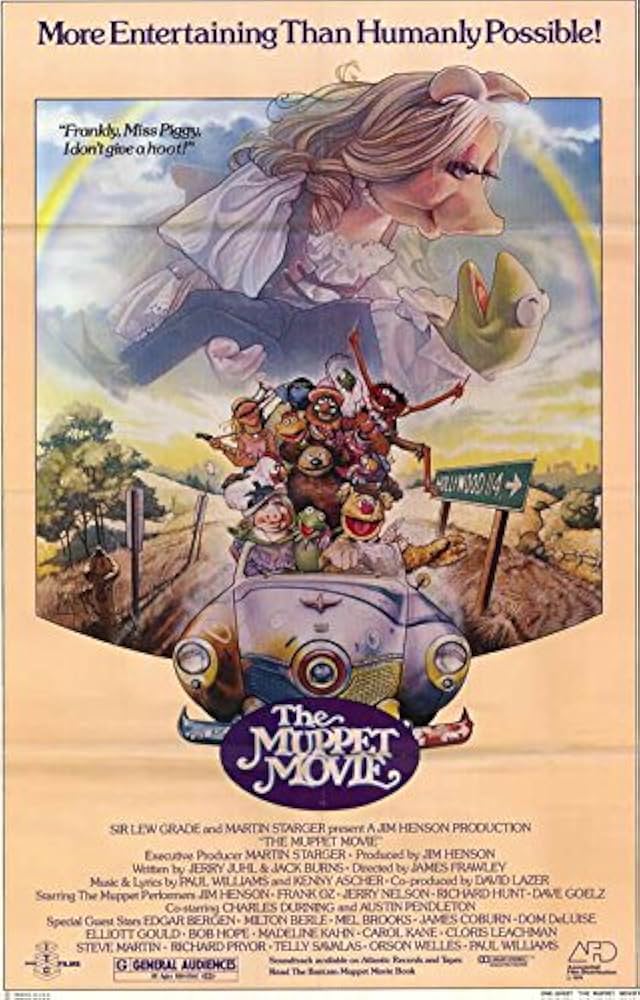
Kermit (Jim Henson) is a lonely frog living in a Florida swamp who dreams of one day making it to Hollywood and becoming famous. He then meets talent agent Bernie (Dom Deluise) who hears Kermit singing a song with a banjo and becomes convinced that the frog has what it takes to become a star. He hands him his card and tells him to give him a visit when it makes it to California. Kermit then sets-off on a cross-country trip and along the way meets several other characters all looking for their big-break including Fozzie Bear, a struggling comedian, and Miss Piggy (Frank Oz) who wants to become a fashion model. They tag along on the trip with Kermit while pilling into Fozzie’s Studebaker as he drives them to the west coast, but then they meet up with Doc Hopper (Charles Durning), an owner of restaurants who specializes in frog legs, who wants Kermit to be his new spokesmen in some commercials that he’s producing, but Kermit declines. However, Doc refuses to take no for answer and chases after the gang and using increasingly more sinister methods in order to get the frog to change his mind. 

Due to the success of ‘The Muppet Show’ creator Jim Henson was given financing to produce his own movie featuring the same puppet characters audiences had grown to love from the program. Since this would be a large-scale production great effort had to be put into making the muppets appear real and able to blend into an actual outdoor setting versus having everything done on a sound stage like it was in the TV-show. Henson refused to compromise on anything and insisted that money would not be a limitation, and this included the segment where Animal, one of the muppet characters, grows to giant proportions. Initially the idea was to keep the puppet the same size and place him on a miniaturized set, which would’ve cut down on costs, but Henson felt this didn’t look convincing enough, so instead they constructed Animal’s head to gigantic proportions that measured over sixty feet, which called for way more money and was very time consuming, but ultimately worth the effort. 

The story itself is pedestrian and relies, similar to the TV-show, with rapid fire quips and comebacks much like in old vaudeville. On the surface the humor is corny, and some could find the whole thing silly, but enjoyment comes with the puppet characters that are made to be like caricatures of humans, and their amusing responses and reactions. It’s also filled with a lot of great songs all written by the talented Paul Williams, who appears briefly. Normally in movie musicals the songs end up sounding the same and it starts to feel like we’re just listening to the same loop done over and over, but here each music bit has a distinct beat and a good toe-tapping quality, which not only adds to the fun, but actually helps move the story along versus holding it up. 

The only drawback is the massive amount of guest star appearances. There are many familiar faces, but most of them are only in it for a half-minute, or so and few of them have anything that’s actually funny to say, or even moderately clever. Performers like Bob Hope, Richard Pryor, Madeline Kahn, and Edgar Bergen, in his last screen appearance before dying just a couple weeks later, are essentially wasted in bits that add nothing and could easily have been excised and not missed. However, there’s a few cameos that do work including Steve Martin as an annoyed waiter, Cloris Leachman as a receptionist allergic to animal hair and Orson Welles who comes on near the end and has the film’s best line. Mel Brooks also quite memorable in an over-the-top send-up of a German mad scientist. 

Durning though is the one exception as he is more like a main cast member and in it quite a bit. Of course, he’s an outstanding character actor and a personal favorite and he shines here as well particularly with his attempt at a Cajun accent, but it seemed a bit ridiculous for a guy to go to such extreme measures just to get Kermit to be in his commercials. A better storyline would’ve had Kermit witness Durning turning one of his family members, perhaps one of his distant frog cousins, into a frog legs meal and thus threaten to turn Durning into the authorities and this would cause him to chase after him in order to try and keep him from squealing.  It also would’ve been nice had he shown a change-of-heart at the end and come around to being a friend to the muppets versus remaining an adversary. It comes close at one point when Durning realizes he doesn’t have any real friends like Kermit does, but I would’ve liked to have seen him come to grips with his aggressive personality and make amends to do better moving forward. 

My Rating: 7 out of 10

Released: June 22, 1979

Runtime: 1 Hour 35 Minutes

Rated G

Director: James Frawley

Studio: Associated Film Distribution

Available: DVD, Blu-ray, Amazon Video, YouTube

The Pink Panther Strikes Again (1976)

By Richard Winters

My Rating: 7 out of 10

4-Word Review: Clouseau battles doomsday weapon.

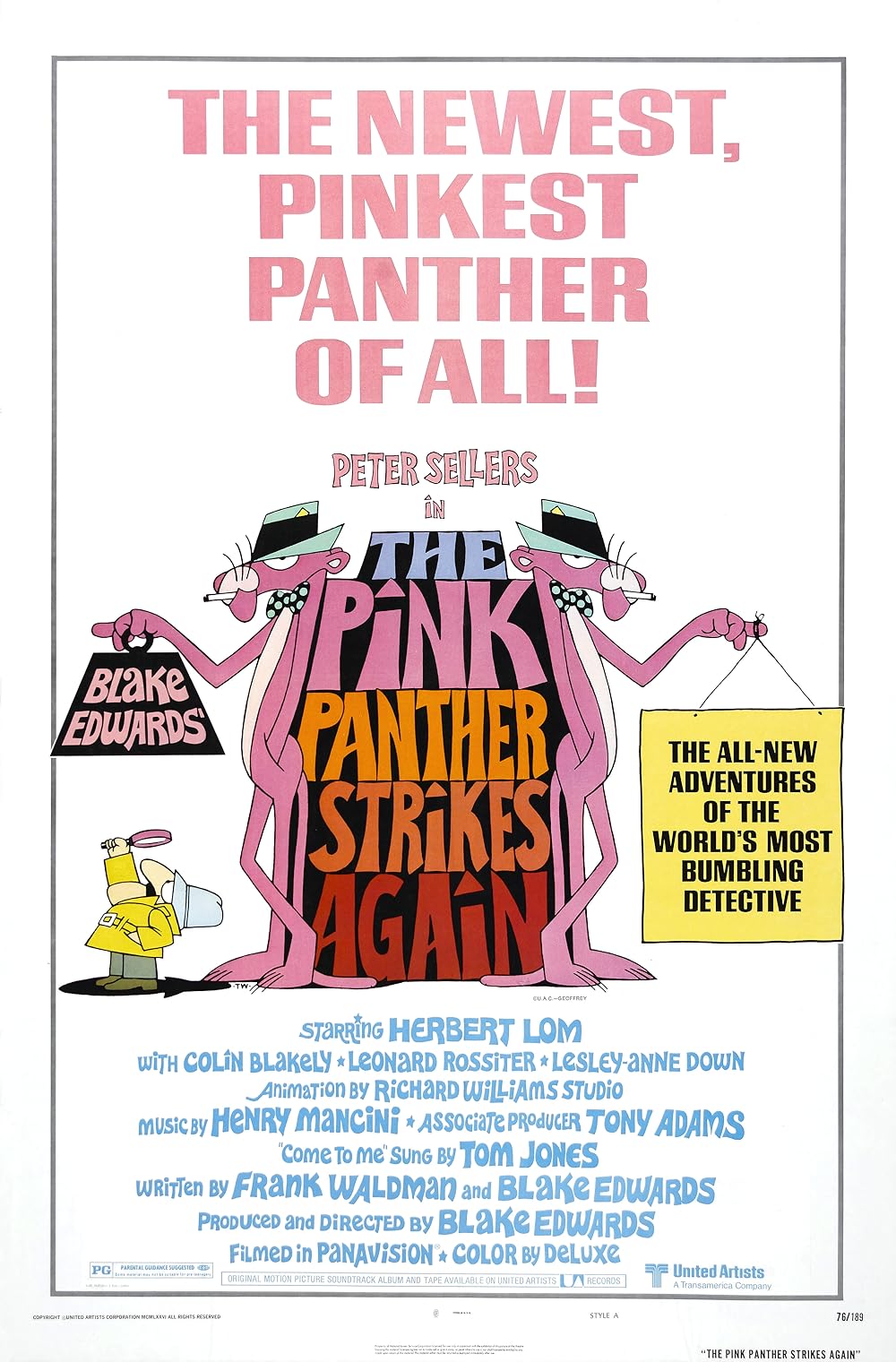
Dreyfuss (Herbert Lom) has been informed by his psychiatrist (Geoffrey Bayldon) that he has been cured of his obsession with Clouseau (Peter Sellers) and now deemed sane. He’ll be recommending his release from the mental institution he’s been in later that day at the sanity board of which Dreyfuss is elated. However, Clouseau shows up unannounced planning on speaking to the sanity board on behalf of Dreyfuss, but when he gets there the two meet and after several mishaps, all inadvertently caused by Clouseau, occur it sends Dreyfuss spiraling back into insanity. He then though is able to escape and goes on a mission to kill Clouseau, first on his own and then with the help of several worldwide assassins. When this doesn’t go as planned, he kidnaps a nuclear physicist (Richard Vernon) and blackmails him to create a doomsday weapon that can take out entire buildings with its laser beam and which Dreyfuss has no problem using against the world unless he’s given Clouseau in return.

After the unexpected success of The Return of the Pink Panther, director Blake Edwards was given an immediate green light to write and direct a follow-up. Since he had originally intended for this to be a TV-series he used one of the scripts he had written for that one and expanded it for feature film length. The original cut came out to 126 minutes, but the studio insisted it be trimmed to 95-minute runtime with the excised scenes being used as material for the Curse of the Pink Panther, which released 6 years later after the passing of star Sellers.

Despite constant behind-the-scenes struggles between Edwards and Sellers this film is widely considered their best output second only to The Party, which they collaborated on 8 years earlier. A lot of the reason why it works is the excellent pacing with an almost rapid-fire collage of jokes and mishaps, the scenic European locations and the pleasing yet still bouncy Henry Mancini score.

The humor hits the target in almost all cases, unlike most comedies where there’s usually a few misses, with some of the best moments coming from the supporting players like stuntman Dick Crokett who plays a perfect parody of then President Gerald Ford and Lesley Ann-Down, who replaced Maude Adams who was originally cast, but then fired after she refused to appear nude, as a Russian spy whose attempts to get Clouseau in bed with her proves quite funny. The ongoing confrontations between Lom and Sellers though are still the highlights and the two really work well together with Lom’s angry abrasiveness a nice contrast to Seller’s benign ineptness and in fact this is a rare instance where Sellers gets upstaged as it’s Lom’s performance with his over-the-top villainy that you come away remembering the most after it’s over.

Yet with all of its successes the script is still full of logical loopholes and missing key moments. For instance, Dreyfuss escapes from the mental hospital, but it’s never shown, which I felt since it’s so integral to the storyline needed to be seen and explaining how he was able to do it. What he did to gain access to the apartment downstairs from Clouseau’s should’ve been inserted as well and some sort of answers for how he was able to avoid injury from the bomb going off as it destroyed Clouseau’s apartment and the fallout from it would’ve most assuredly affected the apartment beneath it as well. Clouseau’s ongoing physical confrontations with his house servant Kato (Burt Kwouk) becomes problematic too as they’re constantly damaging the furniture during their fights and if this happens every time he comes home then the furniture should already be in disarray from their last battle as there wouldn’t have been time to have cleaned it up and replaced it with new stuff.

Spoiler Alert!

While the film does at least have Dreyfuss masterminding a major bank heist, which helps to explain how he got funding to build the giant laser and purchase the castle that he and his crew move into, it still makes it seem that they’re able to build the elaborate weapon and all the computers that go along with it, almost overnight, which of course isn’t believable. It also at one point has the laser beam striking Lom making his legs disappear, but he’s still able to somehow walk around anyways as well as maintain his same height, making it seem that his legs are still there and simply invisible.

There’s also the issue of Dreyfuss disappearing at the end, due to the effects of the laser, but in the following installment, Revenge of the Pink Panther, he’s fully intact and no mention of his previous madness to destroy the world. Fans of the series say this is because this whole film was meant to be a dream that Dreyfuss had, which would’ve made a lot of sense. He was already obsessed with Clouseau, so having nightmares about things one is constantly focused on would be logical and the film should’ve had at the very end Dryefuss waking up and still in a strait-jacket, but it doesn’t making it an oversight and not properly thought through.

My Rating: 7 out of 10

Released: December 15, 1976

Runtime: 1 Hour 43 Minutes

Rated PG

Director: Blake Edwards

Studio: United Artists

Available: DVD, Amazon Video, YouTube

Superman IV: The Quest for Peace (1987)

By Richard Winters

My Rating: 3 out of 10

4-Word Review: Fighting for nuclear disarmament.

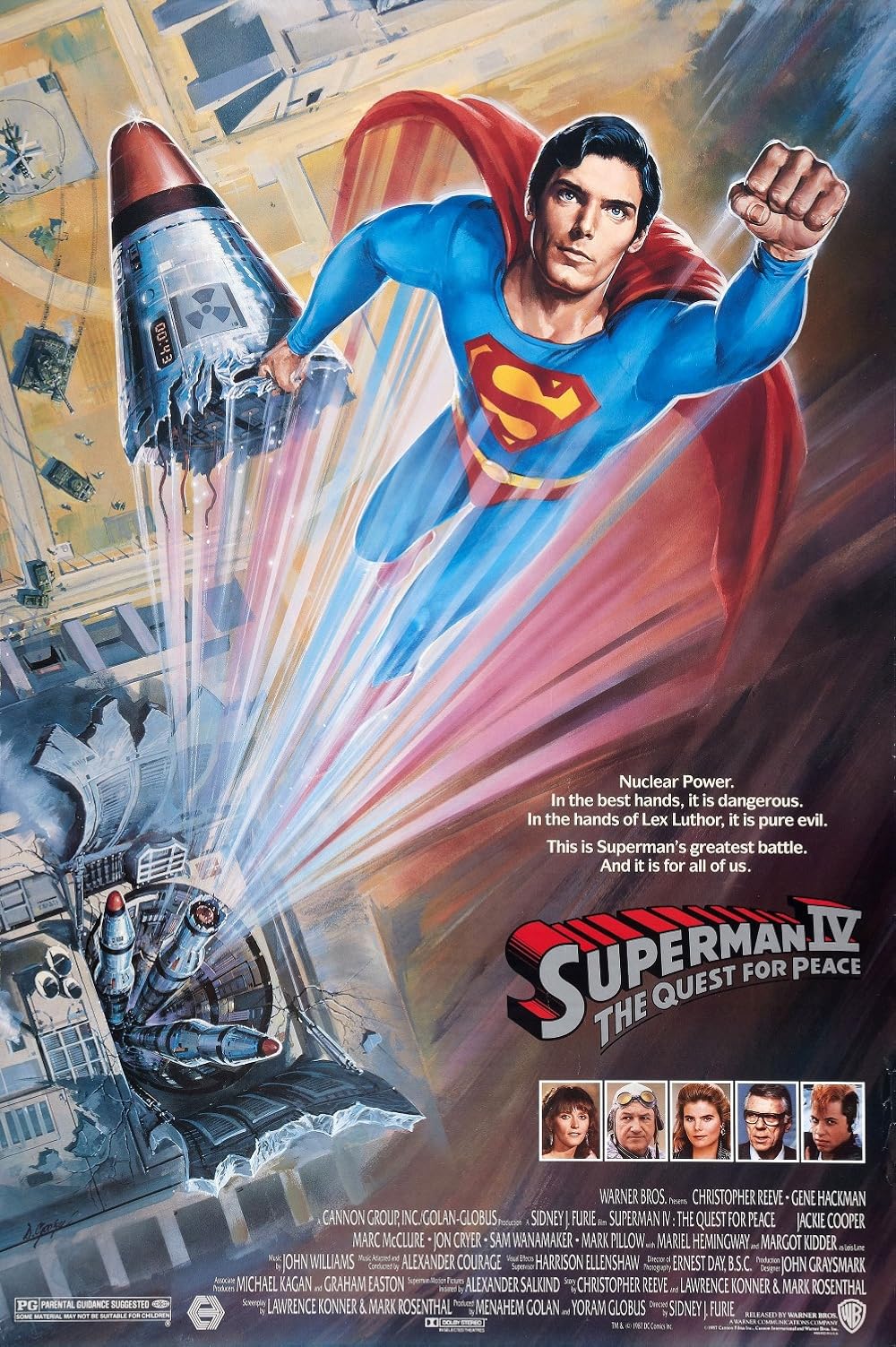
Lex Luthor (Gene Hackman) escapes from prison with the help of his nephew Lenny (Jon Cryer). He is then able to create a powerful villain named Nuclear Man (Mark Pillow) by stealing a strand of Superman’s hair from a museum and using its code to create a genetic matrix. Nuclear Man has many of the same powers as Superman, but, unbeknownst to Superman, he’s only powerful when he’s in sunlight and without that he becomes weakened. Meanwhile Clark Kent is having battles of his own when the newspaper he’s working for, The Daily Planet, gets taken over by a rich tycoon named David Warfield (Sam Wanamaker) who degrades the paper’s integrity by insisting only stories with a salacious bent get printed. David’s daughter Lacy (Mariel Hemingway) takes a liking to Clark and the two soon become an item.

The fourth installment was the first not to be produced by the Salkinds who decided to give up on the franchise after the box office flop of Supergirl and sold the rights to the Cannon Group who were suffering financial strain, which caused the budget for this one to be cut from $36 million down to $17 million. Many have complained that the result of this compromised the special effects though I didn’t find the drop-off to be quite a bad as I feared. The biggest drawback are the flying scenes where it clearly looks like Superman is matted in front of a greenscreen and isn’t nearly as slick looking as the first two. The opening bit though that takes place on a Russian space station I thought was alright, but I did wonder how Superman was able to know that the cosmonauts were in trouble, as he appears to the rescue out of nowhere, and what would tip him off that they were in danger?

The dumbest addition is the Nuclear Man. In the 45-minute deleted footage there were actually two with the first one being portrayed by Clive Mantle and resembling the comic book villain Bizarro. This one gets defeated by the Man of Steel prompting Lex to create a another one. The second creation is the only one shown in the studio cut version and this one looks like a male model wearing a tacky get-up stolen from Clash of the Titans. He speaks with Lex’s voice and I’m not sure why it was done this way outside of actor Mark Pillow, who plays the second incarnation, not having any acting experience, so they had his lines dubbed by Hackman, but the explanation that he has Luthor’s voice because Luthor made him doesn’t make sense. Why just stop at the voice? If he’s going to replicate his creator then he should have the same eyes, ears, and body as Luthor as well.

I was happy that Margot Kidder gets more screentime as in Part III she was relegated to being not much more than a cameo appearance. However, having her Lois Lane character constantly getting into extreme danger, this time on a subway train where the driver passes out, causing the car she’s riding in to accelerate to dangerous speeds, starts to get a bit overbaked. How many times statistically can one person accidentally walk into a life-threatening situation? Once sure, could happen to anyone, but even just twice would be a stretch. However, this lady inadvertently falls into a scary mess seemingly every other day making her more like a walking-talking bad luck charm that everyone else should stay away from for their own protection.

The scenes that she shares with Superman are stupid as he takes her on a flight with him into the night sky, but this was already done in Part I, so why redo it? Then when they land back at her apartment after revealing to her that Clark is really Superman, he does something that makes her forget that, but why even bother to let her know about his secret identity if he’s just going to make her lose her memory of it right after?

Initially I liked the addition of Hemingway as the new love interest as I thought the bratty persona of her character would lend some spice. Unfortunately, she loses her entitled attitude right away becoming benign and boring like everything else. The scene featuring her getting kidnapped by Nuclear Man, who takes her into space with him, is ridiculous because she’d never be able to survive outside of the earth’s atmosphere as there would be no oxygen, which along with the frozen temperature, would’ve had her dead instantly.

I really liked Hackman recreating his role as Luthor, who adds a much-needed campy charm. Cryer isn’t bad either as his young henchman and he does have the film’s one and only funny line. The story isn’t as political and preachy as I thought it was going to be either, which is good, but everything else falls flat. The initial runtime was supposed to be over 2-hours, but I was thankful it got cut down to a mere 90-minutes and even then, it was a drag to sit though. The franchise came to a merciful end after this, and I feel it was for the best.

My Rating: 3 out of 10

Released: July 24, 1987

Runtime: 1 Hour 30 Minutes

Rated PG

Director: Sidney J. Furie

Studio: The Cannon Group

Available: DVD, Blu-ray, Amazon Video, YouTube

Superman II (1980)

By Richard Winters

My Rating: 8 out of 10

4-Word Review: Superman loses his powers.

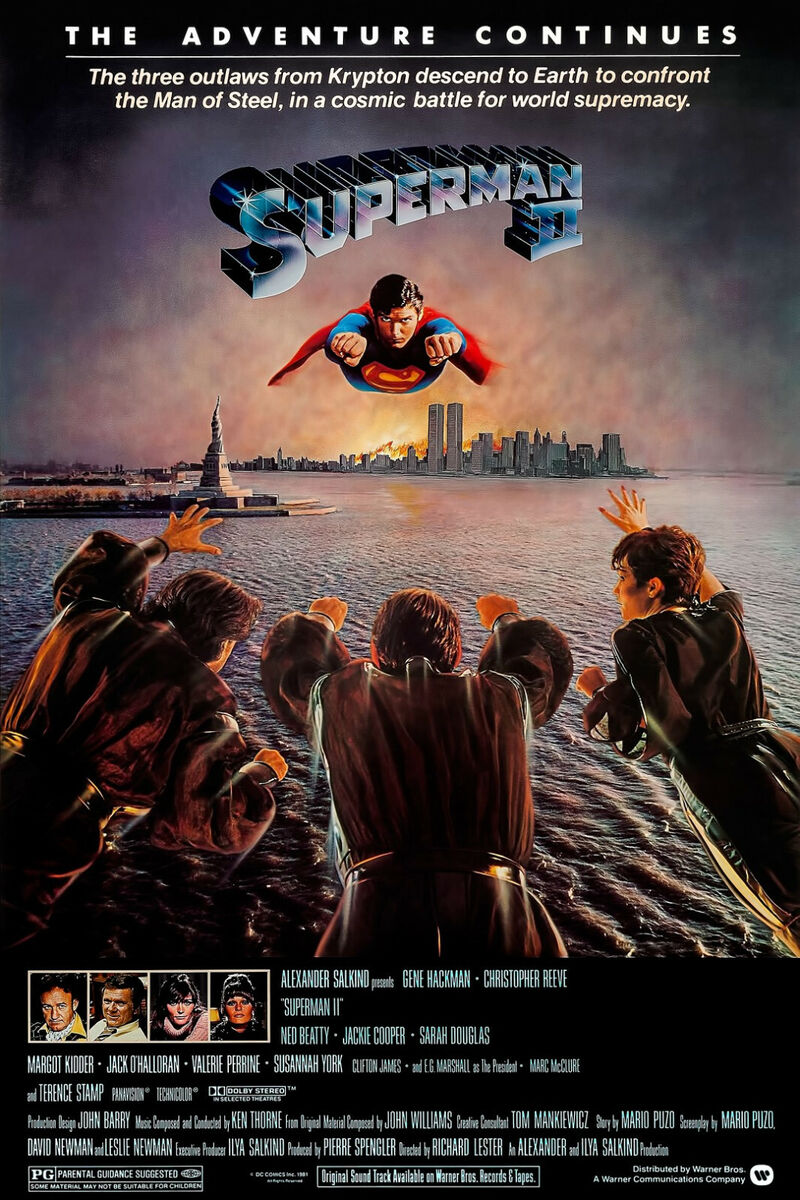
Superman (Christopher Reeve) flies to Paris in an attempt to save Lois Lane (Margot Kidder) who was assigned to go there to cover terrorists who’ve taken over the Eiffel Tower and threatening to detonate a hydrogen bomb unless their demands are met. Superman manages to take control of the bomb and lift it into outerspace where it goes off, but unbeknownst to him the explosion also releases Zod (Terrence Stamp), Ursa (Sarah Douglas) and Non (Jack O’Halloran) from their imprisonment inside the phantom zone. The three now fly towards earth planning to take it over with the superpowers they’ve been given from the sunlight. Meanwhile Clark falls in love with Lois and admits to her that he’s Superman. He takes her to the artic to see his Fortress of Solitude and it’s there that he listens to a past recording of his mother Lara (Susannah York) advising him that if he wishes to marry Lois that he will then have to enter a crystal chamber where he’ll then lose his powers, which he does. Now that Zod and his evil associates have taken over the country by invading the White House he becomes powerless to do anything about it as he desperately searches for a way to regain what he gave up.

The production had many behind-the-scenes upheaval including run-ins between director Richard Donner and the producers who insisted that he was going over budget. Initially it was deemed necessary to film both the first segment and the sequel at the same time, but due to money concerns they stopped filming part 2 with 75% of it already completed in order to finish the first part and get it out to theaters. During the pause the producers then fired Donner and replaced him with Richard Lester. Lester was known more for his zany comedies and had a different directorial style than Donner. His approach was to insert campiness into the story and move it away from the dark elements. This caused several scenes to be refilmed some of which without the original cast including Hackman who refused to come back to do reshoots causing a few of his scenes to be dubbed while Brando had sued the producers for his share of the gross profits causing all of his scenes to be taken out completely and replaced mostly with York who ended up speaking the lines that he would’ve and for the most part does a far better job of it.

While the Donner version was released onto DVD in 2006 and is a bit different this review will stick with the one that was shown in the theaters and I felt is quite well done. Unlike with part 1 this one gets right to the action without the stagy back story from the first, which I found boring. The showdown between Superman and the evil three done on the streets of Metropolis as well as the massive destruction that the villains cause the small redneck town of East Houston are very exciting with great special effects that should please anyone. The comedy bits that Lester inserted I didn’t feel went that over-the-top and in some ways were helpful as it released some of the tension as these were some really nasty bad guys, who caused massive destruction, so inserting a campy chuckle here and there I didn’t feel was that out of order.

The script doesn’t have as many plot holes like in the first one. The only major issue to quibble about is when Superman goes into the chamber that sucks away his powers. Why though is it necessary that he should have to give up his powers just because he wants to get married is a whole different discussion that’s worth questioning, but I get that there needed to be a dramatic conflict, so we’ll roll with it. However, it’s never explained how Clark and Lois get themselves out of the artic and back to civilization as they ‘flew’ into the Fortress using his flight powers, but once he was made mortal, they couldn’t rely on that on the way out and without any other mode of transportation I wasn’t sure how they were able to travel and nothing gets shown, but should’ve.

Spoiler Alert!

His long trek back to the Fortress in an attempt to retrieve the powers is equally problematic as he is shown doing it completely on foot, which could take many weeks, or longer to do. He’s also shown wearing nothing more than a light jacket while he does it without any head covering, which now that he’s human, wouldn’t be enough to shield him from the brutal elements and frigid cold and he most likely would’ve died before he got there from either frost bite, or pneumonia. How he’s able to get the powers back aren’t sufficiently explained either. Supposedly it’s because of a green crystal that Lois dropped and is still there when he returns, but if the control module was already destroyed then how would this get it to work again?

End of Spoiler Alert!

The acting is again what really makes it fun. Hackman is once more excellent as Luthor as here he plays it both ways as the ‘middleman’ between Zod and Superman where one minute he’s arrogant and confident and then the next he’s nervous and pleading. It’s a shame though that Perrine and Beatty, his cohorts in crime, aren’t in it as much as I felt the three together had a great chemistry. Gotta love Kidder as a brash Lois who manually squeezes oranges for Vitamin C as she’s become a self-described ‘health nut’ all the while a cigarette dangles from her mouth. Stamp is really good too as the main villain and his intense performance is what keeps the tension going, which again is why the comedy bits aren’t a problem here, though in Part III this does become a major issue, which will be discussed in the next review.

My Rating: 8 out of 10

Released: December 4, 1980

Runtime: 2 Hour 7 Minutes

Rated PG

Directors: Richard Donner, Richard Lester

Studio: Warner Brothers

Available: DVD, Blu-ray, Amazon Video, YouTube

Superman (1978)

By Richard Winters

My Rating: 8 out of 10

4-Word Review: The Man of Steel.

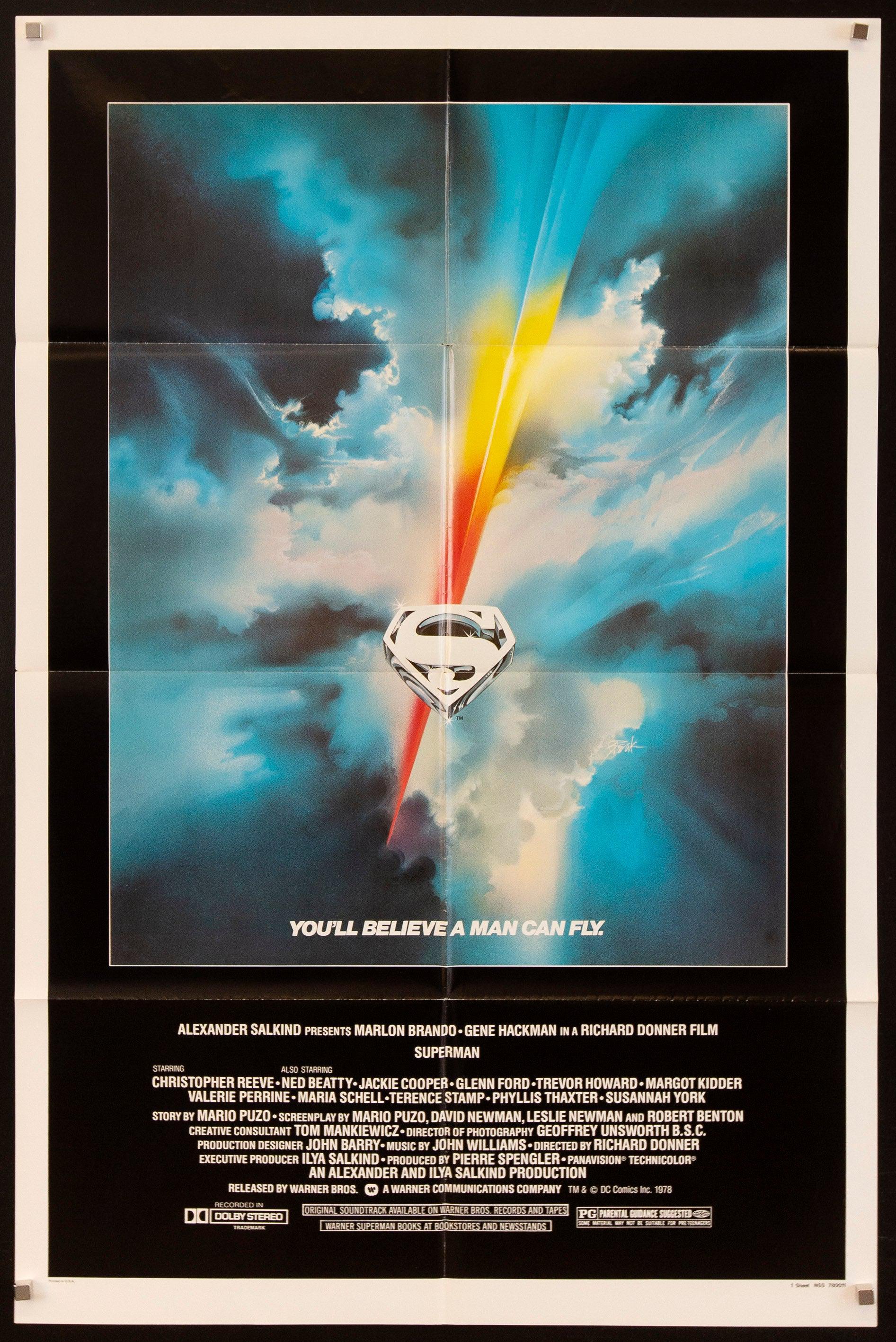
As the planet Krypton gets set to be destroyed by its exploding sun, Jor-El (Marlon Brando) and his wife Lara (Susannah York) put their child on a spaceship that takes him to the planet earth. It is there that his spaceship crash lands into a wheat field that his spotted by Jonathan (Glenn Ford) and Martha (Phyllis Thaxter) who take the child in and treat him as their own. The boy is named Clark (Christopher Reeve) and as he grows, he begins to show amazing abilities including running faster than is humanely possible and incredible strength. Once he becomes an adult, he gets a job as a reporter at the Daily Planet newspaper where he meets fellow reporter Lois Lane (Margot Kidder). He even saves her, while dressed as a superhero, from a helicopter accident and becomes known initially as the ‘caped wonder’ before finally being coined as Superman. His publicity attracts the attention of criminal mastermind Lex Luthor (Gene Hackman) who devises a plan to steal missiles and use them to create an earthquake along the San Andreas fault and thus casting off coastal California into the ocean and turning the desert land he purchased into prime real estate. Superman attempts to stop him, but Lex has found one thing that can stop him: a meteorite known as kryptonite.

At the time this film, which suffered from numerous behind-the-scenes problems and infighting, was made it was the most expensive one ever produced with a whopping $55 million budget. While the effects were mesmerizing for many back-in-the-day I don’t know if they still all hold-up. The flying segments particularly over the Statue of Liberty is impressive to a degree but can’t quite equal today’s technology and appears like two people in front of a greenscreen as does the giant red sun that moves in to destroy Kyrpton. Watching the young Clark Kent running alongside a train looks tacky too like he’s being held up by invisible wires, which he was, and his feet aren’t really ever touching the ground. In all fairness though the earthquake segment and the destruction of the Hoover Dam and the shaking of the Golden Gate Bridge remains top notch.

The script though, which takes on quite a lot and had to be slimmed down from its original 500-page version that was written by Mario Puzo, feels rushed at times and glosses over certain things that I felt should’ve been a little more drawn-out particularly when the Kents find the boy crash land in the field. The film makes it look like they just left the remains of the spaceship in the field making me think other people in the area would’ve also come upon it later and would start a panic that some alien had come out of it and invaded the town. Later on, we come to realize that the ship got hidden inside their barn, but there’s no scene showing them transporting it, or how they went about doing that, which I felt should’ve been put in for the simple sake of clarity.

Watching Superman orbit the earth in an attempt to get it to spin backwards and supposedly ‘turn back time’ is kind of cool to see and an interesting concept though not totally plausible. Making the world rotate the other way would certainly change some things like having the sun rise in the west instead of the east and have the ocean waves go in a different direction among other things, but causing everything to essentially ‘rewind’ and go back to the way they were even bringing certain people who had died suddenly back to life just wasn’t completely convincing though it’s not enough to hurt the movie as a whole.

Most fans will likely tell me I’m quibbling about the Clark Kent disguise though when you really think about it it’s not much of a disguise at all. I admit watching this muscular guy dressed in a suit and acting all clumsy and wimpy is amusing especially the way Reeve plays it but besides combing his hair in a different direction than when he’s Superman the only other difference is that he wears glasses. However, that would be tantamount to saying someone who does wear glasses but then comes to work one day without them would not be recognized by any of his friends, or co-workers especially when he’s still speaking in the same voice making me believe that Lois and Jimmy, played by Marc McClure, should and would’ve caught on to this pretty quickly. I realize the comic book did it this way, but when it got updated into a movie, they should’ve reenvisioned it a little by adding more to the Clark get-up like besides just glasses he’d also have a mustache, or goatee and speak a bit differently, so having those close to him not catch-on would be more understandable.

I think what I enjoyed most was Hackman, who didn’t play a lot of villains during his career but is highly enjoyable here. Initially he didn’t want to take the part as he felt playing a campy character would tarnish his reputation of being a serious actor, but the change of pace does him good and proves if anything how versatile he is. His refusal not to shave his head, as the Lex Luthor in the comic is bald, works in his favor as his hair gets styled differently in each scene in order to represent him wearing a wig, which creates a creative visual. Valerie Perrine is great too as his girlfriend Miss Teschmacher who helps contrast his delusional personality with her more grounded sensibilities and I just loved the way he’d yell out her name every time he got annoyed with her, which is the comedy highlight.

The rest of the supporting cast though, made up of big name starts like Trevor Howard, Maria Schell, and even Larry Hagman didn’t seem needed and given such few lines I was surprised why they’d even take the roles unless it was because of the money. Brando is an equal waste. He’s given top billing and paid an exorbitant amount of money including a percentage of the profits despite refusing to memorize his dialogue and even having his lines written on the baby’s diaper for him to read off of as he puts the child into the spaceship. Had the producers skipped the unimportant ‘star power’ and cast lesser knowns in these roles they could’ve saved themselves a lot of money, which in retrospect might’ve lessened the tensions they had with director Richard Donner for going over budget and ultimately lead to his firing and a very tumultuous follow-up Superman II, which will be covered in the next review.

My Rating: 8 out of 10

Released: December 10, 1978

Runtime: 1 Hour 23 Minutes

Rated PG

Director: Richard Donner

Studio: Warner Brothers

Available: DVD, Blu-ray, Amazon Video, YouTube

Any Which Way You Can (1980)

By Richard Winters

My Rating: 7 out of 10

4-Word Review: Betting on a fight.

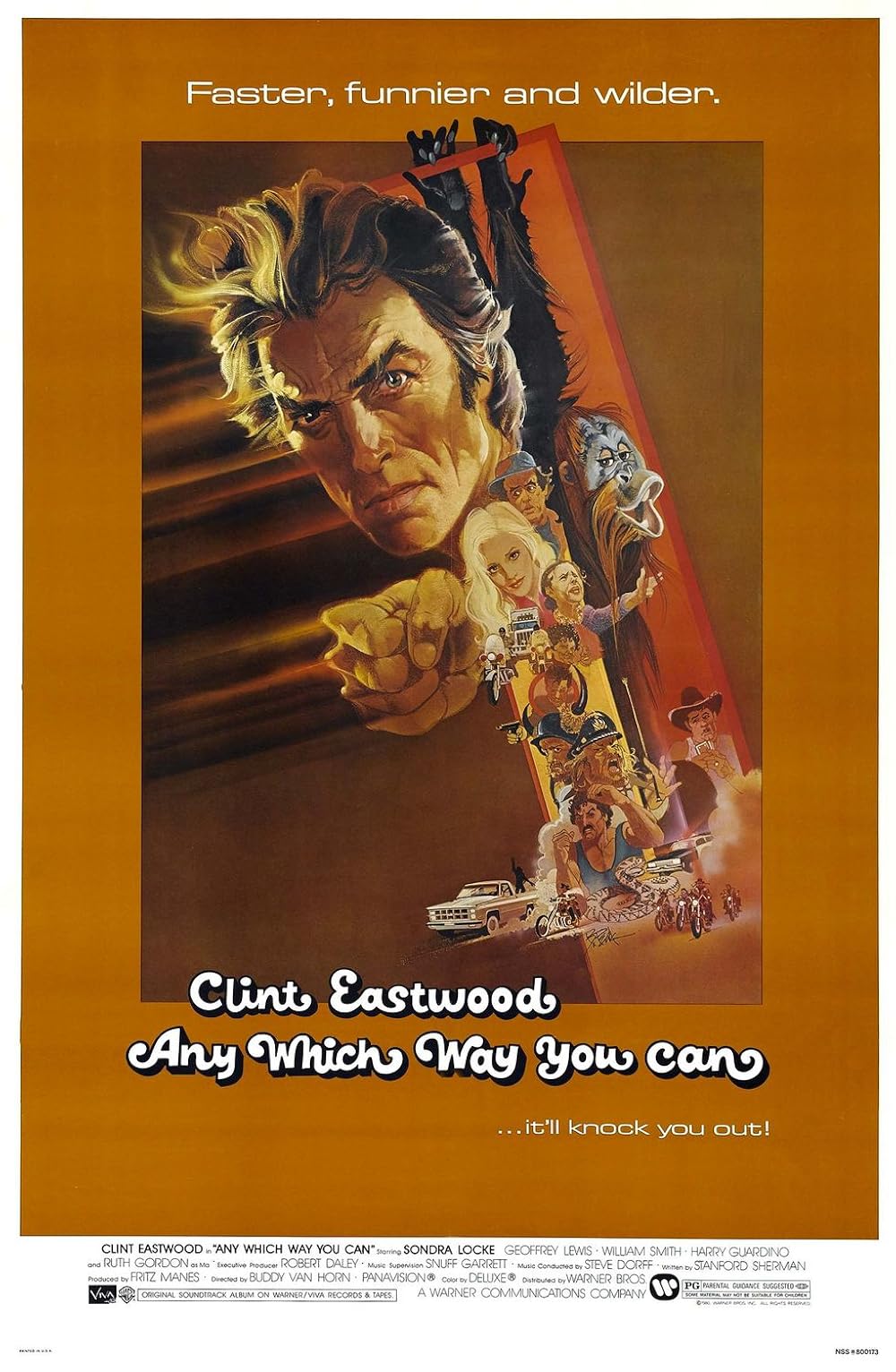
Philo (Clint Eastwood) is still working as a trucker, still travels around with his pet orangutan Clyde, and still lives at home with his mother (Ruth Gordon) while getting involved in some bare-knuckle fights on the side to earn some extra money. He also continues to be harassed by the Black Widow biker gang who constantly hound him to even a past score. Things begin to change a bit when he meets back up with Lynn (Sondra Locke) who apologizes for her behavior from before and wants to rekindle their romance. Philo resists at first, but eventually the two get back together and she even moves-in with him in a spare room, but pressure mounts when fight handicapper Jack Beckman (Harry Guardino) comes-up with the idea of pairing Philo with Jack Wilson (William Smith), whose fighting skills mixes both martial arts and boxing. Jack figures it would be a match that would generate much betting interest and uses his men and money to convince Philo to take part in it. While Philo does initially agree he eventually backs out due to pressure from Lynn as she feels it’s too dangerous, but Jack, who has Mafia money riding on the fight, won’t take no for an answer and kidnaps Lynn in an effort to get Philo to reconsider. 

This is one of those sequels that’s a vast improvement over the first and much of the credit goes to Stanford Sherman, who wrote over 18 episodes for the 60’s ‘Batman’ TV-show and shows a good knack for balancing campy humor with interesting action. He’s also able to tie-in everything that goes on, so it doesn’t come off like a disconnected mess like with the first installment that had characters and situations coming-out of nowhere that wasn’t cohesive. Here each character has a purpose and everything that happens has a reason and connects with the main theme making for a much slicker production even when some of it gets silly.

Much more attention goes to the ape here though it’s not the same one as in the first film. That one was named Manis who was deemed to have grown too big for the part, so he got replaced by Buddha who has some amusing segments with his best moments coming when he tears up some cars, including one being driven by a bad guy, played by Michael Cavanaugh, as he’s trying to get away and another scene where he wears a dress and then ‘flashes’ an amorous hotel owner. However, in a book by Jane Goodall entitled ‘Visions of Caliban’ it was asserted that Buddha was badly beaten by his owner during the production after he stole some doughnuts on the set and was eventually clubbed to death forcing them to bring in a third ape named C.J. to do the publicity tour for the movie after filming had wrapped. 

Like in the first one the movie also features a lot of bare-knuckle brawls though these aren’t quite as interesting since Clint wins every one of them, so there’s never any tension. To keep it realistic, and give it better balance, they should’ve had him lose one, possible in humiliating style, and the rest of the movie could’ve been having him trying to defend his title and the audience would’ve been more emotionally invested in seeing him do it.  Would’ve been nice too had they not implemented that annoying punch sound effect that to me puts the fight at a cartoon level and I wished more movies from the period did it like The Whole Shootin’ Matchwhich didn’t feel the need to have that effect put in and thus actually made the fighting grittier and more intense in the process. 

While the film is way too long, there’s no reason for a runtime of 2-hours with such a slight and goofy plot, which should’ve have not been more than 85-minutes. However, it saves itself with some genuinely inspired moments including when real-life couple Logan and Anne Ramsey, who play a traveling husband and wife who stay in the hotel room next to the two apes whose noisy love making turn them on as does Clint and Sondra in adjacent room while Ruth and the elderly hotel clerk, played by Peter Hobbs, also make it in the motel office, I found to be quite amusing and almost worth the price of admission. The climactic bout between Clint and Smith and the way it galvanizes people from all over to witness it and bet money on it, including the Black Widow biker gang, who survive a ‘taring’ earlier, is good fun making it worth checking out on a slow night. 

My Rating: 7 out of 10

Released: December 17, 1980

Runtime: 1 Hour 56 Minutes

Rated PG

Director: Buddy Van Horn

Studio: Warner Brothers

Available: DVD, Blu-ray, Amazon Video, YouTube

Every Which Way But Loose (1978)

By Richard Winters

My Rating: 4 out of 10

4-Word Review: A bare-knuckle brawler.

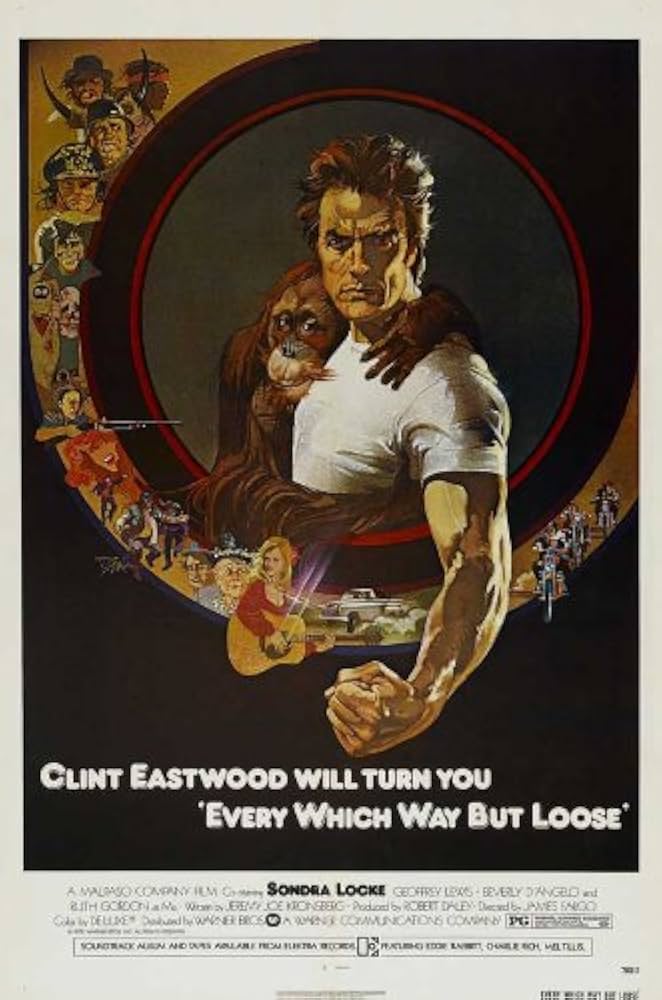
Philo (Clint Eastwood) is a truck driver still living with his mother (Ruth Gordon) and who compensates his income with bare-knuckle fights where people can make bets either on, or against him. He also travels around with an orangutan named Clyde whom he won as compensation for one of his fights. One day while waiting in his pick-up at a red light a biker gang known as The Black Widows and led by Cholla (John Quade) pull up beside them and begin harassing the ape. This creates a confrontation, and the bikers seek a vendetta on Philo determined to challenge him to a fight and begin stalking him until he agrees. Philo is also being chased by Putnam (Gregory Walcott), a cop upset at Philo over a misunderstanding that occurred while the two were in a bar. Meanwhile Philo is also trying to find Lynn (Sandra Locke) a singer he fell for who moved away to Colorado with her boyfriend, but Philo travels there in an attempt to find her and win her back, but Putnam and the Black Widows are in hot pursuit. 

The script is the product of Jeremy Joe Kronsberg, who after watching Smokey and the Banditbecame ‘inspired’ to write this one and was convinced it would make the perfect follow-up vehicle for star Burt Reynolds. However, when he shopped it around to the studios, they all rejected it, so he decided to send it off to Clint Eastwood’s secretary in the hopes that Clint, being good friends with Burt, would show him the script and convince him to do it. Instead to everyone’s surprise Clint, who was looking to broaden his appeal, decided to take on the starring duties himself and even cast Kronsberg as one of the biker gang members.

Many of those close to Clint thought it was a bad career move, and the critics savaged the film upon its initial release, but at the box office, which is what really counts, it did very well and became one of the highest grossing films of Eastwood’s career. A major reason for this is its rural appeal where everyone is essentially a redneck and white collar, college educated suburbanites just don’t exist. Instead, one’s social standing hinges on how much they down at the bar and whom they beat-up, which helps create a strong and surreal atmosphere. Initially though with this type of mentality I thought the setting should’ve been Texas and not California as when most people think of Cali they connect it with rich Hollywood stars and Malibu mansions when in reality that’s only a portion of the state and on the east end it’s much more rustic with a far more blue collar attitude and the movie does a good job of exposing this. 

It’s fun to see Eastwood not taking himself so seriously and being laid-back even smiling versus having him constantly look at everybody with his patented squinty-eyed stare. In support I though Ruth Gordon was great. Usually she plays ditzy old dames, but here she’s crusty and ornery and the segment where this ‘vulnerable old woman’ single-handedly shoots-up the biker gang when they invade her property is the movie’s highpoint. Bevery D’Angelo quite good too playing a free-spirited flower child named Echo. While she doesn’t have anything funny to say it’s nice having a character who’s quiet and subdued to help balance all the other wackiness. 

The script though is in desperate search for a story that never really transpires. Too much hinges on random events strung together by the thinnest of threads versus being connected by actual motivations and momentum. Having Eastwood, a tall and intimidating looking guy, constantly getting harassed for no reason, doesn’t make a lot of sense. The biker gang should’ve hounded him because they were hired by someone who lost to him in a fight and was bitter about it and the cop could’ve been hassling him because he lost a bet on one of his fights and thus wanted some compensation. While these may not be deep and profound motives at least they give a reason for what’s happening versus having things strung together by a lot of disconnected events that come out of nowhere. 

Spoiler Alert!

Sondra Locke though almost saves it. Her hyper and sarcastic personality makes for a nice contrast to Eastwood’s, and I liked how he pursues her as a love interest only to ultimately realize that she’s a psycho and he’d be better off without her. Most other movies have the concept that ‘lover conquers all’ and you’re better off with someone, even if they’re seriously flawed, than without, so having this movie take the alternative viewpoint is a refreshing change of pace and thus deserves some credit. 

My Rating: 4 out of 10

Released: December 20, 1978

Runtime: 1 Hour 55 Minutes

Rated PG

Director: James Fargo

Studio: Warner Brothers

Available: DVD, Blu-ray, Amazon Video, YouTube

Johnny Dangerously (1984)

johnnydangerously

By Richard Winters

My Rating: 3 out of 10

4-Word Review: From newsboy to gangster.

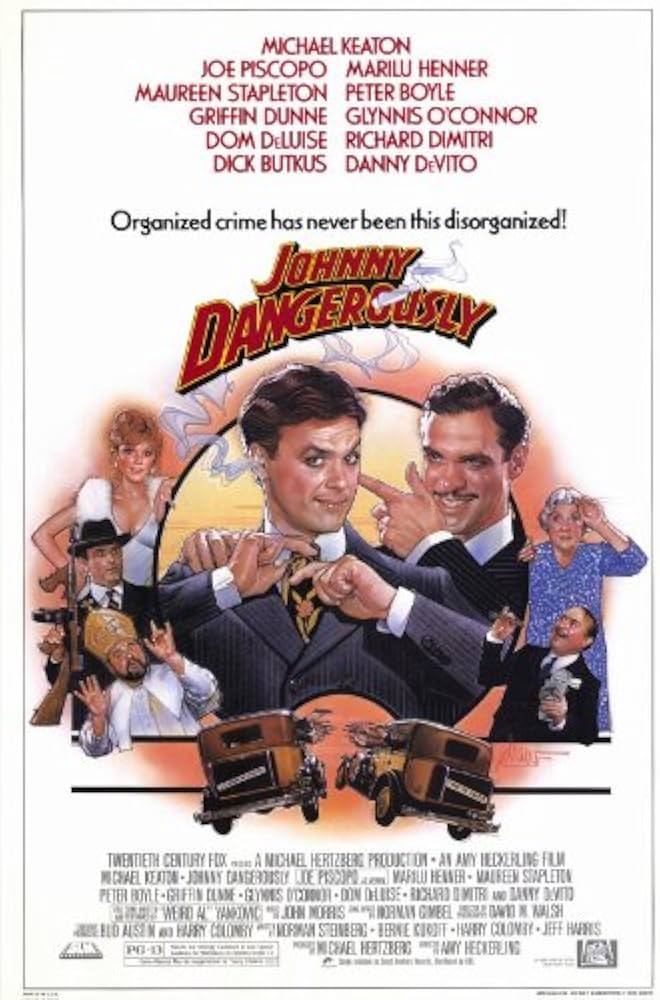
Young Johnny (Byron Thames) must find some income to help his mother (Maureen Stapleton) with her medical expenses. He catches the eye of Jocko (Peter Boyle) a notorious gangster who offers him odd crime jobs to do part-time and Johnny takes him up on it but feels guilty. The years pass and a grown-up Johnny (Micheal Keaton) finds that his mother’s health hasn’t improved, and the bills continue, so he decides to get into the gangster business full-time and even takes over as head of the gang once run by Jocko. The money is so good that it not only covers everything his mother could need but also helps his younger brother Tommy (Griffin Dunne) get through law school. However, once Tommy graduates, he gets a job at the D.A. office where becomes committed to stamp out corruption and put all criminals behind bars even if it would mean his older brother.

The pace and structure are modeled after the more successful Airplane movies in which the light plot works as a platform for a barrage of rapid-fire jokes and pratfalls mostly satirizing gangster movies from the ’30’s. While Airplane came off as fresh and funny as it poked fun of all the disaster movies from the ’70’s this thing seems old and tired before it’s barely even begun. The biggest issue is that gangsters had already been parodied for many years both in TV and on the big screen. By the time this movie came-out most of the jokes had already been used many times over and the comedy fails to create anything inventive. The characters are nothing more than walking-talking cliches that mouth banal one-liners and not much else. Almost all the jokes fall flat, nothing sticks and has no edge to it. It’s something that could’ve easily been made for TV and it should be no surprise that the writers were two men who helped create the ‘Different Strokes’ TV-show.

What surprised me most is that it wasn’t even dirty, or at least not that much. It’s directed by Amy Heckerling who had just gotten done doing Fast Times at Ridgemont High, which seemed to have bawdiness and sexual innuendoes in almost every frame and yet here there’s surprisingly very little. Yes, there’s an animated segment dealing with victims of enlarge scrotums, which doesn’t have much to do with the story, but is kind of amusing, but that’s about it. Some more sex and even nudity could’ve helped enliven things, or at the very least given something more to laugh it. The malapropisms by the gangster character Moronie, played by Richard Dimitri, where he uses a lot of colorful language that sounds like curse words, but really aren’t I didn’t find to be clever at all. Today words like fuck and fucking are used liberally in social media and even casual daily conversations. I even hear young neighborhood kids saying it, so for a movie to think that it’s ‘pushing the envelope’ by having someone use phrases the sound like the F-word but aren’t makes the movie seem quite dated.

I didn’t care for Keaton. He comes-off like some smart ass who’s phoning in his performance with a pasted-on smile that never leaves his face. It’s like he isn’t even acting or trying to create any type of character. He just casually walks on, makes a semi-amusing remark, and then walks-off. Thames who played the younger version of Johnny was better and the movie could’ve been more engaging had Johnny remained a kid the whole way and then watching an innocent teen take down the gangsters and even ultimately become their leader would’ve had some original spin that’s otherwise lacking.

Joe Piscopo, who plays Johnny’s criminal rival, is quite good and as opposed to Keaton, seems to be making some sort of effort to play a role and I thought he should’ve been in it more, or even just given the reins and taken over completely. The film’s promotional poster makes it seem like the two will have equal screentime, but that’s shockingly not the case and Joe’s presence amounts to a few walk-ons, which is a shame.

The rest of the supporting cast are equally wasted. Marilu Henner sings a nice dance number but otherwise doesn’t do or say anything else that’s interesting. Stapleton looks way too old for the role of a mother and would be more suited as a grandmother. At one point she even refers to herself as being ’29’ despite having gray hair. Don’t know if this was meant to be a ‘funny joke’, but it doesn’t work and is dumb like most everything else. Dunne is miscast as well. He’s supposed to be this young idealist but appears much more like someone already in their 30’s and would’ve been more authentic had they gotten a college aged student with a wide-eyed, clean-cut image versus Dunne who’s always had more of a weary and beaten down impression. Dom Deluise though is the most out-of-place in a part that amounts to being a cameo as the Pope who appears inexplicably on a city sidewalk for some strange reason that misses-the-mark completely in a gag that like everything else gets thrown-in with little thought, or care.

I did do enjoy Danny DeVito who amazes me how even when given small roles still manage to steal the proceedings especially with his impromptu hosting of a game show send-up. I’ll even give a few props to the ‘pass the secret message’ segment done inside a jail where one prisoner whispers something into another prisoner’s ear, who then passes it along to yet another guy and so forth down the line until it gets to the last one where the initial message has now become completely distorted, which got me to laugh, but honestly that was the only time during the whole viewing that I did.

My Rating: 3 out of 10

Released: December 21, 1984

Runtime: 1 Hour 30 Minutes

Rated PG-13

Director: Amy Heckerling

Studio: 20th Century Fox

Available: DVD

Uphill All the Way (1986)

uphill

By Richard Winters

My Rating: 2 out of 10

4-Word Review: Bumbling cowboy con-men.

Ben (Roy Clark) and Booger (Mel Tillis) are two con-men living in the old west, who don’t have a dime between them. After getting kicked-off a train for not having tickets they then venture to a saloon in order to win some money at poker, but even though they attempt to cheat, they still end up losing. In desperation they try to trade in their rifle for a loan, but the bank teller (Richard Paul) mistakenly thinks they’re trying to hold him up and sounds the alarm. The two then go on the run while being chased by a posse of sorts that includes the sheriff (Burl Ives) two prostitutes (Elaine Joyce, Jacque Lynn Colton) and the town drunk (Frank Gorshin).

The film is a misguided effort to replicate the campy, rural humor of the TV-show ‘Hee-Haw’, which Roy Clark hosted for almost 17years and which Mel Tillis made several guest appearances, and try to turn it into something resembling a movie. While the show never met any critical acclaim it still managed to succeed because all the humor, much of it being ribald and corny, was set-up into brief segments that only lasted for a few minutes if even that long and relied almost exclusively on one-liners. As soon as the punchline was uttered it would quickly move to another segment much like the variety show ‘Laugh-In’ was styled. However, trying to expand that format and silly comedy into a feature length film is virtually unworkable. Instead of a plot we get a collection of goofy situations coupled with goofy characters saying and doing cartoonish things that gets strung along with a mind numbing 90-minutes before it finally, mercifully manages to end much like putting a sick horse out of its misery.

Had the chemistry between the two stars been better it might’ve had some chance, but Tilis and Clark, both better known as country singers of which they’re very good at, don’t have what it takes to carry a movie. I was thankful at least that Tillis didn’t rely on his old stuttering routine for cheap laughs and here for the most part he articulates quite well, but he fails to have much to say that is amusing. Clark with his tubby physique coupled with his high-pitched voice seems all wrong for different reasons and his attempts at being exacerbated comes-off as affected. The banter between the two is stale and with both being in their 50’s they lack the fresh boyish charm that they might’ve otherwise been able to exude had they done this when they were in their 20’s.

The supporting cast falls equally flat. Burl Ives looks old and tired here and like he’s just phoning-it-in. Gorshin, a great and versatile talent if given the right material, is completely wasted as a drunk who does and says very little. Trish Van Devere, who during the early 70’s was considered a leading lady, reveals how sadly her career had fallen, she officially retired after doing just one more movie after this one and I think it was because she was no longer getting any quality offers, doesn’t appear until 55-minutes in and almost becomes like a background character with not much to do. Burt Reynolds does appear briefly near the beginning, he apparently accepted no fee for his work here, but is quite amusing and had he been in more scenes might’ve saved it. Elaine Joyce stands-out too as she usually played bubble-headed blondes, but here is a bitchy, angry type and does surprisingly well with it though if she’s going to be the best thing about a movie then you know it must be in real trouble.

The story is disjointed too as it starts out as a playful chase comedy then strangely diverts into an extended shoot-out where the two become hold-up in a home with another family trying to fend-off a group of bad guys that are separate from the ones chasing after them making it seem like two different, poorly realized plots meshed into one. I will give it some credit for being a movie with a Texas setting that was actually filmed in Texas unlike some other movies that say the setting is Texas when it really isn’t. You can tell that it is the Lone Star state because of the prickly pear cactus that is seen all about, which is different from the upright variety that’s seen in the deserts of Arizona and California. Though on the negative end it was shot in the month of October when the searing heat of the region was over and any good Texas movie should have the heat play a factor since that’s very much a strong characteristic of the state.

My Rating: 2 out of 10

Released: January 21, 1986

Runtime: 1 Hour 26 Minutes

Rated PG

Director: Frank Q. Dobbs

Studio: New World Pictures

Available: DVD, Blu-ray, Amazon Video, YouTube