Category Archives: British Movies

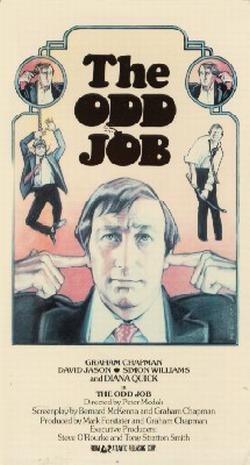
The Odd Job (1978)

By Richard Winters

My Rating: 2 out of 10

4-Word Review: Hired to kill him.

            Arthur Harris (Graham Chapman) comes home one day to celebrate his wedding anniversary only to find that his wife Fiona (Diana Quick) is leaving him. He becomes so despondent that he decides to kill himself. He has a lot of problems doing it, but then he receives a knock on his door by a man (David Jason) looking for some ‘odd jobs’. Arthur decides to hire him to be his killer, but when his wife decides to come back Arthur is thrown into a state of panic trying to avoid being killed.

Normally I love British comedies and this one seemed to have all the ingredients to being a hilarious one, but it never gels. The opening bit where the couple is arguing and Arthur insists that they are ‘happily married’ even if she doesn’t think so is full of great English wit, but everything after that falls into a lull. The jokes become long and elaborate where so much time is spent building the set-up that getting to the punch-line becomes trying. The restaurant scene is particularly drawn-out and unfunny. The ‘zany’ chase sequence in the zoo is derivative and flat.

Quick was not a good casting choice as the spouse. She is too young and beautiful a wife for such a nebbish man. A good comic character actress who was more frumpy and dowdy would have been a better fit. Quick doesn’t show any comic ability, or timing as her affected responses and facial expressions become annoying and tiring. There is also no motivation for why the character decides to come back to her husband and although this is absurd comedy there still needed to be one otherwise the writing comes off as forced and sloppy, which it is.

Chapman doesn’t completely work in his role either.  It seemed strange that he would want to kill himself when a super-hot lady neighbor is more than willing to go to bed with him and even strips off your clothes and hops into the sack before he goes running off in fright. There is also the issue that killing oneself because your wife as left you seems extreme. Most men would probably celebrate if this happened to them and it is hard to relate to a protagonist that seems so pathetic. A stronger motivation, like having him killed in a staged murder, so his family could collect on some life insurance money would have been more effective. There is another part where the police become aware that someone is trying to kill him and for some reason Arthur does not tell them of the bizarre scenario when they ask him about it even though to me it made more sense to let them try to apprehend the man instead of continuing to live in fear of being killed.

The music, which is soft and melodic, was a terrible choice as it does not fit the quirky theme, nor complement the fast-paced comic scenarios. The tacked on ‘surprise ending’ is horrible and pretty much cements the film as a misfire. During his Monty Python days Chapman was famous for walking onto the screen and telling the audience that the sketch they were doing had become too absurd and would now end and I wish he had done that here.

My Rating: 2 out of 10

Released: September 3, 1978

Runtime: 1Hour 27Minutes

Rated PG (Brief Nudity)

Director: Peter Medak

Studio: Columbia-EMI-Warner

Available: VHS
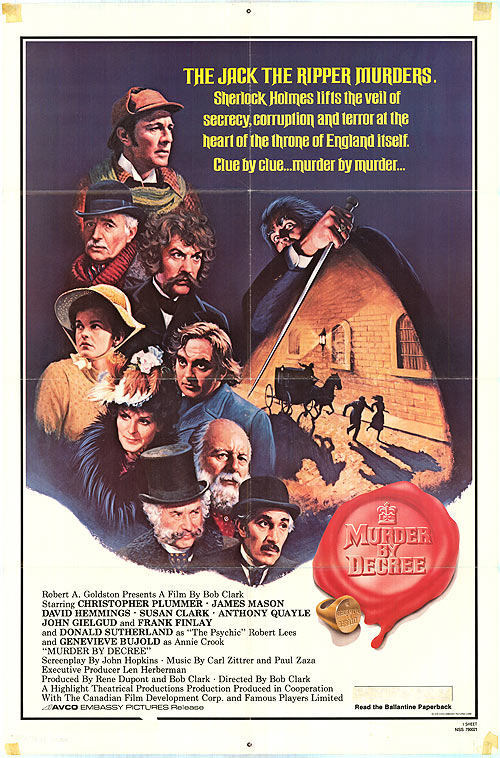
Murder By Decree (1979)

By Richard Winters

My Rating: 6 out of 10

4-Word Review: Jack the Ripper exposed.

Sherlock Holmes (Christopher Plummer) is asked to investigate the killings of prostitutes by Jack the Ripper and the clues lead to a massive conspiracy that goes all the way up to the British Royalty.

This rendition of the Holmes versus Ripper theme is fun and handsomely produced. My favorite element was the recreation of the dark, dingy, atmospheric streets of old London. The fog, lighting, and sounds of carriages going over the cobblestone streets is perfect and I wanted to see even more of it. The killings are surprisingly graphic, the strangulation of a woman near the beginning looks  quite realistic as does the stabbing of another man in which you can see, from the side, a sword going right through him.

The supporting cast is a treat and includes an almost unrecognizable Anthony Quayle in a beard and a wig, as well as John Gielgud, David Hemmings, Genvieve Bujold, Donald Sutherland, Frank Finley, and Susan Clark. Clark gives the strongest performance in the crucial role of Mary Kelly. She speaks with a believable British accent despite the fact that she was not a native. Sutherland is the only one that is wasted as his character is dull and his screen-time limited.

Both Plummer and James Mason in the role of Dr. Watson are terrific actors, but I don’t know if I was completely sold with them in these parts. Plummer is too polished, handsome, and always displaying a sneering type of grin that I never pictured Holmes having. I would have wanted the character to be just a bit more aloof, awkward, and detached.  Mason is fine, but the chemistry between the two doesn’t seem genuine. I expected more comic interplay. There is some, but not enough. The best moment is the pea scene, which is a howl and written by Mason.

The case is elaborate and well thought out. Normally I find with these types of stories that if you aren’t paying careful attention, or miss one line of dialogue that you become lost and confused, which fortunately did not happen here.  It stays intriguing and the logic is sound for the most part. The wrap-up at the end in which Holmes explains the case and solves the mystery while discussing it in front of the Prime Minister (Gielgud) is satisfying and complete. However, I got a real kick out of the fact that when Holmes starts his dissertation he has a cut on the side of his face from an altercation that he had with Ripper the day before, but in the fifteen minutes it takes him to delivery his speech it turns into a scar before your very eyes.

SPOILER WARNING!

The few misgivings that I had here was that it does not stand out from the myriad of other films that have been done on the same subject.  The mystery and conspiracy angle is interesting, but speculative with no bearing on the actual case. The fact that they turn the Ripper character into being just a couple of idiots who didn’t know what they were doing is clever in one way, but disappointing in a other because it destroys the mystique that has become the Ripper legend and becomes anti-climactic in the process.

My Rating: 6 out of 10

Released: February 9, 1979

Runtime: 2Hours 4Minutes

Rated PG

Director: Bob Clark

Studio: AVCO Embassy Pictures

Available: VHS, DVD

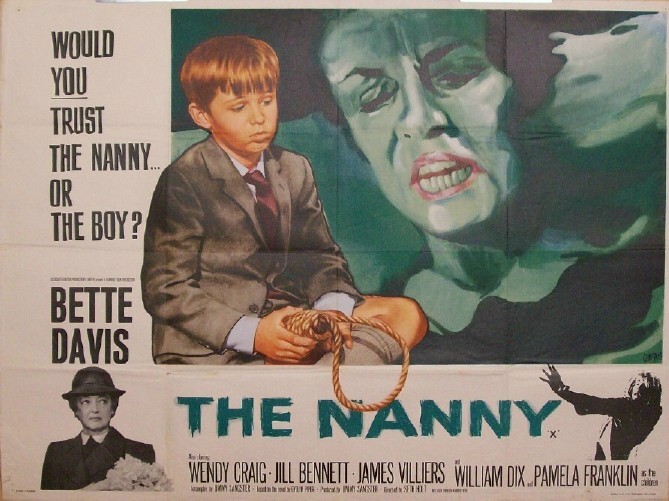
The Nanny (1965)

By Richard Winters

My Rating: 5 out of 10

4-Word Review: Kid doesn’t like nanny.

            Bette Davis plays a nanny to an upper-class British family whose oldest son Joey (William Dix) is accused of accidently killing his younger sister. Joey, who is only 10, is sent away to a home for disturbed children. When he returns he accuses the nanny as the one who did the killing and a psychological game of cat-and-mouse ensues.

Davis is sensational. She plays a type of character that she has never done before and the results are fascinating. She is much more subdued and evasive than usual and she falls into the role of the unassuming nanny in a seamless fashion. The different setting works well for her and I commend her tenacity for taking on a project that was not glamorous. She even puts on some thick eyebrows for her part and at times, especially at the beginning, she starts to resemble her most hated rival Joan Crawford.

Dix is amazingly good as the kid and it is a shame that he did only one other picture after this one. I liked the independent nature of the character and he plays off Davis quite well and showed no signs of being intimated by her. Making the adversaries have such extreme age difference and personalities gives the story an interesting edge that helps carry the picture.

The evocative black and white photography helps accentuate the dark-tone. The British setting along with the expected formalities of that culture, particularly that from the father character Bill (James Villers) give the film some distinction.

The first act though goes on way too long. We are given the general premise right up front and then have to spend the whole first hour going through the scenario that Joey doesn’t like his nanny and is suspicious of her again and again until it becomes derivative. When the second act does finally come about it seems too late. The revelation isn’t all that clever or creative and the climactic sequence desperately needed more action and punch. The final result is unsatisfying. The viewer is given an intriguing premise that it can’t sustain to the end ultimately making this a misfire despite the outstanding presence of Davis and some high production values.

There is also the issue of the three-year-old girl who is adorable and an absolute scene stealer and yet right up front you are made aware that she is killed, which makes the proceedings rather depressing. Having to then watch her actual death is disturbing and, for its time period, rather vivid and startling.

My Rating: 5 out of 10

Released: October 27, 1965

Runtime: 1Hour 31Minutes

Rated: NR (Not Rated)

Director: Seth Holt

Studio: Hammer Productions

Available: DVD

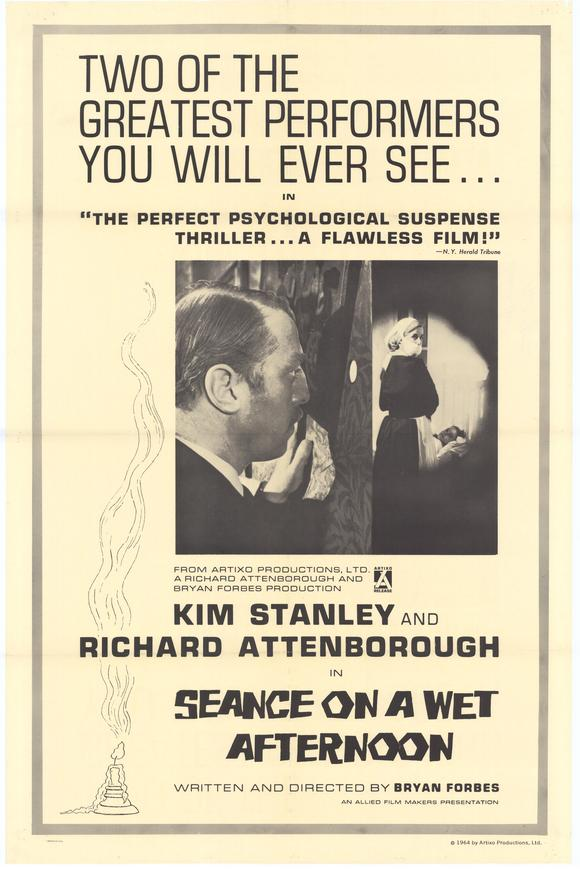
Seance on a Wet Afternoon (1964)

seance on a wet afternoon

By Richard Winters

My Rating: 6 out of 10

4-Word Review: Psychic is a phoney.

Myra Savage (Kim Stanley) is an emotionally unbalanced woman and failed psychic who comes up with an idea that she hopes will revive her career. The plan is for her husband Billy (Richard Attenborough) to kidnap Amanda Clayton (Judith Donner) who is the young daughter of a rich businessman. They will then place her at a strategic location and hold a public séance at which time Myra will ‘miraculously’ predict her whereabouts. This will then, they hope, make her famous and world renowned, but of course things don’t work out as expected.

This is indeed a unique and unusual film that taps into some rare qualities. First and foremost is the black and white cinematography. Every camera shot and angle has a certain evocative flair that is well captured and vivid. The on-location shots pick up just the right amount of ambiance and lighting with each setting. The music score is great and helps create excellent tension. You also will love the little girl that they kidnap. She is adorable without it being forced. Her matter-of-fact sensibilities are a great contrast to Attenborough and Stanley whose characters are child-like and pathetic.

Yet the film doesn’t completely work. The story is handled in a plodding and methodical way without any twists or surprises. There is very little action, some definite slow spots and the conclusion is limp.

If you watch it for the performances then you will be more intrigued. Stage actress Stanley gives a rare film appearance here. It is easy to see why she took the role even though she was known to dislike doing films. The takes are long and give almost unlimited possibilities in creating a character, which is what all stage actors enjoy. She does well and at times may remind one of another legendary actress Geraldine Page who would have also been perfect for the part. Attenborough proves almost her equal. His expressions of shock and worry are memorable. The interplay between the two is fun especially towards the end when this otherwise passive man stands up to the domineering woman.

Overall there are some unique moments, but it is just not suspenseful enough and results in being only slightly above average.

My Rating: 6 out of 10

Released: November 5, 1964

Runtime: 1Hour 55Minutes

Rating: NR (Not Rated)

Director: Bryan Forbes

Studio: Artixo Productions

Available: VHS, DVD (Region 1 & 2)

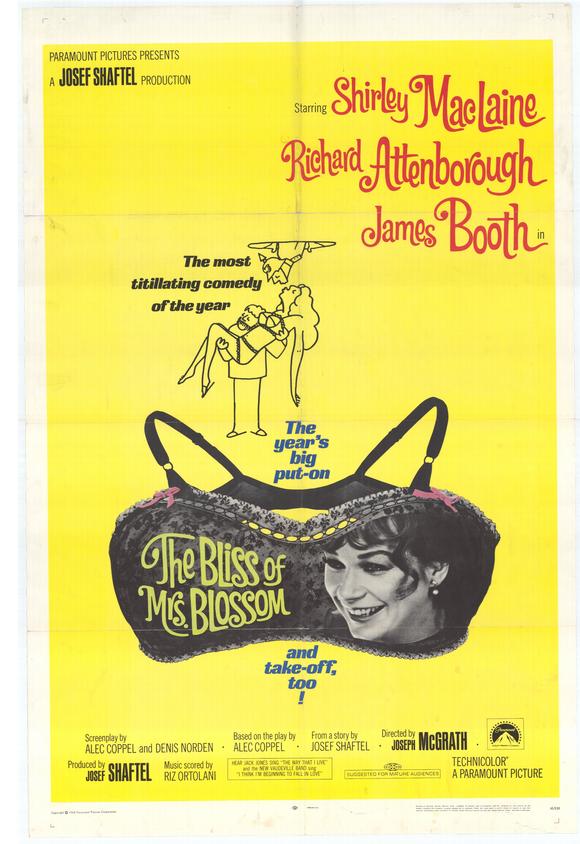
The Bliss of Mrs. Blossom (1968)

By Richard Winters

My Rating: 6 out of 10

4-Word Review: Lover in the attic.

This wacky film nicely exudes the mod, experimental wave of filmmaking that permeated the era of the late 60’s. The story takes place in London and is about a clothing manufacturer’s wife named Harriet Blossom (Shirley MacLaine) who one day calls her husband Robert (Richard Attenborough) while he is at work to tell him that her sewing machine has broken down. Robert sends his lowly assistant Ambrose Tuttle (James Booth) over to their house to help her fix it. Harriet is a bit bored with life and feels neglected by her husband, so she not so subtly seduces Ambrose and then hides him in the attic where he soon takes up residence.  He comes out only when Robert is away, but the unexplained strange noises that Robert hears and the many close calls make him think he is going insane and leads him to a nervous breakdown.

Director Joseph McGrath’s highly visual style is the real star. The lighting, editing, camera angles, set design, and costumes are creative and imaginative.  The home that was chosen for the setting has a nice architectural flair especially the attic and billiards room, which seems to be draped by a large stain glass window. Certain film professors show this movie to their classes as an example of how stylish direction can help accentuate a story as well as deftly define its era. I was disappointed to see that although McGrath is still alive he hasn’t done a film since 1984, which is a shame as it is obvious from this that he is quite gifted and I would have liked to see him doing more.

This is generally considered a vehicle for MacLaine, but to me her performance isn’t interesting. I think she is a first rate actress, but her character here is the only normal one in the film and she acts more like an anchor trying to corral the craziness around her. Booth, as her lover, goes to the other extreme, but doesn’t fare any better. He is too clownish and is always wearing various disguises and going through different personas, which makes the character unrealistic and cartoonish. If anything, out of the three main leads, it is actually Attenborough who does the best. His nervous and confused facial expressions are priceless. The scenes were he comes home from work and to ‘unwind’ pretends to be a conductor of a large orchestra while listening to a loud record, is amusing.

The colorful supporting cast though, full of legendary British Pros, is what steals the film. Some of them appear just briefly, but they still make a memorable and funny impression. Barry Humphries, playing a male character and not Dame Edna, is good as an art dealer. John Cleese, in one of his very first roles, is engaging as an argumentative postal clerk.  The best however is far and away Freddie Jones as the snippy, suspicious, relentless detective that will leave no stone unturned in his pursuit of Ambrose, who once he moves into Harriet’s attic proceeds to completely drop of society and disappear.

Although generally entertaining the plot doesn’t go anywhere and is simply a set-up for a lot of absurdity. What is worse is the fact that this based on a true story that in its own right was very intriguing.  In the real-life incident that took place in 1913 a 33 year old woman by the name of Dolly Oesterreich met a 17 year old named Otto Sanhuber. She, like the character in the movie, was a bored wife of a wealthy textile manufacturer, and took in the young man as her ‘sex slave’, which he readily accepted. To avoid possible suspicion she had him move into their attic, where he remained for five years and despite some close calls was never caught.  When the Oesterreich’s moved to Los Angeles in 1918 Dolly made sure that their new home had an attic as well and Otto then took up residence there and the deception continued until 1920 when Otto finally ended up killing the husband.

Of course none of that happens here. In fact Ambrose is fond of the husband and considers the three to be one big happy ‘family’, which is offbeat for sure, but not particularly satisfying. Again, this film does have some funny moments. I thought the scene where Robert invents the world’s first inflatable bra only to have the system go awry during an exhibition, which forces the model’s breasts to grow to unbelievable proportions before they go floating in the air, to be hilarious.  Still the end result of this production can best be described as cinematic soufflé.

My Rating: 6 out of 10

Released: September 11, 1968

Runtime: 1Hour 33Minutes

Rating: NR (Not Rated)

Director: Joseph McGrath

Studio: Paramount

Available: VHS

Venom (1982)

By Richard Winters

My Rating: 3 out of 10

4-Word Review: Kidnappers versus deadly snake.

            Phillip Hopkins (Lance Holcomb) is an 8-year old boy and son of a wealthy couple. When his parents leave for a trip the family’s maid and chauffeur (Susan George, Oliver Reed) conspire to kidnap the boy and hold him for a ransom with the help of a ruthless gunman (Klaus Kinski).  Unbeknownst to any of them the boy has mistakenly acquired a black mamba snake that escapes from his cage. As the culprits try to pull off their crime they become trapped in the house by the deadly reptile that starts to attack them one-by-one.

For starters the cast is one of a kind. Besides the performers listed above the film also has Sarah Miles as a Dr. with a serum to help fight the snake’s poisonous venom. Nicol Williamson appears as the police negotiator and Sterling Hayden, in his last film role, plays the boy’s grandfather.  How anyone could manage to direct a cast with such legendarily huge egos and eccentric personalities seems hard to fathom and probably explains why original director Tobe Hooper left the production after only ten days of shooting and was replaced by Piers Haggard. Supposedly Reed and Kinski were at odds with each other during the entire production and their animosity clearly shows on screen. For the most part the talents of the cast is wasted with a script that is limited and filled with characterizations that allow for no range.

I did like Hayden in the scene where he is forced to go searching for the snake in a darkened room and armed with nothing more than a lamp and a makeshift weapon. George is also fun playing a duplicitous character for a change and I was disappointed that she gets killed off so soon. However, she does make the most of it with a very theatrical death scene. Probably the best performance in the whole film is that of the boy. He has a very sweet, young looking face and the widest most innocent pair of blue eyes you’ll ever see and the kind that most casting directors would kill for. The kid plays the frightened part well and does an effective asthma attack. He hasn’t done much since, but I am sure that if he wrote a book dealing with his experiences on the set and his interactions with that cast that if would most assuredly be a best-seller.

The set-up is good and I found myself riveted to it for the first half-hour. I liked the idea that an actual mamba snake was used. There is a part where the snake is slithering towards the camera and opens its wide, black mouth and hisses straight at the camera, which could be enough to get most viewers to jump out of their seat. Director Haggard uses the novel idea of shooting scenes from the snake’s point-of-view and he does it through a fuzzy and slightly distorted lens to help replicate the snake’s vision. The only problem I had in this area is that the snake is seen slithering throughout the picture inside the home’s venting system, which is shown to be very clean and spotless, which didn’t make sense to me since the home was old making me think that the metal piping would be more corroded and rusted.

Despite the excellent concept the film’s second hour is quite boring. The characters don’t have enough to do and spend most of the time standing around. The interplay between Kinski and Williamson brings no tension. There is one cringe inducing scene where the snake crawls up Reed’s pant leg, but overall the scares are quite sparse. The climatic sequence is too convenient and becomes more of a disappointment then a shock. It is hard to say if the film would have been better if Hooper had stayed on or not. Reportedly none of the footage that he shot is in the final cut. The film is based on a novel by Alan Scholefield, which I suspect is probably more intriguing and after watching this makes me interested in reading it.

My Rating: 3 out of 10

Released: January 29, 1982

Runtime: 1Hour 33Minutes

Rated R (Mature Theme, Violence, Language) 

Studio: Paramount

Director: Piers Haggard

Available: DVD

Entertaining Mr. Sloane (1970)

By Richard Winters

My Rating: 3 out of 10

4-Word Review: The first gay marriage.

Based on the Joe Orton play of the same name, this film deals with a handsome young stranger named Sloane (Peter McEnery) who becomes a lodger at an isolated household in the English countryside. He is on the run from a murder he committed and feels this will be a safe haven due to the only other inhabitants being a quirky old lady name Katherine (Beryl Reid) and her equally quirky father Kemp (Alan Webb).  Katherine, or Kath, takes a sexual interest in Sloane despite their wide age difference, which Sloane doesn’t mind as he uses this to manipulate her. When Kath’s brother Ed (Harry Andrews) arrives and takes an amorous interest in Sloane as well, he does the same thing to him. Then Kemp recognizes Sloane as the killer and Sloane is forced to kill him, which culminates with ironic results.

Playwright Orton was years ahead of his time. His plays always had a dark, sexual, even explicit nature to them and his characters were always perverse and amoral in a darkly hilarious way. It is unfortunate that he was bludgeoned to death in 1967 by his jealous gay lover and his career was cut short. However, this adaptation done by screenwriter Clive Exton seems to miss the mark. The dialogue is endless with very little action. The other adaptation of Orton’s work that was made into a film, Loot, was much more lively and full of a lot of campy, zany humor as well as quick edits and imaginative camerawork. This film is visually dull and all the action is jammed into a cramped, dark house with bland decorations. It never really gets going until the final 15 minutes when you get to see the world’s very first gay marriage performed, but by then it is much too late.

For 1970 this film does seem edgy and even controversial in certain parts. The gay erotic subtext is quite strong especially the way the camera scans Sloane’s tan, half naked body. There is also Ed’s pink Cadillac that he drives around, which I got a real kick out of. I liked the way it squeaked as he drove it and was constantly bouncing up and down.  There is also his very provocative hood ornament of a naked man that the camera hones in on. The best part comes when Ed washes his car and is more focused on the ornament, which he lovingly caresses with his towel, than the rest of the vehicle.

However, 40 years later this stuff seems pretty tame and there are too many segments where nothing happens and is handled too conventionally.  It seemed like director Douglas Hickox really didn’t get, or appreciate the material enough, or interpret it in some interesting way because the final result is nothing more than a filmed stage play. The music that is used is terrible and almost enough to get you to turn off the film. It also gets overused and played over scenes when it isn’t needed and hurts the film’s mood in the process.

The biggest problem with the film may actually be with actress Reid herself. Don’t get me wrong this is a wonderfully unique actress who has done some memorable work. I especially liked her in The Killing of Sister George, and she is quite good here as well. However, I do have two issues. The first is a small one. It involves the fact that the character wears dentures. In one scene Sloane supposedly knocks them out and breaks them, but then Reid turns around and screams and you can see that she still has teeth in her mouth.  The other, much more serious issue is the fact that near the beginning of the film she is seen walking through a cemetery in broad daylight wearing a see through blouse. Now with some woman this can be quite sexy and I certainly wouldn’t complain, but when they are 60 and looking more like 70 this is a bad idea, even for perversely comical purposes as it is here it is still a bad idea. What is even worse is when she turns around and a gust of wind blows up her skirt and you can see her entire bare backside, which might be enough to make some viewers sick.

Now, before anyone accuses me of ageism let me relate an interesting experience that happened to me. Back in 2003 I was home from work and decided to take in a movie. I was living in Chicago at the time and I went to the neighborhood theater to see the interesting French mystery Swimming Pool starring Ludivine Sagnier and Charlotte Rampling.  It was a Tuesday and little did I know that it was senior discount day and the place was packed, literally, with people all looking well over the age of 70. The lady that sat beside me looked to be at least 80 and came in using a walker. The film featured an abundance of nudity from the young and attractive Sagnier, which I thought might shock and offend the seniors, but no one reacted to it and everyone went on enjoying the film. Then, towards the end of the movie, 58 year-old actress Rampling starts to take off her clothes and this indeed elicited a nervous response from the crowd. The lady next to me even said ‘oh dear’. In all fairness Rampling didn’t look all that bad naked, but it still hits home the point that even old people don’t want to see other old people naked.

My Rating: 3 out of 10

Released: July 27, 1970

Runtime: 1Hour 34Minutes

Rated R

Director: Douglas Hickox

Studio: Continental Distributing

Available: VHS, DVD (Region 2)

Privilege (1967)

By Richard Winters

My Rating: 5 out of 10

4-Word Review: Teen idol is pawn.

A British pop singer by the name of Steven Shorter (Paul Jones) becomes a major hit with the young teen audience of the day and his managers realize they have a powerful and influential weapon on their hands.  They assign him to do an ad for apples and soon everyone is eating apples. They then use him as an example to support God and Country by making him sing a rock rendition of ‘Onward Christian Soldiers’.  With the help of some high-ranking church leaders they get him to introduce a Nazi type salute to everyone in order for them to show their allegiance.  Steven is aware of how he is being manipulated and is unhappy with it, but can’t seem to find a way out it.

This reminded me a lot of the Fonzi character on the old ‘Happy Days’ TV-show from the 70’s, a character with a rebel image who eventually became benign and unrealistic when the producers tried to turn him into a role model for his young audience. The film’s message is certainly a good one and as pertinent today as ever.   Unfortunately it is done in an extremely heavy-handed way that made this viewer feel like he was being hit over-the-head.

I became a fan of director Peter Watkins after seeing the pseudo-documentary Punishment Park where a group of hippies are thrown into the dessert and forced by the military to play a brutal game of survival.  That film featured some emotionally charged scenes that were amazing and the execution was so flawless that it seemed almost authentic.  This film takes the same documentary approach, but it is not as consistent with it nor as effective.  The result is a weird mishmash between the surreal and allegorical to the dramatic and satirical and it never comes together as a whole. It does contain a few moments of funny humor, but there needed to be more of it and most of it comes in film’s first half. The drama is awkward and at times clumsy. It ended up leaving me alienated with it.

I had equally mixed feelings with the lead character.  He was played by Paul Jones better known as the lead singer to the 60’s group Manfred Mann who did such hits as ‘Do-Wah Diddy’ and ‘Mighty Quinn’.  He certainly had the chiseled, boyish good looks that one would expect from a teen idol and resembled Jim Morrison from The Doors.  However, he seems passive to extreme with no ability to ever stand up for himself.  Although looks are certainly one element, a rock star also needs to have some charisma and this guy had none and I would think the public would quickly see that.  He allows his managers to almost completely dominate him and the constant shots of his pained and unhappy facial expressions become, like everything else in the film, way over-done.  I could never understand why a singer with millions of adoring fans would feel so powerless. I would think he would have a healthy ego and sense of empowerment and if was unhappy with his managers then he would simply fire them, which happens all the time in the music world.

I did think that the camera work and cinematography were excellent and probably has a lot to do with director Watkins background.  The scene at the assembly where there is a giant picture of Steven and then the actual Steven stands in front of it making it look like he is being devoured by his own image was effective symbolism.

The points that the film makes in regards to conformity, those in position of power, and the superficiality of pop idols are all right on target.  I just wished that the narrative and storyline were done in a little more sophisticated way and that the characters were more fleshed out. The works of British director Lindsay Anderson came to mind as I watched this film. A lot of his films had the same types of themes like If, Britannia Hospital, and O Lucky Man. However, those films were more cerebral and layered and the wit was more consistent and biting.

My Rating: 5 out of 10

Released: February 28, 1967

Runtime: 1Hour 43Minutes

Rated NR (Not Rated)

Director: Peter Watkins

Studio: Universal

Available: DVD

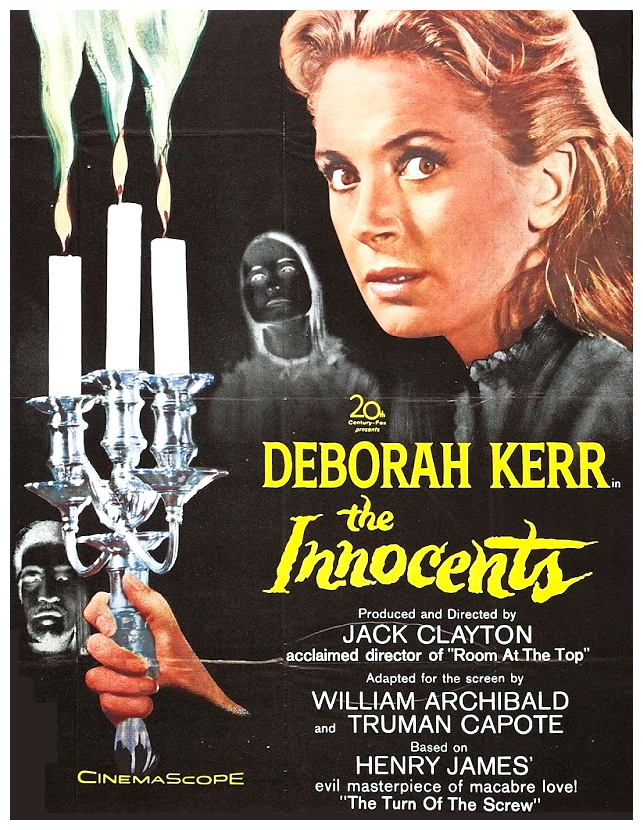
The Innocents (1961)

innocents 1

By Richard Winters

My Rating: 6 out of 10

4-Word Review: Children frighten their governess.

Legendary British actress Deborah Kerr plays Miss Giddens, the governess hired to care for two children at a sprawling English estate. However, the children are not exactly as they seem. Strange occurrences and behaviors begin to manifest as well as several ghostly sightings, which leads Miss Giddens into believing that the children may actually be possessed.

The film is based on the Henry James novel The Turn of the Screw. I have not read the book, but those that have feel this is a pretty satisfying adaptation. I did like the slow, methodical pacing. It helps to build the tension as well as enhance the mystery. Things are revealed in deliberate layers, which kept me intrigued throughout.

Director Jack Clayton shows a marvelous handle on the material.  The estate that they chose for the setting is perfect and captured well in glorious black and white by famed cinematographer Freddie Francis.  There is a lot of spooky imagery throughout including a creepy nightmare sequence in the middle.  The garden with its hulking, strange statues is used quite effectively especially in the haunting finale.  The music also grabs your attention right from the start with a very eerie song that is played before you see a single image on the screen. The song is similar to the one used in Rosemary’s Baby.  In fact there are several things here that reminded me of that film as well as The Shining.

Kerr was a good choice for the increasingly frightened governess.  I loved that scared expression on her face, which becomes progressively more frequent. Yet she is also effective when the character decides to become proactive by taking matters into her own hands and singlehandedly trying to ‘cure’ the children herself.  This also helps make both the character and the story a more multifaceted because you are never sure if this stuff is really happening or all just inside her head.

What really impressed me the most though was the performances of the two children especially Martin Stephens who plays Miles the young boy. His character shifts through many different moods, playing an innocuous child one minute and then a menacing, volatile one the next. He does each one flawlessly and becomes practically mesmerizing in the process.  Pamela Franklin is also fine in the role of Flora. This was her film debut. Eight years later her career would peak playing her signature role as Maggie Smith’s nemesis in The Prime of Miss Jean Brodie.

Another thing that I liked about the children is that they are initially portrayed as being normal and even engaging.  This is unlike other films with a similar theme like Children of the Damned or Children of the Corn where the kids are given creepy features right from the start. Here it works better and is more chilling to the viewer because the children’s dark side is unsuspected.

Unfortunately, despite the film’s impeccable technical quality, I still went away feeling unsatisfied. Part of the problem is that nothing really happens.  The ghosts appear but then do nothing but just stand there, which quickly becomes tiresome. One scene in particular has the camera constantly cutting back to the lady ghost standing across the lake until she starts to look like a mannequin, which I suspect she was.  The buildup is good, but I would have liked more of a payoff.  The ending is much too vague and gives no explanation as to why this was happening, if it was happening, or whatever became of the main character.

I couldn’t help but feel that this story would have worked better as an episode from one of the old horror anthology series like The Alfred Hitchcock Hour or even The Twilight Zone where it could have all been compacted into an hour. A hundred minutes seems like much too long for such little to happen. It is also interesting to note that in 1972 a film came out entitled The Nightcomers starring Marlon Brando that attempts to speculate what happened to the children before the main character of the governess arrives and before James’s original story begins.

My Rating: 6 out of 10

Released: December 25, 1961

Runtime: 1Hour 40Minutes

Rated NR (Not Rated)

Director: Jack Clayton

Studio: 20th Century Fox

Available: VHS, DVD