Category Archives: Black & White

The Last Picture Show (1971)

last picture show 1

By Richard Winters

My Rating: 9 out of 10

4-Word Review: A Texas sized drama.

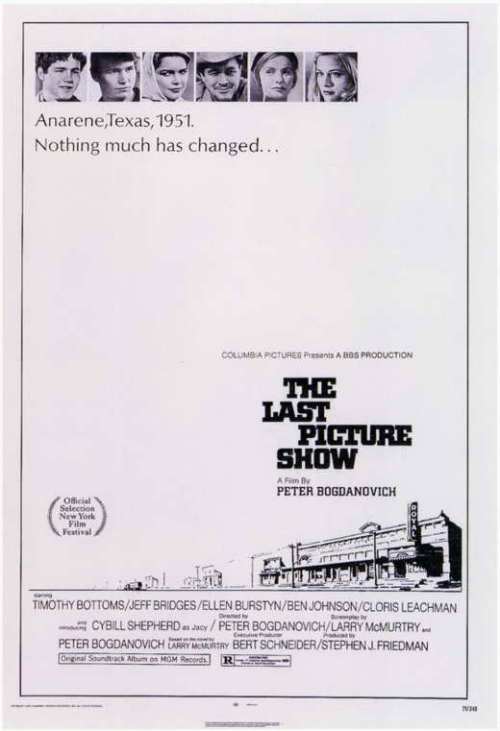
Based on the Larry McMurtry novel, who also co-wrote the screenplay, the story deals with the inter-workings and relationships of a people living in a small Texas town known as Anarene during the years of 1951 and 1952.  There’s Duane (Jeff Bridges) and Sonny (Timothy Bottoms) two high school seniors who are also best friends. Duane dates the highly attractive Jacey (Cybill Shepherd) who seems more geared to playing the field with every guy in town and even makes a play for Sonny, which seriously affects his relationship with Duane. There’s also Ruth (Cloris Leachman) the lonely coach’s wife who begins a brief affair with Sonny until he decides to bail-out for the more attractive Jacey. Sam (Ben Johnson) makes up part of the older generation still stuck in the dusty town and trying to make ends meet by running the local movie theater and pool hall both of which come to a halt when he dies suddenly.

I saw this film just recently outside on the big screen as part of the Texas Film Heritage and Preservation Society here in Austin. Although I had seen it before I was hit with how much more impressive and visually sumptuous it is on the big screen. Robert Surtees’ black and white cinematography is top-notch and the main ingredient to what makes it so spellbinding, so much meticulous attention is taken into each and every shot that one could almost watch this with the sound down and still find it thoroughly compelling.

Director Peter Bogdanovich takes great care to make sure that all of the elements are there and spins them together like a well-crafted machine so the viewer learns bit and pieces about these characters and their attitudes through each shot and camera angle that comes along. Filming it on-location in Archer City where McMurtry grew up helps accentuate the authenticity as does playing the country music from the period although I could’ve done with a little less of that and more of the sound of the wind and dust crackling across the barren region instead.

What surprised me most was how interesting and varied the love making scenes where and how instrumental they became to the film as a whole. One of the most memorable ones is when Sonny first tries to make love to Ruth, but is quite awkward about it. We see the pained expressions on both of their faces, hear the rusty springs of the mattress, and then finally witness Ruth’s attempts to shield her crying and frustration from Sonny. Duane’s futile attempt at sex with Jacey later on is also good particularly the fiery look of anger spewing from Jacey’s eyes when he is unable to perform. The scene involving a mentally challenged young man pushed into attempting sex with an obese and caustic prostitute inside the backseat of a cramped car is both darkly funny and sad, but the most provocative love making moment comes near the end when Jacey has sex with her mother’s boyfriend (Clu Gulager) on top of a pool table inside a dark and lonely pool hall while bracing the table’s side pockets with her hands for leverage.

The performances are all-around outstanding and both Leachman and Johnson won the Academy Award for their work here, but I still came away feeling, just like I did twenty years ago when I first saw this film, that Shepherd does the best job and leaves the most lasting impression. I love how her character slips between being insecure and indecisive to cunning and conniving and Shepherd’s facial expressions are completely on-target all the way. Her striptease done on top of a diving board is still pretty hot and my only complaint about the character is the way she elopes with Sonny and then completely bails on him the next day. I realize she didn’t love the guy and she’s just used him like she did others, but I didn’t understand what her motivation was in this instance as she seemed to get little if anything out of it.

I was also a bit disappointed that the Coach Popper character played by Bill Thurman didn’t have a bigger role in the story. The way he berates his players during practice is amusing and would most likely get coaches in today’s more sensitive world in hot water. I also found his constant spitting of tobacco juice into a cup that he carries around with him to be grotesquely amusing, but my biggest beef is the fact that we have a main character screwing his wife and the whole town knows about it, but never any reaction from the man himself. Maybe he was aware and didn’t care, but the movie should’ve made an attempt to show this, or at least some interaction between Sonny and the Coach since Sonny was at one time one of his players, which would have to make things quite awkward whenever they would bump into each other and in a small town that would most likely happen on more than a few occasions.

Overall though this is a great movie and I was surprised at how frank and explicit it was despite its 1950’s setting. Some may argue that it was done with too much of a revisionist mindset and things weren’t quite this wild, but others, like myself, will insist that it probably was, but just not talked about as much.

My Rating: 9 out of 10

Released: October 22, 1971

Runtime: 2Hours 6Minutes (Director’s Cut)

Rated R

Director: Peter Bogdanovich

Studio: Columbia Pictures

Available: DVD, Blu-ray, Amazon Instant Video
One Way Pendulum (1965)

one way pendulum 1

By Richard Winters

My Rating: 4 out of 10

4-Word Review: An absurd little movie.

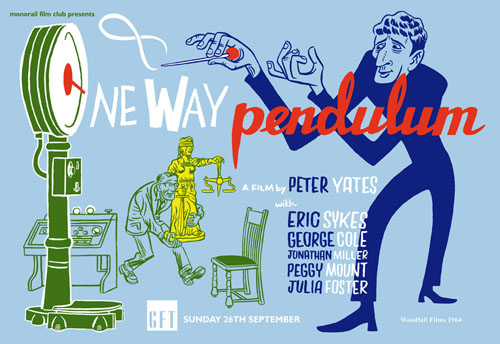
The Groomkirby family is one really absurd bunch. The father (Eric Sykes) wants to build a replica of the Old Baily courtroom in his living room and then have a trial, involving his son Kirby (Jonathan Miller) as the accused, reenacted. His daughter Sylvia (Julia Foster) wishes that she were an ape so that her arms would be longer and discusses this at length with her mother (Alison Leggatt). Kirby steals weight machines, which voices the person’s body weight, off the city streets and brings them back to the family’s attic were he then converts them into machines that sing. There’s also Aunt Mildred (Mona Washbourne) who thinks she’s waiting for a train that never comes as well as Mrs. Gantry (Peggy Mount) who’s paid to come over and eat the family’s unwanted leftovers.

The film is based on the stage play of the same name written by N.F. Simpson and was labeled as being ‘A farce in a new dimension’. John Cleese is purportedly a big fan of the movie and credits it as inspiring many of the absurd ideas that they used in their later Monty Python sketches. It was also directed by Peter Yates who went on to direct such quintessential hits as Bullitt, Breaking Away, and Year of the Comet.

The film certainly does have its share of funny and highly original moments. One of my favorite scenes is where the father carts the props that he needs to build his courtroom down a busy street of London using nothing but a wheel barrow and holding up traffic while he does it. Kirby’s ability to make the weight machines sing and sound like a genuine chorus is fun also as well as the climactic courtroom segment in which a myriad of comically absurd arguments, testimony, motions and reasoning is used until it becomes almost mind bending.

Unfortunately it all gets just a little too weird. Normally I’m a fan of the offbeat, but there still needs to be something to anchor it down and this film lacks it. The dialogue, characters and storyline are so progressively strange that it becomes downright nonsensical. The court case loses its edge as well because the father is somehow able to recreate it and the people in it in some magical way using a machine where kidnapping a magistrate and lawyers and forcing them perform in their makeshift court of law would’ve been funnier.

The movie will certainly satisfy those with inkling for the offbeat and the film seems intent to push the absurdity as far as it possibly can with a cast primed to pull it off, but it ends up being too weird for its own good and parts of it are confusing and hard to get into.

My Rating: 4 out of 10

Released: March 2, 1965

Runtime: 1Hour 20Minutes

Not Rated

Director: Peter Yates

Studio: United Artists

Available: None at this time

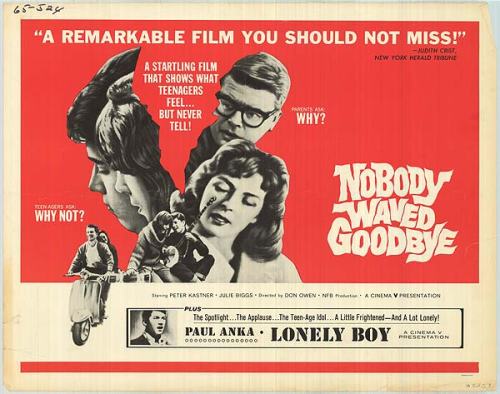
Nobody Waved Goodbye (1964)

nobody waved goodbye 1

By Richard Winters

My Rating: 8 out of 10

4-Word Review: Teen learns hard lesson.

Peter (Peter Kastner) is 18 and looking to spread-his-wings, but doesn’t like what he sees in the adult world. Everyone seems trapped by their dull jobs and mundane routines, which is something he doesn’t want to fall into. He has big dreams. He wants to run away with his girlfriend Julie (Julie Biggs) and live a life based completely on his own whims while never becoming a slave-to-the-system like everyone else. Then he gets in a fight with his parents and they kick him out and after struggling to find work without even a high school diploma his attitude quickly changes.

If you can get past the wretched opening song, which is sung by Kastner and played over the credits, then this film really hits-the-mark. I was impressed with the camera work especially during the dinner time conversations amongst the family members where director Don Owen shoots it with a hand-held camera and zooms in and out on the person’s face as they are speaking. This is something that is quite common today especially on TV-shows, but back then was rarely if ever used, which makes this well ahead-of-its-time and even groundbreaking. I also enjoyed the conversational quality of the dialogue and having two conversations going on at the same time, which again didn’t come into vogue until years later when Robert Altman did it in M*A*S*H.

The film also clearly allows for ad-libbing amongst its actors. There is a scene in which Peter and Julie go paddle boating and come upon a large sofa submerged in the water and then comment on it. Clearly the filmmakers didn’t put the sofa into the lake simply to film the short scene that has nothing to do with the rest of the story, but it still helps set the tone for keeping things fresh and real.

Kastner is great and it’s refreshing to have a protagonist in a film that you like at some points and feel like wringing-his-neck at other times. Too many movies today, especially Hollywood ones, create lead characters that are politically correct caricatures while this movie instead has real human beings that are not tailored made to conform to the likings of any particular demographic.

It’s a shame to say that a movie that came out over 50 years ago is still considered cutting-edge, but compared to the tired, formulaic glop coming out today it really is. The script is uncompromised and holds-no-punches while keeping things gritty and stark and making profound, universal points along the way. I also found it fun that the main character here, who was clearly a baby boomer, displays the same anti-establishment, anti-work attitude that now gets placed squarely onto the ‘dreaded millennials’ and yet it seems the boomers were just as reluctant to get into the rat race as all the generations that have followed them and therefore shouldn’t be waiving their finger at anyone.

nobody waved goodbye 2

My Rating: 8 out of 10

Released: August 13, 1964

Runtime: 1Hour 20Minutes

Not Rated

Director: Don Owen

Studio: National Film Board of Canada

Available: None at this time.

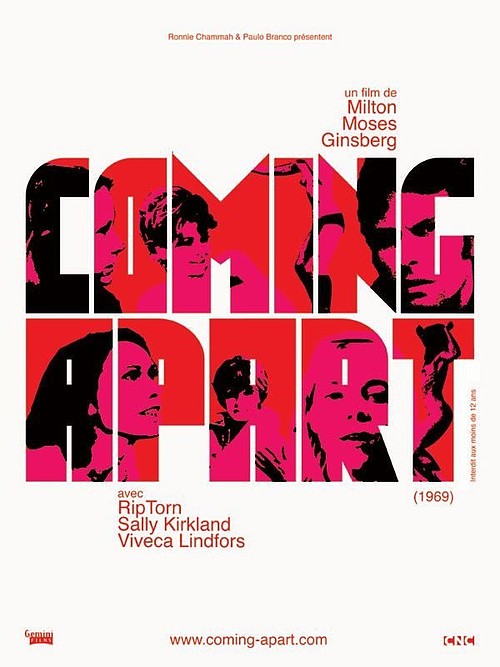
Coming Apart (1969)

coming apart 1

By Richard Winters

My Rating: 2 out of 10

4-Word Review: Psychiatrist secretly films people.

Rip Torn plays a psychiatrist living in a Manhattan apartment who has a camera secretly film everything that goes on there. Many of his female patients including Joann (Sally Kirkland) talk about their intimate desires and his ex-wife Monica (Viveca Lindfors) shares her darkest secrets thinking he is the only one hearing it, but instead a glass box resembling an antique camera sits in the living room and takes it all down.

The film’s concept is novel and if executed in a slightly better manner could’ve been brilliant. Without a doubt it breaks all the old filmmaking conventions and was year’s ahead-of-its-time. The sexual openness of its characters and tawdry subject matter make it quite voyeuristic and real. The actors have an amazingly natural quality to their delivery giving one the idea that it was ad-libbed when in actuality it wasn’t.

Kirland gives an emotionally over-the-top performance that is both remarkable and riveting. Her meltdown at the end in which she proceeds in slow motion to tear up the apartment is quite memorable and the best part of the whole film.

Writer/director Milton Moses Ginsberg manages to keep things relatively fresh by continuously introducing situations that become increasingly more provocative including a party that turns into a sex orgy and explicit love making between Torn and Kirkland that could almost be considered pornographic. There’s even an interesting scene involving a young lady looking to be barely 18 coming to the apartment with her baby in a carriage and propositioning herself to Torn and then having the two make love on the floor while the baby, still in the carriage, cries next to them. There is also a segment featuring recorded phone conversations that Joe has with his fellow psychiatrists that I found to be revealing as well.

Unfortunately despite these creative efforts the film is agonizingly boring to sit through. No matter what is going on in the scene the viewer is still forced to stare at the same wall, same mirror, and same skyline for almost two-hours. The scenes needed to be broken up with cutaways that would’ve taken the viewer out of the apartment and given them some other visual element to look at. Simply turning on a camera that’s nailed to the floor and then filming whatever happens in front of it is not a movie, but more like C-Span and the ultimate result is a failed experiment lacking the necessary cinematic touches that would have made it come off as a fluid whole.

My Rating: 2 out of 10

Released: October 26, 1969

Runtime: 1Hour 51Minutes

Not Rated

Director: Milton Moses Ginsberg

Studio: Kaleidoscope Films

Available: DVD

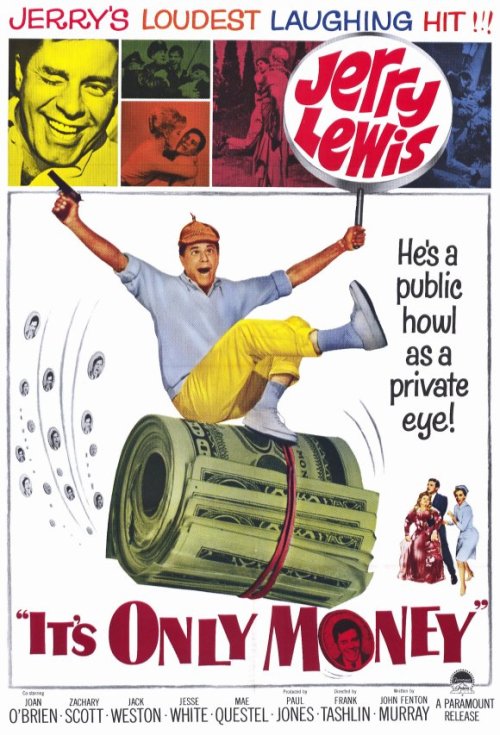
It’s Only Money (1962)


its only money

By Richard Winters

My Rating: 3 out of 10

4-Word Review: TV repairman gets rich.

Lester March (Jerry Lewis) is a dimwitted TV repairman who has a penchant for reading detective magazines and desires to become a private eye. When Pete Flint (Jesse White) who is an actual detective comes to his shop one day with a broken TV set Lester uses the opportunity to ‘audition’ himself as Pete’s assistant on his next case. Pete decides to try him out by putting him on a case involving a rich family whose heir to their fortune is missing yet when Lester starts to investigate he realizes it may be himself that they are looking for.

The script by John Fenton Murray comes off like it was written in one day and could’ve possibly been done by a 10-year-old in a matter of an hour. The plot is lame and flimsy, the humor excessively silly and the movie offers nothing new or creative. The running gag involving the Jack Weston character and his many attempts at trying to kill Lester is nothing more than a live action, subpar version of the Wiley E. Coyote/Road Runner formula.

How much one enjoys this film relies heavily on how much they can tolerate Lewis. To some extent he is mercifully more restrained here and not as obnoxious as usual, but there are still several scenes that get unnecessarily extended just so he can play up a gag that has nothing to do with the plot and isn’t funny. The biggest issue I have with the character is that he’s too unrealistically and painfully stupid. It’s one thing to be a slightly dimwitted schmuck, but this guy speaks and acts like he has a severe mental defect and needs clinical help.

Mae Questel, who was best known as the voice of cartoon character Betty Boop, is far funnier and without trying half as hard. The scene where she gets into a tight jumpsuit despite being quite overweight and elderly and then tries to do some exercises will certainly elicit a few genuine chuckles from just about anybody and the only real funny part in the movie. Weston isn’t too bad as the nemesis especially the scene involving his attempts to run Lester over with a car.

The climactic sequence involves Lester being chased around by robotic lawn mowers, which offers a slight diversion, but the rest of the film is forgettable and subpar even for Jerry Lewis standards.

My Rating: 3 out of 10

Released: November 21, 1962

Runtime: 1Hour 23Minutes

Not Rated

Director: Frank Tashlin

Studio: Paramount

Available: DVD, Amazon Instant Video, You Tube

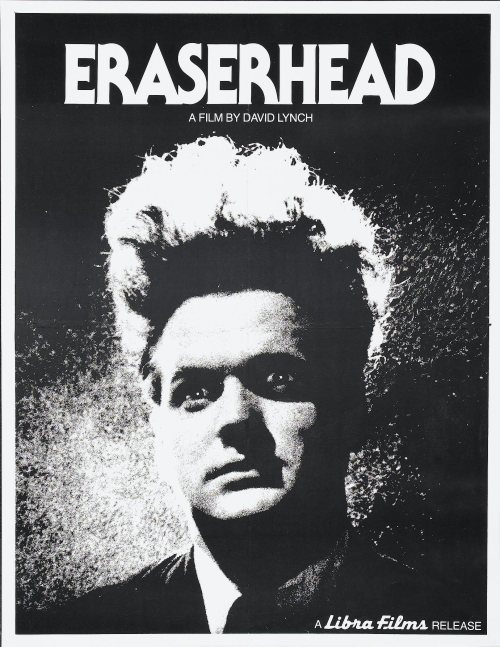
Eraserhead (1977)

Eraserhead

By Richard Winters

My Rating: 6 out of 10

4-Word Review: Couple has deformed baby.

In David Lynch’s first feature length film, a movie that took almost 5 years to make and had a good deal of it financed by Sissy Spacek and her husband, we have a surreal almost cryptic-like tale detailing a lonely man named Henry (Jack Nance) and his ultimate descent into a madness as he is forced to take care of severely deformed child while also harboring the dark urge to kill it.

It is hard to say whether one can like or dislike this as it goes so far out of the conventional form of film narrative that it seemingly defies all genres and puts itself into a category all its own. On a sheer technical level it is quite impressive especially when you factor in its shoestring budget and array of production set-backs. Each scene is meticulously detailed with wild and unsettling imagery that on a purely visual level will be more than enough to leave an impact. Overall the film is cold, ugly and unyielding, but helped tremendously by Nance’s presence as a sort of detached everyman who seems as confused and aloof to his surroundings as the viewer.

To me the most jarring image is the baby, which is incredibly lifelike. Had it came off looking fake, or like some puppet or Claymation attempt the film would’ve been a failure, or deemed laughable, but this thing is freaky looking to the extreme and Lynch spares no expense in getting the camera close up to it, which could force some viewers to turn away. Supposedly it was made from the embalmed fetus of a calf, but no one knows for sure and the crew was forced to blind fold themselves when Lynch set it up, so the secret would never come out. Either way it is effective and it manages to move its eyes and mouth almost like it were real and coming off as far more authentic than any computerized effect.

Spoiler Alert!

Of course the most confounding thing about the film is its story and symbolism’s that can be interpreted in a million different ways depending on the viewer’s own perspective. For what it’s worth I’ll give you my interpretation, which isn’t that complicated. To me the deformed baby symbolizes Henry’s soul, which has been mangled by the soulless world that he lives in, which would explain why he is so extremely passive because he is simply a walking zombie. The scene where his head pops off and the ugly child’s head pops into its place only reinforces this. The lady that he sees in the radiator is an angel from heaven and the beautiful lady that lives across the hall from him is the devil who entices him with sex, but when she realizes he has no soul to take, just an ugly mangled remnant of one, which gets exposed to her when she sees him standing in the doorway, she quickly loses interest and moves onto someone else. When he finally kills the baby he is essentially killing himself, which then explains why he ends up in the final scene in heaven with the lady in the radiator.

The man in the planet that we see at the beginning represents Henry’s own subconscious as he quarrels within his mind at the thoughts of killing the child. The man could also represent the world at large and how it controls everyone with its levers, which when Henry finally kills himself they start to have sparks fly from them and the man struggles in containing them, which shows that Henry has now ‘broken free’ from the man and this world by taking his own life.

End of Spoiler Alert!

Some consider this a horror pic, but I found certain parts of it to be quite funny in a darkly humorous way particularly the segment where Henry goes to visit his girlfriend’s parents. To me the most horrifying thing about is the way it challenges the viewers to question their own morality by forcing them to face the difficult quandary or what they would do if put into the same situation as Henry and forced to care for a hideous looking baby that some would consider would be better off dead.

My Rating: 6 out of 10

Released: September 28, 1977

Runtime: 1Hour 29Minutes

Not Rated

Director: David Lynch

Studio: Libra Films International

Available: DVD (Criterion Collection), Amazon Instant Video

Grunt! The Wrestling Movie (1985)

grunt

By Richard Winters

My Rating: 4 out of 10

4-Word Review: Who is masked wrestler?

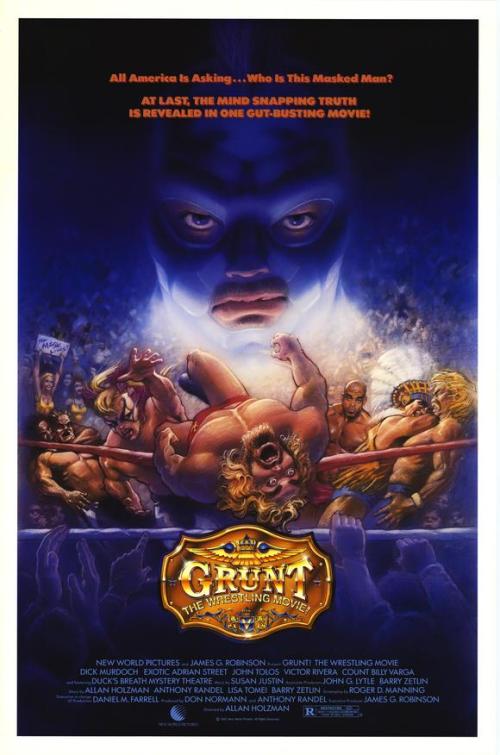
On October 13, 1979 Mad Dog Joe De Curso (Greg ‘Magic’ Schwarz) has a violent wrestling match with defending champion Skull Crusher Johnson (Greg Rivera). During the melee Johnson accidently gets his head stuck in the ringside ropes where Mad Dog decapitates him with one swift kick. The wrestling world then goes into an uproar with the biting question on everyone’s mind ‘Does a defending champion lose his title when he loses his head?’ that nobody, not even the commissioner seems willing to answer. After spending 90 days in jail Mad Dog gets released, but suffers from severe depression and eventually jumps to his death off of a bridge. Yet documentary filmmaker Leslie Uggams (Jeff Dial) thinks that Mad Dog is still alive and working under the disguise of a masked wrestler whose identity is unknown. Uggams begins a crusade of trying to unravel the mystery by interviewing those who knew Mad Dog best while also following the masked wrestler around to his events and trying to get to know both him and his French lady manager Angel Face (Lydie Denier).

The first 10 minutes of this thing is brilliantly bizarre that has just the right mix of offbeat humor, wrestling action and cinematic quality to make it interesting, original and hilarious. I am no wrestling fan myself, but director Allan Holzman manages, at least in the opening segment, to draw the uninitiated into the wrestling world by unfolding all the side dramas, storylines and over-the-top characters that fans of the spectacle find so enjoyable. The bit is also filmed in black-and-white with a sort-of foggy back drop that helps give it a surreal effect while also playfully making fun of the event and those who watch it.

Unfortunately the remainder of the movie is unable to sustain that same momentum becoming instead an overplayed one-joke that goes nowhere. It also spends too much time in the ring where the viewer is forced to watch one wrestling bout after another until it becomes more like a pay-per-view event than a movie.

One of the few non wrestling segments that I did enjoy is when the masked man and Angel Face go onto Wally George’s ‘Hot Seat’ TV-Program. George was a notoriously combative conservative talk show host during the ‘80s and the precursor to Rush Limbaugh and Bill O’Reilly. He was also the father to actress Rebecca De Mornay who has spent her entire career trying desperately to downplay that fact. Liberal guests would come onto his show and almost immediately be berated before being thrown off, which is what happens to the masked man and Angel Face, but not before George gets into the masked man’s face and demands he take it off, which is pretty funny.

Adrian Street, a wrestler who dresses in drag, is a scene stealer and the segment with the masked man being interviewed on his show is equally good. I also enjoyed Denier as the rambunctious manager who flashes an opposing player during one of the mask man’s wrestling matches and carries around a pet poodle who wears a mask similar to her clients.

The scene involving a bout between two lady wrestlers with the song ‘She Was a Mighty Big Girl for Her Age’ is good and the match where the masked man takes on four dwarf wrestlers is an absolute howl, but the film is geared too much to the hardcore fan and those with very little interest in the ‘sport’ will find it off-putting and overtly silly.

My Rating: 4 out of 10

Released: November 24, 1985

Runtime: 1Hour 29Minutes

Rated R

Director: Allan Holzman

Studio: New World Pictures

Available: VHS, DVD-R, Amazon Instant Video

King Rat (1965)

king rat 1

By Richard Winters

My Rating: 6 out of 10

4-Word Review: An island prison camp.

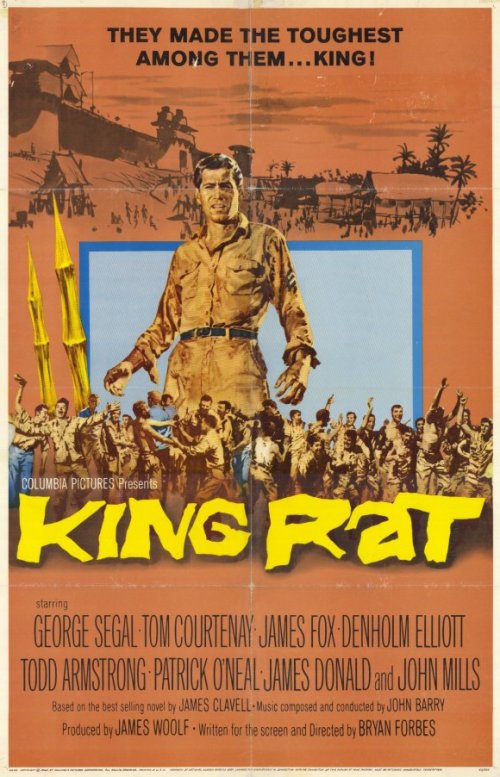
British and American POWs are held on an Island prison camp run by the Japanese during WW II. This camp is unlike the others as it does not have any walls, barbed wire fences, or prison guards. The men are allowed to roam freely while trapped on a tiny island with nowhere to go. Corporal King (George Segal) manages to wheel-and-deal his way to the top of the food chain by getting involved with the underground black market, which allows him to live the relative good-life while the other prisoners remain near starvation. He befriends Marlowe (James Fox) who can speak the Malaysian language, which he feels can come in handy as he gets involved with a diamond smuggling operation as well as selling deer meat, which unbeknownst to his customers is actually meat from rats who’ve feed off of the bodies of the other dead prisoners.

To some extent one can find some similarities to this and The Great Escape or Stalag 17 in that the prisoners have managed to create their own underground network without their captors being aware, but that is pretty much where the comparisons end. This film is darker and examines more the psychological deterioration that the men go through while realizing its themselves and each other that is more the enemy than the actual Japanese guards who are shown very little and have no presence at the camp or in the movie.

Segal gives a star making performance as a anti-hero who could easily be quite unlikable, but Segal’s engaging on-screen persona gives the character an added spark making him and his constant conniving more amusing than anything particularly with the way he barters with the Malaysian guards during their discussions on the price of the transfer of diamonds.

The supporting cast is outstanding as well especially Fox as the only sympathetic character and Tom Courtenay as the overzealous Grey and his never-ending crusade to take King and his cronies down. James Donald is also good as the no-nonsense Dr. with a very matter-of-fact bedside manner and a young Richard Dawson who gets the shock of his life when he comes in after the Japanese surrender to free the men of their enslavement only to find that they’re strangely reluctant to leave.

The film works in episodic fashion and while it maintains a gritty level it also has some lulls and few too many shifts in tone. There are though many unique and memorable moments including the ending where the men find themselves free to return home, but respond much differently than you’d expect. There is also a scene where the men kill a dog after it attacks some chickens and then later eat it as if it were a delicacy.

My Rating: 6 out of 10

Released: October 27, 1965

Runtime: 2Hours 14Minutes

Not Rated

Director: Bryan Forbes

Studio: Columbia Pictures

Available: DVD, Amazon Instant Video

Mickey One (1965)

mickey one 1

By Richard Winters

My Rating: 6 out of 10

4-Word Review: Comic hides his identity.

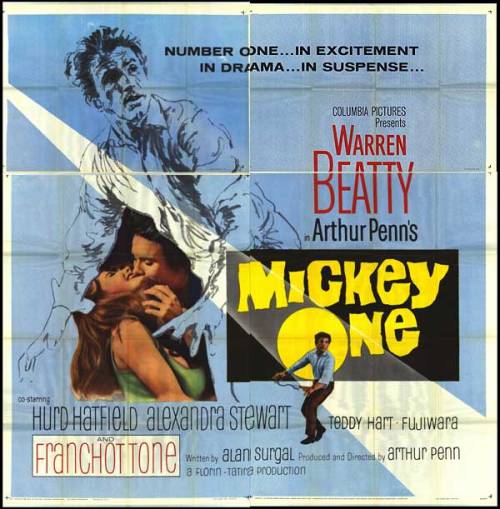
Warren Beatty plays a successful night club comic who’s living the good life until he falls into disfavor with the mob. He decides to go on the run by burning his social security card and getting a new one with a Russian name on it that is so hard to pronounce that everyone just calls him Mickey One. After spending time on the streets of Chicago he finally gets himself another gig at a club run by Ed Castle (Hurd Hatfield), but the better things get for Mickey the more paranoid he becomes convinced that he is being watched and followed at every turn and unable to relax for even a second.

This film marks the first pairing of Beatty and director Arthur Penn and their next project, Bonnie and Clyde, was a great success, but the results here are only so-so. The idea of trying to replicate the artsy French New Wave films of the late ‘50s and early 60s is intriguing, but poor pacing and a lack of consistent style hurts it. An early scene taking place inside an automobile junkyard has just the right combination of crisp editing and camerawork to give it an enticing visual quality, but then the film veers off into too many talky segments. It manages to recover at the end by giving the viewer a strong sense of the paranoia that the main character is feeling, but wide shifts in the film’s dramatic tone hurts it overall making this more of an interesting curio than a classic.

Beatty is okay, but he tends to be a bit too detached and his attempts at stand-up comedy are unfunny despite the many shots of audience members laughing. Hatfield is terrific in support and his presence significantly helps. Franchot Tone is also quite good in a part that features no lines of dialogue.

The film does have some unique and memorable moments. Tone’s strange art exhibit that he names the Yes Machine that he constructs on the ice rink of the Marina Towers is engaging particularly when he sets it on fire only to have it put out and ruined by the Chicago fire department. The best moment though is when Beatty tries to do a stand-up routine in an empty and darkened room with only a bright spotlight shining on him and a mysterious, unseen man sitting behind it, which has the perfect blend of mood and style and a scene I wished had been extended.

My Rating: 6 out of 10

Released: September 27, 1965

Runtime: 1Hour 32Minutes

Not Rated

Director: Arthur Penn

Studio: Columbia Pictures

Available: DVD-R, Amazon Instant Video

Dear Heart (1964)

dear heart 3

By Richard Winters

My Rating: 7 out of 10

4-Word Review: Love at a convention.

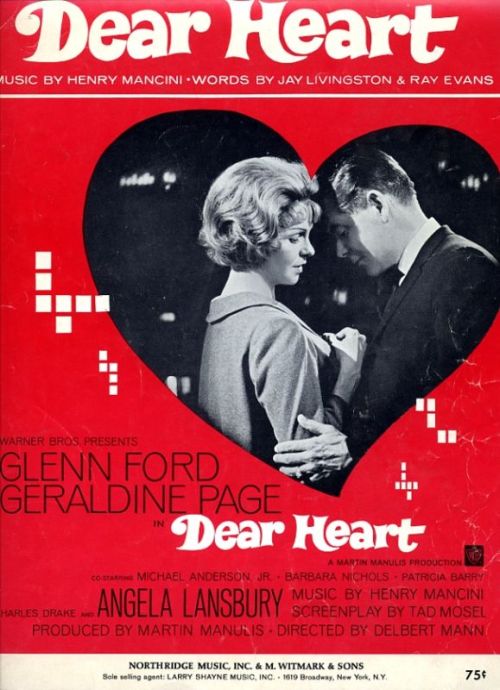
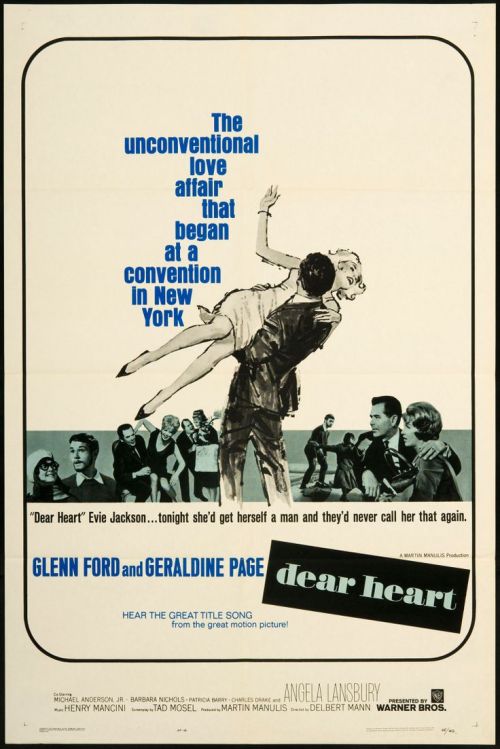
Harry Mork (Glenn Ford) is a greeting card salesman traveling through New York on business when he bumps into the quirky and very lonely Elvie (Geraldine Page) who’s attending a convention there and eyes Harry as a potential catch. Harry though is already engaged to Phyllis (Angela Lansbury) a woman he has only known through correspondence, but is starting to have second thoughts about when he meets her grown son (Michael Anderson Jr.). Elvie tries putting on some moves, but Harry keeps backing away unsure at age 48 if he even wants to settle down at all as he has at times still feels the itch for the occasional fling.

One of this film’s crowning achievements and something that becomes like a third character are the crowd scenes. This may sound inconsequential, but many films have a hard time getting background extras to behave like people amidst large groups of strangers do, but here for whatever reason it gets it right and seeing the dizzying stream of people going back and forth leaves a strong impression and helps accentuate the loneliness and isolation of the main characters particularly Elvie.

I also liked the way the characters hemmed and hawed with each other during the beginning stages. At times Elvie seems more into Harry than he is with her and then other times it gets reversed. Both characters at different points put up an array of defenses and it takes a while for either of them to trust the other and come out of their shells and move into an actual relationship, which is far more realistic than most movies that usually jumps ahead too quickly and never shows the awkward phase that most anyone else goes when testing the waters with someone that they’ve just met.

Page is excellent as always playing the eccentric type of character that she’s proven to be quite adept at, however her myriad of strange quirks got a bit ridiculous and overdone.

Ford is equally good especially with this type of comedy where he plays nervous characters unsure of how to deal with some of the offbeat people around him. I was disappointed though that there was a long drawn out sequence where he tries to get a clerk at the gift card shop (Barbara Nichols) up to his hotel room for a fling, but the film then cuts away and never follows through with what occurred once they got up to the room even though it is later intimated that things didn’t go too well.

The supporting cast of familiar faces lends great comic support, but the most memorable thing about the film is that it features both actresses who went on to play the Mrs. Kravitz character in the ‘Bewitched’ TV-Show. There’s Alice Pearce, who played Mrs. Kravitz for the first two seasons before she died of cancer and then Sandra Gould who replaced her and there’s even a surreal moment where the two have a bit of a confrontation, which I found to be pretty cool.

dear heart 2

My Rating: 7 out of 10

Released: December 2, 1964

Runtime: 1Hour 54Minutes

Not Rated

Director: Delbert Mann

Studio: Warner Brothers

Available: VHS, DVD (Warner Archive), Amazon Instant Video