Category Archives: 80’s Movies

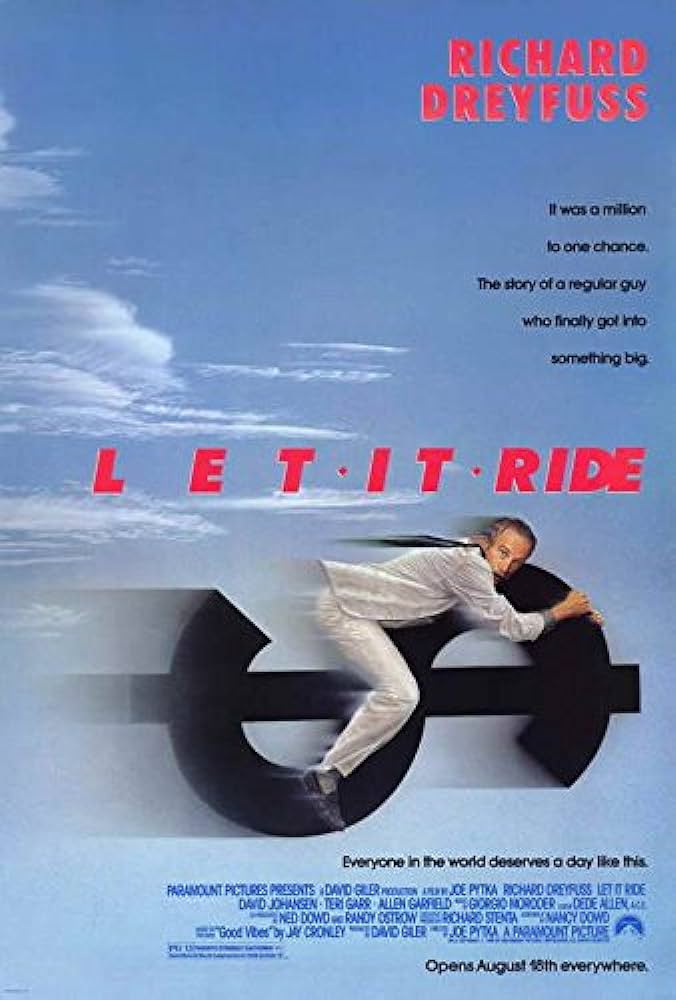
Let it Ride (1989)

let

By Richard Winters

My Rating: 5 out of 10

4-Word Review: Betting at horse racing.

Jay (Richard Dreyfuss) along with his friend Looney (David Johansen) are two struggling Miami cab drivers. One day Looney, who secretly records discussions that his passengers have while in the backseat of his cab, overhears a tip by two men of an upcoming horse race. He passes on the recording to Jay. Jay has not had much success in betting and has even promised his wife Pam (Teri Garr) that he will quit, but he can’t pass up this opportunity and places a wage on the horse that had been discussed. It turns out to being a photo finish in his favor and he spends the rest of the day making more bets by using all of his winnings as his wagering. Soon, he finds himself getting richer and richer even as his wife comes to the track in an effort to get him to stop. Will his luck hold, or run out?

Probably the best thing about the movie is the acting particularly by Dreyfuss, who’s known for playing aggressive, snarky types, but here comes-off as surprisingly sympathetic. You genuinely feel for the guy and his need to win at something and has one comically touching moment where he kneels at the toilet of a grimy bathroom stall and prays/pleads to God for a break. Garr, who reunites with Dreyfuss as the two starred 10 years earlier in Close Encounters of the Third Kind where they also played a husband and wife, is equally engaging though while seen right at the start disappears for quite awhile only to reappear briefly during the second act where it would’ve been better had she remained in it all the way through.

In support Johansen, better known as Buster Poindexter the lead singer of the punk band the New York Dolls, is amusing as Jay’s ever losing friend and Robbie Coltrane has some great reaction moments as the ticket seller. Jennifer Tilly almost steals it as a voluptuous vamp while Allen Garfield gets in a few funny quips as her Sugar Daddy boyfriend. A young Cynthia Nixon, wearing braces, can be seen as a underage girl trying to sneak in a bar with a phoney ID though her part doesn’t have all that much to do with the main plot and Michelle Phillips, singer from the Mama’s and the Papa’s, as a rich women who comes onto Jay at a luncheon.

The story, which is based on the 1979 novel ‘Good Vibes’ by Jay Conley, starts out well. I enjoyed the way it captures the working class life of Miami versus the usual glossy look at the chic neighborhoods of the area. All the actors including the stand-ins and those milling about in the background have a very ordinary, everyday quality, which nicely captures how people, who sometimes have very little money, will still flock to the track in a desperate attempt to ‘make it big’ even though it rarely ever happens. The shooting, done on-location at the famed Hialeah Park Race Track, one of the oldest in Florida, is terrifically done and you feel like you’re right there standing next to the track as the horses go thumping by while kicking up clumps of dirt.

The tone though is inconsistent. Instead of remaining this character study with a slice-of-life quality it instead skewers into becoming a camp comedy. Case in point comes when Jay gets arrested for mistaken identity, but still makes a mad dash to place his bet, which gets filmed in a sped-up fashion including having him crash through a wooden door with a cartoonish flair that’s jarring and out-of-place. It also gets highly exaggerated as in only one day’s time everyone at the track gets to know Jay and cheers him on, which is too quick of a turnaround for such a thing to realistically happen.

Spoiler Alert!

The ending leaves much to be desired as Jay just continues to win and win until his earnings amount to over $600,000 (or $2 million in today’s dollars), but what is causing him to have such a streak of luck? Did God really answer his prayers, or is some other mystic source at play? Everyone knows that you end up losing more than you win at gambling and a winner’s luck will eventually run-out at some point.  Showing a guy who never was good at gambling before without having earned it like learning some special skill, or insight, makes for a flimsy and fanciful movie. Getting lucky on one bet, maybe even a really, really big one that beats long odds, which is how the movie should’ve played it, might happen, but having him just continue to ‘get lucky’ with no explanation is too exaggerated and doesn’t show the harsh downside, which if you’re going to do a story about gambling in any type of realistic way, needs to be shown as well.

My Rating: 5 out of 10

Released: August 18, 1989

Runtime: 1 Hour 27 Minutes

Rated PG-13

Director: Joe Pytka

Studio: Paramount

Available: DVD, Blu-ray, Amazon Video, YouTube

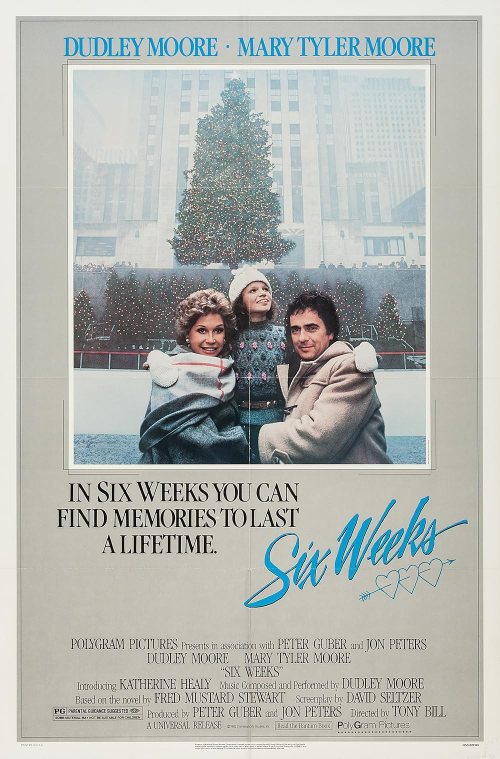
Six Weeks (1982)

sixweeks

By Richard Winters

My Rating: 1 out of 10

4-Word Review: Young girl has leukemia.

Patrick Dalton (Dudley Moore) is running for political office in the state of California when he becomes lost while trying to find his way to a political fundraiser where he is to be the keynote speaker. He stops to ask a young girl, Nicole (Katherine Healy), for directions and the two strike-up a conversation. He invites her to the fundraiser and finds that she’s the daughter of Charlotte (Mary Tyler Moore) who is the wealthy owner of a cosmetic company. Initially Charlotte is frosty towards Patrick convinced he’s just another opportunist politician. Nicole though grows very fond of Patrick and volunteers to work on his campaign. Charlotte, after seeing how much her daughter likes Patrick, even agrees to give him a generous donation, which he initially rejects until he learns that Nicole has been diagnosed with leukemia and has only a short while to live. This causes Patrick to become quite close to Charlotte and Nicole and he begins visiting them frequently much to the concern of his wife Peg (Shannon Wilcox) who thinks he’s having an affair.

Hard to find much to like about this shallow tear-jerker that was based on the novel of the same name by Fred Mustard Steward. I did though like seeing Dudley, who also composed the film’s score, in a rare dramatic turn. He’s best known for his comedy, but even when he was at his goofiness I still detected a serious side to him and this role here brings that out quite well. I did though have issues with the marriage angle as I felt the wife gave up too easily. She does show-up at a party that the three others are at in an attempt to make them uncomfortable, which it does, but I felt she should’ve created more of a scene. This was done in an era where putting up a veneer of civility was expected even when it was with people who shared intense feelings towards each other, but these days there’s jilted women out there that don’t take kindly to those that are out to ‘steal their man’ and could lead to some very public catfights, which could’ve given the film a lively energy as well as making the viewer more sympathetic to Dudley for leaving her as she would be better deemed as a ‘psycho’. Yet the way the film does it here you’re actually sympathetic to the wife and Dudley, as noble as his intentions are, comes off looking a bit like a cad for literally just abandoning her and getting with the other two essentially full-time.

I was confused too why this didn’t hurt him politically. If I’m his opponent and I catch-wind that he’s been seen regularly with another women that’s not his wife I use it to my advantage to crush him in the polls with it, or this is something his wife could’ve done by tipping off to the press that he was seeing someone else in order to ruin his bid and get back at him, yet none of this occurs. What’s the point of having him be in politics if it’s not going to be used to enter in some potentially delicious dramatic conflicts? Might as well have him being a bland accountant since him as a politician doesn’t really add much, or make that much of a difference to what happens.

Healy, who as of this date is the only theatrical film she’s been in and much better known for her ballet work, is fantastic and shows a lot of poise for someone who never acted in a movie before. I enjoyed her worldly-wise character who despite her age shows a keen awareness to many adult topics, which I appreciated. Kids can be far more observant about things than many adults would like to think, so I was glad she wasn’t played-up to being cute, but painfully naive. I did though feel her protruding, poorly spaced teeth should’ve been straightened with braces and was surprised that her mother, being as rich as she was, hadn’t had that done.

Her leukemia that she’s supposedly suffering from is problematic as she goes through the great majority of the film showing absolutely no symptoms of it. She states that she’s refused treatment, so I guess that could explain why her hair doesn’t fall-out, but I’ve known people who’ve suffered from the illness and it takes a toll on one’s energy to the point that they become bedridden as it progresses and yet here she shows nothing but boundless energy and even dances on stage without any signs of exhaustion near the end. It got to the point that I started to wonder if she was faking being sick and I wouldn’t blame anyone for thinking the same thing.

The casting of Mary Tyler Moore, who won the Razzy award for her work here, was a real mistake. Although she was only 45 she looked more like she was 55 and too old to have a daughter that wasn’t yet even in high school. She shows at times quite a cold demeanor making the way she melts away and falls for Dudley seem too quick and forced. Watching the two walk side-by-side where she’s clearly way taller than him makes it resemble a mother walking her son than a couple and thus has the romantic angle visually look even more odd and awkward than it already is.

I was confused too about who this girl’s father was. I have never read the book of which this is based, so maybe it gets talked about there, but here it’s never mentioned. I would think that even if she was a product of a painful divorce her father would still want to see her especially if he knew she was dying. Even if it was just a passing fling that the mother had year’s ago it would be presumed that Dudley would be curious about it and at least ask since he was essentially taking the father’s place with his presence.

Having the Dudley character ‘pull some strings’ in order to get Nicole to perform onstage in the New York Ballet at the last minute was too fanciful to be believed. The other cast members would resent that they would have to rehearse for weeks, even months and years, just to get the opportunity to be on the show and yet this kid gets whisked into the lead, at the sacrifice of someone else, all at the last minute. I admit I liked seeing the Nutrcracker production, but having Nicole already a part of the cast, but afraid due to the onset of the disease she might not be able to do it when it became time for the performance, and having some overly ambitious understudy ready to take over if she couldn’t, would’ve made more sense and been more interesting drama.

Spoiler Alert!

The death scene has got to be one of the lamest I’ve ever seen. Again, she spends virtually the entire movie showing no outward signs of any problem and then while on a subway car she starts feeling ‘weird’ and then a few seconds after that she promptly falls over dead, which was so corny it was almost like the movie makers were begging the viewers to make fun of it.

My Rating: 1 out of 10

Released: December 17, 1982

Runtime: 1 Hour 48 Minutes

Rated PG

Director: Tony Bill

Studio: Universal Pictures

Available: Amazon Video, Tubi, Freevee, YouTube, VHS

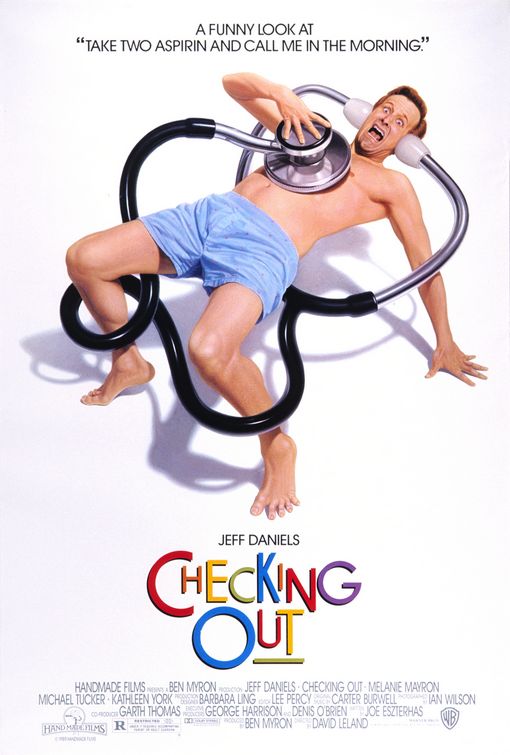
Checking Out (1989)

checking2

By Richard Winters

My Rating: 4 out of 10

4-Word Review: Man becomes a hypochondriac.

Ray (Jeff Daniels) is a middle-aged father who suddenly experiences deep concerns about his health when his boss (Allan Havey), who’s the same age as he is, drops over dead from a heart attack while at a backyard BBQ. His increasing paranoia about being sick, or potentially dying soon puts a strain on his marriage and his whole life gets essentially put on-hold as he constantly goes in and out of doctor visits over any perceived malady that comes-up.

The film certainly had big-name talent behind it as it was directed by David Leland, who got critical acclaim just a year before in his directorial debut with Wishing You Were Here while the screenplay was written by Joe Eszterhas who wrote such hits as Flashdance and Basic Instinct. However, while the film show flashes of interesting potential, even visually creative moments where Daniels, in a dream segment sees himself getting buried in a grave inside his children’s bedroom while the kids look down on him as the dirt gets shoveled over him, it never fully comes together as a whole. The tone shifts from satirical to sitcom and the concept becomes like a one-joke that gets stretched too far. Leland had promised Eszterhas that he wouldn’t change a thing from his script, but then added in several subplots, which angered Eszterhas to the point that he threatened to have his name removed from the credits, so Leland took out the extra sequences, but I’m almost wishing he had kept them in as it might’ve made the movie more interesting.

The one element that really sinks it is the overreaction by Daniels to his boss dying. For one thing the boss was a total jerk that did nothing but spew out corny jokes, so having him suddenly collapse dead, while saying yet another one of his eye-rolling quips, should’ve been a source of celebration and not dread, which might’ve actually been funny. What’s more is that Daniels immediately starts worrying about his own health, which seemed too rash. If his other friends were also dying suddenly then maybe, but just one guy dropping-over didn’t merit such a panic. Maybe the boss had some underlying heart defect that went undetected and that was the cause of his collapse, but either way it shouldn’t have caused such a drastic change in Daniels’ personality. Only if Daniels had already had some concern about his well-being previously, which he doesn’t, and then this incident brought those deep-seated fears to light would it have made sense. Even if it just meant paying better attention to his diet, but going to such extremes so quickly makes him seem like a completely different person.

The humor is too subtle and there’s long, boring segments in-between where nothing funny even happens only to answer it with a light one-liner. The running gag where Daniels becomes obsessed to find out what the answer is to why Italians can’t have barbeques, which was the joke his boss was saying when he suddenly died, gets overdone. The character arch is handled awkwardly as Daniels gets super hyper about his perceived maladies only to by the second act forget about it and then suddenly go back to being a hypochondriac again when his therapist dies, which makes the story seem like it’s not working in a linear fashion by ping-ponging the character from one goofy personality to the next.

Daniels is excellent and the one thing that keeps the movie watchable. I also enjoyed seeing Melanie Mayron, who up to this time had only played young adult women, getting her first stab at portraying a  middle-aged housewife, she even sports a suburban hair-style, and veteran character actor Allan Rich is quite good too as Daniel’s exasperated doctor. Elderly actor Ian Wolfe, who’s second-to-last movie this was, has a few key moments as an old undertaker who Daniels keeps bumping into at indiscriminate moments.

Spoiler Alert!

However, as interesting as the eclectic cast is they can’t overcome the otherwise mish-mash of the shallow script. Even the twist ending, which features Daniels dreaming that he is dying and going to heaven is forgettable as there have been too may other movies that have featured the afterlife in a more interesting and humorous way.

Watching Daniels then wake-up out of his dream and speed out of the hospital in his wheelchair ready now to take-on life again doesn’t really make it seem like the character grew, or learned anything, but more like a bland family man who went crazy for awhile until he finally snapped out of it. A much better way to have ended it would’ve had Daniels wheeling himself out the hospital door only to then get hit by an ambulance. This would’ve conformed better with the film’s otherwise darkish undertone and been a better payoff. It might’ve even made sitting through the rest of it seem worth it.

My Rating: 4 out of 10

Released: April 21, 1989

Runtime: 1 Hour 36 Minutes

Rated R

Director: David Leland

Studio: Warner Brothers

Available: DVD

If You Could See What I Hear (1982)

ifyou

By Richard Winters

My Rating: 2 out of 10

4-Word Review: Blind man finds love.

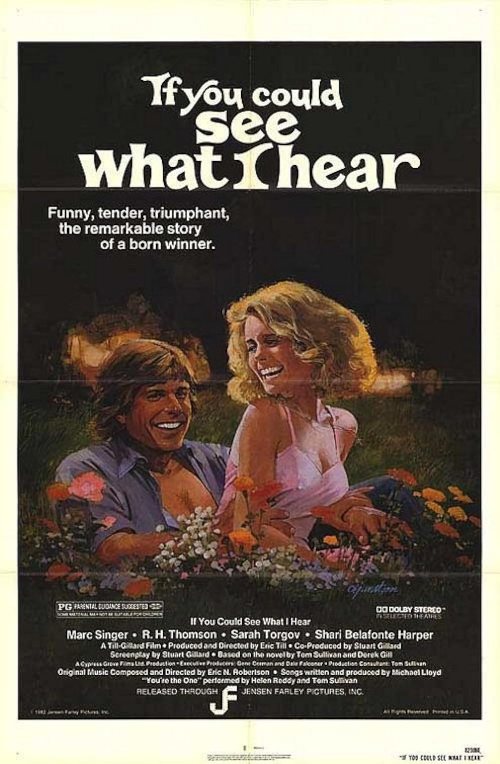
Tom (Marc Singer) is a young man attending college who also happens to be blind due to being a premature baby and put into an incubator that had too much oxygen. He meets up with Sly (R.H. Thompson) and the two become fast friends and eventual roommates. Both go on the prowl for women with Tom having the better luck as he soon gets into a relationship with a black woman named Heather (Shari Belafonte) though when he proposes marriage she bails. He then has flings with many other women that he meets at a bar where he works at, but when he meets Patti (Sarah Torgov) he begins to fall in-love despite their differences as she’s a staunch catholic while he’s an atheist.

The story is based on the early life of Tom Sullivan who became a famous songwriter and singer during the 70’s, he even sang the National Anthem at Superbowl X, as well as gust starring in several popular TV-shows of that era though today probably not that many people would know who he is. Marc Singer, best known for having starred in The Beastmaster as well as the 80’s TV-miniseries ‘V’, is also a casualty of that period and not real well known outside of those who lived through the decade. Why Singer was even cast I’m not sure as Sullivan clearly had acting experience and I would’ve thought he could’ve played himself and it might’ve been a better movie had he done it.

Story-wise it comes-off as comical vignettes spliced together and hardly seems believable, or at the very least highly exaggerated. Sullivan is given too much of a bigger-than-life vibe as where ever he goes everyone immediately gravitates to him and he becomes the life-of-the-party.  When he does seem to get into trouble he’s able to easily get out of it in circumstances that others wouldn’t. For instance he gets stopped by the police for driving a car without a license or vision, something that would get anyone else a ticket, fine, and arrest especially when his car does end up causing damage, but here the cops just shake their heads in a bemusement and walk away. He also jumps off a boat in the middle of a deep lake without a life jacket and unable to spot the life line that gets thrown to him and yet miraculously he gets out of this pickle just fine too. He’s even able to play golf against opponents with vision and beat them at their own game even catching them when they try to cheat. It’s like the guy can never lose.

The romantic/sex angle gets handled in an equally glossy way. He has a Fonzi-like quality with hot women clinging to him like he’s a magnet. Bimbo blondes and other babes prance in an out of his rented bedroom on an almost nightly basis to the point I was stunned when one of them refuses to go up to his room. This is only because she was ‘catholic’, but then after awhile she ends up doing it with him anyways with the brief delay being caused by her ‘morality’. It’s like his handicap is never a factor and in some ways almost an asset.  Some may argue this is a good thing as it shows a blind person can still live a normal life, but I don’t think there’s anything ‘normal’ here as even a good-looking sighted man isn’t able to score as frequently and consistently as this guy.

Spoiler Alert!

I have nothing against cute. Sometimes a cutesy moment or two in a movie is a good thing and can help bring in a lighthearted mood, but when it gets done constantly throughout it becomes like eating an entire carton of ice cream, which may be good for awhile, but will eventually make you puke. Even when it does finally get serious, which doesn’t occur until 90-minutes in, when he tries to save a young girl whose fallen into a backyard pool, it gets botched. Supposedly this is based on Sullivan’s true-life incident where he saved his own daughter from drowning, but I have a strong feeling the logistics were changed from the real one as here we see the girl floating lifelessly for several minutes making it look like her lungs were filled with water and beyond saving.

Of course there will always be those that may like it. There’s one commenter on IMDb who states she used to watch this over and over back in 1983 when it was on HBO and really loved it though if she went back to it now she might I suspect see it in a more critical way. Siskel and Ebert, who could never agree on anything, both voted it the worst movie of 1982.

My Rating: 2 out of 10

Released: April 23, 1982

Runtime: 1 Hour 43 Minutes

Rated PG

Director: Eric Till

Studio: Citadel Films

Available: DVD-R (dvdlady.com)

Rich and Famous (1981)

rich2

By Richard Winters

My Rating: 0 out of 10

4-Word Review: College friends become writers.

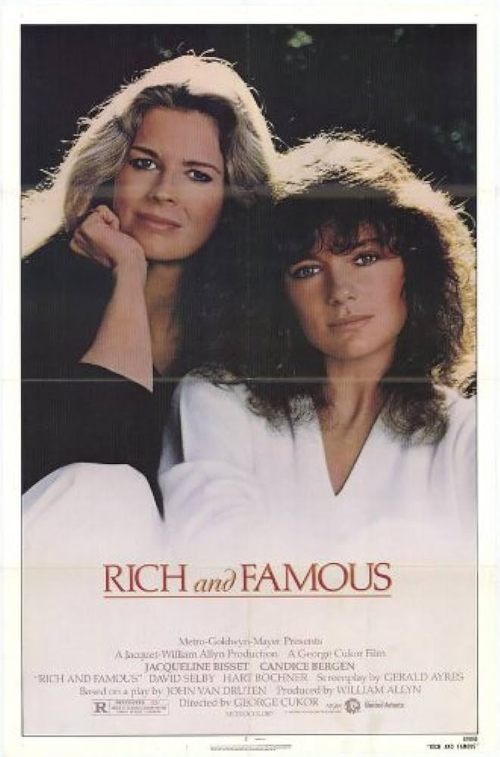
Liz (Jacqueline Bisset) and Merry (Candice Bergen) meet while attending college and become best friends. After graduation Liz achieves accolades for writing a novel and Merry, despite being married and living in posh Malibu, becomes jealous. She strives to write her own novel based on real-life experiences of her rich southern California acquaintances where only the names are changed. One night while Liz is visiting  Merry digs the first draft of her book out and reads it to her. Liz does not care for it, but promises the pleading Merry she’ll run it by her publisher (Steven Hill) convinced he won’t like it and nothing with come of it. To her surprise it does get published  and becomes a best seller. Now she’s the one seething in jealousy since her writing career has crested from writer’s block. While this is going on Merry’s husband Doug (David Selby) begins to come-on to Liz behind-the-scenes and openly wanting to have an affair with her, which Liz finds tempting since the two had a fling during college.

This is a remake of Old Acquaintances, which came out in 1942 and starred Bette Davis and Miriam Hopkins. Bisset spent 2 years working on the script and getting it funded as she was determined to play a ‘real person’ for once and not just the proverbial beauty. However, the movie, which was the last to be directed by legendary filmmaker George Cukor, bombed badly at the box office and it’s easy to see why. The storyline is out of touch with the decade that it’s in. What gets used as fashionable status symbol like having Merry stay at the Waldorf Astoria hotel might’ve been considered glitzy back in the 40’s, but for the 80’s generation would be looked upon as passe. Nothing is hip or trendy. The characters and their conflicts are of a soap opera variety, which is where this tepid storyline should’ve stayed.

My biggest beef was the whole friendship thing, which didn’t make a lot of sense. The two characters are about as different as you could get with Merry coming-off, particularly with her annoying southern twang, as dim-witted particularly when compared with Liz who’s clearly more sophisticated and articulate. Why these two opposites would bond is a complete mystery. There’s no backstory given, only a brief scene during their college days is shown, but nothing displaying what lead to the friendship blossoming, or what they had in common that they’d enjoy each other’s company. For the relationship to work it needs to be believable and organic, and the viewer able to buy into it, but instead it’s quite shallow and forced. Merry is incredibly annoying painfully insecure, emotionally needy, and grossly self centered. She’s the type of person most people would want to quickly dump as a friend and you wonder why Liz, who could easily find new friends more her intellectual equal, doesn’t do just that.

Merry’s marriage to Doug has the same issue. Why would he marry someone that had such a contrasting personality to his? The film fleetingly intimates that it was Liz he was truly after, he went to their same college, and only married Merry as an attempt to stay close to Liz, though the film relies on the viewer reading into this and should’ve instead fully confirmed it.

Merry’s ascent into the writing world is equally ridiculous. From the opening three paragraphs that she reads out loud to Liz gave more than enough reason that it was poorly written and should never see the light-of-day and yet somehow it becomes an immediate best-seller. In a better movie this might get used as satire showing how bad the American Public’s taste in literature is, but the film here has the audacity to show her winning awards for her writing, which just makes it all the more absurd and laughable. It also makes it seem like writing a book is easy and simply requires someone to sit down and throw some words on a page and walah it gets published when it reality it takes many drafts and polishing before it’s even potentially considered publish ready, but the movie glosses over this part completely.

I enjoyed Bisset who’s clearly the stronger actress, but Bergen makes an utter fool of herself particularly her attempt at a southern accent. Normally she’s good at playing the snarky type, which best reflects her personality. Trying to portray a simpleton isn’t her best suit and the film digresses every time she’s in it to the point her sporadic appearances start to seem almost like unintentional comic relief.

Had the film ended with some bitter, knockout cat fight I might’ve forgiven it and even gave it a few points. Not everyone is meant to get along and in real life these two would be a bad match. It’s one of those friendships that ultimately fizzles because the two just don’t have enough in common to keep it going and in a lot of ways ingrate on each other’s nerves. A nasty bitch session would’ve been just what the doctor ordered, and they do have a little bit of one, but then immediately make-up, which just cements the film’s profound shallowness.

My Rating: 0 out of 10

Released: September 23, 1981

Runtime: 1 Hour 57 Minutes

Rated R

Director: George Cukor

Studio: United Artists

Available: DVD, Amazon Video, YouTube

Zorro, The Gay Blade (1981)

zorro

By Richard Winters

My Rating: 4 out of 10

4-Word Review: Brothers become masked hero.

Diego (George Hamilton) is living in Madrid, Spain during the 1840’s when he receives a letter from his father ordering him to return to California. Once there he meets Esteban (Ron Liebman) whom he shared a friendship with when the two were children. Esteban has now married Florinda (Brenda Vaccaro) who Diego had a crush on when they were younger. He has also become Magistrate of the region upon the death of Diego’s father who suffered from a riding accident when his horse became startled by a turtle. Later Diego receives his inheritance, which turns out to being the disguise worn by Zorro the famous hero throughout the region. Diego now takes on the hero’s persona as he battles with Esteban who oppresses the already impoverished citizens of the area with high taxes. Unfortunately Diego breaks his ankle while jumping off a high balcony and is forced to turn-over his Zorro duties to his gay brother Ramon (also played by Hamilton) who uses a whip instead of a sword while also wearing flamboyant, color coordinated attire.

Hamilton’s career by the late 70’s had nose-dived to the point it seemed on life support until the surprise hit Love at First Bite helped revive it. This lead to many starring opportunities in the comic vein. He eventually decided to take this one since it allowed him the option to also be producer, but the film ultimately tanked at the box office killing off any more offers and he was never in another film for the rest of the decade and today he’s known less for his screen work and more for his vain persona, perpetual perfect tan, and appearing on reality shows dealing with has-been celebrities.

I’m not sure why this film is so obscure and hard-to-find as it’s not streaming anywhere, nor available on blu-ray while it’s DVD issue is from 20 years ago. Maybe it’s because of a white guy playing a Latino, though with Hamilton’s tan you’d never know, or maybe it’s because of the over-the-top caricature of the gay brother that could be deemed ‘controversial’ by today’s generation, but overall it’s adequately amusing for the most part. Hamilton is especially energetic and is the main reason it’s watchable though I felt it misses-the-mark when Diego goes from regular dude to caped crusader too easily. I would think becoming a masked super hero would bring in a certain learning curve that would invite mistakes to occur along the way. Outside of spraining his ankle no other missteps happen, which loses out on a lot of potential comedy.

Leibman as the bad guy is terrible as he overplays the campiness too much. A villain, even in a comedy, should have some threatening ability and this guy comes-off as a complete doofus from the get-go, so there’s never any suspense since we know this inept idiot’s bark is far worse than his bite. He also conveys his lines in a shrill tone that genuinely hurt my ears though he does have one good bit where he wiggles his hips in an attempt to replicate gay mannerisms, which is the only part of this movie that I remembered from when I first saw it over 40 years ago.

Vaccaro for her part is quite funny as she manages to balance the campiness with character’s personality in just the right way, so it seems organic. If anything I thought she should’ve been the heavy and Leibman could’ve been fully kicked-out. Lauren Hutton on-the-other-hand, who plays the other female lead as an idealistic woman fighting for change, and also Diego’s potential love interest, isn’t funny at all and is quite bland. I felt too that the idealistic period are usually when people are college-aged, so they should’ve cast a woman that was more that age, of which Hutton was clearly way past.

While there is a few chuckles here and there it overall comes-off as quite empty and limp. Not enough happens to make it intriguing and memorable. The sword fights become redundant and the hero is never put in any type of real peril. The humor is too constrained and needed to be played-up much more as does the sexual aspect. This was done when just having a gay character was considered ‘edgy’, but now seems quite pedestrian. There’s also only a few filming locations, so the visual backdrop offers little variety. The final shot has the heroes riding off into the sunset, which looks to be a painted backdrop, and it probably was, that just accentuates the film’s cheap looking production.

My Rating: 4 out of 10

Released: July 17, 1981

Runtime: 1 Hour 33 Minutes

Rated PG

Director: Peter Medak

Studio: 20th Century Fox

Available: DVD

Daniel (1983)

daniel

By Richard Winters

My Rating: 7 out of 10

4-Word Review: Researching his parent’s execution.

Based on the 1971 novel ‘The Book of Daniel’ by E.L. Doctorow, who also wrote the screenplay, which was inspired by the true story of Ethel and Joseph Rosenberg, who were convicted and executed in 1953 for being spies to the Soviet Union. The story here centers on Daniel (Timothy Hutton), the now grown son of Paul (Mandy Patinkin) and Rochelle (Lindsay Crouse), who many decades after his parent’s execution now decides to research their case to see if his parents really were spies, or not.

Despite being well produced the film failed at both the box office and with the critics, which is a shame as I felt director Sidney Lumet does some marvelous work here and creates a few powerful scenes. One is when the the FBI agents raid Daniel’s house, who is played at this stage by Ilan Mitchell-Smith, and the look of horror in his eyes as the home gets torn up from top to bottom and his father violently removed in handcuffs. Another great moment are the execution scenes filmed in the actual death chamber at the Sing Sing Prison. These moments are quite chilling as Lumet’s focuses in on the close-up shots of the two being strapped in and the leather flaps of their hoods pulled down over their frightened eyes and then seeing their bodies shake violently while a group of men sit quietly observing it is effectively disturbing and one of the more impactful execution segments put on film.

There are though some things that could’ve been done better. The jumping back and forth between time periods proves distracting and takes the viewer out of the story instead of wrapping them in. The book of which it’s based had a very fluid structure as well, but here the scenes involving Daniel and his sister as children prove far more impactful while segments involving Hutton all grown-up are weak by comparison. The film would’ve been more effective had it taken a linear structure.

Watching Hutton walk along the sidewalk while voice overs are heard from his sister, played by Amanda Plummer, chastising him for not caring more about what happened his parents, was unnecessary and heavy-handed as we had heard her saying all this earlier to him at the dinner table and could see by the shocked reaction on his face that it really got to him, so we didn’t need the same lines getting repeated again. The music particularly the singing, is way too intrusive and having almost no music and just relying on the action and visuals would’ve been far better.

I was also confused who Linda was, played by Tovah Feldshuh, whom Daniel comes upon at a dental office years later and acts like he knows her from childhood. I didn’t remember seeing a young Linda, though one is listed in the closing credits, and then it dawned on me that there was a quick moment when a snotty girl tells Daniel and his sister, when they’re kids, that they ‘smell’ while they’re riding in a car, but because this character does end up returning and playing a pivotal role to the plot I felt the confrontations between them as kids should’ve been more pronounced and extended instead of so fleeting that you completely forget about it.

Hutton, who turned down the starring role in Risky Business to be in this at the protest of his agent, gets wasted. He gives a strong performance, but is over shadowed by Ilan Mitchell-Smith. His character also had too wide of an arch as he seems to have a complete personality change after the argument with his sister even though I thought he should’ve been shown harboring the same feelings and questions about his parent’s death for a long time and decided to explore the case out of his own curiosity and anger. I also felt that both he and his sister should’ve done the investigation together instead of discarding her off to a mental institution and barely seen. I know the book had her going to a mental hospital as well, but we see them go through the trauma together as children and therefore it seemed only right that they should work as a team as adults to find the answers.

The film offers no conclusions. The parents are portrayed in a highly sympathetic way like they didn’t really do anything and it does play with the idea that there might’ve been another phantom couple ‘who were the real culprits’ though it doesn’t pinpoint to anyone specifically. I felt it would’ve been a stronger movie had it based itself on the real children of the Rosenbergs, Michael and Robert, and detailed things from their true-life experiences. Maybe they didn’t want the limelight, which is okay, but fictionalizing a real historical event with a lot of made-up people and situations doesn’t have the same profound effect.

My Rating: 7 out of 10

Released: August 26, 1983

Runtime: 2 Hours 10 Minutes

Rated R

Director: Sidney Lumet

Studio: Paramount

Available: DVD, Amazon Video, Paramount +

Private Eyes (1980)

privateeyes

By Richard Winters

My Rating: 3 out of 10

4-Word Review: Inept detectives investigate case.

Inspector Winship (Don Knotts) and Dr. Tart (Tim Conway) are two American detectives hired by Scotland Yard to investigate the murder of two people at a country estate in the 1920’s. Despite receiving a letter from one of the murdered victims asking them to investigate their murder the two prove to be quite inept. The various members of the mansion’s staff begin to turn-up dead one-by-one, which further deepens the mystery as a figure shrouded in a dark robe menaces the two as they investigate the case.

After the surprise box office success of The Prize Fighter, which became one of the most profitable films ever released by New World Pictures, screenwriter John Myhers, who had co-wrote that one, convinced Conway and Knotts to do another one. This one also did well earning a big profit, but for whatever reason it was the last of the Conway/Knotts comedies and they appeared together only once more in a brief cameo as two highway cops in Cannonball Run II

To some degree this is an improvement over their other one because here the entire cast is allowed to be funny and there’s none of the awkward, corny drama. Conway has a few good moments like when he stuffs his mouth full of apricots, or tries to cut a rope tied around Knotts’ hands with a sword that’s still connected to a knight’s armor. These two also get to reveal that they have a sex drive as they fight with each other over who gets to look through a tiny peephole to see the ravishing Mistress Phyillis, played by Trisha Noble, undress.

On the negative end a lot of the comedy falls flat. The opening animated bit, styled after the Inspector Clouseau Pink Panther films, is especially lame and should’ve been nixed. The running gag where the killer leaves notes where the last word never rhymes with the others is amusing for awhile, but gets overplayed. The stunts, pratfalls, and special effects are cheap and despite being filmed on-location at the Biltmore Estate in Asheville, North Carolina you really only get to see a few rooms of it making it seem like a waste.

Conway and Knotts can certainly be amusing at times, but they’ve played these types of characters for so long that they now have become predictable and boring. The Sherlock Holmes-styled parody has been done many, many times and this adds nothing new to the mix. It’s also hard to understand why if these guys are really this hopeless and everyone in the world seems to know it how they’d continue to find work and why Scotland Yard continues to give them employment and doesn’t just let them go. Inspector Clouseau was also very inept, but he always managed through irony and dumb luck to solve the case and come-out still looking like the ‘hero’ to the public, which only helped to bolster his career. These guys though don’t ever get anything right and are perpetually clueless, so why are they detectives to begin with?

A much better idea would’ve been to have placed the setting into the modern day especially since none of the humor, or pratfalls are contingent to the period. They could’ve played two guys who were out of work and saw an ad in the newspaper looking for amateur private eyes and they decide taking a stab at it as a ‘fresh start’. Then all of their bungling would make more sense and actually would’ve been funnier since the comedy would’ve had a more plausible setting.

Spoiler Alert!

Beyond just the bland comedy the case itself, particularly the final explanation, is illogical as it has one of the victims, Lord Morley, played by Fred Stuthman, coming back to life at the end as he essentially faked his own death. This though doesn’t make sense as we see a screaming newspaper headline at the beginning stating that two people were killed, or two bodies found when the car that Lord and Lady Morley were in drove into a lake, so if Lord Morley wasn’t one of the bodies then whose was it?

My Rating: 3 out of 10

Released: April 17, 1980

Runtime: 1 Hour 31 Minutes

Rated PG

Director: Lang Elliot

Studio: New World Pictures

Available: DVD, Blu-ray, Amazon Video

Martin’s Day (1985)

martinsday

By Richard Winters

My Rating: 4 out of 10

4-Word Review: Escaped convict kidnaps boy.

Martin Steckert (Richard Harris) breaks out of jail and disguises himself as a policeman while also absconding with a squad car. Soon some other cops notice the stolen car, which has a broken rear window, and begin to inspect it while Martin is buying groceries. When Martin returns he sees the cops inside the car, but notices their vehicle, which has caught the attention of some neighborhood boys, is sitting idle. He decides to use that car to getaway, but just as he tries to get inside it the other cops take out their guns and point them at him. In a desperate move Martin grabs one of the kids and threatens to kill him, which forces the officers to put down their weapons and let him get away. During the subsequent road trip the two get to know each other and he learns that the kid’s name is also Martin (Justin Henry). A unique bond is created, but the Canadian police force, lead by Lt. Lardner (James Coburn), is hot-on-their-trail.

Richard Harris is fantastic as usual, but the majority of the film is too intent on being a family-friendly movie that it ends up having no edge. The Canadian landscape, shot in September of 1983 in the province of Ontario, is nice and gives one a good feel of rural Canada, but everything else comes-off as trite and predictable though the eclectic supporting cast allows for some added interest.

I especially got a kick out of Lindsay Wagner playing the prison psychiatrist, who tries to replicate the Canadian accent by adding an ‘eh’ at the end of her sentences. I was surprised though that James Coburn, who was still considered a quality leading man at the time, was relegated to such a small role and only seen sporadically. Karen Black does a fine job as Harris’ former lover, but she’s in it for only about 5-minutes and they should’ve had her go along on the trip with the other two, which would’ve added some much needed energy and even a little spice.

The story itself is weak mainly because it telegraphs everything out and there’s absolutely no surprises. It’s clear right from the start, that Harris, while in jail, is a nice guy with a few anger issues, but then when he kidnaps the kid we know upfront that he isn’t going to hurt him. A more intriguing way to have done it, which would’ve allowed for some genuine tension, was to have shown him getting into angry confrontations with his cellmate and possibly even his therapist, so when the kid and him are alone you start to worry how he’ll behave and then during the course of the movie he could learn to be more calm and sympathetic. Even having him threatening the kid versus telling him upfront he’s not going to hurt him, would’ve upped the dramatic ante and allowed for a wider character arch.

I also couldn’t understand why the kid wouldn’t want to go back to his parents and start missing his home life at some point. The movie portrays his mom and dad, whom we never see, as being ‘strict’, but the rules that they had for him, like not eating candy on weekdays and only on weekends, didn’t seem all that outrageous. Had the film shown some scenes at the beginning where his folks were abusive towards him then his ‘escape’ with Harris might’ve made more sense, but as it gets done here the concept becomes highly strained.

Also, for a film aimed at a younger audience the segment where Harris intentionally sets himself on fire while inside his cell was quite graphic and could disturb a lot of children viewers. The scene where Harris backs the squad car that he’s just stolen into the front wall of the policeman’s house gets botched when I noticed that the backend of the vehicle remains completely intact and with no signs of damage, which just painfully illustrates that a breakaway wall was used and not a real one. Another logistical lapse comes when Harris and the kid park their pick-up on the train tracks, which forces the locomotive to stop and allows them to holed-up the train while the kid gets trained by the engineer on how to work it. Then in the next shot we see the train starting down the tracks with the kid now at the helm, but with the pick-up on the side of the tracks and no longer on them, but  it’s never shown how did the pick-up got moved.

My Rating: 4 out of 10

Released: February 22, 1985

Runtime: 1 Hour 38 Minutes

Rated PG

Director: Alan Gibson

Studio: MGM/UA

Available: DVD (Region 2), Amazon Video

Walk Like a Man (1987)

walk

By Richard Winters

My Rating: 1 out of 10

4-Word Review: Raised as a wolf.

Henry (Christopher Lloyd) travels with his family to Alaska in the search of gold. His oldest son Reggie though doesn’t like the cold and so after finding his fortune Henry tells his family they’re leaving via a dog sled. Reggie is told that he’s now old enough to push the sled, which he doesn’t like, so when his father isn’t looking he hops onto the sled where his mother (Cloris Leachman) and younger 2-year-old brother, nicknamed Bobo, are. Bobo ends up getting pushed off the sled and lost in the icy wilderness where, despite the arduous search by his father who perishes while looking for him, is presumed dead. 28 years later a biologist named Penny (Amy Steel) comes across a man (Howie Mandel) with a pack of wolves. He gets identified through a tattoo as being the lost son and ‘returned’ to a now grown Reggie (Christopher Lloyd), his mother and Reggie’s wife Rhonda (Colleen Camp). Reggie has no interest in caring for his brother, who behaves like he’s a wolf, but because he’s squandered his father’s fortune and because Bobo was given a $30 million inheritance, Reggie agrees to let Penny teach him how to write, so he can ultimately sign over his money to Reggie.

The script was written by Robert Klane who burst onto the scene during the late 60’s with both ‘The Horse is Dead’, a highly irreverent, politically incorrect novel, but still quite funny, and ‘Where’s Poppa’, about a man trying to kill his senile mother. The latter got made into a movie, which was directed by Carl Reiner with the script written by Klane, that’s considered a landmark in dark comedy. So, how someone goes from doing stuff that’s highly inventive to this empty-headed, bare bones ‘comedy’ is hard to fathom, but the results are ‘blah’. The plot is threadbare and hinges on a lot of slapstick scenarios that prove to be predictable and overly-extended. Instead of picking up the pace, as a good comedic scene should, it saps the energy right out making the movie, as a whole, strained and boring.

The problems start out right away during the Alaska scene, which was clearly shot on a soundstage using fake snow, where the young Bobo falls off the sled, which if you think about it is quite horrifying as there is simply no way a toddler could survive in that climate. There’s no chance the wolves would ‘raise him’ either and instead would just eat him. Also, when he gets found by Penny he’s seen running around wearing a loincloth, but if he thinks he’s a wolf he shouldn’t be wearing anything at all just like the other wolves. Where did he find this cloth to wear, or did the wolves make that when they took up parenting him?

The running joke of Reggie’s neighbor, played by George DiCenzo, getting upset because Bobo keeps trampling through his freshly paved cement driveway, is overdone. The first time it happens it’s good for maybe a slight chuckle, but then several months later it goes back to Bobo doing it again, but the neighbor should’ve learned from the past and built a fence, or partition around the cement to prevent Bobo from going on it, or at the very least not be so shocked when the driveway gets ruined again since its already happened several times already.

The only interesting aspect is seeing Lloyd, who has later described this film as an ’embarrassment’, playing the lead. Usually he does likable, but eccentric character roles, so seeing him actually carry a film, which he does well despite the mess, is interesting and in fact he’s the only thing that gives it any energy and when he’s not in it it all falls flat. Mandel on the other hand isn’t dynamic enough to make his scenes work and his wolf routine is more tiresome than funny.

Leachman steals it as the mother with child-like instincts. She does have a few funny lines and her sitting with Bobo as Penny tries to teach him to read and write and her reactions to things being almost as clueless and fanciful is Bobo’s is definitely amusing. Steel, while quite bland, is good simply because she’s the only normal one in the movie, which when doing wacky comedies it’s nice to at least have one sensible person to help ground things.

I’ll give a point to the segment dealing with a trip to mall and the infamous sneezing scene, which did get me to laugh-out-loud, but everything else clunks badly. The final courtroom battle is especially cringey. Showing clips of ‘funny moments’ during the closing credits, which weren’t all that great when we saw them the first time, and acting like it’s some sort of ‘highlight reel’ just extends the pain further. If anything they should’ve shown bloopers and outtakes of the actor’s messing up their lines, which would’ve been funnier than hearing them speak the actual ones.

My Rating: 1 out of 10

Released: April 17, 1987

Runtime: 1 Hour 26 Minutes

Rated PG

Director: Melvin Frank

Studio: MGM

Available: DVD