Category Archives: 80’s Movies

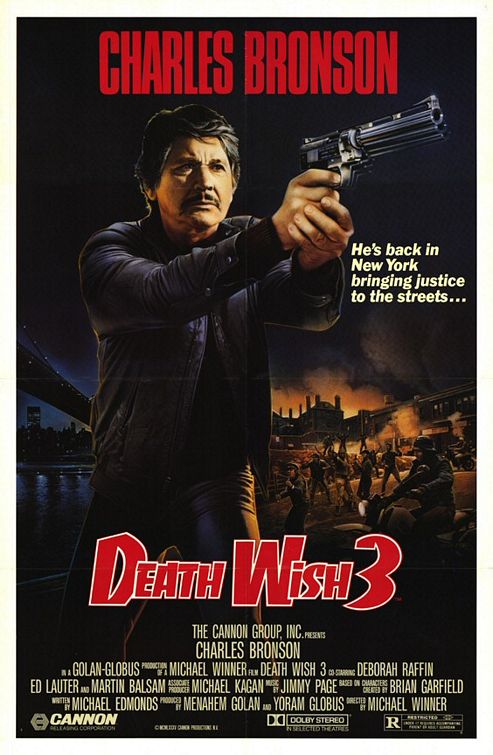
Death Wish 3 (1985)

By Richard Winters

My Rating: 2 out of 10

4-Word Review: Vigilante defends senior citizens.

Paul Kersey’s (Charles Bronson) vigilante act returns this time he goes back to New York City and defends the senior citizens in a neighborhood of his war buddy Charley (Francis Drake) who was killed by members of a street gang lead by Manny Fraker (Gavan O’ Herlihy).

The third entry in the series goes completely off-the-rails with a neighborhood setting resembling an apocalyptic world better suited for a surreal dystopian sci-fi film. The gang members behave like vile creatures straight out of somebody’s worst nightmare and look like leftover cast members from a cheesy version of The Warriors while the senior citizens seem ready to be ordained into sainthood.

After the first movie was released and met with criticism Bronson argued in interviews that his films did not promote violence and yet here that’s all you see. Not only does it brazenly promote vigilantism as being an effective deterrent to crime, but advocates that it’s the only option.

It also portrays the police in a horrible light. Yes, there are bad cops and films have every right to expose that, but there are some good ones too and this film never bothers to show that. All the viewer gets to see are brutal monsters dressed in uniform openly ignoring a suspect’s due process, or just being cowardly and inept when dealing with the real criminals. It got so bad that I was surprised that the police force nationwide didn’t boycott this flick in protest.

The only one looking like he’s having a good time is Bronson who actually appears relaxed and able to convey other emotions besides just anger. This is also the first film in the series where there is an actual clear reason for why the thugs hound him. For instance he drapes an expensive Nikon camera around his shoulder to entice the gang members to mug him and when they do he shoots them, which is the precise type of thing that should’ve been in the first two movies.

He also gets two unintentionally funny moments. One is where he is having a nice peaceful dinner with an older couple, but then excuses himself to shoot two men who are robbing his car before returning to his dinner like it was no big deal. Another scene has him getting out of his car to go grab something from a grocery store while leaving the attractive Kathryn (Deborah Raffin), who he has just started seeing, in the vehicle. While he is away the thugs break the passenger side window and knock Kathryn out before putting the car in neutral and letting it roll down the street and ultimately crashing into another car. Bronson runs down to initially save her, but once he sees the blaze he nonchalantly turns around and walks away almost like saying ‘Fuck, looks like that hot babe I wanted to date has just been burnt to a crisp. Guess now I’ll just have to find somebody else’.

The final 30 minutes is one of the most violent that I have ever seen in a film. It’s literally just one graphic image after another put to a rapid fire pace. Director Michael Winner seems compelled to throw in as many repugnant images of death, blood and rape that he can making it almost laughable in its audaciousness if it weren’t so nauseating instead.

My Rating: 2 out of 10

Released: November 1, 1985

Runtime: 1Hour 32Minutes

Rated R

Director: Michael Winner

Studio: Cannon Film Distributors

Available: DVD, Blu-ray, Amazon Video, YouTube
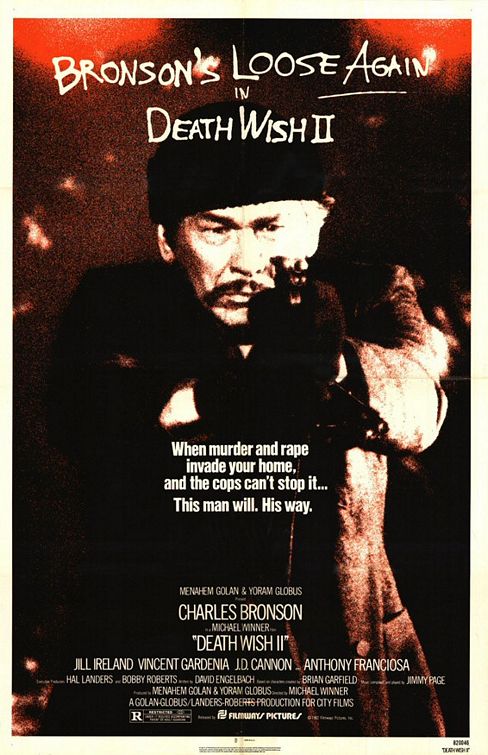
Death Wish II (1982)

By Richard Winters

My Rating: 4 out of 10

4-Word Review: Architect becomes vigilante again.

Paul Kersey (Charles Bronson) has recovered from his traumatic loss of his family from 8 years earlier and is now living in L.A. where he continues his work as a successful architect. One day while taking his new girlfriend Geri (Jill Ireland) and cationic daughter Carol (Robin Sherwood) to a fairground he gets robbed of his wallet by a gang of 5 thugs (Thomas F. Duffy, E. Lamont Johnson, Kevin Major Howard, Laurence Fishburne, Stuart K. Robinson). They use the address on Paul’s driver license to find his home and invade it while he is away. There they rape and kill his maid (Silvana Gallardo) and then when Paul returns they knock him out while kidnapping his daughter who they take back to their ‘hideout’. While there they attempt to gang rape her and in her effort to escape she’s impaled on a fence and dies. This sets in motion for Paul to return as a vigilante this time prowling the underground neighborhoods of L.A. where he’s motivated to shoot each of the 5 gang members who participated in the crime.

The film is less like a sequel and more just a slight variation from the original. Having to go through yet another home invasion/rape sequence, which is almost shot-for-shot the exact same as in the first installment (if even more exploitive) is mechanical to the extreme and an insult to the viewer. It’s like a TV-station promising their audience a new episode of their favorite series only to end up showing them a rerun instead. The story should’ve evolved more perhaps having Paul now becoming a ‘professional vigilante’ and being hired by people to track down the killers of their loved ones or at least something that would’ve taken the theme in a slightly different angle.

There continues to be the issue, like in the first film, of why does Chuck constantly get marked by these hoodlums for harassment anyways. For instance at the fairground there’s many other people milling  around and yet for some reason it’s Bronson, this very nondescript middle-aged man, that becomes their target.

The recasting of the daughter role is another problem. In the first film she was played by Kathleen Tolan and portrayed as being an adult married woman. Here though the character has regressed back to being a teenager and looking to be no older than 18 if even that.

To some degree on a sleazy B-level it actually hits-the-spot the soundtrack is done by former Led Zeppelin guitarist Jimmy Page and it is perfect especially the strained, loud electric guitar chords that effectively reflect the film’s dark, grimy mood. Most of the locales were filmed in actual buildings that were abandoned and in crime-ridden areas forcing the cast to require 20 off-duty police guards for protection. There’s even a scene featuring large squealing rats roaming around at the character’s feet as they say their lines.

The fact that Paul hunts down the actual perpetrators of the crime is on an emotional level satisfying, but it also becomes a logistical problem as it’s just not believable that he’d be able to find them all at random times, one-by-one simply by going to the city’s ‘bad areas’. I was also flabbergasted that in a later scene when Paul returns home from shopping and after dealing with his home being invaded now twice by crooks he doesn’t bother to lock the door once he gets inside, which you would think would be the first thing done each and every time!

The one interesting aspect that could’ve helped the film stand-out was the reintroducing of Vincent Gardenia who played the NYC police chief Frank Ochoa who tracked down Kersey in the first film and does the same here, but not to  arrest him, but instead to kill him. This could’ve created more tension had it been played out effectively as Kersey would constantly have to watch his back for an attack while simultaneously attacking the thugs when he came upon them. Unfortunately this side-story dies before it gets going when Ochoa gets kill just as he decides to help Kersey, which in itself could’ve been an intriguing odd couple-like pairing.

The ending  jumps-the-shark by having Kersey disguise himself as a doctor so that he can infiltrate a mental hospital in order to kill the last of the thugs who now resides there. This segment though becomes more like a scene from one those cheap horror movies with an asylum setting and not like an action flick at all.

The credibility gets seriously strained too by having Kersey constantly coming into contact with regular citizens who always conveniently side with him when it is most needed and thus helping him escape the clutches of the authorities. Sure this might happen every once in a while, but eventually he would confront someone who sees things differently, which all helps to make this film too dumb to take seriously, but slick enough to appease those looking for nothing more than simple-minded action.

My Rating: 4 out of 10

Released: February 19, 1982

Runtime: 1Hour 28Minutes

Rated R

Director: Michael Winner

Studio: Filmways

Available: DVD, Blu-ray, Amazon Video, YouTube
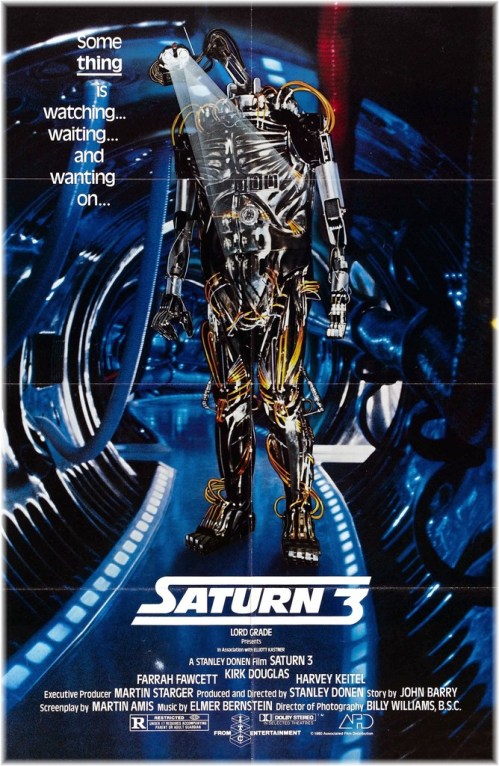
Saturn 3 (1980)

By Richard Winters

My Rating: 4 out of 10

4-Word Review: Space couple battles robot.

Mentally unhinged Captain Benson (Harvey Keitel) arrives on a space station that is located on Saturn’s 3rd moon along with a robot named Hector that has brain tissue made up of human fetuses. On the space station resides Adam (Kirk Douglas) and Alex (Farrah Fawcett) who are a couple researching on how to grow plants without soil. Captain Benson is assigned to assemble the robot, which will supposedly help the couple in their research, but instead it goes on a rampage killing Benson and then threatening to do the same to the other two.

The film was the brainchild of award winning set designer John Barry best known for his production design in the movies Star Wars and A Clockwork Orange. Unfortunately most of his work was done inside an office and his ability to actually direct actors was limited leading to constant conflicts between he and star Douglas, which eventually forced the film’s producer Stanley Donen to step in and takeover. Barry then left to work on The Empire Strikes Back only to collapse suddenly and die just a few months later from meningitis at the young age of 43 while never seeing the completed version of his original vision.

The sets are dazzling and clearly the film’s best element. In fact one could watch the movie for its visual quality alone with no sound and be better entertained. The robot is amazing too because he comes off looking like a genuine mechanical concoction and not just some stunt guy in a body suit. The thing doesn’t even have a head, but simply a protruding wire coming out the top with two lights on the end of it representing its eyes. Watching him being put together is mesmerizing as he looks very much like modern robots seen today at science shows making the film, at least in this area, seem astutely ahead-of-its-time.

The story though comes-off like an afterthought. Never once did I feel any tension even as the robot chases the couple all around. The characters are bland and the cast needed to be larger as the production lacks energy or liveliness. The dark, isolated space station is gloomy and depressing, which eventually crosses over to the film as a whole.

This was supposed to be a sci-fi/horror hybrid in the realm of Alien, but unlike that movie this one lacks any shocks or scares. There were two scenes that were filmed but later deleted one involved a dream sequence where Adam and Alex kill Benson while another had the robot ripping apart Benson’s dead body. These scenes sounded like they had exact edginess that the film lacked and it’s a head-scratcher why they were cut. When you’re trying to attract the same audience of another sci-fi flick that had its share of gore then you need to go for the gusto and not hold back.

The casting is cockeyed. Why is a 65-year-old codger banging a hot 30-year-old? Not only does it look like a father/daughter thing but even more like a grandfather/granddaughter situation. Kirk’s a fine actor, but not for this and his son Michael would’ve been a far better choice especially since there’s no chemistry between the two stars anyways.

Farrah’s acting skills have improved slightly from her first two films, but she still comes off as transparent and in-over-her-head, hired solely for her looks and nothing else.  Male viewers will enjoy her brief topless scene, but most likely no one, male or female, will be excited about seeing Kirk’s bare wrinkled old ass, which you’ll unfortunately also get a glimpse of.

I was most perplexed by the fact that Keitel’s voice was dubbed over by actor Roy Dotrice apparently because Donen didn’t like Keitel’s Brooklyn accent, but why hire the guy in the first place if you don’t like the way he speaks? The dubbing is obvious from the moment he utters his first word and will be a definite distraction to Keitel fans.

Ultimately the film becomes victim to what happens to a lot of big budget sci-fi productions where too much emphasis is put into one element while almost no thought is given to anything else. The result is a flimsy entry into the sci-fi genre that barely deserves any attention at all.

My Rating: 4 out of 10

Released: February 15, 1980

Runtime: 1Hour 27Minutes

Rated R

Director Stanley Donen (John Barry uncredited)

Studio: ITC Films

Available: DVD, Blu-ray, Amazon Video

Cloak & Dagger (1984)

By Richard Winters

My Rating: 7 out of 10

4-Word Review: Kid witnesses a murder.

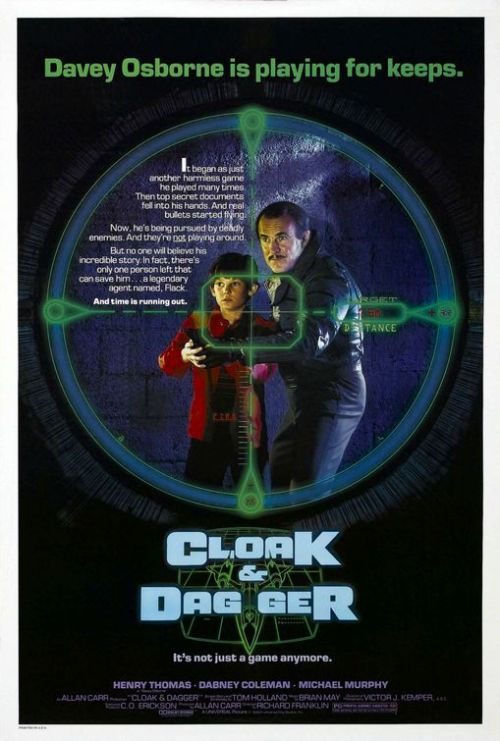
Davy (Henry Thomas) is an imaginative 11-year-old who spends his days immersed in the fantasy world of an espionage game called Cloak & Dagger and its rugged hero Jack Flack (Dabney Coleman). His home life spent with his dad (also played by Coleman) isn’t as exciting and he uses his escape into the game as his way of coping with a father who is too busy to have any time for him. One day he inadvertently witnesses a murder and just before the victim dies he hands Davy a video game cartridge telling him that there is top secret information on it. Now Davy finds himself in a very real game of life and death forcing him to depend on the advice of his fantasy hero and help from his dad to save him from the bad guys.

Tom Holland’s script is based on the short story ‘The Boy Cried Murder’, which was first made into a movie in 1949 The Window that starred Bobby Driscoll. This version is definitely aimed for the kids, but manages to be engaging enough to keep an adult’s attention, which is what makes it fun. Director Richard Franklin, a noted Hitchcock disciple, manages to infuse humor with the suspense and uses a variety of locations to keep the action interesting.

Thomas is excellent as the kid, but I felt his character seemed a bit too even-keeled about things. I would think a kid would be traumatized at witnessing a murder and unable to cope, but Davy takes things in much too matter- of-fact way only to become overwhelmed by the reality of the situation much later when I felt it should’ve occurred right from the start.

Christina Nigra is cute as Davy’s young friend Kim, but she looks to be barely 6 years-old. Her lines are amusing, but she conveys them in a way that has no inflection like she is simply mouthing stuff that she has memorized. The dashingly handsome Michael Murphy makes for an effective bad guy and elderly real-life couple Jeannette Nolan and John McIntire get flashy roles in the twilight of their careers. You can also spot Louie Anderson in a brief bit as a cab driver.

Dabney Coleman’s presence is the only thing that doesn’t work. He’s a gifted comic character actor, but only engaging when he plays a sleazy slimeball and never as a good guy. Here he is downright boring and already in his 50’s making him a bit too old for either the father or superhero. I don’t think they are too many kids who would imagine their own fathers in the role of an idolized comic book-like hero anyways. Most of the time it would be someone who is brawny and glamorous. In either case the film would’ve worked better and made more sense had the father and hero role been played by two completely different actors.

For me though the best part of the movie is simply its on-location shooting done in San Antonio. It’s unfortunate that they didn’t film a scene at the Tower of the Americas, but the other tourist sites are included featuring a fun chase sequence at the River Walk, the Sunken Gardens and even the Alamo. In the case of the Alamo they were allowed to film the exteriors there, but the interiors were recreated on a soundstage, but having been in the actual Alamo I couldn’t tell the difference, which is impressive.

My Rating: 7 out of 10

Released: July 13, 1984

Runtime: 1Hour 41Minutes

Rated PG

Director: Richard Franklin

Studio: Universal

Available: DVD, Amazon Video, YouTube

Raw Courage (1984)

By Richard Winters

My Rating: 1 out of 10

4-Word Review: Harass the marathon runners.

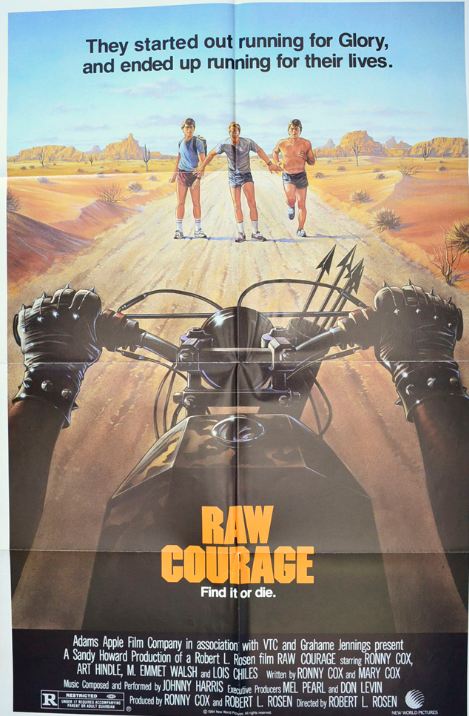
Three male friends (Ronny Cox, Art Hindle, Tim Maier) decide to challenge themselves by running through a 72-mile span of the New Mexico desert. Along the way they come into contact with a right-wing militia known as The Citizen’s Brigade that is headed by Colonel Crouse (M. Emmet Walsh). Initially the military unit toys with the runners making them a part of their exercise, but when one of the runner’s insults their members things turn ugly and the three friends find themselves running for their lives amidst the harsh terrain and from soldiers better conditioned to handle the elements.

The script, which was written by Ronny Cox and his wife Mary, has such a stupid premise that it’s hard to take any of it seriously. Aren’t there parks or a contained outdoor survival course that the men could take where they could still prove how ‘tough’ they were without throwing themselves into the barren wide-open desert? The men bring along NO FOOD, I repeat NO FOOD is brought along on this 72-mile trek by foot and their water bottles are so puny that they wouldn’t last them 10 miles let alone 70. These suicidal men don’t need a nutty right-wing militia to end their lives as they seem quite capable of doing it just fine all by themselves.

The second-half drags as the runners evade the militia while occasionally coming into contact with them and having very fake looking fights. The militia members are extreme caricatures that border on unintentional camp and Walsh, who has had a great career playing colorful character roles, is not effective as the menacing colonel

The climactic finish in which a large crowd of observers stand at the finish line waiting for the three runners to appear has to be the dumbest part of the movie. Why are all these people so excited to see who wins when they hadn’t seen any part of the race as it was run nor where there when it began? Who’s sponsoring this race and where the participants required to sign a legal waiver before they joined? What kind of a race has no checkpoints that the runners are forced to pass through to make sure that they hadn’t cheated? What’s to say they couldn’t have jumped into a car when no one was looking and drove the whole way and then when they neared the finish line they simply got out of the car and acted like they had run it when they really hadn’t?

Watching the men hobble to the finish looking all beaten down from their self-imposed foray into the harsh desert didn’t seem ‘courageous’ at all, but instead incredibly moronic. A better title for this film would be RAW INSANITY.

Alternate Title: Courage

My Rating: 1 out of 10

Released: August 4, 1984

Runtime: 1Hour 30Minutes

Rated R

Director: Robert L. Rosen

Studio: Adams Apple Film Company

Available: VHS

Risky Business (1983)

By Richard Winters

My Rating: 6 out of 10

4-Word Review: Teen becomes suburban pimp.

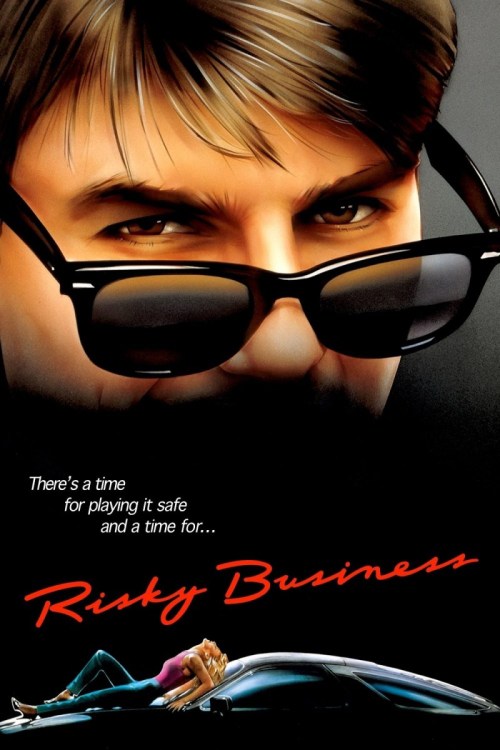
Joel (Tom Cruise) is a teenager living in a sprawling home on the North Shore of suburban Chicago who is stressing about getting into a top college. His parents (Nicholas Pryor, Janet Carroll) announce that they will be leaving on vacation for two weeks and he’ll have the whole place to himself. After some prodding by his friends he invites over a beautiful prostitute named Lana (Rebecca De Mornay) and takes her for a spin in his Dad’s Porsche, which accidently slides into the lake. The repairs will be expensive, so Lana devises a scheme where his home will be used as a temporary, make-shift whorehouse bringing in customers, many of whom being Joel’s high school friends who will pay to have sex with Lana’s beautiful call girl friends and whose proceeds will go to fixing the car.

The film is a fresh, funny look at capitalism and a perfect composite of the Reagan years and ‘80s attitudes. However, the conversations that the teens have here is jarringly out-of-touch with today’s youngsters who seem to favor more socialistic concepts. On one hand this then dates the picture, but it also makes it fascinating at seeing how people thought from a bygone era.

Cruise is fantastic and really looks like a teen, especially with his bowl haircut, even though he was already in his 20’s at the time. The character though allows himself to be taken advantage of too much by his friends. For most people the friendship would immediately end if they had a pal who would invited over a prostitute as a ‘joke’ that they didn’t want and would still be expected to pay for.

Why are these friends doing these hijinks anyways? It was almost like Joel had never been home alone before. Most likely he had, so why now are his buddies doing these things when they hadn’t earlier? A much better premise would’ve been to have Joel achieve some sort of accomplishment, like pass an all-important SAT test and as a ‘reward’ his friends would pitch-in and buy him a prostitute for the night while his parents were away. Everything else that follows would be the same, but at least the catalyst that sets it in motion would make more sense and Joel would seem less like a pushover straddled with irritating friends no one in their right mind would want.

The sex scene between Joel and Lana comes off like an overly stylized bit from a soft core porn flick. There were several fantasy segments that came before it and I was fully expecting this to be one of them, but it isn’t. Joel is a kid that seriously lacks confidence in every other way, so I would imagine his initial meeting with a prostitute would be awkward especially since he had never done anything like that before. Most likely he would’ve been so nervous that he might not have been able to even ‘rise-to-the-occasion’. Having Joel initially behave clumsily towards Lana would’ve been funny and more believable instead as it is here the ‘reality’ segment is dreamier than the fantasy ones.

The Lana character is frustrating as she remains an aloof composite of a hooker that the viewer never gets to understand as a real person. Seeing her in a vulnerable moment would’ve helped, but it never comes. (Her conversation with Joel about her life was too brief and not enough.) I would’ve liked a more conclusive ending revealing whether their relationship ‘blossomed’, worked into a long term friendship, or just dissipated. Having a scene at the end with Joel in college and calling Lana up to chat could’ve solidified this.

The parents are portrayed as being too stuffy and more like caricatures. The ending, which entails Joel buying back his parent’s furniture that had been stolen and then moving it all back into the home with the help of friends before his parents arrived is implausible. The house was too big and had too many items for them to be able to get everything in near spotless position in only 2 hours’ time.

The movie’s original charm is also affected by the fact that films like Home Alone and Ferris Bueller’s Day Off have had similar plots and stronger cult followings, but there’s still plenty of engaging moments. Watching Cruise dance around in his underwear to a Bob Segar song is hilarious. His precarious attempts to save the Porsche from going into the lake is really funny as is his interview with a college admissions dean from Princeton (Richard Masur) in Joel’s home while prostitutes and their customers scurry all around.

( Joel’s house as it appears today.)

My Rating: 6 out of 10

Released: August 5, 1983

Runtime: 1Hour 39Minutes

Rated R

Director: Paul Brickman

Studio: Warner Brothers

Available: DVD, Blu-ray, Amazon Video, YouTube
Lobster Man from Mars (1989)

By Richard Winters

My Rating: 0 out of 10

4-Word Review: Teen makes bad movie.

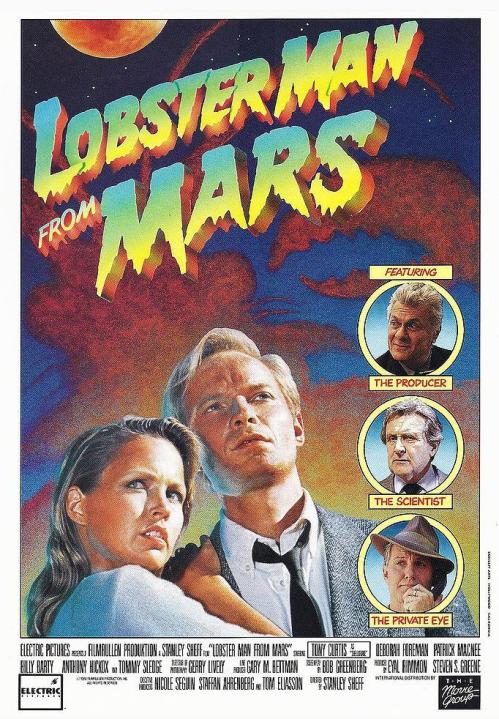
J.P. Shelldrake (Tony Curtis) is a desperate Hollywood producer looking for a film that will be guaranteed to bomb at the box office so he can use it as a tax write-off to help him pay off his back taxes. He thinks he’s found the potential answer when he receives a film directed by a young novice Stevie Horowitz (Dean Jacobsen) entitled ‘Lobster Man from Mars’, which comprises to be a tacky send-up to cheesy ’50s sci-fi flicks, but the film surprisingly does well sending the desperate Shelldrake even further into a hole.

The film is the so-called brainchild of Stanley Sheff and Bob Greenberg who in 1977 were offered $50,000 by a studio to write a script in the vein of a low budget ‘50s movie, but the two decided instead to make it a movie-within-a-movie and use it as an excuse to poke fun at all the clichés many of those films had. Unfortunately once they completed the script the studio pulled out of the deal forcing them to spend the next 10 years looking for another studio to fund their project. Finally in 1987 they were able to secure financial backing and then just two days before filming was to commence Greenberg died in a car accident and thus never got to see the script he worked so hard on come to fruition and this film ended up being dedicated to his memory.

However, what may sound funny and clever in concept does not always reflect what ultimately comes out on the screen. The film relies too heavily on lame, corny humor as well as broad caricatures to propel it. Cheesy B-movies and Hollywood studio bigwigs are easy targets that have been satirized many times before and this parody fails to supply any new spin to it.

The benign, blank personality of the young filmmaker is completely wrong. I went to film school during the ‘80’s and met first-hand some ‘up-and-coming’ young directors to-be and they behaved nothing like the dull kid here. They always had a pretentious attitude about them like they were the next Kubrick or Spielberg in waiting. They would never have made a corny ‘50s styled flick as that would’ve been considered ‘unhip’ and instead they would’ve tried to emulate the latest trendy hit like Dune or Rambo or maybe even a gory slasher movie.

Bad movies are fun when the filmmakers were trying to make something serious, or ‘profound’ only to have it end up being unintentionally humorous yet this kid’s movie has obvious gags in it like he was trying to make something campy, which then kind of loses the whole point. I also kept wondering how the kid managed to find so many different actors to play the parts and how he was able to fund it.

Things would’ve been funnier had everything been filmed in his own house or backyard while they tried to poorly disguise it as being someplace else. All the parts should’ve been played by his high school friends or family members some of whom would be forced to double-up and play two or maybe even three different parts. The film should’ve also of had a third running storyline dealing with the behind-the-scenes calamity of how the silly movie got made in the first place. I’ve worked on several low budget 48-Hour projects and believe me the stuff that goes on behind the camera on those amateur productions is far more interesting than what you end up seeing on screen.

The ‘innovative’ movie-within-a-movie concept fails to work because it doesn’t cut back to the film producer screening the movie enough. Instead we’re forced to watch 15 to 20 minutes of the cheesy flick only to see the producer’s reaction for a brief half-minute and then back to the cheesy flick until it seems like that’s all there is and the secondary storyline becomes an afterthought.

The ‘twist’ where the kid’s movie inexplicably becomes a giant moneymaking hit is nothing more than a plot rip-off from the far superior and funnier The Producers and it doesn’t really make sense. First there’s no way the American public, as dumb as their movie tastes can sometimes be, would flock to see this kid’s awful flick to the tune of it becoming the highest grossing movie of all time. Even if it did make that much money wouldn’t it then mean that the producer would have enough money to pay off his back taxes and thus stay out of jail?

If you want to watch something genuinely funny then check-out an actual B-movie from the ‘50’s that was trying to be serious, but ended up not being instead of this thing that tries to be intentionally lame until it becomes just plain too lame. You’ll be far more entertained I guarantee it.

My Rating: 0 out of 10

Release: January 29, 1989

Runtime: 1Hour 22Minutes

Rated PG

Director: Stanley Sheff

Studio: Electric Pictures

Available: DVD

Endless Love (1981)

By Richard Winters

My Rating: 2 out of 10

4-Word Review: Romance turns into obsession.

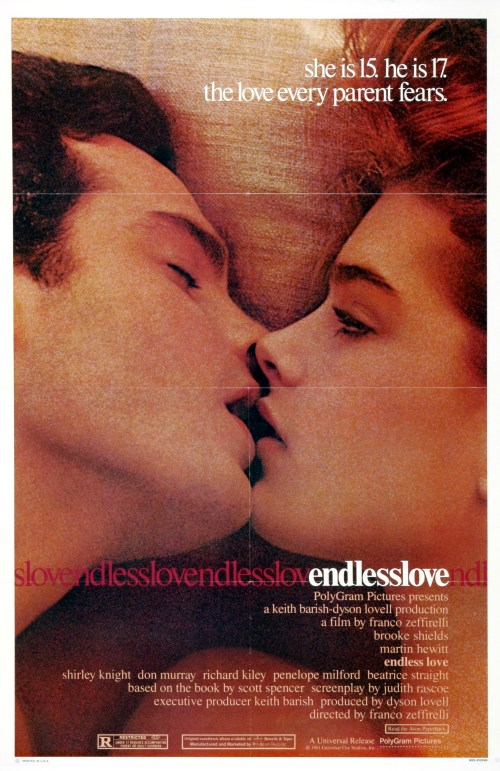
Based on the acclaimed Scott Spencer novel the story focuses on two teens locked in a relationship built around complete infatuation. Jade (Brooke Shields) is only 15 while David (Martin Hewitt) is a high school senior and 17. Jade’s parents (Don Murray, Shirley Knight) are aware that the two teens are having sex, but choose to be ‘open-minded’ and allow it, but when Jade’s grades begin to suffer her father demands that David not see her until the school year is over. David is upset at this ultimatum and decides, through advice from one of his friends (Tom Cruise) to set Jade’s house on fire and then at the last minute come in and ‘save’ them while making him look like a ‘hero’ and get back into their good graces, but things don’t work out as planned.

The film’s biggest detriment is that it chooses to emphasize mood over substance. The teen’s sex sessions are shot with a soft focus lens and gives off too much of a dreamy, fantasy feel. We are never shown how the relationship actually began as the film starts off with the two are already madly in love. It gets mentioned that they were introduced to each other by Jade’s older brother (James Spader) but it would’ve been interesting to have seen this played out as the really good movies ‘show it instead of just tell it’.

Shields has the face of an innocent 15-year-old, but her acting is not up to par and I never got the feeling of any genuine chemistry between the two. Hewitt, in his film debut, doesn’t have the acting chops to carry the movie and gets badly outperformed by Spader who would’ve played the David character far better and could also help explain why Spader has remained in the acting profession while Hewitt since 1993 has been running a home inspection business and no longer acting in movies at all.

The film’s second-half shifts too much focus on David to the point that Jade becomes this mysterious enigma. The father bars David from seeing Jade at their house, but the two could’ve easily have gotten together at school or some other place. If the two were both equally infatuated then they would’ve found a way to see each other, but they don’t, so what does this mean? Was Jade not as in to David as it was thought and what exactly was she doing and thinking during those two years when David was stuck in a mental hospital? None of this gets explained, which becomes the film’s biggest plot hole.

The story relies too heavily on extreme circumstances. For instance David’s friend gives him the idea to set the place on fire by using a stack of old wet newspapers. David then immediately goes to Jade’s home where almost like magic is a stack of old newspapers sitting on the front porch just waiting to be doused in flames. David’s chance meeting with Jade’s father in the middle of New York on a crowded highly traveled sidewalk seemed to pushing the odds as well.

Knight gives a good performance as the mother, but having the lady literally throw herself at David when he gets out of the mental hospital even after he tried to set her family on fire makes her seem crazier than he is. Murray is equally good as the father, but the fact that the guy allows the two to have sex in their house at such a young age makes him unlike most parents. Just about anyone else would’ve seen the red flags far sooner and the fact that he doesn’t until it’s too late makes him seem unusually naïve.

Spencer once stated in an interview how very disappointed he was with this film and how he felt director Franco Zeffirelli missed the whole point of what his novel was about. I agree as Zeffirelli seems driven to turn the whole thing into a modern day Romeo and Juliet while equating unhealthy obsession with love, which it isn’t. This all comes to a glaring clarity with the film’s final shot, which is the most annoying thing about this already annoying movie.

My Rating: 2 out of 10

Released: July 17, 1981

Runtime: 1Hour 55Minutes

Rated R

Director: Franco Zeffirelli

Studio: Universal

Available: DVD, Amazon Video, YouTube

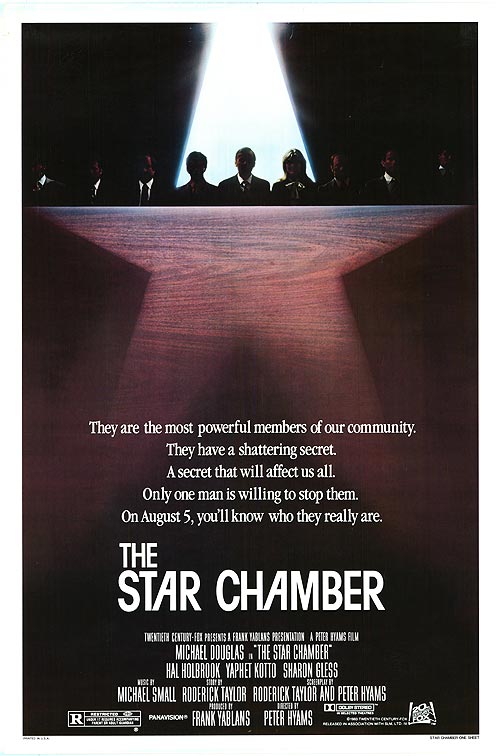
The Star Chamber (1983)

By Richard Winters

My Rating: 5 out of 10

4-Word Review:  Judges form vigilante group.

Idealistic young judge Steven Hardin (Michael Douglas) is sickened by the fact that so many known criminals are able to avoid jail time through legal technicalities. His friend and fellow judge Ben (Hal Holbrook) tells him of a secret underground group consisting of nine judges who have a hit-man sent out to kill the criminals who were otherwise able to get off through legal loopholes by the regular courts. Steven initially likes the idea and even sits in as one of the judges, but then he tries to stop a hit when it is later determined that the criminals set for vigilante execution were actually innocent, but finds to his horror that once the ball is set in motion there is no way it can be stopped.

The film is nicely directed by Peter Hyams who makes great use of mood lighting particularly in the scenes showing the nine judge tribunal as well as Steven’s visit to an abandoned warehouse. There is also a terrific foot chase at the beginning that is as exciting and intense as any car chase out there and it reminded me of a similar foot chase done in Busting, which was also helmed by Hyams.

The story by Roderick Taylor is an intriguing one, but it takes too long to get to the second act. The whole first hour is spent dwelling on Steven’s quandary of letting known criminals off-the-hook, which becomes quite derivative and could’ve easily been addressed in only 5 minutes. The story would’ve worked better had it started with Steven already involved in the underground organization and then through a brief flashback shown how he came to be there.

The scenes involving the vigilante tribunal are good, but I ended up having a lot of questions that never got answered or even touched on. For instance only one assassin (Keith Buckley) carries out all of the hits, but who is this guy and how did he come to work for them? Who’s the middle-man who gives him the assignments and how much does he know about the organization and what happens if he gets caught and starts talking to the police? How widespread is this movement and does it cover cases from the entire nation or only a certain area and are there other organizations like this one in other parts of the country and around the world?

I liked the wrinkle that gets thrown in, in which two criminals (Don Calfa, Joe Regalbuto) who Steven thinks are deserving of punishment, but later found to be innocent. Too many times Hollywood films dealing with this theme portray it in too much of a one-dimensional way that fails to bring out how vigilantism can sometimes be just as dangerous as the criminals it hopes to punish. Unfortunately the film fails to tackle the full complexity of the issue and instead just barely touches the surface.

The film also avoids making any clear statement or taking any position, which makes the whole thing come off as quite transparent when it’s over. The ending has no conclusion and leaves everything wide-open, which is a real cop-out. The concept is a good, but it needs to be redone by people who are willing to delve deeper as the effort here is too shallow to be considered satisfying.

My Rating: 5 out of 10

Released: August 5, 1983

Runtime: 1Hour 49Minutes

Rated R

Director: Peter Hyams

Studio: 20th Century Fox

Available: DVD, Blu-ray

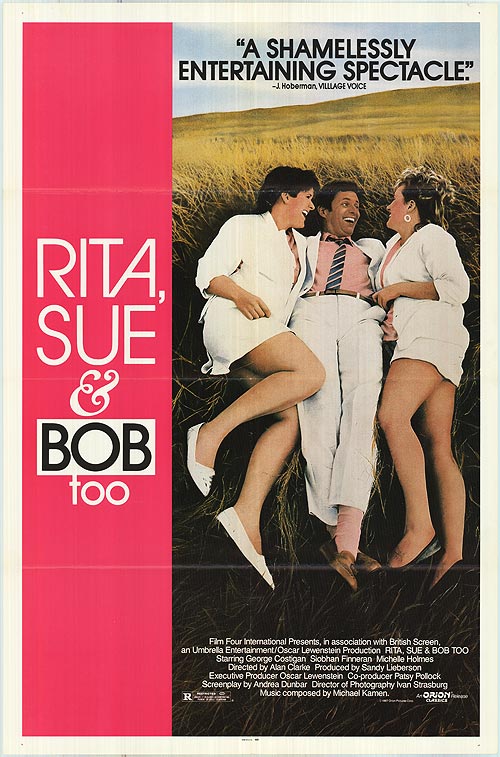
Rita, Sue and Bob Too (1987)

By Richard Winters

My Rating: 5 out of 10

4-Word Review: Dad fucks the babysitters.

Rita (Siobhan Finneran) and Sue (Michelle Holmes) are two friends from high school who babysit for Bob (George Costigan) and his wife Michelle (Lesley Sharp). One night while Bob is taking the two babysitters home in his car he decides to make a sexual overture to them and they both enthusiastically reciprocate, which ends up turning into a mini sex orgy. Soon the three are routinely getting together for sexual trysts until Michelle eventually catches on and leaves Bob while taking the kids with her. Sue’s parents find out too, which causes a great deal of stress and infighting amongst the three.

This offbeat comedy unexpectedly became a worldwide cult hit that made stars of the three leads particularly the two women whose first film this was. Unfortunately the same cannot be said for the film’s director Alan Clarke or its writer Andrea Dunbar who both tragically died just 3 years after the film’s release. Clarke from cancer while Dunbar, who was living on welfare and an alcoholic, passed away at her local pub at only 29 years of age.

The film comes off as an odd mix of lighthearted comedy and gritty drama that doesn’t completely work. The story jumps from the upscale middle class neighborhood of Bob’s house to the abject poverty of Sue and Rita’s family life with their apartments so vividly rundown that it’s almost horrifying to imagine anyone could live in such squalor. Part of the reason for this shift is that the film was based on two of Dunbar’s plays, the first being ‘The Arbor’, which was an autobiographical story of her growing up in the slums and at the hands of an abusive father, which she wrote at the age of 15 as a class project, and the other on a later play that she wrote with the same title as the film.

I’m not sure why director Clarke choose to mix the two plays together. Maybe he thought it would give the story more substance, but it really doesn’t. The antics that go on here could’ve happened in any neighborhood and the income bracket issues showing the stark scenes of the girl’s sad home life seem inconsequential and meandering.

I didn’t like the film’s abrupt start either as it jumps almost immediately to the three getting-it-on inside the car without any backstory. I kept wondering when did Bob get the idea to make a pass at the two girls and why are the girls so unsurprised when he does? I would think most young women would be shocked when an older man that they babysat for would suddenly make an aggressive sexual come-on and yet here these two aren’t, but why? What sort of signals were the two sending out to Bob to make him feel that he could behave the way he does? Was he already getting ideas when they first came to babysit for him, or did it evolve later? These questions and scenarios never get shown or answered, but should’ve.

We also never see Rita and Sue interacting with the children. The scenes involving their babysitting shows them either sitting watching TV or stuffing their faces with snacks after raiding Bob’s refrigerator while the two children remain complete afterthoughts that are only shown briefly for a few seconds at the 54-minute mark and that’s it, which then brings me to another crucial question. Why is it necessary to hire two babysitters to watch over two kids? When I was younger and babysat I could easily watch my neighbor’s two kids without any help. When I was a child only one babysitter was hired to look after me and my two siblings. Hiring two teen girls to look after two kids is highly impractical and quite unusual to the point that it makes no sense.

The ending leaves open a lot of questions making the film seem almost like an incomplete treatment to a wider story. For instance the three end up moving in together without showing whether this unusual living arrangement would be able to sustain itself long term. I was also curious to see how Bob would explain this arrangement to his children when they came to visit. There is also a side-story dealing with Sue’s relationship with a Pakistani boyfriend (Kulvinder Ghir) that seemed better suited for another movie altogether.

The scenes involving the three inside the car are the funniest, but otherwise I’m not sure why this movie became the hit that it did.  There’s also too many tracking shots almost like director Clarke found himself a new toy that he couldn’t help playing with. Initially the constantly moving camera comes off as innovative and gives the film added energy, but it ends up getting overused.

My Rating: 5 out of 10

Released: May 12, 1987

Runtime: 1 Hour 33 Minutes

Rated R

Director: Alan Clarke

Studio: Film Four International

Available: DVD, Blu-ray