Category Archives: 80’s Movies

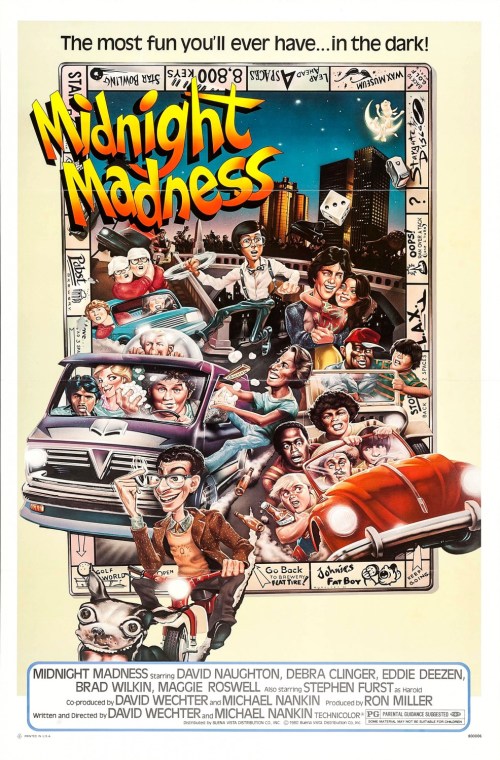
Midnight Madness (1980)

By Richard Winters

My Rating: 4 out of 10

4-Word Review: All night scavenger hunt.

Leon (Alan Solomon) is a geeky college student who comes up with an elaborate scavenger hunt to be played by his fellow students. The object of the game is to pick-up on certain clues hidden throughout the city of Los Angeles and each team must solve the clue given to them before they can move onto the next one. The game is played by 5 teams who have 5 members each: David Naughton heads the preppy Yellow team, Maggie Roswell plays the leader of the nerdy girls red team, Eddie Deezen leads the geeky white team, Brad Wilken leads the green team, which is made up of party animal jocks, and Stephen Furst heads the anti-social/misfit blue team.

On the surface this comes off as just another crude, sophomoric 80’s teen comedy complete with gross out humor of having to watch overweight Furst constantly stuffing his face with food, which is genuinely painful to watch when you realize that in real life he had a big issue with diabetes that made him retire from acting and he ultimately died from the illness. The film fails to have anything all that funny in it and it doesn’t even show any skin from its attractive female cast, which most likely was a result of it being financed by Disney.

The game itself though is kind of interesting and posses some legitimate logic oriented clues that force both the viewer and participants to think it through in order to solve. There is also some interesting on-location shooting done in famous landmark locations throughout Los Angeles including the Griffith Observatory, Grauman’s Chinese Theater, and the Westin Bonaventure Hotel, which helps give this otherwise low budget production a bit of a visual spark.

Even with these elements in place the film fails to take full advantage of its setting. If this is all supposed to take place during the wee hours of the night then there really shouldn’t be such large crowds present at the locations they go to including tours going on at the Pabst Blue Ribbon beer plant. It would’ve been more of a surreal ambiance had it just been the players of the game roaming around an otherwise shuttered city while everyone else was fast asleep. The final part of the game takes place in the daytime, which again ruins the nightime/midnight theme and effort should’ve been made to have the entire story take place while it was dark.

The story is also full of a ton of logic loopholes including never explaining how Leon was able to get his face painted on the side of beer cartons at the beer plant as well as a wide assortment of other issues. One also had to wonder why Leon goes to such great lengths to create such an elaborate game that doesn’t really seem to benefit him directly. If this kid is so smart to create such an intricate game then why doesn’t he put his creative energies into forming a profitable business so he doesn’t have to live in a rundown apartment that has paper thin walls and a crabby landlady screaming at him every time he makes any noise?

The cast has some familiar faces in small roles including Paul Reubens (aka Pee Wee Herman) in a bit part at a game arcade and Marvin Kaplan, an aging character actor best known for his work in Adam’s Rib and the TV-show ‘Alice’, as an overwhelmed hotel desk clerk. Kudos also go out to Irene Tedrow as an elderly and quite obnoxious landlord and Dirk Blocker, who is the son of famous ‘Bonanza’ star Dan Blocker and looks just like him, as a dim-witted party animal who just can’t get enough beer.

Naughton though is quite stale in the lead and doesn’t seem to have much acting talent at all although I did like the in-joke of seeing him drink a Dr. Pepper since he’s probably best known for singing the ‘I’m a Pepper’ jingle in TV commercials during the 70’s. This also marks Michael J. Fox’s film debut who plays the younger brother to Naughton though the subplot dealing with his anger at being taken for granted by his older sibling is misplaced and heavy-handed in a film that is otherwise super silly.

My Rating: 4 out of 10

Released: February 8, 1980

Runtime: 1 Hour 52 Minutes

Rated PG

Director: Micheal Nankin, David Wechter

Studio: Buena Vista Distribution Company

Available: DVD, Amazon Video, YouTube
Maxie (1985)

By Richard Winters

My Rating: 0 out of 10

4-Word Review: Silent film star resurrects.

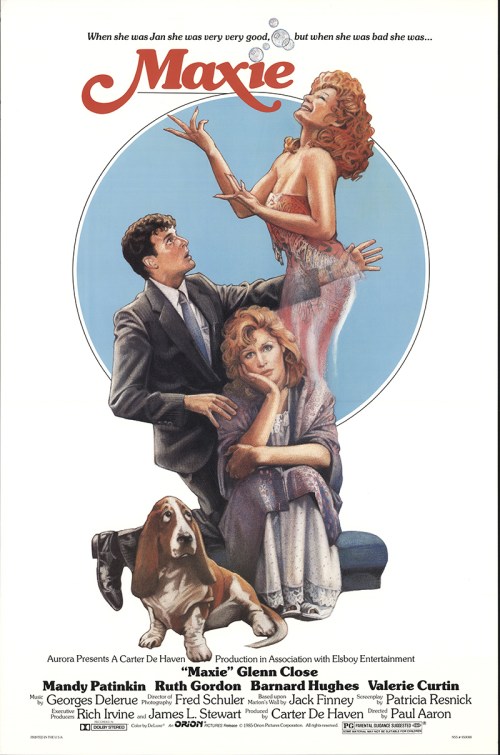
Nick (Mandy Patinkin) and his wife Jan (Glenn Close) move into a San Francisco home that was once lived in by Maxie Malone (also played by Close) a 1920’s flapper that died in a car crash the night before her big audition and who now haunts the place. She eventually inhabits Jan’s body and with the help of Nick tries to get the big Hollywood break in the 80’s that she missed out on in the 20’s.

The biggest problem is the title character that’s supposed to be amusingly ‘eccentric’, but comes off as obnoxious instead. Her belief that she should be the ‘life of the party’ no matter where she goes and her obsession with becoming a famous star makes her narcissistic and self-centered. She also shows no awareness of social propriety that every other functioning human being does as she throws herself quite literally at every attractive man she sees including married ones, which would be considered outrageous behavior by today’s standards and even more so from the era from which she came. Instead of being a person transported from a different time period she’s more like a cartoonish entity from a completely different universe.

Her affected Jersey-like accent is extremely annoying and why she’d even be speaking in one had me confused. Maxie’s spirit is taking over the body of Jan who does not have an accent. The spirit is using Jan’s legs, arms, eyes, mouth and ears, so then wouldn’t it be logical that the spirit would then use Jan’s voice as well?

Patinkin is equally irritating like the way he puts up with his boss (Valerie Curtain) openly and aggressively coming-on to him at work and for all to see and he doesn’t have her reported for harassment. What’s worse is when she threatens to fire him he begs her for his job even though she should be the one looking for work and not him.

The third makes this dumb script, which is based on believe it or not a novel by Jack Finney who also wrote ‘Invasion of the Body Snatchers’, even dumber by having Maxie get a part in a commercial, but without the benefit of having any resume, head-shot or agent, which casting directors insist is a must to even be considered.  From that she then gets asked to do a screen test for the starring role of a big budget remake of ‘Cleopatra’, but all she did in the commercial was play this lady victim tied to some railroad tracks, so what from that brief performance made the producers of ‘Cleopatra’ think she’d be ‘perfect’ for a starring role in their big Hollywood project?

I realize Close most likely took the part because she wanted the fun of playing two different characters, but Jan is so buttoned-down and shy that she becomes completely transparent making Maxie the only one you remember.

My Rating: 0 out of 10

Released: September 8, 1985

Runtime: 1 Hour 38 Minutes

Rated PG

Director: Paul Aaron

Studio: Orion Pictures

Available: DVD

Repo Man (1984)

By Richard Winters

My Rating: 7 out of 10

4-Word Review: Alien in the trunk.

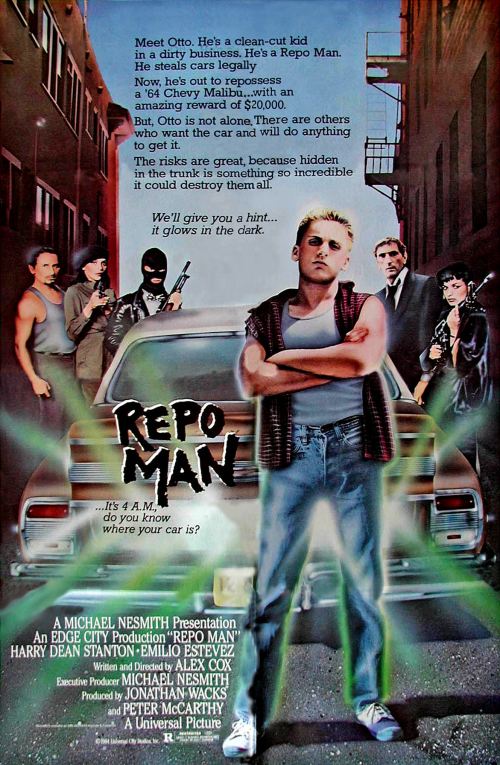
Otto (Emilio Estevez) has trouble accepting authority, which causes him to get fired from many of his jobs. He eventually gets courted into the car repossession business, which he at first resists, but then, especially with its lure of quick cash, he grows into. This then leads him in pursuit of a Chevrolet Malibu with a $20,000 bounty on it driven by a very strange man (Fox Harris) who harbors a glowing radioactive substance in its trunk that kills anyone who comes into contact with it.

The film’s best selling points is that it gives one a gritty feel of what being stuck in society’s poor underbelly is really like as it traps the viewer inside the inner-city of Los Angeles with its almost non-stop capture of its rundown buildings, which becomes like a dominant third character. The viewer then begins to share the same anxiety, anger and frustrations of the people in a place they don’t really want to be, but with no idea of how to get out of it. The only time the film shows the more vibrant area of L.A. is during a brief shot of the skyline from a distance making it come off like a far away place that’s out-of-reach.

The rebel mystique gets better explored and examined here than in other 80’s films where the term ‘rebel’ seemed to apply exclusively to mouthy suburban teens who didn’t like their parent’s rules and would wear punk attire because it was ‘trendy’. Here you get a much more authentic feeling of being an outsider and the unglamorous, desperate qualities that comes with it.

Writer/director Alex Cox also examines the thin, merging line between being a conformist and non-conformist and the ironic/contradictory results that can occur. This gets best captured with the character of Duke (played with gusto by Dick Rude) who is an in-your-face-I-don’t-like-any-rules street punk one minute only to turn around and tell his girlfriend at another moment that he wants to get married and have kids because ‘everybody else is doing it’.

Estevez gives his signature performance here though his excessive cockiness becomes a bit of strain, which fortunately gets tempered in the scene where he gets shot at and panics showing that even a streetwise brash kid like himself has  his limits, which makes it all worth it. Harry Dean Stanton as his partner is terrific and the vast 40 year age difference between the two isn’t apparent at all. Olivia Barash is quite good too without even trying. Her likable unrehearsed quality makes for a refreshing contrast to all the rest who are more compelled to put on a facade and for the this reason I wished she had been in it more.

Honorable mention should also go to Fox Harris who plays Parnell the driver of the much sought after car even though in real-life he couldn’t drive and he got the vehicle in a few accidents and even damaged other props on the set in the process. Normally this would’ve gotten him fired, but because he had been the only actor who was nice to Alex Cox when he worked as a lowly security guard at the Actor’s Studio and before he became a director, he choose to stick with him despite the problems, which shows that if your nice to everybody even those that have very little social standing it can come back in rewarding ways in the long term.

My Rating: 7 out of 10

Released: March 2, 1984

Runtime: 1 Hour 32 Minutes

Rated R

Director: Alex Cox

Studio: Universal

Available: DVD, Blu-ray (Criterion Collection), Amazon Video, YouTube

Scandal (1989)

By Richard Winters

My Rating: 5 out of 10

4-Word Review: Politician has an affair.

Based on the Profumo affair that rocked the British parliament in 1963 the story centers around an exotic dancer named Christine Keeler (Joanne Whalley-Kilmer) who catches the eye of Stephen Ward (John Hurt) a doctor with a thing for attractive young ladies. She moves in with him and the two share an unusual relationship where he pimps her and her friend Mandy (Bridget Fonda) out to members of the conservative party. Her sexual affair with one of the high-ranking officials of parliament, John Profumo (Ian McKellen) eventually reaches the attention of the press and leads to far-reaching ramifications for all involved.

Part of why this movie didn’t work for me and may not for others is that politicians getting involved in a scandal is no longer a big deal. We’re living in an age where political figures have been caught having affairs, even while in office, and it isn’t enough to have them removed. Yet this film expects the viewer to be in jaw-dropping shock from the first frame to the last even though in this cynical age it would be more shocking if one actually lived a squeaky clean life.

The first hour meanders along from one racy sex scene to the next until it almost seems like a soft core porn flick with no story. I had no idea where any of this cavorting around was going to lead and wasn’t really all that intrigued in finding out either. First time director Michael Caton-Jones takes too much of a detached approach to his characters. They all come off like wild sexual animals unable to control their inner urges, but with no other discernible differences making everything that goes on seem like one giant frolicking blur with no point.

Hurt gives a great performance, but I didn’t understand the motivations of his character. Why doesn’t he want to sleep with Christine and instead get more turned-on listening to her stories about her having sex with other men? What about him makes him this way, which the film should’ve helped answer, but doesn’t.

Whalley is too old for her part as she was supposed to be playing someone who was 19, but in reality was already 29. Having a true 19-year-old play the part, and have a definite look of innocence about her, may have given the provocative material a little more bite.  Her character also has the same issues as with Hurts. I got how she wanted to get away from her impoverished surroundings and sleeping with rich influential men could help her do that, but I didn’t understand why she liked her Hurt, or their unusual relationship.

The film ends with the court proceedings, which like with everything else doesn’t have the impact that it should. While the attention to detail and accuracy is impressive it would’ve worked better had it began with the trial and then worked backwards through flashback showing how they all got there instead of the linear narrative that it does take, which is too plodding. Focusing on only one of two characters would’ve helped too instead of trying to encompass so many of them where none of them are all that interesting or distinct.

My Rating: 5 out of 10

Released: March 3, 1989

Runtime: 1 Hour 46 Minutes

Rated R

Director: Michael Caton-Jones

Studio: Miramax

Available: DVD, Blu-ray (Region B/2)

The Stone Boy (1984)

By Richard Winters

My Rating: 6 out of 10

4 Word Review: Accidentally killing his brother.

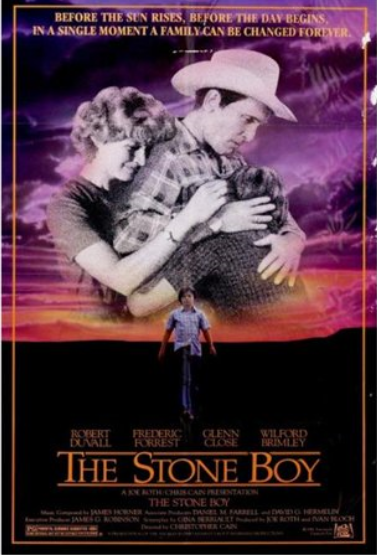
Based on the 1957 short story by Gina Berriault, the film centers on a 12-year-old boy named Arnold (Jason Presson) who accidentally kills his older brother Eugene (Dean Cain)  one morning while they go out to pick peas on their farm. His parents (Robert Duvall, Glenn Close) don’t know how to react to the tragedy and begin to treat Arnold like he’s a stranger to his own family, which causes him to consider running away.

In an era of big budget special effects I enjoyed the film’s low-key approach, but this gets ruined right away by instilling all sorts of ill-advised cinematic effects, including slow motion, during the shooting scene. You can’t spend so much time and effort creating a docu-drama look and feel to a production, which nicely reflects the slow/quiet paced lifestyle of rural America, only to suddenly pivot away from it at the most inopportune time, which results in a jarring, disconcerting feel for the viewer.

The shooting scene goes against the grain of the main character too. We’re supposed to emotionally connect with the kid, but the way he behaves is bizarre. I would’ve expected him to start crying when he realizes he has shot his brother and go running back to the house for help, but instead he conveys no emotion at all and calmly continues to pick the peas like nothing has happened, which makes him seem mentally disturbed.

It’s also rare for a person to instantly fall over dead with one shot like the brother does here. For that to happen the bullet would’ve had to hit the heart directly or some other vital organ, but the gun went off while it was being held at a precarious angle and most likely the bullet would’ve only grazed his brother, or just injured him. The accident also occurred not far from the house, so why the parents didn’t immediately come running out when they heard the gun going off, or the boy screaming is hard to understand. It’s important to note that we don’t actually hear him scream as the scene is shot with no sound, but we do see him open his mouth real wide in horror, so I can only imagine that he did scream out and if so the rest of his family should’ve heard it.

It would’ve been better had this scene not been shown at all and only alluded to, or done like it was in Ordinary People, which had a similar storyline, but didn’t play out the death sequence until the very end as a flashback. In either case the rest of the film is okay and even has a few touching and profound moments, but it stretches out the premise of the short story it’s based on too much, which creates draggy periods that prevents it from being as effective as it could’ve.

My Rating: 6 out of 10

Released: April 4, 1984

Runtime: 1 Hour 31 Minutes

Rated PG

Director: Christopher Cain

Studio: 20th Century Fox

Available: DVD, Amazon Video, YouTube
Big Trouble (1986)

By Richard Winters

My Rating: 3 out of 10

4-Word Review: Insurance agent commits fraud.

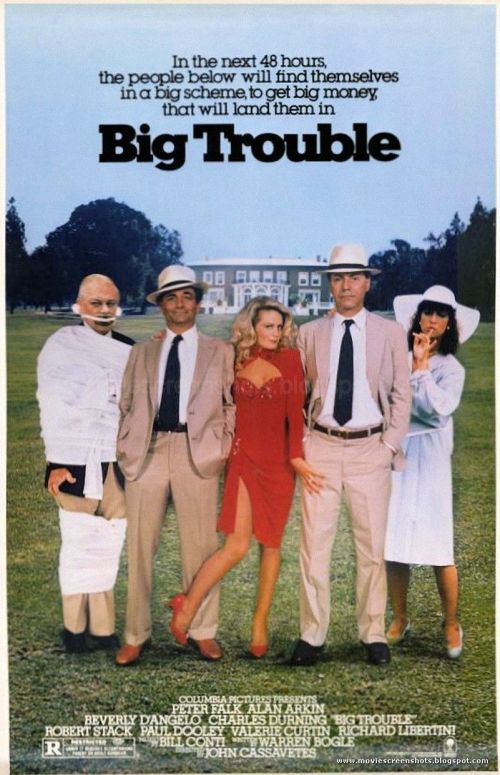
Leonard (Alan Arkin) is an insurance agent who does not have enough funds to put his three sons through Yale, which causes him a lot of stress. During a random sales call he meets Blanche (Beverly D’Angelo) who has a sick husband named Ricky (Peter Falk) who has only a week to leave. They hatch a scheme to write-up a life insurance policy that has a double indemnity clause that offers a big payout if Ricky dies by falling off a moving train. The plan starts out fine only to ultimately backfire when Leonard realizes he’s been double-crossed.

At the outset one might assume that this is a sequel to The In-Laws since it has the two stars from that film as well as the same screenwriter, though done under the pseudonym of Warren Bogle, but that’s not the case because Andrew Bergmen got the bright idea of trying to do a parody of Double Indemnity instead. This became a complete disaster for its studio Columbia Pictures because after the script was completed it was deemed a remake of the original film, which Universal Studios still held the rights to, forcing Columbia to give up the rights to Back to the Future and given to Universal as compensation who made a ton of money off of it while this film flopped badly.

A lot of the problem is that unlike in The In-Laws the two stars don’t play off of each other enough and in fact for most of the film they seem to be adversaries. The tone is also inconsistent seeming at times that it wants to be a parody/farce while at other moments it comes off more like a surreal comedy. It doesn’t help matters that John Cassavetes took over directing the production when Bergmen dropped out and his forte was more in drama with a cinema vertite approach causing many of the scenes here to go on longer than necessary while lacking a good comic pace. I also thought it was ridiculous that the plot features many twists, but then ends up telegraphing to the viewer well ahead of time that they’re coming, which takes away any surprise.

Arkin’s character is particularly problematic. Part of why he was so funny in The In-Laws is because he played this sane man thrown into an insane situation, but here he allows himself to get swept up into the nuttiness too easily until he seems almost as crazy as the rest. There’s also no way that a seasoned insurance agent, such as the one he played, would be dumb enough to think he could pull off such a poorly thought out scheme. Being an agent he would know that an autopsy would be done on the dead body and they would find that the victim had been strangled well before he fell off the train and the fact that this all occurs less than 24-hours after the policy was signed would send off massive red flags to anyone working in the industry.

While there are a few funny moments which includes Arkin trying to disguise himself as Falk and even speak in his voice as well as Arkin’s reaction when he takes a sip of Falk’s very exotic liqueur, the rest of it falls depressingly flat. The worst of it is the ending, which throws in a wild coincidence that has no bearing to the main plot nor any forewarning or connection to anything else that came before it, which helps to cement this as a big mistake that should’ve never have been given the green light.

My Rating: 3 out of 10

Released: May 30, 1986

Runtime: 1 Hour 33 Minutes

Rated R

Director: John Cassavetes

Studio: Columbia Pictures

Available: DVD, Amazon Video, YouTube
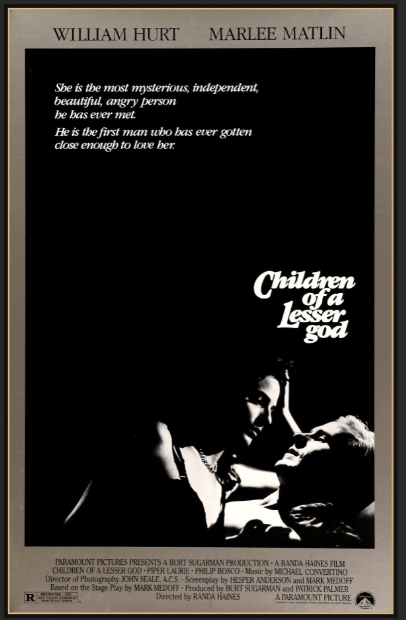
Children of a Lesser God (1986)

By Richard Winters

My Rating: 6 out of 10

4-Word Review: Romance with deaf woman.

James (William Hurt) gets a job as an instructor at a school for the deaf. He’s brought in to try and teach the students to become less reliant on sign language and to speak more. It is there that he becomes infatuated with Sarah (Marlee Matlin) a 23-year old janitor who used to be a student there. She refuses to speak despite James’ efforts to get her to. Eventually they get into a relationship where James still insists that she must learn to speak, which creates a wedge between the two that could eventually drive them apart.

The film is based on the play of the same name by Mark Medoff, which in turn was based on the real-life experiences of deaf actress Phyllis Frelich  and her relationship with her husband Robert Steinberg. The play was quite successful and ran for 887 performances, but when it transitioned to film several changes were made most notably that in the play the Sarah character was a former student to James, but here that’s not the case, which to me didn’t make a lot of sense. It almost seemed like James became more obsessed with a janitor than his own students even though they suffered from the same fears of speaking as she did and the story could’ve been just as riveting had it stuck to his dealings with them, who otherwise end up getting seen only intermittently.

The whole romance angle comes off as forced especially since James blurts out the ‘I love you’ line before any relationship had even been established as they had  previously gone out to dinner as friends and not as a date. In many real-life situations when one partner says the ‘love’ statement too soon it can drive the other person away instead of bringing them closer and with Sarah being as defensive as she was that’s exactly what I think would’ve happened in this case.

It would’ve been better, especially since film is a visual medium, had we seen the relationship go the next level through actions and not words perhaps by having James impulsively jump into the pool that Sarah is swimming in and then have the two playfully splash each other before ending up with a passionate embrace and kiss, which would’ve hit-home the same point to the viewer, but without the melodramatic dialogue.

The constant use of the sign language that the two used to communicate with each other I liked, but got annoyed with the way James had to not only verbally repeat everything he said with his hands, but everything Sarah communicates with her hands as well. I would presume that a conversation done with sign language should be in silence, much like at the party that Sarah goes to with her deaf friends where everyone speaks with their hands while saying nothing with their mouths. I realize that it’s to the viewer’s benefit that James verbally ‘narrates’ what’s being said, but it comes-off as unrealistic and using subtitles during these segments would’ve been better.

Matlin’s Academy Award winning performance is excellent and proves that great acting isn’t just about conveying lines, which she, sans one sentence, doesn’t have, but also about facial expression which she does brilliantly. The scene where she goes swimming in an indoor pool and the viewer hears nothing but silence is excellent as well and helps us get inside the head of a deaf person and sense what their world is like. The story though goes on a bit too long and never really confirms if their relationship permanently works out long term, or not and for having to sit through so many of the couple’s ups-and-downs that’s one question that should’ve gotten answered.

My Rating: 6 out of 10

Released: October 31, 1986

Runtime: 1 Hour 59 Minutes

Rated R

Director: Randa Haines

Studio: Paramount

Available: DVD, Amazon Video, YouTube
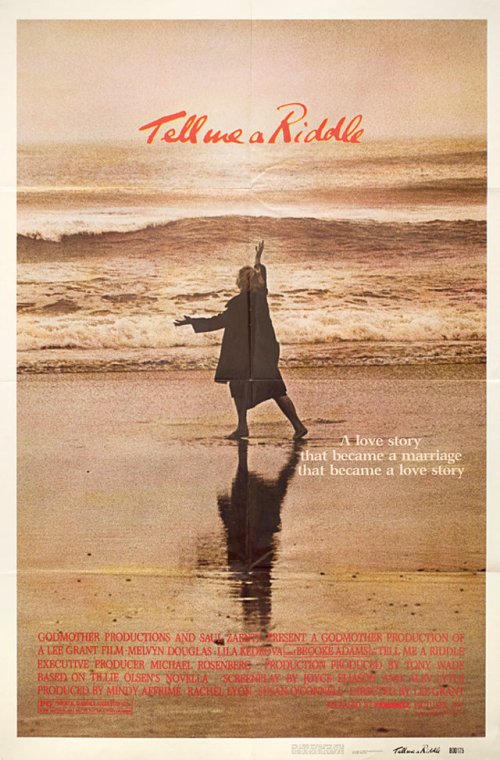
Tell Me a Riddle (1980)

By Richard Winters

My Rating: 3 out of 10

4-Word Review: Adjusting to old age.

Eva (Lila Kedrova) is an elderly woman who has been diagnosed with cancer, but her husband David (Melvyn Douglas) does not tell her of the terminal disease and instead takes her on a cross country journey to visit their grandchildren in San Francisco. Eva though begins to feel homesick and wants to return to the place that she is used to only to learn that David sold the home without her knowledge and forged her signature on the papers, which creates a rift between the two just as she enters her final days of life.

This modest low budget film was notable as the first feature film in America to be written, directed, and produced by women. It is based on the 1961 short story by Tillie Olsen and the first feature directed by actress Lee Grant, who felt that after she won the Academy Award for best supporting actress in 1975 that her days on the screen were numbered due to her age and the only way to stay busy in the business was to go behind the camera. She choose this script because it tackled two topics most important to her: feminism and her fear of aging.

For the most part, at least at the beginning, the slow pace works as it helps replicate the elderly lifestyle. The flashbacks showing the couple when they were young, which features a then unknown Peter Coyote as the younger David, help to make the two main characters more multi-dimensional. The different locations that they go to and live-in on their trip, which includes sleeping in their daughter Jeannie’s (Brooke Adams) cramped apartment while she sleeps with her boyfriend across the hall as well as visiting an elderly friend, Mrs. Mays (Lili Valenty), who lives in a place no bigger than a small bedroom and forced to walk-up several flights of stairs just to get to it, helps to give the film an indie vibe.

Unfortunately the second half stagnates as the couple’s journey ends at Jennie’s apartment, which cuts off the visual variety that gave the movie energy during its slow spots. The cross country journey should’ve been played-up much more, like with Harry and Tonto, where the trip becomes the main focus by having the couple travel by car instead of by plane while still keeping the main crux of the story intact.

Douglas gives an impeccable performance and speaks in an authentic Eastern European accent and Adams does quite well in support. However, Kedrova barely says much of anything making her character seem like she’s suffering from a personality disorder and having Douglas do the majority of the talking comes off too much like he’s the ‘narrator’ and it doesn’t help. I also didn’t like the hearing aid cord dangling out of her ear either, which seemed overdone. My grandmother, who lived at the same time this movie was made, wore a hearing aid too, but it was much more inconspicuous and didn’t require any cords.

The film also suffers from an unrelentingly downbeat perspective making old age seem like it’s just one depressing thing after another. I liked the way this same subject matter was approached in Harry and Tonto  where it examined the elderly years from different angles showing how there could be some downsides to it (like with any age), but also some positive ones too. Instead of approaching it as an end-of-life scenario it presented it as a transition that was still full of possibilities and new adventures, which is what I wished this film had been better able to convey.

My Rating: 3 out of 10

Released: December 15, 1980

Runtime: 1 Hour 33 Minutes

Rated PG

Director: Lee Grant

Studio: Filmways Productions

Available: DVD, Amazon Video, YouTube
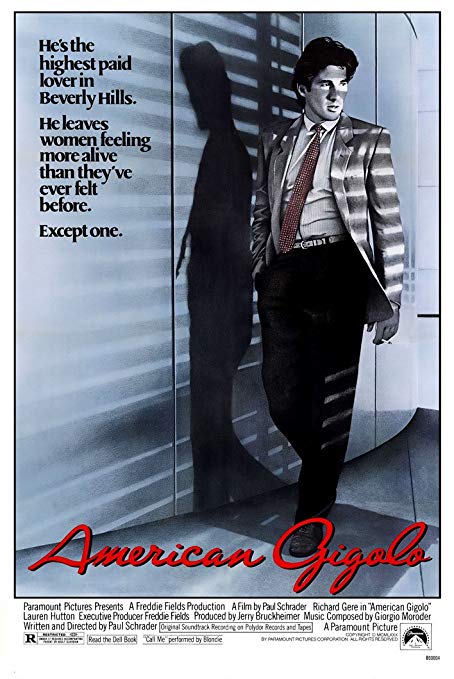
American Gigolo (1980)

By Richard Winters

My Rating: 5 out of 10

4-Word Review: Male escort gets framed.

Julian (Richard Gere) works as a male escort in the Los Angeles area servicing affluent female clients, which allows him to drive expensive cars and live in a luxury apartment. He even gets into a relationship with Michelle (Lauren Hutton) a senator’s wife, but just as everything seems to be going his way it comes crashing down when he gets accused of murder, which he didn’t commit. His only alibi is Michelle who he was in bed with that night, but she is reluctant to come forward fearing it will tarnish both her reputation and that of her politically ambitious husband (Brian Davies).

The film’s chief asset is Gere’s performance who puts a gritty edge in a film that is otherwise quite shallow. His character though is blah as we learn little about him, which I found frustrating. Male prostitution is not a profession most men get into, so why does Julian? Having a backstory dealing with his upbringing and showing his relationship with his family could’ve helped us better understand his motivations, but none is ever shown leaving us with a character that may look sexy, but is otherwise an empty shell that is neither interesting nor memorable.

The film offers no insights into the sex profession either. I kept wondering how he was always able to ‘get-up for the occasion’ with all of his clients especially when a lot of them were older women who were not all that attractive. Many male actors working in the adult film business will admit to taking Viagra or some other drug to guarantee an erection on cue. They also have women working behind-the-scenes as ‘fluffers’ who will give male performers a hand-job/oral sex, so when it’s time for his scene he’s erect, but Julian doesn’t have any of these things, so what’s his secret? The film makes it look like he can get-it-up on demand, which in reality I don’t think would always be the case.

I was also disappointed when Julian is told by the husband (Tom Stewart) of one of his clients to get rough with her by slapping her and Julian turns around with a shocked expression, but then the scene immediately cuts away without seeing what happened. I felt this was a crucial moment that needed to be played-out and it would’ve helped us understand Julian better by seeing how he responds to demands that he’s uncomfortable with. The film most likely cutaway because seeing him slap a woman would’ve made him unlikable to the viewer, but if he’s the type of person who will compromise his ethics to make money then we need to know this, or if he returns the money and walks away we need to see this as well.

Julian’s relationship with Michelle is ridiculous and unbelievable. Why would a guy who’s been to bed with hundreds of different women suddenly decide to fall-in-love with this one and why would a woman, who’s otherwise living a comfortable lifestyle, allow herself to fall for a man whose profession won’t allow him to be faithful to her? It doesn’t help either that Hutton gives a horribly wooden performance and it would’ve been far better had Julie Christie, who was the original choice for the role, played the part

The mystery angle is somewhat intriguing, but the wrap-up gets botched by suddenly instituting long pauses between scenes in which the screen goes completely black and silent for several seconds, which is jarring since this was not done at any earlier time and only helps to cement how over-the-top Paul Schrader’s directing is. Had more effort been put into character development instead of flashy lighting/camera angles we would’ve had a more interesting movie.

My Rating: 5 out of 10

Released: February 1, 1980

Runtime: 1 Hour 57 Minutes

Rated R

Director: Paul Schrader

Studio: Paramount

Available: DVD, Blu-ray, Amazon Video, YouTube

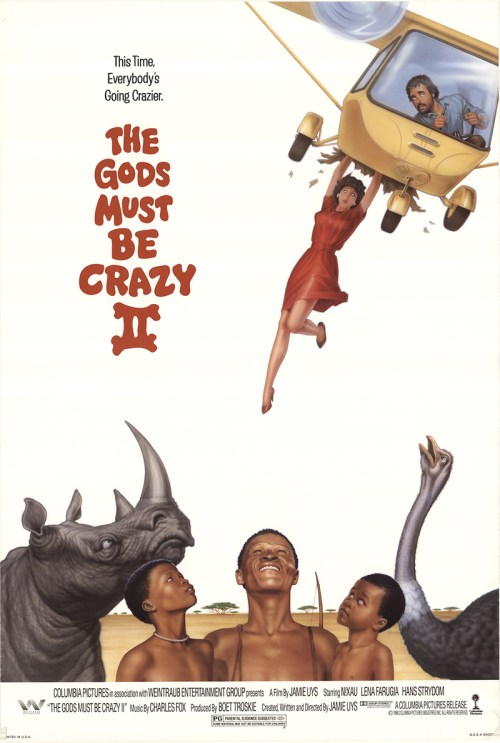
The Gods Must Be Crazy II (1989)

By Richard Winters

My Rating: 7 out of 10

4-Word Review: Misadventures in the desert.

Xiri (Eiros) and Xisa (Nadies) are the two children of Xixo (N!xau) and a part of a nomadic desert tribe of the Kalahari who go roaming off into the wilderness and encounter a truck driven by two elephant poachers (Lourens Swanepoel, Pierre van Pletzen). Having had no previous contact with modern technology the children become fascinated with the vehicle and climb into its water tank just as it drives off taking them many miles away from their home. When the children fail to return their father goes out looking for them and in the process comes into contact with a lawyer (Lena Farugia) and a zoologist (Hans Strydom) who are stranded after their small engine plane crashes as well as two soldiers (Erick Bowen, Treasure Tshabalala) fighting from opposite sides of the war and each precariously trying to get the upper hand on the other.

This follow-up to the run away hit was filmed in October, 1985, but took over 4 years to find a distributor and suffered many setbacks during its production, which frustrated writer/director Jamie Uys so much that he retired from directing after completing this one and never worked on another film. On the whole though it’s not too bad, but like with the first one it does start out a bit clumsily.

My biggest complaint had to do with the scenes dealing with the lady lawyer named Ann and her interactions with the macho pilot/zoologist Hans who takes her up in the plane, which to me became too sexist and too similar to the scenario played-out in the first film where a lady-in-distress being rescued by a male character more acclimated to the environment. However, in the first film this was funny because the male was so clumsy and inept it made him seem more like a lovable clod, but here the guy character resembles the male image, especially with his mustache, of the Marlboro man and his constant aggravation at this ‘ditzy lady’ isn’t amusing while her inability to understand technology played too much into the feminine stereotype that women can’t comprehend machinery must have a man come to their rescue.

I did find the small engine plane that they rode in, which was a modified Lazair Ultralight, fascinating as I found it interesting at how something so small and flimsy could carry two people and still get off the ground, but was disappointed to learn later that this was only because it got attached to a crane and in reality wouldn’t have flown. Although the filmmakers achieve this illusion pretty well the scene where the two fly above the clouds is clearly fake as you can tell the backdrop of the sky is a painting and in that regards the whole plane scene, especially since it really couldn’t fly anyways, should’ve been discarded and some other plot line created that would’ve brought the two together.

The two runaway children though are quite cute especially the frightened but resourceful little boy who grabs a nearby piece of wood to put on top of his head to fool the hyena that has been stalking him into thinking that he is taller than he really is, which actually ends up working. I was also most impressed with the scenes dealing the Honey Badger, which is known for its ferocious defensive abilities and lives up to its reputation here when he grabs a hold of Hans boot with his teeth and refuses to let go no matter how far Hans walks.

The last half-hour when all the various characters from the four divergent story lines eventually merge is when the film finally manages to hit its stride and it’s a shame this couldn’t have occurred sooner, but ultimately as a sequel it’s surprisingly funny and manages to retain much of the same charm from the first one.

My Rating: 7 out of 10

Released: October 13, 1989

Runtime: 1 Hour 38 Minutes

Rated PG

Director: Jamie Uys

Studio: 20th Century Fox

Available: DVD, YouTube