Category Archives: 80’s Movies

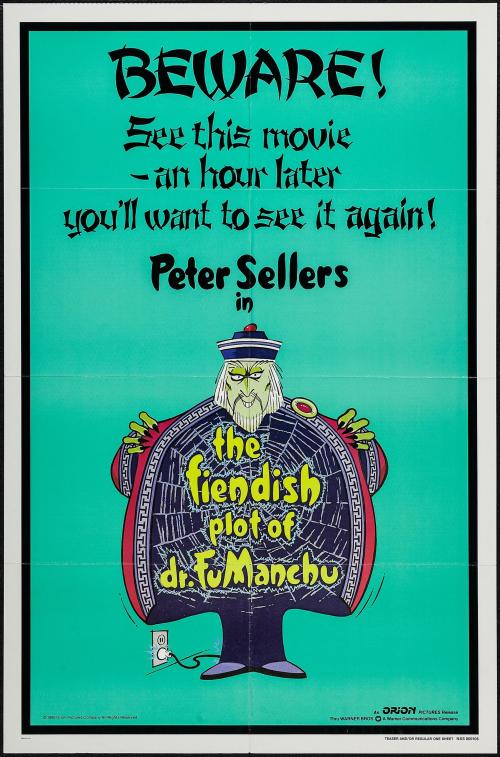
The Fiendish Plot of Dr. Fu Manchu (1980)

fiendish

By Richard Winters

My Rating: 1 out of 10

4-Word Review: Peter Sellers’ last movie.

Fu Manchu (Peter Sellers) is a 168-year-old man, who on his birthday must drink a elixir vitae in order to remain youthful and alive. When one of his servants (Burt Kwouk) brings in the formula his shirt sleeve catches fire from all of Fu’s birthday candles and it causes the servant to use the elixir to put the flames on his sleeve out. This forces Fu to have his henchmen go on a international crime spree to find the necessary ingredients to create a new youthful formula for him to drink. After one of Fu’s men steals a diamond in an exhibit it catches the attention of Scotland Yard Chief Inspector Roger Avery (David Tomlinson) who then calls in two F.B.I. agents (Sid Caesar, Steve Franken) to help him on the case. They also visit the aging Nyland Smith (Peter Sellers) who is a former adversary to Fu and knows his traits well, but Nyland has become senile and eccentric. They also use the services of Alice (Helen Mirren) an undercover police detective who masquerades as the Queen, which they feel Fu’s men will try to kidnap, but when Alice gets kidnapped she falls-in-love with Fu and agrees to help him in his crimes.

This marked Peter Sellers last film and for all purposes it may well be the worst one he was in. He was just coming off high praise for his performance in the critically acclaimed Being There, but instead of using his career resurgence to find more highbrow fare he instead reverted back to his old ways of campy comedy. During the early 70’s, when he was in a lot of duds, his excuse was that he was doing it only for the money, but in this case I’m not sure of his reasoning. In any event it’s a train wreck from the first frame to the last.

Initially he was going to team-up with director Richard Quine as the two had worked together two years earlier in The Prisoner of Zenda, but they had a falling-out before production even began. Piers Haggard was then brought in to take Quine’s place, but he became horrified to learn that Sellers had taken it upon himself to rewrite the script turning it from a plot driven story into a cheap gag-a-minute stuff that didn’t seem to go anywhere. Haggard, despite Sellers objections, tried to turn the screenplay back to what it was, or at least in Haggard’s words, ‘give it something that resembled a beginning-middle-and-end’, but his attempts were futile and the whole thing becomes one, long misguided farce that goes nowhere and lacks any interesting elements.

A lot of the humor is lame and includes Nyland having falling-in-love with his lawn mower, which he takes with him everywhere even when he’s inside people’s homes. One segment has him ‘mowing’ the carpet of the inspector’s office, which is kind of funny, but then it cuts to a long shot where we see no damage to the carpet, so what’s the point of doing the gag if there’s no visual payoff? The bit where Nyland turns his country home into a flying machine had potential, but the abysmal special effects ruin it.

Helen Mirren almost saves it with her excellent performance and I enjoyed David Tomlinson in his last film, who shows more energy than the rest of the cast. Sellers though seems tired and worn-out and his acting lacks the required energy. In some ways he looks quite healthy here including showing a nice tan when he’s in the Nyland role, but this actually hurts the characterization as Nyland is supposed to be old and elderly, but despite his gray hair he really doesn’t look it. Peter’s two good moments comes when he’s in the Fu role and breathing heavily as he watches Helen strip, the bit at the end where he becomes a rock star is impressive and he seems to be singing in a completely different voice. If it was dubbed then it takes away from it, but if he was using his real voice then he deserves credit as it certainly didn’t sound like any of the other accents he had ever used in his career.

My Rating: 1 out of 10

Released: August 8, 1980

Runtime: 1 Hour 40 Minutes

Rated PG

Director: Piers Haggard (Peter Sellers uncredited)

Studio: Orion Pictures

Available: DVD-R (Warner Archive), Amazon Video, YouTube

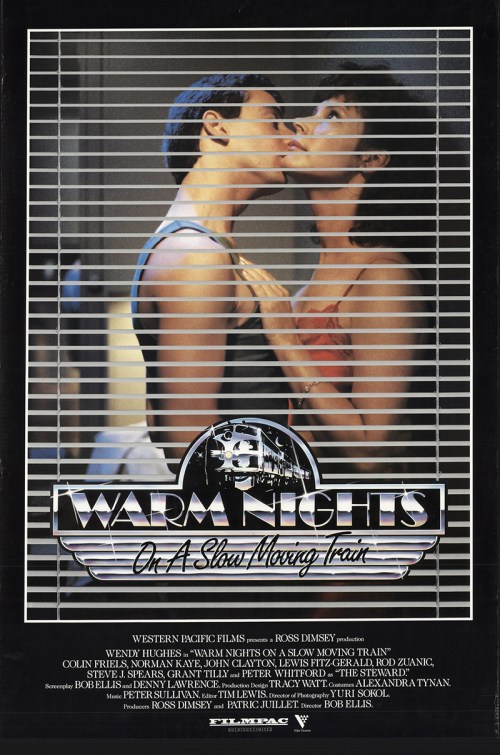
Warm Nights on a Slow Moving Train (1987)

warmnights

By Richard Winters

My Rating: 4 out of 10

4-Word Review: Prostitute on the weekend.

Jenny (Wendy Hughes) is an elementary catholic school teacher during the week, but on weekends she’s a prostitute riding a train that travels across the Australian countryside. She picks up lonely men that she meets at the train’s bar and takes them to her cabin for sex, but makes sure they’ve left by 3 AM. While she’s friendly and conversational with them during the night by the next day she virtually ignores them. She does this to help pay for her handicapped brother’s needs and for many years she’s able to juggle these dual lifestyles without much of a hitch. Then she meets a suave businessman (Colin Fields) who gets her involved in an assassination plot that not only disrupts her routine, but sends her precariously close to losing her freedoms.

Director Bob Ellis said the idea for the film was inspired by a long train ride that he took with actor Denny Lawrence and the two wrote the script during the duration of their trip. In order to get the needed funding it was contingent that Wendy Hughes be cast in the lead, which Ellis felt was wrong for the part, but eventually agreed to simply to get the film made. Ultimately though he and the film’s producer, Ross Dimsey, had a different vision for the story and Dimsey greatly trimmed the final cut turning what Ellis felt was one of the best scripts he had ever written into something he would later disown. The full director’s cut had been stored at his residence and he was hoping to eventually release it to the public, but it got destroyed during a house fire.

The version definitely has issues with the biggest one being the slow, plodding pace. I was also disappointed that it starts with Jenny already a seasoned hooker as I would’ve been more interested in seeing how she came up with the idea and seen the awkward moments she most assuredly would’ve gone through when she first jumped in and did it. The fact that she had no ‘Plan-B’ for the potential times when a male client might get aggressive, or not promptly leave at the agreed to time, was a weak point for me. There’s one scene where one of her johns follows her out of the train and won’t leave her alone, but she calls out to a nearby security officer to get him away from her, but if she’s a seasoned sex worker she should have another line of self-defense to use, like a gun or something, to take out if things got out-of-control and no one else was around to help her and the fact that she doesn’t have this makes it seem like she’s not as streetwise as we’re supposed to believe.

Having Jenny suddenly let down her guard and fall for one of her johns (Colin Friels) didn’t make much sense either. After years of being defensive around her clients why now get all emotional about this one who comes-off just as sleazy and aggressive and just as potentially dangerous? The assassination subplot doesn’t get introduced until 60-minutes in and the way she’s able to off the target by simply scratching the guy lightly on his back with a fingernail dipped in poison seemed much too easy.

I did like the juxtaposition of a catholic school teacher being a prostitute, but the film doesn’t explore this contradiction enough. You’d think after having done this for a long time her superiors might catch-on, or have it filter back to them, which could’ve created more conflict and added tension to a story that for the most part is too leisurely paced to hold one’s sustained attention.

My Rating: 4 out of 10

Released: May 10, 1987

Runtime: 1 Hour 31 Minutes

Rated R

Director: Bob Ellis

Studio: Filmpac Distribution

Available: dvdlady.com

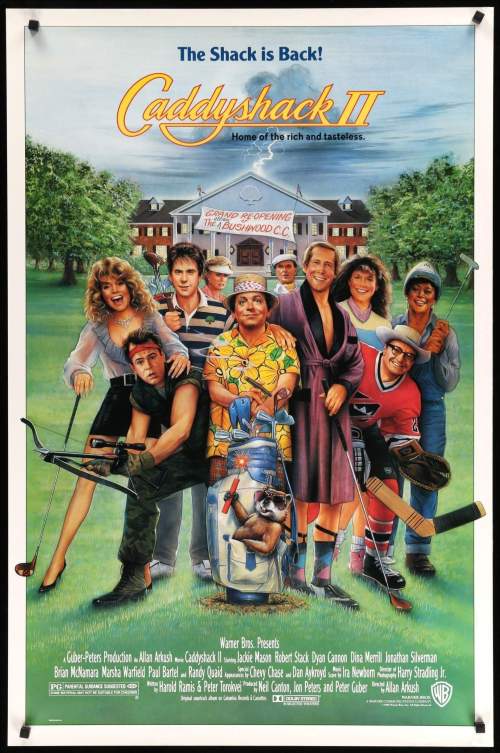
Caddyshack II (1988)

caddyshack2

By Richard Winters

My Rating: 1 out of 10

4-Word Review: A very bad sequel.

Kate (Jessica Lundy) is looking to fit-in with fashionable society by becoming friends with snooty Miffy (Chynna Phillips) whose parents (Robert Stack, Dina Merrill) run the affluent Bushwood Gold Club. Miffy tries to get Kate and Kate’s father Jack (Jackie Mason) to join the club. Kate, wanting to move-up the social ladder, convinces her father to send in an application and since Jack is financially well-off he’s quickly accepted. However, once Jack arrives his oafish personality and gaudy attire make him a turn-off to the other members. Miffy’s parents also don’t like him since he wants to build low income housing in their ritzy neighborhood. Jack is soon kicked-out of the club and told never to return, which causes Jack to buy the course and turn it into an amusement park and the only way Miffy’s family can win it back is if they challenge him to a golf game.

This is another sequel that had no business being made since the original had a perfect ending and no need for any continuation. Harold Ramis, who directed the first one and gets onscreen credit for co-writing this script, was not interested in making it, but eventually decided to dive in at the insistence of Rodney Dangerfield, who had figured prominently in the first film and wanted to take part in another one. Unfortunately Rodney became displeased with the quality of the scripts that were sent to him and eventually bowed out, which caused Ramis to leave the project as well. Bill Murray didn’t want to recreate his role and neither did Michael O’Keefe, while Ted Knight had already passed away leaving only Chevy Chase to return unless you count the gopher who figures more prominently here. Chase, who later regretted being in this, is the only funny thing about it, and seems for the most part to be ad-libbing his lines as it went along.

The biggest problem is that many of the performers add nothing to the story. This is especially true for Dyan Cannon, who at 50 looks great and would be considered these days as a ‘MILF’, but her character serves no other function other than to fall in love with Mason and appears only sporadically. Jonathan Silverman, who fills-in for the role played in the original by Michael O’Keefe, is barely seen and could’ve easily been cut-out. The normally reliable Dan Akroyd, who plays the part that Bill Murray would’ve, is wasted while speaking in a high-pitched voice that is more annoying than funny.

What I found most irritating is the presence of Robert Stack, who is stiff and pale and looking like an old guy with too much plastic surgery. Ted Knight, who played the role in the original at least had a colorful way of conveying his lines, but Stack speaks his lines like an over-rehearsed robot, which makes his presence quickly forgettable. I was also dismayed that he took over the antagonist role from Dina Merrill, as it initially seemed like she’d be the one to be Jackie Mason’s nemesis, which is a shame as a strong, powerful, yet ruthless woman going up against a putzy guy like Mason could’ve brought out some interesting dynamics that gets lost when it’s just between two aging men.

I was also confused why Randy Quaid is in this as he plays Mason’s obnoxious lawyer, but says things that Mason’s character could’ve easily said himself. I suppose in an attempt to make Mason more likable the writer’s decided to give the more edgy lines to Quaid, but the result is throwing in another character that really isn’t necessary. Apparently had Dangerfield agreed to be in it then his friend Sam Kinison would’ve played this role, who would’ve been better.

The film also fails to recreate the day-in-the-life feel of a country club, which is what had made the first one so engaging. In fact there are a lot of scenes that don’t even take place at the golf club. I also couldn’t stand how Mason renovated the place into a tacky miniature gold-like course, which seemed like a desecration and made me actually want Robert Stack to win the final match, so that he, even as much of a jerk that he and his wife were, could’ve turned the place back into a sensible looking golf course that it should’ve been.

My Rating: 1 out of 10

Released: July 22, 1988

Runtime: 1 Hour 38 Minutes

Rated PG

Director: Allan Arkush

Studio: Warner Brothers

Available: DVD, Hulu, Amazon Video, YouTube

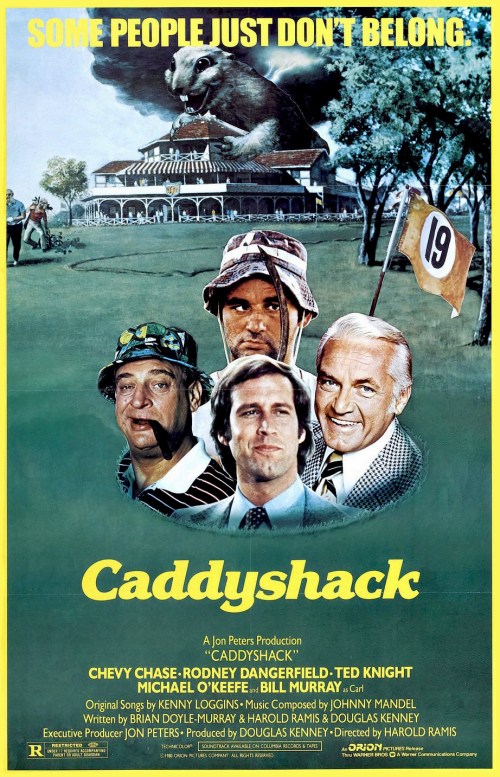
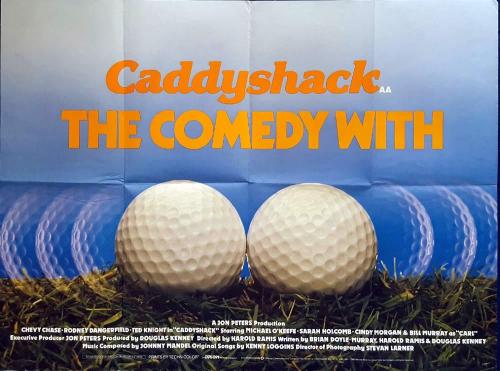
Caddyshack (1980)

caddyshack1

By Richard Winters

My Rating: 7 out of 10

4-Word Review: Blow-up the gopher.

Trying to work his way through college, Danny (Michael O’Keefe) gets a job as a caddie at an exclusive golf course. He becomes friends with Ty (Chevy Chase) who is the son of the club’s co-founder. He also begins caddying for Judge Smails (Ted Knight) in hopes to get on his good side since the Judge is also in charge of the caddie scholarship program, which Danny hopes to win in order to help pay for his education. The Judge and Danny form a hot-and-cold relationship with the Judge usually more annoyed with Danny than not though he does warm-up to him after the Judge accidentally hits an elderly woman with a golf club that he recklessly threw, but gets off-the-hook for taking the responsibility when Danny comes forward and takes the blame. The man though that really causes the Judge’s ire is Al (Rodney Dangerfield) a wealthy real-estate tycoon, who begins golfing at the club and constantly makes fun of the judge at every turn. Al considers the judge to be an uptight elitist snob, while the judge sees Al as being uncouth and lacking in social graces. The two men ultimately square off in a high stakes golf match just as the club’s dim-witted groundskeeper Carl (Bill Murray) rigs the course up with tons of dynamite in an attempt to get rid of a pesky gopher that’s been destroying the grounds.

This was another film that upon its initial release, like with The Shining and  Blade Runnerwas given a lukewarm response by the critics, but has since then become a classic by the vast portion of the movie going public. Part of the reason this one didn’t gel well with the critics is because of what was considered ‘sloppy’ comedy that had very little story and relied too heavily on gags to keep it going. The script, written by Brian Doyle-Murray, brother of Bill, and Douglas Keeney, was supposed to emphasize the caddy’s more and be a coming-of-age comedy, but the producers, much to the writer’s dismay,  decided to throw-in more colorful characters including a gopher who chews up the course and constantly avoids capture, which was an idea that co-writer Douglas Kenney really hated. The result made the story come-off as being too loosely structured and more concerned with creating comical bits than making any type of statement.

I admit when I first saw this movie over 20-some odd years ago that’s how I came away feeling too, but this time I approached it more as a day-in-the-life saga between society’s have-and-have-nots with the caddies portraying the working class while the course’s nouveau riche clientele made up the establishment. When taken in this vein the film works really well and I especially liked the way the Danny and the Judge’s relationship evolves throughout with the judge ultimately much more dependent on Danny than you might’ve originally thought possible.

Of course it’s the comedy that makes it all come together and there’s truly some side-splitting moments including the infamous Babe Ruth candy bar in the pool bit that was the one thing about the movie that I had remembered when I first saw over 2-decades ago and now upon viewing it a second time had me rolling over in laughter even more especially when you realize that it apparently is based on a real-life incident that occurred to writer Doyle-Murray while he worked at a golf club in Winnetka, Illinois. I also really enjoyed the moment where we see Bill Murray’s incredibly makeshift living quarters inside the course’s utility shed that features a reunion between he and fellow SNL alum Chevy Chase. The two had gotten into a well publicized fist-fight behind-the-scenes while working on that show a couple years before, but both managed to work together in this scene, which had been written-in at the last minute by director Harold Ramis for exactly that purpose, without a hitch.

Rodney Dangerfield’s star-making turn as the crass, but wealthy patron is a riot too and I particularly enjoyed his over-sized, multi-purpose golf bag and his nervous fidgeting especially his twitchy legs when he stands, which was all genuine and anxiety driven. Knight quite good too in a perfect caricature of a pompous jerk though he reportedly was vocally upset during the production at the excessive partying and hijinks that went on amongst the rest of the cast members, including a lot of drug use, which he felt was unprofessional. I even liked Cindy Morgan as the Judge’s niece and resident ‘hot babe’ who despite being a blonde was fortunately not portrayed in the stereotype of being dumb, but instead as savvy and observant. Followed 8 years later by a sequel, which will be reviewed next.

caddyshack2

caddyshack3

My Rating: 7 out of 10

Released: July 25, 1980

Runtime: 1 Hour 38 Minutes

Rated R

Director: Harold Ramis

Studio: Warner Brothers

Available: DVD, Blu-ray, HD-DVD, Amazon Video, Hulu, YouTube

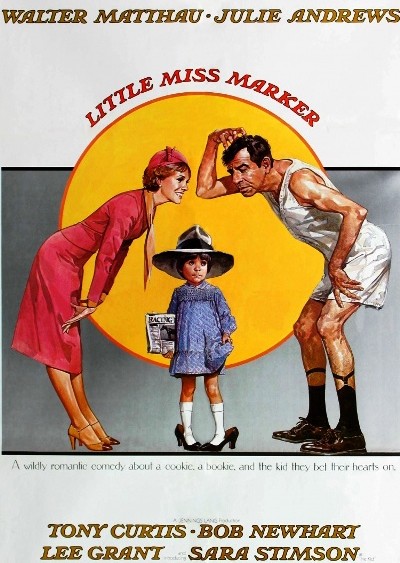
Little Miss Marker (1980)

little1

By Richard Winters

My Rating: 3 out of 10

4-Word Review: Kid used for collateral.

Sorrowful Jones (Walter Matthau) is a no-nonsense bookie running a gambling operation during the 30’s. When one of his clients named Carter (Andrew Rubin) cannot pay back his $10 debt he puts up his 6-year-old daughter (Sara Stimson), who is simply known as ‘the Kid’, as collateral. Sorrowful tells his assistant named Regret (Bob Newhart) to look after her, but Regret does not like kids, so he drops the young girl off at Sorrowful’s doorstep one night and then promptly leaves forcing Sorrowful to begrudgingly become her surrogate father figure. Eventually the two grow fond of each other and become inseparable, as does Amanda (Julie Andrews) who’s the girlfriend to a crime boss named Blackie (Tony Curtis). Blackie does not like that Sorrowful is showing an interest in Amanda, or her in him and  proceeds to try and throw a monkey-wrench into their potential affair while also coercing Sorrowful to partner with him in a fixed horse race.

This film was the fourth remake of the story that originally came out in 1934 and starred Adolphe Menjou as Sorrowful and Shirley Temple as the Kid. In 1949 it got remade with Bob Hope playing Sorrowful and Mary Jane Saunders as the child. Then is 1962 a variation of the story was was done called 40 Pounds of Trouble that was shot on-location in Disneyland and starred Tony Curtis in the Sorrowful role, though the character name was changed to Steve, and Claire Wilcox portraying the child, whose name in the film was Penny. While I have not seen any of those versions I still came away feeling this one had to be the weakest. A lot of the problem is that the script relies too heavily on the cuteness factor of the child, who is certainly adorable, but has no discernable personality. It’s also hard to imagine that a child who has just been abandoned by her father, and had also gone through the trauma of the death of her mother, would be so well-behaved and in reality would probably be showing some serious adjustment issues.

I’m not sure why Matthau, who also produced, thought this project would be a good idea, but appearing in it did not bolster his career. Didn’t he ever hear of the old adage never share the screen with animals or cute kids as they’ll just steal away all the attention? It’s not like Stimson, whose only movie role this was and who now works as a pediatrician in Arizona,  didn’t have to do anything special for that to happen as her big blue eyes are enough to capture the heartstrings of just about any viewer. I also had a hard time understanding his character particularly the fact that he was this brash, tough talking bookie yet doesn’t carry a gun nor have any fighting skills as proven by the fistfight he attempts to have with Curtis where even though Curtis was shorter Matthau he’s is still frightened of him and constantly backing away whenever Curtis got in his face. You’d think a streetwise person would have some ability to defend himself if needed and not just slink away the second someone else, particularly one who was smaller, suddenly got aggressive.

Bob Newhart gets completely wasted in a role that’s so small and insignificant I’m surprised why he even took it. I also didn’t think this was the right movie for Julie Andrews either. Sure, she has an engaging quality, but for a woman dating a crime boss she seemed way too pure and innocent almost like she was completely oblivious to his underhanded nature. In reality the people one hangs out with will inevitably rub off on that person and a more realistic portrayal would’ve had her being a bit corrupt, which would’ve actually been more interesting as it would’ve created a two-dimensional character who was cold and conniving most of the time, but then when the kid comes along a softer side gets exposed.

In contrast both Curtis and Brian Dennehy, who plays his henchmen, are a delight and needed more screen time. It’s interesting too seeing Lee Grant appear near the end playing a judge and almost unrecognizable in a gray wig, but the story as a whole flounders chiefly because, outside of the scenes showing a fixed horserace, there’s no action at all, which makes it absurd to call this a ‘family movie’. If I, as an adult, was bored I can only imagine a kid being even more so. In fact I’d say this movie really wasn’t made for kids at all, but instead little old ladies who enjoy cutesy kids the way they like cutesy puppy dogs and want children only shown as being adorable even though kids, like with everyone else, can have their bad side, which conveniently gets left out here.

My Rating: 3 out of 10

Released: March 21, 1980

Runtime: 1 Hour 43 Minutes

Rated PG

Director: Walter Bernstein

Studio: Universal

Available: DVD, Blu-ray

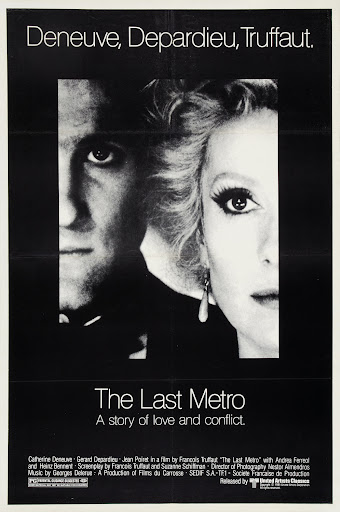
The Last Metro (1980)

lastmetro1

By Richard Winters

My Rating: 7 out of 10

4-Word Review: Hiding from the Nazis.

Bernard (Gerard Depardieu) is a young actor, who’s also a member of the French Resistance, living in occupied Paris during World War II. He gets a part as the leading man in a play at a playhouse run by Marion (Catherine Denueve) who has taken over the business since her husband Lucas (Heinz Bennent), who was Jewish, and supposedly fled the country when the Nazis took over, but in reality is hiding-out inside the cellar. Bernard and Marion don’t get along at first, but slowly form a bond when they find a mutual enemy in the form of theater critic Daxiat (Jean-Louis Richard) who is an anti-Semite that writes a nasty review about their play, accusing it of being pro-Jewish, in an effort to close the place down, so that he can take it over.

The film, which was writer/director Francois Truffaut’s most successful movie financially and one of the highest grossing French Films ever, remains sufficiently compelling despite very little that actually happens. One of the elements though that I found intriguing was the behind-the-scenes segments revealing all the work that gets put into a play before its opening night premiere . I especially liked Nadine (Sabine Haudepin) as a young actress who tirelessly goes from one acting gig to another, sometimes multiple ones on the same day, in order to help her career and get established.

Revealing right away, or pretty much by the end of the first act, that the husband has never left the country like everyone presumes, was a mistake that lessened the intrigue. For one thing the place he is hiding in, which is the cellar of the theater, is not too creative and even has a back door leading out to the alley way, which made me feel that anyone could’ve caught on to his whereabouts a lot sooner especially as Marion sometimes leaves her visits with him by going out the back entrance. Any passer-by/snitch could see her doing this and wonder what the door lead to, or called the Nazi authorities to have them investigate. It’s also not clear how, in seemingly a few minutes time, Marion is able to hide Lucas and his bed/personal belongings, from the Gestapo when they eventually insist on checking-out the basement.

Marion’s interactions with her husband is not particularly compelling and yet these scenes take up the majority of the runtime during the second act while Depardieu, who is excellent, barely gets seen at all. Then during the third act Marion and Bernard suddenly get really into each other, but the interactions between the two needed to be shown more for this to be organic to the viewer and in fact should’ve been more the focus of the film than Lucas. Had I been the director I would’ve kept Lucas’ whereabouts a secret until near the end when Bernard finally becomes aware of it and used the mystery of whether Marion knew more about it than she lets on as part of the intrigue.

The ending is a bit of a disappointment. The tone of the film works as a drama, but then suddenly shifts with about 10 minutes to go into a quirky comedy, which doesn’t work. The story threads get wrapped up in too tidy of way leaving the dynamics of Marion’s relationship with Bernard and Lucas’ response to it wide-open. After 2 hours and 10 minutes the character arcs should’ve been better defined and since they aren’t it makes the viewer feel like the movie doesn’t really go anywhere, or lead to anything insightful, which is a shame as it’s a nice looking, period authentic production otherwise.

My Rating: 7 out of 10

Released: September 17, 1980

Runtime: 2 Hours 11 Minutes

Rated PG

Director: Francois Truffaut

Studio: Gaumont

Available: DVD, Amazon Video

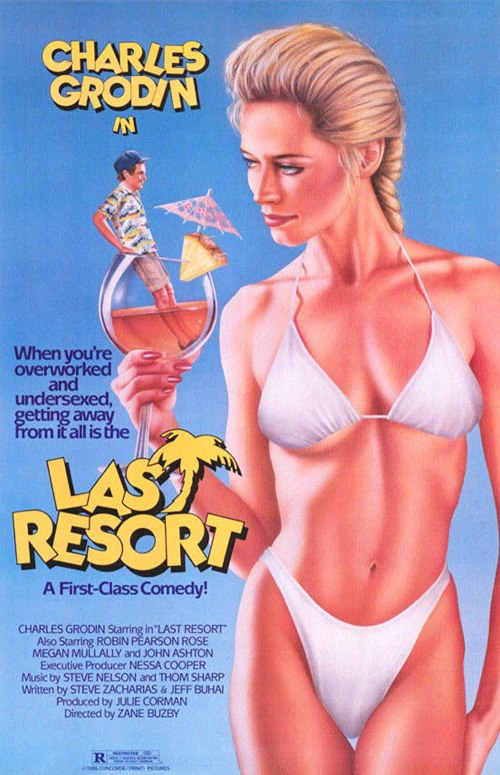
Last Resort (1986)

lastresort1

By Richard Winters

My Rating: 2 out of 10

4-Word Review: Family takes nightmarish vacation.

George (Charles Grodin) is a Chicago salesmen who loses a major client when he calls him fat, which in-turn costs him his job. Feeling the need to get away from the cold Chicago winter and reassess things he decides to take his family to a tropical island for some much needed r-and-r, but finds the place run by crazy people who house everybody in tiny little cabins. The island is also surrounded by a barbed wire fence due to a civil war going on, which soon has George stuck in the middle of it.

This film was directed by Zane Buzby, who appears here as a abusive summer camp counselor and who has since left the directing profession and devoted her life to brining aid to last surviving members of the Holocaust in Eastern Europe, which is a far better way to spend her time than making films like these, which isn’t funny and lacks any type of visual style. Much of the blame for this is the low budget, which makes the movie look cheap right from the start with its stock footage of a Chicago blizzard, the generic music score, and every indoor shot looking quite shadowy as if they weren’t able to afford enough spotlights to give it the properly lighted look. The island setting is bad too looking nothing like an actual island, but instead the brown, sun scorched landscape of a studio backlot.

The story is built around a lot of gags the majority of which aren’t funny, or even slightly original. The concept is the reverse of a National Lampoon’s Family Vacation where Chevy Chase plays the inept father who bungles everything while everyone else around him is normal. Here the father is the normal one and all the other people are nuts, but this doesn’t work as well as the folks behave in such an extremely absurd and obnoxious way that they have no bearing at all to real people and for satire to work it still needs to have some semblance to reality and this thing has none. It’s just insanity for the sake of goofiness with no point to it, which gets old fast.

I’m a big fan of Grodin, but his dry humored, deadpan observations are not put to good use and he ends up getting drowned out by all of the foolishness. I did though at least start to understand why Howard Stern always would accuse him of wearing a wig. To me I never thought he did wear one and Grodin, who disliked Stern immensely as he felt the shock-jock’s humor was too vulgar, would hotly dispute these accusations and even had one segment on his own short-lived talk show during the late 90’s where guests were allowed to tug on his hair just to prove it was natural and wouldn’t come off. However, here for whatever reason it really does appear like some rug plopped onto his skull that doesn’t even fit the dimensions of his head right.

Some of the supporting cast, which consists mainly of yet-to-be-famous, up-and-coming-stars does help a bit. This though does not include Megan Mullally, who plays Grodin’s daughter Jessica, who puts-on a high pitched, squeaky voice that I found really irritating. I did though find Jon Lovitz somewhat amusing as a bartender that can supposedly speak English, but can’t understand anything that Grodin says. Phil Hartman, wearing a blond wig, is a riot as a French gay guy named Jean-Michel who comes-onto Grodin, but my favorite was Mario Van Peebles as a flaming gay man who’s also one the tour guides. Some viewers may complain that his portrayal is too over-the-top and stereotypical, but it’s still campy fun especially at the end when he rips off his wig and suddenly turns into a macho guerrilla soldier freedom fighter.

My Rating: 2 out of 10

Released: May 9, 1986

Runtime: 1 Hour 24 Minutes

Rated R

Director: Zane Buzby

Studio: Concorde Pictures

Available: DVD, Amazon Video, Shout Factory TV, Pluto TV, Tubi

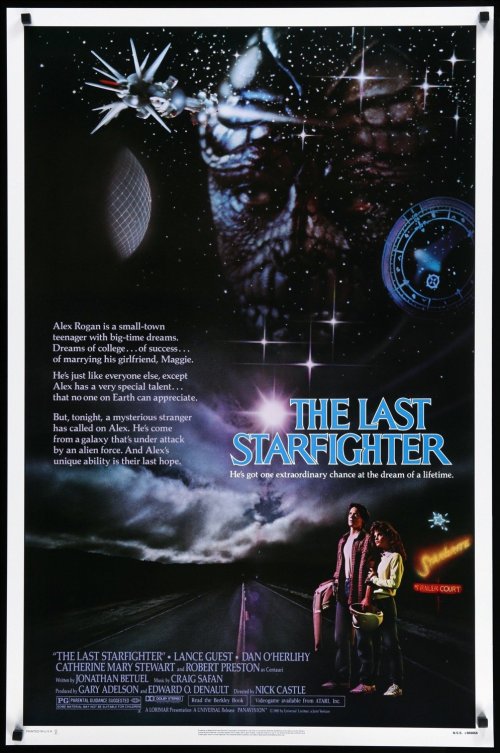
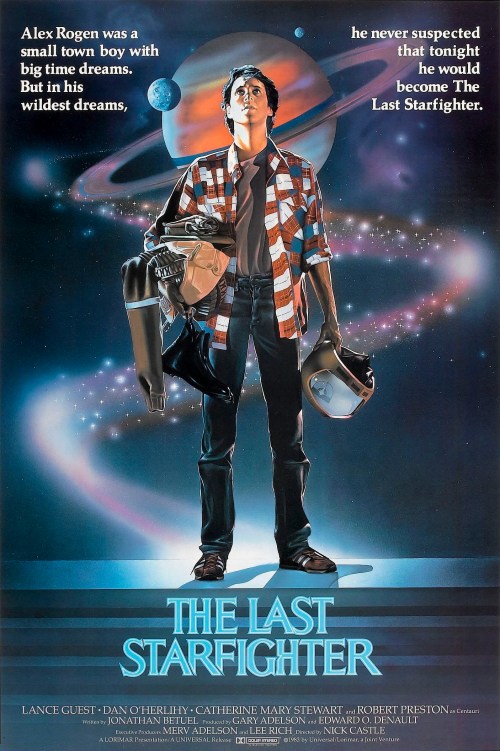
The Last Starfighter (1984)

laststar1

By Richard Winters

My Rating: 2 out of 10

4-Word Review: Teen recruited into battle.

Alex (Lance Guest) spends his time playing an arcade game called ‘Starfighter’ and gets so good at it that he becomes the game’s highest scorer. He’s then approached by the game’s inventor, Centuri (Robert Preston), to take a ride in his  futuristic-looking car as a prize. Alex accepts the invitation only to learn that Centuri really isn’t human, but instead an alien recruiting Alex to help them protect the frontier from Xur (Norman Snow) who has found a way to breach the forcefield that protects Rylos and the surrounding planets from invasion. The ‘Starfighter’ game was meant to be a test to find those that were good at the game and then bring them into the battle since the skills needed to win the game are the same ones needed for the battle.

While the film did quite well at the box office, bringing in $28 million from a $15 million budget, as well as spawning a novel version, a video game, and even an off-Broadway musical, I still found it to be a complete bore to watch. I don’t mind sci-fi, space-age movies, which were all-the-rage in the 80’s, but the special effects in this one are so tacky looking that I couldn’t take it seriously. This was one of the first films to use computer graphics instead of physical models, but the result makes this entire galactic war look like a video game. Maybe that was the intention, but I didn’t care for it.

The story, which was written by Jonathan R. Beutel while he worked as a cab driver, is full of too many plot holes. Having the setting inside a trailer park, which wasn’t even Beutel’s idea anyways, but instead director Nick Castle’s, is the only original thing about it. I didn’t understand though why all the people living in the trailer park would be so excited about Alex getting the high score in the game and come out of their homes to cheer him on. To them it’s just a silly kid’s game and becoming good at it doesn’t really mean much in the real-world, or lead to anything, so outside of an idle teenager with too much time on his hands, why care? It would’ve been more ironic had Alex achieved the high score with no one else around making him feel his efforts were under appreciated, only to later learn that in a far off galaxy it was anything but.

The way Centuri finds him, by literally driving up to him in the middle of the night in his snazzy car while Alex is conveniently walking alone is not interesting and this scenario could’ve been played-up in a more creative way by forcing Centuri to tour through the trailer park and visiting the many residents, which could’ve included some offbeat interactions, before he finally comes upon Alex. Also, why are these aliens forced to recruit a human teenager in their effort to save their own space fortress? Aren’t there other aliens within their own galaxy that could take-up the cause? What’s in it for Alex to get involved and put his life on the line for some distant, separate universe that he has nothing to do with and won’t directly affect his life in any way should these planets get invaded? The idea too that only two individuals, Alex and his alien pal Grig (Dan O’Herlihy), can take on this massive army and win are long odds that would only make sense in a cheesy Hollywood movie.

Guest was not the right choice for the part either as he was too old, playing a teen when he was already 23 at the time of filming and looking it. The part should’ve been played by a 12-year-old especially since the storyline is at a bubblegum level that only a preteen would be able to buy into. Preston is certainly a great actor, but I didn’t understand why his character felt the need to wear a human mask to disguise his alien face when all the other aliens freely showed who they were. It’s disappointing too that Norman Snow, who gives an campy performance as the villain, disappears too soon, but I really did like O’Herlihy, who’s completely unrecognizable underneath all of the make-up, and the only thing that makes watching this dopey thing slightly worth it.

The one aspect of the plot that is amusing is the Beta Alex that’s put in Alex’s place to help disguise that the real Alex is missing. These scenes, where the Beta learns to adapt to the human culture in awkward ways, are the only original bits in the film and where filmed after production had already finished when test audiences reacted favorably to the character forcing Guest to return to shoot the added scenes, but because he had already gotten a haircut by this time, the Beta Alex is then seen wearing a wig. Outside of these moments though I found the film to be pretty flimsy especially on the logical end and one of the weakest entries of the 80’s sci-fi craze.

laststar2

My Rating: 2 out of 10

Released: July 13, 1984

Runtime: 1 Hour 41 Minutes

Rated PG

Director: Nick Castle

Studio: Lorimar Film Entertainment

Available: DVD, Blu-ray, Amazon Video, YouTube

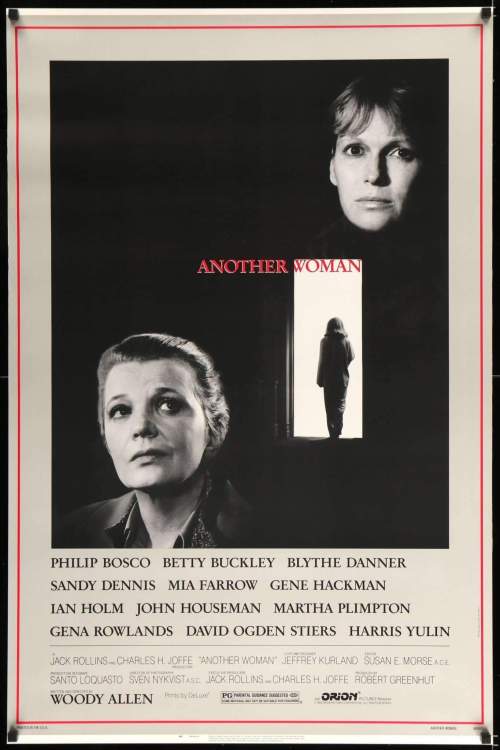
Another Woman (1988)

another

By Richard Winters

My Rating: 6 out of 10

4-Word Review: She reanalyzes her life.

Marion (Gena Rowlands) is a college professor over 50, whose taken a leave of absence in order to write a book. Due to the construction at her place she sublets another apartment in order to have it quiet for her writing, but finds that it’s next to a psychiatrist’s office and through the vent can hear everything that the patients talk about. She becomes especially intrigued with a young pregnant woman named Hope (Mia Farrow) who talks about how empty her life is and this touches a cord with Marion, who despite being much older, feels the same way about her own life. This then forces her to reanalyze how she’s treated her family and friends through the years and causing her to face some harsh realities about herself.

While writer/director Woody Allen has the reputation of a being an intellectual as well as a perfectionist, the film’s opening shot had to be rewritten several times before he was happy with it, it’s surprising how dumb he is with basic physics. The idea that Marion could put a couple of couch cushions over the vent and this would be enough to blot out all of the noise coming from the neighboring apartment just doesn’t ring true. Sure it might muffle the voices a bit, but not a complete block of sound to where she’d hear no noise at all and having the vent be in another room in the apartment, which would’ve allowed her the convenience of simply closing that room’s door in order to cut-off the noise, would’ve worked better.

I was also surprised how later on in the film, Marion tells the psychiatrist about the ‘acoustical irregularities’ that allows her to hear everything that’s said in his office and the Dr. admits to being aware of this, but says he’ll ‘correct it’. What kind of psychiatrist though would knowingly allow his patient’s most personal thoughts to get out for others to hear? This made me think the plot would’ve worked better as one of Allen’s comedies where a writer puts the stories overheard from the patients into their book and when it becomes a best-seller, both the author and Dr. get sued and tormented by the angry patients sending them to a psychiatrists of their own.

Like with all of Allen’s dramas the cast of characters are entirely made-up of upper middle-class intellectuals, which gives the film an elitist, snobby vibe by implying that these types of people are the only ones sophisticated enough to have complex problems that people in the lower socio-economic classes supposedly don’t. They seem too much like caricatures as well who have the exact same interests (writing, the arts, and going to operas) and it would’ve been nice had there been one working class person who wasn’t into all of these things thrown into the mix simply to give it a better balance.

The fact that just about all of the characters are having affairs, many times with each other, makes it too soap opera-like. The scene where Gena bumps into Sandy Dennis and her husband and the three go to a pub for drinks gets particularly over-the-top when Dennis bluntly accuses her husband of paying too much attention to Gena. In most cases if a wife has a problem with her husband’s behavior she’ll keep it to herself and then bring it up later when the two are alone and not out in public for everyone to hear especially to a friend that she hasn’t seen in awhile and is only an acquaintance.

I didn’t like Marion as she’s too cold and while I realize this was intentional she’s not the type of person that the viewer can warm-up to, or care that much about. Mia Farrow’s character is far more appealing and I wanted more of her and was shocked how little screen time she ultimately gets. The part wasn’t even meant for her as she was set to play Marion before she got pregnant and then when Dianne Weist, who was originally cast as Hope, had to leave the production due to illness and her replacement, Jane Alexander, didn’t approach the character the way Woody wanted, so it was eventually given to Farrow, who does quite well despite the fact that she was already in her 40’s at the time even though the person she was playing was supposed to be in their 20’s.

The film does end on a strong note, but it does take awhile before it gets there and comes-off as clunky and unintentionally funny at other points. The scenes with John Houseman, who plays Marion’s father, are particularly hammy as he sits at the dinner table conveying his lines like he still thinks he’s Professor Kingfish speaking to an auditorium full of students. However, David Ogden Stiers impression of Houseman (he plays a younger version of him during a flashback scene) is spot-on and the movie is almost worth catching just for that.

My Rating: 6 out of 10

Released: October 14, 1988

Runtime: 1 Hour 21 Minutes

Rated PG

Director: Woody Allen

Studio: Orion Pictures

Available: DVD, Amazon Video, Blu-ray (Region 0), YouTube

Goodbye Paradise (1983)

goodbye1

By Richard Winters

My Rating: 6 out of 10

4-Word Review: Searching for Senator’s daughter.

Michael Stacey (Ray Barrett) is a retired cop whose written a scathing exposé on the corruption of his former profession, which has gotten him many enemies and, along with his alcoholism, pushed to the very fringes of society. He now lives in a tiny, rundown apartment while playing chess with himself as his only means of companionship. One day he gets a call from a high-ranking Senator (Don Pascoe) who wants Michael to find his runaway daughter as he’s concerned that she’s gotten involved with an underground cult movement, which he fears could be detrimental to both her safety and to his own political career. Have no other means of income Michael takes-up the offer and soon gets immersed with an array of odd people and many twists that ultimately finds him in the middle of a military coup.

This offbeat movie starts out strong, but eventually goes overboard. The original idea by screenwriter Denny Lawrence was to have an ex-cop working as a private investigator who takes on a case of a runaway daughter who joined a religious cult run by a charismatic charlatan that eventually lead to the deaths of many of its members. However, after the Jonestown massacre, which was led by religious cult leader Jim Jones, this idea got nixed and the plot, with the help of co-scripter Bob Ellis who wanted a more political bent, got turned into a completely different direction, which doesn’t work as well.

The whole idea of a parent hiring a down-and-out, aging guy to find his long lost daughter doesn’t make much sense. The father’s a rich senator with lots of connections, so why not use the resources of the police, or a more polished detective to do the searching instead of an old bum more focused on when his next drink will be? Had Michael’s actual job, like in the original script, been as an private investigator then maybe, but in this version Michael was a struggling writer, so why pay someone to do something that they had no practice in doing, or if they did it had been a seriously long time and someone else could’ve been found to do it better?

The protagonist is a lovable loser, a sort of anti-hero who was meant to be a modern-day Philip Marlowe, and the main reason that get me hooked into the movie right away especially with Barrett’s perfect portrayal that is both raw and funny at the same time. However, the supporting characters are dull. The is especially evident with the Senator’s daughter, which due to a case of mistaken identity, he ends up dealing with two different young women, but both of them are stereotyped and cliched to the extreme. The dialogue and conversational exchanges that they have with Michael are flat making these scenes the most boring part of the movie. Nothing is worse than a film that does a excellent job of creating a multi-faceted person in one area, but then cuts-corners with the rest making the viewer like they’ve gotten stuck with only half a movie.

Spoiler Alert!

The climactic sequence, which involves an all-out military coup and lots of warfare-like action, is just too extreme and surreal especially for a story that starts out in a realistic vein. Much of the fault could be blamed on the two script writers with Lawrence wanting it to be a genre piece while Ellis preferring a more political take. The result is an imbalance that gets increasingly more wacky and implausible as it goes on until it becomes too cluttered to make much sense. Whatever statements the writers hoped to make here gets lost in the insanity and leaves the viewer feeling overwhelmed with all of the absurdity.

My Rating: 6 out of 10

Released: July 21, 1983

Runtime: 1 Hour 59 Minutes

Not Rated

Director: Carl Schultz

Studio: New South Wales Film Corporation

Available: DVD (Region 0 Import)