Category Archives: 70’s Movies

Dog Day Afternoon (1975)

dog

By Richard Winters

My Rating: 9 out of 10

4-Word Review: Money for sex change.

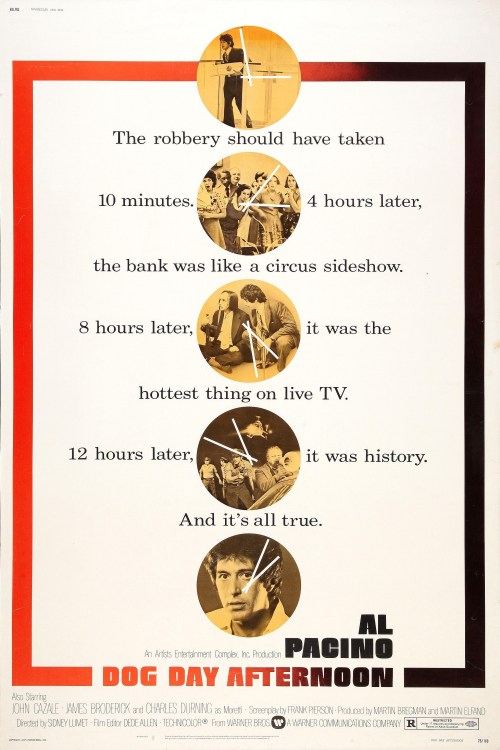
Dog Day Afternoon is a 1975 film based on a true story that took place on August 22, 1972.  It tells the tale of a man by the name of John Wojtowicz, who robbed a Brooklyn bank in order to pay for his gay lover’s sex change operation.  Here the character’s name has been altered slightly to John ‘Sonny’ Wortzik (played by Al Pacino), but otherwise this Oscar-winning script by Frank Pierson pretty much sticks closely to the actual events in this incredible saga about everything that can go wrong will.

Just about everyone who has watched this film will tell you how it manages to grab and pull you in right from the start.  It achieves this without having any special effects, pounding soundtrack, elaborate camera work, or artificial lighting.  Instead of ‘telegraphing all of its punches’ the film draws back and puts more emphasis on the little subtitles like the character’s facial expressions, side conversations, and other nuances that put together make this film very rich and textured.   In essence it successfully ‘shows’ instead of ‘tells’, which is a remarkable achievement since so many Hollywood films seem to want to do the exact opposite.

Director Sidney Lumet allowed for a lot of improvisation by his actors and gave each performer full rein on how to create their character, even the minor supporting ones. The result gives each and every one of the characters a distinct personality. The bank hostages become almost as fascinating as the thieves and it is interesting seeing all the different ways each one responds to the situation and how they interact with the robbers, which at times is both amusing and surprising.

The film also vividly captures 1970’s Brooklyn atmosphere. The sights and sounds of the area as well as the people’s personalities and the anti-establishment sentiment that was still quite prevalent at the time are all right on target.  After you finish watching this movie you feel like you just got back from a trip over there.  I really liked how during the opening credits you are shown all sorts of shots and scenes of Brooklyn, so by the time the story actually begins you are already well entrenched in the setting.

Pacino gives a dynamic performance in the starring role.  Some insist this is the best performance never to be nominated for an Oscar and I might have to agree.  If you are a Pacino fan than you absolutely have to see this, but if you are not a Pacino fan you still should see it because afterwards you might become one.

The supporting cast is stellar.  Sully Boyar, who was a real-life lawyer who did not enter into acting until he was in his 50’s, leaves a strong impression as the stoic bank manager.  As the police captain, the always durable Charles Durning is a blast especially during his frenzied and frantic negotiations with Pacino that almost become the film’s highlight. Another memorable moment is the improvised phone conversation between Sonny and his gay lover played by Chris Sarandon.  John Cazale is also amazing as Pacino’s bank robbing partner.  The partner in the actual incident was only 18 while Cazale was then 39, which created some controversy. However, Cazale is so convincing in the part that it is hard to imagine anyone else doing it as well.

In the end the film’s brilliance comes from its ability to convey the humanity of its characters. You can’t help but feel for the Sonny character despite his many flaws.  This a man who craves acceptance and yet goes through life being betrayed and hurt by everyone he meets. The shocked expression he shows at being betrayed by his own hostages, who he felt he had ‘bonded’ with, is, in my opinion, the most memorable shot of the whole film.

I only have two negative comments about this film and they are both minor.  One is the abrupt ending.  Since the film was made only a few years after the incident there wasn’t much of an epilogue to the characters.  The real John Wojtowicz, who really did look a lot like Pacino, didn’t end up dying until the year 2006.  It would have been a stronger conclusion by showing what happened to the Sonny character through the years and maybe even how he might of changed or grown.  My only other complaint is the fact that actress Carol Kane appears as one of the bank employees, but is shown very little.  A quirky and unique talent such as hers should have been given a bigger role.

Overall this is a great movie that I would recommend to any serious movie fan who can appreciate great film-making in top form.

My Rating: 9 out of 10

Released: September 21, 1975

Runtime: 2Hours 5Minutes

Rated R

Director: Sidney Lumet

Studio: Warner Brothers

Available: VHS, DVD (2-Disc Special Edition), Blu-ray, HDDVD, Amazon Instant Video
W (1974)

w1

By Richard Winters

My Rating: 1 out of 10

4-Word Review: Ex-husband is psycho.

For all you trivia buffs out there it may be good to know that Oliver Stone was not the first person to make a film with the twenty-third letter of the alphabet as its title, although that one technically has a period after it.  The first one was in 1974 and starred British super-model Twiggy. She had just made a splash in Ken Russell’s brilliant musical The Boy Friend and this film was supposed to send her to superstardom by proving that she could act by placing her in a completely different genre. Unfortunately for her it never happened.

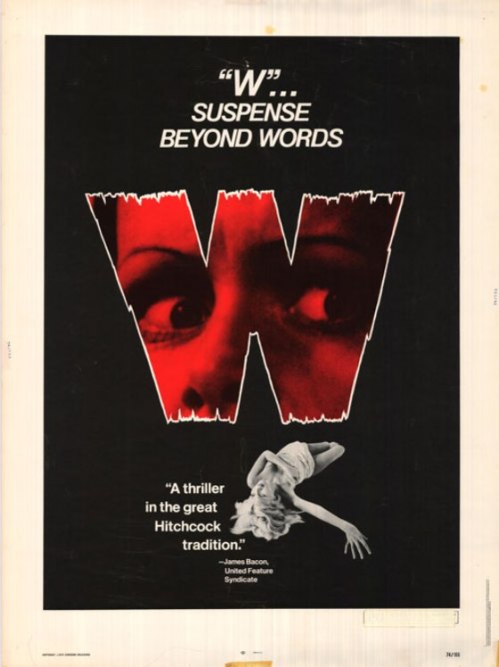
The film is a thriller and the tagline read ‘W…suspense beyond words’. It is a story about a woman who has remarried but it still being stalked by her psycho ex-husband (Dirk Benedict). His name is William and at all of the scenes of his murders, or ‘accidents’, he scrawls the letter ‘W’, hence the film’s title.

At the time the critics came down hard on Twiggy’s performance, but I kind of liked it. She comes off as very innocuous and vulnerable and in this kind of role it works.  Her present husband was played by Michael Witney, who at the time was her real-life husband.  He was eighteen years older than her, but the age difference is not apparent.  You can tell that the two are genuinely fond of each other and that chemistry helps.  Yet they have no real onscreen presence and too much of the time is spent with only them in it, which hurts.

Viewers enjoyed Eugene Roche’s performance in a supporting role as a detective.  His gritty, matter-of-fact approach is refreshing and gives him some distinction over the other characters who are very transparent. Unfortunately he gets phased out rather quickly and this is too bad because it is the type of persona that could have really carried the film.

Where this film really fails is that way too much time is given to extraneous dialogue that is not interesting and does not propel the plot along.  The scenes are also excruciatingly slow and in great need of quicker cuts and edits.  I would have like to have seen cutaways showing the Twiggy’s character’s relationship with her ex-husband and how that all started, but it is never shown. She doesn’t even end up talking about it until well over an hour into the film and then it is only done briefly.

This is also one of the first thrillers that I have ever seen that has no creepy or pounding music score.  In fact the music is very soft and melodic like something you would hear in an elevator. There is also extended amount of footage showing the couple going sailing, walking hand in hand in a park, or spending time at their lavish beach house, making it seem more like a dreamy romance movie.  Some scary imagery, or just a few shocks are badly needed.  There is one nightmare sequence that has a little potential, but it lasts less than ten seconds and that just isn’t enough.

The film also has a lot of loopholes that completely throws you out of the story.  One is the fact that as they are becoming increasingly terrorized by this ex-husband they decide not to go to the police, but instead call on the services of a private detective, who has ulterior motives and just ends up making things worse. There is also a scene where the killer cuts off two of his fingers and attaches them to the victim’s burned body so when the police identify the body using the fingerprints they think it is the killer.  However, I wasn’t exactly sure how he pulled this off. Certainly he wouldn’t have the skill or time to actually graft the fingers onto the body and even if he did you would still think that the police would notice that the victim had too many fingers.

The biggest head scratcher of them all has got to be the fact that the prison in which the ex-husband resides gives daily tours to the public.  Now I have toured a prison myself in Boise, Idaho, but that was only after the prison had been closed and the prisoners shipped off to another facility.  Here the visitors can get right up next to the prisoners and observe them without any guards, or protection.  The person leading them around is not armed and dresses and acts like a tour guide to a museum.  I would think one of the prisoners could easily obtain a homemade knife of some kind, grab one of these visitors, and use them as a shield to break out. Of course in this film that doesn’t happen, but in real life I think it would, which just makes you wonder what kind of drugs were they on when they made this.

My only interest in watching this film to begin with was seeing Dirk Benedict playing the psychotic.  He is probably best known for the character of Face in the 80’s TV-show ‘The A-Team’.  Not that he is a real great actor or anything, but he has had a career where he usually always plays the nice guy, so I was interested in seeing him as the bad guy. Unfortunately he doesn’t appear until the final ten minutes and these scenes are strained and probably the most boring of the whole film.  His character is also poorly fleshed out with no reason given to his erratic, crazy behavior thus turning him into a cliche.

I came into this film expecting very little and I went away not even getting that much. Being an avid collector of lost films can be fun because every now and then you can come across a real gem, but that was definitely not the case here.

My Rating: 1 out of 10

Released: June 8, 1974

Runtime: 1Hour 35Minutes

Rated PG

Director: Richard Quine

Studio: Cinerama Releasing Corporation

Available: None

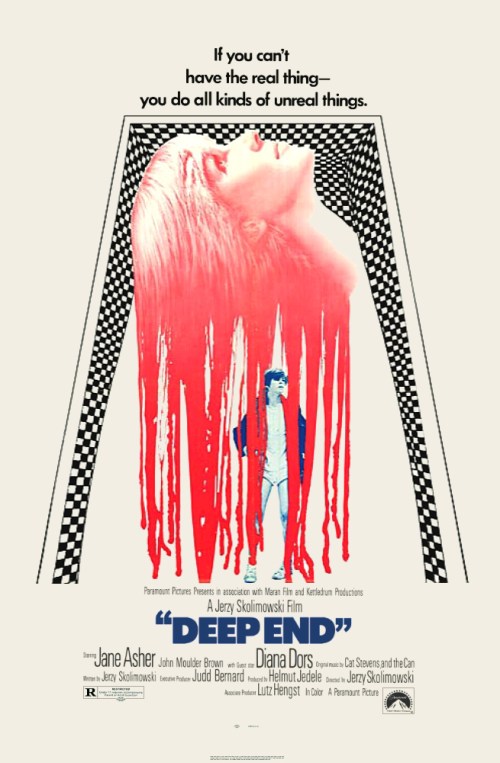
Deep End (1970)

deep

By Richard Winters

My Rating: 7 out of 10

4-Word Review: He will have her.

This is a moody drama detailing the story of a 15 year old boy named Mike (John Moulder-Brown) who goes to work at a public bath in London.  There he meets an alluring red-headed woman named Sue (Jane Asher).  She begins flirting with him, which causes him to become infatuated with her.  He starts following her around and even tries to scare off her two boyfriends as she is seeing both a man her own age as well as an older, married one.  Sue, who seems to enjoy manipulating all the men in her life, treats it all like it’s a silly game that ultimately ends with tragic results.

One of the things that really helps this film stand-out is the believability of the Mike character.  It was fascinating seeing all the different sides to his personality and I felt each one rang true for a boy his age.  There are times when he seems streetwise and even savvy and then there are other moments when he is immature, irresponsible, and emotionally out-of-control.  Although his obsession with Sue borders on being frightening I did like how he comes up with clever ways to help her like the ingenious way he finds her diamond that fell from her ring and into the snow.  I also liked how he becomes shocked at seeing a semi-nude poster of Sue outside a club, as she works as a stripper part-time, and how he steals it away in order to ‘protect her honor’.

Sue on the other hand seems almost all bad with very little good traits, but still equally believable.  She is mean and catty with everyone, abuses animals, and comes up emotionally hollow at every turn.  However, I could see how a young man of his age could become trapped by her seductive ways and perceived ‘maturity’, which makes the obsession itself as intriguing as their personalities.

Acclaimed writer/director Jerzy Skolimowski seems very much in control here and what buttons to press and when to do it.  I liked the color schemes especially his use of the color red. Having Cat Stevens do the music score gives the soundtrack and nice distinction.  I also liked how he foreshadows the film’s final shot several times during the movie.

I did end up having a few qualms with the film.  I wanted Mike’s initial interactions with Sue to be a little more extended than just the brief flirting that is shown.  The film takes place in buildings that are all old, rundown, and murky, which in some ways is good because it helps reflect the murky personalities of the characters.  Yet I wasn’t sure if this was all intentional or just the result of working on a low budget.  I would have liked a few scenes done against a more appealing background just to allow for  more visual variety.

The ending, especially the final shot, is very provocative and perverse.  It reminded me in a way of Nicholas Roeg’s excellent film Bad Timing: A Sensual Obsession (1980). Everything gets played out in such an odd way that it keeps you guessing until the final second as to what happens, which ends up staying with you long after the film is over.

Diana Dors, who was a popular British actress during the 50’s and 60’s and even considered a sex symbol for a time, gets a great cameo bit here that has to be seen to really be appreciated.  She plays a sexually frustrated middle-aged woman who rents a room at the public bath and then tricks Mike into coming into the room with her. She grabs his hair and shakes his head while describing a sexual fantasy that she has going on in her head.  When she is done she throws him back to the floor and says “You can go now, I don’t need you anymore.”

My Rating: 7 out of 10

Released: September 1, 1970

Runtime: 1Hour 33Minutes

Rated R (Sexual Situations, Adult Theme, Brief Nudity)

Director: Jerzy Skolimowski

Studio: Paramount

Available: DVD, Blu-ray (Import)

Dirty Mary Crazy Larry (1974)

dirty1

By Richard Winters

My Rating: 5 out of 10

4-Word Review: Fast cars fast women.

During the 70’s car chase movies were all the rage.  Smoky and the Bandit, Convoy, Vanishing Point, and Two-Lane Blacktop were just a few.  Most of these films followed the comedy adventure blueprint closely resembling the politics of the time where the police were the befuddled authority figures and those being chased symbolized the downtrodden masses looking to break free from the values and customs of yesteryear and find their own identities. Dirty Mary Crazy Larry is pretty much the same as the rest with a few notable exceptions the biggest being its very downbeat ending, which was quite talked about at the time of its release and one of the main reasons this film continues to have a strong cult following today.

The story is based on the novel by Richard Unekis called The Chase. It involves an out of work race car driver named Larry and his mechanic (Peter Fonda, Adam Roarke) who decide to rob a grocery store to make ends meet. Much to their dismay they are accompanied by a hooker named Mary (Susan George) and the three spend the rest of the film riding in Larry’s Dodge Charger with a powerful V-8 engine and avoiding the relentless pursuit of the police.

The screenplay follows the book pretty closely, but does make a few ill-advised changes. One is that in the book the two leads characters were career criminals who robbed for a living. I thought this made more sense and gave the characters a little more grounding.  I didn’t understand why a race car driver and his mechanic would suddenly be pushed to robbery, or what lead them into their fix. The robbery is executed in much too sophisticated a way for a pair of novices as they kidnap the store manager’s wife and daughter and then threaten to harm them unless the manager opens up the store’s safe. They also rig his home phone up to a tape recorder device so every time he calls home he hears the voice of the two and thinks they are still there even though they had already hit the road.  Criminals who had done this all their lives would be brazen enough not only to come up with this idea, but to also pull it off.  People with no background in robbery most likely would not.  There is also no explanation as to why they chose this store and how they planned the whole thing out, which would have helped.

Another change that was made was the addition of the Mary character.  In the book it was just the two men, which made it more gritty.  Although easy on the eyes the character serves no fundamental purpose to the story line.  All she does is have very redundant arguments with Larry that quickly become tiring.  I began to realize that these shouting matches were put in solely as filler material and it ends up getting inane.

Although I have like Peter Fonda in other films, most notably Easy Rider, I did not feel his laid back persona fit this part.  Larry is indeed a potentially interesting character as it is a person who can only find solace when he is taking extreme risks and driving real fast, but Fonda seemed unable to bring out this edginess effectively and his incessant gum chewing ends up becoming real annoying.

Vic Morrow probably gives the film’s best performance as the sheriff.  Normally the police are portrayed as bumbling idiots in this type of genre, but here they were a little more human and I liked the way that he was a bit of a non-conformist himself in the relentless way  he pursued the trio.

I also liked the attempt by the film makers to put in more realistic elements to a car chase that is never shown in most movies. One particular scene involves a pick-up truck that has nothing to do with the chase pulling out and getting side-swiped by Larry’s car.  For a minute the film becomes somber as they think they may have killed the other driver, which is good. Too many chase films always show other drivers and pedestrians miraculously getting out of the way and never being hit or injured even though in reality a lot of them probably would. The subject of seat belts also comes up, which is another pet peeve that I have with these films.  The occupants of these cars are never shown wearing them and with the stunts that they do they would all end up injured and killed without them.  They don’t wear them here either, but at least Larry does mention to Mary that she should put one on and there is also an amusing scene where a big yellow billboard stating ‘There is only one word for people that don’t wear seatbelts…STUPID’ which is shown briefly just before one of the out-of-control police cars goes careening through it.

Of course the best thing about the film and the one thing that has made this film so famous is the notorious ending, which is a downer for sure. If you consider this a spoiler then please don’t read any further, but the truth is when I first saw this film many years ago I already knew it was going to have a downbeat ending, but it kept me more intrigued because I didn’t know how it would happen.  Unless you count the film’s opening shot there is no foreshadowing of it and it happens very suddenly where the victims end up not knowing what hit them, which is also realistic.  Personally I loved it and most other viewers seem to also.  Too many chase movies have the good guys being able to escape one close call after another when in reality the odds will catch up with you sooner or later and with this film that is what happens, which in some ways can be considered ‘refreshing’. The scene is captured well and features one of the best explosions I have seen and without any of that tacky computerized special effects. I also liked the way the film ends very abruptly after it happens without any denouncement.

Normally I argue against Hollywood remakes, but this is one instance where it would be a good thing.  One of the main problems here is the film’s low-budget.  Although I felt they captured the central California countryside nicely (it was filmed in and around Stockton) the indoor sets are quite bland and dull. A bigger budget, tighter script, and some flashy camera work could work wonders here.  Too many times Hollywood seems driven to remake films that were already good the first time and only ends up tarnishing the original instead of remaking films that didn’t quite work on the first run and trying to make them better.

My Rating: 5 out of 10

Released: May 17, 1974

Runtime: 1Hour 33Minutes

Rated PG

Director: John Hough

Studio: 20th Century Fox

Available: VHS, DVD, Amazon Instant Video

$ (Dollars) (1971)

dollars

By Richard Winters

My Rating: 8 out of 10

4-Word Review: Robbery done inside safe.

Inspired by the British hit Perfect Friday this inventive and original bank heist film holds up well and has a great mix of action and comedy as well as oozing with cynical sensibilities and jaded characters.  It is one of the very few films ever made that has a symbol for its title and no words. Although most reference books do list the word ‘dollars’ in parenthesis, technically it is the dollar sign that is the official title. It also has the distinction of not displaying its title on screen in any type of print format. Instead a brief scene with a large steel structure made into a dollar sign is shown at the beginning being hauled in the air by a crane.

The story evolves around a crafty bank robbery devised by Joe Collins (Warren Beatty) who is also the bank’s security expert. He comes to realize that various criminals have stolen money stored in the safety deposit boxes inside the bank’s safe.  He figures that he could steal the money from them and they would be unable to go to the police. He gets a ditzy call-girl named Dawn Divine (Goldie Hawn), who has been a prostitute to most of the criminals whose money is in the safe, to call in a bomb threat to the bank. As the bank is evacuated, Joe enters the safe and closes it. He then methodically transfers the money from the bad guy’s boxes and into Dawn’s, who also rents a box there, as the bomb squad searches for the explosive. Then the next day Dawn takes the money from her box and stuffs it into her bag without anyone suspecting a thing.

Of course this is only the first-part. The second half deals with the crooks slowly figuring out what happened and chasing down Joe, who they think has the money. This begins one of the longest and most elaborate chase sequences ever put on film.  It takes up almost the whole second hour and it is amazing. Joe ends up being chased through city streets, tunnels, subways, trains, and even on a frozen lake with thin ice. Beatty did most of his own stunts here, which is impressive especially during the lake sequence, which was done on location in Sweden. When he goes through the ice he is really going into icy water and seems to be genuinely struggling to get out. Veteran character actor Scott Brady is memorable as one of the antagonists named Sarge.  He was much older than Beatty, but this contrast is fun, especially with the very relentless way he stays on Joe’s tail despite being out-of-shape.

Goldie is great as always, somehow her ditzy blonde routine never seems to get old and it is played to perfection here. I did have a few issues with the character though. She has sex with these slimy middle-aged men and even plays out their kinky fantasies, but ends up only taking $100 dollars from them for her ‘services’. I know this takes place in 1971, but even if you factor in inflation it still seemed low when these guys were loaded. I also thought her attitude was a little too carefree.  She invited these men into her apartment, but seemed to have no back-up plan in case things got out of control, which seemed risky. It is also never explained how Joe came to know her, or devise the plan that he did, but it would have been helpful. There also the fact that despite being a very crucial link in the plan she shows little confidence and describes how she always breaks down under pressure. It is nice that Joe stays supportive and sticks with her, but I felt it was unrealistic. Just about anyone else would have second thoughts about going through with it when they have a partner who is so shaky, or at the very least considered someone who is more self-assured.

Beatty is a terrific. He displays a cool demeanor and nicely underplays everything.  His mop-top Beatles like haircut  shows in a subtle, visual way his non-conformity from the more staid and conventionally dressed bank mangers.

Gert Frobe, best known as the villainous Auric Goldfinger from the classic James Bond film Goldfinger, is a hoot as the bumbling, clueless bank manager Mr. Kessel. The only actor I didn’t like was Arthur Brauss as ‘the candy man’. He certainly had the steely cold eyes of a killer, but his excessively raspy voice was a distraction and did not sound natural. There was no reason given why he sounded that way, but I would have liked one.

Even after 40 years the film still seems fresh. There are certain things here that I have never seen anywhere else. The prolonged chase is one, but there is also the scene where, to get Joe out of the safe, they have a torch burn a hole through the metal. They use an actual blowtorch and the sounds of it burning into the metal as well as the smoke and flying sparks is vivid and exciting.

I know my brother, who once watched the film with me, as well as other reviewers on IMDB, have complained that the first part of the film is too disjointed, slow and confusing. It does have a certain fragmented, cinema-vertite style to it where the viewer is forced to make their own connections, but I have watched this movie several times and it has never bothered me. The robbery and chase are so creative that I feel it more than makes up for any other limitations.  This early segment also effectively show how nasty the villainous men are and there is a part where, at a strip club, a stripper has a giant image of a dollar bill projected on her nude body, which I found to be evocative and artsy.

Critic Leonard Maltin has called this film ‘awfully similar to Perfect Friday’, but I have to disagree. I have seen both movies, which are excellent in their own right, but quite different in a lot of aspects. If you are looking for light entertainment that is exciting and still intelligently done, than this is a good flick to check-out.

My Rating: 8 out of 10

Released: December 17, 1971

Runtime: 2Hours 1Minute

Rated R

Director: Richard Brooks

Studio: Columbia Pictures

Available: DVD, Amazon Instant Video

The Anderson Tapes (1971)

By Richard Winters

My Rating: 8 out of 10

4-Word Review: They can hear everything.

In Sean Connery’s long and storied career in which he has played in a wide variety of films, The Anderson Tapes somehow always gets lost in the shuffle, which is unfair as it is really an offbeat gem waiting to be discovered and appreciated.  Fortunately in October it was finally released to DVD and the print is excellent and there is now discussions of a remake, but see the original first.

It involves a man by the name of Duke Anderson (Connery), who upon being released from prison, seeks to borrow money from the mob in order to finance a high scale robbery of an apartment building that is filled with affluent tenants. The problem is that Duke is being tailed by the government who, through means of sophisticated electronic devices, are able to record everything he says and does.  Even by today’s standards I thought the gadgetry and the way it was used was quite clever.

Many things help make this film stand out. One is the very distinctive music score by the legendary Quincy Jones.  It has a weird electronic, techno quality to it that nicely compliments all the gadgetry in the story.

The casting is also interesting.  Martin Balsam, who made a career playing typical, everyman characters, appears here as a flaming gay interior decorator, which he does hilariously well. Comedian Alan King gets cast in a serious role as the crime boss. Even the casting of Connery is offbeat.  Usually he plays characters with strong personalities who are very much in control.  Here he plays a character who is constantly forced to compromise and trying desperately just to hold everything together  he even ends up getting rejected by his girlfriend (played by Dyan Cannon) for another man and all Connery’s character can do is stand there looking dumbfounded.

The script has some really sharp dialogue. This is probably the third or fourth time that I have seen this film and yet I was still impressed by some of the great lines that I hadn’t caught from the previous viewings.  One should actually make a point to watch this film twice just so they can take in all the great writing, which coincidently was done by Fran Pierson the same person who did Dog Day Afternoon.

The most unique thing about the movie though is the actual robbery sequence, which is made memorable due to director Sidney Lumet’s innovative approach.  It is told in semi-flashback form where you see a scene of the robbery and then it cuts to a scene where the victim recounts what happened to the police, which makes for some creative segues. The robbery victims are full of odd quirks and quite amusing.  Two of the best ones involve Margaret Hamilton best know as the wicked witch from the Wizard of Oz who plays a cursing, argumentative elderly woman in this her final film role. I also like the bedridden, paraplegic young boy (Scott Jacoby) who is far more resourceful than anyone thinks and ends up single handily ruining all of their well thought out plans.

This sequence also edits in scenes of the police force quietly getting set-up to raid the building.  I especially like the shots of the S.W.A.T. team members sliding along a rope from one high rise rooftop to another.  It is photographed in a realistic way so you see them dangling high in the air with nothing but the street below, which made me cringe a little.  This is also a great chance to see Garret Morris in a pre-Saturday Night Live role playing the head of the S.W.A.T. team.

There is very little that I didn’t like in this film that I otherwise found to be original and engaging from start to finish. However, of the two issues that I do have, one is the ending, which in typical 70’s fashion was a bit of downer. It does have a twist to it, but it is not as clever as I think the film-makers thought it was.  There is also a glaring factual error that in a film as sophisticated and polished as this should never have happened.  It deals with a woman on a phone stating that she is calling from Wichita Falls, Kansas.  Now Kansas does have a city of Wichita, but Wichita Falls is actually in Texas.

I highly recommend this movie not only to those who may be fans of Connery or director Lumet, but also to those who enjoy movies with an offbeat story and approach.

My Rating: 8 out of 10

Released: June 17, 1971

Runtime: 1Hour 39Minutes

Rated PG

Director: Sidney Lumet

Studio: Columbia Pictures

Available: VHS, DVD, Amazon Instant Video

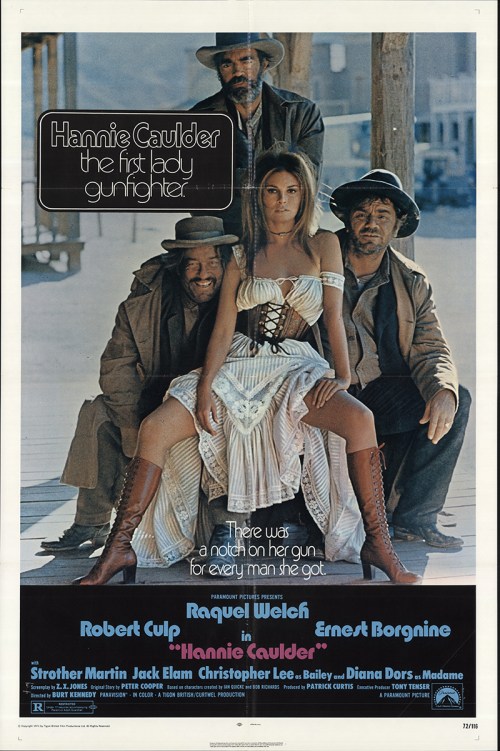
Hannie Caulder (1971)

hannie1

By Richard Winters

My Rating: 5 out of 10

4-Word Review: Hannie gets her revenge.

Three outlaw brothers (Ernest Borgnine, Jack Elam, Strother Martin) on the run from a botched robbery come upon an isolated house in the dessert. There they kill the husband and then gang rape the wife whose name is Hannie Caulder (Raquel Welch). They set the house on fire and then ride away laughing.  She manages to escape the blaze and makes a personal pledge to get her revenge. She has never used a gun before in her life, but with the help of a kindly bounty hunter named Thomas Price (Robert Culp) she learns the art of being a gunfighter.

The film nicely symbolizes the emerging force of women in 70’s society while using it inside a western motif. When we first see her she is in the kitchen with an apron on and cooking.  She learns though how to survive in a man’s world, do everything they can, and earn their respect in the process. It follows the same formula used in later cult hits I Spit on Your Grave and Ms. 45 except those titles were far more explicit and violent.

Critic Leonard Maltin, in his review of the film, called it a ‘bizarre, mystical western’, but I saw little of that.  In a lot of ways it was very routine with the only difference coming in the fact that it was a women single-handily seeking revenge instead of a man. There were only a few offbeat qualities that stood out enough to be mentioned. One was detailing the making of a gun, which I found to be interesting as well as the Hannie’s training and the different, subtle techniques that a gunfighter uses. British horror actor Christopher Lee is cast as a Mexican gunsmith. There is also one shootout segment that is done in slow motion, which is very cool.  Otherwise the majority of it is standard fare that is adequate, but not real impressive.

The idea of having the bad guys play it up as comical goofballs was a mistake.  It hurts the tension because we should want to see Hannie get her justice on these guys.  It also seems to minimize the savage act that they do and make the brutal subject matter seem lighthearted and silly when it shouldn’t be. Now, with that said, I still found some of the lines Strother Martin was given to be amusing and he almost became a scene-stealer

Raquel is looking gorgeous and wears a few revealing outfits, but there is no actual nudity, which would have helped. I still feel her acting ability is a bit lacking and the range of characters that she can play is limited. I did like her attempt at portraying a gritty character and taking a role that wasn’t glamorous. For a leading lady she has very few lines of dialogue. It wasn’t until the end when she says a few snappy one-liners at the bad guys that her part begins to click.

Robert Culp is all wrong as the bounty hunter and love interest. He can be a good actor in certain roles.  I always liked him as Peter Falk’s main nemesis in the Columbo series, but here he just doesn’t seem rugged enough. He wears glasses and is middle-aged and looks like a tenured college professor instead of a gunfighter.  The budding romance between the two doesn’t work either. He was about 12 years older than Raquel and always behaved more like a father to her right from the start.  The scene showing them holding hands while walking along a beach seemed almost creepy.

To me the film doesn’t come together until the end when she tracks the outlaw brothers down one by one in unusual locales. One is at a whorehouse, the other in a ladies clothing store, and the third is in an abandoned prison. This is the best moment as the prison itself is very isolated and the sound of the blowing wind and the late afternoon sun gives the scene a lot of atmosphere.

This is not a bad movie, but it is not a particularly good one either.  It is quite compact, running only 85 minutes, and the pace is quick. Despite the subject matter it runs pretty much on the light side. Western and Welch enthusiasts may find this more interesting than others. Borgnine fans may also like it as he is effectively slimy here.

My Rating: 5 out of 10

Released: November 8, 1971

Runtime: 1Hour 23Minutes

Rated R

Director: Burt Kennedy

Studio: Paramount

Available : VHS, DVD, Blu-ray, Amazon Instant Video

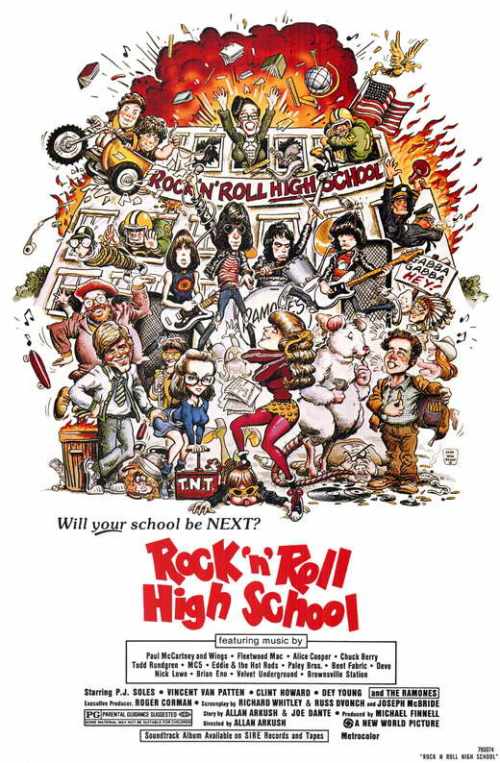
Rock ‘N’ Roll High School (1979)

rock

By Richard Winters

My Rating: 1 out of 10

4-Word Review: They like The Ramones.

Vapid, schlocky nonsense about high school students rebelling from an oppressive new principal named Miss Togar (Mary Woronov) with the help of the punk rock band The Ramones.

The film was produced by Roger Corman, who was known to be quite stingy with his budget, and it shows. As a joke the crew put in birds in the background to chirp ‘cheap, cheap’ over the credits.

There really is no storyline here. It is just a rapid-fire parade of one corny, lame gag after another that gets progressively worse as it goes along. Despite being labeled a teen comedy the humor is embarrassingly kiddie with the expected sex jokes and innuendos at a minimum. Normally, even in the worst of comedies, I can usually find a few lines, or scenes, to be funny, but here I found nothing that was amusing, or even halfway clever.

What is worse is the fact that there is no nudity! What kind of self-respecting teen comedy doesn’t have nudity? Not that a few fleeting naked bodies would have saved it, but at least it would have helped.

P.J. Soles won a cult following for her rambunctious performance as the student leading the rebellion, but her acting is very hammy. Vincent Van Patten, son of actor Dick Van Patten, is cast against type as the good-looking blonde All-American, who seemingly can’t get laid. Unfortunately, he has always had a very blank, ‘deer-in-headlights’ stare and I find his acting follows in the same suit.

Woronov is ineffective as the heavy. She is just not mean, or repressive enough and stupidly falls for all the dumb tricks that the students play on her. Her character should have been played-up more and her evilness more accentuated, which would have, even on a minor level, allowed for more tension and made the film seem less one-dimensional.

If I liked anybody here it would be Dey Young, who is the younger sister of actress Leigh-Taylor Young and the two look a lot alike. She is real cute, but in a nice natural way that is not overdone. She seems to be having a good time throughout and I enjoyed her spontaneity. Male viewers may also like her revealing gym outfit.

The punk band The Ramones appear as themselves. Initially the producers had wanted singer Todd Rundgren, who would’ve been better, but he refused. They then tried to get Van Halen, but backed down when they heard they were wild and too hard to control. For a while they even considered bringing in a disco band and calling it ‘Disco High School’.  For what it was worth I was not into their music, or at least from what I heard here, as their songs sounded too much alike with no harmony, or melody, and a beat that was too repetitive. Also, their vocals sounded more like shouting than singing. They showed no screen presence and reportedly their acting was so bad that the majority of their lines were cut. For the record though their lead singer Joey looks almost exactly like radio personality Howard Stern.

Sometimes, if done right, teen comedies can be fun because they allow one to harken back to their own high school years and bring back fond memories like John Hughes’s Sixteen Candles and The Breakfast Club do. However, those films at least had some shred of reality to them while here the characters and situations are too cartoonish and over-the-top. Nothing is relatable and even for satire it goes overboard. It’s a ‘bomb’ in every respect.

My Rating: 1 out of 10

Released: August 24, 1979

Runtime: 1Hour 33Minutes

Rated PG

Director: Allan Arkush

Studio: New World Pictures

Available: VHS, DVD, Blu-ray

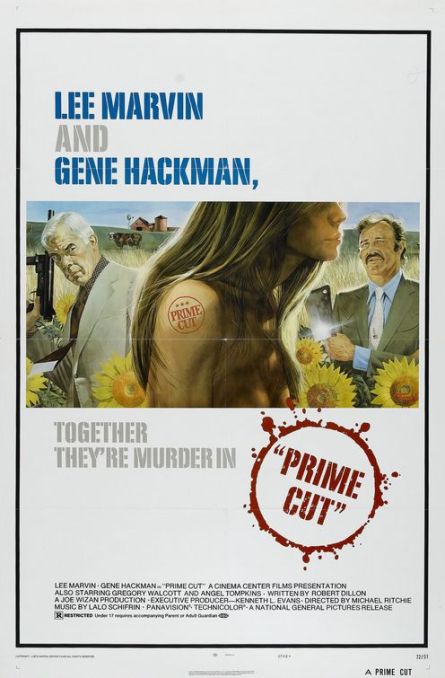
Prime Cut (1972)

By Richard Winters

My Rating: 8 out of 10

4-Word Review: Shoot-out in Kansas.

If you enjoy a great compact action flick, but are tired of the same old formula then Prime Cut may be for you.  It is the story of Nick Devlin (Lee Marvin) who is head of the crime syndicate in Chicago who travels to Kansas City to take on the head of their syndicate and avenge the death of one of their men as well as recouping an unpaid debt.

The movie has a lot of great offbeat touches that starts during its opening montage that takes place in an actual slaughterhouse.  Here you get a graphic glimpse of the inner mechanics of meat packing while soft, romantic piano music is played in the background.  The credits are displayed in a way that makes them look like they are being sliced by a meat cutter with cool meat cutting sound effects.  From here the quirky elements just keep coming. There is a wild chase through a wheat field where Marvin and Sissy Spacek find themselves attacked by a giant wheat thrasher that eats up their limousine and spits out the car parts into hay bails.  There is also a well filmed shootout amidst a sunflower field as well as Spacek’s revealing see through dress, which she wears to a posh restaurant and a giant plastic cow that gets shot up with holes and spews out milk.

This film is so unique that I am amazed it hasn’t acquired a stronger cult following. It stands up very well by today’s standards and even seems a bit shocking as it includes a scene involving white slavery where drugged young women are caged naked in stalls just like cattle and ranchers inspect and bid on them.

Marvin does well in his tongue-and-check role and pretty much steals it. He speaks his snappy lines in his usual terse manner with his famous stone expression, but he does it with a wink in his eye and at times even shows a soft side.  Sissy Spacek, in her film debut, looks young and fresh faced here. She is pretty and appealing in a very natural way. Only Gene Hackman as the villain named Mary Ann seems wasted. He does a good job for the material that he is given, but he needed more screen time and his character is not allowed to evolve at all.  Honorable mention also needs to go to Gregory Walcott as Hackman’s slimy henchman named Weenie.  The two get involved in an amusing scuffle while their accountants sit at their desks and busily add up their numbers and futilely try to ignore them.

Director Michael Ritchie nicely captures the Kansas landscape and gives it a very picturesque quality. It is probably the best on-location shooting of Kansas since Picnic. I did wish that the film was a little longer and showed more of a history between the two adversaries. It also seems to run out of steam at the end with a final shoot-out that isn’t all that clever or exciting and not up to the standards of the rest of the film.  Still this movie should appease any action fan and the story and direction are consistently original.

My Rating: 8 out 10

Released: June 28, 1972

Runtime: 1Hour 28Minutes

Rated PG

Director: Michael Ritchie

Studio: National General Pictures

Available: VHS, DVD

Lipstick (1976)

By Richard Winters

My Rating: 3 out of 10

4-Word Review: Don’t get her angry.

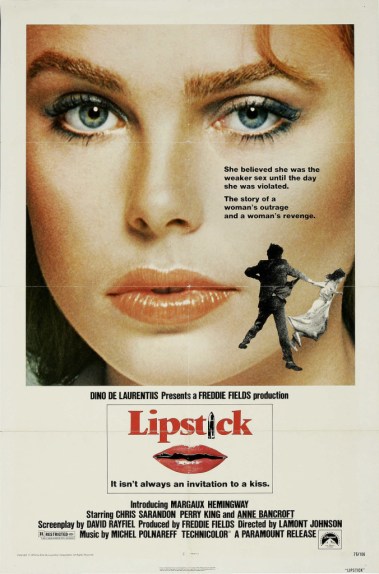
During the mid-70’s, Margaux Hemingway, granddaughter of the legendary author Ernest Hemingway, was one of the most photographed and highest paid models in the business, in fact she was the very first model ever to be awarded a million dollar contract.  After appearing on the June, 1975 cover of Time magazine she caught the eye of famous Hollywood producer Dino De Laurentiis who thought he could turn her into a star. The idea was to prove that she wasn’t just another pretty face by casting her in the difficult and challenging role of a rape victim, which they hoped would affirm her as a ‘serious’ actress. The gamble failed and she appeared in only a few more B-pictures even though her kid sister Mariel, who was cast in the film by Marguax’s suggestion, ended up having her career take off. Alcoholism and depression followed before she eventually committed suicide in 1996 at the age of only 42.

The story is basically just another tired exercise in the now cluttered rape and revenge genre. Chris McCormick (Marguax) is a beautiful lipstick model who is brutally victimized by a weirdo named Gordon Stuart (Chris Sarandon). She is dragged through the long and arduous court proceedings only to have him found not guilty and then start to stalk her younger sister (Mariel), which forces her to take matters into her own hands.

Right from the beginning this film comes off as very clumsy dramatically. Gordon is the high school music teacher of her younger sister Kathy. Chris is introduced to him at one of her photo shoots, but is too busy to listen to his music tapes, so she gives him her home address and tells him to ‘stop by anytime’.  Now, back in the 70’s people may have been a little less cautious than they are these days, but giving one’s home address to a man that she barely knows and isn’t interested in just to listen to one of his weird music tapes seems utterly ridiculous.

The rape happens almost right away before there is any character development. It almost seemed like this was the intended leering ‘highlight’ of the film with the rest just thrown in as second-rate filler. Wikipedia describes this scene as being one of the most ‘infamous in film history’.  That may have been the case at the time, but since then there have been many films that have exceeded what you see here, most notably in the controversial French hit Irreversible. Personally, I didn’t find it to be all that extreme. The one good thing I could say about it is that Sarandon is effectively menacing. I also liked the way his character is initially shown to be very meek and geeky and his inner-rage only comes out after he feels he has been slighted, which I felt made him a little less one-dimensional.

The courtroom scenes fall flat. Normally I find a good court drama to be riveting, but here it is stagy, phony, and uneven. The best thing about this segment is the presence of Anne Bancroft as Chris’s attorney Carla Bondi. She helps give the picture some stature and I wished she could have been in more of it.

If the film comes together at any point it is after the assailant is found innocent and Chris is forced to try to move on with her life and career despite the emotional toil and stigma. This segment has a certain socially relevant drama quality and to an extent it works even though it is brief. It also conveys some rather alarming statistics including the fact that only 10, 000 out of an estimated 50,000 rape cases every year actually ever get reported and only 2 out of 100 rapists ever get convicted. Since the credits list experts in the field that were consulted I can only assume that these numbers were accurate. Things may have hopefully improved since then, but the figures still seemed startling. However, all of this gets undermined by a tacked-on, manufactured, over-the-top, Rambo-like finale that relies too much on extreme coincidence and severely stretches the credibility.

I also found the film’s visual style to be unappealing. The colors are garish and gaudy while captured through a soft focus lens that resembles a model shoot in a glamour magazine and gives one a glossy trash perception.

I can see why Mariel made a strong impression with viewers. Her testimony on the stand is both touching and heart-wrenching and her emotionalism seems genuine and gripping. Marguax does not fare as well. Although her performance improves as the film progresses I still felt she was in way over her head and her nasal sounding voice is a bit irritating.

Although this film was pretty much panned by critics and audiences alike upon its initial release there is a new generation of people who feel it is underrated as evidenced by the many positive comments about it at IMDB. I approached this with an open-mind, but couldn’t help but come away from it feeling it was exploitation from beginning to end and even at that level it seemed derivative and uninspired. The whole thing left me cold and feeling like I wasted 90 minutes.

My Rating 3 out of 10

Released: April 2, 1976

Runtime: 1Hour 29Minutes

Rated R (Rape, Violence, Mature Theme, Language)

Director: Lamont Johnson

Studio: Paramount

Available: DVD, Amazon Instant Video