Category Archives: 70’s Movies

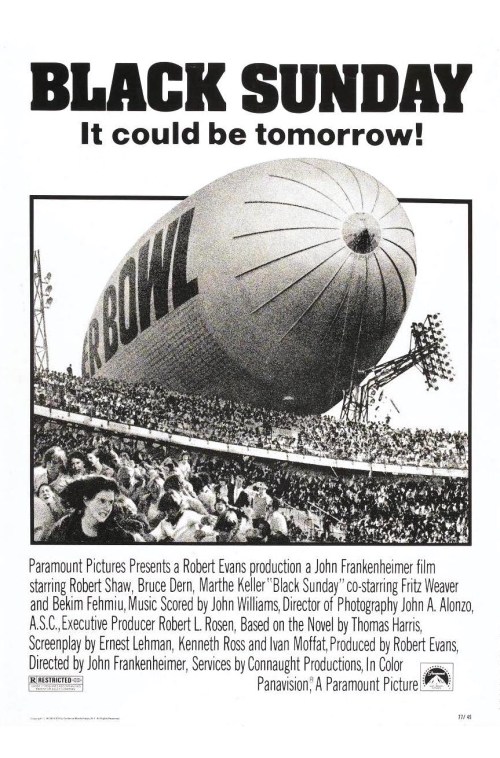
Black Sunday (1977)

blacksunday

By Richard Winters

My Rating:  6 out of 10

4-Word Review: Blimp wrecks the Superbowl

            Based on the Thomas Harris novel this film involves a female terrorist named Dahlia (Marthe Keller) working for a group called Black September. She plans on killing thousands of people at the Superbowl with the help of a blimp captain named Michael Lander (Bruce Dern), who is also a disgruntled Vietnam vet. As they are putting their plan into place their compound is attacked by an Israeli anti-terrorist group headed by Major David Kabakov (Robert Shaw). He decides not to kill Dahlia when he has the chance, but they confiscate all of their materials including a tape recording by Dahlia talking about a massive terrorist attack planned on U.S. soil in the near future.  Kabakov gives this information to the F.B.I. and they go on the offensive trying to track down what their operation is, as the details are vague, before they can pull it off.

Overall, as a spy thriller, the film is pretty good. I had to chuckle a little at the fact that the government takes the vague threats seriously and acts so swiftly based simply on an obscure tape recording when in real-life our government was warned long before the 9-11 attacks that a terrorist plot was being planned, but did nothing because they didn’t think it was possible. It would be nice to think that the government could one day act as semi-efficiently as it does in films.

There are indeed some memorable moments. One includes Kabakov shoving his gun down the throat of a suspect (Michael V. Gazzo) and giving him a very terse ultimatum ‘Blink for yes; die for no’. There is also an exciting well-choreographed shoot-out chase that starts out in a hotel lobby, goes through the streets and alley ways of the city, and ends up on the ocean beach. Another twisted moment is when Dahlia and Michael go to an isolated hanger in the Mojave Desert to try out a gadget that can supposedly shoot thousands of bullets in a single shot. The image of seeing all the tiny holes created on the wall of the shed from the bullets is cool enough that I was willing to overlook the fact that the wooden beams that crisscrossed the same wall were untouched. This scene also has a good bit of black humor when one of the employees of the hanger, who thinks the machine is a camera, and stands in front of it smiling only to have hundreds of bullets go slicing through him.

Shaw is excellent in the lead although it took me awhile to adjust to him in that type of role simply because he has played so many dark characters so well that it was hard to see him as a good guy. I liked that the character is human and admits to his mistakes, namely to the fact that he doesn’t kill Dahlia when he first has the chance. He also professes doubts about himself and his career, which adds to his multi-dimension. He tends to lean towards rogue tactics when forced, which helped reflect the brutal nature of the business that he was in. Certain lines that the character says are made memorable by Shaw’s dialect and tone that probably no other actor in the part could have done quite as well. I was also amazed at the incredible run he does during the game when he races down several flights of stairs and across the entire football field, which almost becomes a highlight in itself. I know the actor suffered from a weak heart and ended up dying from a heart attack just a year after this film came out, but I was almost surprised that he didn’t fall over from one right there.

Keller is great as the female adversary. Her American acting career never really took off, but that still doesn’t mean that she isn’t a strong actress. Her expression when she is caught in the shower with a gun pointing at her is priceless. I liked how initially she is portrayed as the ‘sane’ one in relation to the Dern character, but by the end it becomes quite clear that she is probably more evil and crazier than he could ever be. Her fight with Michael inside his house when they fear that their intricate plot may be falling apart is definitely her finest stuff.

Dern of course is an exceptional actor whose unique style and odd intensity make him a joy to watch even if the script is poor.  He is certainly well cast here, but I wished he was given more screen time and latitude as I don’t think his talents where given quite enough justice. His best moment maybe the long rant he has during one of his counseling sessions at the V.A. Medical center.

The film’s weakest point is what should’ve been its strongest, which is the segment involving the blimp barreling into the stadium. The set-up is perfect and consists of the some dazzling aerial photography and good up close footage of the football game. However, the actual blimp attack is highly compromised.  For one thing the edits are quick making it hard to follow. A much smaller blimp was used in the long shots and in the scenes where the spectators are running scared onto the field director Frankenheimer put the front end of the blimp onto a crane, which looks tacky and obvious. The blimp’s explosion is fake and when it was all over I felt disappointed. The film’s promotional items, including the film poster as seen above, promised this spectacular event, but then doesn’t come through. It almost makes one feel cheated and ruins the movie’s other good points.

My Rating: 6 out of 10

Released: March 11, 1977

Runtime: 2Hours 23Minutes

Rated R

Director: John Frankenheimer

Studio: Paramount

Available: VHS, DVD, Amazon Instant Video
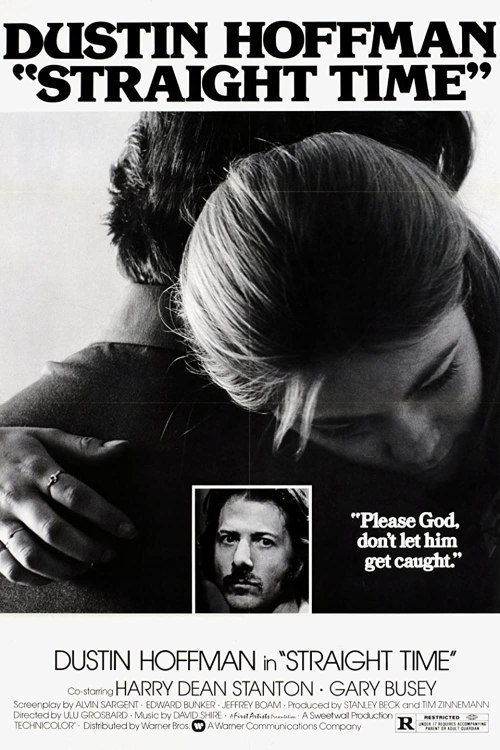
Straight Time (1978)

straight

By Richard Winters

My Rating: 8 out of 10

4-Word Review: Parolee can’t go straight.

Straight Time is an engrossing, highly realistic drama detailing a parolee by the name of Max Dembo (Dustin Hoffman) who gets released from prison and cannot seem to stay away from the allure of crime despite his initial efforts. The movie is based on the novel ‘No Beast So Fierce’ by Edward Bunker.  Bunker himself was a career criminal who was in and out of jail from 1955 to 1975 and only managed to finally turn his life around when this novel, which he had written while incarcerated and deals with many of his own exploits, got published. Bunker co-wrote the screenplay and appears in a bit part playing a character with a really bad comb-over by the name of Mickey.

I found this film gripping from the second it started and infinitely fascinating the more it progressed. It gives you a whole new perspective on things as you are forced to see it from the viewpoint of the criminal and as an outsider looking in. Every facet of the story and characters is believable and the film does a very good job of being stark and searing without ever getting exploitive, or overtly shocking.  I remember back in 1977 when I toured the new county jail in the town where I grew up when it was first opened and before it housed any inmates. I remember the officer describing the rather degrading procedures all felons had to go through when they were first booked including being stripped searched and forced to take a shower nude while a fully clothed officer stood by and watched them.  The scene where Max and other criminals are ‘welcomed’ to the L.A. County jail worked exactly like that. It was so authentic and frank that it seemed almost like a documentary.

The essence of the story revolves around Max and his relationship with his parole officer Earl Frank that is wonderfully played by noted character actor M. Emmet Walsh. Earl does his job a little too well. He shows a constant distrust of Max and gives him no respect while overzealously tracking his every move until it finally forces Max to snap. It is a terrific indictment on the flawed system as it examines just how hard it is for the criminal to go straight and stay straight even if they want to. It also exposes how it seems almost designed to push the person back into crime in its refusal to ever treat the criminal as a human being. The part where Max finally has enough and overpowers Earl and chains him naked to a fence in broad daylight on a busy L.A. freeway while hundreds of cars drive by him should leave an indelible image on the minds of anyone who sees it.

The remaining supporting cast is great as well. Theresa Russell is surprisingly effective as Max’s girlfriend Jenny Mercer. Usually she has played more glamorous types of roles, but here she is perfect as a very ordinary woman who inadvertently gets caught up in Max’s eventual self-destruction until she finds herself in over her head.  I liked the fact that she wore no makeup and the camera was able to pick up her natural beauty through regular lighting. The only issue I had with her character is that it is never made clear why she would fall in love with Max so quickly and what it was about him that she liked since he shows some clear destructive tendencies right from the beginning. To me it just came off as a bit forced and phony to have an otherwise well-adjusted woman that he meets at an employment agency get so infatuated with him after just one date that she immediately agrees to move in with him, visit him in jail, and even quit her job on the spot and go on the run. I know it is standard practice in a Hollywood film for the anti-hero to always have ‘his girl’ that can be used to humanize and compliment him, but there still needs to be more of an explanation and history shown to her character in order to validate the relationship.

Harry Dean Stanton gives another great performance as Jerry Schue. He was a long-time partner to Max during the robberies he did before landing in prison. Jerry has now turned his life around. He has a nice house in the suburbs, an honest job, and a beautiful wife. However, when Max comes to visit, and the minute his wife leaves the room, Jerry begs him for a crime job that they can do together because he finds his new found life to be boring.  I thought this made a great statement as to how the sterile suburban existence is not the American dream for everyone and how it will not necessarily ‘domesticate’ those that still harbor a reckless urge.  I also found it interesting how Jerry views the art of robbery as an actual profession that he takes a great deal of pride and care in. When one of the men shows up late for a planned robbery Jerry calls him ‘unprofessional’.

The robbery scenes are filmed in a diverting way. In most films the camera gets real close to the action in order to heighten the tension. Here the action is captured from a long shot that allows the viewer to see just how chaotic and frantic a robbery really is as well as showing how the most nervous people in the place are the thieves themselves.

If I have one complaint with the film it is in the fact that the second hour becomes rather difficult to watch as it focuses solely on the self-destructive downward spiral of the main character. Max has some good qualities, which makes it all the more painful to watch. Yes, some of his anger is justified, but his insistence at ‘evening the score’ with everyone who has wronged him ends up only hurting himself. Hoffman is outstanding as usual. It is interesting to compare his role here playing a very violent character with the pacifist one that he played just seven years earlier in Sam Peckinpah’s classic Straw Dogs.

If you are looking for an intelligent, searing drama that is still relevant today then this no-holds-bar character study is highly recommended.

My Rating: 8 out of 10

Released: March 18, 1978

Runtime: 1Hour 54Minutes

Rated R

Director: Ulu Grosbard

Studio: Warner Brothers

Available: VHS, DVD, Amazon Instant Video

Entertaining Mr. Sloane (1970)

By Richard Winters

My Rating: 3 out of 10

4-Word Review: The first gay marriage.

Based on the Joe Orton play of the same name, this film deals with a handsome young stranger named Sloane (Peter McEnery) who becomes a lodger at an isolated household in the English countryside. He is on the run from a murder he committed and feels this will be a safe haven due to the only other inhabitants being a quirky old lady name Katherine (Beryl Reid) and her equally quirky father Kemp (Alan Webb).  Katherine, or Kath, takes a sexual interest in Sloane despite their wide age difference, which Sloane doesn’t mind as he uses this to manipulate her. When Kath’s brother Ed (Harry Andrews) arrives and takes an amorous interest in Sloane as well, he does the same thing to him. Then Kemp recognizes Sloane as the killer and Sloane is forced to kill him, which culminates with ironic results.

Playwright Orton was years ahead of his time. His plays always had a dark, sexual, even explicit nature to them and his characters were always perverse and amoral in a darkly hilarious way. It is unfortunate that he was bludgeoned to death in 1967 by his jealous gay lover and his career was cut short. However, this adaptation done by screenwriter Clive Exton seems to miss the mark. The dialogue is endless with very little action. The other adaptation of Orton’s work that was made into a film, Loot, was much more lively and full of a lot of campy, zany humor as well as quick edits and imaginative camerawork. This film is visually dull and all the action is jammed into a cramped, dark house with bland decorations. It never really gets going until the final 15 minutes when you get to see the world’s very first gay marriage performed, but by then it is much too late.

For 1970 this film does seem edgy and even controversial in certain parts. The gay erotic subtext is quite strong especially the way the camera scans Sloane’s tan, half naked body. There is also Ed’s pink Cadillac that he drives around, which I got a real kick out of. I liked the way it squeaked as he drove it and was constantly bouncing up and down.  There is also his very provocative hood ornament of a naked man that the camera hones in on. The best part comes when Ed washes his car and is more focused on the ornament, which he lovingly caresses with his towel, than the rest of the vehicle.

However, 40 years later this stuff seems pretty tame and there are too many segments where nothing happens and is handled too conventionally.  It seemed like director Douglas Hickox really didn’t get, or appreciate the material enough, or interpret it in some interesting way because the final result is nothing more than a filmed stage play. The music that is used is terrible and almost enough to get you to turn off the film. It also gets overused and played over scenes when it isn’t needed and hurts the film’s mood in the process.

The biggest problem with the film may actually be with actress Reid herself. Don’t get me wrong this is a wonderfully unique actress who has done some memorable work. I especially liked her in The Killing of Sister George, and she is quite good here as well. However, I do have two issues. The first is a small one. It involves the fact that the character wears dentures. In one scene Sloane supposedly knocks them out and breaks them, but then Reid turns around and screams and you can see that she still has teeth in her mouth.  The other, much more serious issue is the fact that near the beginning of the film she is seen walking through a cemetery in broad daylight wearing a see through blouse. Now with some woman this can be quite sexy and I certainly wouldn’t complain, but when they are 60 and looking more like 70 this is a bad idea, even for perversely comical purposes as it is here it is still a bad idea. What is even worse is when she turns around and a gust of wind blows up her skirt and you can see her entire bare backside, which might be enough to make some viewers sick.

Now, before anyone accuses me of ageism let me relate an interesting experience that happened to me. Back in 2003 I was home from work and decided to take in a movie. I was living in Chicago at the time and I went to the neighborhood theater to see the interesting French mystery Swimming Pool starring Ludivine Sagnier and Charlotte Rampling.  It was a Tuesday and little did I know that it was senior discount day and the place was packed, literally, with people all looking well over the age of 70. The lady that sat beside me looked to be at least 80 and came in using a walker. The film featured an abundance of nudity from the young and attractive Sagnier, which I thought might shock and offend the seniors, but no one reacted to it and everyone went on enjoying the film. Then, towards the end of the movie, 58 year-old actress Rampling starts to take off her clothes and this indeed elicited a nervous response from the crowd. The lady next to me even said ‘oh dear’. In all fairness Rampling didn’t look all that bad naked, but it still hits home the point that even old people don’t want to see other old people naked.

My Rating: 3 out of 10

Released: July 27, 1970

Runtime: 1Hour 34Minutes

Rated R

Director: Douglas Hickox

Studio: Continental Distributing

Available: VHS, DVD (Region 2)

The Eiger Sanction (1975)

By Richard Winters

My Rating: 5 out of 10

4-Word Review: Clint goes mountain climbing.

Dr.  Jonathan Hemlock (Clint Eastwood) is a retired assassin and mountain climber now working as a college art and history professor. However, due to his penchant of collecting rare paintings he is sucked in to doing hits from time to time by an obscure government bureau in order to help pay for his expensive collection of artwork. His assignment this time is to track down the Russian assassin who killed his old army buddy that at one time had saved his life while back in the war. The identity of this killer is not known, the only thing that is known is that the man walks with a limp and is a part of a team of mountain climbers set to scale the foreboding Eiger Mountain in the Swiss Alps.

Eastwood’s foray into the spy genre while entertaining enough to be considered passable still ends up being a misfire. Sure it is fun to see him go a bit against type especially with the accepted image of the spy. Here he wears glasses and actually turns down the advances of beautiful women at least when approached by an attractive student who states she is willing to do ‘anything’ in order to get better grades. It is even fun hearing him speak like a flaming homosexual when he disguises himself as a gay delivering man. However, the overall hokey premise does not suit Eastwood’s rugged persona and mentality. He seems stiff, out-of-place and unemotional most of the way and never believable. I also couldn’t buy into the idea that this paid assassin was actually a deep and philosophical man who abhorred the violence.  A person who becomes as good of a killer as this character is purported to being would have to have some deep dark passion for it in order to spend as much time doing it as he does.

The supporting cast does not fare much better. Dragon (Thayer David) who is head of the secret government bureau that recruits Roger is over-the-top and cartoonish as an albino man who must live in almost complete darkness in an underground temperature controlled room. George Kennedy gets another bland, thankless role this time as Ben Bowman the man who helps train Roger to climb the mountain. It seems like once he won the Academy Award for Best supporting actor in 1967 for Cool Hand Luke his career when straight downward. I also didn’t like the names given to the characters, which were supposedly done as an ‘inside joke’. The last name of Hemlock for the main character is too obvious and naming the black prostitute Jemima seemed even worse.

The only actor and character that comes off well here is Jack Cassidy as the gay man named Miles Mellough who walks around with a pet poodle named Faggot while playing a crafty game of cat and mouse with Jonathan. The character is both threatening and amusing and it was a real shame that he gets killed off in the middle as he could have made the tension more interesting had he stayed on until the end.

Most critics have described the pacing as ‘sluggish’ although I thought it was alright and it gets sprinkled so much with Eastwood’s amusing one-liners that it is always entertaining. The only real issue I had in this area is the first part, which seems unnecessary. It has Jonathan flying out to Switzerland to kill one of the killers only to come back and then fly out again to get the other one. This all becomes redundant and the scene involving the assassination of the first killer is poorly choreographed and edited.

The film’s main redeeming quality is the mountain climbing sequences, which is impressive. I loved the bird’s-eye view camera shots that captured the majestic landscape both in the scenes at Monument Valley as well as in Europe. The fact that Eastwood did almost all of his own climbing and stunts is equally impressive. There looks to be a lot of research put into the making of this film and the climbing segments are well shot and authentic looking. The climax atop of the Eiger becomes a bit drawn out and if anything I found the climb that Eastwood and Kennedy did on the ‘Tootem Pole’ in Utah in the middle of the movie to be more exciting and breath taking.

(Spoiler Alert)

The biggest, most glaring problem that I had with this movie comes at the very end with the ‘surprise’ identity of the killer, which turns out to be the Kennedy character who is finally seen walking with a limp. This though makes no sense because if the man had a limp how was he able to disguise it for so long during the many weeks that he spent with Jonathan during their training and how was he able to climb up the mountain with Jonathan in Utah. The fact that none of this gets answered and almost seems over-looked really makes this thing seem pointless and poorly thought out.

(End of Spoiler Alert)

Rod Whitacker who wrote the novel of which this movie is based labeled this film as being ‘vapid’ and I would have to agree. The story seems to borrow a lot of the same ingredients from other spy films without adding anything new or original of its own.

My Rating: 5 out of 10

Released: May 21, 1975

Runtime: 2Hours 3Minutes

Rated PG

Director: Clint Eastwood

Studio: Universal

Available: VHS, DVD, Amazon Instant Video

The Fury (1978)

By Richard Winters

My Rating: 5 out of 10

4-Word Review: Blow up the body.

Another Brian De Palma/Hitchcock wannabe, this one involving a sinister secret government agent named Ben Childress (John Cassavetes) who wants to use the amazing psychic abilities of a young college-aged man named Robin Sandza (Andrew Stevens) for his own nefarious purposes. While he is in Israel with the father and son he decides to stage a terrorist attack, which he hopes will kill the boy’s father Peter (Kirk Douglas) and allow him to whisk Robin away to an underground research lab where no one will find him. However, Peter manages to survive the attack and goes on a relentless pursuit to find his son. This occurs while a young woman named Gillian Bellaver (Amy Irving) with equally strong parapsychological traits starts to have visions of Robin and his whereabouts while attending a school that specializes in people with these abilities and eventually she teams up with Peter to help him in his quest.

I liked the opening sequence being shot on-location in Israel, which gives the film an exotic feel. The attack is well-handled and comes as a surprise without any set-up, but I felt there was a fatal flaw with the premise. This is namely the fact that with Robin’s amazing psychic abilities you would think he could figure out that his Dad was still alive and be able to find him while also outsmarting the people who are holding him.

The secret agency thing and what they are using him for is vague and we see only a few scenes with him there. I felt this should have been more detailed and less time spent with Gillian at the psychic school, which is not very compelling and rather draggy.     There are a few good action moments, but unfortunately they come at the beginning and end with a talky middle that lacks any real suspense.

However, Peter’s escape from some gunmen by jumping out of an apartment window and onto the ‘L’ tracks along Wabash Avenue in Chicago is amazingly well shot and nerve-wracking.  A scene where Robin tortures a female Dr. (Fiona Lewis) by using his telepathic powers to spin her around a room until  blood oozes from her body and sprays all over the walls and furniture deserves some merits, but I wished it had been more extended. There is also the exploding body that is the film’s final shot and possibly its best and it is shown several times at different angles. I also enjoyed the darkly humorous scene where Robin uses his powers to send a ride at an indoor amusement park out of control and throwing the riders through the window of a nearby restaurant.

De Palma’s trademark over-direction is in full gear. Sometimes it works, but other times it is a distraction. For instance he uses a lot of panning shots showing one person talking and then panning to the other person and then back again. During a funny scene where Peter breaks into an older couple’s apartment while looking for a disguise this really works, but De Palma continues to go to this well throughout and eventually it becomes annoying. There is also a foot chase that is done in slow-motion, which to me sapped the tension and excitement right out of it. He does have a few bird’s-eye view shots, which while not adding anything to the story, are still kind of cool.

Andrew Stevens, son of actress Stella Stevens, is well cast as the young man who starts out likable, but slowly becomes evil as the film progresses. Stevens has a good knack for this as he can go from nice to menacing very quickly and I first noticed this during a classic episode of Murder She Wrote. His clear blue eyes can give off a creepy stare as well.

John Cassavetes is an excellent bad guy.  He is best remembered as an independent film director with a unique vision, but with his dark features, cryptic glare, and intense delivery he can also be a very good villain. I don’t think the film made the most of it, but it was astute casting.

Although billed as the star Douglas does not have the most screen-time and there are long periods where he isn’t seen at all. This was really a vehicle for Irving, who is convincing and makes the viewer sympathetic to her quandary of having super-powers that she does not fully understand, cannot control and doesn’t really want.

It’s an interesting idea, but doesn’t go far enough with it. There weren’t enough twists to justify sitting through almost two hours. The pacing is poor and had it been trimmed to 90 minutes it would have worked better. The special effects are decent, but there needed to be more of them and they might not hold-up to contemporary standards. John Williams’s orchestral sounding score helps elevate what is really just bubblegum material.

This is a great chance at seeing some young stars in their film debuts including Darryl Hannah, Laura Innes, and James Belushi. There is also an amusing scene featuring Dennis Franz with a full head of hair playing a nervous and befuddled Chicago cop.

My Rating: 5 out of 10

Released: March 10, 1978

Runtime: 1Hour 58Minutes

Rated R

Director: Brian De Palma

Studio: 20th Century Fox

Available: DVD, Amazon Instant Video

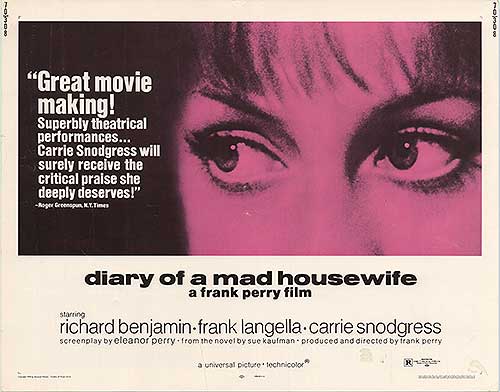
Diary of a Mad Housewife (1970)

diarymad1

By Richard Winters

My Rating: 9 out of 10

4-Word Review: Married to a jerk.

Director Frank Perry may not be a name one throws out when mentioning some of the top directors, but a lot of his early work that he did with his screenwriter wife Eleanor were definite forerunners of the independent film movement and ahead of their time. David and Lisa was their first and it dealt with the budding romance between two patients at a mental hospital. Ladybug Ladybug was their follow-up and it was the true story of what happens when an errant nuclear warning siren goes off and the staff and students of a small rural school think it is for real. There was also the critically acclaimed film Last Summer dealing with the brutal gang rape of a teen girl by her so called ‘friends’.  They also did the revisionist western Doc starring Stacy Keach as well as the brilliantly quirky Rancho Deluxe.  However, it is Diary of a Mad Housewife that I find to be their very best.

It is the story based on the best-selling novel by Sue Kaufman dealing with the character of Tina Balser.  On the outside she seems to be living the American dream. She is married to a up and coming lawyer, living in a swank Manhattan apartment, and the mother of two beautiful girls.  Unfortunately the husband is an obnoxious bore, the girls are spoiled and mouthy, and she feels lonely and depressed.  She decides to have an affair with a novelist, but he ends up treating her just as poorly and when she tells her troubles to a support group, they end up doing the same.

I have seen this film many times over the past twenty years and am always impressed at the fluid way it goes between satire and drama as well as the fact that it doesn’t seem dated at all. The scenes with Richard Benjamin as the jerk husband are hilariously over-the-top.  Yet the scenes involving Frank Langella as the lover who is bitter about his lagging writing career and repressed homosexuality and takes these frustrations out on Tina, are just as interesting, but in a much more subtle way.  In fact these scenes feature some great dialogue and character development and I find them more intriguing with each viewing.  Langella, in his film debut, makes a lasting impression.

The cinematography, editing, and color schemes are also first-rate. Perry does a great job in infusing the counter-culture movement of the time with the old values of marriage and family. The mod party that they go to is well staged with scantily clad mannequins in a provocative poses placed throughout.  The pretentious attitudes of the party goers is nicely captured.  This scene also features the Alice Cooper Band as well as giant pillow fight.

Carrie Snodgrass performance is what really makes this work.  She was nominated for the Academy Award and she should have won it. Her ability to display her characters feelings through such subtle methods as facial expressions, body gestures, and reactions is impressive.  The viewer can easily relate to the character and feel her pain.  Rock singer Neil Young was so impressed with her that he wrote her a fan letter and the two ended up getting into a relationship. Unfortunately because of this she dropped out of Hollywood and didn’t do another movie until almost nine years later.  When she returned all the top roles were no longer accessible and she was relegated to ‘B’ movies and small supporting roles until finally succumbing to cancer in 2004. This was a real shame because her talents were never fully utilized, but at least this was a perfect vehicle for her and one that movie fans today can really appreciate.

In the end though what makes this film so very good is that it makes a great statement on the fact that isolation is a part of modern day living and at some point everyone will have to deal with.  Getting married, having kids, even having a lover or a support group will not necessarily be an effective buffer and may actually only exacerbate it. The whole film kind of reminded me of a statement made by a character on the old ‘Ally McBeal’ TV-show “My loneliest times in life are when someone is lying in bed next to me.”

My Rating: 9 out of 10

Released: August 10, 1970

Runtime: 1Hour 43Minutes (Theater Version) 1Hour 35Minutes (TV Version)

Rated R

Director: Frank Perry

Studio: Universal

Available: VHS

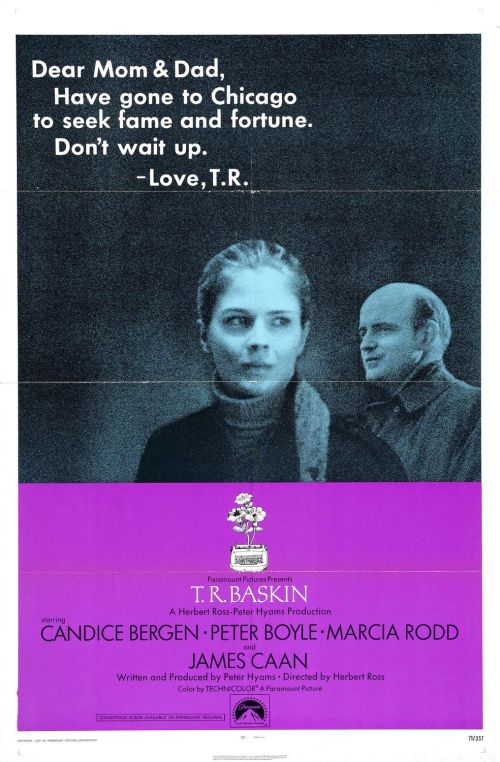
T. R. Baskin (1971)

tr baskin

By Richard Winters

My Rating: 8 out of 10

4-Word Review: Out on her own.

T. R. Baskin (Candice Bergen) is a young woman who leaves the nest by striking out on her own in Chicago. Unfortunately she finds nothing but a lot of loneliness, dead-end dates, crummy apartments, and soul-sucking jobs. Our protagonist becomes so emotionally beaten down that when a traveling salesman named Jack Mitchell (Peter Boyle) calls her looking for a ‘good time’, as he mistakenly is given her number under the impression that she is a prostitute, T.R. accepts his invitation simply as a chance to connect with someone. The film then cuts back and forth between conversations that she has with Jack in his hotel room as well as her experiences when she first gets into the Windy City.

Although this film does have its share of faults I was really taken aback by its strong emotional impact. The film was directed by Herbert Ross who would later do Footloose, The Goodbye Girl, and Steel Magnolias. The screenplay was written by Peter Hyams famous for writing and directing Capricorn One, Narrow Margin, and 2010 to name a few.

The film manages to recreate the monotony and isolation of day-to-day living better than just about any other movie that I have seen. Some of the best scenes include T.R.’s job interview process at an accounting firm as well as a long camera pan showing all the rows and rows of desks in the office and T.R. looking lost in the middle. There is another part where she sneaks back into the office on a weekend day in order to make silly announcements over their intercom system and the images of all the dark shadowy desks looks just as ominous. Another moving moment is when she is shown pacing her lonely apartment as well as her phone conversation with her parents where she tries to convince them that she is doing ‘just fine’, but breaks down into tears the second it ends.

The film leaves you with a strong impression. The music that was selected was first-rate and fits the mood of the picture perfectly. It is a real shame that this sleeper has never been released on either VHS or DVD and has not been shown on television since December of the 1980 when it was broadcast on Cinemax. It is well worth seeking out and certainly deserves more attention.

Bergen is terrific in the lead. This is before she attained her acerbic persona from her ‘Murphy Brown’ days and here comes off as more shy and sensitive. Her delicate and attractive features help capture the viewer instantly.

Boyle is equally good and the introspective conversations that the two have nicely runs the gamut between funny and sad. James Caan, who for some reason appears unbilled, has a nice cameo as an attractive and intelligent man that T.R. falls for only to have him callously break her heart.

If the film has any flaw it is in the fact that it is a bit uneven. It starts out with some terrific dry humor including a hilarious scene when she goes apartment hunting, but eventually the movie becomes too much of a downbeat drama. There are certainly universal truths to many of the sad situations that she goes through, but I found it frustrating that we are never shown her eventual fate. All we see is a small period in her life and then a very abrupt and unsatisfying ending. It would have been nice if the story had cut to five, ten, even twenty years down the road and allowed us to find out if she ever found ‘Mr. Right’ and some happiness.

Despite being made forty years ago this film is as trenchant and timely as it was back then. People who avoid watching older films because they believe that they are ‘dated’ are being foolish. This film has more bearing in reality and the human experience than a lot of the movies out today.

My Rating: 8 out of 10

Released: October 20, 1971

Runtime: 1Hour 30Minutes

Rated PG

Director: Herbert Ross

Studio: Paramount

Available: Amazon Instant Video

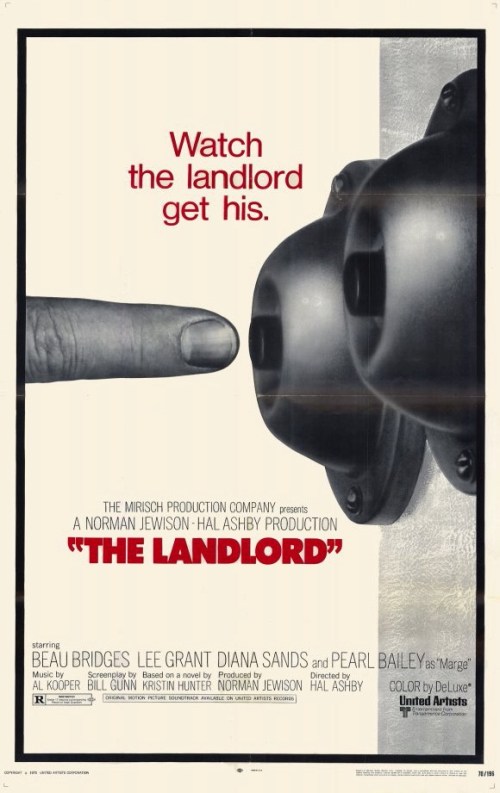
The Landlord (1970)

By Richard Winters

My Rating: 8 out of 10

4-Word Review: In over his head.

Elgar Enders (Beau Bridges) is a spoiled 29 year-old from a wealthy family who is still living at home with his parents in an affluent suburb of New York.  He decides it is time to ‘make his mark’ by purchasing a rundown building housing black tenants in inner-city Brooklyn.  He plans to evict the people and have the structure renovated into a posh flat.  He starts having second thoughts though as he gets to know the people and learns of their struggles.  He begins a relationship with one of the women (Diana Sands) and soon he is working to upgrade the building as well as trying to enlighten his racist, snobbish parents (Walter Brooke, Lee Grant) to embrace the black movement.

The Enders character is a perfect microcosm to the 70’s period where idealism and efforts to improve inner-city life, as well as some of the harsh realities that came with it, where at an all-time high.  Director Hal Ashby’s first film is full of strong gritty visuals from the rundown, graffiti-laden buildings to the garbage strewn lawns. Everything was filmed on-location and you get a vivid taste of the black experience. It is boosted even more by the detailed cinematography of Gordon Willis, which makes the most of the natural lighting and making you feel like you are right there.   The honest no-holes-barred approach is terrific. It perfectly captures the mood and feel of its era. I was surprised for a first time director, even a really good one like Ashby,  how well-constructed and technically sharp this was, which could have some link to the fact that it was produced by another great director, Norman Jewison, whom I’m sure lent a lot of input.

Initially I found the Elgar character to be off-putting, but that could’ve been intentional.  We first see him sitting on his lawn chair being served a drink by a black servant while talking about his great plan and looking like a spoiled, snot- nosed kid who has been coddled all his life.  The one scene that I remembered from this film when I first saw it over 20 years ago is when he  gets out of his Volkswagen bug to look at the building while wearing a tacky looking Pat Boone white dress suit.  When some of the black men sitting on the building’s front steps tease him a little, he immediately panics and runs eight blocks down the street in terror even though no one was chasing him.  However, he does start to grow on you as the film progresses.  I liked the fact that he faces adversity and is not scared away.  He learns to persist and adapt.  He genuinely starts to care about the people and backs-up what he says to the extent that he single-handedly carries new toilets one-by-one from the hardware store to the apartment building when the plumbing breaks down in an amusing vignette.  He isn’t afraid to tell off his arrogant parents when he needs too and his definition of NAACP is pretty funny.  It is satisfying to see him mature, learning that instituting change is not easy and things are the way they are for a reason.  He eventually is forced to confront his own limitations, but becomes a stronger person for it. This is without a doubt Bridges best performance to date.

There are other great performances as well.  Pearl Bailey is a gem as one of the building’s feisty, older women tenants who is the first to befriend Elgar.  Her awkward visit with Elgar’s equally feisty mother is considered the film’s highlight by many viewers and critics. I also loved the look she gives Elgar at the very end when he tries to wave goodbye to her.  The gorgeous Diana Sands is outstanding playing the role of Francine who has an ill-fated affair with Elgar. She shows just the right balance of sexiness and seriousness and it was a shame that just a few years after this film was made she ended up dying of cancer at the young age of 39. Susan Anspach is fun in one of her early roles as Elgar’s pot smoking sister.  The performance though that leaves the strongest impression is that of Lee Grant who is hilariously hammy as Elgar’s priggish mother.

When I first saw this film I came away thinking that it was uneven and a bit bipolar. It runs most of the way as a gentle, quirky satire filled with goofy cutaways, but then ends with a very stark and frightening scene with Elgar being chased down the grimy hallways of the building by Francine’s angry ax-waving husband (Louis Gossett Jr.) when he finds out that Elgar has gotten his wife pregnant.  The scene is ugly and intense and a far cry from the rest of the film’s gentle tone. Yet upon second viewing I think this scene works and was necessary. It makes a good statement at how volatile temperaments can be of those that are forced to leave in squalor as well showing how easily people, even with the best intentions, can get in over-their-heads when they don’t fully appreciate, or understand the situation that they are getting into it.

The side story involving a mulatto women (Marki Bey) who falls in love with Elgar is solid as well and gives the viewer a keen insight as to how difficult it is for someone who can’t seem to be accepted by either race. The language and conversations are tough and vulgar, but always laced with realism.

The only complaint I have with the film is the portrayal of the white characters who are buffoonish and overly idiotic even for satire.  I thought the idea of having them still use black servants was over-done, but then when one of them shows up at a party wearing blackface it was overkill. I thought it was unfair and unrealistic in the way that the film worked so hard to give depth to its black characters, but then turns around and, with the exception of Elgar, paints the whites as nothing more than broad caricatures.

The Landlord has finally been released on DVD through MGM’s Limited Edition Collection. I would suggest this film for anyone who enjoys an intelligent comedy-drama with something to say. It is also a great chance to see young up-and-coming actors. This includes Hector Elizondo as well as comedian Robert Klein. You can also get a very quick glimpse of Samuel L. Jackson who appears briefly in an uncredited role as a minister near the end.

My Rating: 8 out of 10

Released: May 20, 1970

Runtime: 1Hour 52Minutes

Rated R

Director: Hal Ashby

Studio: United Artists

Available: VHS, DVD

Avanti! (1972)

avanti1

By Richard Winters

My Rating: 7 out of 10

4-Word Review: Juliet shows her boobies.

Jack Lemmon plays Wendell Armbruster Jr. a conservative, set-in-his-ways businessman who travels to Italy to arrange the return of his father who died in a car accident. To his shock he finds that his father did not die alone, but instead was with his secret lady lover of twenty years. Apparently they would meet every summer and the two had been carrying on the secret affair without any of their family members knowing. Juliet Mills plays Pamela Piggott the daughter of the other woman. She comes to claim the body of her mother and after the two meet a certain romantic spark slowly begins to ignite.

This film is similar to The April Fools, which was another romantic Lemmon vehicle that was done just a few years earlier.  This film though works much better. For one thing there is a nice bit of mystery as to whether this thing will continue on or not and the ending leaves you guessing. Sometimes the best romances in life are the brief flings one has with someone that they know for only a short period of time and then move on and this film nicely captures that. The relationship grows at a realistic pace without ever being forced, clichéd, or sappy. In fact the two at first don’t even like each other.

Lemmon’s character here is much improved from the one in The April Fools. Instead of just being a bland schmuck he is more crusty, argumentative, and confrontational almost like talk show host Bill O’Reilly. His snappy comebacks and one-liners are fun and help hold the movie together. Mills (sister of Hayley, daughter of Sir John and wife of Maxwell Caulfield) is a delight as always playing a serene good-natured character similar to the one she did in her famous TV-show ‘Nanny and the Professor’. The fact that the two leads have such diametrically different dispositions helps give it a spark and make it intriguing.

Director Billy Wilder nicely captures the ambience and scenic beauty of the region and screenwriter I.A.L Diamond’s script is paced with amusing side-stories and characters. However, a 145 minute runtime is too long for such slight material and it spends a little too much time on side-stories that go nowhere. The scenes themselves are stretched out longer than they should with hardly any action and there is too much emphasis on the Neil Simon-like comical banter that ultimately makes this production seem more like a filmed stage play than a movie.

The film though does have some nice moments of humor. The part where the two go the morgue to identify the bodies and the very particular way the administrator sets out the legal documents to be signed and the way he packs them back up is amusing. There is also a scene where the two go skinny dipping and swim out to a small island. Yes, you do get to see both stars in the buff and although Mills isn’t bad, Lemon with his pale, out-of-shape, middle-aged-body, might be a bit too much for some. However, it is funny seeing him swim in the nude, but still leaving on his brown socks, which is a perfect testament to his uptight character. The best part and by far and away the funniest moment in the film comes when a boat load of sailors come by and start whooping and hollering at the nude Pamela. Wendell then tries to ‘protect Pamela’s modesty’ by taking off his wet, dripping socks and holding them over her ample bosoms while she merrily waves to the passing men. It’s a visual thing, but it had me laughing-out-loud.

I did have two issues with the film that I feel should be discussed. The first is the opening bit where Wendell gets on the plane without any luggage and wearing casual attire because he was given too short a notice to change clothes before he had to board the plane. He sees a man with a nice suit on and asks him if they could change clothes. Yes, it is a bit amusing when everyone on the plane, including the stewardesses and the pilots, crowd around the bathroom door in confusion after seeing two grown men go in, but the joke falls flat because it is not in any way believable. Who in their right mind would go into a small bathroom of a plane with a perfect stranger to change clothes with him, especially when there was no money exchanged? Most would probably think he was a kook and tell him to get lost. The first rule they teach you in comic screenwriting 101 is that for the joke to work there needs to be some grain of truth to it, or otherwise it will come off as stupid, which it does here.

The other problem has to do with Pamela and her apparent ‘weight problem’ that gets mentioned not only by her, but by the other characters as well. The truth of the matter is that she looks great and has a figure most women would die for. I noticed this same thing with the Anne Hathaway character in The Devil Wears Pavda where she was labeled as ‘fat’ when compared to the other models even though she looked terrific. Apparently Hollywood, in their never ending quest for ideal beauty, cannot bring themselves to actually cast a plain, over-weight woman in the pivotal role of a love interest even if the script calls for it so instead they get someone who is just slightly under the gorgeous level, but still way above the average woman, and then hope to pass her off as a ‘plain Jane’. The result becomes not only ridiculous, but highly annoying and even insulting especially when it continues to be brought up and discussed.

Overall romance fans should find it appealing as the story has all the necessary ingredients and fits the formula well.

My Rating: 7 out of 10

Released: December 17, 1972

Runtime: 2Hours 20Minutes

Rated PG

Director: Billy Wilder

Studio: United Artists

Available: VHS, DVD, Amazon Instant Video

Movie Movie (1978)

By Richard Winters

My Rating: 3 out of 10

4-Word Review: Two movies in one.

Initially, the unique concept for this film seems intriguing.  The idea was to recreate the movie viewing experience of the 30’s and 40’s by having a double bill feature along with theatrical trailers in between. The stories would have all the clichés, storylines, and characters from films of that era, but done with a tongue and cheek approach. The same core performers including: George C. Scott, his actress wife Trish Van Devere, Red Buttons, Art Carney, and Eli Wallach would play different characters in all the stories much like doing skits on a variety show. Legendary director Stanley Donen, famous for such films as Singing in the Rain, Royal Wedding, and Seven Brides for Seven Brothers, would direct and the screenplay would be written by Larry Gelbert best known for writing Oh God! and Tootsie.

Unfortunately, it never really takes off. Part of the reason is that the parody is too restrained. There are a few funny lines here and there, but that is about it. This was released two years before the Zucker brother’s groundbreaking hit Airplane that redefined parody and still stands as the standard today. This film doesn’t even come close to that. In fact certain audiences that saw this movie in other countries didn’t get the wry, gentle humor at all and took it seriously. I got the feeling that Gelbert and Donen had gone to the theaters as kids and watched these same types of films. Their affection and nostalgia for this stuff is clearly evident and prevented them from unleashing the over-the-top, in your face farce that would have really made this hilarious and is what most audiences of today expect.

The first feature is entitled ‘Dynamite Hands’ and is a story about a young boxer from the 30’s named Joey Popchik (Harry Hamlin, in his film debut) who becomes a prizefighter in order to pay for his kid sister’s (Kathleen Quinlan) eye operation. This segment features all the expected clichés, but the subtle humor that is injected fails to make it seem fresh or interesting. It was shot in color, but I felt black and white would have been better. The one thing I did like was Hamlin who these days seems pretty washed-up as he appears almost exclusively in direct to video fare, or dumb reality shows with his fat-lipped wife. Yet here he is right on target with his portrayal of the naïve, wet-behind-the-ears, All-American kid and I enjoyed it. Wallach is also fun as the heavy.

The middle segment is a mock theatrical trailer called “Zero Hour” that features Wallach, Scott, and Buttons as WWI flying aces. This was shot in black and white, but is brief and unexceptional. I was disappointed that there wasn’t any silly newsreel footage as this was also a mainstay in theaters during the time and could’ve been a riot.

The third part is a send-up of all the old Busby Berkley musicals and is entitled “Baxter’s Beauties of 1933”.  Scott, who is nicely hammy, plays a famous Broadway producer named Spats Baxter that finds out he is dying from a very rare illness and has only a month to live. He decides to go out on top by putting on the most lavish musical show that he can. Again, like with the others, this segment is a disappointment. The musical numbers, which were choreographed by Michael Kidd, are poorly photographed and with the exception of one routine done on a giant roulette wheel fail to match the spectacular and extravagant quality of Berkley’s. Van Devere’s kitschy performance as an alcoholic, tyrannical leading lady is the only thing that saves it. Gifted actress Barbra Harris is completely wasted in a thankless role of one of the chorus girls that doesn’t take any advantage of her talents.

George Burns, who is credited as the film’s ‘host’, appears only briefly at the beginning, but I would have liked to have seen more of him.

The cast and crew clearly had more fun making this than the viewer had in watching it. The formula is followed too closely and the result is tedium.  Even if you are a fan of films from that period I would still not suggest this as the originals are far better.

My Rating: 3 out of 10

Released: November 3, 1978

Runtime: 1Hour 45Minutes

Rated PG

Director: Stanley Donen

Studio: ITC Entertainment

Available: Amazon Instant Video