Category Archives: 70’s Movies

Rabid (1977)

By Richard Winters

My Rating: 5 out of 10

4-Word Review: Graft patient craves blood.

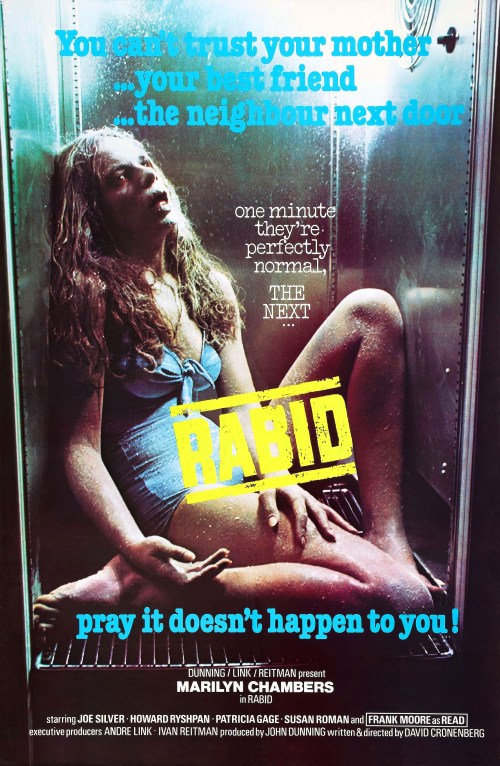
Rose (Marilyn Chambers) becomes the victim of a horrible accident when the motorcycle she goes riding on with her boyfriend (Frank Moore) crashes and she gets pinned underneath the burning wreckage. Fortunately for her the accident occurs near a clinic that specializes in plastic surgery. The head surgeon (Howard Ryshpan) is able to perform an experimental procedure on her that helps graft her burned skin back to normal, but in the process creates a strange orifice in her armpit that sucks blood from everyone she attacks. Her victims then become possessed by a rare form of rabies that sends the city of Montreal into a panic as the authorities try to control the outbreak while also trying to figure out the cause.

This marked director David Cronenberg’s third feature film and from a low budget standpoint the results are impressive. I was especially amazed by some of the car stunts including having an out-of-control vehicle jump a guard rail and crash onto a highway below where a large semi then rams into it. His ability to somehow hire an entire fleet of squad cars is admirable too as most budget-challenged films will make do with just one police car when having authorities investigate the scene of a crime/accident even though in reality there are usually many especially if the crime or accident is severe like here.

I also loved the way he captures the gray/bleak Canadian landscape, which helps supplement the film’s dark and moody tone as well as the bits of dark humor that gets implemented into the story that made me wish the whole thing had been approached as a black comedy from the start.

The horror though isn’t all that much and genuine scares are light including the scenes showing rabid people attacking others, which becomes both clichéd and redundant. The orifice itself looks like an asshole and similar to the giant one that Cronenberg created many years later for his equally provocative film Naked Lunch.

Unfortunately porn star Chambers doesn’t have the presence or talent for mainstream film work. She broke into the business years earlier with a bit part in the Barbra Streisand movie The Owl and the Pussycat, but to her surprise other film offers didn’t follow, which eventually forced her into the X-rated business, which included starring in the cult classic Behind the Green Door, but she always held out hope to one day breaking back into mainstream movies and finally got it here, but it never propelled her further.

Part of the issue is her voice which is abnormally high-pitched and at times sounds like that of a very young child’s. In certain scenes it’s worse than others, but I found listening to her speak to be disconcerting and distracting although she does still look great naked.

The somber, downbeat ending is unusual for a horror film and it might’ve had more impact had the main character been given more depth. The viewer though learns little about her and she fails to have a distinctive personality, which limits the film’s ability to be anything more than just a curio.

My Rating: 5 out of 10

Released: April 8, 1977

Runtime: 1Hour 31Minutes

Rated R

Director: David Cronenberg

Studio: Cinepix Film Properties

Available: DVD, Blu-ray, Amazon Video, YouTube
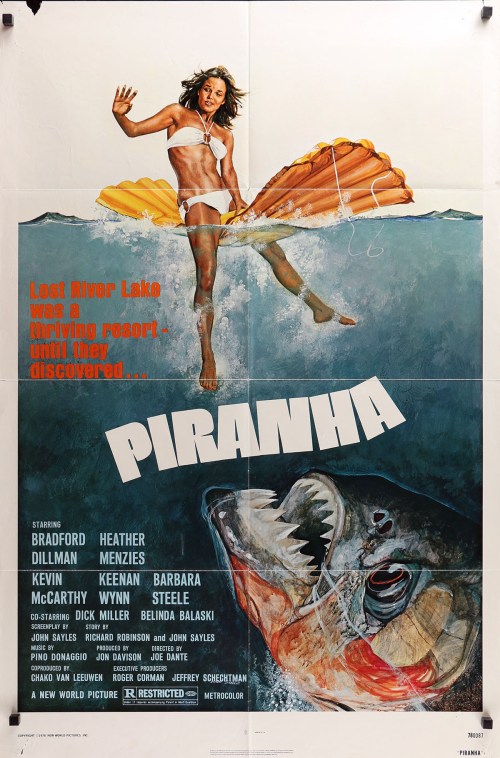
Piranha (1978)

By Richard Winters

My Rating: 5 out of 10

4-Word Review: Mutant fish attack swimmers.

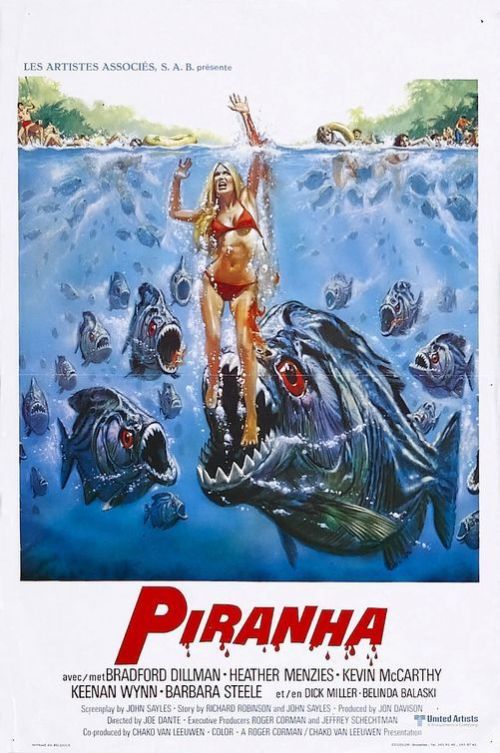
When two teenagers disappear late one night while swimming in a pool inside an abandoned military complex it’s up to Maggie (Heather Menzies) a professional skip tracer to find them. She recruits Paul (Bradford Dillman) a drunken backwoods loner to serve as her guide. As their investigation continues they learn that the swimmers were killed by some mutant fish that had been created by the government to be used as a weapon during the Vietnam War. Now that the war was over they were being kept inside a secret underwater tank, but when Maggie inadvertently drained the tank in order to search for the bodies she released the fish down the river where they are set to attack a children’s summer camp of which Paul’s daughter Suzie (Shannon Collins) is in attendance.

This is billed as a spoof of Jaws and supposedly according to Leonard Maltin’s review loaded with in-jokes, but to me I saw very little that was humorous and in many ways this film could work as a legitimate horror film on its own. The only amusing moments I found are when Maggie plays a Jaws video game near the beginning as well as a female beachgoer who is spotted reading ‘Moby Dick’, but otherwise the chuckles are light unless you count Dick Miller as an overzealous promoter who is indeed pretty funny.

The film starts out like I wants to be different from the typical horror film and initially I was intrigued particularly with the two protagonists. Normally the female/male leads in these types of films consist of good-looking teens/college aged kids, but here we get a guy who was near 50 and a female, who although being quite attractive has more of a take-charge attitude that is usually seen in a guy. Having the film play against gender stereotypes was for me the best thing it had going for it and I really liked the way the awkward relationship between Maggie and Paul initially developed.

Unfortunately it doesn’t stay that way and by the halfway mark Paul is the one taking control while Maggie is just tagging along, which I found disappointing. It also tries to sneak in a romance angle, which is ridiculous since the guy was clearly old enough to be her father. Paul is also seen continually drinking alcohol, but he never shows any signs of being inebriated and I realize alcoholics have a higher tolerance to the stuff, but still I doubt he would’ve been able to stay so sharp and heroic as he ends up being while still under the influence as he supposedly is.

The fish attacks become monotonous and consist of the same shot of rubber fish put on strings shown swimming towards their prey and the sound effects used for the fish when they start biting was performed by underwater dental drills, which to me sounded cheesy. There are a lot of pools of blood that form around the victim as he/she are being bitten, but not much else in the way of special effects. Only at the end does it get gorier and there’s even a shot of one of the fish coming straight towards the screen with its toothy mouth wide open, but I felt this should’ve been put in earlier.

The supporting cast of eclectic B-movie stars is interesting but underused and this also marks the final film appearance of Barry Brown who at the age of 27 killed himself just two months after the film wrapped shooting and was already dead by the time it was released to theaters. Overall though, the whole thing, which was remade in 2010, is watchable but disappointing. The humor and offbeat elements should’ve been played-up much more and the characters made to be more eccentric especially the two leads. In the end it becomes just another routine horror flick that’s no better or worse than the hundreds of others that are already out there.

My Rating: 5 out of 10

Released: August 3, 1978

Runtime: 1Hour 34Minutes

Rated R

Director: Joe Dante

Studio: New World Pictures

Available: DVD, Blu-ray, Amazon Video, YouTube
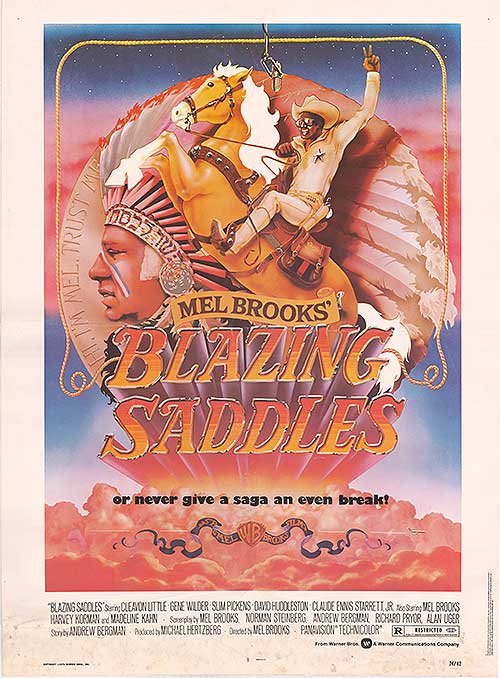
Blazing Saddles (1974)

By Richard Winters

My Rating: 7 out of 10

4-Word Review: Black man becomes sheriff.

Classic western parody centers on a new railroad being built during the 1870’s and how an attorney general named Hedley Lamarr (Harvey Korman) connives to have it run through a town called Rock Ridge, but in so doing devises a plan to have the residents run out, so the railroad can be put in. He hires a bunch of outlaws to ride into the town and terrorize the people hoping they’ll be scared off and move, but instead they put in a request to the state’s governor (Mel Brooks) for a sheriff. The inept governor gets tricked into hiring a black man named Bart (Cleavon Little) to act as the sheriff, which sends the racist residents of Rock Ridge into an outrage.

The film was known at the time for its outlandish humor, which thanks to political correctness is now considered even more outrageous and would most likely have no chance of being made today. The film’s biggest sticking point deals with its excessive use of the N-word, which writer/director Brooks was pressured to take out by the studio executives (along with many other things), but he resisted insisting that co-writer Richard Pryor and star Little had their blessing to keep it in and that most of the letters he received that were critical of the word being used were from white people. Personally I felt that it was realistic for its setting, which was supposed to be 1874, so in that regard it worked.

The stuff that got on my nerves was the constant anachronistic jokes dealing with people that weren’t even alive when the film’s setting took place. This type of humor gives the film too much of a campy feel and should’ve been scrapped. I was also disappointed when Gene Wilder talks to Little about his past and how he was accosted by a gun-toting 6-year-old, but the film doesn’t cut away to a reenactment of this, which would’ve been hilarious to see, even though it does do this when Little talks about his own past.

The funniest bits that I did find myself laughing-out-loud to where the ones involving Brooks as the cross-eyed governor, but I was frustrated that the streaming video that I watched did not have the scene where Brooks goes to the town of Rock Ridge and mistakes the wooden dummies that are there as being real-people. I remember this scene vividly when I watched it on network TV back in the 80’s and thought it was hilarious, but apparently this segment is only available on the Blu-ray version.

The acting by the supporting cast is great with Korman getting the best film role of his career. Liam Dunn is memorable as the town’s pastor and I got a kick out of Jessamine Milner as a racist old lady who later tries to make amends with Bart, but only under certain conditions. Madeline Kahn is quite good too in a send-up of Marlene Dietrich and rumor has it that she intentionally gave a bad performance in Mame, which was filming at the same time, just so the director would fire her, so she could then get the part here, but still be paid for that one as her contract stipulated guaranteed pay as long as she was terminated and didn’t quit.

The only bad performance comes from Little, who is just too serene and laid back almost like he’s treating the whole thing as a joke and doesn’t get into his part at all. I would’ve expected to see some anger from his character over the way he had been treated by white folks, but none is conveyed and instead he comes off like some guy picked off the street who mouths his lines and that’s about it. The part was intended for Richard Pryor who would’ve given the role the extra edge that it needed.

Spoiler Alert!

As controversial as the film is it’s the bizarre ending that has always had me the most baffled as it breaks the fourth wall and has the characters without warning go from the western time period into the modern-day. When I first saw this years ago I thought it was the weirdest thing I had ever seen and didn’t like it as I felt it ruined the story as I was enjoying seeing the town’s residents take matters into their own hands by literally beating up the bad guys as well as realizing that their racist ways were wrong. Having them suddenly thrown onto a Hollywood backlot made it too gimmicky and took away any possibility for some minor depth/message that the story might otherwise have had.

In retrospect I can only conclude that Brooks did this to show that these characters were never meant to be a part of the true west. In fact the whole reason that attracted him to the project, which was based off of an idea by Andrew Bergman, was because of its so-called ‘hip-talk’, which had 1974 expressions done in an 1874 setting.

If this was the case then the film should’ve started out with the characters in the modern day and then transported them via a time machine into the old west. The movie is so goofy anyways that I can’t see how this funky added element could’ve hurt it and then at the end when they return to the present it would’ve seemed more fluid and less like a cop-out where the writer’s ran out of ideas, so they decided to just go weird.

My Rating: 7 out of 10

Released: February 7, 1974

Runtime: 1Hour 33Minutes

Rated R

Director: Mel Brooks

Studio: Warner Brothers

Available: DVD, Blu-ray, Amazon Video, YouTube
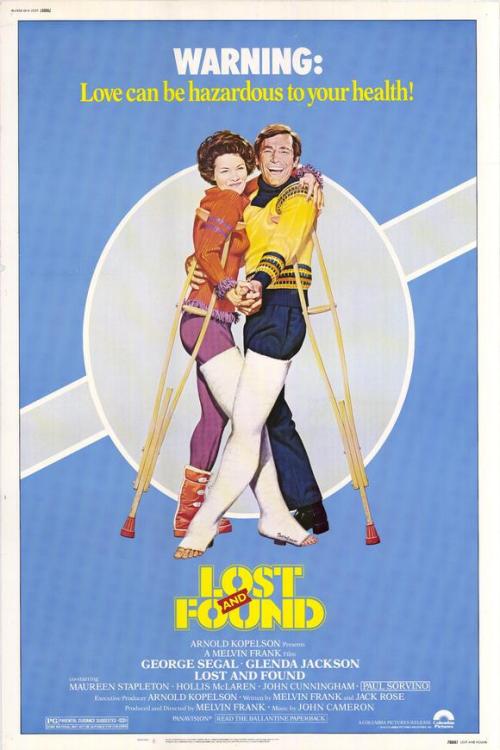
Lost and Found (1979)

By Richard Winters

My Rating: 2 out of 10

4-Word Review: Fighting keeps couple together.

Adam (George Segal) is a college professor vacationing in France whose car collides with that of British divorcee Tricia (Glenda Jackson). He tries to get her to write a letter admitting that she was at fault, but she instead writes the exact opposite while doing it in French, so he wouldn’t know. When he finally catches on to this he tracks her down at the ski resort and again collides with her this time on skis. Eventually they find a way to reconcile and even fall in love before finally marrying yet when they return to the states they start fighting again over just about anything until it seems that is all that they do.

Sloppy, poorly structured romance should’ve never been given the green light. The characters are bland and one-dimensional and the humor cartoonish while the couple’s relationship is strained to the extreme. The story has no momentum and the inane fighting seems put in simply to give it some comical conflict that leads nowhere and eventually becomes tiring.

The main problem is that the two reconcile too quickly. Viewers who watch these types of films enjoy wondering whether ultimately the couple will get past their differences and tie-the-knot, which is what compels them to keep watching, but here any suspense of that is ruined when they get married within the first half-hour and thus the arguments that they have afterwards is anti-climactic. The film would’ve worked better had the two remained antagonistic. The conflict could’ve started in the French Alps and then continued onto the college campus by having the Jackson character work as a prof in the same department as Segal and had their animosity only slowly melt away when they’re forced to work on some project together with the wedding bells then coming in only at the very end.

What makes this movie odd is that it reteams Jackson and Segal as well as the writer/director team of Melvin Frank and Jack Rose who all did A Touch of Class together just 6 years earlier. One would presume that this would be a sequel to that one with Segal and Jackson playing the same characters that they did before, but that’s not the case. In retrospect that’s how it should’ve been played and it would’ve then avoided having to show the dumb, over-the-top way that the two meet here, which is so forced and corny that it cements this has being a bad movie before its even barely begun.

The supporting cast manages to add some life. I got a kick out of Maureen Stapleton as Segal’s free-spirited, hippie-like mother, but she was only 52 at the time and didn’t even have any gray hair making her look much too young to have given birth to a middle-aged man in his 40’s and was in fact only 9 years older than Segal in real-life. Paul Sorvino is amiable as a talkative cabbie and the segment where he and Jackson try to resuscitate Segal after a failed suicide attempt is the only mildly amusing bit in the film.

The ski resort scenery is picturesque although it was actually filmed at Lake Louise in Alberta, Canada and not in the French Alps like the movie suggests. You also get to see John Candy in a brief bit and Martin Short in his film debut, but everything else falls painfully flat and I couldn’t help but feel that the entertainment world had passed both director Melvin Frank and Jack Rose by. They had written and directed many successful comedies during the 40’s, but what passed off for funny back then now seemed seriously dated and it should be no surprise that they both only did one more movie after this one.

My Rating: 2 out of 10

Released: July 13, 1979

Runtime: 1Hour 46Minutes

Rated PG

Director: Melvin Frank

Studio: Columbia Pictures

Available: DVD-R, Amazon Video

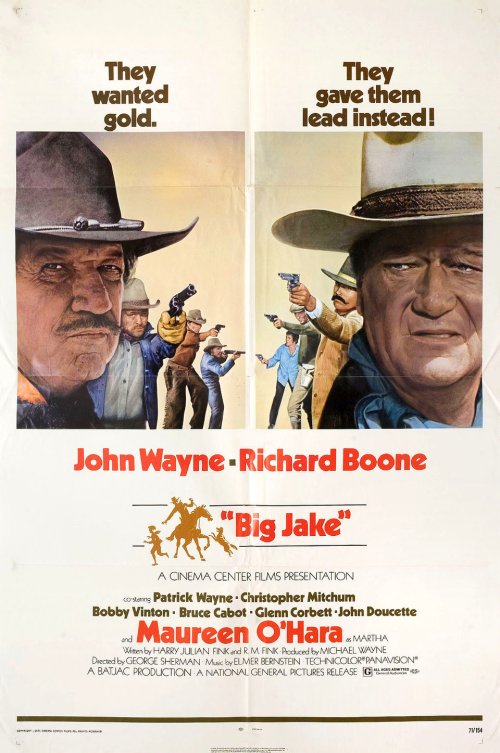
Big Jake (1971)

By Richard Winters

My Rating: 4 out of 10

4-Word Review: Grandfather tracks grandson’s kidnappers.

In 1909 a group of outlaws led by John Fain (Richard Boone) raid the McCandles homestead and kidnap their grandson (Ethan Wayne). Martha (Maureen O’Hara) is the home’s matriarch who decides that the help of the army and Texas Rangers just won’t do and the family’s estranged grandfather, Big Jake McCandles (John Wayne) will. Big Jake, who was once a legendary gunfighter in his day has been roaming the west alone for many years, but once he gets word that his grandson has been kidnapped he snaps into action using the help of an old Apache associate named Sam (Bruce Cabot) to help track where the kidnappers are.

This another film where in Leonard Maltin’s review book he gives two different takes of the film depending on which version, older vs. newer, that you have. I realize Maltin does not review all of the movies that are in his book, but whoever reviewed this movie in the older versions gave it only 2-stars and describes it as an ‘uneasy combination of a traditional Wayne western and a Butch Cassidy-type spoof’. In the newer versions Maltin or whoever did the review now suddenly likes it and gives it 3-stars calling it ‘an underrated western that’s well paced and handsomely shot’. The only consistency between the two is that both consider Boone’s performance as being ‘especially good’.

For me the original review is far more accurate. Although the film does start out with a rather offbeat, Avant-garde opening everything that comes after is formulaic and mechanical. The plot is too basic and not all that exciting or gripping you never see or learn much about the boy who has been kidnapped and therefore one’s concern for his safety wanes. It starts out right away with the violent kidnapping without any backstory and then deviates into a lot of side-story adventures until you almost forget about the kidnapping plot completely only to finally come back to it with a so-so shootout finale. In a lot of ways the kidnapping theme could’ve been excised completely as the only time it gets amusing is during Wayne’s bantering with his co-stars as they ride around looking for the bad guys, so everything should’ve centered on that while possibly changing the plot around to them looking for gold or lost treasure instead.

Wayne’s presence is the biggest detriment as he has played this domineering, stubborn old codger for far too long and there needed to be a fresh new spin put on it, but none is supplied. I was hoping for one brief moment that the arrogant, brash Wayne character might be proven wrong at something, or forced to swallow his immense pride just to keep things balanced, but of course its only everyone else that has do that while the mystical Wayne proudly plods on like he can do no wrong.

I thought the introduction of the automobile into the plot, where some of the men decide to ride in those while Wayne stubbornly sticks with his horse, might offer this by having the old-fashioned character eventually forced to modify his thinking and embrace change and modernization. In reality everyone must eventually have to do this at some point in their lives, so The Duke should too, but instead here the reverse occurs, where those that adapt to change are made to look foolish while the hard-headed Wayne rides off unblemished, which to me made it too agonizingly predictable.

Having Wayne’s real-life son Patrick playing Big Jake’s feisty and rebellious son is fun, but I wanted their confrontations to be played up more. Christopher Mitchum is okay too as Big Jake’s other kid who rides a motorbike and this was the last movie that Mitchum did with Wayne because afterwards he quit speaking to him due to Wayne’s right-wing leaning politics, which I found ironic since 25 years later he ran for a California congressional seat as a conservative republican.

O’Hara is sadly wasted and seen only during the film’s first 15 minutes and then that’s it. Singer Bobby Vinton also appears at the beginning, but his acting is terrible and fortunately for the viewer his time on the screen is brief.

The only thing that I liked about the movie is the gorgeous view seen outside the ranch home in the opening scenes and I wished that the entire story had taken place in the home so we could keep enjoying its breathtaking surroundings, which was filmed on-location in the Mexican state of Durango. Otherwise everything else is a bore.

My Rating: 4 out of 10

Released: May 26, 1971

Runtime: 1Hour 50Minutes

Rated G

Director: George Sherman

Studio: National General Pictures

Available: DVD, Blu-ray, Amazon Video

A Touch of Class (1973)

By Richard Winters

My Rating: 5 out of 10

4-Word Review: Sexual liaison turns romantic.

Steve (George Segal) is an American businessman working in London who meets Vickie (Glenda Jackson) a divorced mother of three. Despite being married he immediately takes a liking to Vickie after sharing a cab ride with her and makes no secret that he’d like to have a ‘no-strings-attached’ sexual affair. Vickie approves of the idea, but wants a more romantic setting, so Steve whisks her off to Malaga, but things get complicated when Steve’s friend Walter (Paul Sorvino) shows up on the same trip and constantly gets in the way.

Surprisingly this limp comedy got nominated for Best Picture, which is really hard to believe since there isn’t anything all that funny or original about it. In fact it seems very similar to another picture that writer/director Melvin Frank did in the ‘60s called The Facts of Life, which starred Lucille Ball and Bob Hope and had almost the exact same plot.

The biggest problem is that it doesn’t take enough advantage of its comical potential. Having Steve’s wife Gloria (Hildegard Neil) show up with the kids unexpectedly and want to go on the trip with Steve should’ve been played out much more as it was ripe with comic potential, but instead the film nixes this idea after introducing it and nothing is more annoying than a movie, which sets-up an interesting idea only to then backtrack on it.

Paul Sorvino’s character is equally wasted and his presence could’ve created far more complications that never transpire. In return the movie falls back to a lot of lame situations that seem thrown in for cheap laughs like Steven suddenly going through back spasms, or challenging a 13-year-old kid to a golf game that has nothing much to do with the main plot and basically comes off as forced and lame. The arguments or ‘spats’ that couple have are equally inane and this culminates with the two throwing furniture and clothing at each while in the hotel room, which sends this supposedly ‘sophisticated’ adult comedy dangerously close to becoming benign slapstick instead.

The third act in which the two rent out a flat and continue to have the affair even after they return to London doesn’t improve things. Jackson is supposedly this single mother and yet after she moves into the flat she seems to essentially abandon the kids who disappear from the movie altogether. It also seems hard to believe that Steve’s wife wouldn’t at some point start to catch on to the fact that something was going on as these things eventually will catch up with a person and there’s just so many close calls one can have before finally getting caught and yet here that never happens.

The fact that Steve is very open about his marriage to Vickie and even confides in having previous affairs makes Vickie seem really stupid for wanting to get involved with him in the first place. Supposedly she just wants casual sex as much as he does, but then refers to their trip as a ‘romantic’ one making it seem like she has the idea that this will turn into a relationship. When things do finally sour one doesn’t feel sorry for her as she was old enough to know better and anyone with an IQ over 2 would’ve seen the red flags from the start, so why didn’t she?

The only interesting aspect about the movie is that Jackson won her second Oscar for it, which was highly unusual since she had just won her first one 2 years earlier and quite unexpected making many people consider a recount was necessary as they were convinced it had to have been a mistake. It’s not that Jackson gives a bad performance because it is actually quite good, but Marsha Mason, who was the predicted front-runner, gave a superior one in Cinderella Liberty and she should’ve won it.

For years many people wondered what it was about Jackson’s acting in this film, which is a very ordinary fluffy movie at best, that made her stand out to the Academy judges and beat such long odds. A few years back I read somewhere, and I can’t remember where it was at this point, that the reason she won it was for one particular moment where Segal tells her that the relationship is over, but instead of her breaking down and crying like the script asked for she puts her head into her hands and remains silent for several seconds. Director Frank argued with her about doing this, but she insisted she wasn’t the type of woman who cries easily and therefore doing it the other way seemed more natural to her and in turn this impressed the judges when they watched the movie because her character responded to something in a completely unexpected way, which apparently was enough for her performance to stand out.

My Rating: 5 out of 10

Released: June 20, 1973

Runtime: 1Hour 46Minutes

Rated PG

Director: Melvin Frank

Studio: AVCO Embassy Pictures

Available: DVD, Amazon Video

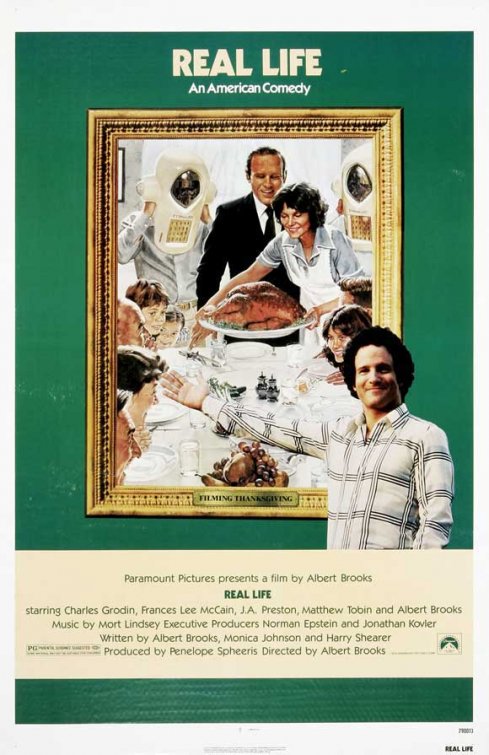
Real Life (1979)

By Richard Winters

My Rating: 4 out of 10

4-Word Review: Ordinary family reality show.

Albert Brooks plays Albert Brooks a hot shot young filmmaker determined to make a splash by filming a regular American family in their home and capturing everything that they do. The idea is for the family to go about their daily lives as if the cameras aren’t really there and then record their interactions. Things though go off-kilter almost immediately, which sends Brooks into a panic as he fears his movie won’t be entertaining enough and forcing him to compromise the project by instilling outside influences in order to make the movie more commercially viable.

This is another film that gets listed in the book ‘1001 Movies You Must See Before You Die’, but I’m not sure why. I’ll admit when I first saw it over 30 years ago it struck me as being quite irreverent and edgy at least the beginning, but the second half fades as Brooks loses sight of the main theme and writes himself into a hole. This results in a lot of tired jokes that focuses too much on the filmmaker and not the family.

The idea is based off of the documentary called ‘An American Family’, which was broadcast on PBS from January to May of 1973. This is where a filmmaking crew followed around the Loud family of Santa Barbara, California for 7 months in 1971 and filmed everything that went on between them. The idea was not to sensationalize anything, but instead have it work as an educational program examining the dynamics of how a typical American family works. Although things started out normal it soon began to unravel when the wife asked for a divorce and the couple’s 20 year-old son suddenly came out as gay. All these things were unexpected and many critics felt it was the presence of the cameras that brought them out.

Unfortunately this film misses the mark by having the family’s unraveling occur almost immediately and therefore not taking advantage of a prime comedic arch. The family members also lack any discernable personality and proceed to just get more boring as the film progresses. Certain darkly humorous moments like the scene where the father, played by Charles Grodin, performs a botched operation on a horse as part of his veterinarian practice are not funny at all and instead quite disturbing especially since a real horse was used.

The audience comes into this thing expecting to see a story about a family, but instead gets bombarded with Brooks whose sarcastic personality is only tolerable in small doses. The intended satire of a popular TV-series morphs into scenes of a narcissist filmmaker endlessly whining about his anxieties making the whole thing seem more like a vanity project or worse a limp remake of Federico Fellini’s 8 ½.

Some great moments particularly the opening scenes showing the audition phase get lost amidst a rapid fire of sardonic gags that go nowhere.  I started to wonder if Brooks had even seen the actual series that he is supposedly trying to make fun of, or if he just considered the concept as an excuse to try and make himself the star. The intended surrealism doesn’t work and actually gets in the way with a whacked-out Gone with the Wind-like finale being the worst and only helps cement this as a misfire.

My Rating: 4 out of 10

Released: March 2, 1979

Runtime: 1Hour 39Minutes

Rated PG

Director: Albert Brooks

Studio: Paramount

Available: DVD, Amazon Video, YouTube

Born to Win (1971)

By Richard Winters

My Rating: 6 out of 10

4-Word Review: Junkie needs his fix.

J.J. (George Segal) is a former hairdresser now residing on the streets due to his heroin addiction. To help pay for his expensive habits he agrees to transport drugs for Vivian ( Hector Elizondo) which gets him into deeper trouble with the criminal underworld. Eventually two cops (Ed Madsen, Robert De Niro) catch up with him and agree to strike a deal, which will allow him to avoid jail time if he agrees to turn Vivian and his cohorts in. J.J. though is more concerned with getting his next fix and nothing else matters not even the hot young chick Parm (Karen Black) who he has just moved in with.

There were many 70’s films, some might say too many, dealing with the drug addiction theme. Some were quite compelling while most of the others were highly clichéd. This one though takes a slightly different angle by injecting comedy into the proceedings and surprisingly it works. J.J.’s conversation with an older woman cashier (Sylvia Syms) about enemas, which he does in order to distract her from seeing his buddies stealing the company’s safe, is quite amusing. The best part though is when J.J. is stripped naked and forced to wear nothing but a woman’s bathrobe and then when he’s held prisoner in an apartment bedroom he flashes a young woman from across the street in order to get her attention to call the cops, but instead she proceeds to just flash him back, which is a laugh-out-loud moment especially when the viewer later gets to see Segal running down the city’s streets in the pink bathrobe with startled pedestrians looking on.

The film though fails when it tries to get serious. The dramatic moment where J.J.’s friend Billy (Jay Fletcher) takes some corrupted heroin and it kills him gets botched. Maybe it’s just me as I’ve seen many movies, but I could tell where this scene was headed right from the start and the intended ‘shock’ and ‘surprise’ of it instead becomes boring and overly played-out.

Karen Black’s presence helps. Her character is quite goofy to the point that she gets turned-on by J.J. when she catches him trying to steal her car and even invites him back to her place afterwards. Normally this behavior would be considered too wacky to be believable, but Black’s ability to channel her inner freak gives the whole thing an authentic feel and her later conversations dealing with how many men she has slept with is a gem as well.

Segal’s performance is solid, but we never effectively get inside his character’s head. The film would’ve been far stronger had we seen what his life was like before he became an addict and the jarring contrast in his lifestyles could’ve made for a powerful statement, which unfortunately is lacking. We also never get to see him actually putting the needle into his arm. We see at one point the needle marks in his skin, but seeing him taking the drug would’ve hit the message home visually.

Spoiler Alert!

The ending is frustrating as he is given a bag of heroin that he knows may be tainted and ultimately will kill him if he takes it and yet it is left wide open as to whether he tries it or not. The idea that someone would be so strung out to get a high that they would knowingly take something that they knew could instantly kill them is an intriguing quandary that needed to be answered and the fact that it doesn’t is why this film despite a few good moments ultimately misses-the-mark.

My Rating: 6 out of 10

Released: December 1, 1971

Runtime: 1Hour 28Minutes

Rated R

Director: Ivan Passer

Studio: United Artists

Available: DVD, Amazon Video

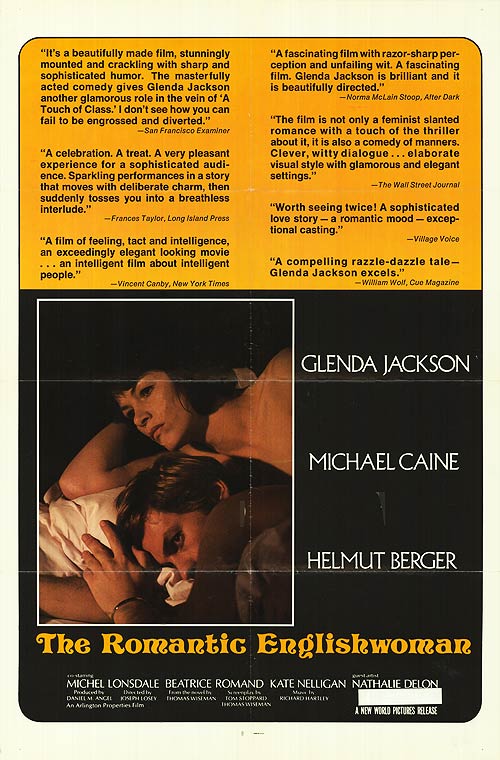
The Romantic Englishwoman (1975)

By Richard Winters

My Rating: 6 out of 10

4-Word Review: Writer suspects wife’s infidelity.

Unhappy in her marriage Elizabeth (Glenda Jackson) goes off to Baden-Baden, Germany for a little respite and there meets up with the dashing Thomas (Helmut Berger). Although quite charming Thomas is also caught up in the criminal underworld and being chased by gangsters. After the two share a brief tryst she returns home to her husband Lewis (Michael Caine). Lewis suspects that Elizabeth was unfaithful during her trip, but can’t prove it. He invites Thomas to stay at their place in order to help him finish a screenplay that he is working on and in the process the affair between Thomas and Elizabeth starts up again, but this time Lewis is determined to stop it.

The concept is intriguing, but the film gets ruined by playing its cards too early. A far more interesting scenario would’ve been to have Lewis not suspect Thomas at all or even his wife’s longing for him and instead simply invited Thomas over as a genuine writing partner and only slowly becoming aware of the tensions boiling beneath the surface. Unfortunately having Lewis almost immediately figure things out even before Thomas arrives makes for a very boring first hour with the couple arguing over the same staid, redundant infidelity talking points that have been done a million times before.

The story’s only interesting wrinkle has Thomas starting up a relationship with the nanny (Beatrice Romand), which made more sense as Elizabeth was way older than him and I failed to see why he would’ve been attracted to her to begin with. The nanny was young and cute and it was fun seeing Elizabeth seethe with the same type of jealousy as Lewis, but the film quickly kills this storyline by having the nanny forced to move out and everything goes back to the same formulaic love triangle.

Having Lewis recreating scenes in his screenplay that replicates what he is going through in real-life had potential as it nicely illustrates the thin line between fact and fiction that writers routinely do. Unfortunately the film treats these scenes in a campy/hooky manner and then drops it just as quickly as the romance scenario mentioned above.

The direction is static with a camera nailed to the ground and everything captured in a dingy, shadowy way. The opening bit detailing how Elizabeth first meets Thomas had a naturalistic quality, but the shot were she spots Thomas from across the room and her eyes remained locked on his and she never turns away is not believable. If two people are strangers and one catches the other one staring at them it’s sheer human reflex that the other one will divert their gaze as it’s rude, awkward and off-putting otherwise. Also, to have the word romantic in the title is absurd especially after the two proceed to have sex inside an elevator during their first meeting, which is pure animalistic lust and a more accurate title would’ve been ‘The Horny Englishwoman’.

Spoiler Alert!

The third act helps fill in the gaps in regards to Thomas’ secret past, but having Elizabeth run off with him makes her character seem exceedingly shallow as she essentially abandons her young child in the process. Earlier in the film she got very upset when she saw her child sitting out on a ledge and she fired her nanny for being irresponsible and not watching him more carefully only to then by running off with Thomas behave just as irresponsibly.

The film’s final shot features strange people inhabiting Lewis and Elizabeth’s home like they’re having a party without the owners there. Lewis then after having taken Elizabeth away from Thomas and back with him drives the car the two are in up to their house. Elizabeth looks shocked at seeing all the people inside, but Lewis has a jaded expression and seems to being enjoying watching Elizabeth’s discomfort, but then the film cuts to the credits and never explains what’s occurring and nothing is more frustrating than a film which ends just as it’s finally beginning to get interesting.

My Rating: 6 out of 10

Released: November 26, 1975

Runtime: 1Hour 56Minutes

Rated R

Director: Joseph Losey

Studio: New World Pictures

Available: DVD, Blu-ray, Amazon Video

Blue Collar (1978)

By Richard Winters

My Rating: 7 out of 10

4-Word Review: Workers rob their union.

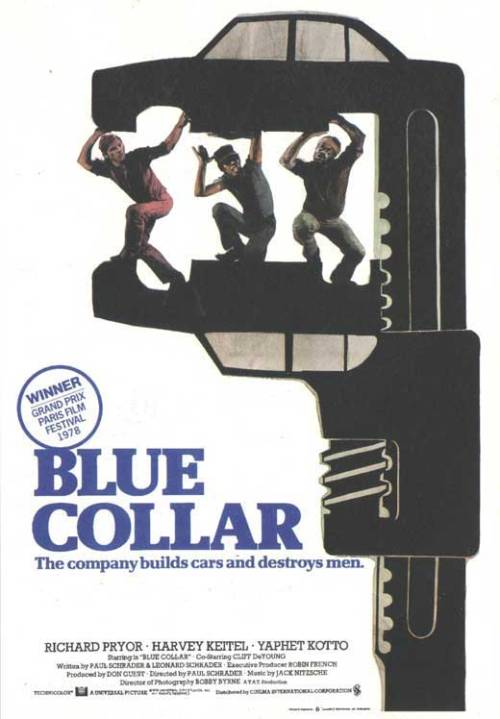
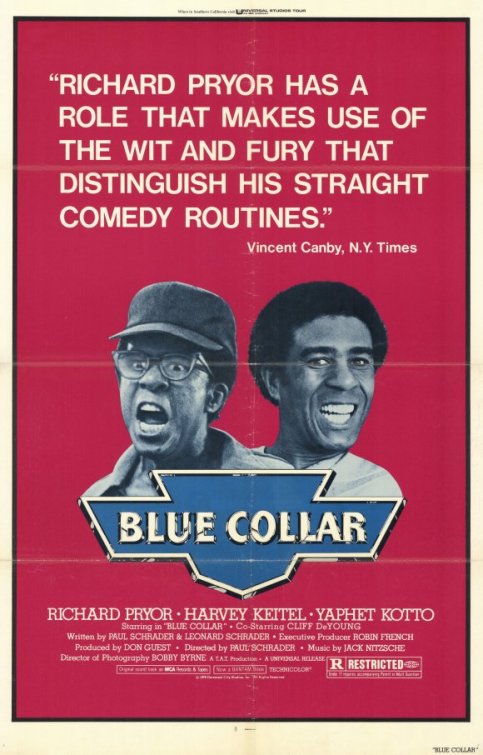
Zeke (Richard Pryor) Jerry (Harvey Keitel) and Smokey (Yaphet Kotto) work at an auto plant in Detroit and become increasingly frustrated with their union, which they feel is ripping them off. The three get the idea to rob a safe stored at the union office. The crime itself is a cinch, but they only get $600 dollars out of it even though the union reports to the press that $10,000 was stolen. Then they find paperwork detailing some of the union’s dirty loan deals and decide to use that as blackmail, but the union has other ideas.

This was the first film directed by Paul Schrader and although he has gone on record stating that he dislikes it and has never watched it since its release I consider it to be one of his best. The music by Jack Nitzsche is a bit heavy, but otherwise this is a strong hard-hitting look at the life of an auto worker a subject that doesn’t get tackled too often. The fact that the film takes no sides and shows that both management and unions can be equally corrupt gives the proceedings a refreshingly honest tone.

Personally I support unions, but I realize that like with everything some can be less than perfect and since reality is not black-and-white, but instead quite complex it’s important to show all sides of an issue. The whole inspiration for the film came when Schrader went to Detroit and interviewed actual assembly-line workers and found to his shock many of them hated their unions even more than management. Films like Norma Rae, which is still excellent, tend to portray a very one-sided narrative while this one makes you wonder who the good guys actually are especially as the three leads turn on each other for different reasons.

The biggest surprise is Richard Pryor who really drives this film with his excellent dramatic performance. He seems to be channeling his harsh upbringing to create an edgy and enduring character. I loved the way he critiques other black sitcoms like ‘Good Times’ and ‘The Jeffersons’ as well as the way he constantly says the f-word even when in front of his own kids. George Memmoli a very obese actor gets a memorable bit as a disgruntled factory work that destroys a vending machine when it won’t give him his coffee.

The film features two very unique scenes. One is where a character dies while being trapped inside a room where a car is being painted and it’s quite intense. The other scene features Keitel in a car chase as he tries to get away from some bad guys who want to shoot him. Most films capture a car chases from the outside-looking-in with shots showing both vehicles at a distance and the point-of-view of both drivers. This one stays only on Keitel’s perspective making the viewer feel like they are trapped in the car with him and thus making the chase a much more personal and frightening experience.

Due to the subject matter no auto company would allow the film to be shot at their plant, so the producers were forced to use the Checker Cab Company, but this was a much smaller plant and the viewer never gets a true feeling of the immensity of an actual auto factory. The film’s final shot is another distraction as it’s the one point where the movie suddenly becomes heavy-handed despite successfully remaining otherwise gritty. It’s still a strong story overall that brings out perplexing issues without supplying any easy answers.

My Rating: 7 out of 10

Released: February 10, 1978

Runtime: 1Hour 54Minutes

Rated R

Director: Paul Schrader

Studio: Universal

Available: DVD, Blu-ray (Region B/2), Amazon Video, YouTube