Category Archives: 60’s Movies

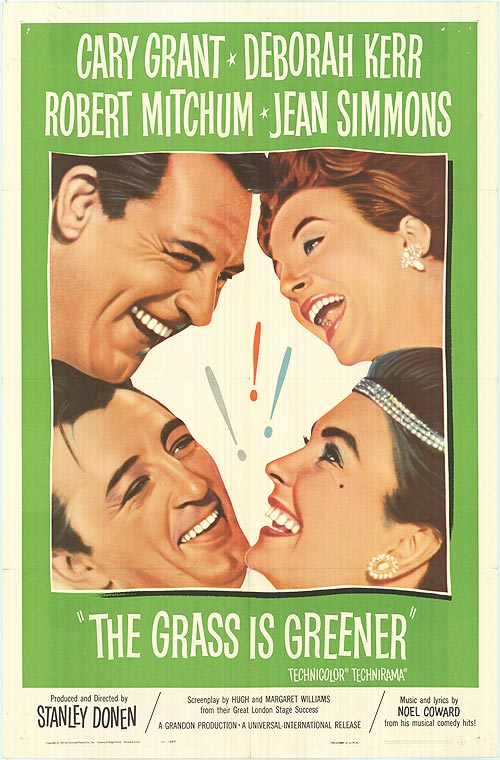
The Grass is Greener (1960)

grass is greener

By Richard Winters

My Rating: 4 out of 10

4-Word Review: They all fool around.

Hilary (Deborah Kerr) is married to Victor (Cary Grant) and they are low on funds so they give guided tours of their castle in order to make ends meet. Then one day rich American businessman Charles Delarco (Robert Mitchum) stops by and takes an immediate liking to Hilary and her to him. Soon they are having an affair and Victor along with his friend Hattie (Jean Simmons) devises a plan to win her back.

The film starts out well with a funny montage of cute babies in goofy poises shown during the opening credits, but then things go rapidly and irrevocably flat. One of the main problems is that there is simply too much talking and most of it isn’t funny or engaging. In fact none of the conversations between any of the four leads is interesting. The best dialogue in the whole film is the ones between Victor and his butler Trevor (Moray Watson) who is doing the job while working on his novel.  I wished there had been more of Trevor and that the story had revolved around him as the rest is trite and predictable.

Mitchum just doesn’t seem right as the love interest. He is best in parts requiring a rugged or villainous character as his romantic appeal is lacking. I actually thought he came off as downright creepy especially with the way he barges into Hillary’s room unannounced and is reluctant to immediately leave when he realizes he has walked into the wrong place. Most women would have considered him a stalker and his squinty eyes don’t help things.

I also thought Hillary throws herself at him a little too quickly. He is a stranger who pops out of nowhere. The two have a boring ten minute conversation and then are in a passionate embrace. Victor tries like crazy to win her back while I’m thinking why bother keeping a woman who jumps at any man who has money. Might as well just hire a good lawyer and take the hussy for all she’s worth.

The fact that Victor immediately figures out about the affair was another negative in my opinion as it doesn’t allow for hundreds of potential comic scenarios of them carrying on behind his back. As it is scenarios of any kind are woefully lacking. There is one scene where Victor takes Charles out fishing and another where they have a dual, but both end up being much too brief. For the most part it is just a static filmed stage play with background sets that a boring and color that looks faded and washed out.

Of course I did like Cary it is hard to dislike him simply because he is so good at being Cary. If anything his charm manages to keep this waterlogged thing afloat. Simmons isn’t bad either. I loved her variety of outfits and spunky personality. Kerr though looks and acts tired and not able to keep up with the comic timing of the other two.

If you like an old-fashioned but still very tasteful bedroom farce then this would at best be passable although Grant fans may like it a bit more while others will find it stagnant.

My Rating: 4 out of 10

Released: December 23, 1960

Runtime: 1Hour 43Minutes

Rated NR (Not Rated)

Director: Stanley Donen

Studio: Universal

Available: VHS, DVD, Amazon Instant Video
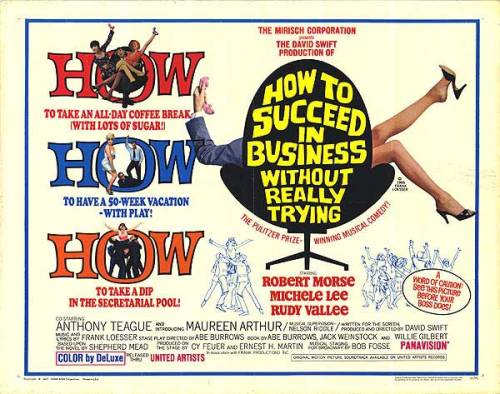
How to Succeed in Business Without Really Trying (1967)

how to succeed in business without really trying

By Richard Winters

My Rating: 8 out of 10

4-Word Review: Up the corporate ladder.

J. Pierpont Finch (Robert Morse) is a window washer looking to get ahead in the business world. By pure chance he finds a book entitled ‘How to Get Ahead in Business without Really Trying’. He reads it and follows the advice. He quickly gets a job at a large company and within days he moves all the way up from the mailroom to the head of advertising and eventually chairman of the board all without doing much work in this adaptation of the hit Broadway play, which in turn was an adaptation of the Abe Burrows novel.

This delightful film is lively and fresh even after all these years. The humor of course exaggerates life in the business world, but remains on target nonetheless. It accurately pinpoints all the universal problems and politics one goes through when working at a large company and dealing with the inside politics of getting ahead. Nothing is dated because it sticks with exposing the human foibles that come about in any generation when in a competitive and uncompromising environment, which is why I found it funny and interesting.

David Swift’s direction is top-notch. The pace is fast and furious balancing the humor and songs nicely. The sets are colorful and garish enough to accentuate the story’s farcical nature, but still bring out an office atmosphere feeling as well as the bigness of the company with large and imposing doorways including the amusing cathedral-like one that opens up to Finch’s office at the very end. At no times does the film suffer from the static staginess like most stage plays do when adapted to the screen.

The songs by Frank Loesser are upbeat and melodic and sound distinctive. My favorite one was the toe-tapping ‘A Secretary is Not a Toy’, but the showstopper ‘Brotherhood of Man’ had the best dance routines and was rousing enough to almost get me out of my seat. Rudy Vallee and Morse are also great in their rendition of ‘The Old Ivy’ fight song.

Morse recreates his role from the Broadway production. His voice isn’t necessarily the best and some of his singing seems a bit off-key, but his very boyish looks, gap-toothed grin, and bowl haircut is perfect for the part. A fun moment involving him is the scene where he prances down a busy New York sidewalk that was done with hidden cameras and the reactions from the other people on the street are genuine and real.

Michele Lee is terrific in her film debut. Her energy and perky smile are perfect as is her voice in the rendition of ‘I Believe in You’. She is probably best known to most for her starring role in the long running TV-series ‘Knots Landing’. What I can’t get over is how she continues to look like she hasn’t ever aged. A video on YouTube from her appearance at a 2011 AARP event has her looking almost the same as she does in this film. The interviewer tells her she is looking good and Lee replies ‘I always do’, which may seem conceited to some, but when one continues to look as great as she does then I suppose it is deserved.

Vallee best known as a crooner from the 1920’s is fun as Jasper Biggley the pompous head of the corporation. Anthony Teague with his devilish grin is great as the nefarious Bud Frump. I also liked the cute Kay Reynolds as Smitty and found it a shame that neither of these two talented young performers went on to do much else film-wise after this.

The only one I really didn’t like was Maureen Arthur as the ditzy and dumb Hedy Larue. Her high pitched voice and body gyrations were clichéd, over-the-top, and more annoying than funny. However, the incompetent way she takes down a dictated letter as well her reluctance to put her hand on a giant Bible during the film’s hilarious treasure hunt scene did manage to elicit some chuckles.

In 2011 the play was brought back to Broadway with Harry Potter’s Daniel Radcliffe in the lead. I wouldn’t be surprised if a remake of the film version comes out at some near point although nothing has been announced. Either way this film stands fine on its own and although never mentioned amongst the classic musicals I think it should be.

My Rating: 8 out of 10

Released: March 9, 1967

Runtime: 2Hours 1Minute

Rated NR (Not Rated)

Director: David Swift

Studio: United Artists

Available: VHS, DVD, Amazon Instant Video, Netflix streaming

The Anniversary (1968)

anniversary 2

By Richard Winters

My Rating: 6 out of 10

4-Word Review: Bette eats them up.

Since tomorrow will mark the 1st anniversary of when this blog started I wanted to choose a movie that had a similar theme in its title. The anniversary here deals with Mrs. Taggart (Bette Davis) celebrating the date of when her and her now deceased husband where married. Taggart is a bully who enjoys manipulating her grown sons and having her way. On this occasion all three of her sons carries a secret, which will all slowly come out as the evening progresses. Terry (Jack Hedley) is the oldest and is married to Karen (Sheila Hancock) their secret is that they plan on moving to Canada much to his mother’s dismay as she likes having her children close by. Henry (James Cossins) harbors a secret fetish to dress in women’s underwear. Tom (Christian Roberts) brings his fiancée Shirley (Elaine Taylor) to visit with their secret being that she is already pregnant.

If you’re a Bette Davis fan then this is required viewing as she is at her bitchy best. Although Mona Washbourne played the role when it was on stage it was revised by Jimmy Sangster for the screen with Davis’s personality very much in mind. It has all of her famous caricatures and she revels in it. Her insults are like arrows that slice through the other characters until they are mush. She gives her part just the right amount of camp and her infatuation with a statue of a little boy that is hooked up with a hose that when squeezed spurts water out of its front end like he is peeing is priceless.

Hancock makes for a good adversary and in fact out of all the other performers she is the only that seems to be able to stay toe-to-toe with Davis. Apparently Davis did not like Hancock and tried to get her replaced with Jill Bennett. Hancock was aware of this and I think that animosity comes out perfectly on the screen.

Taylor is young and gorgeous and she has one good moment when she tells off Davis, but that is about it. The three male actors are just not as effective as the females. Part of it could be the characters that they play, but on the most part they are rather blah.

Director Roy Ward Baker, who replaced Alvin Rakoff one week into the shooting at Miss Davis’s request, does his best to avoid the filmed stage play look. He opens the movie at an outdoor construction site, which is unusual. He also has a dazzling fireworks display in the middle, but my favorite is when Henry steals women’s bras and panties from an outside clothesline and replaces them with dollar bills in an attempt to ‘pay’ for what he is stealing. Yet despite all this the movie eventually gets stagy and becomes a bit draggy for it.

My biggest complaint is the fact that this type of thing has been done before. There is no new angle or perspective to any of it. Davis rants on and on with the other characters too cowardly to fight back. The little that they do is not enough. This is the type of film that screams for a big payoff, but it never happens. Taggart, as mean as she is, comes through it pretty much unscathed and for most viewers that will probably not be satisfying.

My Rating: 6 out of 10

Released: February 7, 1968

Runtime: 1Hour 35Minutes

Rated NR (Not Rated)

Director: Roy Ward Baker

Studio: 20th Century Fox

Available: DVD

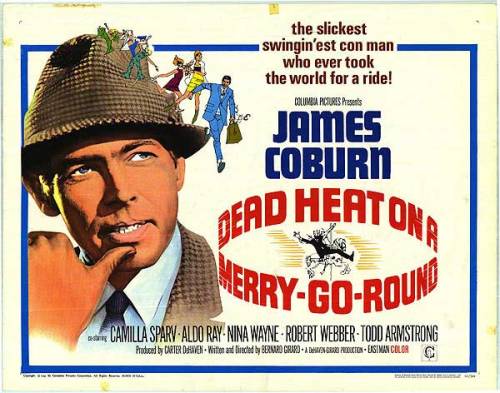
Dead Heat on a Merry-Go-Round (1966)

dead heat on a merry go round

By Richard Winters

My Rating: 6 out of 10

4-Word Review: Robbery at an airport.

Eli Kotch (James Coburn) manages to con his way out of jail by playing on the affections of his pretty jailhouse psychiatrist (Marian McCargo). His plans are to rob the bank at the Los Angeles International Airport while they are hosting the arrival of a Soviet Premier, which he figures will sufficiently keep the security personal distracted. The blueprint for the bank will cost him a hefty sum, so to help finance it he travels across the country seducing rich women and making off with their expensive possessions and money. Once the blueprint is purchased he assembles his men and executes the daring and elaborate scheme.

The film, which was written and directed by Bernard Girard, is by all means slick although it goes a bit overboard. The first hour is hard to get into. The filmmakers seem intent to keep the viewer guessing about the Kotch’s motives and intricate plans as the rest of the characters. There is so much cutting back and forth between scenes in L.A. and Boston as well as all the lady victims that Kotch finds that it becomes confusing and off-putting. Everything comes off too easily for our protagonist. I suppose that is the intended charm, but a few hiccups here and there to their plans might have offered more tension and reality.

He also beds too many women almost like he is some sort of modern day Don Juan. Having even just one of them slap him across the face when he makes his advances instead of just robotically disrobing and hopping between the sheets with him would’ve been funny. If this film were to be remade the women characters would have to be updated as here they are simply caricatures of a bygone era.

Camilla Sparv’s character and the way Eli treats here was a particular problem with me. Sparv looks drop-dead gorgeous to the point of being breathtaking. Most men would feel blessed at having such a beautiful woman fall in-love with them, but Eli takes it all for granted. He callously lies to her and uses the genuine feelings she has for him to take advantage of her and use it for his own gain. It gets to the point where Eli starts to come off as a real cad and makes the viewer dislike him. There is a twist at the end involving the Sparv character, but it is not enough. I was really hoping that she would somehow manage to screw-up his plans whether intentional or not, but that doesn’t happen even though it should’ve.

Coburn’s toothy grin and deep laugh manages to carry it and probably no other leading man would’ve been able to pull off this type of part as well. The supporting cast is equally good. Rose Marie is fun in a brief part as an older woman that Eli cons. Severn Darden is effective as the nerdy and smart, but very nervous member of Eli’s group. Nina Wayne is funny as one of Eli’s first female victims, a ditzy blonde filled with very quirky philosophies on just about everything. Yet it is Robert Webber, a very under-rated character actor, who steals the show as the high-strung head of the airport security. You can also spot a young Harrison Ford in a brief bit as a bellhop.

The excellent on-location shooting gives the film an added flair. The shots of the Los Angeles International Airport are good especially the way it captures the iconic and modernistic Theme Building. Images of a wintry Boston during Eli’s jaunts to that city are quite scenic particularly all the tree branches covered with snow.

The film’s final half-hour is captivating and even intense. The editing is excellent and the sheer brazenness of the crime is amusing. There are certain things though that seemed implausible and whether such a plan could be pulled off in real-life is doubtful. Still, if you’re a fan of heist films this should offer two hours of suitably fluffy entertainment, but just don’t think about it too hard.

My Rating: 6 out of 10

Released: October 12, 1966

Runtime: 1Hour 44Minutes

Rated NR (Not Rated)

Director: Bernard Girard

Studio: Columbia Pictures

Available: VHS, DVD, Amazon Instant Video

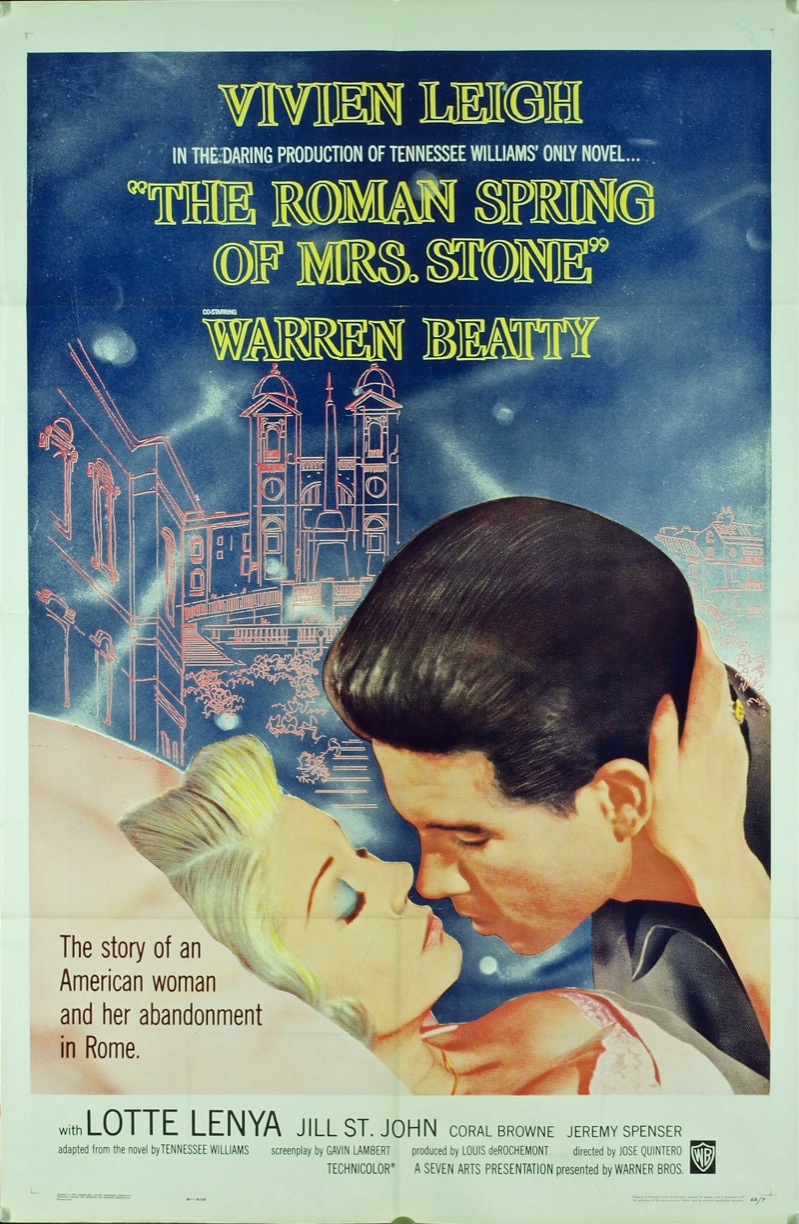
The Roman Spring of Mrs. Stone (1961)

By Richard Winters

My Rating: 6 out of 10

4-Word Review: Throw keys to transient.

Karen Stone (Vivien Leigh) is an aging actress who is no longer getting the top roles like she used to. She and her husband decide to travel off to Rome for a retreat, but instead he dies of a fatal heart attack while on the plane. Karen then decides to remain in Rome where she leases a luxurious apartment, but becomes lonely and starts feeling insecure about her desirability.  She meets Contessa Madga (Lotte Lenya) who is known in the area with setting up young men with lonely rich older women.   She sets Karen up with Paolo (Warren Beatty) a dashing young gigolo who is only attracted to Karen because of her money and the belief that she will pay him to be her lover while Contessa will get a cut of the profit. Karen does give Paolo a ‘salary’, but remains under the delusion that eventually he will fall in love with her for real.

Although the story moves along at a slow and plodding pace and there is little if any action I still found myself captivated. The script is based on a novel by Tennessee Williams and somehow his stuff always remains strong drama no matter how talky it may appear. The characters and their situations are real. Their fragility and desperation are things many people can sometimes find themselves facing and therefore it makes an impact.

The sets are excellent. Karen’s apartment has a nice mixture of elegance and airiness. I also liked the recreation of the streets of Rome that was done inside a sound stage. Normally I prefer on-location shooting, but when the sets are built in such a meticulous way it becomes almost mesmerizing.

Leigh, in her second to last film role, is solid as usual. Some may complain that she is playing a part that is too similar to her Oscar winning role of Blanche Dubois in A Streetcar Named Desire and to some extent they have a point. It almost seemed like Leigh in her later career was becoming a bit of a caricature, but she does it so well that it is a treat nonetheless. Just watching the way she moves her eyes as she gazes at Paolo secretly flirting with another woman is memorable.

Beatty is equally good. He speaks with an authentic sounding Italian accent and has a tanned complexion. This was the role that established him as a leading man and worth seeking out for his fans.

Lenya is engaging as the wicked Contessa. Most viewers today will know her best as the villainess Rosa Klebb in the classic James Bond film From Russia to Love. I always felt that she was one of the best Bond villains, but the amazing thing is that here she ends up being almost as menacing though in a more subtle way. She exudes evilness with clarity that is both impressive and creepy.

Jill St. John is terrific as Barbra Bingham a younger, more attractive actress who makes no secret about her desire to take-over from Karen’s now fading spotlight. Her bratty, haughty behavior is effectively on-target. Apparently Leigh like her character felt intimidated by St. John’s youthful beauty and refused to say even one word to her during the production.

Spoiler Alert

My only real complaint is with the ending. Paolo abandons Karen and so in a fit of desperation she throws her apartment keys down to a transient who has been stalking her during most of the movie. The next shot has the homeless man entering the apartment and walking towards the camera, but then it fades and we are left to wonder what happened. Supposedly at the time just having a woman throw her keys down to some strange man on the street was considered shocking enough, but I wanted more of a conclusion. Did he kill her, or did they have sex and then start some sort of weird relationship? These are interesting questions that I felt should have been answered and the story’s ambiguity is frustrating.

My Rating: 6 out of 10

Released: December 28, 1961

Runtime: 1Hour 43Minutes

Rated NR (Not Rated)

Director: Jose Quintero

Studio: Warner Brothers

Available: VHS, DVD

Inherit the Wind (1960)

By Richard Winters

My Rating: 6 out of 10

4-Word Review: Don’t teach Darwin theory.

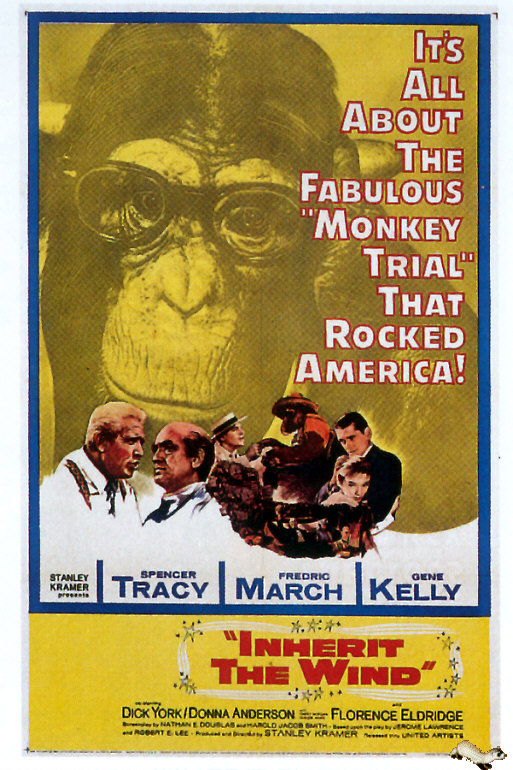
Bertam Cates (Dick York) is a  young school teacher who is put on trial for the teaching the Darwin theory of evolution in the film version of the hit stage play, which in turn was a variation of the famous trial of 1925.

Although labeled a ‘classic’ this film seems awfully stilted and heavy-handed. Everything gets overplayed with too much emphasis on high drama, which in certain instances becomes unintentionally funny. Director Stanley Kramer shows his bias from the beginning and doesn’t allow the viewer to come to their own realization on the issue. The townspeople are the embodiment of every small town cliché you can think of. The buildings that make up the town appear quite obviously to have been built on some studio back-lot. The same goes for the stagy indoor sets as well. Location shooting really helps even if it does go over budget. Just look at this film and then watch Joshua Logan’s Picnic and then decide which one gives you the stronger more lasting impression of small towns.

Fredric March is an accomplished actor, but goes over the top with his performance as the fundamentalist prosecutor Matthew Brady. He plays the character like he is a comical buffoon and uses too many exaggerated gestures and facial tics. Having the character go through a meltdown at the end is almost anticlimactic since he seemed destined for it from the very beginning. George C Scott, who played the same role in the Showtime remake, is much better.

Spencer Tracy as the defense attorney Henry Drummond is great and becomes the film’s main virtue. He is such a master of his craft that he is a joy to watch. He makes it seem all so effortless and natural and yet fascinating at the same time and the character he creates is quite memorable.

The courtroom showdown does allow for some fireworks and the final segment between Gene Kelly and Tracy proves interesting and introspective. The film does have some strong moments, but as a whole it seems kind of clunky.

My Rating: 6 out of 10

Released: July 21, 1960

Runtime: 2Hours 8Minutes

Rated NR (Not Rated)

Director: Stanley Kramer

Studio: United Artists

Available: VHS, DVD, Amazon Instant Video 
Summer and Smoke (1961)

By Richard Winters

My Rating: 7 out of 10

4-Word Review: She is sexually repressed.

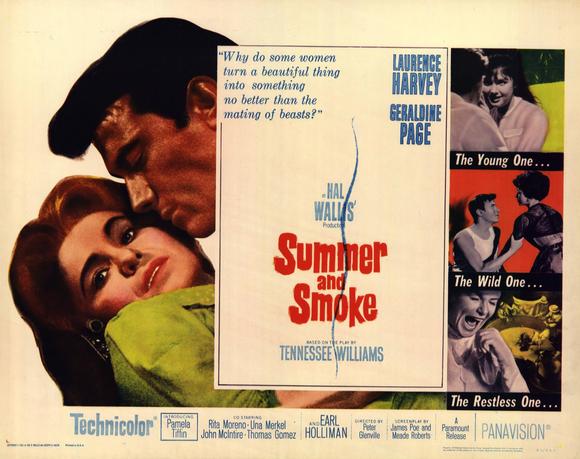
Alma (Geraldine Page) is an adult woman still single and living with her parents. Her father (Malcolm Atterbury) is a minister while her mother (Una Merkel) having suffered a mental breakdown several years’ earlier acts and behaves in a perpetual child-like state. Alma yearns for the affections of John (Laurence Harvey) the dashing doctor who lives next door with his father (John McIntire). However, John’s lifestyle is much too wild for Alma’s repressed tastes, but when she tries to change she finds that it may be too late in this film version of the Tennessee William’s play.

I have been a fan of Geraldine Page for years. She has a terrific ability to play fragile and eccentric characters while doing it with a panache and style. Her characterizations are always vivid and revealing and executed in a seamless fashion. One can become so entranced with her performances that sometimes it becomes more interesting than the story itself. Her appearance here proves to be no exception. She became known for playing a lot of dark, sinister characters, so it was a nice change seeing her play this part. She even does some singing and in fact the scene where she sings to John’s father as he lies on his deathbed for me left the most lasting impression. I always love watching the woman’s body language, gestures, and facial expressions and how she uses them to create a three-dimensional character. Her acting discipline should be studied and emulated by students of the craft everywhere.

Harvey as her co-star was an interesting choice. Despite his reputation as being an over-rated actor and possessing a strange personality off-camera I have found some of his performances to be excellent particularly the one in the original Manchurian Candidate. However, he seems to be better suited playing parts with a cold and aloof presence. The role here demanded more emotion and I didn’t think he could quite hit it. By the end Page was acting circles around him and turning the production into her own vehicle.

The supporting performers aren’t bad. It is fun seeing Rita ‘Hey you guys’ Moreno in an early role playing a young vixen with eyes for John. McIntire is fine in his small role and the part where comes home to find all sorts of drunken people lying about passed out in his living room and hallways is good. Thomas Gomez is memorable simply to glimpse his large almost unbelievable waist size.

I really didn’t like Merkel’s part as the crazy mother. I found it frustrating that there really was never any explanation for why she behaved in such a strange way. Simply saying that she had a ‘breakdown’ wasn’t enough and I wanted more of a scientific or medical reason. It also would have been more interesting to see what she was like before her breakdown, but that is never shown.

Technically the film is well produced. The sets, costumes and performances are all very turn-of-the-century and it helps draw you into the mood and thinking of the era right away. I did not like that the outdoor scenes where done on a soundstage as the foliage and sky look annoyingly artificial.

Most of William’s plays deal with sad, lonely, and pathetic characters and this one proves no exception. However, I was pleasantly surprised that after the expected histrionics this one manages to have a somewhat upbeat ending, which helped distinguish it above some of his others. The characters and situations are all too real and Alma reminded me very much of someone I know and others may know someone like her as well, which on a personal level made this story all the more fascinating.

My Rating: 7 out of 10

Released: November 16, 1961

Runtime: 1Hour 58Minutes

Rated NR (Not Rated)

Director: Peter Glenville

Studio: Paramount

Available: DVD, Amazon Instant Video, Netflix streaming

Texas Across the River (1966)

By Richard Winters

My Rating: 3 out of 10

4-Word Review: A cheek slapping showdown.

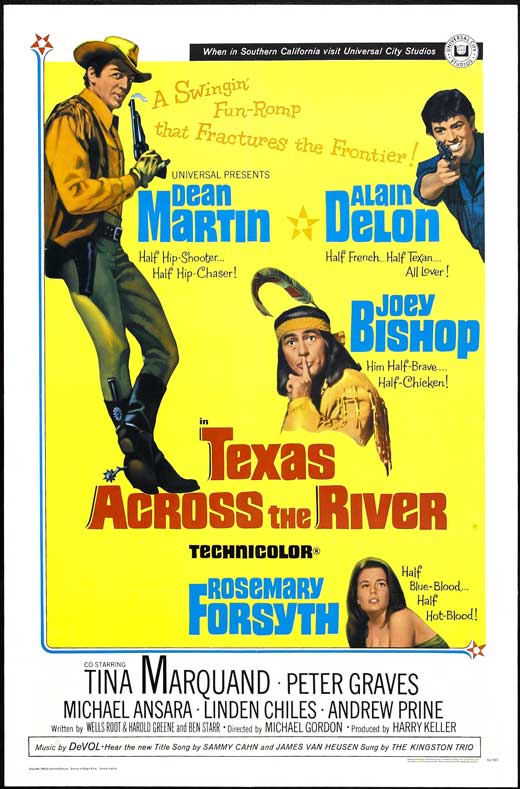
This is a silly western spoof that borders on the inane and is just an excuse to give Martin another vehicle this time in a western setting. The story deals with the wedding between Don Andrea (Alain Delon) and Phoebe (Rosemary Forsyth) being stopped by the arrival of the U.S. Calvary headed by Captain Stimpson (Peter Graves). When they charge Don with murder he escapes to Texas and Phoebe tries to follow him later on. There she meets Sam Hollis (Dean Martin) and his Indian sidekick Kronk (Joey Bishop). Sam becomes smitten with Phoebe and when he later meets up with Don the two become instant rivals while reluctantly working together to allude the Calvary, which arrives in Texas to celebrate its statehood.

In many ways the production takes on Martin’s persona as everything is half-hearted. The humor and scenarios are quite standard. There are a few chuckles here and there, but more misses than hits. It’s so obvious when the actors are standing in front of a blue screen or using a stunt double that it almost looks like an amateur college production. The biggest insult though is that it is all about Texas and yet wasn’t even filmed there. It was done in San Diego and it shows. This is almost like deceptive advertising and for punishment the producers should be forced to spend a summer in the REAL Texas without any air conditioning.

Delon’s presence is good simply because he is French and he gives it a unique flavor, but the film doesn’t portray him as such and instead tries to pull off that he is SPANISH!! He also gets to be too much of a brawny do-gooder and in the end he becomes like Dudly-Do-Right with a French accent.

Bishop is funny simply because he is playing himself. The credits may say he is playing an Indian, but really it’s just Joey in a silly Indian get up. His headband alone looks like it was taken from somebody’s unwanted tie collection. In fact the overall portrayal of the Indians is badly stereotyped and if the film was better known it might merit protesting.

Forsyth gives the film’s best performance. However, having Martin pursue her looks off-kilter since he was old enough to be her father and her and Delon made a better couple. Of course since this is Martin’s vehicle he ends up with her no matter how forced or unnatural it looks.

If you are really easy to please or just a Dean Martin fanatic then you might find this film more passable. The cheek slapping showdown between Martin and Delon is cute and the running joke involving that ‘Texas Tea’ isn’t bad either.

Look carefully for Richard Farnsworth is his first major role as he is almost unrecognizable as the Medicine man.

My Rating: 3 out of 10

Released: October 26, 1966

Runtime: 1Hour 41Minutes

Rated NR (Not Rated)

Director: Michael Gordon

Studio: Universal

Available: VHS

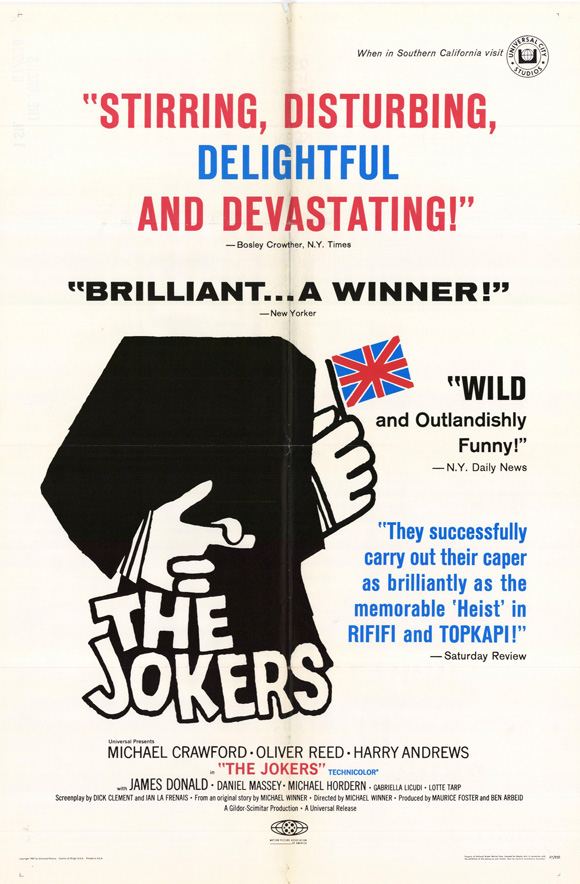
The Jokers (1967)

By Richard Winters

My Rating: 8 out of 10

4-Word Review: Rob to avoid work.

Brothers Michael (Michael Crawford) and David (Oliver Reed) decide that working life is not for them and come up with an elaborate robbery that will afford them enough money to drop out of society for good. Their plan is a clever one as they stage random bomb threats across parts of London, which creates a panic in the city. Then they threaten to blow up the tower of London, disguise themselves as military experts who can go in to diffuse the bomb and then run off with the crown jewels in the process, which they conveniently hide underneath the floor boards of their home.

The film has a great irreverent flair that was common amongst the new wave British films of the late 60’s. The quick edits, fragmented narrative, and quirky humor is similar to Richard Lester’s The Knack…and How to Get It, which also starred Crawford. The comedy, especially its potshots at the establishment, is right on target and engaging. I was surprised that it was directed by Michael Winner as so many of his later films, especially the ones he did with Charles Bronson, seemed so formulaic that I could never imagine he could show so much spunk and flair.

The crime is imaginative and plays out nicely. There is also a neat and completely unexpected twist near the middle that keeps things intriguing to almost the very end.

Crawford shows charm and his boyish looks help strengthen is character. He somehow manages to upstage Reed, which I never thought would be possible and his charisma carries the film. He does though look too scrawny and almost anorexic in parts and having him gain some weight and ‘putting some meat on his bones’ before filming began would have been advisable.

British character actor Harry Andrews is amusing as the exasperated Inspector Maryatt. However, I found James Donald as the completely clueless Colonel Gurney-Simms to be the funniest.

If the film fails anywhere it is in the fact that it loses its satirical edge and focus. It starts out making fun of the upper-crust English society, but then becomes too preoccupied with the crime itself. David and Michael’s interactions with their stuffy, conservative parents (Peter Graves, Rachel Kempson) are cute and I would have liked to see more of it as well as more jabs at ‘respectable’ society. The film’s conclusion is extremely weak. For such a clever movie I was hoping for something a little better. It is almost like they ran out of ideas and threw in some bland denouncement simply as a way to end it because they didn’t know how else to do it. Nothing is more of a letdown then seeing a writer write themselves into a hole that they can’t get out, which is what you get here and it almost ruins the entire film in the process. However, the majority of it is so slick I was willing to forgive it and almost wished there could be more movies like these coming out today.

My Rating: 8 out of 10

Released: May 15, 1967

Runtime: 1Hour 34Minutes

Rated NR (Not Rated)

Director: Michael Winner

Studio: Universal

Available: None

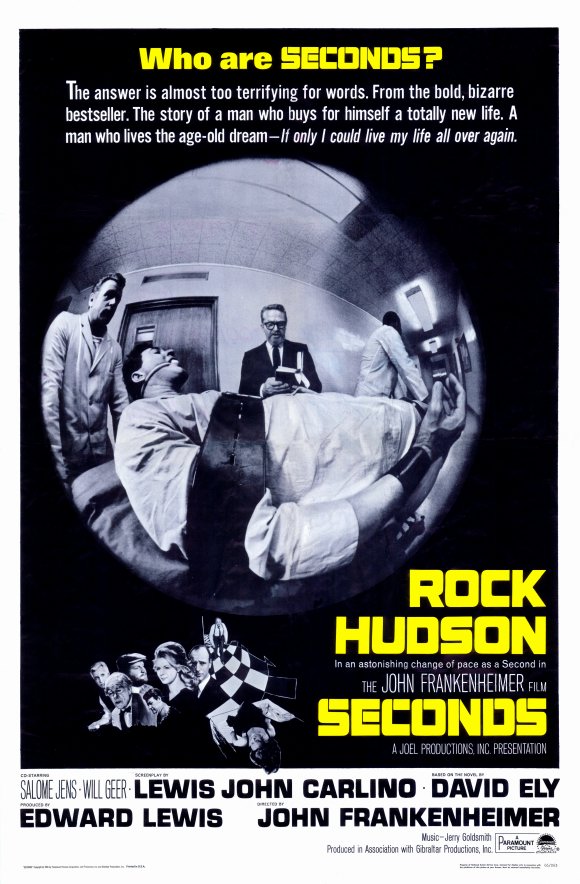
Seconds (1966)

By Richard Winters

My Rating: 8 out of 10

4-Word Review: Starting a new life.

Arthur Hamilton (John Randolph) is a middle-aged man just going through the paces of life. He is stuck in a marriage that no longer has any spark and a job that is boring. His life is confined to the basic suburban rituals and he is quietly looking for a way out. Then he gets a call from Charlie Evans (Murray Hamilton) who he thought was dead. Charlie tells him that he is very much alive, but with a new identity. Arthur goes to a address that Charlie gives him and there he is told for $30,000 dollars he can be ‘reborn’ and given a completely new identity via plastic surgery as well as a whole new life with new friends and no connection to his dreary past. He would even be given a new set of fingerprints and new teeth while the death of his former self would be created in a way that it would leave no question, or suspicion.

This story is unique and fascinating on many levels. It pinpoints the monotony of middle-aged life and views living in suburbia not as the great American dream, but more as the American trap. I enjoyed the part where one of the Doctors named Davalo (Khigh Dhiegh) tells Arthur who has now been changed into Tony Wilson (Rock Hudson) that his new identity will be that of an established painter and he will no longer have to be quarantined with any responsibility and will instead be able to live the rest of his life pursuing is own individual interests, which is probably what everyone secretly desires.

The second half of the story where Tony tries to adjust to his new ‘dream’ lifestyle is equally as interesting if not more. Tony finds that his new friends and neighbors are other ‘reborns’ who will not allow him to backtrack into his old identity and seem compelled to keep in line with his new environment whether he was completely happy with it or not. During this segment I couldn’t help but think of the characters from Easy Rider and how Tony’s situation wasn’t much different. Both longed for complete personal freedom, but the more they tried to escape the societal strings the more they seemed to be dragged back into it. The part where Tony goes back to visit his wife while under the disguise of being a long lost friend of her late husband is revealing and dramatically the strongest part of the whole film.

John Frankenheimer’s direction is superb and intoxicating. The opening sequence featuring a lot of distorted imagery is excellent and creates a terrific mood for the story. The dream sequence where Arthur finds himself in a hotel room with another woman is captured in such a way that it looked almost like a Salvador Dali painting. The use of the fish-eyed lens that is put in at certain strategic moments is effective as well as stylish. The black and white cinematography is evocative and the organ playing soundtrack is distinct and moody.

Rock Hudson has always seemed to me as a weak leading man and apparently Frankenheimer considered him ‘lightweight’ as well, but when his first two choices turned down the role he decided to go with him and here it actually worked. I felt Hudson’s blank expression and confused demeanor fit well with the character’s situation. The part where he is shown tied to a bed and struggling to get out while his mouth is gagged is convincing. Veteran actor Randolph is quite good in the beginning playing Arthur a man who seems run over by life. The close-up of his nervous and sweating face leaves a strong impression. Will Geer is also excellent in support as the founder and head of the secret organization.

The twist ending is well done although I saw it coming long before our naïve protagonist did. Unlike the book it is clearer and less vague. This is one case where the film can make a great companion piece to the book, or vice versa. This is a definite sleeper of a movie screaming for more attention and has strong cult potential.

My Rating: 8 out of 10

Released: October 5, 1966

Runtime: 1Hour 46Minutes

Rated NR (Not Rated)

Director: John Frankenheimer

Studio: Paramount

Available: VHS, DVD,  Blu-ray (Criterion Collection) Amazon Instant Video