Monthly Archives: December 2011

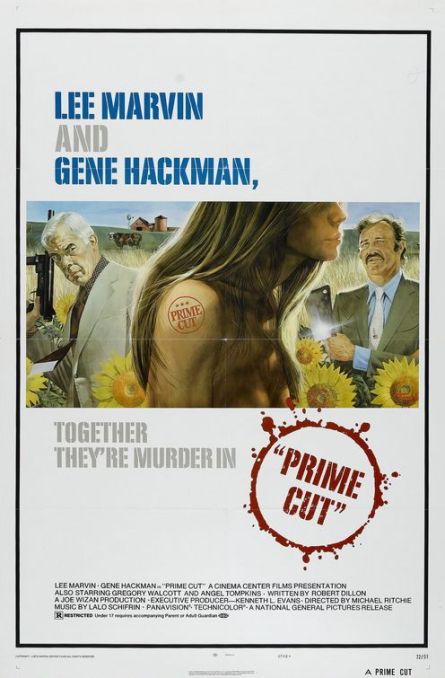
Prime Cut (1972)

By Richard Winters

My Rating: 8 out of 10

4-Word Review: Shoot-out in Kansas.

If you enjoy a great compact action flick, but are tired of the same old formula then Prime Cut may be for you.  It is the story of Nick Devlin (Lee Marvin) who is head of the crime syndicate in Chicago who travels to Kansas City to take on the head of their syndicate and avenge the death of one of their men as well as recouping an unpaid debt.

The movie has a lot of great offbeat touches that starts during its opening montage that takes place in an actual slaughterhouse.  Here you get a graphic glimpse of the inner mechanics of meat packing while soft, romantic piano music is played in the background.  The credits are displayed in a way that makes them look like they are being sliced by a meat cutter with cool meat cutting sound effects.  From here the quirky elements just keep coming. There is a wild chase through a wheat field where Marvin and Sissy Spacek find themselves attacked by a giant wheat thrasher that eats up their limousine and spits out the car parts into hay bails.  There is also a well filmed shootout amidst a sunflower field as well as Spacek’s revealing see through dress, which she wears to a posh restaurant and a giant plastic cow that gets shot up with holes and spews out milk.

This film is so unique that I am amazed it hasn’t acquired a stronger cult following. It stands up very well by today’s standards and even seems a bit shocking as it includes a scene involving white slavery where drugged young women are caged naked in stalls just like cattle and ranchers inspect and bid on them.

Marvin does well in his tongue-and-check role and pretty much steals it. He speaks his snappy lines in his usual terse manner with his famous stone expression, but he does it with a wink in his eye and at times even shows a soft side.  Sissy Spacek, in her film debut, looks young and fresh faced here. She is pretty and appealing in a very natural way. Only Gene Hackman as the villain named Mary Ann seems wasted. He does a good job for the material that he is given, but he needed more screen time and his character is not allowed to evolve at all.  Honorable mention also needs to go to Gregory Walcott as Hackman’s slimy henchman named Weenie.  The two get involved in an amusing scuffle while their accountants sit at their desks and busily add up their numbers and futilely try to ignore them.

Director Michael Ritchie nicely captures the Kansas landscape and gives it a very picturesque quality. It is probably the best on-location shooting of Kansas since Picnic. I did wish that the film was a little longer and showed more of a history between the two adversaries. It also seems to run out of steam at the end with a final shoot-out that isn’t all that clever or exciting and not up to the standards of the rest of the film.  Still this movie should appease any action fan and the story and direction are consistently original.

My Rating: 8 out 10

Released: June 28, 1972

Runtime: 1Hour 28Minutes

Rated PG

Director: Michael Ritchie

Studio: National General Pictures

Available: VHS, DVD
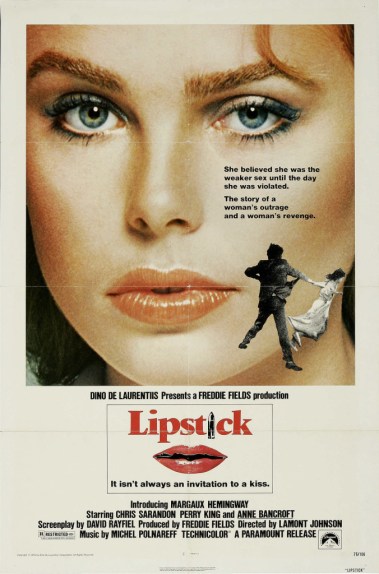
Lipstick (1976)

By Richard Winters

My Rating: 3 out of 10

4-Word Review: Don’t get her angry.

During the mid-70’s, Margaux Hemingway, granddaughter of the legendary author Ernest Hemingway, was one of the most photographed and highest paid models in the business, in fact she was the very first model ever to be awarded a million dollar contract.  After appearing on the June, 1975 cover of Time magazine she caught the eye of famous Hollywood producer Dino De Laurentiis who thought he could turn her into a star. The idea was to prove that she wasn’t just another pretty face by casting her in the difficult and challenging role of a rape victim, which they hoped would affirm her as a ‘serious’ actress. The gamble failed and she appeared in only a few more B-pictures even though her kid sister Mariel, who was cast in the film by Marguax’s suggestion, ended up having her career take off. Alcoholism and depression followed before she eventually committed suicide in 1996 at the age of only 42.

The story is basically just another tired exercise in the now cluttered rape and revenge genre. Chris McCormick (Marguax) is a beautiful lipstick model who is brutally victimized by a weirdo named Gordon Stuart (Chris Sarandon). She is dragged through the long and arduous court proceedings only to have him found not guilty and then start to stalk her younger sister (Mariel), which forces her to take matters into her own hands.

Right from the beginning this film comes off as very clumsy dramatically. Gordon is the high school music teacher of her younger sister Kathy. Chris is introduced to him at one of her photo shoots, but is too busy to listen to his music tapes, so she gives him her home address and tells him to ‘stop by anytime’.  Now, back in the 70’s people may have been a little less cautious than they are these days, but giving one’s home address to a man that she barely knows and isn’t interested in just to listen to one of his weird music tapes seems utterly ridiculous.

The rape happens almost right away before there is any character development. It almost seemed like this was the intended leering ‘highlight’ of the film with the rest just thrown in as second-rate filler. Wikipedia describes this scene as being one of the most ‘infamous in film history’.  That may have been the case at the time, but since then there have been many films that have exceeded what you see here, most notably in the controversial French hit Irreversible. Personally, I didn’t find it to be all that extreme. The one good thing I could say about it is that Sarandon is effectively menacing. I also liked the way his character is initially shown to be very meek and geeky and his inner-rage only comes out after he feels he has been slighted, which I felt made him a little less one-dimensional.

The courtroom scenes fall flat. Normally I find a good court drama to be riveting, but here it is stagy, phony, and uneven. The best thing about this segment is the presence of Anne Bancroft as Chris’s attorney Carla Bondi. She helps give the picture some stature and I wished she could have been in more of it.

If the film comes together at any point it is after the assailant is found innocent and Chris is forced to try to move on with her life and career despite the emotional toil and stigma. This segment has a certain socially relevant drama quality and to an extent it works even though it is brief. It also conveys some rather alarming statistics including the fact that only 10, 000 out of an estimated 50,000 rape cases every year actually ever get reported and only 2 out of 100 rapists ever get convicted. Since the credits list experts in the field that were consulted I can only assume that these numbers were accurate. Things may have hopefully improved since then, but the figures still seemed startling. However, all of this gets undermined by a tacked-on, manufactured, over-the-top, Rambo-like finale that relies too much on extreme coincidence and severely stretches the credibility.

I also found the film’s visual style to be unappealing. The colors are garish and gaudy while captured through a soft focus lens that resembles a model shoot in a glamour magazine and gives one a glossy trash perception.

I can see why Mariel made a strong impression with viewers. Her testimony on the stand is both touching and heart-wrenching and her emotionalism seems genuine and gripping. Marguax does not fare as well. Although her performance improves as the film progresses I still felt she was in way over her head and her nasal sounding voice is a bit irritating.

Although this film was pretty much panned by critics and audiences alike upon its initial release there is a new generation of people who feel it is underrated as evidenced by the many positive comments about it at IMDB. I approached this with an open-mind, but couldn’t help but come away from it feeling it was exploitation from beginning to end and even at that level it seemed derivative and uninspired. The whole thing left me cold and feeling like I wasted 90 minutes.

My Rating 3 out of 10

Released: April 2, 1976

Runtime: 1Hour 29Minutes

Rated R (Rape, Violence, Mature Theme, Language)

Director: Lamont Johnson

Studio: Paramount

Available: DVD, Amazon Instant Video

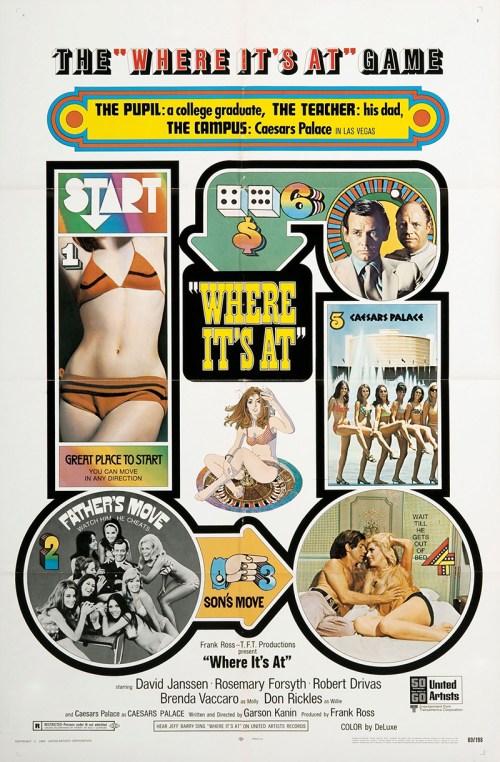
Where It’s At (1969)

where1

By Richard Winters

My Rating: 2 out of 10

4-Word Review: Father and son argue.

Garson Kanin, best know for penning such comedies as Adam’s Rib (1949), The Girl Can’t Help It (1954), and Born Yesterday (1950), tries his hand at drama here.  David Janssen plays a Las Vegas Casino owner who tries to train his son (Robert Drivas) in the business, so he can take over.  The father is a hard-bitten realist while the son, who has just graduated from college, is a strong idealist.

One of the main problems with this film is that there is nothing distinctive about it.  The arguments between the father and son are  typical stuff. The same topics were argued between ‘Meathead’ and Archie in ‘All in the Family’, but at least there they were funny.  Despite Kanin’s reputation, and despite what some sources list, this film is definitely not a comedy.  There are a few amusing bits by Brenda Vaccaro, who plays Janssen’s secretary and easily steals the film, but that is it.  The rest is  by-the-numbers drama that gets played out in a methodical way.

Despite the Las Vegas setting the sets are dull looking and unimaginative. The opening theme song by Jerry Ball is terrible and the characters unappealing.  I could never get myself involved in the story and kept checking my watch the whole time.

I was interested in seeing this film simply for the presence of Janssen.  I am a big fan of the old ‘The Fugitive’ TV series and was impressed with his work on it.  This film certainly does prove that he can act as his character here is the exact opposite of the Richard Kimble one on the TV show.  There he was always mild-mannered and self-effacing.  Here he is obnoxious and abrasive.  Unfortunately the character stays too one-dimensional in a negative way.  There is never any soft side revealed and thus causing the viewer to be uninterested in seeing what happens to him.

Robert Drivas as the son is another talented and interesting actor whose life and career was sadly cut short by AIDS in 1986.  He had some memorable performances in various TV-shows including ‘The Wild Wild West’ as well as in the movies The Illustrated Man (1969) and Joseph Strickland’s independent classic Road Movie (1974). However, his best ability was in conveying a dark brooding side to his characters, which doesn’t work here.  You never believe for an instant that the character is all that innocent, or honorable because the dark elements start coming out from the beginning.

Don Rickles appears briefly as a card dealer who starts stealing from the house.  When he is caught he breaks down into a long crying spell before he is demoted to a full-time dish washing job until he can pay the money back.  Rickles as a comedian is funny, but as a serious actor he is limited.  Yet it was still fun seeing him play such a wimpy and passive person because it goes completely against his persona.  The film might have been stronger had there been a few more scenes with him.

The film does have a bit of an interesting twist towards the end where the son decides to turn the tables on his father and takes advantage of one of his father’s shady deals by purchasing the casino from under him and then throwing the old man out on the street.  This of course shocks the father and forces him to reevaluate his values as well as what he has taught his son. This might have been more intriguing had the exact same theme not been done so much better in The Godfather movies as well as Harry Chapin’s classic son ‘Cat’s in the Cradle’.

My Rating: 2 out of 10

Released: May 7, 1969

Runtime: 1Hour 46Minutes

Rated R

Director: Garson Kanin

Studio: United Artists

Available: Amazon Instant Video

Thieves (1977)

By Richard Winters

My Rating: 1 out of 10

4-Word Review: A couple drifting apart.

Sally and Martin Cramer (Marlo Thomas, Charles Grodin) are a middle-aged, married couple whose relationship is slowly drifting apart.  They were once connected through their youth and idealism, but now Martin is older and more cynical. He just wants to settle down and live the quiet life as he feels ‘the world is not worth saving’. Sally is still the idealist, she teaches at an inner-city school and even wants to adopt a young African-American boy, which Martin does not want because of the boy’s propensity to steal things. Sally is also pregnant and considering an abortion. The film consists mainly with them arguing about these issues while considering divorce and having affairs.

The film did not go over well with the critics at the time of its release and I was surprised because it was written by renowned playwright Herb Gardner.  I was impressed with Gardner’s talents after seeing the film A Thousand Clowns, which was based on one of his plays. I enjoyed his offbeat characters and situations as well as the sharp one-liners.  I was expecting more of the same here, but found this to be flat and slow going. The idea of having a couple argue almost endlessly for the entire movie can be tough to pull off, but has been successfully done. Most notably in Made for Each Other starring real-life husband and wife Joseph Bologna and Renee Taylor as well as Can She Bake a Cherry Pie?. However, in both of those films the characters were eccentric and interesting and their fights were lively and animated.  Here the characters are dull to the point that there is really no reason to care how their marriage turns out, or even what happens to them. Their arguments become almost soap opera like. Yes, some of the dialogue is eloquent and you can tell it was done by a playwright, but there still needed to be more action and cutaways. The overall mood of the film is very downbeat and paints the city of New York and modern life in general as an urban hellhole.  There could be some truth to this, but it ends up becoming real depressing when the viewer gets beaten over the head with it the whole time.

Although billed as a comedy there is very little of it. The majority is heavy drama and the comedy that they do have comes off as forced, unimaginative, and heavily reliant on stereotypes. For instance Sally makes all her inner-city students put their weapons into a box before they enter her class. I thought it would have been more believable had one of them decided to use them on her, but they never do. Despite the ‘rough and tough’ image the kids seem strangely compliant.  Martin is a principal at a snotty private school, so his problems are at the other end. One scene has him ‘negotiating’ with a spoiled ten year old to come out of his limousine and into class, which is equally contrived.  There is also the strange neighbor who lives in the apartment beneath theirs and is played by actor Hector Elizondo.  He makes random, weird comments throughout that supposedly are used for comic relief, but end becoming quickly irritating.

I thought it would be fun to see Marlo Thomas in a film role as she has done very few of them in her career. She is most well-known for playing the part of Ann Marie the struggling actress in the 60’s TV-series That Girl. Her character was known to be very naïve and proper in that series. Here her character is more jaded and savvy, which makes for an interesting comparison although she is known as a feminist and liberal activist in real-life, so if anything this character more closely identifies with her true personality. She does end up giving an excellent performance overall. Charles Grodin does not fare as well. Usually his sardonic humor and dry approach can elevate even the blandest material, but here the maudlin script ends up pulling him down. Even Grodin fans who have seen this film stated that he seems to be just going through the motions. I also didn’t like the fact that he has a flute and ends up constantly playing the same sad tune. Noted character actors Gary Merrill and Mercedes McCambridge appear as homeless people, but are not given a single line of dialogue, which I found to be frustrating and a waste of their talents.

If there is one positive thing to say about this dreary production that has no visual or cinematic style it is in the presence of Irwin Corey, who plays Sally’s racist and scatological father.  He manages to liven up all the scenes that he is in and I came away impressed as he is mainly a stand-up comedian famous for his bawdy Professor Irwin Corey act. I was even more impressed to find that as of this writing he is still alive and well at the ripe old age of 97 and still doing his comedy act while married to the same woman for over 70 years. A documentary about his life and career called Irwin and Fran is set to be released later this year. Judging just from the trailer it looks more interesting and enjoyable than this film.

My Rating: 1 out of 10

Released: February 11, 1977

Runtime: 1Hour 32Minutes

Rated PG

Director: John Berry

Studio: Paramount

Available: Netflix Streaming

The Choirboys (1977)

By Richard Winters

My Rating: 3 out of 10

4-Word Review: These guys are crude.

I’ve been a fan of author Joseph Wambaugh ever since I was fourteen and read ‘The Onion Field’, which I found to be incredibly gripping.  Wambaugh, a former policeman turned author, usually writes stories about cops that are laced with drama as well as humor.  ‘The Choirboys’ novel had all of these ingredients and rose to the top ‘New York Times’ bestsellers list. Unfortunately the film version did not do quite so well.  Wambaugh hated it and continues to lambast it even in interviews today.

Most others disliked the film as well although there are a few who liked its outrageous humor.  As any good reviewer I wanted to be open-minded.  The film has languished in obscurity for decades.  It was released to theaters just two days before Christmas in 1977 and then faded out quickly.  It has never been shown on broadcast television. It was released to VHS on 1993, but copies of it are rare.  It has never been released on DVD, but just recently it has become available on the Netflix streaming option as well as Starz Play. So if you still want to see this film after reading this review, then that is where you can find it.

The film, like the novel, starts out with a scene from the Vietnam war where we see a soldier trapped in a cave and panicking as the enemy moves in.  It then cuts to the present day where a group of policemen who, after a grueling day of work, routinely let loose by having what they call ‘choir practice’ in the evenings.  This is simply a code word used as an excuse for hard partying and practical jokes, which takes up the whole first half of the film.  The second hour turns dramatic as that same soldier that was trapped in the cave, and is now one of the policemen, has a frightening flashback which leads to tragedy.  His police buddies try to cover it up and the rest of the movie deals with the subsequent investigation.

One of the biggest drawbacks to the film is the incessant amount of pranks and juvenile behavior that is shown, which quickly becomes  redundant.  I did like the part where one of the jokes goes too far and one of the men yells out “let’s get out of here before somebody calls the cops”.  I also like the statement George DiCenzo’s character says to a prostitute as he is having sex with her.  It is very anti-PC, but a laugh-out-loud moment nonetheless.  The rest of the pranks are dull and unimaginative. Director Robert Aldrich could have cut ninety percent of it and still made his point. It all ends up making cops look like inane buffoons without balancing it with their humanity like the novel did.

The second hour deals more with the drama, but really isn’t much better.  The lighting is dark and shadowy.  The shot composition has no visual flair and ends up looking more like a cheap TV show than a movie.  The editing is very choppy and the film fails to find a good pace or momentum.

There are a few bright spots.  I really liked the Burt Young character. Many people remember him best from the Rocky movies.  Here he plays an incredibly grungy, crass police sergeant who exposes a tender side at a completely unexpected moment.  I also liked Don Stroud’s performance as the unhinged policeman.  In many ways I felt he carried the majority of the movie.  Perry King is also good as a cop hiding a dark side.  He does real well in these types of parts and reminded me of his performance in The Procession of Joel Delaney. The movie also stars the very durable Charles Durning, which is also a good thing.  As of this writing he is now eighty-seven years old and has four, yes four, projects on his slate for this year alone.

The film though does not live up to the novel and reading the book in this case would be the much better choice.  Normally I dislike Hollywood’s recent penchant for remaking old films, but in this instance I would applaud it.

My Rating: 3 out of 10

Released: December 23, 1977

Runtime: 1Hour 59Minutes

Rated R

Director: Robert Aldrich

Studio: Universal

Available: VHS

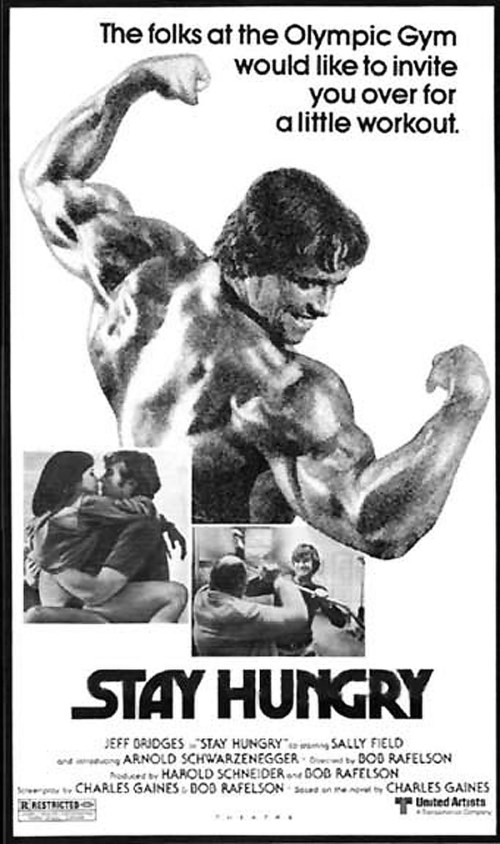
Stay Hungry (1976)


stay hungry 2

By Richard Winters

My Rating: 3 out of 10

4-Word Review: Read the book instead.

Craig Blake (Jeff Bridges) is a young southern man left alone with his butler in a big mansion when both his parents die in a car crash.  He works at a shady investment firm run by the con-man Jabo (Joe Spinnell).  They have managed to purchase all the other buildings on a block except for a workout gym. Craig is told to meet with the owner of the gym named Thor (R.G. Armstrong) and transact a purchase, so the firm can use the space to build a high-rise office complex.  However, once Craig meets with some of the people working there, including Joe Santo (Arnold Schwarzenegger) who is a body builder and uses the gym to prepare for the Mr. Universe title, as well as the pretty receptionist Mary Tate (Sally Field) he starts to have second thoughts about going through with the deal.

The film is based on the 1972 best-selling novel of the same name by Charles Gaines. There are quite a few differences between the book and the film, with the novel being much better. In the book there is no real estate firm, or potential acquisition of the building. Craig is simply bored with life and goes to a gym on a whim and uses the idea of bodybuilding as a way to find an identity. The book also features a camping trip that the group goes on and a fascinating psychedelic experience that Craig has when he takes an illicit drug that was completely cut out of the movie. The book has much richer characterizations and a profound philosophy that is devoid in the movie.

The film is poorly paced. Nothing really seems to happen and it only comes together at the end and by then it is too late.  Director Bob Rafelson tries to make the movie take on too many things. It shifts awkwardly between drama and sardonic comedy, but fails to achieve any type of cohesion, or momentum.  The flow is more like a European style of filmmaking where the story is told in a more relaxed pace and features long takes and side conversations. However, the dialogue isn’t interesting enough to carry it and the film focuses too much on the relationship between Craig and Mary, which happens too fast and doesn’t seem to have enough chemistry.

I also didn’t like how the character of Craig is portrayed. Bridges gives his usual dependable performance, but he has no southern accent even though he is from the area and everyone else speaks in a very thick one. He talks and acts much more like he is from the west coast and, like the viewer, acts as if he is some detached stranger that is just passing through with no real roots in the area, people, or customs. I think the Hollywood producers intentionally did this because they figured mainstream audiences could not relate to a southerner, who are still straddled with the unfair stigma of being hick, redneck, and racist. So the character was modified to bring broader appeal, but in the process becomes unrealistic and a bit annoying.

On the technical end it is okay although the budget looks limited. Filming on-location in Birmingham, Alabama helps, but I would have liked to have seen more of the area. There are a few unique scenes that make it somewhat enjoyable. One includes Craig stealing a painting off the wall of an office and another involves a throng of half-naked body builders spilling out onto the streets of the city and holding up traffic. There is also a very violent altercation at the end between Craig and Thor that features them battling with each other while using equipment from the gym. The action here is choreographed and edited nicely and looks genuinely real. There is also a brief moment where Field and Bridges go water skiing that was done by the actors themselves and not stunt doubles.

Schwarzenegger is appealing in what is considered his first official acting debut since in his previous two films his voice was dubbed and he had no speaking lines in the other. I liked the way the character is humanized here and shown with a different side to him including having him play the fiddle in a country band. Field is good playing a very feisty and rambunctious character. It also features her in a nude scene although it is from the back only. Woodrow Parfrey also deserves mention as Uncle Albert simply because his eccentric acting style always grabs your attention even in the smallest of roles. He also is the film’s narrator and speaks with the most authentic, best sounding Southern accent out of everyone.

R.G. Armstrong is by far and away the most memorable part of the film. He wears a hilariously awful wig throughout and is slimy in a real goofy way in every scene he is in. His best part comes when he has sex with a couple of prostitutes while on some of the workout machines. He also did, at age 60, his own nude scenes, so you have to give him credit there.

stay hungry 1

My Rating: 3 out of 10

Released: April 23, 1976

Runtime: 1Hour 42Minutes

Rated R

Director: Bob Rafelson

Studio: United Artists

Available: VHS, DVD

What Ever Happened to Baby Jane? (1962)

By Richard Winters

My Rating: 7 out of 10

4-Word Review: Living in the past.

This is a classic horror film that managed to resurrect the sagging careers of acting legends Bette Davis and Joan Crawford. It also spawned a whole new ‘psychobiddy’ genre of films. The movie is based on the 1960 bestselling novel by Henry Farrell.

The story takes place almost exclusively in an old, rundown Hollywood mansion where two aging, feuding sisters live. Baby Jane Hudson (Davis) was at one time a big child star, but never managed to cross-over to adult roles. She lives in a fantasy world, refusing to move on with her life, and takes out her frustrations on her crippled sister Blanche (Crawford), who at one time was a big movie star until a horrible car accident left her bound to a wheelchair.

The real-life feud and animosity that the two stars had for each other is now legendary. Some of the things the two said about the other is hilariously over-the-top and too many to quote here, but well worth checking out. When you hear of all the incredible things that the two did to each other behind the scenes you almost become amazed that the film was ever able to get made. I wished that a documentary had been filmed examining the movie’s production as that could have been almost more entertaining than the film itself.

All things considered, Davis is nothing short of fabulous here. She should have won the Oscar hands down and she pretty much steals the film. She also wore gaudy make-up that gives her an almost ghost like appearance. Crawford is very good as well, but her role is not as flashy. Sadly for her this was her last hurrah as her alcoholism took its toll and her roles after this were in B-movies while Davis went on strong for the next twenty years.

Of course some may argue that the real star was director Robert Aldrich. I liked the bird’s-eye shot of Blanche spinning around in her wheel chair in frustration and terror. It is brief, but gives the viewer a very unnerving feeling. The scene where Baby Jane does an old rendition of one of her routines that she did as a child in front of a mirror that she has set-up in her living room that is also surrounded by stage lights is a nice directorial touch. The campy opening that takes place in 1917 that shows Baby Jane at her peak is memorable as is the very offbeat climatic sequence on a crowded beach. I also got a real kick out of all the Baby Jane toy dolls.

Victor Buono deserves mention as he was nominated for the supporting Oscar for his role as Edwin Flagg, the fledgling composer who Baby Jane hires to help resurrect her stage show. Although best remembered for his comedic skills he was also quite good in his serious parts and his immense girth always made his presence known. I enjoyed how they form this weird quasi-relationship that is based solely on each other’s lies and delusions.

I did have a few complaints to what seemed to me to be some serious logistical flaws. One is the fact that Blanche is stuck in her upstairs bedroom with no way to get downstairs. You would think that with all the money that they once made that they would’ve been able to afford building either an elevator, or a chair lift. It also seemed implausible to believe that Blanche had been stuck in her bedroom since 1935 when she had her accident, until present day 1962, which is what the film seems to imply. As much as I liked the African-American housekeeper Elvira Stitt (Maidie Norman), who is well aware of Baby Jane’s psychosis and has no trouble standing up to her, I thought it was awfully dumb the way she set down a hammer that she was holding right in front of Baby Jane and then turned her back to her, which allowed her to be attacked that anyone else could have predicted would happen. I also felt there was a little too much background music that at times got a bit melodramatic.

Still, this is a great film that his highly entertaining from beginning to end. With the exception of some of Baby Jane’s ‘dinner surprises’ the film is devoid of any real scares and there is no gore, which may disappoint today’s younger, more jaded viewers. However, the film has a very strong, dark psychological undercurrent, which proves to be immensely fascinating and will be appreciated by those who are more sophisticated. The film’s theme, which is that of Hollywood’s fickle, vicious cycle of fame, is universal and as strong today as it was back then.

It is interesting to note that the director’s 18 year old son William, who appears at the end as a lunch attendant at the beach, produced  29 years later the made –for-TV remake of this film that starred the Redgrave sisters, but was not as good. Also director Aldrich later made two variations of this same story. One was Whatever Happened to Aunt Alice which he produced and starred Geraldine Page and Ruth Gordon and also the British classic The Killing of Sister George which he also directed.

My Rating: 7 out of 10

Released: October 31, 1962

Runtime: 2Hours 14Minutes

Rated NR (Not Rated)

Director: Robert Aldrich

Studio: Warner Brothers

Available: VHS, DVD, Blu-ray, Amazon Instant Video

The Late Show (1977)

By Richard Winters

My Rating: 6 out of 10

4-Word Review: Quirky couple solve mystery.

Ira Wells (Art Carney) is a crusty, old-fashioned detective from a bygone era who has settled down into retirement while renting out a small bedroom in the house of a sweet old lady (Ruth Nelson). One night he is visited by his old friend and fellow detective Harry Reagan (Howard Duff) who has been shot and dies before he can tell him the identity of his killer. Ira makes it a pledge to avenge the death of his friend and bring the killer to justice.  At the funeral he meets a flighty, free-spirited woman by the name of Margo Sperling (Lily Tomlin). She tries to hire Ira to get him to find out who has kidnapped her pet cat and holding him for ransom. Ira initially refuses until he finds out that his friend Harry had been investigating the case before he was shot.

Although billed as a comedy this is really much more of a gritty crime-drama molded as a modern day film noir. I think this is what threw me off when I first saw the film as well as audiences of the time.  With those two leads I was expecting a lot of zaniness especially with the pairing of such divergent characters. There is some subtle humor at times and one instance where Margo drives a van throw the front yards of some houses while escaping the bad guys, but overall the emphasis is really on the characters and the mystery. On this end it is okay. The mystery is intriguing enough to keep you involved and has a few nice twists and an array of weird suspects. Eugene Roche is the most amusing as Ron Birdwell, a man who is constantly trying to sell merchandise that he has stolen and has cluttered throughout his house.

The two lead characters propel the film and are well developed. Both actors play their parts well. I thought this was quite possibly Lily Tomlin’s best performance. It is also one that mostly closely resembles her true personality.  I enjoyed how at first both disdain the other, but then quietly come to appreciate each other and even grow a certain fondness and attachment.  However, I was disappointed that the film did not go further with this.  I thought the characters were highly believable and would have liked to have seen more conclusion as to what happens with their budding friendship. Personally I would have liked the first hour of the movie dealt with the initial case and then had them team up to solve an even more complex one in the second hour. A sequel or series would have been even better as it is certainly a potent premise.

One thing that really impressed me was writer-director Robert Benton’s keen eye for detail even with the little things. Although not always consciously noticed by the average filmgoer, the little things such as lighting, set decoration, and staging can having a very strong effect as to whether the film succeeds, or not.  A good director will always pay close attention to this while the poor one will overlook it, or cut corners. One example of this is Ira’s bedroom, which had the cluttered look most people’s homes have, but most movies fail to effectively recreate, as well as pictures and artifacts from years past that helped explain the character in a visual way. There is also a scene where Ira is doing his laundry at the local Laundromat while Margo talks to him about the case. I thought this was a nice touch as usually movie characters are never shown doing mundane daily tasks even though it is something most regular people have to spend a lot of their time doing. I noticed that he put in his clothes first and then the detergent, which I thought was a mistake. I presumed it was because actor Carney was just going through the motions and not paying attention, but then Margo mentions the error. This might have been an ad-lib on Tomlin’s part, but it is nice that they left it in as it helps accentuate the reality and shows even further how meticulous the detail was. I appreciated the scene involving actor Bill Macy who plays a bartender. Being a recently trained bartender I can attest that he mixed and served the drinks in the correct way, which isn’t always the case in other movies.

The Ira character also wears a hearing aid as did actor Carney in real life. There is one scene where Ira aims his gun and gets ready to shoot at a fleeing suspect, but just before he does he takes out his hearing aid. This makes sense as the loud sound from the blast at such short range would probably destroy the mechanism. The scene is so unusual that they added it into the film’s trailer and actress Tomlin even mentions it when she is interviewed about the film on the Dinah Shore show, which is part of the DVD’s special features. The only quibble I had here was that on the very next shot Ira has the hearing aid back in his ear and I thought it would have been too quick for him to have done that.

The only area where this film fails is in the use of the blood, which is a problem in a lot of movies. Blood is always a very dark red and yet here it is a bright red and looking almost like cherry syrup. When Ira investigates a murder scene he finds a long streak of this bright red stuff going along the carpet that looks quite evident that it was put on with a paint brush.

If you like a mystery that closely resembles the feel and pace of an old Phillip Marlowe case than you may enjoy this. It is technically well made in just about every aspect, but I still went away feeling that the films from the 30’s and 40’s end up doing it better.

My Rating: 6 out of 10

Released: February 10, 1977

Runtime: 1Hour 33Minutes

Rated PG

Director: Robert Benton

Studio: Warner Brothers

Available: VHS, DVD

Open Season (1974)

By Richard Winters

My Rating: 3 out of 10

4-Word Review: Humans are their prey.

This is the type of film that has a really great concept, but ends up being ruined with its poor execution. It is based on the novel ‘The All-Americans’ by David D. Osborn, who also co-wrote the screenplay. The story involves three ‘All-American’ suburban family men (Peter Fonda, Richard Lynch, and John Phillip Law) who once year go on a ‘hunting trip’ except here they hunt people. They typically pick their victims up at random and then drive them to their isolated hunting lodge in the woods. They feed and entertain them for a week and then give them a few supplies as well as a compass and tell them that the highway is twenty-five miles north.  If they are able to make it to the highway they are free and if not the three men will hunt them down like animals. The victims are always given a thirty minute head start, but none of them ever make it. The movie focuses on a man and woman (Alberto de Mendoza, Cornelia Sharpe) that are having an affair and are kidnapped by the three outside of a truck stop.

The beginning is well-done and quite easily the best part of the whole film. It goes back in time to when the three men where in college and accused of gang raping a young lady.  To the shock of the girl’s mother the prosecuting attorney tells them they have no case because these boys are great athletes with stellar reputations and nobody would believe they would do something like that. I liked this part for two reasons. One is the fact that at least we are given some sort of history to these culprits. A lot of movies never do this and you always wonder how these psychos where able to get away with it for so long. At least here we are given a backstory and somewhat plausible one at that.  Many sociopaths have been able to fool people for years simply because they smart enough to play the respectable role in society and bring out their deviance only when it is completely safe to do so. Also, athletes, especially in the past, where given much more leeway and many of their transgressions would get over-looked. So to me this made a lot sense and helped get me into the movie right away. I also liked the imagery used over the opening credits as well as the very haunting music score.

I also liked how the film then cuts to the present day showing the men at a neighborhood block party and interacting with their wives and kids. The three actors are perfect for their parts.  They were all B-actors who’ve made a career playing sleazy characters and fall into the roles easily. Richard Lynch is especially good. In real life he once set himself on fire in 1967 while taking LSD and his scarred, pale, and rough looking face always makes a creepy impression. Director Peter Collinson does some good camera work with detailed bird’s-eye view shots that show how sprawling the forest is and indeed gives the viewer a very remote feeling.

Unfortunately the rest of the film goes downhill. Part of the problem is that there is just too much talking.  In fact the whole middle section is spent with a lot of drawn out conversations that aren’t interesting, or well-written. It saps the tension out of the film until there isn’t any left.  It isn’t until the very end that they finally get around to letting the victims go out into the woods and then tracking them down. However, this too is poorly handled. The action is limited and not well choreographed. The whole sequence goes by too quickly and comes off like it was nothing more than an after-thought that fails to take advantage of its immense forest setting.  In fact for a film with such a sadistic and exploitive theme there is actually very little violence to speak of and no gore at all. The three bad guys also end up becoming quite banal and one-dimensional. They show no distinctive personalities whatsoever as they agree with each other on everything and seem to do nothing more than laugh and guffaw and each other’s juvenile jokes and antics.

If you are interested in watching this film then please don’t read any further as it may be considered a spoiler:

The film’s twist ending is weak as well. It features actor William Holden (a very accomplished actor and why he took this role, which amounts to nothing more than a cameo, I will never know) playing the father of the girl that the three men raped in college. He secretly followed the men on their hunting trip and decides to have his revenge by gunning them down just like they had done to all their victims. Again, the action here is handled in an unexciting and unimaginative way. I couldn’t buy into the fact that these men, who supposedly fought in Vietnam, would panic so quickly and act like a bunch of scared children the minute they found out that they were being shot at. They show no savvy or survival skills and allow themselves to be easily picked-off in an uninspired fashion.

I have always enjoyed Deliverance and I liked how this film used a variation of that theme where instead of the civilized man going out and coming to terms with the savage of the wilderness they instead go into the wilderness to come to terms with their own, inner savage. More action, better tweaking of the characters, and a faster pace and this film could’ve been a cult classic as the ingredients are all there. As it is now though I think it is much too bland to interest or intrigue anybody.

My Rating: 3 out of 10

Released: November 1, 1974

Runtime: 1Hour 44Minutes

Rated R

Director: Peter Collinson

Studio: Columbia Pictures

Available: VHS

Charley Varrick (1973)

charley

By Richard Winters

My Rating: 7 out of 10

4-Word Review: Charley outsmarts them all.

Charley Varrick (Walter Matthau) is a crop duster and former stunt pilot who in order to make ends meet robs small banks in and around the state of Nevada. He does this with the help of his girlfriend Nadine (Jacqueline Scott) as well as a young, quick tempered man named Harmen Sullivan (Andrew Robinson). Unfortunately the latest bank that they rob was a front for the mob and the money they take was already stolen cash and the mob is soon hot on their trail as are the police. Worse is the fact that Charley and Harman don’t seem to see eye to eye on anything, which leads to a lot of intense confrontations and intrigue at every turn.

Initially I felt Matthau may have been miscast. We are so used to seeing him in comedies that watching him in a movie that features gritty violence seems almost unsettling. However, as the movie wears on and the story gets more intricate I started to really enjoy Matthau’s character and felt he was a perfect fit. I loved how he is so laid back and unassuming and yet in his own subtle way still manages to outwit everyone, even the dangerous mob. The film definitely feeds off of the confrontations between Charley and Harman who are diametrically different in every aspect. The fact that Charley manages to get the upper hand on the otherwise violent prone, out-of-control young man makes it all the more pleasing.

Robinson again gives another outstanding performance. The guy is an amazingly intense actor, who has never been given his just recognition. The guy stole the film in his most famous part as the killer Scorpio in Dirty Harry and he practically does it here as well.

Woodrow Parfrey another unfairly over-looked character actor gives a delightful performance as the timid bank manager stuck between the mob and the police. The conversation that he has with the mob boss Maynard Boyle (John Vernon) out near a cow pasture where they ascertain that the cows may have it better in life than the humans is memorable.

The only actor that didn’t quite hit the mark with me was Joe Don Baker as the mob hit man named Molly. I liked the character who was this extremely cold, calculating killer smoldering underneath his calm façade with a nasty penchant for violence and sadism as well as an odd moral code. Baker seems to be having a lot of fun with the part, but I would have liked the character to have been bigger physically and a few more scenes showing just how mean and threatening he really was. Although politically incorrect to the extreme the scene where he ‘convinces’ the Sheree North character to go to bed with him is amusing.

The cinematography seems to be lacking. Nevada can be a scenic desert state if captured right, but that wasn’t done here. The majority of the action takes place in a dusty trailer park, which is expectedly bland visually. The bank that was chosen for the opening sequence was very ordinary as was the locale. I think they should have scouted around for something a little more exotic as the opening shot should always be something that should grab the viewer in and that certainly didn’t happen. Despite being directed by the legendary Don Siegel this whole thing had a little too much of a TV-movie look.

Another beef I had with the film is the segment where Charley goes to bed with a woman named Sybil Fort (Felicia Farr) who is the secretary of the mob boss that Charley wants to get into contact with. Charley barges into her apartment after disguising himself as a flower delivery man and then threatens to harm her if she screams. Then, just a little while later they go to bed together and she behaves like she has suddenly gotten really ‘in’ to him. I know in the post-sexual revolution 70’s and in Hollywood’s effort to always seem ‘sophisticated’ and ‘relevant’ it was common for characters of the opposite sex to go to bed together even if they had just met. Sometimes though this ritual seemed to border on the absurd and this scene here was a perfect example. This woman had no idea who this man was and who had threatened her just a short while before. Also, Matthau does not have the face or physique that most women are going to get the ‘hots’ for. My only guess is that this was meant to be an inside joke since Farr in real-life was the wife of Jack Lemmon and therefore they thought it would be fun to have Matthau go to bed with his best friend’s wife and also possibly live out a private fantasy. Either way it came off as dumb and forced.

Despite all of this it is an entertaining and fun movie especially for those who enjoy a story that emphasizes a clever battle of wits. A remake wouldn’t be a bad idea if it could give it a little more visual flair and a slightly better choreographed action.

My Rating: 7 out of 10

Released: October 19, 1973

Runtime: 1Hour 51Minutes

Rated R

Director: Don Siegel

Studio: Universal

Available: VHS, DVD, Amazon Instant Video