Tag Archives: Victor French

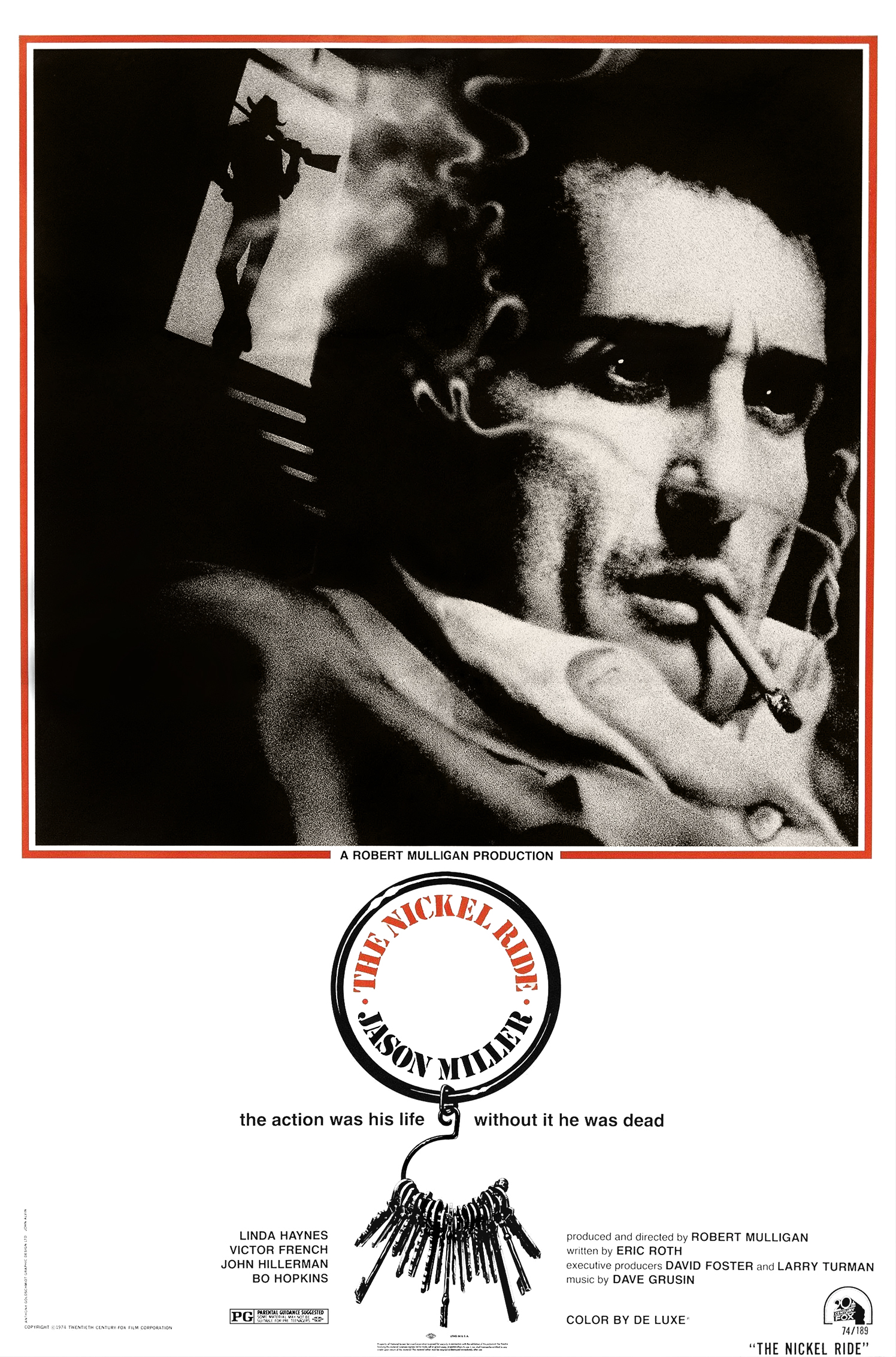
The Nickel Ride (1974)

By Richard Winters

My Rating: 4 out of 10

4-Word Review: No one to trust.

Cooper (Jason Miller) is a member of a Southern California crime family and harbors a large set of keys to local warehouses that are used to store stolen goods. Things though haven’t been good recently as he’s starting to feel that his crime ‘friends’ are turning on him. It all starts when Paulie (Lou Frizzel) whom he is close to, is unable to fix a fight, and then turns up dead. Feeling the pressure after a few close calls he takes himself and his girlfriend Sarah (Linda Haynes) out of the city and to a country cabin hoping the distance will protect them, but there’s soon signs that they’re being watched and the cabin even gets broken into while they’re away. Will Cooper be able to stave off those that want him killed, or become their next victim?

This film is best known as being the first screenplay written by Eric Roth, he wrote The Strangers in 7A in 1972, but that was a teleplay, and who later went on to win the Academy Award for writing Forrest Gump. While the script does start out with some good conversational dialogue where it shows criminals more as people than caricatures the element that really makes this film interesting is the cinematography by Jordan Cronenweth especially with the way it captures Los Angeles. So many other films focus on the glitzy side of the city, but here we’re treated only to its working-class neighborhoods filled with grimy old buildings and factories until it almost seems like it was shot in some rust belt city in the Midwest. The yellowish tint gives it a faded look and helps to symbolize, at least for me, Cooper’s fading out of favor with the syndicate.

The film also has stellar performances with Bo Hopkins being a stand-out. He plays this Joe Buck type of character. A self-styled cowboy who seems more performative than anything and who Cooper initially discards as a non-threat only to have him slyly start to tease that line. Haynes, looking at her most beautiful, is also excellent as a country girl with a hick accent, who quietly catches onto things quicker than Cooper expects, and who has a physical altercation with him, which is quite startling. The movie also features Victor French, who later found fame on the TV-Shows of ‘Little House on the Prairie’ and ‘Carter Country’, but here he doesn’t have a mustache and I didn’t recognize him until almost the very end.

Casting Miller in the lead is the most interesting aspect. Initially I thought he was given the part due to his breakout role as Father Karris in The Exorcist, but this movie was shot in the fall of 1973 well before the release of the other one, which didn’t come out until December of that year, so why the producers would take a chance on someone who was relatively unknown at the time I don’t know. His presence though works for the most part. The supporting cast do a better job at acting, but the stiffness that he displays helps accentuate his character being out-of-the-loop and essentially lost in his own movie. My only criticism with him comes when Hopkins enters his office and Miller displays a fearful look. Most people would be scared at that point as they’d have no idea if Hopkins, a rogue, quick trigger, is going to kill them, but when you’ve been in the criminal underworld environment, you’d know not to display such a vulnerable emotion to your would-be advisory.

The movies downfall, and the most likely reason why it did poorly at the box office, is that it’s way too talky. People are expecting action with these types of movies and for the first hour there’s very little. Things improve slightly during the second part when the couple moves to the cabin, but even here there’s some head-scratching moments like Cooper deciding to store his handgun in a drawer of a table that’s right next to the front door. If a bad guy breaks in, which would most likely be through the front door, he’d have no way to get to his gun as the intruder would be blocking his access to the drawer. Why even store the gun at all? Since he had no idea when they might be attacked why not keep the gun on him at all times?

Spoiler Alert!

The most annoying thing is when Hopkins steals away Miller’s rifle and then shoots Haynes dead. Cooper is then forced to try and run through the forest surrounding the cabin in an attempt at evading Hopkins. However, this all turn out to be a dream, which is a cop-out. Then about 8-minutes later, Hopkins again comes after Miller and shoots him with a rifle and this is not a dream, but why even have the dream aspect at all if the showdown between Hopkins and Miler is going to be inevitable anyways?

I did like the way Miller strangles Hopkins as it’s more delayed than in other movies where you’re made to believe you can successfully strangle a person in only a few seconds, but in reality, it takes much longer. Miller even makes grunting noises while he’s doing it in order to emphasize the amount of strength and pressure that would be required, which is great. However, when Hopkins does finally die, his neck does not display any abrasions or red marks even though it should’ve.

My Rating: 4 out of 10

Released: May 17, 1974

Runtime: 1 Hour 39 Minutes

Rated PG

Director: Robert Mulligan

Studio: 20th Century Fox

Available: DVD (2 Disc)
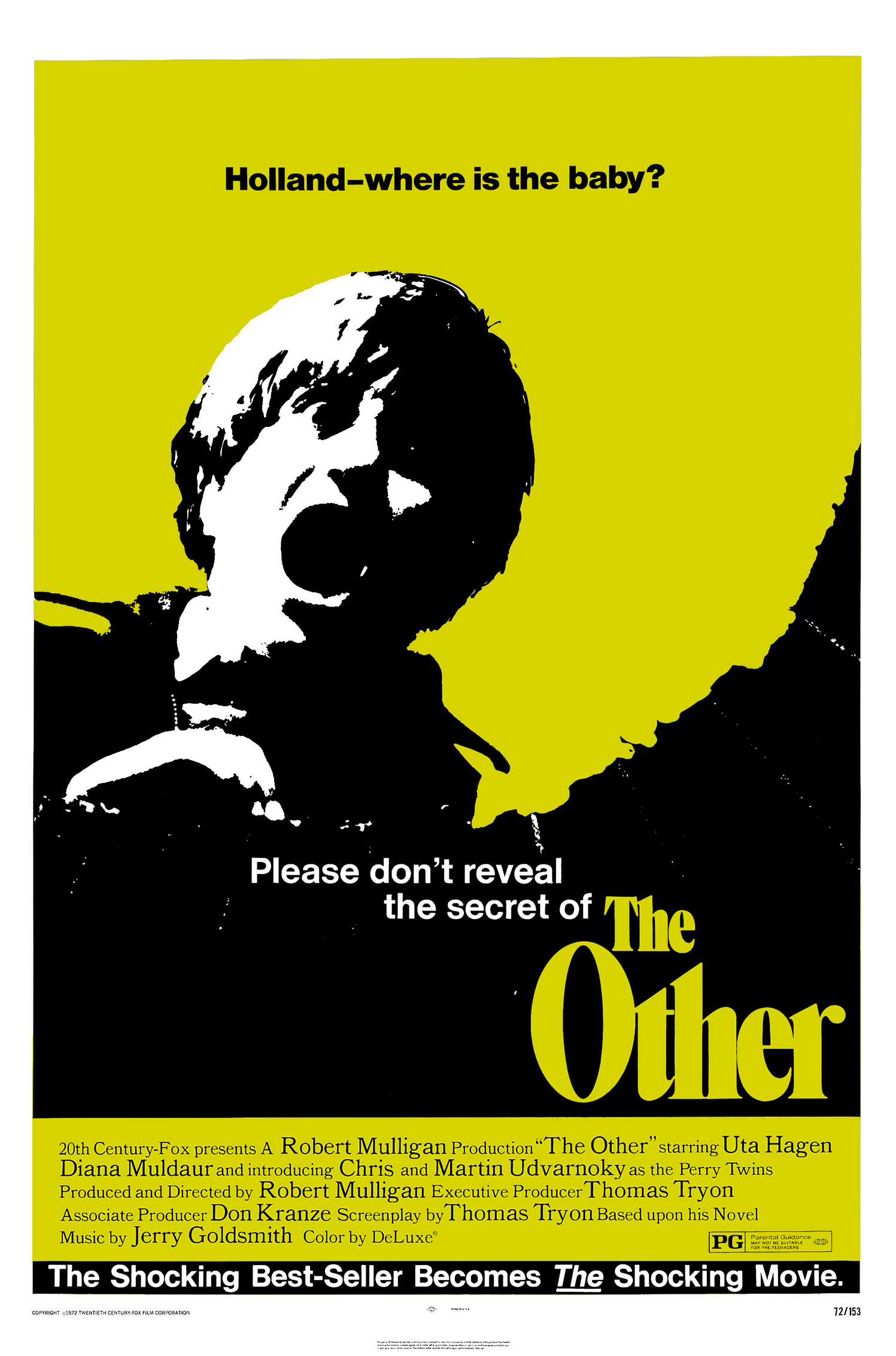
The Other (1972)

By Richard Winters

My Rating: 7 out of 10

4-Word Review: Twin brother causes havoc.

Niles and Holland (Chris and Martin Udvarnoky) are twin brothers living with their mother (Diana Muldaur) and aunt and uncle (Norma Connolly, Lou Frizzell) on an isolated farm. Niles becomes good friends with Ada (Uta Hagen) a neighbor lady who taps into Niles’ special abilities. She teaches him a technique in which he can separate his mind from his body and then have it harbor in another body be it a person, or animal, or even a bird. Ada though fears Niles is using this ability for evil purposes when those around him begin turning up dead. When his mother is found at the bottom of the stairs unconscious and stuck to a wheelchair the rest of her life afterwards Ada tries to convince Niles to give up the game, but Niles insists it’s really his brother Holland that’s committing the acts of violence and not him, but Ada refuses to believe him as she’s in on a secret that Niles is refusing to accept.

Tom Tryon, who had been an actor throughout the 50’s and 60’s, became frustrated at the quality of roles he’d been offered and wanted to try novel writing. After watching Rosemary’s Baby and seeing the reaction it got he decided to write his own horror story basing it on some of the experiences he had gone through while growing up in a small New England town. It took nine different rewrites before he was able to get it published where it became a best seller and allowed him to quit acting and become an author fulltime. When it was bought into a movie Tryon retained the rights to the story, which allowed him to write the screenplay though he later admitted to not liking the finished product and blaming it on the casting and editing, which had cut out a significant portion of the story, over 25-minutes of it, based on feedback from test audiences.

On the surface the film really doesn’t seem much like a horror movie, or at least what modern audiences have come to expect from horror. There’s no gore, several of the killings aren’t even shown and just implied, there’s also no shocks, or scares and the majority of the plot takes place outside in the sunshine versus the darkness of night. Initially viewers didn’t take to it too well and it lost money at the box office with many feeling that Robert Mulligan, best known for having done To Kill a Mockingbird, was not the right choice for this type of material with the biggest complaint being that the movie was ‘too beautiful’ and made more like a drama, which had been my feeling when I first saw it years ago on TV. However, after viewing it again in its complete form without any commercials I was able to get into it more and if one is patient, it can have many benefits.

It still could’ve been played up more, and I didn’t like the setting at all. It was shot in Murphys and Angel Camp, California even though the setting in the book had been a small town in the east. Originally Mulligan had wanted to shoot it in Connecticut, but since the story took place in the summer and they weren’t able to begin production until the fall he felt the leaves changing color would have a negative effect and thus choose to do it in the west, but topography is all wrong as all you get is very dry, brown, parched earth that doesn’t allow for much atmosphere. The eastern autumn foliage would’ve been to its benefit and made it even creepier as it would’ve reminded one of Halloween.

Despite this there are some good moments like the twin’s trip to the circus where they sneak behind the curtains and view the participants of the freakshow including witnessing a fetus floating in a glass jar of liquid, which is a great foreshadowing. Niles ability to view things outside himself like witnessing the point of view of a crow as it flies around the property is well done too though the best moment comes at the end when a baby is found missing during the night that creates a panic and is quite riveting both emotionally and visually.

The Udvarnoky twins was an unusual choice as they hadn’t been in any movies before, nor did anything films afterwards and only became aware of the roles through their grade school teacher who sent in their headshots upon learning that a film was being shot in the area and searching for twins to star in it. Originally the part was meant for Mark Lester, who could’ve done it easily since neither twin is ever in the same shot, but the brothers do admirably especially Chris, who sadly died at the young age of 49 from kidney disease, who’s able to carry the film throughout and in just about every scene though their constant whispering may eventually become irritating to some. Uta Hagen, who was known for being an acclaimed acting teacher as well as for her stage work, but had never been in a movie before, is splendid and the one element that keeps it both compelling and unnerving. Good work too by Victor French in a small, but pivotal bit and a young John Ritter.

Spoiler Alert!

The story was actually given three different endings. In the book we find that Niles is sitting inside a mental hospital as an adult and describing what happened through flashbacks. In the version broadcast on TV Niles is able to escape the fire set by Ada, but then through voiceover is heard talking to his dead brother where he states that they’ll be ‘taken away’ (most likely an institution) and will be able to ‘play the game’ there. In the film though we see Niles looking out his bedroom window before being called down to dinner revealing that he had escaped detection by the others who did not suspect him of committing the killings and thus was still free to kill again, which is the scariest.

My Rating: 7 out of 10

Released: May 26, 1972

Runtime: 1 Hour 41 Minutes

Rated PG

Director: Robert Mulligan

Studio: Twentieth Century Fox

Available: VHS, DVD-R