Tag Archives: Ted Post

Magnum Force (1973)

By Richard Winters

My Rating: 8 out of 10

4-Word Review: Harry battles renegade cops.

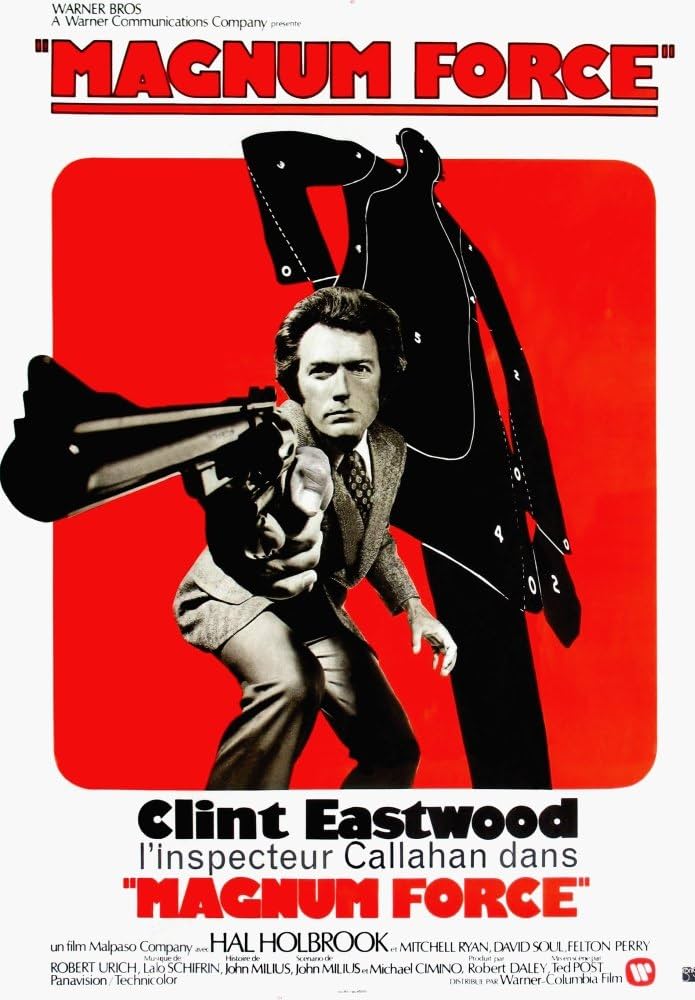
Somebody is killing San Francisco’s well-known criminals who have been able to manipulate the courts in a way that they’ve gotten off and have not served any time. “Dirty” Harry Callahan (Clint Eastwood) isn’t sure at first who’s behind it, but every time he tries to get investigate his superior, Lt. Neil Briggs (Hal Holbrook) tells him to essentially ‘back off’ and go back to stakeout duty of which he’s been assigned, but in his off hours he continues to pursue it. He comes to the conclusion, after a pimp is shot at close range while sitting in the driver’s seat of his car, that a policeman pretending to be a traffic cop is behind it. He then begins to focus in on four new recruits (David Soul, Robert Urich, Kip Niven, Tim Matheson), who all show remarkable aim on the gun range, as being the ones behind it, but how does he prove it before they kill again, or set their sights on him in order to keep him quiet?

In this follow-up to the classic Dirty Harry the direction isn’t as stylish as Don Siegal didn’t return to helm this one, so the reins were handed over to Ted Post who’s better known for his TV work and which Eastwood knew through them working together on the ‘Rawhide’ TV-show from the 50’s. While not all bad there were certain segments that appeared a bit off like when the motorcycle cop pulls over the mob boss, played by Richard Devon, who’s riding in a limousine. The car clearly comes to a stop on a well-traveled bridge, but when the men inside the vehicle get shot you can see through the rear window that the car now appears parked in some urban neighborhood street. The segment where Harry drives into the parking garage of his apartment complex and then gets out of his car after parking it only to be surprised when the four renegade cops, who are also parked there on their motorbikes, begin speaking to him, is botched too as Harry would’ve seen them already there when he drove up and thus the scene should’ve been shot from his point-of-view through the front windshield of his car.

The action segments though are top notch. The scene inside an airplane where Harry disguises himself as a pilot in order stop hijackers from taking it over is both funny and tense as is his shooting down thieves trying to rob a grocery store. The gun range segment, where he and David Soul compete to see who’s the most accurate shooter, is well-handled as is the final chase inside an abandoned airplane hangar in a shipyard. There’s also a cool, but grisly sex orgy shootout in which a naked woman’s body tumbles out a high-rise apartment and then down several flights. You can also spot a nude Suzanne Somers during a poolside massacre.

The film also features the infamous Drano scene where a pimp, played by Albert Popwell, forces a prostitute, played by Margaret Avery, to swallow drain cleaner, which inspired a group of criminals in Ogden, Utah to try and replicate it when they robbed a record store and took the employees hostage on April 22, 1974 in what became known as the Hi-Fi Shop murders. However, instead of instantly killing the victims like it did in the movie it instead created blisters on their mouths and internal burning, which caused them to go through extreme suffering for hours.

My biggest complaint is how Harry is too nice and has lost some of his edge that made him so interesting. In the first film he was described as someone that didn’t like minorities, but here he’s matched up with an African American partner, played by Felton Perry, right off-the-bat with no complaints. He’s also seen with children in one segment and seems to enjoy them, but I’d think with Harry’s irritable temperament he’d find kids running around and making noise to be annoying. A downstairs neighbor lady, played by Adele Yoshioka, comes on to him quite strongly, she literally walks out into the hallway as he’s coming home and asks him what she needs to do in order to go to bed with him, which seemed too forward even for the carefree 70’s. I agree with John Milius who wrote the original draft of the screenplay where that scene was not in there but got added later at Eastwood’s behest. Harry was not the sociable type and if anything, he’d be doing prostitutes simply as a release for his sex drive. The character really didn’t have the capacity nor desire for a relationship and if he was married to anything it would be his job and mowing down bad guys making this romantic segment forced and not believable.

The bad guys are a bit too cliched and dull, especially the mob bosses, which is a far cry from the first one where Andrew Robinson made his psycho character quite distinct and intriguing. One scene has a group of mafia guys sitting around a table eating Chinese food, but none of them says a word, which to me was not realistic. Even bad people still follow sports, weather, and current events and would like to chat a little with those around them, supposedly these are their ‘friends’ since they work closely together, and not just eat in stone cold silence, which paints them too much as robots with no life, or personality outside of being killing machines.

While it’s fun seeing Urich and Soul in early roles and in Urich’s case looking downright boyish, the four renegade cop’s presence onscreen is quite flat. There’s no distinction between their personalities and no backstory given to how they came together, or what brought them to becoming vigilantes. Did they have a loved one, for family member die at the hands of a criminal who then was given a lenient sentence? This is never explained, or elaborated on, but really should’ve.

It’s also confusing to have Harry, who in the first installment was fed-up with the politics of policework and looking to work ‘outside the system’ suddenly dislike these guys for doing what he himself had previously advocated. Would’ve been more interesting had they invited him to join the group, and he initially obliged thinking this would be a good to solution to criminals getting off easy only to eventually realize the group was taking things too far and then work to stop them. 

My Rating: 8 out of 10

Released: December 25, 1973

Runtime: 2 Hours 3 Minutes

Rated R

Director: Ted Post

Studio: Warner Brothers

Available: DVD, Blu-ray, Amazon Video, YouTube
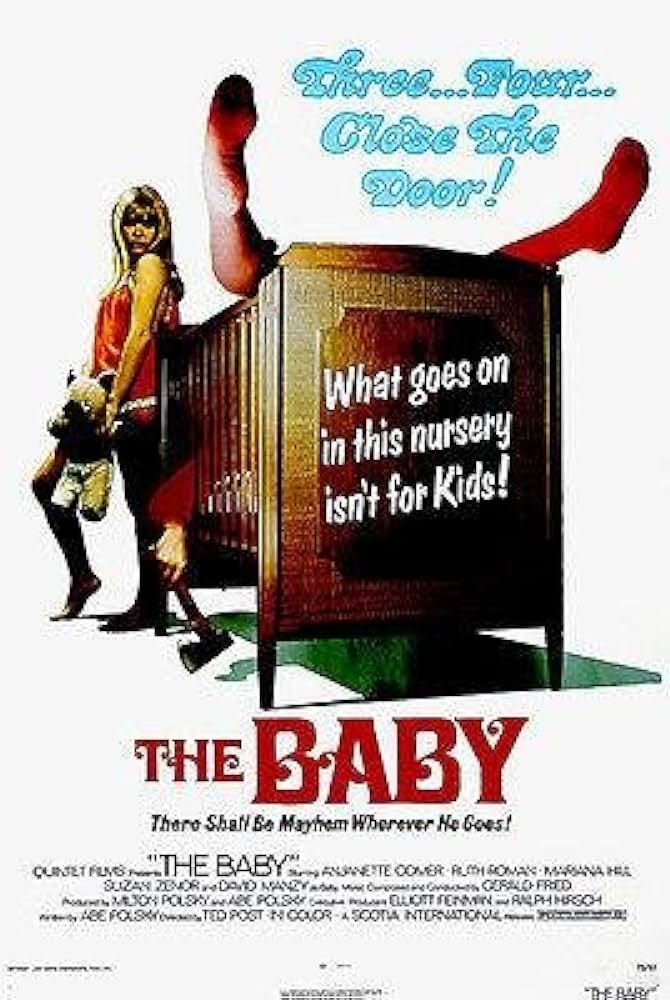
The Baby (1973)

baby1

By Richard Winters

My Rating: 7 out of 10

4-Word Review: Family harbors man-baby.

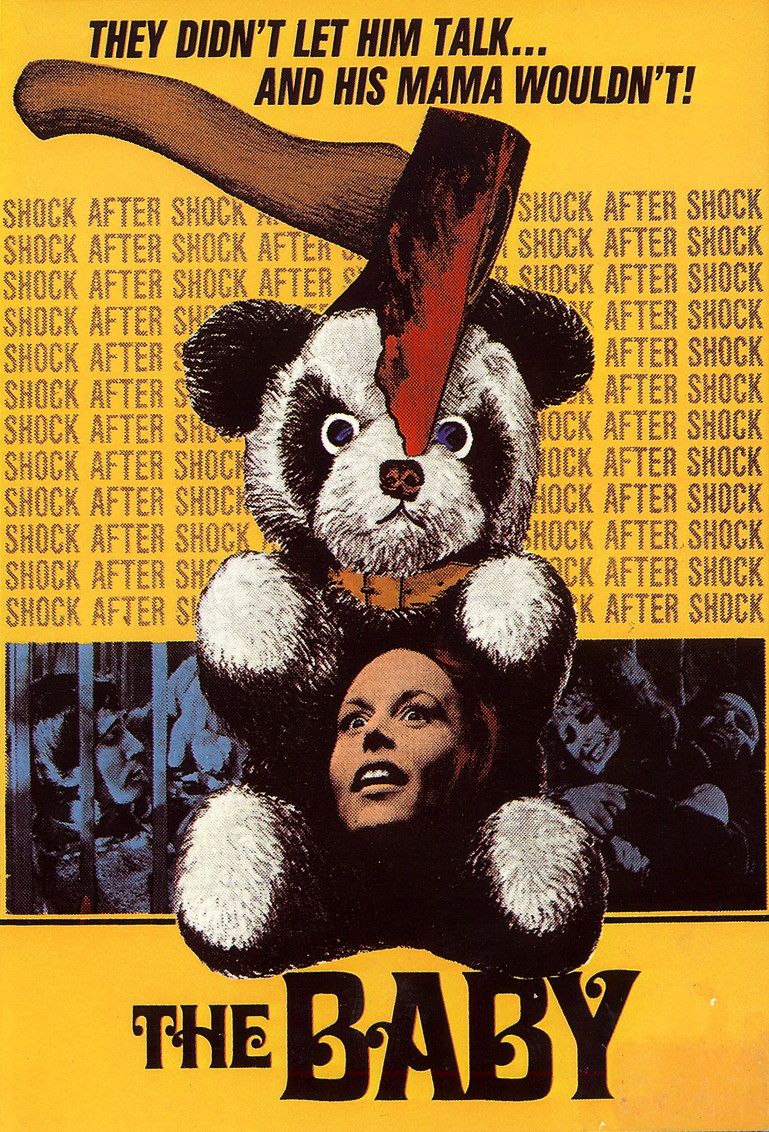
Ann (Anjanette Comer) is a social worker who, still tormented by the car accident that has left her husband severely brain damaged, decides to throw herself into her work by focusing on a bizarre case in which a mother (Ruth Roman) and her two daughters (Marianna Hill, Susanne Zenor) take care of a third sibling (David Mooney, but billed as David Manzy) that is a grown man, but permanently trapped in an infant state. As Ann meets with the family she becomes convinced that ‘the baby’ has potential for intellectual capacity and it’s only because of the abuse that he receives from his embittered mother, who harbors a grudge for men after her husband walked out on her and is now taking out that anger on her son, that is holding him back. She devises a plan to kidnap the son, so that she can take him out of that toxic environment in order to help him, but when she does the mother and her two daughters plot a violent revenge in order to take him back.

It took many years for screenwriter Abe Polsky to get his friend Ted Post, who appears onscreen during the party scene, to agree to film his script as he insisted that it was, in his words, ‘too negative’. His ambivalence for the material shows as visually it’s given the TV-movie treatment that lacks atmosphere, or a visually provocative approach the would help accentuate the darkly quirky elements of the story. While this has still attained a cult following it’s mainly because of the offbeat story and might’ve gotten more fans and attention had the direction been equally offbeat instead of so basic.

The acting on the other hand is a stand-out. Ruth Roman, a one time leading lady during Hollywood’s Golden Age, but by the 70’s was relegated to low budget horror, is terrific with her raspy voice and chain smoking making her like a snarly version of Suzanne Pleshette. The caustic confrontations between her and Comer, who initially seems like the angelic, law abiding one, helps accentuate their contrasting personalities. Comer of course is quite good too. She’s played many offbeat characters, but here comes-off as the noble, straight one and does so convincingly, which is detrimental for pulling off the stories plot point. Hill, as Roman’s twisted amoral daughter, is interesting as well though there was no need for two daughters as they both shared seemingly the same personality and could easily have been merged into one and since Hill gives her part a little better nuance she should’ve been cast while Zenor cut out completely.

Mooney as the man-child though is the scene stealer. He got into his part by observing special needs children and his infant mannerisms is on-target to the extent it’s creepy. Having him put into a crib though that he supposedly couldn’t get out despite being a grown man physically doesn’t really gel as even toddlers can ultimately figure out a way to get out of one. Putting him into a big cage that would sit in the middle of the ‘nursery’ would’ve been more sinister visually as well as realistic. The source of his infantile state, that he’s seemingly been abused by a cattle prod all these years to not grow up, or to even learn to talk, or walk, is equally ridiculous. Explaining that his condition was caused by being in a car accident when he was an actual baby, which then trapped him in that state forever due to brain damage would’ve been far more easier to swallow while also tying it in to Comer’s husband’s condition that eventually becomes a key element.

The scene with the young babysitter, played by Erin O’Reilly, didn’t make sense either. She’s portrayed as being just this average teen taking care of the baby like she would a real one for extra money, but there’s no way any teen would be comfortable changing the diaper of a grown man, as it’s still a man’s body no matter how he behaves, and not come away feeling sick and perverse. by doing it Thus the part should’ve been played by some kooky older woman, perhaps a friend or cousin to the mother, who was lonely and liked taking care of the ‘baby’ due to sharing the same man-hating instincts, or had a secret quirk where she enjoyed having a male in a subservient condition.

Spoiler Alert!

The third act had holes in it as well as Comer kidnaps the ‘baby’ and brings him home with her, but the mother and sisters don’t call the police to get him back. Supposedly this is because the mother is afraid the years of abuse, that Comer has become aware of, would come to light, but it would still be her word against theirs and I felt they should’ve responded more aggressively maybe even hiring a lawyer to take the case to court and then becoming impatient with the slow legal process and then finally deciding to take matters into their own hands, but just having them sit around the house for several days/weeks waiting to see what Comer does next doesn’t really jive.

The ultimately twist though I did like and took me by surprise. I’m usually able to guess where movies are going and can get it right most of the time, but this one is novel and for that gets high marks despite its other issues.

baby2

My Rating: 7 out of 10

Released: March 4, 1973

Runtime: 1 Hour 24 Minutes

Rated PG

Director: Ted Post

Studio: Scotia International

Available: DVD, Blu-ray, Fandor, Tubi, Amazon Video, YouTube

Nightkill (1980)

nightkill1

By Richard Winters

My Rating: 5 out of 10

4-Word Review: Somebody is listening in.

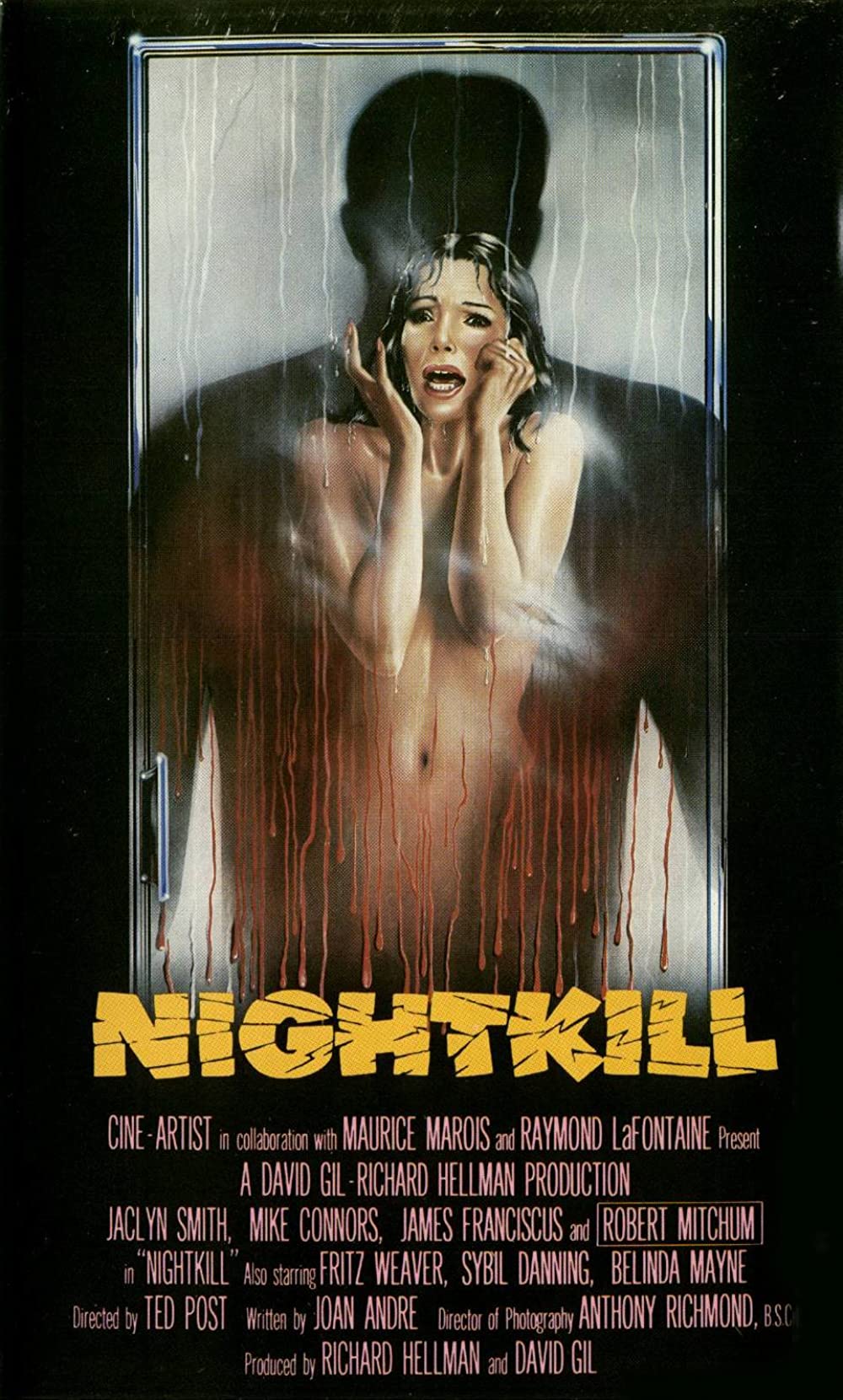
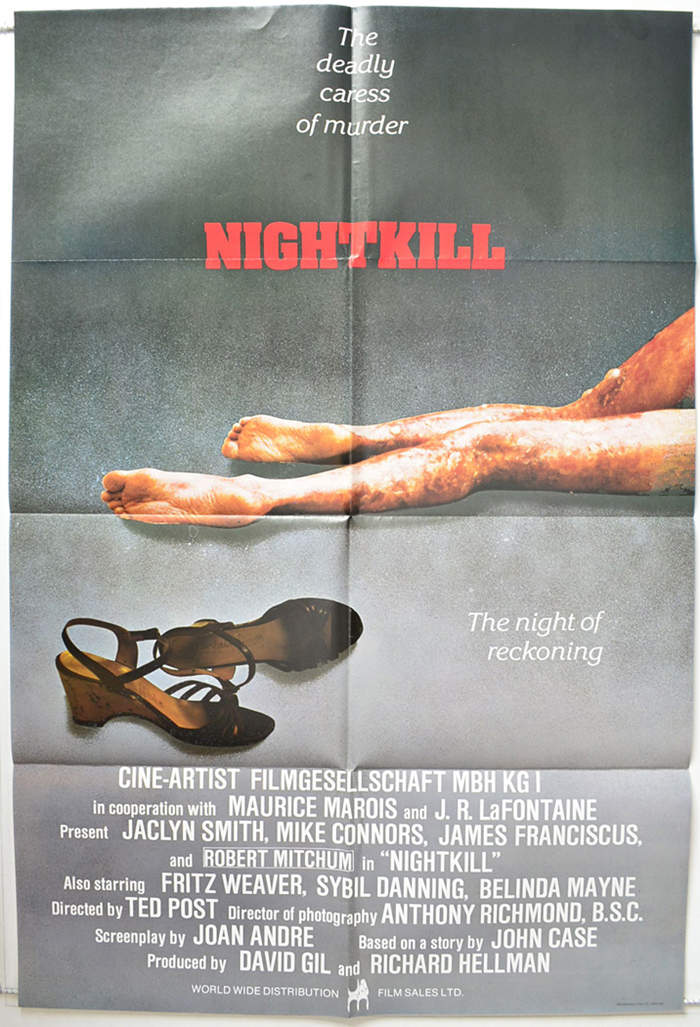
Kathy (Jaclyn Smith) is married to Wendell (Mike Connors) a wealthy, but unethical businessman living in Arizona. She’s unhappy in the marriage and wants a divorce, but Wendell promises to make things hard for her if she does, so she reluctantly stays in it, but on the side has an affair with Steve (James Franciscus) his close business associate. Steve poisons Wendell and sticks his body inside the freezer of Wendell’s home and then impersonates him on a flight to Washington to make it appear that he’s still alive. Kathy remains at home only to become harassed by a aggressive detective Donner (Robert Mitchum) who’s suspicious that Wendell has become a victim of foul play. Kathy decides she must get rid of the body, but when she opens up the freezer she discovers it’s no longer Wendell’s corpse that’s inside, but instead Steve’s.

Odd thriller that was produced by a German film company, but filmed in the US. The film succeeds with having a distinct score and great location shooting of Arizona in which it’s dry, desolate landscape helps reflect the empty, inner nature of the characters. It was directed by Ted Post, who’s best known for the cult hit The Baby, which is famous for its twist ending, and there’s a lot of story twists here too, but for whatever reason fails to be captivating and this is mostly due to the dull characters.

Kathy was the one that got on my nerves the most. One minute she’s telling him that she can’t stand him and then the next minute she’s upset and sobbing over his unexpected death, so which is it? It seems like she should’ve been elated when he keeled-over and having her played-up as being this innocent is unrealistic. When you spend your life associating with bad people it tends to rub-off and it’s hard to imagine she wouldn’t have been tainted by the corruption of not only her spouse, but lover and Smith’s poor attempt at crying just makes it all the more worse. I rather have openly bad people going after each other and seeing which one is left standing then some idealized angel who’s completely out-of-place in the setting and would have to be extraordinarily naïve not to have caught-on to the shenanigans that were going on long before she does. If anything Sybil Danning, who is seen in a much smaller role, should’ve been given the lead as her conniving, sauciness was exactly what the character needed to have made it interesting.

Franciscus isn’t in it long enough to make much of an impression and Mitchum sleep walks through his part and thus making his onscreen presence quite bland and his big name, star status adds nothing. The only one that is fun is Connors, best known for his starring role in the cop TV-show ‘Mannix’. Here he plays against type by being an obnoxious jerk that delights in upsetting some caged monkeys that they have in his home. The rotten personality of his character is over-the-top enough to be fun and it’s just a shame he had to die-off so quickly.

Spoiler Alert!

An mentioned there are some nifty twists, but it ultimately adds up to little. The biggest problem is that Mitchum, who’s just as shady as Connors and Franciscus, ends up getting away with it, by stealing the stolen money that Connors has in his airport locker and flying out of the country, which isn’t exactly an audience pleaser. Smith doesn’t completely die either as we see her injured body on the bathroom floor calling the police making it seem that with her information there was still a chance he could get caught and the film should’ve played this out to completion and not left it open to guessing.

Lots of logistical issues too. For instance Mitchum kills Francsicus supposedly at the airport, but for some reason, we never see it but can only presume, drags the dead body back to Smith’s home just so he can put it into the freezer, but why bother? Also, where does he put Connor’s body when he replaces it with Franciscus’? Where does he get the mask of Mike Connors’ face that he uses to disguise himself that he is him? Does he know a manufacturer that makes specially made masks  to resemble someone they know and if so what company is this because I’ve never heard of it? Also, how does he know there’s a cop inside the police department named Donner as he pretends to be this man when he investigates the case even though he’s really a private eye named Rodriguez? These along with several other questions never get answered, which significantly hurts the plausibility.

Original Cinema Quad Poster - Movie Film Posters

Original Cinema Quad Poster – Movie Film Posters

My Rating: 5 out of 10

Released: December 18, 1980

Runtime: 1 Hour 35 Minutes

Rated R

Director: Ted Post

Available: DVD-R, Blu-ray