Tag Archives: Sam Waterston

Crimes and Misdemeanors (1989)

crimes1

By Richard Winters

My Rating: 7 out of 10

4-Word Review: Threatening to tell wife.

Judah (Martin Landau) is an eye doctor whose mistress of several years, Dolores (Anjelica Huston), is threatening to tell his wife (Claire Bloom) about their affair. Judah tries to persuade her not to, but she insists on going through with it unless he gets a divorce, which he refuses to do. Feeling he has no other option he hires his brother (Jerry Orbach) to do a hit on her in order to get her off of his hands. Once the job is done Judah then becomes wracked with guilt and though he had been a non-believer for many years begins to rekindle the fear of the wrath of God for what he’s done. Meanwhile Cliff (Woody Allen) is a struggling documentary filmmaker who gets a job filming a movie of a obnoxious comedian (Alan Alda) who’s highly narcissistic and difficult to deal with.

The film is unusual in that it has two correlating stories that go on at the same time with very little that links them. The only connecting thread is a Rabbi, played by Sam Waterston, who is friends with both Alda and Landau, as well as Cliff and Judah getting together briefly at a party to have a discussion near the end. Otherwise it’s like two separate movies with one being semi-funny while the other is made to be more like a searing drama and character study. While it’s engaging most of the way I felt the segment dealing with the egotistical celebrity wasn’t interesting or comical enough to be worth having especially since Alda didn’t seem able to convey an obnoxious jerk in a way that was amusing. The film also goes off on several tangents including Cliff counseling his sister about a date she had where a man tied her up and defecated on her that didn’t have anything to do with the main story and just taking up runtime for no reason. There’s also segments that I did find intriguing like the mysterious phone calls Judah gets late at night where the caller immediately hangs up when Judah answers that I felt should’ve been explored more.

A good way to have solved this and would also have tied-in Allen’s character better would’ve had him filming a documentary on Judah who could’ve been portrayed as this heroic eye doctor who saved the vision of underprivileged kids, or even gone to Africa for awhile to help heal the vision of the kids there and thus his efforts were considered a suitable material for a film. Alda’s character could’ve been cut out totally and not missed. Judah could’ve still be conniving behind-the-scenes about how to get rid of the other woman and thus the irony of him being lionized in front of the camera, but a complete jerk behind it would’ve been even more accentuated and interesting.

As it is the moments with Landau are still quite strong. His career during the 80’s had nearly tanked with him having to accept co-starring roles in low budget horrors just to keep busy only to finally get his name revitalized with his role in Tucker: A Man and His Dreams in 1987 that lead to an Academy Award nomination for best supporting actor and helped him get better quality work including this one. Here his expressive blue eyes come into play particularly after the dirty deed gets done and he begins having reoccurring visions of himself as a boy going to synagogue and quarreling with his moral depravity, which is effective.

This is also the rare movie where Allen plays someone who is actually likable. Normally his incessant whining and misguided belief that he’s more sexually attractive than he is and can bed any hot women I’ve found annoying, but here he’s more of a ignored chump who’s still struggling to make a name for himself and this makes him endearing. Instead of aggressively coming onto women in tacky ways he instead shyly courts Mia Farrow who plays a sort-of nerdette here and their scenes together are cute.

Spoiler Alert!

The ending in which Allen and Landau meet briefly and he tells Allen about this ‘great’ movie idea in which a husband finds away to kill off his mistress, which is essentially what he’s really done, and feels no guilt afterwards doesn’t really work. For one thing it’s hard to believe that he’d wake-up one day, as he describes, and no longer feel any remorse and could just go on normally as he had felt so guilty about it earlier that you’d think it would’ve left some sort of lasting affect. The viewer should’ve also seen this realization play-out visually through the story versus having him just describe it.

I realize Allen’s whole point was to show that the universe doesn’t dispense justice and sometimes people really can get away with murder and can go on living happy lives unlike in the movies where it’s expected that the bad guy should suffer some consequence. Yet realistically I actually think Landau would’ve been caught, or at least been more of a suspect than he is. He was already questioned by the police earlier due to all the phone calls he had with the victim and I don’t think his flimsy excuse would’ve sufficed. Since he had been to her apartment many times including even on the night of the murder that most likely one of the other tenants would’ve spotted him coming and going and all the police would’ve had to do was show his picture around for him to be easily fingered by someone else living in the building. Thus watching Landau confidently leave his discussion with Allen thinking he could go on happily with his life only to have a detective there with handcuffs would’ve been funnier and in a lot ways ultimately more believable.

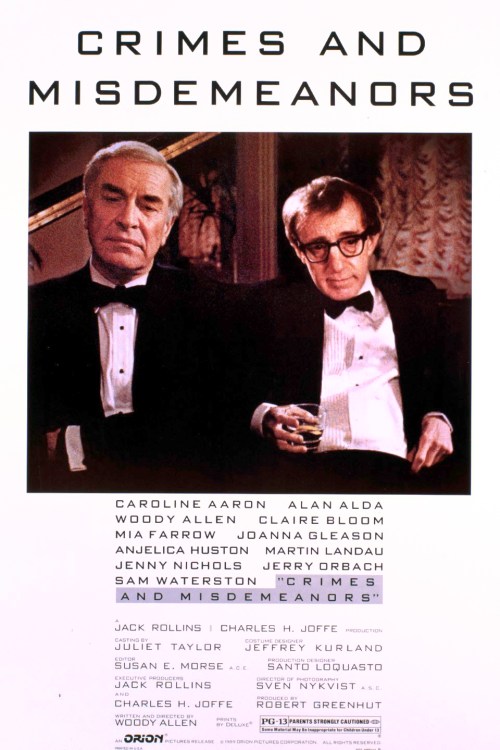
The film’s promotional poster, as seen above, doesn’t get the mood of the scene right. If you look at the poster it seems like Landau is the despondent one who’s suffering from inner turmoil while Woody is nonchalant, but if you watch the movie it’s Landau that is at complete ease while Woody is in turmoil over Mia getting married to Alda, so the poster is essentially misleading.

My Rating: 7 out of 10

Released: October 12, 1989

Runtime: 1 Hour 44 Minutes

Rated PG-13

Director: Woody Allen

Studio: Orion Pictures

Available: DVD, Blu-ray
Mahoney’s Last Stand (1972)

By Richard Winters

My Rating: 7 out of 10

4-Word Review: Trying to find solitude.

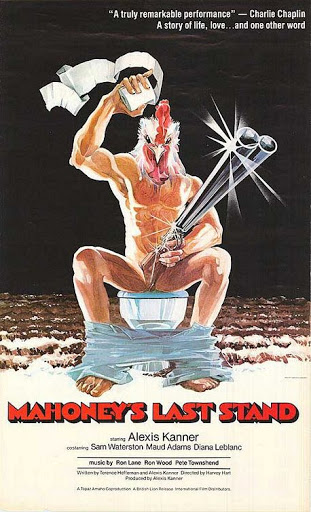
Leroy Mahoney (Alexis Kanner) wants to be away from the rat race and out in the Canadian wilderness where he feels he can live in peaceful harmony with nature. He finds a rundown home in a vacant area and begins the process of renovating it only to meet a woman named Miriam (Maud Adams) who lives nearby and routinely comes over to visit. Felix (Sam Waterston) is his old friend from the city who hitches a ride to the country and moves-in. Later, so does Felix’s girlfriend Joy (Diana Leblanc) making Mahoney feel like he’ll never find the solitude he craves and will always be surrounded by people who annoy him.

The film was the inspiration of Kanner, who not only starred in it, but wrote the script, co-directed, and even produced. The quirky tone is what helps it stand out as it’s a mixture of the man-in-the-wilderness theme meets the counter culture and to a great degree it works. Some of my favorite moments are things that might seem off-putting, or even boring when put in any other film, but here it helps add to the offbeat quality like the scene featuring Mahoney sitting on his porch endlessly twiddling with his garden hoe, or the segment where he remains trapped in his outhouse as he’s too afraid to come out and meet with Miriam when she arrives unannounced.

The Mahoney character, if you can get past his odd accent and crusty exterior, is quite engaging. Initially he comes off as this rugged individualist only to end up getting scared late at night over the least little noise that hears outside. The scene where he tries to pretend he’s a seasoned horseback rider in an attempt to impress Miriam and his love-hate friendship with Felix and Joy are all amusing as well, but what I really liked is that he remains a true introvert all the way through. Most other films make the broad presumption that everyone secretly craves companionship and can only be truly happy with other around, but here Mahoney only finds his ultimate utopia when he’s finally all alone.

The film’s rustic landscape, which was shot in and around King City, Ontario, helps add to the ambiance. It was filmed between October and December of 1971 with the idea that filming would wrap before the snow and cold moved in as there was no heating in the cabin, but fortunately an early season snow hit the production in late November and gets incorporated into the story. Although it only blanketed the area with an inch or two it still at least gave a preview to what living in Canada year round would be like and if you’re going to do a pic about the rugged adventures of dealing with the northern climate then there better be some snow and cold in the mix or it’s just not fully authentic otherwise.

Spoiler Alert!

The film’s ending really stands out as it recreates the feeling of solitude in a way I’ve never seen done before and will stick with you long after it’s over. It features Mahoney wondering around his property naked with only the faint sound of a water drip in the background, which gives the viewer a total sense of peace and freedom and has a soothing meditation-like quality.

Alternate Title: Mahoney’s Estate

My Rating: 7 out of 10

Released: Unreleased theatrically until 1976.

Runtime: 1 Hour 49 Minutes

Not Rated

Director: Harvey Hart, Alexis Kanner

Studio: Topaz Productions

Available: None

Three (1969)

By Richard Winters

My Rating: 3 out of 10

4-Word Review: Two guys one chick.

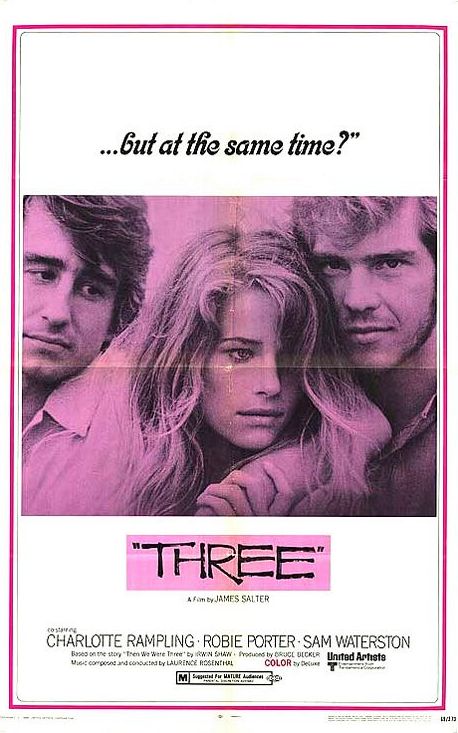
Taylor (Sam Waterston) and Bert (Robbie Porter) are two college chums spending their summer traveling through Europe. When they get to Italy they come upon a free-spirited young woman named Marty (Charlotte Rampling) who agrees to become their traveling companion, but underlying sexual tensions soon rise to the surface. Both men want to make a play for her, but resist because they fear it will ruin their friendship yet as the trip progresses the temptations get too strong to ignore.

Normally I enjoy a film with a laid back pace as I feel American movies tend to be too rushed and leave the viewer no time to allow the characters, story, or imagery to sink in. However, here it’s too slow with plot and character development at a minimum. The extraneous dialogue is not interesting and too much footage is given to capturing the Italian countryside, which makes this seem more like a travelogue.

Waterston is transparent as usual, which makes me wonder how he has managed to have the long career that he has had. Porter, who is better known as a composer, is better looking and much more dynamic and I was surprised that Rampling’s character doesn’t just gravitate towards him immediately as Waterston is dull and wimpy and not what most attractive women would want to consider.

Rampling is great and gives each scene an extra kick, which makes sitting through this meandering production slightly worth it, but the sexual tension is lacking. Supposedly this is what it’s all about, but for the most part it shies away from examining it even though it should’ve been constantly reinforced either through imagery, flashback or dialogue instead of being largely forgotten until the very, very end when it no longer mattered.

This was writer James Salter’s one-and-only foray behind the camera and it’s no surprise he never directed another one as he clearly shows no ability or understanding for pacing.  The characters are not unique enough to be captivating and one eventually begins to wonder why they’re bothering to watch it or what point the filmmakers had for even making it.

My Rating: 3 out of 10

Released: December 23, 1969

Runtime: 1 Hour 46 Minutes

Rated M

Director: James Salter

Studio: United Artists

Available: None at this time.

Sweet Revenge (1976)

sweet revenge

By Richard Winters

My Rating: 6 out of 10

4-Word Review: Pretty lady steals cars.

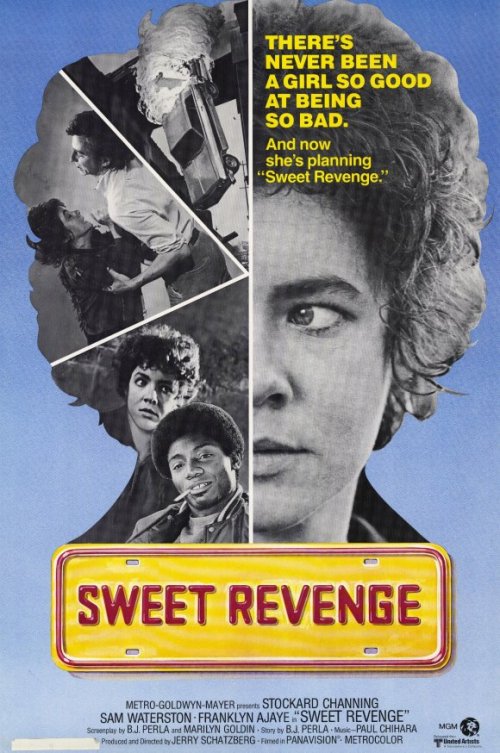
Despite squatting in an abandoned house, having no job, no money and virtually no life Vurrla (Stockard Channing) becomes obsessed with getting herself a brand new Dino Ferrari. She knows how to steal cars, so she decides to steal a Porsche, resell it to unsuspecting buyers and then a few days later steal the same car back and resell it again and continue this process until she has secured enough to pay for the Ferrari. The plan works smoothly, but public defender Le Clerq (Sam Waterston) has been following her and determined that she turn herself in before she gets herself into even deeper trouble.

As I watched this movie I found myself quite perplexed as to how Leonard Maltin in his Movie Guide could’ve given this thing a ‘bomb’ rating. This is certainly not a four-star flick, but it’s far from being bad one either. The plot moves along at a nice breezy pace with an engaging combination of drama, action and humor. The characters are believable and interact with each other in interesting ways. The on-location shooting of Seattle, which was done by renowned cinematographer Vilmos Zsigmond who died just this past New Year’s, is quite vivid and focuses on some of the city’s lesser known neighborhoods, which should be fun for those from the area as it is sure to bring back a flood of memories.

Channing is dynamic and especially enjoyable when she puts on different wigs and a variety of accents as she tries to sell the cars to different people and I wished these segments were played up more. Waterston’s character is much more controlled and practical making the two play off each other in revealing ways. Franklyn Ajaye lends great support as Vurrla’s streetwise friend and Richard Daughty is amusing as Vurrla’s dimwitted cohort and I was surprised that he seemingly disappeared off the face of the planet and never did a thing after this. This also marks the acting debut of Daryl Anderson who appears briefly getting out of his car and going inside only to have Vurrla sneak up and steal it a few minutes later.

On the negative side the film could’ve used a little more action. There is one car chase that occurs near the end, which turns inexplicably tragic and hurts the film’s otherwise lighthearted tone. The ending is frustratingly vague and outside of watching a Ferrari burn into a cinder offers no finality to the character’s eventual fate. There is also a segment where Channing and Daughty go shopping at a grocery store and for a brief couple of seconds the scene is shown through the lens of a black-and-white security camera making the viewer believe that the two are being monitored and will soon be arrested since they are shop lifting, but nothing ever happens, so why insert that shot if it serves no purpose?

My Rating: 6 out of 10

Released: June 16, 1976

Runtime: 1Hour 30Minutes

Rated PG

Director: Jerry Schatzberg

Studio: MGM

Available: DVD (Warner Archive)