Tag Archives: Sally Kirkland

Anna (1987)

By Richard Winters

My Rating: 7 out of 10

4-Word Review: A struggling Czech actress.

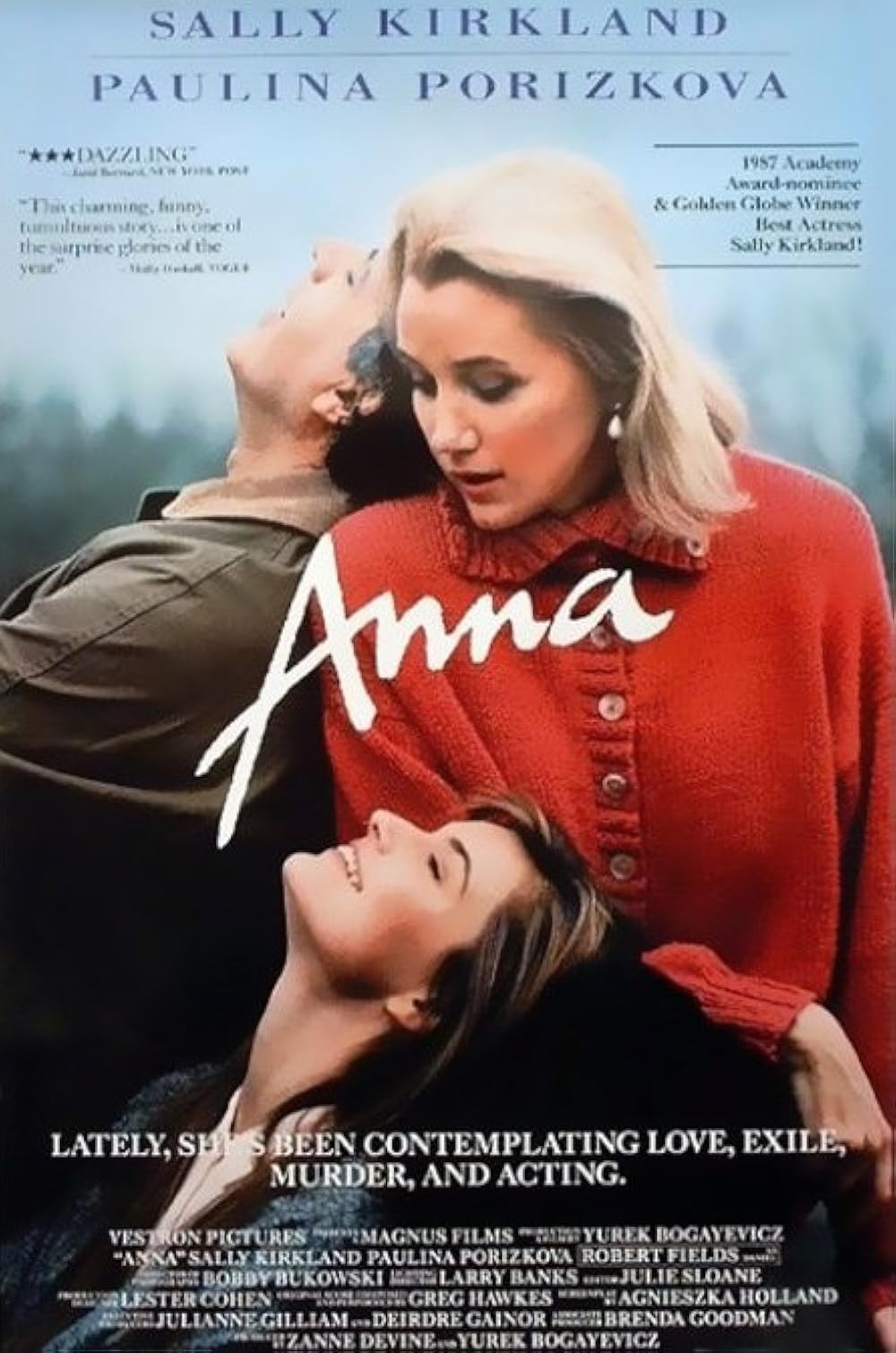
Anna (Sally Kirkland) was at one time a major movie star in her homeland of Czechoslovakia, but when a new government regime took over her country during the 1968 communist invasion and she spoke out against it, she was banned from reentry. She then moved to the United States trying to seek acting employment in New York, but only able to eke out a measly living with bit parts and understudy work. Krystyna (Paulina Porizkova) is a young and aspiring actress who’s also from Czechoslovakia and who comes to the U.S. looking to meet Anna whom she has always idolized. Anna decides to take Krystyna under her guidance, teaching her English and improving her appearance in hopes that she can one day land the big role, but for Krystyna things come more easily. Soon she’s a big star, which sends Anna into a jealous and despondent state.

The film was inspired by the life and career of Polish actress Elzbieta Czyzewska and her relationship with a young Joanne Pacula, who came to the U.S. from Poland looking to break into show business and in the process became a bigger star than her mentor. At the time though upon its release the attention was much more on Kirkland’s brilliant performance and whose career struggles had closely emulated the character she was playing having landed a major role in 1968 in the film Coming Apart but had since been relegated to only bit parts until her breakthrough here. This also marked a career resurgence for her co-start Robert Fields, who burst onto the scene in 1958 co-starring in the cult hit The Blob, but outside of The Sporting Club saw very few substantial speaking roles until this one came along of which he also does quite well.

The film succeeds in the recreation of the audition atmosphere. I had in my younger days went to a few acting auditions for small roles in stage productions while living in Chicago and what I went through closely resembled what Anna has to deal with here particularly the improvisational aspect where the actors are expected to discard the scripts they’ve memorized and instead forced to elaborate on a personal or touchy life experience of which Anna refuses to do with good reason. The humiliating demands the casting directors force her to do and the impersonal and competitive vibes she gets from the other auditioners are completely on-target making it some of the stronger moments in the film.

The film’s weaker scenes are when director Yurek Bogayevicz tries for the symbolic. I actually didn’t mind the shot of watching Anna going down a lonely, dark elevator while Krystyna gets invited to a posh party, or her rekindling her relationship with her off-again boyfriend Daniel while outside in a rainstorm, but when she goes to a theater to watch one of her old movies, and the film gets stuck in the projector and the image of her face gets burned up in front of her was pouring things on too thickly.

I also had a hard time understanding how Krystyna was able to get her rotted teeth fixed for free. No dentist is going to repair someone’s teeth, which looked to be a daunting task, for nothing yet that’s what seems to occur here. There’s a passing comment that he was expecting ‘something’ in return, but it’s not clear what. Maybe it was sex I don’t know, but it should’ve been verified instead of glossed over and then quickly forgotten. Krystyna’s ability to find Anna all by herself in the big city of New York where she can’t even speak the language was a bit too easy and needed better explaining as well.

The characters are also, with the possible exception of Daniel, not always likable. Krystyna is appealing most of the way but then goes on a TV talk show where she steals a personal life experience that Anna had told her about earlier and makes it her own. Then she comes back to the apartment and is somehow confused with why Anna is upset with her, which for anyone else wouldn’t have been that difficult to understand. Anna’s meltdown on stage when she was finally able to land a speaking role gets a bit overdone as well. I realize she was going through a lot in her personal life, but as a working actress she still needs to put that stuff behind and able to tackle her role, even if it’s last minute, in a professional manner and not ruin the entire production by behaving like some angry, petulant child, which actually made me agree with a member of the stage crew who told her she’d never work again.

Spoiler Alert!

The ending in which Anna stalks Krystyna and attempts to shoot her while she’s filming a movie scene on a beach is a shocker. This was the type of film where I didn’t see that coming as typically things like that only occur in thrillers, but this one had been a drama all the way, so it’s definitely unexpected, but still works. While it’s realistic that Anna most likely wouldn’t have killed her since she wasn’t used to shooting a gun, so having her miss and hit Krystyna in the arm did make sense, but it still would’ve packed a more powerful punch had she died.

I felt too that having Anna walk in the ocean and commit suicide would’ve given it a more complete finality. The idea that Krystyna would take care of Anna and even let her live in her home defied logic. This was someone who had just tried to kill her and what’s to say she wouldn’t attempt it again? How could she ever trust her again, or be comfortable around her? In reality she would’ve been either charged with attempted murder and incarcerated or put into a mental hospital.

My Rating: 7 out of 10

Released: October 2, 1987

Runtime: 1 Hour 40 Minutes

Rated PG-13

Director: Yurek Bogayevicz

Studio: Vestron Pictures

Available: DVD

Fatal Games (1984)

By Richard Winters

My Rating: 1 out of 10

4-Word Review: Javelins can be deadly.

Student athletes with promising futures are suddenly turning up dead at the hands of a mysterious killer who pierces their bodies with a javelin that he is able to expertly throw from a far distance. Authorities fear that time is running out as more of them are killed and no witnesses or clues to identify the culprit.

Many consider this to be a rip-off of Graduation Day and while both films aren’t very good this one at least starts out better. I enjoyed the lighthearted comedy used at the beginning and how a formal dinner meeting turns into a big food fight and then a group tug-of-war. The film also keeps it realistic by showing the athletes actually training and conditioning.

In fact it really doesn’t start to go downhill until it reverts into a horror movie mode and dwells almost religiously in all the formulaic clichés seen in every other ‘80s slasher flick. The killings aren’t as novel as they sound and eventually become quite redundant. They are also lightly sprinkled in-between long, drawn out dramatic segments dealing with the characters relationship struggles and pressures to perform until you almost forget that this is supposed to be a slasher film at all. Most ‘80’s horror movies will have boring extraneous dialogue at the start to help create ‘character development’, but once the killings get going they will usually drop the other stuff and stick just to the scares while also picking up the pace, but this one just keeps the stale drama going, which along with its synthesized music score gives it a very amateurish quality.

The acting by the young cast isn’t as bad as the adult actors who speak like people under a trance. The film’s director Michael Elliot who plays a doctor who secretly gives them team members some ‘retardation shots’ (no joke that’s what they call it) and the movie’s screenwriter Christopher Mankiewicz who plays the coach give the two worst performances in the movie. Even Sally Kirkland, who plays the team trainer is bad and seems to be playing down to the level of the material.

The female cast is attractive and there is an abundance of nudity including one segment where the killer chases a fully nude Angela Bennett down the darkened hallways of the school. However, the film’s cute and perky star, Lynn Banashek, was too shy to take off her clothes and so in the scene where she gets a rub down by Kirkland scream queen Linnea Quigley was used as her body double.

The identity of the killer was a bit of a surprise and something I hadn’t expected and I’m pretty good about guessing these things, so in that regard it’s kind of original, but it’s still not worth sitting through as everything else is by-the-numbers.

My Rating: 1 out of 10

Released: March 13, 1984

Runtime: 1 Hour 28 Minutes

Rated R

Director: Michael Elliot

Studio: Impact Films

Available: VHS

Coming Apart (1969)

coming apart 1

By Richard Winters

My Rating: 2 out of 10

4-Word Review: Psychiatrist secretly films people.

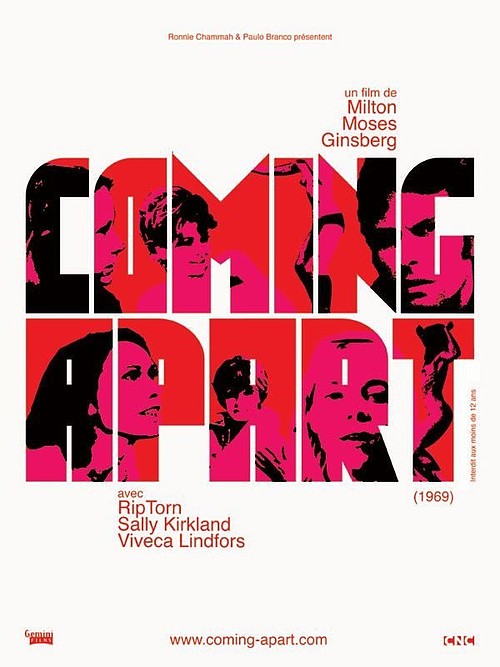
Rip Torn plays a psychiatrist living in a Manhattan apartment who has a camera secretly film everything that goes on there. Many of his female patients including Joann (Sally Kirkland) talk about their intimate desires and his ex-wife Monica (Viveca Lindfors) shares her darkest secrets thinking he is the only one hearing it, but instead a glass box resembling an antique camera sits in the living room and takes it all down.

The film’s concept is novel and if executed in a slightly better manner could’ve been brilliant. Without a doubt it breaks all the old filmmaking conventions and was year’s ahead-of-its-time. The sexual openness of its characters and tawdry subject matter make it quite voyeuristic and real. The actors have an amazingly natural quality to their delivery giving one the idea that it was ad-libbed when in actuality it wasn’t.

Kirland gives an emotionally over-the-top performance that is both remarkable and riveting. Her meltdown at the end in which she proceeds in slow motion to tear up the apartment is quite memorable and the best part of the whole film.

Writer/director Milton Moses Ginsberg manages to keep things relatively fresh by continuously introducing situations that become increasingly more provocative including a party that turns into a sex orgy and explicit love making between Torn and Kirkland that could almost be considered pornographic. There’s even an interesting scene involving a young lady looking to be barely 18 coming to the apartment with her baby in a carriage and propositioning herself to Torn and then having the two make love on the floor while the baby, still in the carriage, cries next to them. There is also a segment featuring recorded phone conversations that Joe has with his fellow psychiatrists that I found to be revealing as well.

Unfortunately despite these creative efforts the film is agonizingly boring to sit through. No matter what is going on in the scene the viewer is still forced to stare at the same wall, same mirror, and same skyline for almost two-hours. The scenes needed to be broken up with cutaways that would’ve taken the viewer out of the apartment and given them some other visual element to look at. Simply turning on a camera that’s nailed to the floor and then filming whatever happens in front of it is not a movie, but more like C-Span and the ultimate result is a failed experiment lacking the necessary cinematic touches that would have made it come off as a fluid whole.

My Rating: 2 out of 10

Released: October 26, 1969

Runtime: 1Hour 51Minutes

Not Rated

Director: Milton Moses Ginsberg

Studio: Kaleidoscope Films

Available: DVD