Tag Archives: Ruth Gordon

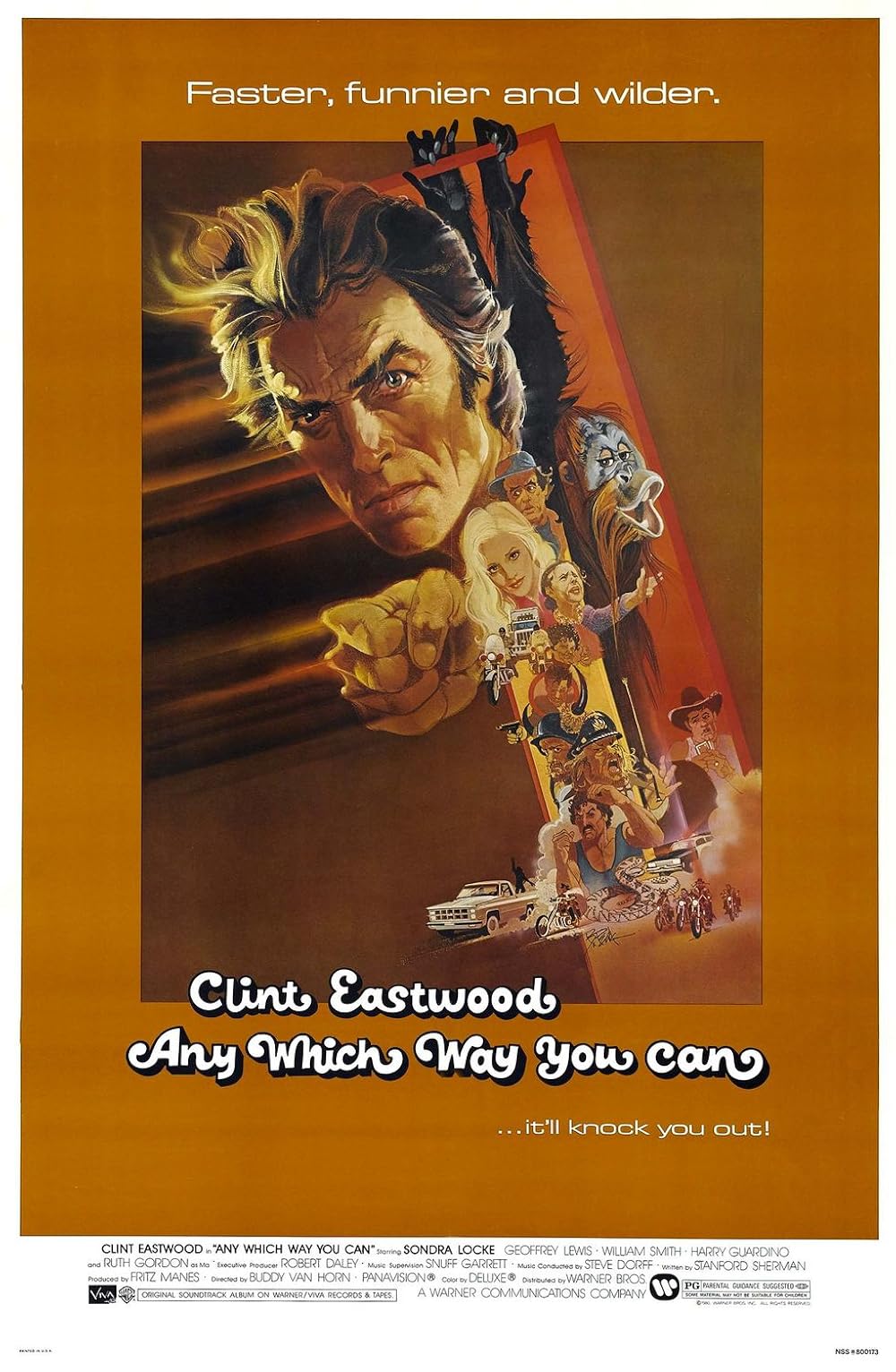
Any Which Way You Can (1980)

By Richard Winters

My Rating: 7 out of 10

4-Word Review: Betting on a fight.

Philo (Clint Eastwood) is still working as a trucker, still travels around with his pet orangutan Clyde, and still lives at home with his mother (Ruth Gordon) while getting involved in some bare-knuckle fights on the side to earn some extra money. He also continues to be harassed by the Black Widow biker gang who constantly hound him to even a past score. Things begin to change a bit when he meets back up with Lynn (Sondra Locke) who apologizes for her behavior from before and wants to rekindle their romance. Philo resists at first, but eventually the two get back together and she even moves-in with him in a spare room, but pressure mounts when fight handicapper Jack Beckman (Harry Guardino) comes-up with the idea of pairing Philo with Jack Wilson (William Smith), whose fighting skills mixes both martial arts and boxing. Jack figures it would be a match that would generate much betting interest and uses his men and money to convince Philo to take part in it. While Philo does initially agree he eventually backs out due to pressure from Lynn as she feels it’s too dangerous, but Jack, who has Mafia money riding on the fight, won’t take no for an answer and kidnaps Lynn in an effort to get Philo to reconsider. 

This is one of those sequels that’s a vast improvement over the first and much of the credit goes to Stanford Sherman, who wrote over 18 episodes for the 60’s ‘Batman’ TV-show and shows a good knack for balancing campy humor with interesting action. He’s also able to tie-in everything that goes on, so it doesn’t come off like a disconnected mess like with the first installment that had characters and situations coming-out of nowhere that wasn’t cohesive. Here each character has a purpose and everything that happens has a reason and connects with the main theme making for a much slicker production even when some of it gets silly.

Much more attention goes to the ape here though it’s not the same one as in the first film. That one was named Manis who was deemed to have grown too big for the part, so he got replaced by Buddha who has some amusing segments with his best moments coming when he tears up some cars, including one being driven by a bad guy, played by Michael Cavanaugh, as he’s trying to get away and another scene where he wears a dress and then ‘flashes’ an amorous hotel owner. However, in a book by Jane Goodall entitled ‘Visions of Caliban’ it was asserted that Buddha was badly beaten by his owner during the production after he stole some doughnuts on the set and was eventually clubbed to death forcing them to bring in a third ape named C.J. to do the publicity tour for the movie after filming had wrapped. 

Like in the first one the movie also features a lot of bare-knuckle brawls though these aren’t quite as interesting since Clint wins every one of them, so there’s never any tension. To keep it realistic, and give it better balance, they should’ve had him lose one, possible in humiliating style, and the rest of the movie could’ve been having him trying to defend his title and the audience would’ve been more emotionally invested in seeing him do it.  Would’ve been nice too had they not implemented that annoying punch sound effect that to me puts the fight at a cartoon level and I wished more movies from the period did it like The Whole Shootin’ Matchwhich didn’t feel the need to have that effect put in and thus actually made the fighting grittier and more intense in the process. 

While the film is way too long, there’s no reason for a runtime of 2-hours with such a slight and goofy plot, which should’ve have not been more than 85-minutes. However, it saves itself with some genuinely inspired moments including when real-life couple Logan and Anne Ramsey, who play a traveling husband and wife who stay in the hotel room next to the two apes whose noisy love making turn them on as does Clint and Sondra in adjacent room while Ruth and the elderly hotel clerk, played by Peter Hobbs, also make it in the motel office, I found to be quite amusing and almost worth the price of admission. The climactic bout between Clint and Smith and the way it galvanizes people from all over to witness it and bet money on it, including the Black Widow biker gang, who survive a ‘taring’ earlier, is good fun making it worth checking out on a slow night. 

My Rating: 7 out of 10

Released: December 17, 1980

Runtime: 1 Hour 56 Minutes

Rated PG

Director: Buddy Van Horn

Studio: Warner Brothers

Available: DVD, Blu-ray, Amazon Video, YouTube

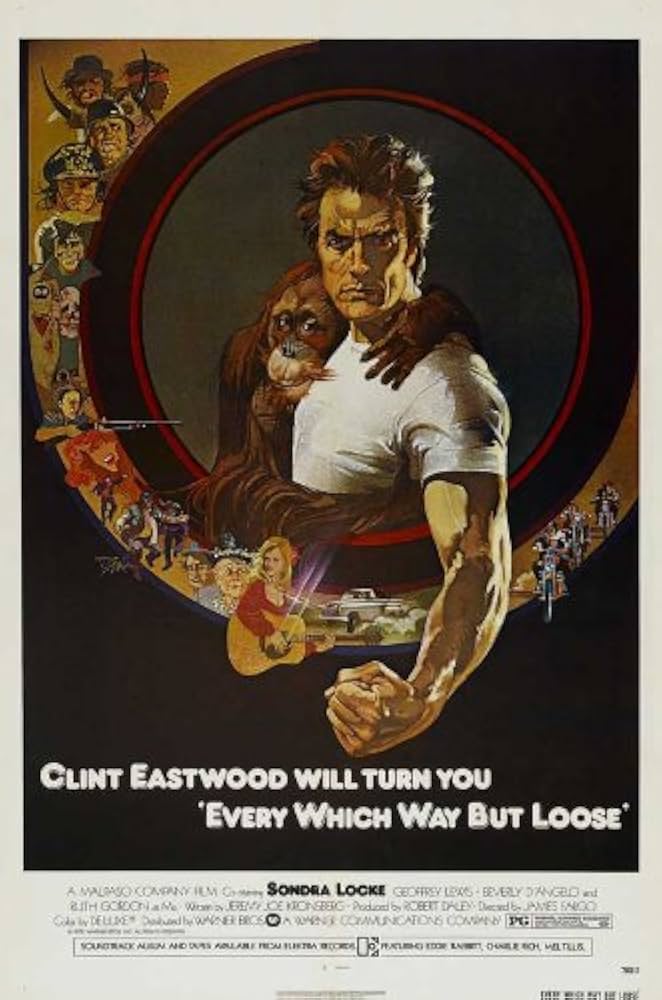
Every Which Way But Loose (1978)

By Richard Winters

My Rating: 4 out of 10

4-Word Review: A bare-knuckle brawler.

Philo (Clint Eastwood) is a truck driver still living with his mother (Ruth Gordon) and who compensates his income with bare-knuckle fights where people can make bets either on, or against him. He also travels around with an orangutan named Clyde whom he won as compensation for one of his fights. One day while waiting in his pick-up at a red light a biker gang known as The Black Widows and led by Cholla (John Quade) pull up beside them and begin harassing the ape. This creates a confrontation, and the bikers seek a vendetta on Philo determined to challenge him to a fight and begin stalking him until he agrees. Philo is also being chased by Putnam (Gregory Walcott), a cop upset at Philo over a misunderstanding that occurred while the two were in a bar. Meanwhile Philo is also trying to find Lynn (Sandra Locke) a singer he fell for who moved away to Colorado with her boyfriend, but Philo travels there in an attempt to find her and win her back, but Putnam and the Black Widows are in hot pursuit. 

The script is the product of Jeremy Joe Kronsberg, who after watching Smokey and the Banditbecame ‘inspired’ to write this one and was convinced it would make the perfect follow-up vehicle for star Burt Reynolds. However, when he shopped it around to the studios, they all rejected it, so he decided to send it off to Clint Eastwood’s secretary in the hopes that Clint, being good friends with Burt, would show him the script and convince him to do it. Instead to everyone’s surprise Clint, who was looking to broaden his appeal, decided to take on the starring duties himself and even cast Kronsberg as one of the biker gang members.

Many of those close to Clint thought it was a bad career move, and the critics savaged the film upon its initial release, but at the box office, which is what really counts, it did very well and became one of the highest grossing films of Eastwood’s career. A major reason for this is its rural appeal where everyone is essentially a redneck and white collar, college educated suburbanites just don’t exist. Instead, one’s social standing hinges on how much they down at the bar and whom they beat-up, which helps create a strong and surreal atmosphere. Initially though with this type of mentality I thought the setting should’ve been Texas and not California as when most people think of Cali they connect it with rich Hollywood stars and Malibu mansions when in reality that’s only a portion of the state and on the east end it’s much more rustic with a far more blue collar attitude and the movie does a good job of exposing this. 

It’s fun to see Eastwood not taking himself so seriously and being laid-back even smiling versus having him constantly look at everybody with his patented squinty-eyed stare. In support I though Ruth Gordon was great. Usually she plays ditzy old dames, but here she’s crusty and ornery and the segment where this ‘vulnerable old woman’ single-handedly shoots-up the biker gang when they invade her property is the movie’s highpoint. Bevery D’Angelo quite good too playing a free-spirited flower child named Echo. While she doesn’t have anything funny to say it’s nice having a character who’s quiet and subdued to help balance all the other wackiness. 

The script though is in desperate search for a story that never really transpires. Too much hinges on random events strung together by the thinnest of threads versus being connected by actual motivations and momentum. Having Eastwood, a tall and intimidating looking guy, constantly getting harassed for no reason, doesn’t make a lot of sense. The biker gang should’ve hounded him because they were hired by someone who lost to him in a fight and was bitter about it and the cop could’ve been hassling him because he lost a bet on one of his fights and thus wanted some compensation. While these may not be deep and profound motives at least they give a reason for what’s happening versus having things strung together by a lot of disconnected events that come out of nowhere. 

Spoiler Alert!

Sondra Locke though almost saves it. Her hyper and sarcastic personality makes for a nice contrast to Eastwood’s, and I liked how he pursues her as a love interest only to ultimately realize that she’s a psycho and he’d be better off without her. Most other movies have the concept that ‘lover conquers all’ and you’re better off with someone, even if they’re seriously flawed, than without, so having this movie take the alternative viewpoint is a refreshing change of pace and thus deserves some credit. 

My Rating: 4 out of 10

Released: December 20, 1978

Runtime: 1 Hour 55 Minutes

Rated PG

Director: James Fargo

Studio: Warner Brothers

Available: DVD, Blu-ray, Amazon Video, YouTube

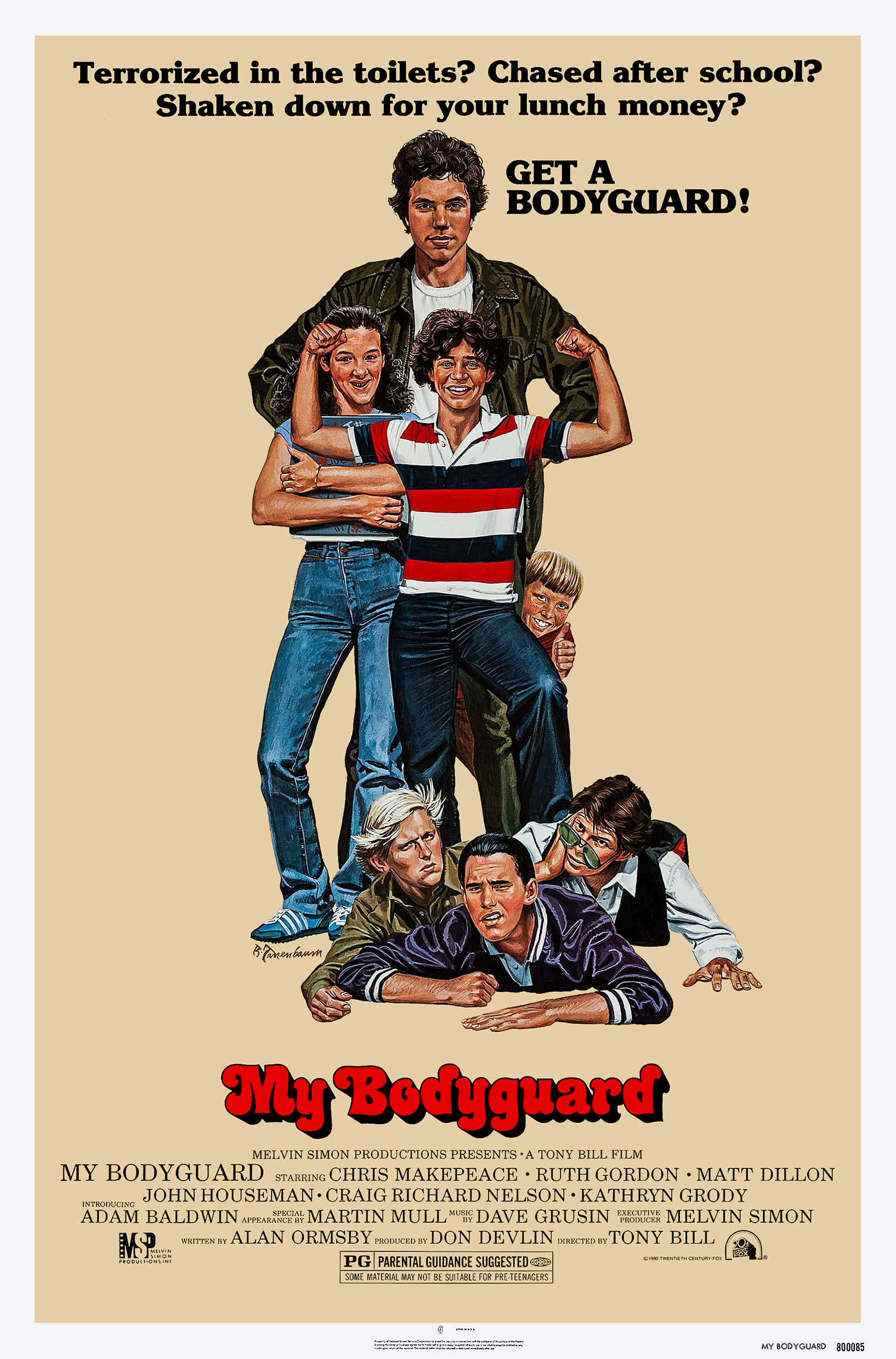
My Bodyguard (1980)

my1

By Richard Winters

My Rating: 7 out of 10

4-Word Review: Hiring protection from bullies.

Clifford (Chris Makepeace) is a new student at a tough Chicago high school who finds himself at odds with the bullies who are headed by Melvin (Matt Dillion), who goes by the nickname ‘Big M’. He and his cronies want Clifford to pay them ‘protection money’ in order to defend him from Linderman (Adam Baldwin) who is a big, loner kid that supposedly killed his own brother. Clifford refuses and thus gets constantly hounded by them, so he decides to go to Linderman and offers him a deal where he’ll pay him some money each week and even agree to do his homework if he’ll become his bodyguard. At first Linderman declines, but eventually comes on board, which is enough to get Big M and his gang to leave them alone. Then a few days later Big M returns with his own ‘bodyguard’ named Mike (Hank Salas), a big muscular guy, who challenges Linderman to a fight, which he at first resists.

This teen movie is unusual in that it was not based off of a novel as its source material, even though you’d be convinced it was, and although a novel version of the story was eventually written after the film was released, it’s ultimately an original idea by screenwriter Alan Ormsby. Ormsby was at that point better known for writing low budget horror movies, with a couple of them he even starred in, and seemed the least likely to have penned something as good natured as this. It also stands out from other teen movies in that its music isn’t some pounding rock score, but instead soft classical that helps give it distinction and let it stand-out from just about all the other high school flicks out there particularly those from the 80’s.

Kids today may not relate to a school where every student doesn’t have an I-phone, a laptop, or piercings, but if you were a teen back then this movie captures that experience to a T. Everything from the bland school lunches where you had to drink milk out of a small carton to the creaky old school buildings (this one was filmed on-location at Lake Forest High) gets recreated. The teens are all realistically geeky and awkward, even Joan Cusack, in her film debut, looks nerdish especially as she smiles exposing a mouth full of metal. Many who see this, or see it again, it will bring back a fondness to their own school days to the point it may even make you feel you’re right back there.

Chris Makepeace is perfectly cast as a sensitive youth who must learn to ‘make connections’ or ‘network’ his way around the new environment and use what social skills he has to maneuver through the teen jungle. Dillon, in only his third movie, makes for a believable bully and Baldwin, in his film debut, is also excellent and while his character doesn’t say much he gives off a very effective almost creepy stare that proves memorable. In support I really got a kick out of Paul Quandt, who’s only film appearance this was, as a scrawny tyke who befriends Makepeace and always supplies funny side comments and reactions. You also get to see Joan and Jon Cusacks’ dad, Dick Cusack, as the school’s much put upon principal.

The only segments and characters that really don’t work are the scenes involving Makepeace’s home-life that are a bit unusual since he resides in a hotel that his father, Martin Mull, manages. He has no mother since she died in a car accident years earlier and Mull behaves more like a big brother, who is into looking at naked women with his son through their telescope, than any type of disciplinarian. Ruth Gordon plays Mull’s goofy mother and while Gordon is quite amusing her scenes go on too long and don’t have much if anything to do with the main plot. Mull’s moments don’t help either though one could argue that his scenes do have some outside connection to the theme as it shows adults have to deal with their own type of bullies in this case his crabby and demanding boss, played by Craig Richard Nelson, who is always threatening to terminate his employment.

Spoiler Alert!

The ending is different too in that it essentially says fighting may sometimes be necessary though many administrators of today try to persuade against the idea that violence is the answer and there are other more constructive ways to tackle conflicts. Of course watching Makepeace clobber Dillon while Baldwin handles Salas is quite satisfying especially since the whole rest of the movie is watching the kids, including even Baldwin, getting humiliate by the bullies, so the bad kids do ultimately get a much deserved come-uppance. However, just because one person ‘kicks some other person’s ass’ means only that they were the more skillful fighter, or just bigger physically, and not necessarily the moral superior.

Still it’s a very pleasant movie that has a rites of passage/ fleeting moment in time quality. The situation is portrayed as a growing pains issue and not a dire one. This is well before mass shootings and all of the ugliness you see happening in schools today where everything spews out into the adult world. Here it was still done at a time where these problems were contained within the school walls, which is the best thing about it.

My Rating: 7 out of 10

Released: July 11, 1980

Runtime: 1 Hour 36 Minutes

Rated PG

Director: Tony Bill

Studio: 20th Century Fox

Available: DVD, Blu-ray, Amazon Video, YouTube

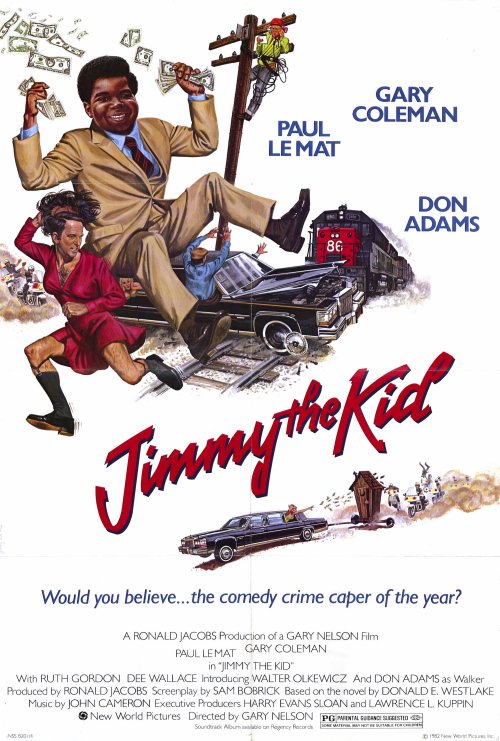
Jimmy the Kid (1982)

jimmy 1

By Richard Winters

My Rating: 1 out of 10

4-Word Review: Inept kidnappers bungle crime.

Jimmy (Gary Coleman) is the son of a singing duo (Cleavon Little, Fay Hauser) who feels neglected while his parents are out on the road singing in concerts. Kelp (Walter Olkewicz) is an inept would-be crook who’s finding it a struggle to successfully commit any crime. He then reads a book about kidnapping and convinces his reluctant brother John (Paul Le Mat), John’s girlfriend May (Dee Wallace) and even his own mother Bernice (Ruth Gordon) to get in on it. Their plan is to kidnap Jimmy and hide him out in a secluded cabin in the woods while extorting money from his rich parents for ransom. The problem is that Jimmy is quite intelligent for his age and outsmarts the crooks at every turn, but also forms a bond with them and they to him, so when his father and the private investigator (Don Adams) comes looking for him in order to ‘rescue him’ he resists their attempts.

The film is based on a Donald E. Westlake novel and while many of his books that were turned into movies were quite entertaining this one isn’t. The same story was filmed before in 1976 as Come Ti Rapisco Pupo and although that was no classic either at least was better than this version, which tries too hard to attract the family audience by being about as benign as you can get. Even a kiddie flick, at least the good ones, need some genuine tension and excitement, to keep the interest going. Classic kid’s films like Benji had some stressful moments where it seem like the kids, who had also been kidnapped, where in danger and you worried for their safety, which got the viewer emotionally caught up in it and intrigued enough to keep watching. This film though makes it quite clear from the start that the bad guys are too stupid to pull-it-off and the kid is never in any kind of real trouble, so the interest level is virtually nil. The crooks are also too dumb to be believable making their clueless remarks and pratfalls more eye-rolling than funny.

The supporting cast is filled with ‘zany characters’ that are equally pathetic. I’ll give some credit to Cleavon who goes out on stage with his wife wearing a get-up that looks like he’s apart of a soul duo, but instead sings a country-tinged song that wasn’t half-bad, Pat Morita as the legally blind limo driver though is ridiculous. I think his part was put-in to give the thing some action by showing all sorts of car pile-ups that he causes as he drives, but no sane person would ever get into a car with him and his ability to hold onto a job as a driver and not be arrested for endangering others, would-be non-existent.

Coleman is especially boring and never says or does anything that’s especially funny. Having him be this super smart kid gets played-up too much and is neither fun, nor amusing. He also shows no character arc other than supposedly ‘learning to be a kid’ though we don’t really see this, which in a good movie would be, but instead verbally explained by Coleman. The movie should’ve had a moment where the crooks, despite their dumbness, knew something that the kid, despite his smartness, didn’t because of the fact that they’d been around longer and a little more worldy-wise, which could’ve lent some insightful irony, but the stupid script wasn’t savvy enough to even go there.

The only two good things about the film are Don Adams and Ruth Gordon. For Adams he plays basically just an extension of his more famous Maxwell Smart persona even having him wear the same type of trench coat. While his pratfalls inside the home of Jimmy’s parents where he inadvertently tears-up the place borders on inane, the scenes where he dresses in drag are actually kind of funny. For Gordon you get to see her, at the age of 85, climb-up a telephone pole. While I’d presume they didn’t really make her do it and just filmed it in a way that made it appear like she did, it still ends-up looking authentic and she says some amusing things as she does, but outside of these two brief moments the movie clunks.

My Rating: 1 out of 10

Released: November 12, 1982

Runtime: 1 Hour 25 Minutes

Rated PG

Director: Gary Nelson

Studio: New World Pictures

Available: VHS

What Ever Happened to Aunt Alice? (1969)

By Richard Winters

My Rating: 8 out of 10

4-Word Review: Old lady kills housekeepers.

After the death of her husband, Claire (Geraldine Page) is shocked to learn that there is no money in his will. Fearing a life of destitution she plots to hire old lady housekeepers who she’ll manipulate to give her their life savings in which she’ll invest into stocks through her broker (Peter Brandon). Once these stocks start making money she’ll murder the housekeeper and keep all the profits for herself. After killing off her fourth housekeeper, Miss Tinsley (Mildred Dunnock) and burying her dead body in her backyard, she hires Alice (Ruth Gordon). Alice though has a secret, she was at one time the former employer for Miss Tinsley, who wants to investigate what happened to her and is suspicious that Claire may hold the secret. Claire though becomes aware of Alice’s scheme and decides to try and make Alice her fifth victim.

This marked the third of Robert Altman’s trilogy featuring old lady killers with the first two being What Ever Happened to Baby Jane? and Hush…Hush, Sweet Charlotte. This was the first one to be filmed in color and the harsh dry desert landscape setting works as a great metaphor to Claire’s barren, evil soul. I also enjoyed the winding plot, which is based on the 1961 novel ‘The Forbidden Garden’ by Ursula Curtiss that has many offbeat twists including a memorable scene featuring the two old ladies rolling around on the floor during a furious fight that you’ll most likely never see in any other movie.

Page’s performance is the main reason why the film is so entertaining. Watching all the various characteristics that she gives to her haughty character is fascinating and she helps make Claire, as nasty as she is, quite memorable. I especially liked the part where after she kills one of her victims she displays for a split second a shocked expression like even she can’t believe what she has just done and this helps to make her character multi-dimensional, like there’s still some semblance of a tortured conscious somewhere within her and she isn’t just a robotic, evil person.

Gordon is okay in support, but I felt her character should’ve had some backup plan that she would use in defense when things got ugly. She keeps assuring her nephew (Robert Fuller) that she can handle things, but when Claire turns on her she becomes almost like a deer-in-headlights. I also didn’t like the wig that she wears and have to agree with one critic who said it makes her look like a giant, walking-talking peanut. I realize that the wig does eventually come into play as part of the plot, but I felt in the brief segments where she’s shown not wearing it she could’ve been seen with her real hair and not just in another wig, which looked just as dumb.

Honorable mention should also go to Spike who plays a stray dog named Chloe. Spike was a well trained animal who was in many films and TV-shows between 1956 and 1971 and the parts where he bares his teeth and growls at Claire every time he sees her, as she attempts to harm him, are amusing.

Spoiler Alert!

The script by Theodore Apstein, fortunately avoids a lot of loopholes, but I did feel at the end they should’ve shown or explained how the characters played by Rosemary Forsythe and Micheal Barbera were able to escape from their burning house. I also found it hard to fathom why Robert Fuller’s character, upon learning that his Aunt had been killed in a suspicious car accident didn’t immediately accuse Claire of doing it. He had pretended not to have any connection to Alice during the majority of the story as that was part of their scheme, but once she was dead I didn’t see why he still needed to pretend. I would think he’d be so emotionally distraught at that point that he would let out his true emotions without even thinking and possibly even tried to attack Claire while having to be restrained by the others.

End of Spoiler Alert!

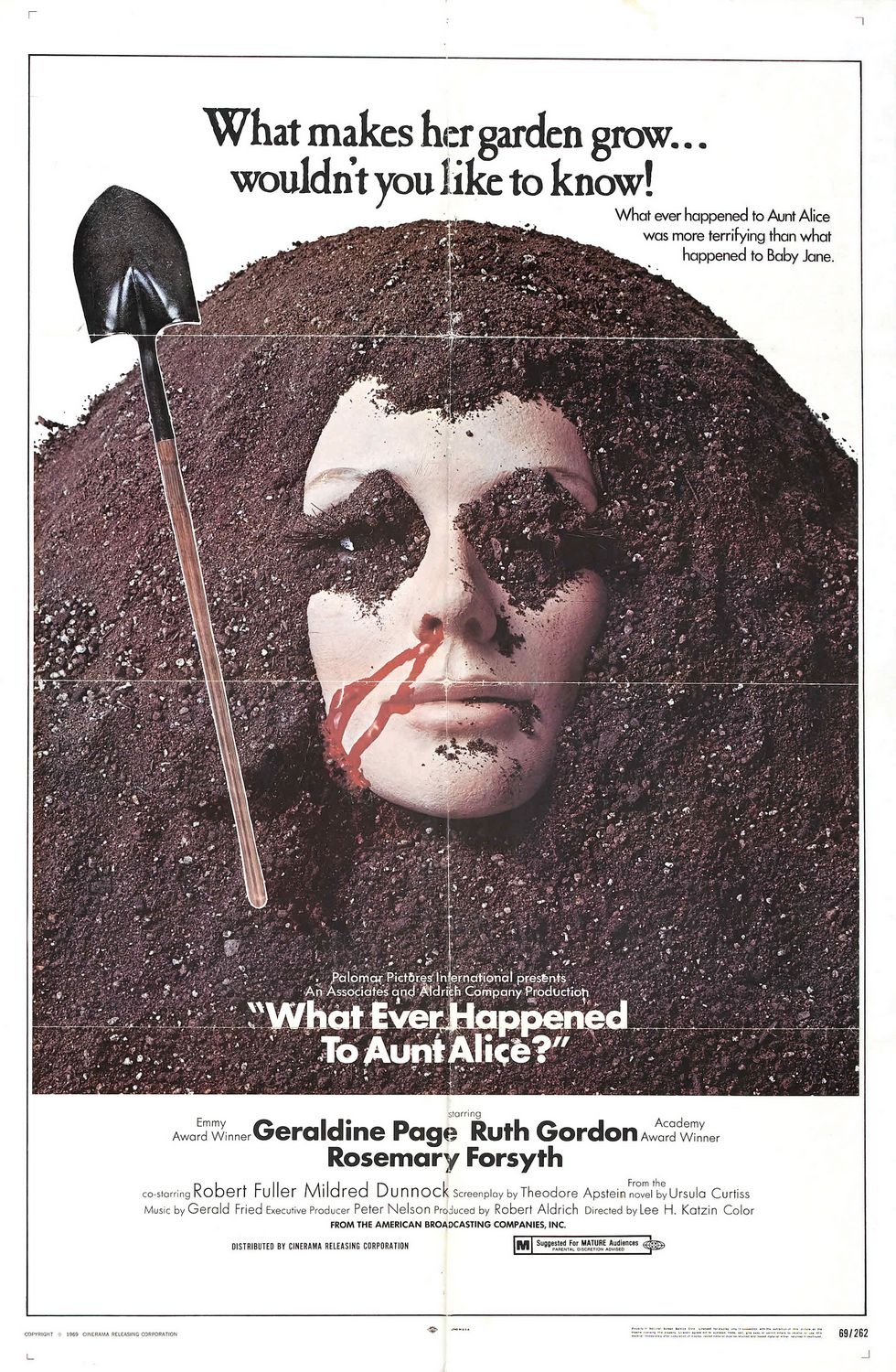
The film’s promotional poster, as seen above, is a bit problematic as it features a young model looking like she’s been buried, but in the movie it was only old ladies that were killed and buried. Showing a beautiful lady may have been more visually appealing, but it’s not authentic to the film that it’s trying to promote.

My Rating: 8 out of 10

Released: July 23, 1969

Runtime: 1 Hour 41 Minutes

Rated M

Director: Lee H. Katzin (Bernard Girard for the first 4-weeks of filming)

Studio: Cinerama Releasing Corporation

Available: DVD, Blu-ray

Boardwalk (1979)

By Richard Winters

My Rating: 4 out of 10

4-Word Review: Gang terrorizes elderly couple.

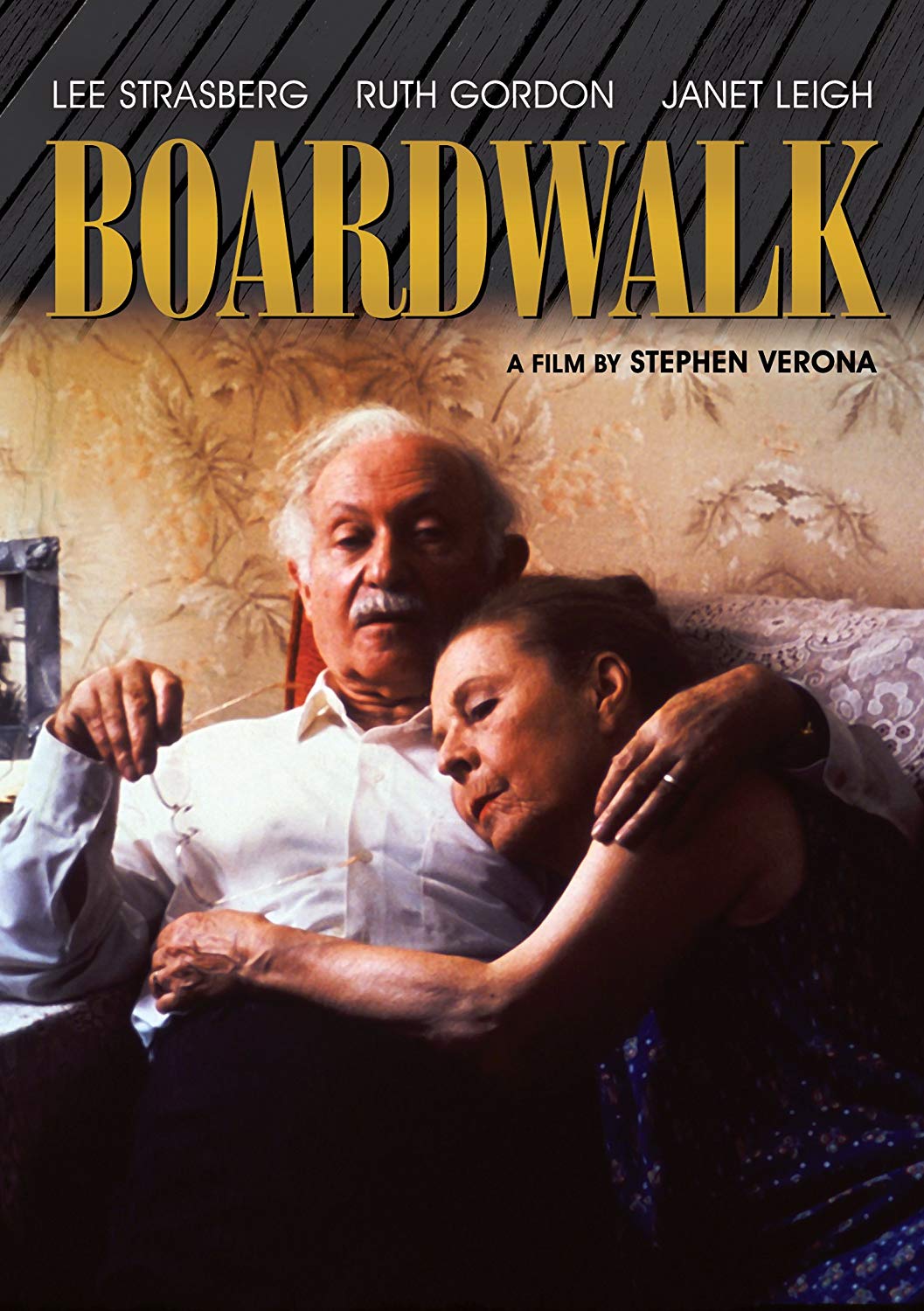
David and Becky (Lee Strasberg, Ruth Gordon) are an elderly couple who spent their entire lives living on Coney Island, but find that their once nice neighborhood has been overtaken by a street gang lead by Strut (Kim Delgado) who demands money from David for ‘protection’. When David refuses to comply it causes Strut and his gang to go on an unrelenting terror campaign where they not only evade David’s home and scare Becky, but also destroy the synagogue where he worships.

The film has a nice independent feel to it and I enjoyed the way the neighborhood’s of Coney Island, many of them with old and picturesque homes gets captured, but this also proves problematic because the area comes off looking too nice to be marred by gangs. In order for the plot to make more sense the couple should’ve been living in a rundown tenet building in an extremely bad part of town instead something looking straight out of a Norman Rockwell painting.

The gang itself is laughable and outside of their campy looking leader seem to be made up of children no older than the fifth or fourth grade. The kids behave threateningly one minute and then get quickly scared off the next. The way they scurry off like a flock of frightened birds makes them seem not very street tough at all, but instead like a bunch of hellions with too much time on their hands and not enough adult supervision. I was also confused why they never get caught and thrown into juvenile detention since they commit most of their crimes in broad daylight for everyone to see.

The story doesn’t focus that much on their activities either as there are long segments in between the gang activities that deal instead with Becky’s cancer and David’s grandson Peter’s (Michael Ayr) rocky love-life, which is actually more interesting and made me believe that the gang storyline could’ve been cut out completely and the movie would’ve been better off for it.

Strasberg, gives a good performance though he’s a bit too serious and probably unable to play a comedic role, or be funny even if he wanted to. Gordon is okay too, despite the fact that her delivery always makes her sound like she’s drunk, but having her collapse and die quite literally in the middle of their 50th wedding anniversary party was over-the-top.

I enjoyed Joe Silver’s supporting performance as David’s grown son especially when he chases a kid who refuses to pay for his food out onto the street and then physically drags him back inside. The scene where David and Becky look through an issue of Playboy before going to sleep is amusing too, but overall the amateurish way it portrays the young gang and the violence that they commit ends up sinking it especially with its  laughable ending.

My Rating: 4 out of 10

Released: November 14, 1979

Runtime: 1 Hour 38 Minutes

Rated PG

Director: Stephen Verona

Studio: Atlantic Releasing Corporation

Available: YouTube

Where’s Poppa? (1970)

wheres poppa 2

By Richard Winters

My Rating: 9 out of 10

4-Word Review: Mother has to go.

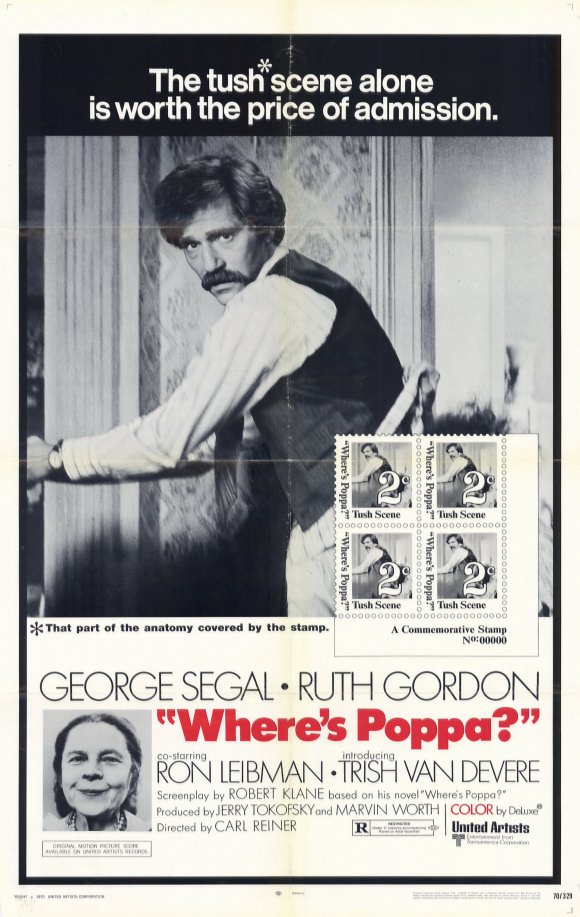
A beleaguered Gordon (George Segal) is a man who must take care of his invalid mother (Ruth Gordon). Despite being a handsome young lawyer he has literally become trapped by this very difficult woman. The majority of the film takes place in a 1940’s styled apartment. It’s gray, dusty bleakness permeates every shot and shows just how lodged Gordon is in his mother’s world. He is a normal man that is slowly being sucked into madness. He is becoming mad because the world he lives in and life in general is driving him to it. The wall between what he really wants to do in life and his obligations have become so thick that going crazy may be the only real answer.

In fact madness maybe pretty much is what this film is really about. It seems to be saying that there is a certain functioning normality to it and at times even a necessity for it. Everyone in this film conveys their own unique form of madness. There’s the overzealous war general (hilariously played by Barnard Hughes) There’s also the henpecked brother/husband Sidney (Ron Leibman) who goes to almost absurd lengths to make sure everyone is happy. Even innocent, conservative Louise (Trish Van Devere) opens into the crazy world when explaining her rather unique honeymoon experience. The film delves so deeply and consistently into the world of the absurd that at times the senile Mother really doesn’t seem so nutty.

This is the film’s genius. It takes everything we have always accepted and turns it inside out. It takes some of life’s most depressing things and then makes it into an inspired and creative masterpiece. A trip to the old folk’s home has never been considered by many to be funny or memorable, yet a trip to Paul Sorvino’s old folk’s home is. In fact it maybe one of the funniest scenes you’ll ever see.

Writer Robert Klane and director Carl Reiner show an amazing grasp of their material, which is crucial for its success. Everything is fluid and consistent in tone. It shows how you can indeed have an offbeat idea, do it in an offbeat way, and still succeed without compromising.

My Rating: 9 out of 10

Released: July 9, 1970

Runtime: 1Hour 22minutes

Rated R

Director: Carl Reiner

Studio: United Artists

Available: VHS, DVD