Tag Archives: Roger Ebert

I Spit on Your Grave (1978)

By Richard Winters

My Rating: 7 out of 10

4-Word Review: Assaulted woman gets revenge.

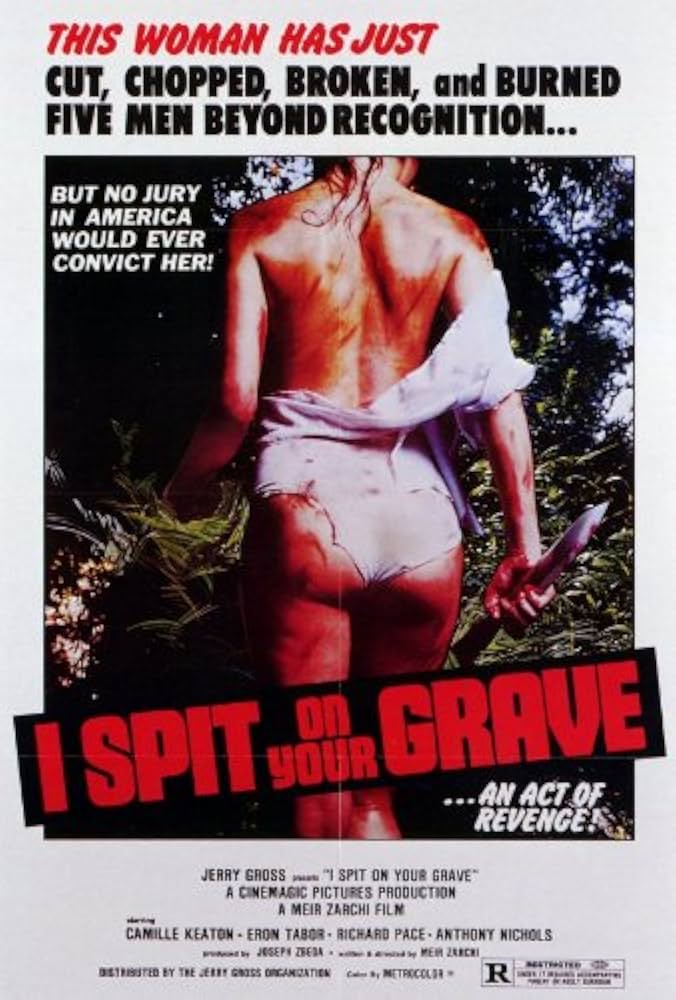
Jennifer Hills (Camille Keaton) is a writer who has decided to get away from the bustle of New York City by renting an isolated cabin by a river that’s just outside of Kent, Connecticut. It’s here that she hopes to finish her novel but finds it hard to do when she inadvertently attracts the attention of Johnny (Eron Tabor) a gas station attendant and two unemployed men named Stanley (Anthony Nichols) and Andy (Gunter Kleeman) who routinely upset her quiet environment with their motorboat. When delivery boy Mathew (Richard Pace), who is mentally disabled and social awkward, comes back to the men describing how when he delivered groceries to her, he ‘saw her breasts’, it gives them the idea to attack her and then ‘offer her up’ to Matthew, so he can finally have sex with a woman. The men chase Jennifer down while she’s relaxing in her rowboat and take her to the backwoods where each of them takes turns raping her over an extended period. Once they finally leave, they give Mathew a knife and tell him to kill her while they wait outside. Mathew though is too afraid to stab her, so he lies and tell them he did when he really didn’t. Eventually, after several weeks, Jennifer recovers from her injuries, both physical and emotional, and decides to seek out the unsuspecting men by killing them off in gruesome ways one-by-one.

This film was and still is highly controversial, some might say it’s the most controversial film ever made and universally condemned by both Roger Ebert and Gene Siskel on their show where they described it as ‘the worst movie ever made’. Ebert even went as far as to write in his review that it made him physically sick to watch it. His review though had a Streisand effect as it garnered it more attention and got people to come to the theater to ‘see what all the fuss was about’ eventually making it quite profitable and a cult classic that’s turned the franchise into marketable one that has given it several sequels and even a 2010 remake.

The inspiration for the story came in October of 1974 when writer/director Meir Zarchi was traveling with his friend and daughter in New York City neighborhood of Jamaican Hills where they came upon a naked, beaten-up woman who told them she had just been raped. When he escorted her to the police, he was appalled at the indifferent treatment she was given and he came home and almost immediately began writing the script.

Almost 2 years later, in August of 1976, he had acquired enough funding so shooting could begin. The argument though was whether this really was a ‘trenchant’ drama meant to expose the brutal nature of rape, versus sanitizing it as other movies at the time tended to do or was simply a cheap way to exploit a difficult subject for money. In a lot of ways, it seems to be the later as gang rapes like the one portrayed here don’t happen too often and it’s usually just one attacker. The fact that the men seem to go away and then suddenly reappear again unexpectedly out of nowhere makes it feel like it’s being played up for tension’s sake and attempting to get the most out of the horror then simply trying to intelligently examine the cruel event.

There’s also no scene showing Jennifer going to the police and being treated poorly, which was supposedly what enraged Zarchi so much during the real event. Without that element it’s harder to justify the plot and there really needed to be a segment showing that.

On the flip side I was impressed with the film’s overall grittiness. It’s like Zarchi had watched Last House on the Left but decided to take out the ill-advised ‘comic relief’ scenes and weird music and just left in the unrelenting tension and to that level it succeeds. Having no soundtrack at all, outside of some organ music that gets played when Jennifer visits a church, helps give it more of a realistic effect almost like we’re watching a documentary where the camera is simply turned-on and whatever terrible things happen is allowed to simply play-out unabated. This along with Keaton’s dynamic performance, where she essentially plays two women, one a victim and the other the perpetrator, is what helps the movie stand out and gives it it’s legs.

Spoiler Alert!

The complaints I had comes more with the third act where Jennifer carries out her revenge. The segment where she entices Matthew to have sex with her again in the woods by the river, so she can put a noose around his neck and hang him, didn’t feel genuine. I would think anyone who had been raped that they wouldn’t want anyone to touch them, or get intimate after such a traumatic event, so allowing herself to get naked and letting a man, one of her former attackers no less, get on top of her, just didn’t seem plausible from a psychological perspective. On the physical end it didn’t seem possible that a young thin woman would be able to pull the rope tight enough to hang someone who clearly weighed more than she.

The second killing where she takes Johnny back to her place and they get naked in her tub had the same problematic issues. She had a gun in her hand when she got out of her car, so why not just shoot him then and get it over with? Why take the chance of bringing him back to her house where he could overpower her? Also, how dumb does this guy have to be that he would completely let down his guard and not think that this woman, who’s assault he happily took part in, could be completely trusted and not try to lure him into a trap?

Her final attack on the two other men is flawed as well as it has her swimming out to the boat that one of them is on, but she comes onboard carrying no weapon. She only gets her hands on the ax when the other guy accidentally drops it into her boat as she tries to side swipe him, but that’s still a very stupid and dangerous way to go about things. If she’s fully intending to kill the guy she should come prepared with something already in hand when she confronts him.

Alternate Title: Day of the Woman

My Rating: 7 out of 10

Released: November 22, 1978

Runtime: 1 Hour 42 Minutes

Rated R

Director: Meir Zarchi

Studio: Cinemagic Pictures

Available: DVD, Blu-ray, PlutoTV, Roku, Tubi, YouTube
 

Roadie (1980)

roadie1

By Richard Winters

My Rating: 7 out of 10

4-Word Review: Truck driver and groupie.

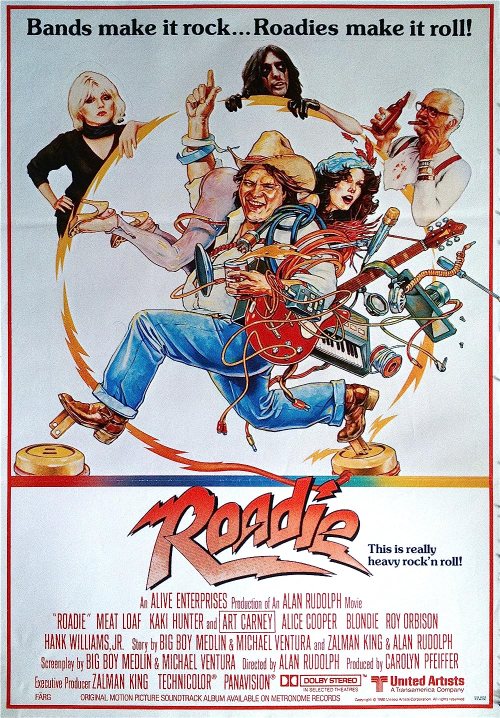
Travis (Meat Loaf) and B.B. (Gailard Sartain) are two truck drivers out making deliveries when they come upon a disabled RV on the side of the highway. Initially they don’t plan to stop, but when Travis sees Lola (Kaki Hunter), a would-be rock ‘n’ roll groupie, peering out the RV window he decides he’s ‘fallen in love’ and pulls-over. His ability to fix mechanical issues using unorthodox tools impresses Ace (Joe Spano) who’s a road manager and wants Travis to drive them to Austin to set-up equipment for a Hank Williams Jr. show. Because of his fondness for Lola he agrees and promptly quits his job as a trucker to travel all over the country meeting such rock ‘n’ roll legends as Roy Orbison and Blondie while also awkwardly courting Lola who’s more infatuated with meeting her idol Alice Cooper.

While director Alan Rudolph has never had a box office hit his movies have usually achieved success amongst the critics except for this one, but  I considered it his most original effort. Roger Ebert described it as being ‘disorganized and episodic’ even though life on the road in a tour group works that way with new issues coming up almost hourly and like driving on the open road there can be many detours and speed bumps as well as fleeting faces, which in that context the film recreates, in quirky comic form, quite well. He also complained about the lack of character development and maybe in Travis’ case there wasn’t much, but he’s such a funny caricature that I didn’t think he needed any. With Lola though I felt there was and impressed me with how much depth she ultimately showed especially since she initially seemed like nothing more than a caricature too. I really liked that she wasn’t as into Travis at the start like he was into her, which can happen a lot, and she has to grow into liking him during their many adventures though still never really openly admits to it to either herself, or others, which I felt was a refreshing change from the ‘love at first sight’ thing in the Hollywood formulas. Ebert also complained that the songs were never played to completion though the ones that are about Texas are.

There’s many unique laugh-out-loud moments. Some of my favorites was the laundromat scene where Travis and Lola have a box of Tide that supposedly holds cocaine. The car chase in Austin done at night in front of the state Capitol building is amusing as is the barroom brawl. Granted there’s been a lot of those in movies, but like with everything else it has a quirky style unlike the others especially as Travis gets hit in the head and begins rambling out incoherent nonsense. The scenes at Travis’ boyhood home where his father (Art Carney) and sister Alice Poo (Rhonda Bates) are a riot including the telephone booth connected to machine belts that allows it to go from the exterior of the home to the inside and the BBQ chicken eating scene, which may be, at least visually, the best moment in the film.

It’s also nice to have a movie that’s all about Texas to actually be filmed in Texas. Too many try to cheat it, a few of them have been reviewed here recently, that mask the Arizona desert, or even the California one to Texas, but anyone from the Lone Star State could easily detect the difference. This one truly has the Texas look and you can see this from the very first shot which features armadillos crossing the highway and because of this it gets the honor of being put into the Scopophilia movie category of ‘Movies that take place in Texas’ versus the ones that say they are set here, but filmed elsewhere.

Spoiler Alert!

Probably the only thing that doesn’t quite work is the ending where Travis and Lola are kissing in the front seat of a pick-up only to see a bright light of a spaceship. I realize the intent was to do a parody of the ‘Paradise by the Dashboard Light’ song and maybe if we had actually seen the ship, which got inadvertently destroyed before shooting began I might’ve forgiven it, or maybe even been impressed, but entering in a sci-fi genre that late becomes almost like a sell-out and too surreal for its own good. Something that stayed true to the playful quirkiness that came before it would’ve tied the bow better.

My Rating: 7 out of 10

Released: June 13, 1980

Runtime: 1 Hour 45 Minutes

Rated PG

Director: Alan Rudolph

Studio: United Artists

Available: DVD, Blu-ray

The Million Dollar Duck (1971)

By Richard Winters

My Rating: 4 out of 10

4-Word Review: Duck lays golden eggs.

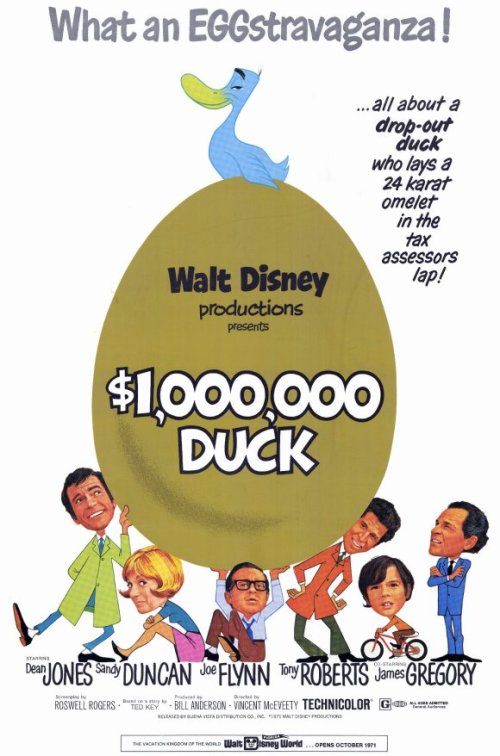
Albert Dooley (Dean Jones) is a research scientist who brings home a duck as a pet for his young son Jimmy (Lee Montgomery) after the bird accidentally gets exposed to radiation while at the lab. To his shock he finds that the duck can now lay eggs with a golden yolk every time she hears the sound of a barking dog. Albert decides to use this to his advantage as he is drowning in unpaid bills, but his neighbor (Joe Flynn), who works at the United States Treasury Department, tries to take the duck away from Albert, so that the government will control it and used the eggs for their own purposes.

The film became notorious as being one of the three that critic Gene Siskel walked out of during his film reviewing career and to which he would brag about for many years later. Roger Ebert described it as “one of the most profoundly stupid movies I have ever seen.” and while I agree it’s no classic I failed to see how it was any sillier than any of the other Disney movies that came out during the same decade.

With that said the plot is loopy although it does define what the term bullion means, so in that respect it’s actually a bit enlightening. The concept though of having a duck lay an egg every time it hears barking is pretty dumb especially when the barking comes from humans who don’t sound anything like a real dog especially Jones’s pathetic attempts. I also didn’t understand why a pinging noise resembling a bell had to be heard each time an egg was laid. Did the radiation cause this to occur too?

The action is pretty light for Disney standards and the only two funny parts are when Sandy Duncan, who plays Jones’s wife, tries to a deposit a golden yolk at a bank as well as when they try to find their duck on a farm amidst hundreds of other ducks who all look the same. The film also comes with a car chase finale that seemed to be a standard plot device for Disney movies of that era although this one is more restrained and not as funny or exciting.

Jones is bland while Duncan and Tony Roberts, who plays Jones’s lawyer friend, are far more amusing. Both Roberts and Duncan had starred together that same year in Star Spangled Girl and they could’ve easily have played the couple while Jones been cut out of it completely and not missed at all.

Montgomery is cute in his film debut and Flynn is funny as the exasperated neighbor. He had co-starred in many Disney films during his career and seemed to have a different color of hair with each role. In some of them his hair was graying while in others it was jet black and here it had a reddish tint. I also found it ironic that he plays a character with a backyard pool and at one point he gets pushed into it as in real-life he ended up drowning in his own backyard pool just three years after this film came out.

My Rating: 4 out of 10

Released: June 30, 1971

Runtime: 1 Hour 29 Minutes

Rated G

Director: Vincent McEveety

Studio: Buena Vista Distribution

Available: DVD, Amazon Video, YouTube