
By Richard Winters
My Rating: 7 out of 10
4-Word Review: Teen challenges the hierarchy.
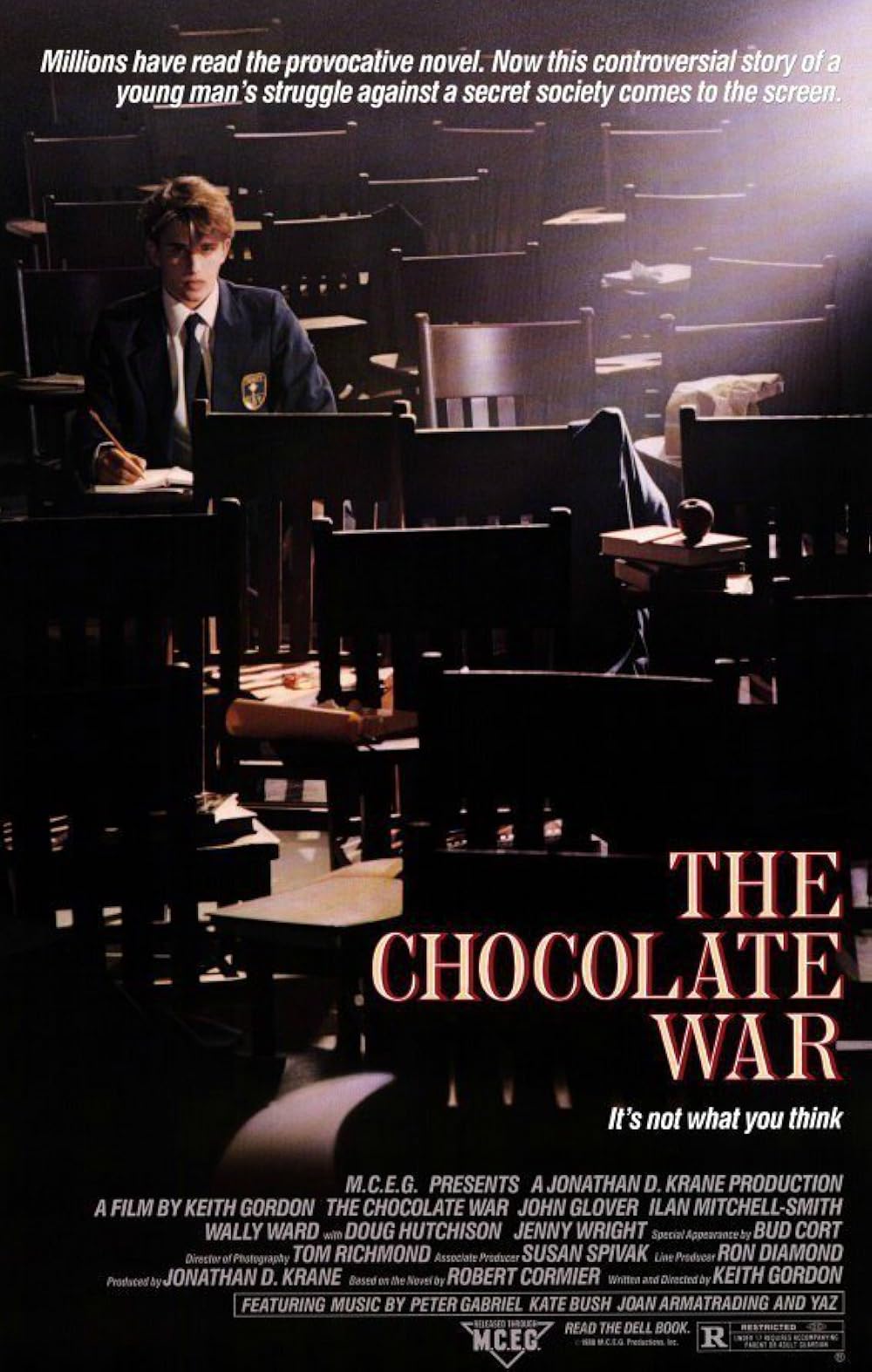
Jerry (Ilan Mitchell-Smith) is the new student at an all-boys Catholic School that finds himself insnared into a controversy that wasn’t of his making. Brother Leon (John Glover), the school’s headmaster, promotes a program in which all the students must sell a certain allotment of chocolates in order to bring in much needed revenue for the school. While it’s technically voluntary the students are strongly pressured to take part in it and all of them do except for Jerry who for ten days refuses to get involved. This it turns out was the result of a hazing ritual brought on by a secret fraternity of students known as The Vigils. The idea was for Jerry to prove himself as being mentally strong enough to join the group by standing up to the intimidating Leon. Leon though becomes aware of what’s going on and since he’s in close contact with Archie (Wally Langham), the Vigil’s leader, he forgives the action convinced that once the 10-days are up Jerry will conform like all the others and take part in the sales drive. However, to everyone’s shock this doesn’t happen. Instead, Jerry continues to rebel, and his nonconformity has an infectious quality causing other students to take part, which challenges the strength of the school’s hierarchy to keep everyone in line.
The film is based on the 1974 novel of the same name by Robert Cormier, which many critics have deemed one of the best young adult novels every written, but also one that routinely shows up as being on the top 10 list of banned or challenged books in high school libraries. It marks the directorial debut of Keith Gordon, who up until this time was better known for his acting particularly his starring role in the horror classic Christine. As a director I think he does a splendid job. I loved the eclectic camera angles, the zooms and hand-held shots. The soundtrack is distinctive featuring songs by artists who allowed their music to be used at a significantly lower price due to the movie’s low budget. The on-location shooting done at an abandoned seminary in Kenmore, Washington is perfect with the gray and dreary Northwest late autumn landscape perfectly reflecting the grim characters and situation.
The acting is impeccable especially Glover who creates a three-dimensional villain who’s bullying at times, but at other points nervous and insecure. Mitchell-Smith, whose teen heart throb appearance belies is high-pitched voice, which I’ve never cared for and the reason I believe his acting career didn’t last, is quite good mainly because he isn’t forced to say much and instead relies on his reactions to what goes on around him, which in that element he excels. Langham is the perfect composite of the preppie bully particularly with that hairstyle that has ‘attitude’ written all over it, but his best moment is when he picks at a pimple on his arm after he gets off the phone with someone. I had noticed it during his conversation and was almost stunned when he picked at it. So many other teen movies show adolescents with unblemished skin, with maybe only a few geeky kids that have acne, but here one of the ‘cool’ kids was shown with it, which coupled with him actually trying to squeeze, which teens in reality will do, was genuinely groundbreaking and not something I’ve ever seen in any movie before or since.
While there’s many memorable moments there’s a few loopholes as well. The fact that the students didn’t have any locks on their lockers, and thus allowing the Vigils to put trash into Jerry’s locker, didn’t seem valid as virtually every high school I’ve been in, past or present, does. The running segment dealing with Jerry and his father receiving harassing anonymous calls is quite dated due to now having caller ID, but even then, they could’ve still called the authorities to have their phone line tapped and thus the calls would’ve been traced, which is something you’d think they’d ultimately would do as it continued to occur. It’s also unclear how the students are able to sell the boxes of chocolates and achieve such a high quota. The film intimates they’re using unscrupulous methods, but not explicit enough as to the exact method.
Spoiler Alert!
The film’s most controversial moment, and one that may have led to it doing poorly at the box office, is the way it changes the original ending. In the book Jerry gets defeated by Archie in the climactic boxing match, but in the movie, Jerry wins, and Archie is subsequently replaced as The Vigil’s leader. Personally, both endings have interesting nuances, so I can’t say I favor one over the other though the movie version does bring out some intriguing elements. However, fans of the novel tend to hate it feeling it was an attempt by Hollywood to give the story a more ‘uplifting’ conclusion.
My Rating: 7 out of 10
Released: November 18, 1988
Runtime: 1 Hour 40 Minutes
Rated R
Director: Keith Gordon
Studio: MCEG
Available: DVD, Blu-ray, PlutoTV, Tubi
 Scopophilia