Tag Archives: Richard Thomas

You’ll Like My Mother (1972)

By Richard Winters

My Rating: 3 out of 10

4-Word Review: Pregnant woman held captive.

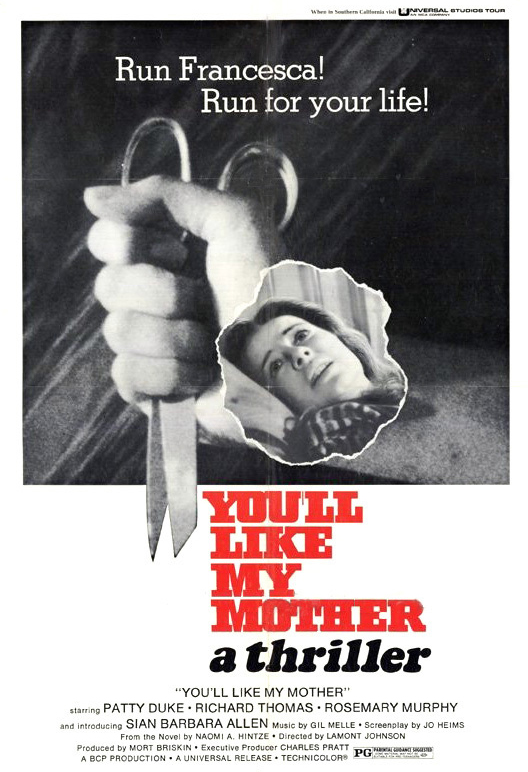
Francesca (Patty Duke) travels by bus to Duluth, Minnesota in order to meet her mother-in-law (Rosemary Murphy) after her husband dies in a plane crash in Vietnam leaving her alone and pregnant. When she arrives, she finds the woman to be cold and indifferent unlike how her husband had described her where he always insisted that ‘you’ll like my mother’. Francesca also finds out that he apparently had a sister, a mute girl named Kathleen (Sian Barbara Allen) that he had never mentioned. A snowstorm blocks her from leaving forcing her to stay in an upstairs bedroom where more troubling secrets come out including the fact that a young man named Kenny (Richard Thomas) is secretly residing in the home and has been accused in the past of being a serial rapist.

Blah thriller based on the 1969 novel of the same name by Naomi A. Hintze. The only interesting aspect about the film is that it was shot on-location at the Glensheen Historic Estate, which 5 years later became the site of a real-life crime when the mansion’s owner, Elisabeth Congdon and her nurse, were murdered by her son-in-law. The movie also marks the debut of Sian Barbara Allen, who died just recently and was quite active in TV and movies during the 70’s before retiring in 1990 in order to focus full-time on being an activist. She was, particularly in her prime, a great beauty with the most mesmerizing pair of blue eyes you’ll ever see. Unfortunately, her role doesn’t have her saying much outside of a few words she manages to mumble out and her character seems to be put in simply to help the protagonist figure out the mystery.

The story unfolds slowly and because the majority of it takes place in one building it becomes visually static. Since it was filmed in Minnesota during the winter the white stuff on the ground is real, which helps with the authenticity, but because it didn’t actually snow when it was being shot the crew was forced to use fake falling flakes in a feeble attempt to replicate a snowstorm, which they’re not able to pull off. Anyone who’s ever experience a real blizzard will see how tacky this one looks and thus the premise that ‘nobody can get through this storm’ is lost.

Patty Duke is good, but her character doesn’t do much outside of staying cooped up in room while Allen does most of the leg work. Her insistence that she didn’t need any help financially makes you wonder then why did she come at all? If it was just for a visit, she could’ve done that in the summer when Minnesota weather is more hospitable and after the baby was born. In many ways having her in need of money would’ve made more sense and heightened the dramatic tension since that would make her desperate with nowhere else to turn.

Murphy is a weak villain as half the time she’s more nervous than Duke and easily fooled making it seem that anyone could outfox her and get away. It doesn’t help that she stupidly gives away who she really is and why she’s there when she has a conversation with Thomas that gets overheard by Duke, which ruins the mystery when the film is only halfway through and thus killing what moderate intrigue there had been.

The foot chase through the snow at the end does offer some tension but waiting all the way until the finale for any action was a mistake and Duke should’ve tried to escape earlier. The plot twists aren’t enough to make sitting through worth it. It’s not adequate material for a 90-minute feature length film as there’s 30-minute episodes of the old ‘Alfred Hitchcock Presents’ with more plot wrinkles than what you get here.

My Rating: 3 out of 10

Released: October 13, 1972

Runtime: 1 Hour 33 Minutes

Rated PG

Director: Lamont Johnson

Studio: Universal Pictures

Available: DVD (Warner Archive)
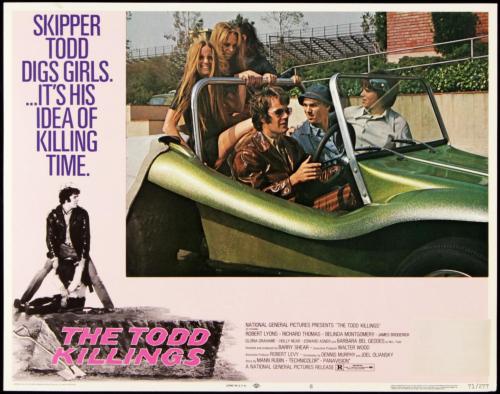
The Todd Killings (1971)

By Richard Winters

My Rating: 5 out of 10

4-Word Review: Pied Piper of Tucson.

Skipper Todd (Robert F. Lyons) is a 23-year-old man who hangs around his local high school and dates many of the teen girls who are mesmerized by his ‘rebel image’. He has no ambitions to work and instead sponges off of his mother (Barbara Bel Geddes) who runs a nursing home while he also dreams of one day becoming a rock star. For kicks he convinces some of his friends to get in with him on murdering a 15-year-old girl just so he can see ‘what it feels like to kill someone’ and they oblige, but then the fear that the others might turn on him causes him to murder even more people.

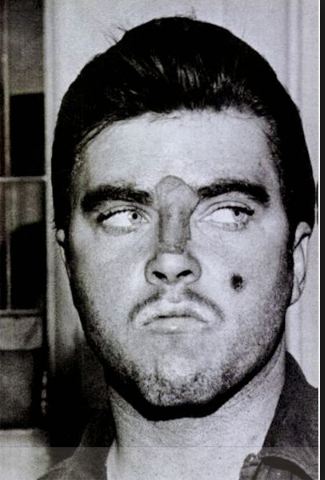
The plot is based on the true story of Charles Schmid, who like the character here hung around a local high school in Tucson, Arizona dating many of the teens there before murdering 15-year-old Aileen Rowe as a ‘thrill-kill’ on the night of May 31, 1964. However, the film does not touch on the extreme eccentricities of Schmid including the fact that he wore cowboy boots filled with flattened cans in an attempt to make him appear taller (and explained the resulting limp as simply a product of getting shot at by the mafia). He also wore make-up to make his nose seem larger, created a large mole on his face so he’d appear more intimidating and even stretched his lower lip with a clothes pin so he would resemble Elvis Presley.

The film though shows none of this and instead tones the character down to the point that he becomes boring. Not only does Lyons look nowhere near as scary as Schmid did, but he plays the part like he was just some lonely kid looking for attention giving the viewer no sense of the allure that he had over the teen girls who flocked around him. Instead of being bigger-than-life the central character becomes flat and forgettable, which is hardly the right ingredient for a riveting drama or thriller.

The murders are not shown, so the viewer doesn’t get a true sense of the horror that went on. The scene where he strangles his girlfriend by gently placing his hands around her neck, which lasts for less than 3 seconds before she falls softly down dead is a perfect example of how overly restrained the whole thing is. The real-life events were shocking, so why create a sanitized film about it when if anything it should’ve been played-up.

The film also begins with the first murder having already occurred, so we get no insight about how he was able to convince his friends to kill the girl. The way he was able to get these otherwise seemingly good kids to do nasty things for him is the most frightening aspect of the case and yet the film glosses over this like it’s no big deal.

Richard Thomas gives a strong supporting performance as Billy Roy who befriends Lyons initially only to eventually turn-on-him. Belinda Montgomery seems quite sincere as his Lyons’ frightened girlfriend and I enjoyed Bel Geddes and Gloria Grahame as the two mothers, but the film’s tepid approach creates a movie that leaves no lasting impression at all.

My Rating: 5 out of 10

Released: October 20, 1971

Runtime: 1Hour 33Minutes

Rated R

Director: Barry Shear

Studio: National General Pictures

Available: DVD-R (Warner Archive)

September 30, 1955 (1977)

september 30 1955

By Richard Winters

My Rating: 4 out of 10

4-Word Review: Death of a legend.

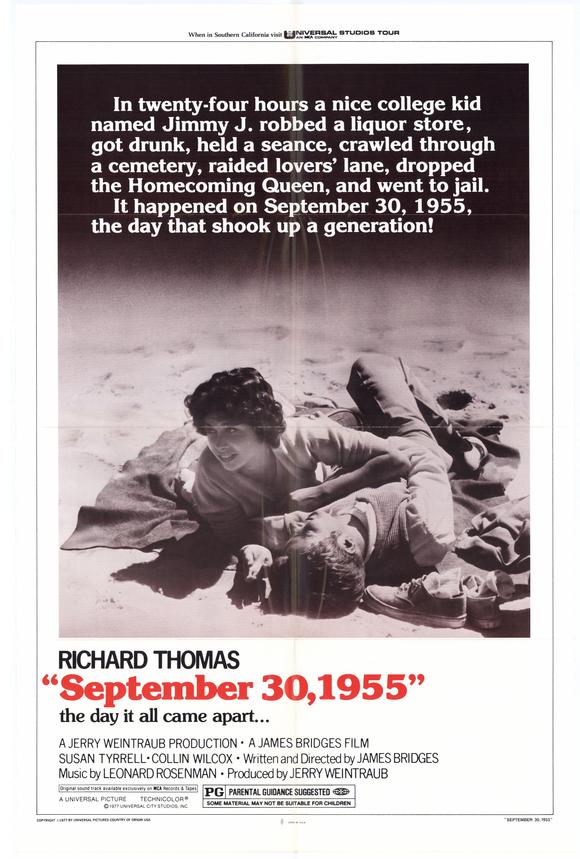
The title represents the date that the legendary actor James Dean died in a car crash and his death has an adverse effect on a group of teens in a small southern town.

Richard Thomas is the main character who, along with his girlfriend Billie Jean (Lisa Blount), seems to get the most upset. Although some of his actions may seem fanatical it is really not as extreme as you may think or could’ve been and at no time does he ever lose sight of reality. For the most part the story is more a look at lost young souls searching for an identity than it is on celebrity worship.

The plot itself is slow with scenes that become unnecessarily drawn out with heavy-handed drama. The ending is unsatisfying as it doesn’t even give us a hint as to whatever became of these characters that are all left hanging in unfinished scenarios making the whole thing seem like just another sappy 70’s teen romance/ tragedy.

Beyond the poor structure there are some good points. One is the chance of seeing budding young talents like Tom Hulce, Dennis Quaid and Dennis Christopher working together and carrying a film. The other is director James Bridges who shows strong insight into Dean’s mystic and why he made such a powerful connection with the youth giving one the feeling that Bridges himself was a big Dean fan at the time as well. He also makes an effective statement about how many lost, lonely souls there are out there and the stifling nature of small town life. His recreation of the period is excellent and the interactions between the characters seem real and authentic. The assessment of the era is honest without being condescending and you feel like you are a part of the 50’s experience, which is interesting and fun.

Unfortunately it becomes too labored and trapped by the sensibilities of a bygone era while also being completely humorless and too talky.

My Rating: 4 out of 10

Released: August 6, 1977

Runtime: 1Hour 41Minutes

Rated PG

Director: James Bridges

Studio: Universal

Available: DVD (Universal Vault), Amazon Instant Video

I Can Make You Love Me (1993)

stalking laura 2

By Richard Winters

My Rating: 7 out of 10

4-Word Review: Stalking is his passion.

To any true film fan TV-Movies have always been considered vastly inferior to the theatrical kind and I would be the first to agree.  However, there is one area where they can shine and that is in their depictions of true-life crimes. Mainly this is because they give it more time as they are usually shown in two parts over consecutive nights.  Also, their lower budgets worked better in recreating the docu-drama style.

Over the years there have been some classics in this area that have helped bring substance to the headlines as well as a better understanding of the victims, the perpetrators and the investigation. Some of the best that I would suggest would be Helter Skelter (1976) starring the Emmy-award winning Steve Railsback as Charles Manson.  The Deliberate Stranger (1986) with Mark Harmon as serial killer Ted Bundy.  There is also Deadly Intentions (1985), A Death in California (1984) with Cheryl Ladd as a woman who falls in love with her rapist, and my personal favorite Fatal Vision (1984) about the infamous Dr. Jeffrey Macdonald.

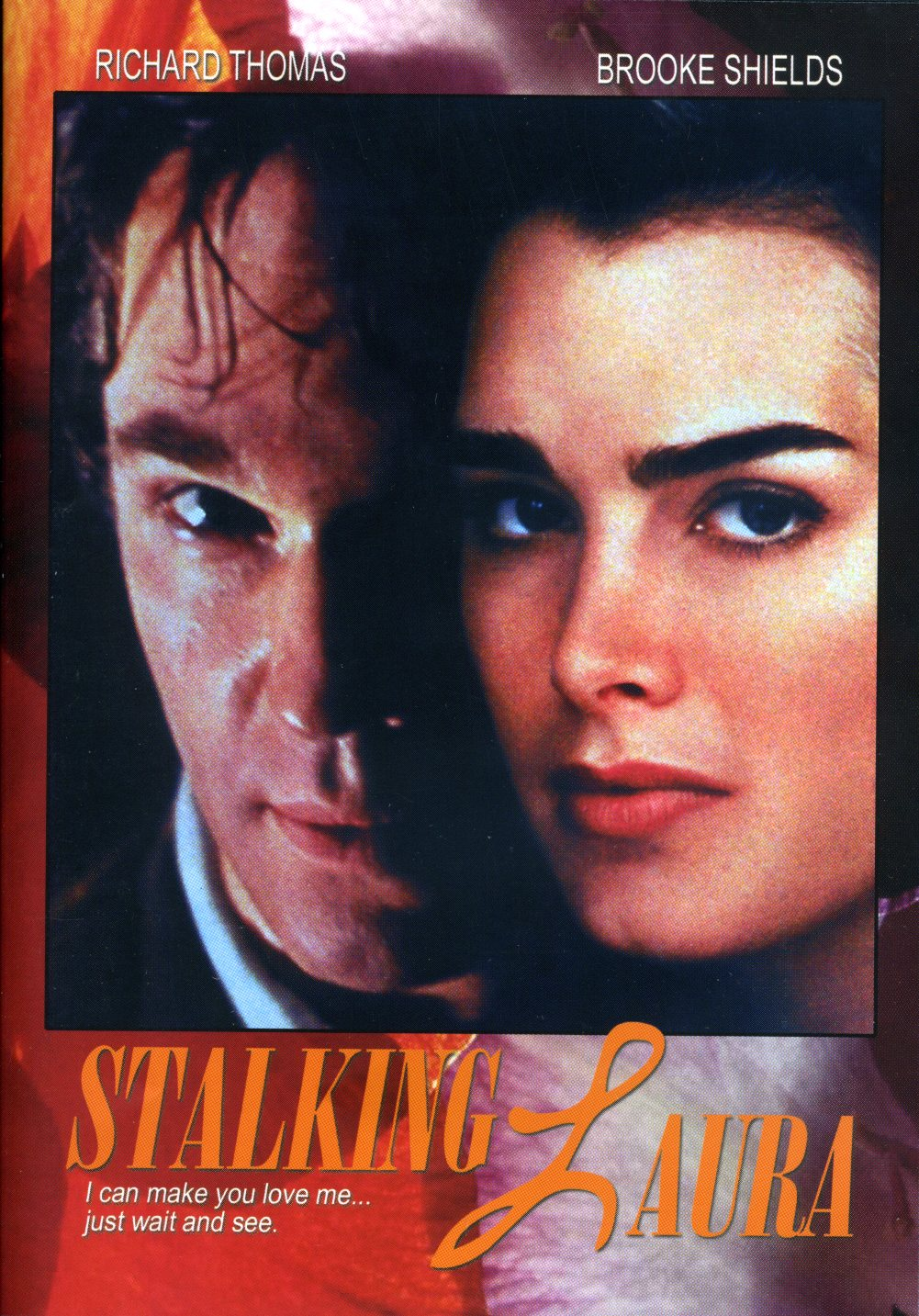
This film deals with the case of Richard Farley (Richard Thomas) that helped develop California’s first anti-stalking laws. Farley was a pudgy, middle-aged man who worked as a computer programmer at a company named ESL in Sunnyvale, California in 1984.  He had been there for 9 years and had no criminal record, but became unhinged when he met an attractive 23- year- old new employee named Laura Black (Brooke Shields).  He began to follow her around constantly as well as sending her gifts and love letters on a daily basis.  When she refused his advances he became even more persistent.  This continued for 4 years until, through his obsession, he ended up losing his job, his house, and his entire life savings, but his stalking continued. Black finally filed a restraining order against him, which sent him into a rage.  He armed himself with an array of guns, stormed the company and shot seven employees including Black, who managed to survive.

Unlike some of the previous movies that I mentioned above, this film did not get the two-part treatment.  Everything that happened gets crammed into 95 minutes, which makes a lot of it seem rushed.  Although the events took place over a four year period, the movie gives you the impression that it was just a few quick months. For the sake of time the film seems to leave certain interesting facts out, which is a shame.  For instance, in real-life Farley actually stood in front of Black’s house for hours going through every conceivable combination on her garage door opener until he was finally able to crack it.  There are also certain things that Farley expressed to Black through his letters that he ends up telling verbally to her here, which causes some of the dialogue to seem awkward.

The film was also not given much of a budget.  It was filmed on a grainy, videotape type of film stock that looks like it was done on somebody’s camcorder.  The story took place in California and yet for whatever reason it ended up being filmed in Topeka, Kansas and the differences in the landscapes are obvious and even a bit disconcerting.

Where the film really seems to come together is during the final 30 minutes where it recreates the office shooting. This sequence is well choreographed and makes you feel like you are right there.  The conversations that Farley has with the negotiator during these scenes are revealing.  I was confused after reading the accounts of the incident as to why Farley would have only shot Black once (in the shoulder) and then allowed her to escape.  Apparently, through his conversations with the negotiator, this was his intention.  He only wanted to injure her and then force her to survive so she would have to live with the ‘guilt’ of having ‘caused’ this by refusing to go out with him.

Another big selling point is the performances of the two leads. Richard Thomas as Farley is astounding.  He does not resemble the actual Farley, but makes up for it with a convincing portrayal that leaves a lasting impression. Shields is excellent as well. Normally I never gave her much credit in the past, but found a new appreciation for her acting ability here.  She does an especially good job during the scenes where she is shot and trying to escape.  It seemed like she was genuinely stressed and in real pain.

Another thing I liked here is that the character of Laura Black is portrayed as being very determined, resourceful, and strong.  She had to struggle with the company about this matter as initially they sided with Farley and was convinced that she must have ‘lead him on’. I felt it was a testament to her strength that she continued to keep working at the company and was still working there five years later when this film was made.

If you find true-life crimes to be intriguing and enjoy seeing them recreated to help your understanding of them, then TV-movies are you best source for this type of genre.  I felt that this case, with its myriad of psychological implications, was no different.

My Rating: 7 out of 10

Released: February 9, 1993

Runtime: 1Hour 32Minutes

Alternate Title: Stalking Laura

Not Rated

Director: Michael Switzer

Studio: Leonard Hill Films

Available: DVD