Tag Archives: Richard Harris

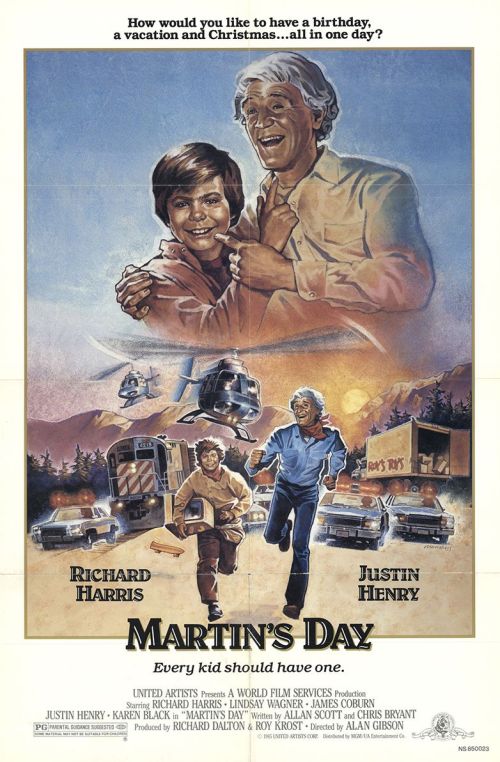
Martin’s Day (1985)

martinsday

By Richard Winters

My Rating: 4 out of 10

4-Word Review: Escaped convict kidnaps boy.

Martin Steckert (Richard Harris) breaks out of jail and disguises himself as a policeman while also absconding with a squad car. Soon some other cops notice the stolen car, which has a broken rear window, and begin to inspect it while Martin is buying groceries. When Martin returns he sees the cops inside the car, but notices their vehicle, which has caught the attention of some neighborhood boys, is sitting idle. He decides to use that car to getaway, but just as he tries to get inside it the other cops take out their guns and point them at him. In a desperate move Martin grabs one of the kids and threatens to kill him, which forces the officers to put down their weapons and let him get away. During the subsequent road trip the two get to know each other and he learns that the kid’s name is also Martin (Justin Henry). A unique bond is created, but the Canadian police force, lead by Lt. Lardner (James Coburn), is hot-on-their-trail.

Richard Harris is fantastic as usual, but the majority of the film is too intent on being a family-friendly movie that it ends up having no edge. The Canadian landscape, shot in September of 1983 in the province of Ontario, is nice and gives one a good feel of rural Canada, but everything else comes-off as trite and predictable though the eclectic supporting cast allows for some added interest.

I especially got a kick out of Lindsay Wagner playing the prison psychiatrist, who tries to replicate the Canadian accent by adding an ‘eh’ at the end of her sentences. I was surprised though that James Coburn, who was still considered a quality leading man at the time, was relegated to such a small role and only seen sporadically. Karen Black does a fine job as Harris’ former lover, but she’s in it for only about 5-minutes and they should’ve had her go along on the trip with the other two, which would’ve added some much needed energy and even a little spice.

The story itself is weak mainly because it telegraphs everything out and there’s absolutely no surprises. It’s clear right from the start, that Harris, while in jail, is a nice guy with a few anger issues, but then when he kidnaps the kid we know upfront that he isn’t going to hurt him. A more intriguing way to have done it, which would’ve allowed for some genuine tension, was to have shown him getting into angry confrontations with his cellmate and possibly even his therapist, so when the kid and him are alone you start to worry how he’ll behave and then during the course of the movie he could learn to be more calm and sympathetic. Even having him threatening the kid versus telling him upfront he’s not going to hurt him, would’ve upped the dramatic ante and allowed for a wider character arch.

I also couldn’t understand why the kid wouldn’t want to go back to his parents and start missing his home life at some point. The movie portrays his mom and dad, whom we never see, as being ‘strict’, but the rules that they had for him, like not eating candy on weekdays and only on weekends, didn’t seem all that outrageous. Had the film shown some scenes at the beginning where his folks were abusive towards him then his ‘escape’ with Harris might’ve made more sense, but as it gets done here the concept becomes highly strained.

Also, for a film aimed at a younger audience the segment where Harris intentionally sets himself on fire while inside his cell was quite graphic and could disturb a lot of children viewers. The scene where Harris backs the squad car that he’s just stolen into the front wall of the policeman’s house gets botched when I noticed that the backend of the vehicle remains completely intact and with no signs of damage, which just painfully illustrates that a breakaway wall was used and not a real one. Another logistical lapse comes when Harris and the kid park their pick-up on the train tracks, which forces the locomotive to stop and allows them to holed-up the train while the kid gets trained by the engineer on how to work it. Then in the next shot we see the train starting down the tracks with the kid now at the helm, but with the pick-up on the side of the tracks and no longer on them, but  it’s never shown how did the pick-up got moved.

My Rating: 4 out of 10

Released: February 22, 1985

Runtime: 1 Hour 38 Minutes

Rated PG

Director: Alan Gibson

Studio: MGM/UA

Available: DVD (Region 2), Amazon Video
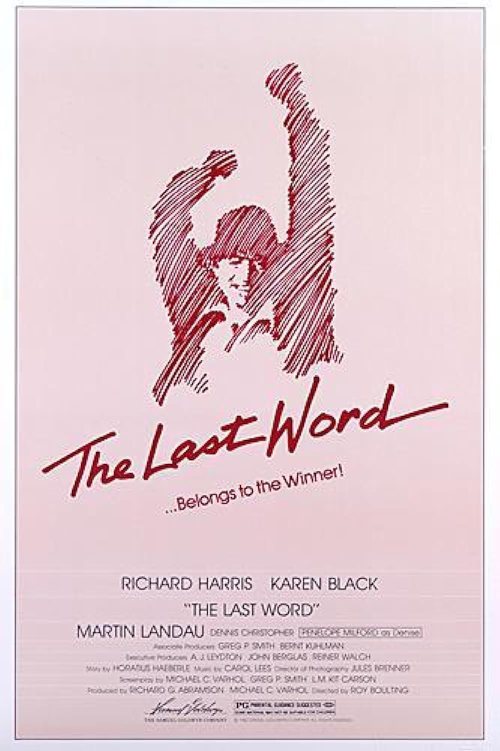
The Last Word (1979)

lastword1

By Richard Winters

My Rating: 2 out of 10

4-Word Review: He won’t move out.

Danny (Richard Harris) is a stubborn and eccentric man who refuses to move out of an apartment building that has been marked for demolition. After his attempts to get a lawyer and also collect welfare prove futile he decides to kidnap the Marshal (Jorge Cervera) who comes to his apartment to serve him his eviction notice. He chains the Marshal to a pipe in his bathroom and then barricades himself and his three children inside. A TV news reporter (Karen Black) feels this will be a juicy story and gets permission to go up to Danny’s place in order to interview him live on the air while the police captain (Martin Landau), who was at one time an old friend to Danny, plots on a way to get him out even if it means deadly force.

This stale drama borrows on a lot elements that have been done before and fails to add anything interesting to the mix. The chief flaw is that there isn’t any explanation for why Danny won’t move out when everyone else in the building does. The apartment itself is quite cramped and nothing special and chances are he could’ve found something bigger, or just as adequate. Without proper motivation the protagonist’s quandry becomes rather irrelevant and even selfish as his stubbornness puts the rest of his family through a lot of needless stress and trauma and having the character be someone who is old and on a fixed income with nowhere else to turn, as much of a caricature as this is, would’ve at least gotten more emotional appeal from the viewer, which with the way it gets done here you really don’t get.

Harris execellent acting helps, but all his inventions start to become a bit cheesy especially his ‘gas masks’ which is nothing more than paper folded around the face with a Campbell’s soup can taped to the bottom, which apparently should be ‘sufficient’ to breath through if under attack, but look laughable and most likely the gas vapors would seep through the paper and thus making them a poor defense. Black, who would co-star with Harris 6 years later in Martin’s Day, plays a serious career driven woman, which is a nice variation from her usual flaky, ditzy types, but her character is unlikable, who initially tries to exploit Danny’s situation for her own gain and having her ‘come around’ at the end to be on his side isn’t enough to make up for it and she should’ve been portrayed as being more emphatic from the beginning.

His three children, played by Penelope Milford, Dennis Christopher, and Natasha Ryan all display the same type of personality and thus become indistinguishable and boring. They all seem to love their father quite a bit and are very loyal and yet refer to him as Danny instead of Dad, which is a bit weird. Landau displays a nice acerbic quality, and the first film where his hair begins to show a few spots of gray, but his character should’ve been the one to go up to the apartment and break into it, especially since he and Danny had a history together, versus having him remain on the ground while his men did the task, which loses out on what could’ve had more dramatic impact.

Spoiler Alert!

The first act is a strain to sit through and is approached in a way that would’ve made it better served as a TV-movie. The second act gets a little more tense when he barricades himself into the apartment and the way he uses all of his different inventions to stop the cops from getting inside is marginally entertaining, but the film leaves way too many things open ended. He eventually gets cuffed and arrested, but no closure as to what happens to him after that. Does he go to trial and win his case? Does he and his family get a new place, or does the building get saved and what happens to the Governor (Biff McGuire) who was exposed as being corrupt? None of this gets answered, which makes the ending like the rest of the film quite unsatisfying.

My Rating: 2 out of 10

Released: October 10, 1979

Runtime: 1 Hour 42 Minutes

Rated PG

Director: Ray Boulting

Studio: Variety International

Available: None

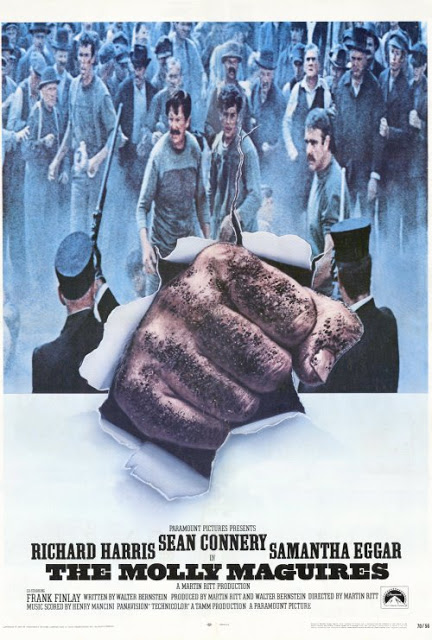
The Molly Maguires (1970)

By Richard Winters

My Rating: 6 out of 10

4-Word Review: Spy infiltrates secret group.

In 1876 a group of Irish immigrants form a secret society known as the Molly Maguires. Their aim is to retaliate against the cruel and unfair working conditions of the mining company that they work at by secretly sabotaging the company’s work site whenever they can. Police Lieutenant Davis (Frank Finley) hires undercover detective James McParland (Richard Harris) to infiltrate the group and find out who the culprits behind the vandalism are. He becomes friends with the group’s leader Jack Kehoe (Sean Connery) which puts into question whether he will turn them in or become a part of the protest.

The story is based on the real-life incident that occurred in 1876 in Reading, Pennsylvania and an actual James McParland who infiltrated a group of Mollies and brought them to justice after their actions ended the lives of several men. The term Molly Maguire comes from the name of an actual woman who lived in Ireland during the 1700’s and helped lead a revolt against rent collectors.

On the technical end the film is well done. The majority of it was shot in Eckley, Pennsylvania whose authentic buildings remained virtually unchanged from when they were built in the 1870’s making it easy for the filmmakers to recreate the period without much effort. The coal plant was built specifically for the film and still stands today, but what impressed me most was that director Martin Ritt allows the natural ambiance of the working conditions to permeate the soundtrack to the point that not a word of dialogue is spoken until 15 minutes in and Connery, who gets shown on and off, never speaks a word until the 40-minute mark.

Despite being made on a large budget of 11 million it managed to only recoup 2 million of its investment at the box office. Personally I feel this was a direct result of exposing the Harris character as an undercover agent right from the start. Usually movies try to keep this element a mystery, which then allows for a surprise reveal at the end, but here that gets ruined.

What’s worse is that the Harris character never changes in any way. He stoically sticks to his mission of turning the men in and betraying the trust that he had earned from them, which I found frustrating. As a viewer you start to bond with Connery and his men and connect to what they’re fighting against. Yes, they do commit crimes of vandalism, but for good reason as they were clearly being exploited by their corporate masters. You’d expect Harris to internally quarrel with this as he becomes friends with them, but he doesn’t and without any insight given to his background it becomes, despite the otherwise high production standards. off-putting and emotionally defeating to have to sit through.

Ritt later directed Norma Rae which dealt with the same subject of worker unions, but that film made unions the center point of the story. Here the union issue seems to be only a side element while Harris’ ongoing con game the main drama, which ultimately creates a nebulous point-of-view.  I walked away wondering what message if anything the film was trying to convey, which could be yet another reason why viewers never warmed up to it despite being otherwise well executed.

My Rating: 6 out of 10

Released: January 27, 1970

Runtime: 2 Hours 5 Minutes

Rated M

Director: Martin Ritt

Studio: Paramount

Available: DVD, Amazon Video, YouTube

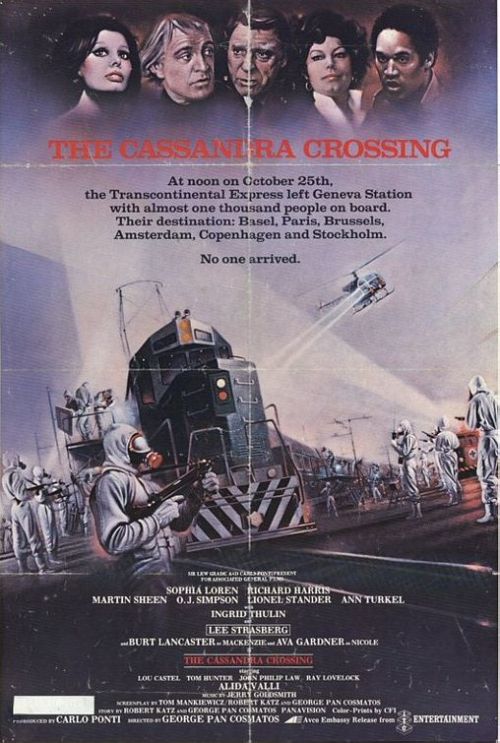
The Cassandra Crossing (1976)

cassandra-crossing-2

By Richard Winters

My Rating: 6 out of 10

4-Word Review: Virus on a train.

A terrorist (Lou Castel) who’s infected with the pneumonic plague sneaks onto a train in order to escape capture, but in the process infects the other passengers. U.S. Colonel MacKenzie (Burt Lancaster) devises a plan to have the train rerouted to a quarantine camp in Poland, but this will require the train to go over a bridge known as the Cassandra Crossing, which has not been used since 1948 and could be structurally unsound. When the passengers realize what the plan is they revolt and make an attempt to stop the train before it gets there, but will it be too late?

The way the bridge gets photographed is excellent and helps make it seem like a third character. An actual working bridge known as the Garabit Viaduct was used and is still in operation today, so the filmmaker’s ability to effectively make it look old and weakened is impressive. The climactic sequence showing the train going over the bridge is very exciting and well shot even if certain angles look conspicuously like a toy train instead of a real one it’s still a showstopper and well worth sitting through just to get to that point.

The film though fails on many other levels. For one thing the characters are not likable, or even all that interesting, so the viewer has little empathy as to whether they are able to make it through their quandary or not. The train is too ordinary looking with little pizazz or visual appeal and more attempts should’ve been made to have a luxury one used instead. The fact that the patients begin to miraculously recover from the disease during the second half makes sitting through the first part almost pointless.

The cast is filled with a lot of familiar faces. Ava Gardner is great in a role that allows her to show some key comic touches, but Sophia Loren, who was cast because her husband at the time was the producer, is completely wasted and forgettable. Lancaster is equally stymied in a role that has him virtually locked inside a control room with not much to do except look perpetually worried. Having his character decide to not panic the passengers by telling them about the virus, but instead he chooses to lie and inform them that the train is being rerouted to avoid bombs planted onto the railway line by terrorists ends up inadvertently getting the passengers just as upset to the point that it’s unintentionally funny.

Richard Harris who plays a doctor trying to treat the infected people while also working to prevent the train from driving into an impending disaster is the only cast member who gives the film any life. Like in the similarly themed Juggernaut his brash and irreverent approach that openly stands up to authority without hesitation helps to make his anti-hero persona seem genuine and refreshing, which in turn makes the film more gripping. His attractive real-life wife Ann Turkel, who plays a singer in a hippie band here, isn’t bad either, or at least not on the eyes.

My Rating: 6 out of 10

Released: December 18, 1976

Runtime: 2Hours 8Minutes

Rated R

Director: George P. Cosmatos

Studio: 20th Century Fox

Available: DVD