Tag Archives: Richard Burton

Exorcist II: The Heretic (1977)

By Richard Winters

My Rating: 0 out of 10

4-Word Review: A really awful sequel.

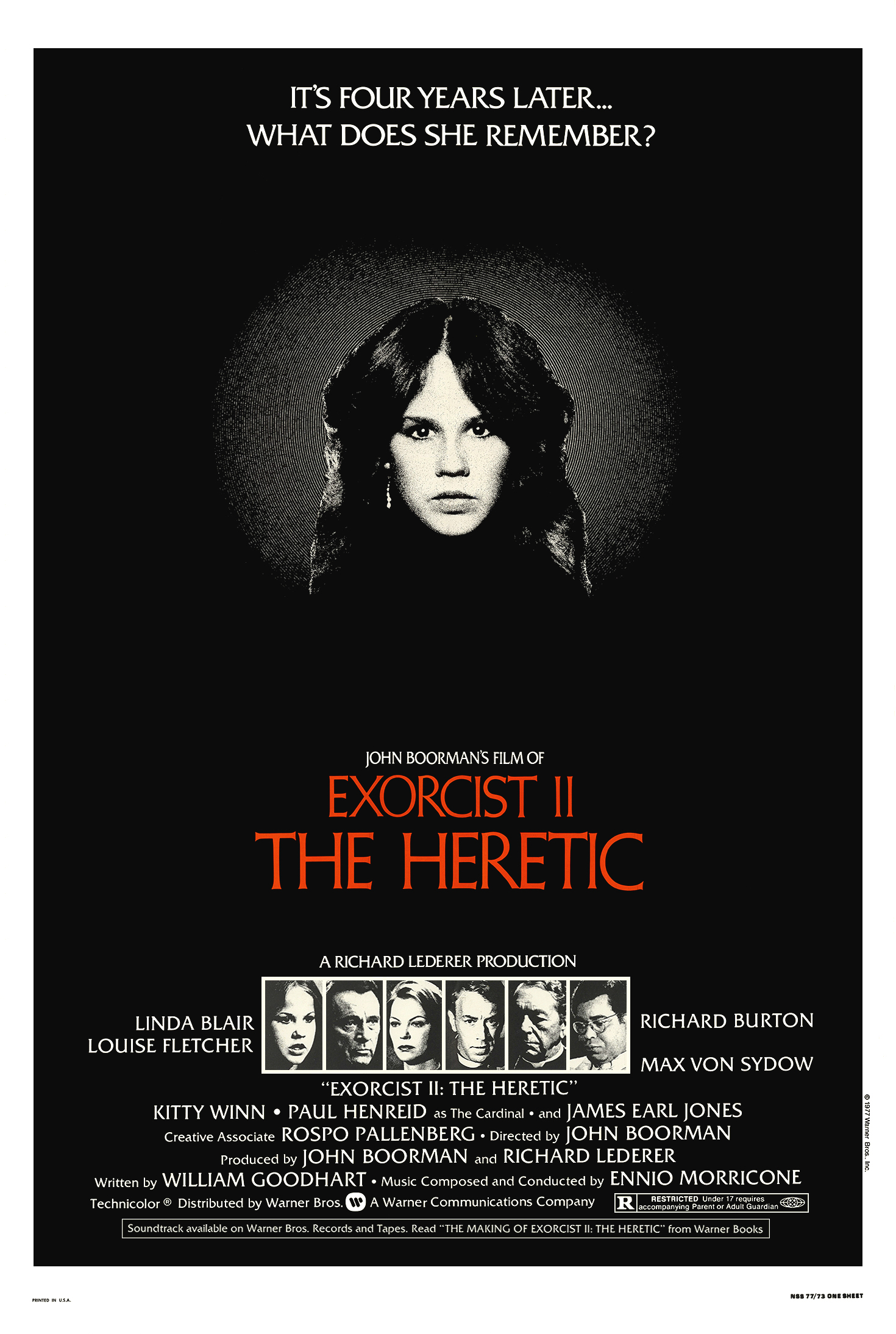
It’s been four years since Regan (Linda Blair) had her bout of possession and is now living a seemingly normal life in New York City with her guardian Sharon (Kitty Winn). Regan does still see a psychiatrist, Dr. Tuskin (Louise Fletcher), who despite Regan’s denials that she can’t remember anything, is convinced that she does have some dormant memories that need to come to the surface. Philip (Richard Burton) is a priest who has been assigned to investigate the death of Father Merrin (Max Von Sydow), who was the priest who died while performing the exorcism on Regan. He meets with Dr. Tuskin and Regan and gets hooked up to a machine called the syncronizer, which allows Philip’s and Regan’s brainwaves to be connected, so he can explore the inner depths of her mind. It is here that he learns about the evil spirit Pazuzu, that was the one that inhabited Regan’s body years earlier, and how Father Merrin had rid a young boy named Kokumo of this same spirit while in Africa. When Philip learns that the now adult Kokumo (James Earl Jones) has developed a special power to defeat Pazuzu he travels to the continent to meet him.

Doing a sequel to the hit movie wasn’t a bad idea per say as there were still some open-ended questions like why did Pazuzu choose Regan’s body to inhabit instead of some other girls and what mental issues would Regan have to deal with after going through such a traumatic event? None of those were ever answered in the first film, but intriguing enough to me that I felt a second film was warranted and could’ve been quite compelling. Unfortunately, what we get wouldn’t even qualify as second-rate. Most of the problem lies with director John Boorman, who admitted in later interviews that his biggest crime was that he didn’t give the viewer what they wanted, which is the truth. I don’t mean to bash the guy as he’s helmed some classics in his own right, but when he professes that he was offered the job to direct the first installment but turned it down because he thought it was ‘repulsive’ then that should’ve disqualified him from getting any consideration to doing the second one.

Everything gets botched right from the beginning including a misguided reenactment of the final segment in the first film that honestly comes-off like a cheap parody. For one thing Father Merrin is seen standing at the end of Regan’s bed, when we know clearly from the first film that he was kneeling on the right side of the bed when he died. Also, due to Blair’s insistence that she didn’t want to go through the grueling routine of having to put on the demon make-up, so a stand-in took her place, but the results are clownish. The silly-‘synchonizer’ further hampers things as it appears more like a child’s toy and the cliched idea of simply attaching a few wires to each participant’s foreheads and that would be enough to get their mind’s ‘in-sync’ looks like something straight out of a tacky B-sci fi flick from the 50’s.

Not able to get Ellen Burstyn to sign-on really hurts though I can’t blame her for being reluctant but trying to use Kitty Winn as her replacement bombs. For one thing the Sharon character didn’t have that much of a prominent role in the first one, I barely even remembered her, and she was Burstyn’s secretary who didn’t interact that much with Blair, so for them to now be so ‘connected’ seemed like a stretch and having Winn sporting short hair, in an attempt I presume to make her ‘seem’ like Burstyn, was tacky. Von Sydow suffers a similar fate. He gets portrayed as being a younger version of his character here but only appears in flashbacks and doesn’t have much to say or do making it seem like it wasn’t even worth the effort.

Fletcher is good in that she played a cold, bitchy nurse in her previous film, One Flew Over the Cuckoo’s Nest, but here shows her great acting ability at playing the total opposite and doing it convincingly. However, her character doesn’t help propel the action and is only there to react to things, which ultimately makes her presence one dimensional. Burton, whose talents I have always greatly admired even when he took less than stellar roles, but his appearance here has to be rock bottom. He admitted that he only did this for the paycheck, due to an expensive divorce he was going through with Liz, but the material doesn’t match his ability and it’s a career low even for him as he was known to make some bad project choices during the 70’s, but this was by far the worst.

To top things off there’s James Earl Jones wearing a giant bug outfit that nearly had me laughing out of my seat. The numerous shots of locusts and the sandy African landscape make it seem more like a nature movie, but whatever it is it’s not scary. It’s so convoluted it’s not even good enough to fall into the ‘so-bad-it’s-good’ category. It is cool though at least see a young Dana Plato playing an autistic child in a small but pivotal part.

My Rating: 0 out of 10

Released: June 17, 1977

Runtime: 1 Hour 57 Minutes

Rated R

Director: John Boorman

Studio: Warner Brothers

Available: DVD, Blu-ray, Amazon Video, Tubi, YouTube
Absolution (1978)

absolution

By Richard Winters

My Rating: 7 out of 10

4-Word Review: Pranking a strict priest.

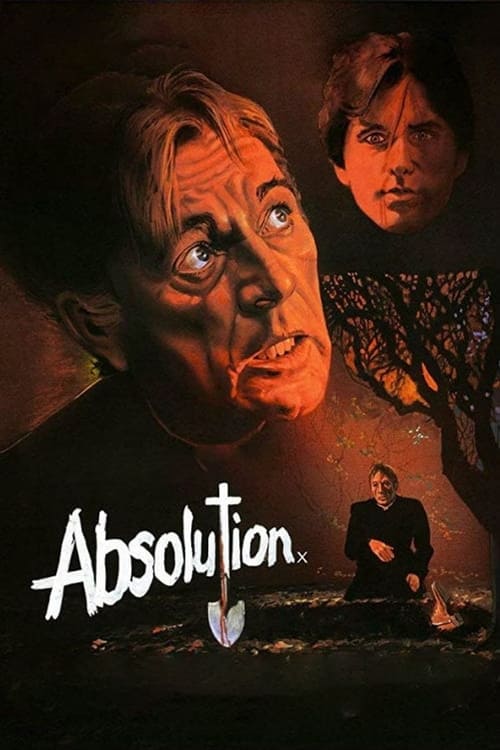
Father Goddard (Richard Burton) is the head of an English Boy’s School and uses his influence to control those who attend and is unflinching on his policies. Goddard constantly displays a cold and detached demeanor particularly with Arthur (Dai Bradley) a handicapped student that the Father doesn’t seem to care for. Benjie (Dominic Guard) on the other-hand is the teacher’s pet and routinely shown favorable treatment. Benjie though grows to resent the Father’s stern ways when he’s told he can no longer visit with Blakely (Billy Connolly) a motorcycle riding vagabond who has set-up an encampment just outside of the school grounds. Benjie decides to play a prank on the Father after hearing the lecture about the seal of confession, which a priest cannot break even if what he’s told is about a murder, so during confession Benjie tells Goddard that he’s murdered Blakely. Goddard initially doesn’t believe him, which sets off a myriad of twists that soon sends Goddard’s life, career and even his sanity spiraling out-of-control.

After the success of The Wicker ManAnthony Schaffer was commissioned by director Anthony Page to write another script that could be made into a movie and Schaffer decided to choose one that had initially been meant as a stageplay, but had never been produced. However, once Schaffer had completed his adaptation Page was unable to find a studio willing to fund it and he was ultimately forced to use his own money and Burton agreeing to slash his normal fee in order to get it made.

The lack of a budget is sorely evident at the start featuring a grainy print with faded color and what initially seems like misplaced banjo music that would be considered more appropriate for a film set in the American south instead of England. Having it shot on-location at Ellesmere Collage helps as many of the local pupils played the students here and the film gives-off a realistic atmosphere about what a boys school would be like with all of the kids looking age appropriate for their grade level and not like, as with other teen school movies, older actors in their 20’s trying to come-off as if they were still adolescents.

Billy Connelly, in his film debut, is terrific and it’s fun seeing Bradley, who was better known for his starring role in KesBurton though is the standout as his jet setting persona that he had at the time with Elizabeth Taylor gets completely erased and he fully sinks into his role of a steely-eyed, cantankerous man who rules with a rigid, iron-fist and whose simple presence wields terror in the boys as he walks-by and to some extent the viewer too. It’s a commanding performance that helps the movie stand-out.

Spoiler Alert!

The story though, while intriguing, doesn’t fully work. It becomes obvious that Goddard is being tricked by the boys, but you feel no empathy for his quandary. He has spent so much time up until then being a jerk that you end up siding with the boys, at least initially, which seriously hurts the tension as normally in a thriller/mystery such as this you’re supposed to side with the protagonist and want to emotionally see them get out of their predicament. Here though you like his mental breakdown and not as invested in finding out the resolution beyond it. The final explanation, dealing with the Arthur character supposedly disguising his voice to sound like Benje’s is too much of a stretch and ultimately hurts the credibility.

Shaffer stated in interviews that this was not meant to be an anti-Catholic movie, but I feel he said this in order not to alienate potential viewers as it’s clearly written by someone who grow-up in the church and had many problems with it. Father Goddard is more a caricature meant to represent Catholicism as a whole and how the religion with its very rigid rules ends up trapping those who follow it with a damned-if-you-do, damned-if-you don’t scenarios leaving its followers in a perpetual state of guilt and paranoia. This becomes quite evident at the end where the Father feels unable to break his seal of confession for fear of divine wrath, but also fears it for the murder he committed and his thoughts of suicide that would equally lead him to hell, per the teachings, making him more a victim of the religion than of the boys, which I feel was the whole point.

My Rating: 7 out of 10

Released: December 8, 1978

Runtime: 1 Hour 35 Minutes

Rated R

Director: Anthony Page

Studio: Bulldog Productions

Available: DVD, Blu-ray, Amazon Video

Equus (1977)

equus1

By Richard Winters

My Rating: 6 out of 10

4-Word Review: Teen blinds six horses.

Martin (Richard Burton) is a disillusioned, middle-aged psychiatrist who gets tasked with finding out why a 17-year-old boy named Alan (Peter Firth) blinded six horses one night in a stable with a sickle. At first Alan is uncooperative during their sessions and will not speak to him and instead sings out commercial jingles repeatedly, so Martin must go to Alan’s parents (Colin Blakely, Joan Plowright) in an effort to find some answers. It is here that he learns the mother is highly religious and taught her son that ‘God sees all’ particularly when it comes to sexual transgressions. Alan though has replaced God with his obsession with horses and idolizes them instead where he essentially makes them his ‘deity’. Martin now must try to break the boy away from this fanaticism in an effort to make him ‘normal’, but realizes when he does that the kid will cease to have passion and become like Martin himself who no longer has any emotions for anything including his own wife whom he no longer shares intimate relations.

Director Sidney Lumet has always had a penchant for turning plays into a movies and with some of them he’s had great success like with 12 Angry Men, but some of his other efforts did not fare as well. This project was met initially with a lot of apprehension, but overall Lumet’s directorial flair adds a lot and cinematically it works for the most part. The effort to get away from the staginess of the story by having several scenes done outdoors, like Martin having a discussion with his friend played by Eileen Atkins, about the case while raking leaves I felt really worked. Again, with cinema you have to have the characters doing something during the dialogue even if it’s some sort of chore as there’s nothing more stagnant than talking heads in a movie. The opening sequence done over the credits is well done too as it features Martin dealing with hostile patients hitting home the point of how burnt-out with his career he is without having it told to us and the white color schemes accentuates the tone one is most likely to see in hospitals.

The controversy came with the portrayal of the horses. In the play there were performed by muscular men inside a horse costume, but for the movie Lumet decided they needed to use real animals. This is okay until it comes to the scene where they get blinded. The play version only intimates the violent act, but with the movie you actually see the sickle go right into the horses’ eyes, which is so realistically done I don’t know how they did it without hurting the animal. This was way before computer effects, so just be warned if you’re an animal lover these scenes may be too graphic to bare and could easily take some viewers out of the story to the extent they may not be able to get back into and might just turn it off altogether.

The casting is a bit problematic. Both Burton and Firth played the roles in the stage version, but by this point Firth was no longer looking like a 17-year-old, he was in fact already 23. I admire his bravery to ride a horse in the nude in one of the movie’s more memorable moments, but he still resembles adult features physically taking away the innocence of the character and the shock of how someone so young, i.e. a teen. could commit such a vicious act. Burton too looks too worn out having spent this period of his career battling alcoholism. Some may say that this fit his role, but his presence seems at times almost lifeless and like he’s just walking through his part. The segments where he speaks directly to the camera become long-winded, stagey and aren’t effective.

The story itself may not work for everyone. It was inspired by a true event, which occurred in 1954, that playwright Peter Shaffer heard about, but did not actually investigate. Instead he wanted to come up with his own hypothesis on how someone could do what this character does without learning the real reason that motivated the actual culprit. Some may find the teen’s motivation here to be interpretive and revealing while others will blow-it-off as pseudo psychology and not able to fully buy into. For example certain viewers will find the scene where the father catches the boy kneeling in front of a picture in his bedroom of a horse and ‘worshipping it’ while wearing a make-shift harness to be quite disturbing though with others this same segment may elicit a bad case of the giggles instead.

My Rating: 6 out of 10

Released: October 14, 1977

Runtime: 2 Hour 17 Minutes

Rated R

Director: Sidney Lumet

Studio: United Artists

Available: DVD, Blu-ray

Circle of Two (1981)

circle3

By Richard Winters

My Rating: 4 out of 10

4-Word Review: Old man/young teen.

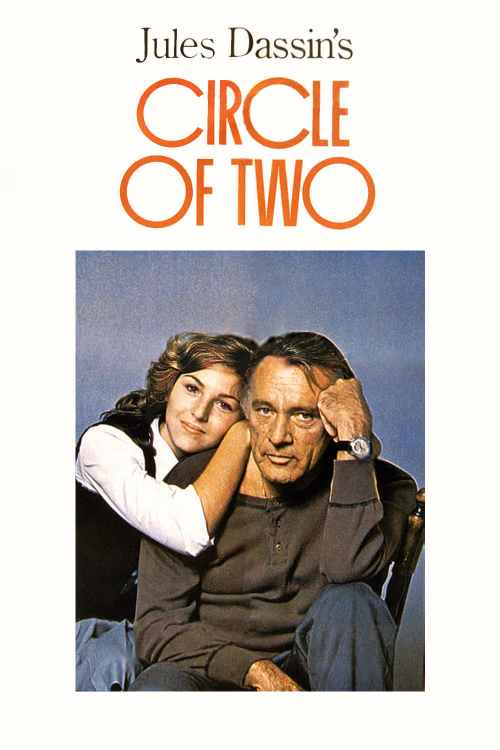
Ashley St. Clair (Richard Burton) is an aging painter of 60 who has lost his passion and hasn’t either sold, or attempted to do a painting in over 10 years. Sarah (Tatum O’Neal) is an unhappy 15-year-old who’s tired of dating guys her own age as she finds them to be immature and only interested in one thing…sex. She then meets Ashley, first after she sneaks into an adult theater to watch an X-rated movie and then later at a coffee shop. Despite the extreme differences in their ages they still connect through their mutual interest in art. Ashley even begins to paint again and the two share an enjoyable, but platonic friendship. However, once Sarah’s parents (Robin Gammell, Patricia Collins) find out about they put an immediate stop to it by locking her in her room and and in protest Sarah refuses to eat.

Based on the novel ‘A Lesson in Love’ by Marie-Terese Baird this film marks the final one to be directed by famed Greek director Jules Dassin and in many ways this may be the weakest one that he did. The whole way the relationship gets going is very rushed and forced. Bumping into the same person twice in one day, in the big city of Toronto, doesn’t seem likely and then having Sarah fall so head-over-heels for him to the point she starts spouting out the ‘L’ word quite quickly is dingy. A more plausible scenario would’ve had Ashley teaching an art class (he no longer paints, but still has to bring in an income somehow) of which Sarah attends and then through the course of several months a bond is slowly created.

The sex angle is a complete mess. Fortunately Ashley makes no moves on her, but Sarah does aggressively begin to come-on to him and at one point stands completely naked in front of him. In her autobiography ‘A Paper Life’ O’Neal expressed great discomfort in having to do this scene though I didn’t detect this, but maybe that’s just because she’s such a great actress, but either way the scene was completely unnecessary.  It’s also inconsistent with the character as she broke-up with her boyfriend Paul (Michael Wincott) because he was trying to pressure her into having sex and she was still a virgin, so if she didn’t want sex with a guy her own age why would she want it with one who was way older and is this era of pre-Viagra how could she even be sure he could do it? A better scenario would’ve had sex never coming into play and it was simply their other mutual interests that connected them and it was only outsiders, like Sarah’s parents, that presumed the worst when it really wasn’t occurring.

The one bright spot is the acting with both leads being superb. O’Neal proves that her strong and memorable performance in Paper Moon was no fluke and the only thing that keeps the film watchable. Burton is excellent as well. Although he usually has a strong presence here he wisely takes a step back playing someone who’s weak and tentative, which in many ways reflected his own career at the time where many felt he was washed-up and the years of alcohol abuse certainly did age him making him look even older than 60 when he really wasn’t, and thus a perfect fit for the part. The only issue here is that Tatum seems way too mature for 15 both physically and personality-wise and having her play someone who was 17 would’ve been more appropriate.

While the film remains marginally compelling the talky ending in which Burton goes on a long speech like a tenured professor lecturing to a college class practically ruins it. I was also frustrated that we never learn much about the old man, played by George Bourne Sr., an elderly gentleman who agrees to let Ashley paint his portrait for a fee, which in-turn revitalizes his career and I felt this character should’ve been in it more, or at least a few scenes showing what they talked about as his portrait was being done.

Tatum’s abstaining from all food plays-out poorly as well. For one thing she doesn’t change physically, so we’d never know she wasn’t eating if it weren’t mentioned. She then travels to New York and I was fully expecting her to pass-out in the middle of crowded Grand Central Station from a lack of nutrients, but apparently in-between time she had eaten something, but this should’ve been shown and the fact that it isn’t is a sign of shoddy film-making, which despite Dassin’s previous output, this whole movie ends up pretty much being.

My Rating: 4 out of 10

Released: May 7, 1981

Runtime: 1 Hour 46 Minutes

Rated PG

Director: Jules Dassin

Studio: World Northal

Available: DVD-R, Amazon Video

The Comedians (1967)

By Richard Winters

My Rating: 5 out of 10

4-Word Review: Life under Papa Doc.

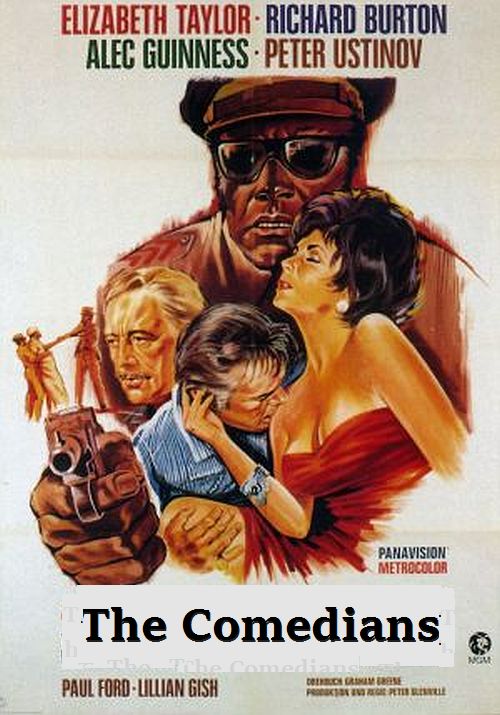
Based on the novel by Graham Greene the film centers on Brown (Richard Burton) an emotionally detached British hotel owner residing in Haiti. He has spent years avoiding the political turmoil of the region and the Francois ‘Papa Doc’ Duvalier regime, but finds now that the walls may finally be closing in. He must deal with the suicide of a government official that occurs on his grounds in his pool as well as a visiting American couple (Paul J. Ford, Lillian Gish) with strong political connections. His ongoing affair with the wife (Elizabeth Taylor) of a South American diplomat (Peter Ustinov) risks him further trouble as does his friendship with an illegal arms dealer (Alec Guinness).

The film ebbs-and-flows unevenly and isn’t compelling despite some strong moments here and there. What grabbed my attention was the vivid on-location shooting that gives the movie an interesting visual appeal. Because of the political environment going on in Haiti the producers were not allowed to film there and instead choose the small African country of Benin, which was still called the Republic of Dahomey at the time, as their substitute setting. The contrast of the serene tropical landscape juxtaposed with the abject poverty of its citizens is stunning with the most impactful moment coming when they visit Duvalierville a planned city with expensive buildings and homes being constructed with poor homeless people scurrying around begging for money as the structures go up.

The acting though by Richard Burton is atrocious and a major hindrance. I like Burton and consider him in most productions that he has been in to be a very strong actor, but here he doesn’t seem into the part at all. His presence is quite aloof and conveys little emotion to the point that he seems to be just walking through his role and mouthing his lines.

Taylor on the other hand is quite strong and manages to speak with an authentic sounding German accent. She made many bad film choices later her in career that ended up stigmatizes her acting reputation, but if given the right script and a competent director she could clearly convey an onscreen brilliance, which she does here. Unfortunately she is not seen enough and appears only sporadically throughout. If this is supposed to be a Taylor/Burton picture then the two needed equal screen time and prominent roles instead of one being relegated to what seems like only a minor part.

The supporting cast is excellent and this is a great chance to see up-and-coming African American actors when they were just starting out including: Raymond St. Jacques, James Earl Jones, Cicely Tyson, George Stanford Brown, and Zakes Mokae.  Gish and Ford offer a surprisingly profound moment when they follow a procession of singing happy young children into a forum for what they think will be a religious ceremony only to find to their shock that everyone is there to witness a firing squad execution instead.

The story has its moments, but I would’ve preferred if it had been a little more focused. At times it is compelling, but it drifts back and forth between too many different story threads and never comes together as a whole not to mention a limp ending that leaves no impact.

My Rating: 5 out of 10

Released: October 31, 1967

Runtime: 2 Hours 31 Minutes

Not Rated

Director: Peter Glenville

Studio: MGM

Available: DVD (Box Set), Amazon Video, YouTube

Boom! (1968)

boom

By Richard Winters

My Rating: 4 out of 10

4-Word Review: Bitchy lady rules island.

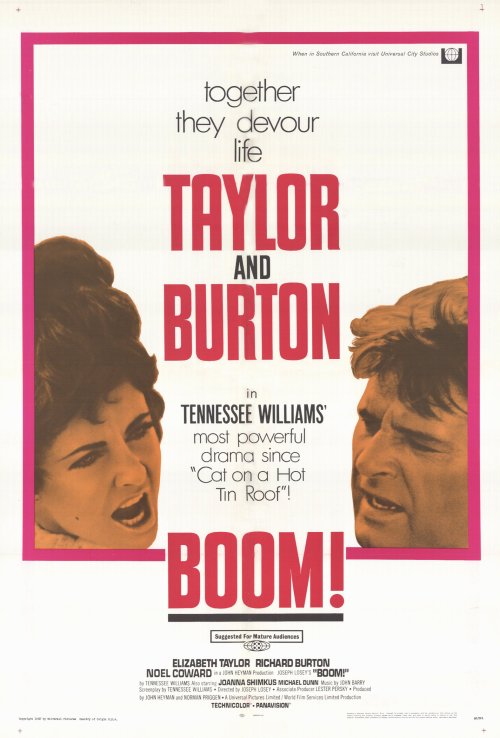
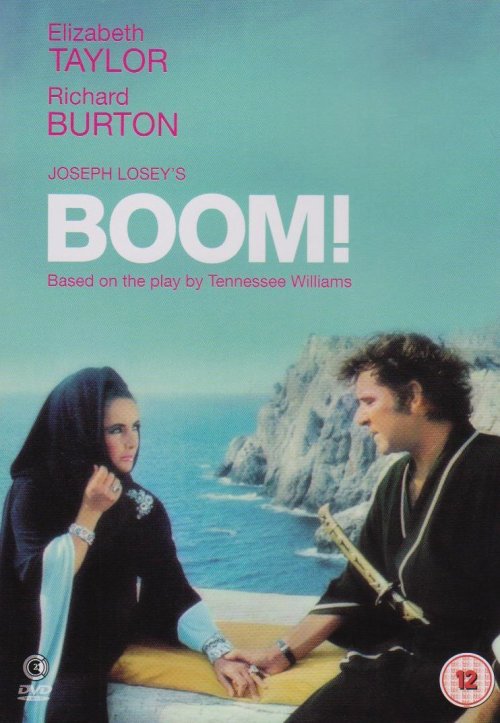
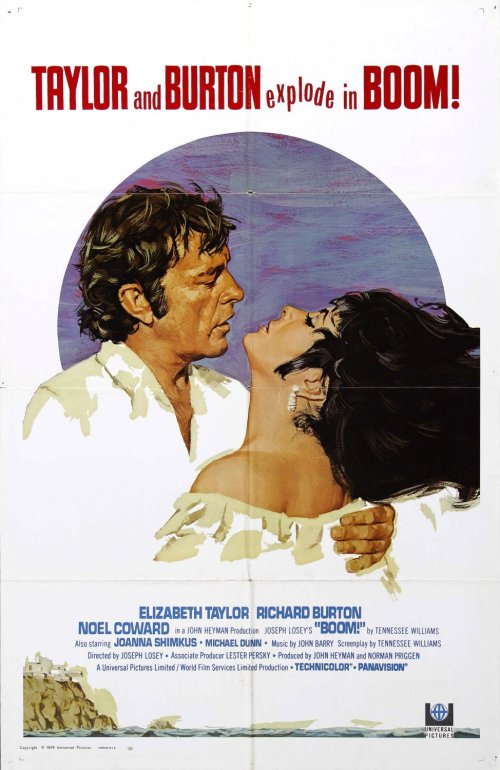
Flora ‘Sissy’ Goforth (Elizabeth Taylor) lives on a secluded island in a large mansion and surrounded by servants who cater to her every whim. She has alienated most everyone she has come into contact with and relies on her secretary Miss Black (Joanna Shimkus) to write down her autobiography that she dictates to her indiscriminately throughout the day. In comes Chris Flanders (Richard Burton) a nomadic poet living on the skids who infiltrates her palace and her oppressed sexual desires with his ruggedness and mystery. Will Sissy fall under his seductive spell, or does this mysterious stranger have even darker intentions?

The film was directed by Joseph Losey who is one of the more inventive and groundbreaking directors who ever lived and sadly doesn’t get enough recognition. Unfortunately he was going through a bout of depression when he made this film, which caused him to abuse alcohol and seriously affected the film’s final result although it still manages to be a fascinating visual excursion nonetheless. The location shooting, which was done almost entirely on the island of Sardinia, is dazzling. The shots of the steep cliffs and crystal blue water, which are literally a part of Sissy’s backyard, are breathtaking. The modernistic mansion that she lives in is equally sumptuous particularly with its myriad collection of art paintings and wet bars that seem to pop-up every few feet in whatever room or patio the characters are in.

The acting is also outstanding as Taylor eats up the scenery with her over-the-top bitchiness and unexplained anxiety attacks, which she takes to an unprecedented campy level. The outrageous hat that she wears to her dinner date is quite possibly one of the most bizarre things ever to be put on top of a human head.

boom4

The normally commanding Burton unfortunately comes off as weak in comparison and overall looks uncomfortable in his role. The script originally called for a young man in his 20’s for the part and thus casting Burton, who was already 42 at the time, seemed misguided.

Dwarf actor Michael Dunn is excellent in support. His character utters only three words, but still makes his presence known with the way he shows complete control over his attack dogs while playing of all things Sissy’s bodyguard. Playwright Noel Coward appears in a fun bit as one of Sissy’s friends who she invites over for dinner. The friends secretly disdain each other in private, but put on a superficial friendship when together and apparently this is also how the two performers behaved with each other behind-the-scenes as well.

Unfortunately the script, which was written by Tennessee Williams and based on his play ‘The Milk Train Doesn’t Stop Here Anymore’ leaves much to be desired. The plot meanders on to an unsatisfying conclusion while rehashing old themes that had already been used in his earlier and better known works.

boom2

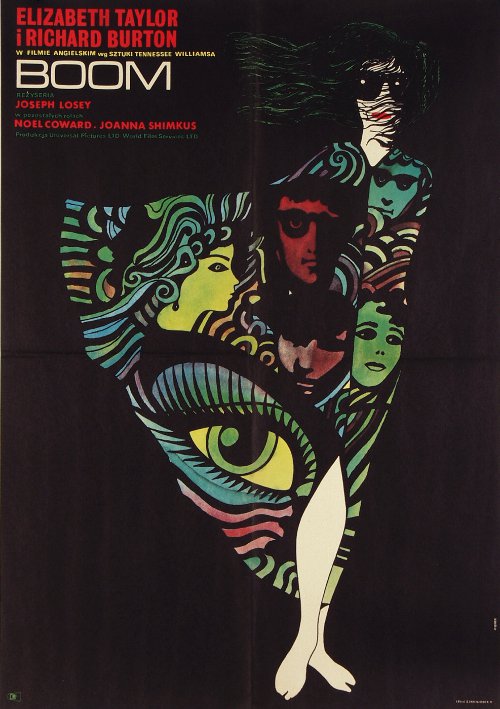
Polish Poster

My Rating: 4 out of 10

Released: May 26, 1968

Runtime: 1Hour 52Minutes

Rated PG

Director: Joseph Losey

Studio: Universal

Available: DVD (Region 2)

The V.I.P.s (1963)

the vips2

By Richard Winters

My Rating: 3 out of 10

4-Word Review: Drama at the airport.

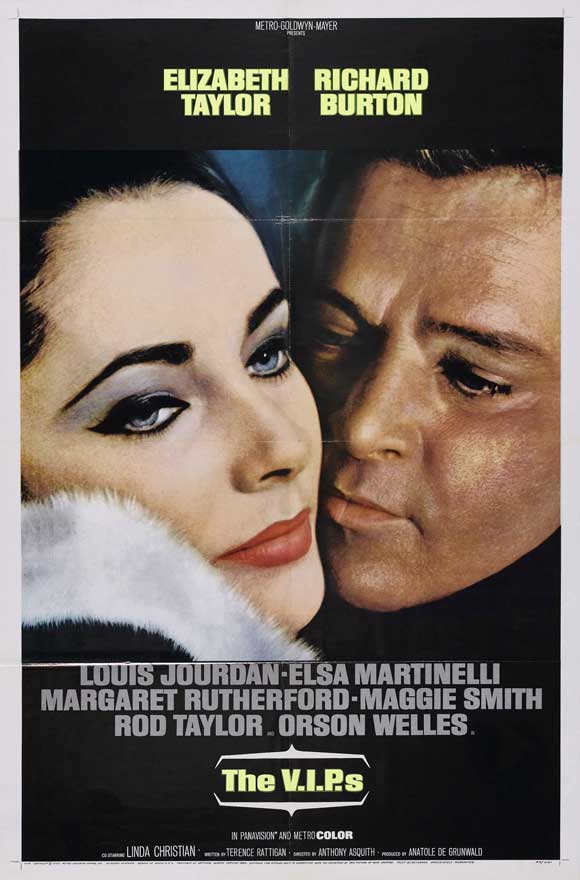
Several diverse characters come together at London’s Heathrow Airport. All have urgent needs that require them to board a certain flight that they hope will take off as soon as possible. Frances (Elizabeth Taylor) is the wife of rich tycoon Paul (Richard Burton) and is secretly having an affair with gambler/playboy Marc (Louis Jourdan). She has left him a ‘dear John’ letter at home and hopes to be well on her way to New York before he reads it. Les (Rod Taylor) is a businessman who also hopes to get to the Big Apple quickly to avoid the hostile takeover of his company. Max (Orson Welles) is a famous movie director traveling with his vapid starlet Gloria (Elsa Martinelli) and hoping to leave England before he is forced to pay an enormous tax penalty. Unfortunately for them a fog rolls in, which delays the flight and sends everyone’s plans into disarray.

The drama has some potential at the beginning, but the 2-hour runtime is much too long for this type of material. Whatever compelling elements the threads may have had when it started become lodged in endless talk and boredom. The scene where Burton smashes Liz’s hand against a mirror is the only time there is any action and Terence Rattigan’s soap opera script is too clichéd. Director Anthony Asquith’s direction shows no visual flair and fails to capture the airport in any type of interesting way. The background sets look like they were built on a soundstage and the fog effects are quite tacky.

Margaret Rutherford won the supporting Oscar for her portrayal of an aging Duchess. She adds some much needed humor particularly in the segment where she has difficulty getting her hat box into the plane’s luggage compartment. However, like with the story thread concerning the Orson Welles character she is seen to briefly and their scenes are spread so far apart that you almost forget all about them.

Spoiler Warning!

There is also another segment where a complete stranger played by actress Maggie Smith approaches the Burton character and asks him for a hundred and fifty three thousand pounds and he gives it to her in the form of a blank check, which had me floored. Men like him don’t become rich by handing out a lot of money to anyone who asks especially people they don’t know. Some may argue that because the character was considering suicide that he didn’t care anymore, but it still seemed too much of a stretch and for me sent this already stale drama into the realm of the absurd and ridiculous.

End of Spoiler Warning

Every story thread gets a nice, convenient happy ending that gives the whole thing a TV-sitcom quality and barely worth the effort to sit through. The production has some glossy aspects and certainly big-name stars, but ends up being a buildup to nothing.

the vips1

My Rating: 3 out of 10

Released: September 19, 1963

Runtime: 1Hour 59Minutes

Not Rated

Director: Anthony Asquith

Studio: MGM

Available: DVD, Amazon Instant Video

Becket (1964)

becket 2

By Richard Winters

My Rating: 7 out of 10

4-Word Review: Betrayed by his friend.

King Henry II (Peter O’Toole) is finding himself at continual odds with the Archbishop of Canterbury (Felix Aylmer) particularly in their disagreement of taxing the church to help fund Henry’s war with France when the elderly Archbishop suddenly dies Henry decides to appoint his longtime friend Thomas Becket (Richard Burton) into the position.  Becket had always shown extreme loyalty towards Henry and many times gotten him out of several jams so Henry expects this will continue in his new role, but finds that Thomas takes his position much more seriously than expected and shifts his loyalty from the king to the almighty, which causes serious conflict between the two.

The film which is directed by Peter Glenville is based on the 1959 stageplay written by Jean Anouilh that starred Laurence Olivier in the role as Becket and Anthony Quinn as Henry. This film version isn’t bad, but not quite the epic spectacle that we are so used to from these types of films from that period. The action is quite minimal and there is a definite staginess. I would have liked more camera movements and even a few scenes with a hand-held to help make it seem a little more authentic and less of a filmed drama. The scene where Henry and Becket are seen riding on horseback appears very corny as it was clearly done in front of a blue-screen. There is also too much music one scene has Henry and Becket running away from a farmhouse after being caught fooling around with a farm girl that has a cartoonish sounding melody that seems completely inappropriate especially for the time period.

Having Henry and Becket go from being friends to bitter enemies seemed to happen too quickly. I got the feeling we were seeing the ‘Cliff Notes’ version of events were they analyze only the important plot points and then quickly moved to the next. I realize the runtime of the film is already long, but spending more time showing the friendship gradually devolve would have been more realistic.

Normally I love Sir John Gielgud and his performance as King Louis VII is amusing, but he is clearly British and speaks with an English accent that doesn’t even come close to sounding French. The part of the Pope is given to an Italian, so the King Louis role should have been done by a Frenchman.

O’Toole is excellent. He has brown hair here instead of his patented blonde and his ability to stay in step with Burton by giving an almost comic performance of a King who is nothing more than an overgrown adolescent is brilliant. The royal food fight is good as are the many putdowns that he gives to both his wife and kids and even his own mother.

Burton is fantastic as expected playing a role different from any of the others that he has done. His piercing blue eyes have never been stronger particularly when he becomes the Archbishop.

The killing scenes done inside the church near the end has some nice camera work and Henry’s final emotional speech as well as his flogging by the monks are all strong and make this worthwhile viewing, but I couldn’t help but feel that we have ‘grown-up’ a bit in the way we do period pieces today and this is one that could use a remake.

My Rating: 7 out of 10

Released: March 11, 1964

Runtime: 2Hours 28Minutes

Not Rated

Director: Peter Glenville

Studio: Paramount

Available: VHS, DVD, Blu-ray, Amazon Instant Video, Netflix streaming

Anne of the Thousand Days (1969)

anne of a thousand days 2

By Richard Winters

My Rating: 7 out of 10

4-Word Review: Off with her head

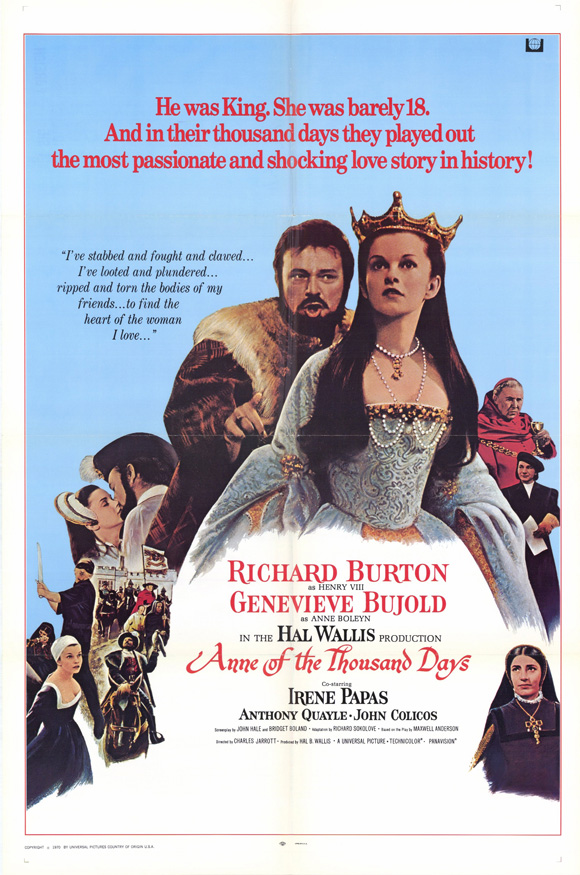
Based on historical fact the setting is 1527 King Henry VIII (Richard Burton) is bored with his current wife Catherine of Aragon (Irene Pappas) and becomes intoxicated by the beauty of 18-year-old Anne Boleyn (Genevieve Bujold). Initially she resists the advances of the King and finds him unappealing, but once she gets a whiff of all the power that being a Queen can give she falls in-love with him. The King wants her to bore him a son, but their first child turns out to be a girl, which causes their marriage to sour. Their acrimony is furthered when their second child turns out to be a stillborn son. Eventually the King grows tired of Anne and hires Thomas Cromwell (John Colicos) to find a way to get rid of her. Cromwell tortures some servants into saying they had sexual liaisons with Anne which gets her placed under arrest and awaiting trial and execution.

Bujold gives a powerful and mesmerizing performance and I am surprised that she didn’t win the Oscar. However, Burton, who is an actor that I admire, seems uncomfortable in his role and just walking through his part.

The story itself is compelling and because it is based on fact makes it all the more amazing. It moves along at a good pace and the viewer can’t help but get absorbed in it. This is no stuffy costume drama and it is probably tawdrier than any soap opera out there. However, Charles Jarrot’s direction is a bit stale. The sets and costumes are great, but the atmosphere and cinematic style is missing and the whole thing seems too much like a filmed stage play.

My biggest quibble with the film is that it doesn’t stay completely accurate. Historians insist that the King does not offer Anne any type of reprieve nor does he visit her after she is imprisoned like he does here. While this scene is nice because it does humanize him who in every other way is despicable it doesn’t help the viewer better understand the story or the people in it by inserting something that really didn’t happen.

My Rating: 7 out of 10

Released: December 18, 1969

Runtime: 2Hours 25Minutes

Rated M

Director: Charles Jarrott

Studio: Universal

Available: VHS, DVD, Amazon Instant Video, Hulu

The Night of the Iguana (1964)

night of the iguana 2

By Richard Winters

My Rating: 6 out of 10

4-Word Review: Flawed clergyman loves women.

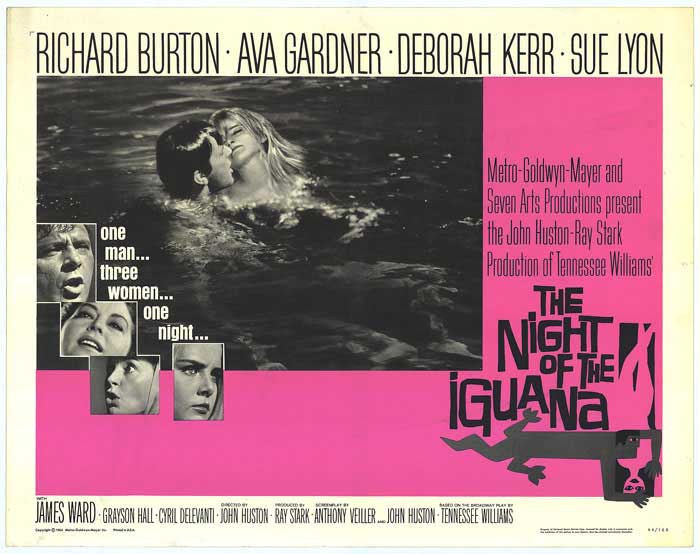
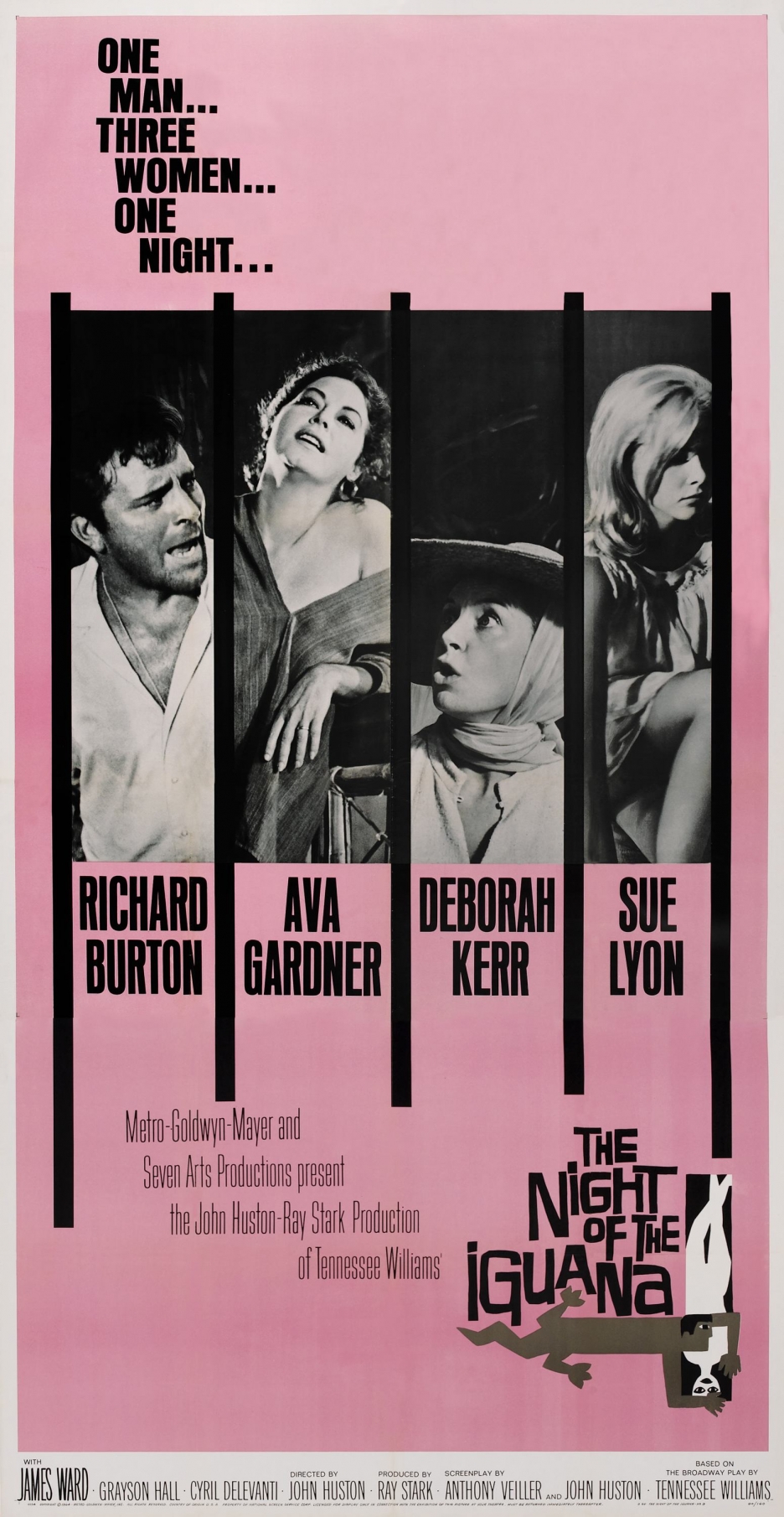
Lawrence Shannon (Richard Burton) loses his job as a clergyman when rumors surface of indiscretions he had with a young female parishioner, which pushes him to preach a ranting sermon at the pulpit that eventually drives all the members of the congregation out of the building. He then gets a job as a tour guide in Mexico and has the chore of leading a bus load of middle-aged women around the country. Charlotte (Sue Lyon) is a young nymph who takes a liking to Lawrence much to the chagrin of her over-protective chaperon Judith Fellowes (Grayson Hall). When Charlotte is caught in Lawrence’s bedroom late at night Ms. Fellowes promises that she will have it reported and get him fired. Unable to handle a another potential job loss Lawrence takes the bus load of women to an isolated seaside hotel run by Maxine (Ava Gardner) an old friend of his. He hopes that by somehow trapping them there he will be able to convince Ms. Fellowes to drop the charges, but along the way he meets Hannah (Deborah Kerr) who he starts to fall in-love with.

Unlike most of Tennesse William’s other plays this one, at least the first half, is full of energy and comical nuance. I found the group of ladies and Lawrence’s exasperated dealings with them to be quite amusing and the film moves along at an engaging pace. The second half though bogs down with more of William’s signature brooding drama that ends up hurting the flow. In many ways this film seems like two movies in one and the difference in tone and pace never gels. Despite a good nighttime conversation between Kerr and Burton I kept hoping the ladies and Ms. Fellowes would come back and felt the film was weaker without them.

Legendary director John Huston hits most of the right buttons here although it is not his best work. I was surprised and impressed to learn that Maxine’s hotel was built specifically for the production in an otherwise deserted region of the country. The building had an authentic old look and helped give the film added style and personality. I had mixed feelings with the black and white photography. On one had it helps bring out the dark recesses of its flawed characters and accentuate the moodiness of William’s script, but it also takes away from the exotic beauty of the locale.

Burton is good as usual and playing the part of an emotionally fractured, alcoholic character seems right up his alley. Gardner is great as the brassy Maxine and the scene of her making out with her two young, shirtless, maraca playing male assistants along the beach late at night is genuinely steamy. Kerr is in fine form as well and her more restrained demeanor makes a nice contrast to Gardner’s.

Lyon’s acting isn’t quite up to her costars and she seems particularly out of her league during her scene with Burton, but in the looks department she is unmatched. She is more filled-out and mature than in Lolita and in many ways even hotter. The scene of close-up shots of her moving her hips to a tune at a Mexican bar may excite some of the male viewers.

The under-rated Hall is excellent in her role as the heavy. Her craggy face and personality are perfect for the part and it rightly got her a supporting actress nomination.

In the final analysis this is not a bad version of Tennessee William’s material, but not a great one either.

night of the iguana 1

My Rating: 6 out of 10

Released: August 6, 1964

Runtime: 1Hour 58Minutes

Not Rated

Director: John Huston

Studio: MGM

Available: VHS, DVD, Amazon Instant Video