Tag Archives: Richard Brooks

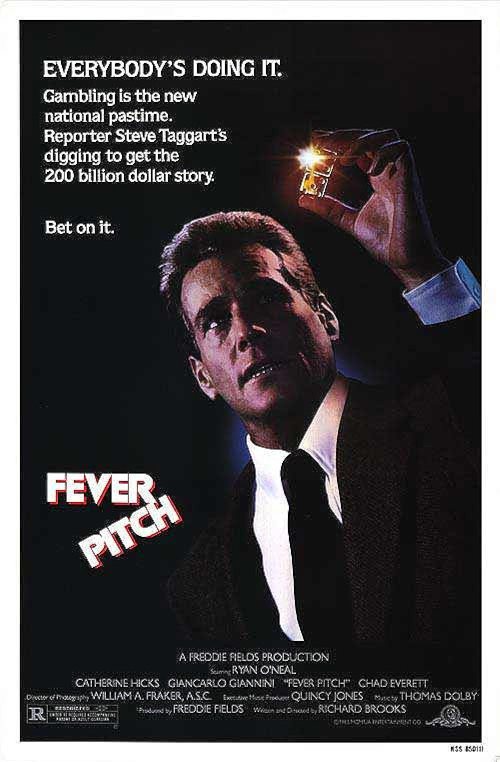
Fever Pitch (1985)

fever1

By Richard Winters

My Rating: 3 out of 10

4-Word Review: Sportswriter addicted to gambling.

To commemorate the sad passing of Ryan O’Neal just last week we here at Scopophilia decided to review one of his more infamous outings in a film that helped to ultimately bring in his career downfall, which was already fading at the time anyways, but this one was the nail in the coffin. He plays Steve Taggart a popular sports journalist who wishes to do an expose on the gambling epidemic. His editor (John Saxon) gives the okay and so he proceeds to write articles dealing with a ‘Mr. Green’ whose addiction is ruining his life and career. Unbeknownst to his editors Mr. Green is actually Steve whose gambling habit is so out of control that he owes $31,000 to a bookmaker named The Dutchman (Chad Everett) who has a henchman named The Hat (William Smith) that follows Steve around and threatens him with violence if he doesn’t pay up. Steve’s recourse is to simply gamble more hoping somehow to get on a lucky streak and be able to pay it all back when instead he just continues to drown in an even more widening debt.

Writer/director Richard Brooks became fascinated with the topic of gambling while recovering from a heart attack and spent years writing the script, where he intended to have Sam Shephard play the lead. Unfortunately despite his great success with other films this one ended up becoming a giant flop that cost the studio over $7 million to produce, but only recouped a paltry $244,000 at the box office. Derided by both critics and viewers its become a ‘so bad it’s good’ type movie that in the ‘Official Razzie Movie Guide’ gets listed as the 100 Most Enjoyable Bad Movies Ever Made.

The movie would’ve been better had they got Shephard in the lead role as intended instead of the wooden O’Neal who doesn’t show enough emotion, or nuance to make his part interesting. The character would’ve had a better arch had we known him before he got into gambling and could see his downfall right from the beginning versus coming into it when he’s already starting to hit rock bottom. Having the viewer fooled into thinking Mr. Green was a real person might’ve made an interesting twist versus giving it all a way at the start that it’s Steve.

The dialogue is badly overwritten with the character’s regurgitating out gambling statistics like they’re a computer and there’s no conversational quality in anything that gets said. Despite being supposedly this ‘hard-hitting’ look at what goes on in Las Vegas it instead comes-off more surreal as it shows only people who are ‘captivated by the madness of gambling’ like these are the only type of people who exist without countering it with others who are not into it and thus giving it a better balance and perspective.

The story also suffers from too many coincidences and extreme dramatic arcs. The most notable is when Steve finds a soldier (Patrick Cassidy) inside a bathroom stall ready to shoot himself with a gun as he’s so depressed about losing all his money, but Steve stops him from doing it. Then gives the soldier money for airfare and a little bit extra for spending cash. The soldier uses it to continue his gambling where he wins it all back at the craps table making it seem like a ‘happy’ ending and going against the film’s own narrative that wants to show the ‘evils’ of the addiction only to laugh it all away when somebody gets on a magical win streak that somehow makes it all better. Going from potential suicide victim to happiest guy on earth in the matter of only a couple of hours is a bit of a stretch.

Having Steve get physically attacked by The Hat inside a gambling lounge as he has both his shins kicked-in and then miraculously having Flo (Catherin Hicks), a cocktail waitress whom he had a fling with, walk by at the exact same instant when The Hat leaves, so she’s able to help back to her room seemed way to coincidental and convenient. The fact that he doesn’t go to a doctor and able to still walk using only some pain pills to get by was even more absurd. What gets even dumber though is that during the melee Steve injures The Hat, using non other than salt and pepper shakers, causing him to wear a over-the-top neck brace as he goes around town trying to ‘even the score’ with Steve by attempting to kill him, but unable to do so at every turn like he’s morphed into the live action version of Wiley E. Coyote.

Spoiler Alert!

The biggest laugh, or most nauseating moment depending on your perspective, comes at the end when Steve is supposedly ‘cured’ of his addiction by having attended a Gambling Anonymous meeting only to, at the airport waiting to go home, decide to put one last quarter into a slot machine called ‘Bet a Buck for God’ in which he amazingly wins a massive payout and having his winnings immediately handed to him by a woman dressed like a nun. I thought for sure this was some sort of dream, but to my shock it’s not and we’re all supposed to take it seriously.

It then gets even worse as Steve goes on one last hot streak and able to win back all the money he’s owed and thus get out of his predicament, which does a complete injustice to the subject. Many other victims of gambling aren’t able to do this as the movie even says itself the odds are the house will ultimately win making the wrap-up completely false and thus the film’s notorious cornball status is highly deserved.

My Rating: 3 out of 10

Released: November 22, 1985

Runtime: 1 Hour 36 Minutes

Rated R

Director: Richard Brooks

Studio: MGM/UA

Available: VHS, DVD-R (dvdlady.com)
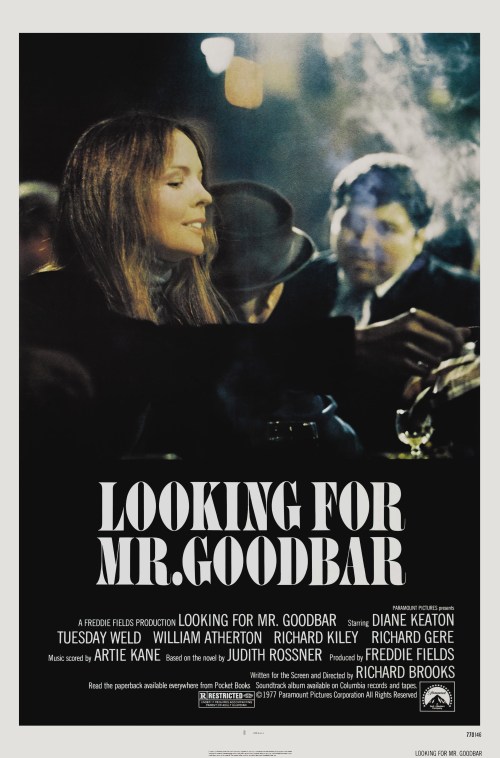
Looking for Mr. Goodbar (1977)

looking

By Richard Winters

My Rating: 7 out of 10

4-Word Review: School teacher sleeps around.

Theresa (Diane Keaton) is a young school teacher trying to get over the break-up with Martin (Alan Feinstein) a married college professor of whom she’d been in a relationship with for several years. Tired of living with her parents (Priscilla Pointer, Richard Kiley) and her domineering father she decides to get a studio apartment near the club scene. She picks-up Tony (Richard Gere) at a bar one night and takes him home. His volatile, drug induced behavior scares her at first, but eventually she enjoys his unpredictable ways. When he disappears for long periods she begins bringing more strangers home finding the one-night-stands to be a liberating change from her repressive catholic upbringing, but the more she partakes in this edgy lifestyle the more danger she puts herself in.

The film is based on the Judith Rossner novel of the same name, which itself is based on the true story of Roseann Quinn. Quinn was a school teacher living in New York City who had a propensity of bringing home men she’d meet from a bar that was across the street from her studio apartment. On the evening of January 1st, 1973 she invited John Wayne Wilson, a man she met at the bar, back to her place for intended sex, but instead it resulted in murder when he was unable to achieve an erection and he felt she was making fun of him.

Rossner read about the incident in a newspaper and became intrigued with the case and intended to write about it for an upcoming article in Esquire magazine, but the editor feared legal action since it was based on an actual case and reneged on the assignment, so Rossner turned it into a novel using fictional names for the real-life people. It got published in 1975 to rave reviews and instantly became a best seller, which caught the attention of writer/director Richard Brooks who had turned other true crime stories into hits such as In Cold Blood and felt he could do the same with this. In fact the film did quite well as it raked in $22.5 million and was the top movie in the country on its opening weekend.

While Rossner openly detested the film version I felt it does a great job of exposing the bleak, lonely existence of the 70’s single’s scene and how sexual liberation can end up being just as much of a trap, if not more, as monogamy. The dim, dark lighting, particularly inside Theresa’s apartment brings out the grim existence, and twisted personalities, of its characters nicely. The viewer feels as caught up in the depressing, aimless world as the protagonist and its the vividness of the 70’s young adult, city culture that makes this an excellent film to see simply to understand the motivations of the people who lived it. While on paper reading about someone that was a school teacher for deaf students during the day turning into a reckless, sexually promiscuous lady by night may seem shocking and hard to fathom, the film seamlessly fills-in-the-blanks to the extent  that you fully grasp, from her stifling family and religious upbringing as well as her painful break-up and insecure body image, to what drove her to it and thus cultivates a very revealing character study.

Keaton, Kiley and Tuesday Weld, who plays Theresa’s older sister who experiments with the wild lifestyle herself, are all stand-outs, but the film also has some great performances from actors who at the time were unknowns. Gere is especially good, quite possibly one of the best acting jobs of his career, as the creepy, but still strangely endearing Tony. LeVar Burton has very few lines, but still makes an impression with his pouty facial expressions as the older brother to one of Theresa’s deaf students. Tom Berenger though turns out to being the ultimate scene stealer as the psychotic who’s so on edge with his personal demons that he lashes violently out over the smallest of provocations.

Spoiler Alert!

While the film is known mainly for its notorious ending, which still packs a bit of a punch, its effect is muted by director Brooks unwisely telegraphing it ahead of time. Virtually the whole movie is done from Theresa’s point-of-view and yet at the very end it cheats it by having a scene between Gary and his gay lover giving the viewer an unnecessary warning about his mental state, which wasn’t needed. For one thing in the real-life incident the assailant was a married man and not gay, so adding in the gay subtext and using it to explain his psychosis could be considered homophobic and armchair psychology. It also hurts the shock value as the audience knows what’s coming versus having them as surprised as Theresa when he suddenly lashes out unexpectedly, which would’ve made for a more emotionally impactful, gripping finish.

My Rating: 7 out of 10

Released: October 19, 1977

Runtime: 2 Hours 16 Minutes

Rated R

Director: Richard Brooks

Studio: Paramount

Available: DVD

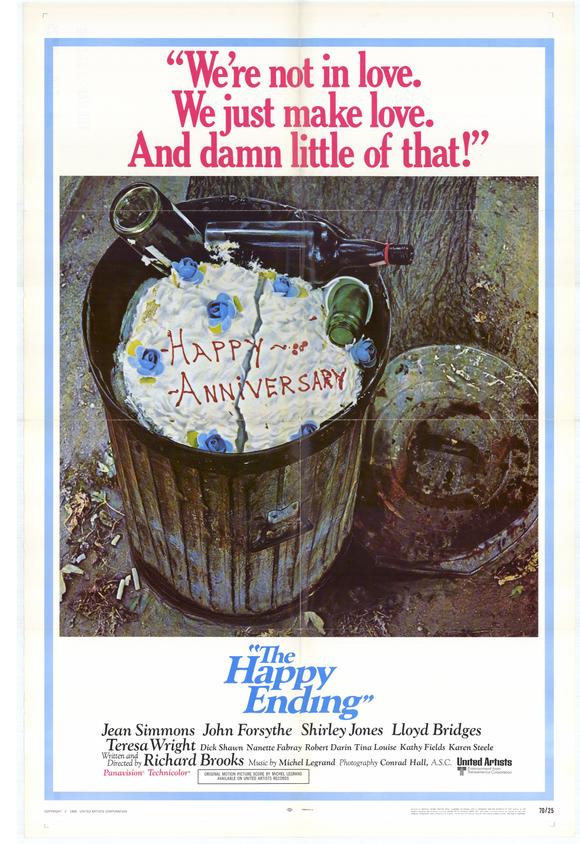
The Happy Ending (1969)

happy ending

By Richard Winters

My Rating: 4 out of 10

4-Word Review: The problems of marriage.

If there was ever a film with a misleading title it is this one. There is no happy ending here and in fact there is nothing in its entire 117 minutes that is happy as the film examines every negative and depressing thing it can think of about the institution of marriage and then rhythmically beats it into the viewer like a victim in a bar fight being pummeled by a brawler. The format works like a boring college professor lecturing endlessly about some tepid subject while tirelessly pinpointing every monotonous detail and not knowing when to stop.

The story is about Mary (Jean Simmons) who at one time was madly in-love with Fred (John Forsythe) and had extremely high ideals in regards to love and marriage when she married him. Now after fifteen years of living in a relationship that no longer has any passion she has turned into a depressed and disillusioned alcoholic looking for any way to escape the confines.

The film itself is intelligently done and well executed and makes some good hard-hitting points. The dialogue and conversations between the characters are realistic and well written and it is nice having adults acting and talking like real people. The only real issue is the question of why the filmmakers would think anyone would actually want to sit through something that is so endlessly downbeat. Sometimes these types of things work better in a satire format where they can still make the same points, but allow the viewer a few laughs as well. As it is the film is in desperate need of some levity and none is ever offered.

I also felt that film was too one-sided. I realize that there are a lot of unhappily married people out there, but there has got to be some couples that are happy with it. By never balancing it out and showing no other viewpoint makes the film come off like one long and unending rant.

Writer-director Richard Brooks infuses certain directorial touches that are novel to some extent, but heavy-handed as well. Showing clips of famous old romantic movies like It Happened One Night and Father of the Bride during Mary’s wedding is creative, but too obvious as is the segment when Mary is on a beach and a young couple asks her to take a picture of them and inside the camera’s viewfinder Brooks inserts an image of Mary and Fred when they were a young and in-love. There is also too much footage of Casablanca shown, which does nothing but make the viewer want to watch that over this dreary thing.

Simmons gives a strong performance and looks as beautiful as ever. She is also straddled with a few difficult scenes but does them well including a harrowing segment where she is rushed to an emergency room after swallowing some pills and has a hose stuffed down her throat in an attempt to vomit them out. Tina Louise is great in support as is Dick Shawn in a rare dramatic turn. Shirley Jones is also good as Mary’s jaded friend Flo and she is given some of the film’s best lines.

Forsythe is okay as the husband, but not too exciting though he never usually is. He should have had the big mole in the center of his forehead surgically removed as my eyes always seemed to fixate on it every time he was shown in a close-up. I got to admit I was amazed his character did not kill his wife on the spot when he found out that she had run up his credit card in one day on $11,421 worth of charges on clothes. This was 1969 dollars and I have no idea what astronomical figure that would be for today, but it would be beyond outrageous nonetheless. Of course he was caught fooling around, so I suppose this was her way of getting back at him and boy did she ever.

The film does have a few powerful scenes that I did like. The part where Fred defends Mary after she has run out on them and their daughter Marge (Kathy Fields) feels that her mother no longer loves her is really good as is the final conversation between Fred and Mary as well as Mary’s conversation with her mother (Teresa Wright) about the happiness of her mother’s own marriage. The moment when the very cynical Flo becomes all teary-eyed and excited when the married man that she has been fooling around with decides to divorce his wife and propose to her despite the fact that she has spent the rest of the movie considering the idea of marriage to be over-rated is savvy.

Like with the sappy and over-played Michael Legrand song ‘What Are You Doing the Rest of Your Life?’ the film goes on too long and there are just not enough good things about it to justify sitting through.

My Rating: 4 out of 10

Released: December 21, 1969

Runtime: 1Hour 57Minutes

Rated PG

Director: Richard Brooks

Studio: United Artists

Available: VHS, Amazon Instant Video, Netflix streaming