Tag Archives: Review

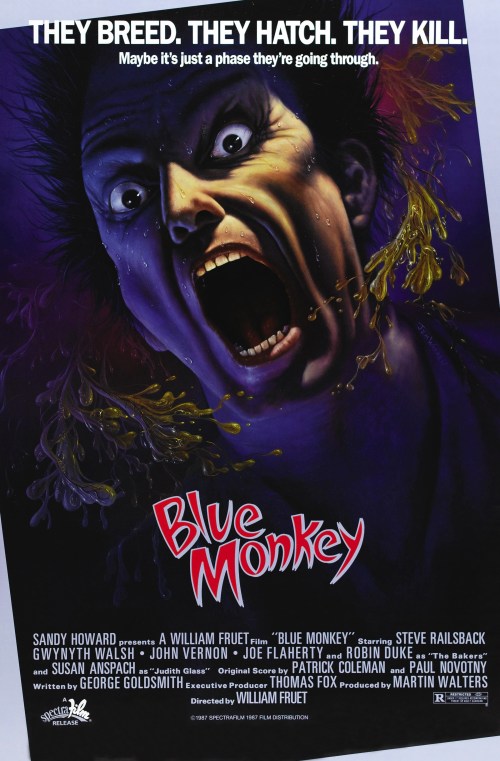
Blue Monkey (1987)

blue1

By Richard Winters

My Rating: 6 out of 10

4-Word Review: Giant insect invades hospital.

When an elderly man (Sandy Webster) gets his finger pricked by a foreign plant he’s immediately rushed to the hospital after he goes into shock. At the hospital he regurgitates an insect pupa, which is taken to the lab for observation. It is there that it gets fed a growth hormone by a group of children causing it to escape and take-over the hospital. Jim (Steve Railsback) is a police detective who was already in the hospital overseeing his partner who had gotten shot while on duty. Together with Rachel (Gwynyth Walsh), an on-call emergency room doctor, and Elliot (Don Lake), a entomologist, they go on the offence to trap the giant bug and kill it before it can reproduce.

I was initially not excited about watching this as it’s admittedly a rip-off of Alien and has many of the same shocks while being directed by Canadian horror maestro William Fruet whose other output I’ve found to be only so-so, but this one is surprisingly compelling. It also has some cool effects including seeing the characters running down a darkened hallway that’s lighted from one end with a bluish hue that gives it a surreal vibe. The shocks aren’t plentiful, but the few that they do have work.

This is also one movie where Railsback, who’s excellent playing psychos like Charles Manson and Ed Gein, is effective as a good guy. In other films where he was a protagonist like in Lifeforce he came-off as unintentionally creepy and it hurt his ability to get starring roles, but here his kindly interactions with a group of sickly children help subside that. I also enjoyed Susan Anspach, looking almost unrecognizable in her black-rimmed glasses, as one of the Dr.’s who takes matters into her own-hands without waiting for a male Dr. to tell her what to do. In fact there really aren’t too many men in white coats at the facility that seemed mainly run by females, which I found interesting.

What I didn’t like were the supporting comical characters. Helen Hughes and Joy Coghill as two drunken old ladies was not needed nor was SCTV alums Joe Flaherty and Robin Duke as a goofy couple having a baby. Sometimes in horror movies that are super intense a brief moment of levity is okay, but this movie wasn’t frightening enough for that and if anything needed to play-up the scares more instead of throwing in goofy scenes that makes it seem too much like a jokey-script instead of a scary one.

The actual bug, when seen in its giant proportion, isn’t the chilling sight you’d expect mainly because its made to look like a regular bug, but just bigger, which isn’t imaginative and more reminiscent of the tacky sci-fi ‘creature-features’ of the 50’s where insects suddenly become bigger and most people today find laughable. It also would’ve been nice during the lab scenes for the camera to have focused on the pupa under the glass instead of the scared faces of the people looking at it. We don’t need to see facial expressions to know if something is scary we just need to be shown the scary thing directly and when we don’t see it, it makes the film look cheap like it didn’t have enough money to create an elaborate effect, so it copped-out by doing it this way.

Even with some of these issues it’s still an entertaining ride. It won’t be for everyone’s tastes and it certainly isn’t going to win any awards nor was it intended to, but if you like giant bug movies this one should satisfy your appetite.  It was also filmed entirely in Canada though the setting is supposed to be the US.

My Rating: 6 out of 10

Release: September 25, 1987

Runtime: 1 Hour 36 Minutes

Rated R

Director: William Fruet

Studio: International Spectrafilm

Available: DVD, Blu-ray

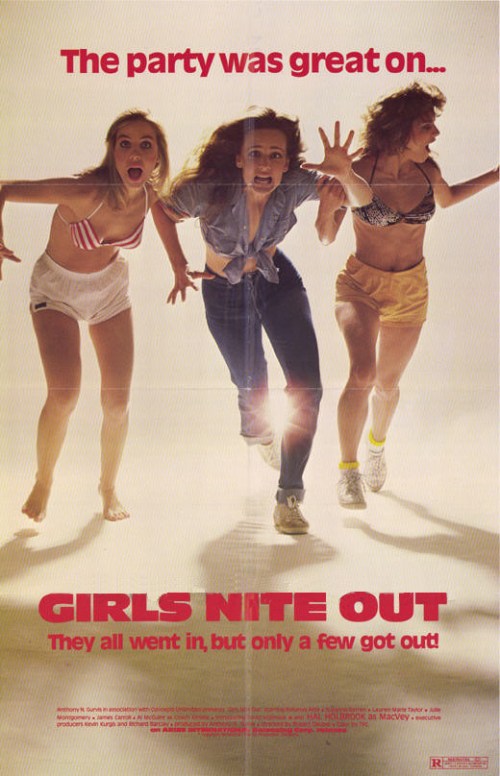
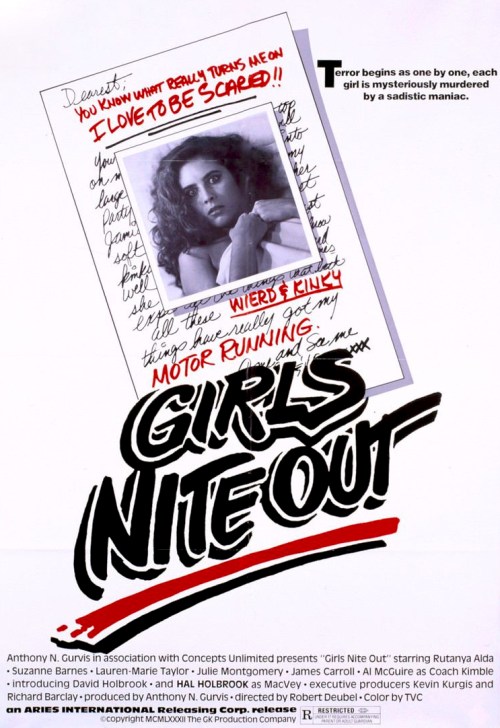
Girls Nite Out (1982)

girls4

By Richard Winters

My Rating: 5 out of 10

4-Word Review: Scavenger hunt turns deadly.

After the DeWitt university basketball team wins the championship the female students go on an all-night scavenger hunt using clues given to them at regular intervals by the DJ at the college radio station, who they listen to via portable radios. During the event many of the participants turn-up dead having been murdered by a killer dressed in a bear costume. No one knows who it is, but many suspect it might have something to do with Dickie Cavanuagh who murdered his girlfriend Patty, the daughter of the school’s security guard Jim (Hal Holbrook), in a jealous rage years earlier and has ever since been locked away in a mental hospital.

The plot is similar to Midnight Madnessbut the scavenger hunt in that one was done in a much more vivid way and a had a wider variety of locales while this one occurs in a limited setting making it visually quite boring. Much of the reason for this was because Upsala College gave the producers only one weekend to film forcing them to cram the entire shoot into a 3-day period and causing much of the cast to work 24-hour shifts in order to get it done while Hal Holbrook did his part separately and only interacts with the cast once in a scene where he has a brief exchange with his real-life son David Holbrook, who plays one of the suspects.

Given that it’s actually quite impressive how good the performances are, but everything else, including the poor pacing, is rock bottom. Way too much time gets spent on the set-up including boring scenes at a campus party that aren’t engaging. The actual hunt doesn’t get going until almost 40-minutes in even though it should’ve begun with the hunt right away while nixing the early conversations and characters that add little to the suspense.

The film also suffers from a musical soundtrack made up entirely of bubblegum bands from the 60’s like The Lovin’ Spoonful, The Ohio Express, and 1910 Fruitgum Co., which all had a sound that was by the early 80’s completely out-of-touch and something no self-respecting college kid would be caught listening to. Especially at a college party where the idea is to play recent hits that are trending and not dancing to songs that sound like jingles from a commercial. Personally I like The Lovin’ Spoonful, but their style was dated by that time, so it seemed weird that was the only band that the college radio station ever played, which would’ve had none of the students listening to them if that was all they were going to hear.

Things do pick-up once the murders get going. Some critics complained that the killings are unimaginative and are handled in a routine way, which they are, but I did like the killer’s weapon that’s fashioned to look like a bear claw using knives in place of the paws and similar to what Freddy Krueger later used in Nightmare on Elm Street. The identity of the killer is also a surprise, so it scores a few points there, but overall it’s still no better than the hundreds of other slashers that were released around the same time.

girls1

Alternate Title: The Scaremaker

My Rating: 5 out of 10

Released: December 3, 1982

Runtime: 1 Hour 36 Minutes

Rated R

Director: Robert Deubel

Studio: Independent-International Pictures

Available: DVD

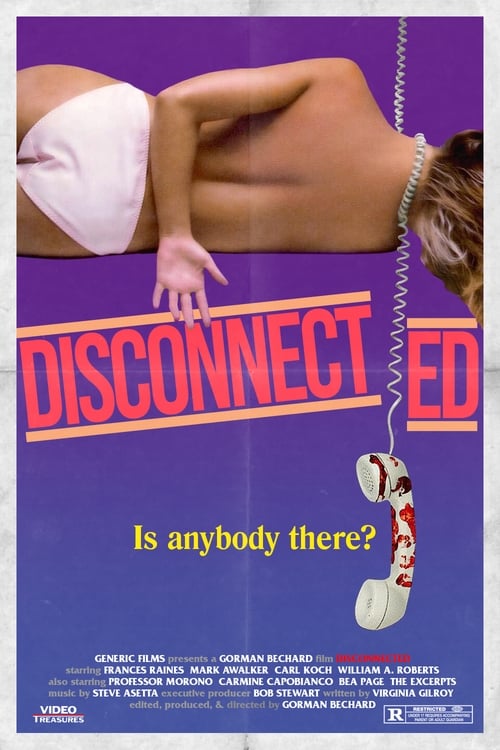
Disconnected (1984)

disconnected2

By Richard Winters

My Rating: 4 out of 10

4-Word Review: Receiving harassing phone calls.

Alicia (Frances Rains) is a young adult woman who brings an elderly man (William A. Roberts) up to her apartment one day so that he can use her phone to make a call. However, once he leaves she begins receiving odd calls at all times of the day and night where loud unexplained sounds emit from the receiver. She also gets a call where she overhears a conversation between her boyfriend Mike (Carl Koch) and twin sister Barbara-Ann, who are apparently are seeing each other behind-her-back. She then breaks up with Mike and begins dating Franklin (Mark Walker) whom she met while working at a video store. Franklin seems nice at first, but she’s unaware that he’s also the notorious serial killer who has been murdering young women in her area.

This horror oddity is the product of Gorman Bechard, who while still a film student decided to make a movie on his own with the low, low budget of only $40,000 and filming it almost entirely inside his tiny one-bedroom apartment. While it’s not a complete success it’s offbeat enough to hold your attention and guaranteed to keep you guessing to the very end.

The scenes inside the video store I enjoyed the most particularly Franklin’s complaints at how it didn’t have enough foreign films, or older movies, which was always the criticism I had of my local video stores too. The dark humor of Franklin hanging a crucifix over his bed where he commits the murders and the little prayer he does before he offs his victims I found amusing. Bechard’s odd camera shots including one segment done with black-and-white, freeze-frames is another asset that keeps it inventive.

The performance by Raines, who is beautiful, is excellent and I felt she would’ve had a long career ahead of her had she not giving up acting in order to raise a family. I was not as enamored though with the two guys playing the cops who lend a cartoonish flair that was not needed. I didn’t like too that one of them gets interviewed by someone sitting behind a camera that we don’t see and asking a bunch of questions almost like it’s a documentary, which begs the question as to who this person was and why does he just interview the cops, but no one else?

Spoiler Alert!

The film’s biggest problem though is that it gets rid of the Franklin too quickly without playing up that scenario as much as it could’ve. It also cuts away without ever showing how the cops are able to subdue him, or how Alicia is able to get away, which seems like a standard scene that a horror movie fan would want to see and not just have discussed later.

The weird calls ultimately become boring. It also takes Alicia too long to figure out that maybe a good way to stop them would be to unplug the phone from the wall, which she finally does at the very end, but most other people would’ve done it a hell of a lot sooner.

The twist ending where the old man that was seen at the start, but then disappears only to return and be shown walking out of her apartment makes no sense. Some viewers have speculated that maybe he was a ghost of some kind, but that’s not made clear. My personal feeling is that there was no meaning to it and it’s intentionally left vague, so the individual viewers can read into it whatever they want, but it’s not a satisfying way to end almost 90-minutes of viewing and in many ways, despite the interesting bits, makes it quite annoying. A better, more focused conclusion would’ve certainly helped.

My Rating: 4 out of 10

Released: July 17, 1984

Runtime: 1 Hour 24 Minutes

Rated R

Director: Gorman Bechard

Available: VHS, Tubi, Blu-ray (Limited Edition only 2,000 copies printed) 

Lady, Stay Dead (1981)

lady1

By Richard Winters

My Rating: 3 out of 10

4-Word Review: Handyman obsesses over singer.

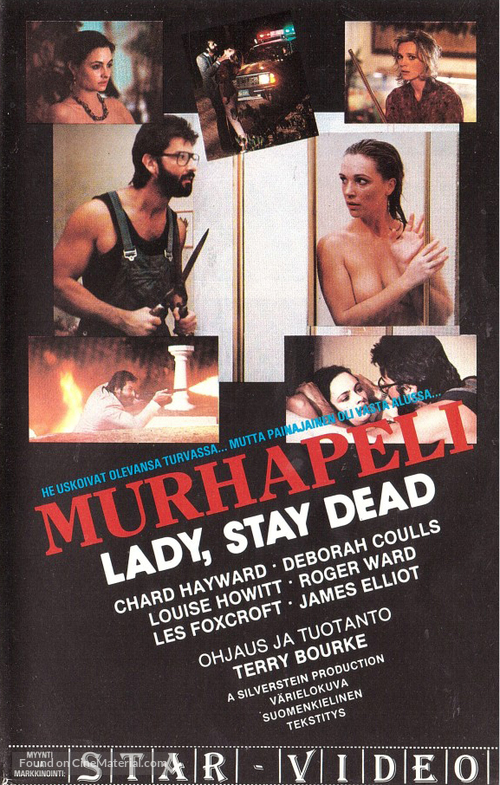
Gordon (Chard Hayward) works as a handyman and is treated poorly by his boss Marie (Deborah Coulls), a famous singer/actress, who routinely berates him as if he were a second-class citizen. Secretly Gordon fantasizes about having sex with her and one day breaks into her home and rapes her. Afterwards he drowns her by shoving her head into a fish tank. When her elderly neighbor Bill (Les Foxcroft) spots Gordon trying to discard her body he then kills him too and his dog, but Gordon fails to realize that Jenny (Louise Howitt), who is Marie’s older sister, is coming for a visit. When she arrives she quickly catches-on to what’s happening and proves to be a formidable challenge to Gordon, who wants to do to her exactly what he did to her sister.

The film was written and directed by Terry Bourke, who was credited with doing the very first horror movie in Australia, Night of Fear, which many consider a precursor to The Texas Chain Saw Massacreand this made him a horror guru in the Down Under and eventually lead to him making this one. This movie is unique in that it’s the first slasher film released in Australia and received okay reviews simply for its production values, which was a step above most other slasher pics.

Initially I was intrigued with the concept as it captures Gordon’s point-of-view and even sympathizes with him over his mistreatment by the callous Marie. It almost seemed to be playing-off the same idea of another Australian cult-hit The Plumberwhere a working-class male takes his animosity out on a female who he believes looks down on him. Had the movie stuck with this idea it could’ve been interesting and I was fascinated to see how both character’s behaviors and insights into each other would evolve as the scenario progressed, but this gets ruined by having Marie killed-off too soon.

Having her sister Jenny, who in no way looks anything like Marie even though they’re supposed to be related, become the main victim is not compelling and the story devolves from being a potentially compelling psychological flick into that of your standard cardboard thriller. Had Jenny, not knowing that Gordon was her sister’s killer initially, fallen in-love with him, could’ve lent a unique twist and might’ve saved it, but it doesn’t go in this direction either. Ultimately I was unsure why the opening bit involving Marie was even needed as it could’ve just started with Jenny as the target of the obsessed handyman and gotten played-out in exactly the same way.

The script also suffers from plot-points being too loosely connected. There’s no cyclical structure like with most stories where what see in the first act connects with what happens later. Instead characters and events get thrown in haphazardly with only the loosest of threads holding it together. The random policemen, played by Roger Ward, jumping in and becoming a major part of the action in the third-act, is a good example of this. Why not have this part played by Billy, the helpful elderly neighbor, who like with Marie gets offed too soon until you wonder why he and Marie were even in it at all.

Spoiler Alert!

The double-ending where you think the policeman has killed Gordon, but really hasn’t was no surprise at all. It’s also impossible to believe that Gordon would’ve been able to drive a squad car around while hunched beneath the dashboard and unable to look a window to see where he was going. Also, the title itself makes no sense as Marie never comes-back to life, so what the meaning of ‘stay dead’ is I don’t know.

Overall the script is too unfocused making what starts out original end-up being quite formulaic and forgettable although the segment where Gordon uses a chainsaw to cut a hole in the front door is genuinely creepy particularly the sound it makes as he does it, which is the only scary moment.

My Rating: 3 out of 10

Released: September 10, 1981

Runtime: 1 Hour 35 Minutes

Director: Terry Bourke

Studio: Ryntare Productions

Available: DVD

Telefon (1977)

telefon1

By Richard Winters

My Rating: 6 out of 10

4-Word Review: Spies hypnotized to kill.

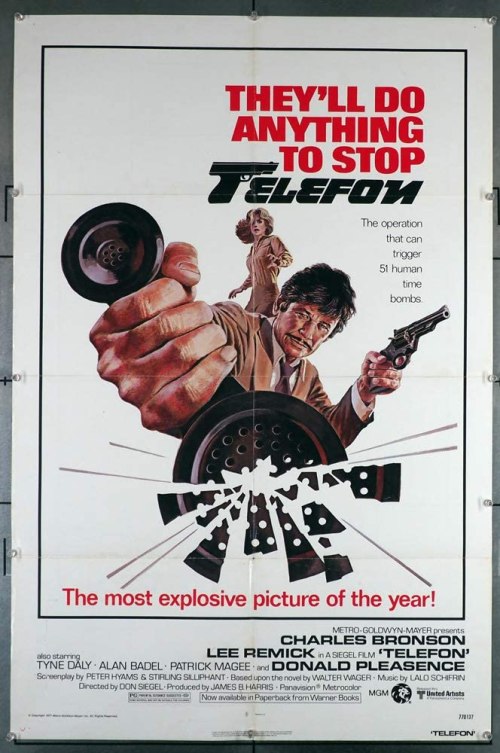
Grigori (Charles Bronson) is a KGB agent ordered to investigate a rash of terrorist activities being done inside the US. All of the crimes are being committed by Russian sleeper agents who are hypnotized to carry-out acts via a call on a telephone where they are read a line from a Robert Frost poem, which  triggers them to act upon preordained instructions. The calls are made by a rogue agent named Nickolai Dalchimsky (Donald Pleasence) and it’s up to Grigori to stop him before it becomes an international incident. While in the US Grigori works with lady agent named Barbara (Lee Remick), who Grigori thinks is on his side, but she’s a double-agent ordered to kill Grigori once the mission is completed.

While Leonard Maltin in his review describes the plot, which is based on the novel of the same name by Walter Wager, as being ‘ingenious’ many others felt it was far-fetched. There actually has been one case in the history of crime, which occurred on March 29, 1951 in Copenhagen,  Denmark, where a man by the name of Palle Hardrup was apparently hypnotized by Schouw Nielsen to carry-out a bank robbery and this lead to two people getting killed. Both men were later convicted and the story was made into a 2018 movie called Murderous Trance. Since then though there has been no other cases on record of this type of thing occurring and many experts in the hypnotic field insist that it couldn’t making what transpires here highly speculative at best.

The issue of Grigori having a photographic memory and able to memorize the names and personal details of all the sleeper agents is questionable too. Many researchers say that this type of phenomenon is only temporary and cannot be retained over a long period. There are others that say the photographic memory is a myth altogether and like with the hypnosis angle, forces the viewer to complete shut off their skeptical side right from the get-go in order to have even a chance of enjoying the movie at all.

The only interesting aspect is Lee Remick and Bronson learning to deal with each other’s contrasting personalities, which makes great use of Chuck’s gruff and brash manner, but I felt Remick as an agent wasn’t believable. When she’s ordered to kill one of the sleeper agents inside a hospital by injecting him with a drug she gets quite nervous, but if she’s killed before, then I’d think it would be like second-nature to her and she’d be cool and calm under pressure. I also felt the film should’ve showed her fully carrying-out the killing instead of cutting away without ever seeing the actual injection.

I didn’t get why she would’ve fallen in love with Bronson as the two had nothing in common and really didn’t get along. The film seems to act off the theory that putting a man and woman together will automatically elicit romance and sexual tensions, but members of the opposite sex work together on jobs sometimes for many years where sex and romance never occurs, so having these two end up getting the hots for each other seemed forced and mechanical. Also, the fact that Remick is a double-agent and Bronson becomes aware of this would make me believe that he, being a professional spy, would never trust her enough to let down his guard to expose his softer side to begin with.

I was disappointed too that several scenes are supposed to take place in Texas, including the city of Houston, and yet ultimately all of  these get shot in either California, at the Hyatt Regency Hotel in San Francisco, which was the same one used in High Anxiety, or on a studio sound stage. Yet there are plenty of other scenes that were shot on-location like New Mexico , Montana, and even Finland, so if they could make it to those places then why not to Texas too?

The climactic sequence, which takes place in a backwoods bar and features a humorous performance by Helen Page Camp, as the wife of the bar owner, gets wrapped-up in too tidy of a way and doesn’t take full advantage of Pleasence, who has been very creepy in his other villainous roles, but here doesn’t make much of an impression. While the film is entertaining on a non-think level it compares poorly to other movies in the spy genre and certainly does not come close to matching many of the better ones.

My Rating: 6 out of 10

Released: December 16, 1977

Runtime: 1 Hour 42 Minutes

Rated PG

Director: Don Siegel

Studio: MGM

Available: DVD-R (Warner Archive)

Mass Appeal (1984)

mass appeal1

By Richard Winters

My Rating: 6 out of 10

4-Word Review: Priest and deacon argue.

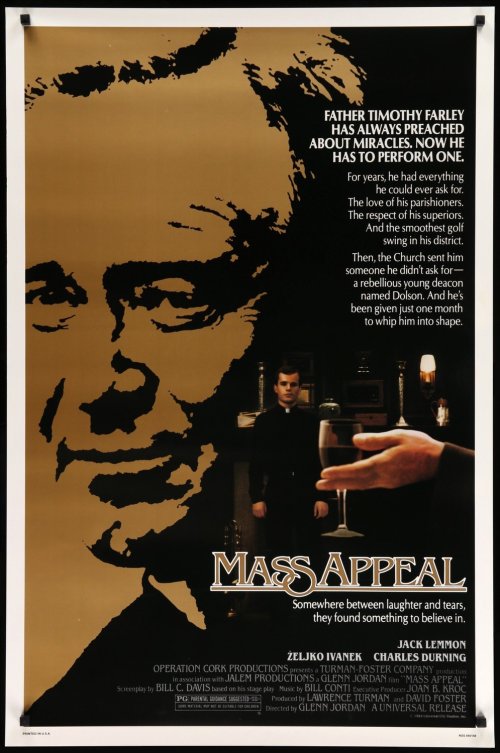
Mark (Zelijko Ivanek) is a young rebellious man attending Catholic seminary, who has a rigidly idealistic approach to how he thinks things should be especially within the church and will routinely clash with his superiors. Father Tim Farley (Jack Lemmon) is a middle-aged man who enjoys not rocking-the-boat and basically just telling people what they want to hear specifically his congregation while avoiding controversial issues at all costs. Tim is put in charge of Mark for a month in hopes that he can teach him to be more tactful and not such an outward firebrand. The two argue quite a lot, but eventually start to bond. When Mark divulges that he had sex with other men in the past and that he has admitted this to the Monsignor (Charles Durning), which could get him kicked-out of the seminary, it puts Tim in a tough bind. Will he stand-up for Mark by refusing to allow the Monsignor to use Mark’s past against him, or will he slink away like he always has to the safety net of the quiet life where he avoids making a stir of any kind?

The film may seem initially like it’s a spiritual one as there are many scenes shot inside the church during Sunday mornings where it perfectly captures the ambiance of a church service including having the mothers quarantined inside a glass ‘crying room’ where they take their babies when they get cranky, but are still able to interact with everyone else via microphones. Yet the more you get into the movie the less religious it is with the centerpiece of the story being instead universal to everyday life as it deals with the different perspectives of the generations and how one wants to vigorously challenge the system while the other is content with accepting things as they are. The arguments that the two have could easily be transferred to debates in other areas of life whether it’s politics, or even business.

The story is based on a two character play, written by Bill C. Davis, that was first performed in small theaters with Davis playing the part of Mark Dolson, a character not unlike himself. Eventually it caught the attention of actress Geraldine Fitzgerald, who agreed to direct it while also helping to revise the script, which then lead to it being produced on Broadway with Milo O’ Shea as the priest and Eric Roberts, who later got replaced by Michael O’Keefe, as Dolson.

The movie made changes from the play including adding in characters like the Monsignor and Margaret, played by Louise Latham, who works as Tim’s housekeeper. I had no problems with the Monsignor role, which is well played by Durning, who makes a strong presence to the plot, but the Margaret character seemed a bit too extreme as she overreacts to saying even a little white lie and like it might get her ‘in trouble with God’. To me this was an unrealistic portrait of a theist as I don’t think they’re quite this stringent and can lie and sin at times like anyone else. It also made me wonder that if she’s so obsessed with being a ‘perfect Catholic’ then her friendship with Mark, who she gets along with initially, would turn frosty after she found out hat he had gay sex because in her mind, if she’s to follow the same Catholic principles, would go against the teachings, so she technically she shouldn’t be associating with him even though this doesn’t actually happen.

Spoiler Alert!

My main beef with the film, which is captivating for at least the first 45-minutes before it becomes too much like a filmed stageplay, is that we never get to see whether Mark is able to stay in the seminary, or not. The movie acts like the big payoff is seeing Tim give this fiery sermon in Mark’s defense, but I would’ve been more interested in seeing how the congregation responded to it. Did they come to Mark’s aid like Tim hoped, or did they turn on Tim and have him banished to a small church in Iowa, which he feared? Not having these questions answered doesn’t bring the story to a satisfying conclusion.

My Rating: 6 out of 10

Released: December 14, 1984

Runtime: 1 Hour 39 Minutes

Rated PG

Director: Glenn Jordan

Studio: Universal

Available: DVD-R (Universal Vault Series)

Mouth to Mouth (1978)

mouth1

By Richard Winters

My Rating: 8 out of 10

4-Word Review: Two teen girl runaways.

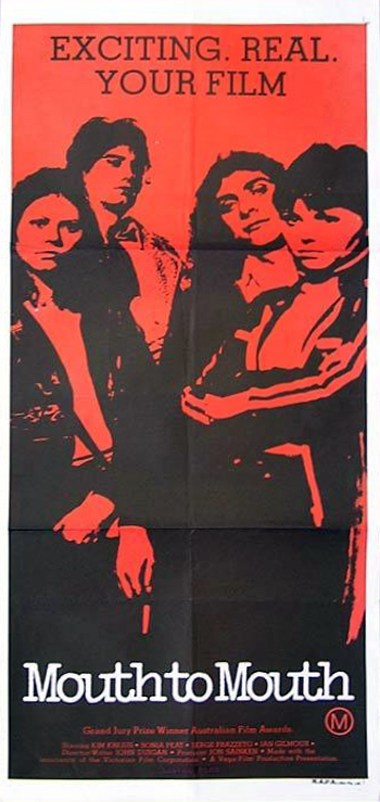
Carrie (Kim Krejus) and Jeanie (Sonia Peat) are two friends living in a juvenile detention center when one of them gets accused of stealing an item. Angered that they’ve been accused of doing something that they didn’t they escape into the night and onto the streets of Melbourne. They manage for find shelter in an abandoned factory building that also has an elderly homeless man named Fred (Walter Pym) living there whom they befriend. They find employment as servers in a cafe and that’s where they meet Tim (Ian Gilmour) and Sergio (Serge Frazzetto) who are two young men who have come to the city looking for employment. They girls bring them back to the factory building and the four create a makeshift home, but Carrie and Jeannie are not happy with the wages that they’re making nor having to shoplift on the side to make ends-meet. Carrie sees an ad in the paper for escorts and convinces Jeannie to join her as they’ll be able to make much more money doing that. Jeannie is reluctant at first, but eventually goes along with it, but after doing it for awhile Carrie becomes increasingly depressed, which eventually leads to her illicit drug use.

Initially I wasn’t excited to watch this as I’d seen many teen runaway movies before and failed to see what new perspective they could put on that would make it interesting, but I was surprised how very compelling it is. A lot of credit for this goes to writer/director John Duigan’s script, which has a nice conversational quality and the characters react the way real teens do where they never articulate how they really feel and go to great lengths to mask their true feelings. The setting, particularly the abandoned building is made all the more stark as a real one was used and not just some prop built on a movie set, which really hits home the kind of squalor some people will be willing to put-up with if their desperate enough and similar to the living conditions in the British film Rita, Sue, and Bob Too. 

Despite the actors having little or no acting experience they manage to give compelling performances and much of this was helped by having the cast room in a house for 2-weeks before the shooting started, which allowed them to bond with each other as well as refined their characters and rehearse their lines until it became almost natural to them. 

The script originally had more of a light-hearted tone, but after 14 rewrites it took on a harsher subject matter as director Duigan wanted to bring to life people that a middle-class movie audience only sees as ‘numbers on unemployment figures, or kids in juvenile court’ and in that regard it’s well-made. The ending is particularly gut-wrenching, but not surprising and yet I was very moved by it and it stayed with me long after it was over. 

On the complaints side it would’ve been nice to have had Fred come-up to their loft to either dinner with the four and see more how he interacted with them. The girls invite him, but he refuses, but for the sake of character development he should’ve agreed. The escort scenes only show Jeannie interacting with her client, but not Carrie with hers, which I found frustrating. Carrie is never seen visiting with her father either during the brief scene when she returns home as he’s not there, but having a conversation between the two could’ve been quite revealing. The film also features a great song entitled “The More You Love the Harder You Fall”, but no credits are given for who sings it, which is a shame.

My Rating: 8 out of 10

Released: July 20, 1978

Runtime: 1 Hour 36 Minutes

Rated M (Australian Movie Rating)

Director: John Duigan

Studio: Victorian Film Cororation

Available: DVD (Region 0 Import)

Gator (1976)

gator2

By Richard Winters

My Rating: 3 out of 10

4-Word Review: Rubbing-out a friend.

Gator McKlusky (Burt Reynolds) is back living in the swamp lands of southern Georgia with his Father (John Steadman) and young daughter (Lori Futch) with no interest of working for the police again. Then one day federal agent Irving Greenfield (Jack Weston) comes by in his boat asking Gator to work with them as an undercover agent to get incriminating information that can be used in court to convict local mob boss ‘Bama’ McCall (Jerry Reed), who just so happens to also be one of Gator’s former buddies. Gator at first resists, but eventually agrees. Bama seems excited to have Gator onboard with his team and even hires him as one of his collectors, but Gator gets turned-off by Bama’s penchant for drugging underage girls and then using them as prostitutes.  Bama eventually lets Gator leave his organization, but this only strengthens Gator’s resolve to put Bama behind bars, which leads the two former friends into a deadly game of cat-and-mouse.

The film was written by William W. Norton, whose colorful life,  was far more interesting than many of his banal scripts, which include such stinkers as I Dismember Mamaand in fact when Norton was on his deathbed in the hospital a nurse asked him if she knew of any of his movies and his response was “I don’t think your IQ is low enough”.  Despite Norton having written the script for the first film, White Lightningthat this movie was a sequel to, Reynolds was initially not interested in doing it and referred to the script as being “terrible”, but when the studio offered him the option to direct it he called it “wonderful”.

Like with many first-time directors the film has many long takes, but overall I felt Reynolds’ virgin effort behind the camera wasn’t too bad. The best part is the opening boat chase shot at the Okeefenokee State Park in southern Georgia that nicely captures it’s picturesque swamp topography as well as some exciting stunt work. Unfortunately after this bit the film goes downhill.

Much of the reason is the script’s inability to keep a consistent tone. The appeal is the spunky humor and action, but by the second act this all disappears and it becomes too serious and slow until it almost starts to resemble a drama. There’s also a few moments of jarring violence that completely losses sight of the playfulness that it had at the beginning.

Reynolds doesn’t seem into his part either, maybe because he was spending so much focus in directing, but in either case he walks through the role and phones in his lines. He also sports a mustache even though in the first installment he didn’t and for consistency he should more or less look the same as he did in the original. The mustache and wavy hair make him look older and the country boy charm that made his character so infectious in the first one is missing here.

Jerry Reed on-the-other-hand is great and shows the necessary energy to keep the scenes that he’s in interesting. Jack Weston is quite funny as the clumsy and constantly exacerbated agent and I was disappointed that he wasn’t in it more as the movie required him to be with Reynolds at all times in order to keep it engaging. I’ll even credit Alice Ghostley as the eccentric cat lady, but Lauren Hutton as the love interest is all wrong. She at least makes fun of the gap in her teeth, which I liked, but the romance angle comes-off as forced and unnecessary and does nothing but bog down the pace, in movie that’s too slow and choppy to begin with.

My Rating: 3 out of 10

Released: August 25, 1976

Runtime: 1 Hour 55 Minutes

Rated PG

Director: Burt Reynolds

Studio: United Artists

Available: DVD, Blu-ray, Amazon Video

The Buddy System (1984)

buddy2

By Richard Winters

My Rating: 7 out of 10

4-Word Review: A kid plays matchmaker.

Timmy (Wil Wheaton) is the 10-year-old son of Emily (Susan Sarandon) who’s a single mother still living with her mother (Jean Stapleton) because she can’t afford a place of her own due to always freezing up every time she tries to take the test to become a court reporter. In an effort to get Timmy into a better school they lie about where they live, which eventually gets found-out by security guard Joe (Richard Dreyfuss). Timmy though immediately takes a liking to him and thinks he’d make a good new boyfriend for his mother. He starts spending a lot of time at Joe’s and becomes fascinated by all the new inventions that he makes during his spare time. Emily though doesn’t like him at first, but slowly warms-up to him, but Joe is still smitten with vapid beauty Carrie (Nancy Allen) making any chance of relationship between Emily and Joe challenging.

This was the last film Dreyfuss did before his career got put on hold after he was caught blacking out while driving and arrested when cocaine was detected in his system. While he was able to kick the addiction he stayed out of the business for 2 years and when he returned he was all gray making this the last movie with his hair still brown.

I’m not quite sure why he thought this was a good role to take as it seems too much like the one he did in The Goodbye GirlIn that film his abrasive personality worked and made it interesting because it went against the grain of what we expect a male to behave in a romantic movie, but here he goes to the well too often. His abrasiveness is obnoxious particularly when he openly insults Emily in public during their first meeting, which should’ve made any attempt at a relationship after that completely impossible.

I felt that his character had too many hobbies as not only does he work a full-time job, but he also spends his free-time busily writing novels, which he can never get published, and also creating all sorts of inventions that litter his home. I realize people do have hobbies, which is great, but there’s only so much time in a day, so it would have to be one of the other and not both, as you start to wonder if he ever sleeps, or just sits back with a brew and watches TV.

His relationship with Carrie is a weak point. This is a smart guy, so what did he see in a clearly dim-witted woman like her that he would ‘fall in love’ with? She’s certainly attractive, so if he wants to get together with her for some sex from-time-to-time, which is all she seemed interested in anyways, then great, but I didn’t see what else she offered him especially intellectually that would make him want to be with her for anything more than an occasional tryst. If anything he’d should’ve found her boring, as the viewer certainly does, and it shouldn’t have taken him moving in with her to finally figure this out.

Sarandon is excellent, but I didn’t like the way her character literally jumps into bed with Joe the minute she mellowed on him. Having her frosty towards him made for an intriguing dynamic, and in a lot ways he deserved it, and the film should’ve played this up a bit longer. The sexual aspect, where they go to bed only for it not to go well, so they decided just to remain friends, doesn’t work. Usually people remain friends because one or both aren’t interested in it getting sexual, but rarely does it happen in reverse, so the film should’ve kept it realistic and not even bothered to throw in the sex angle at all.

As for Wheaton I enjoyed seeing a kid portrayed in a believable way where they aren’t just put into the story to say adorable, cutesy things, but instead shown, despite his young age, to be quite perceptive and aware of what’s going on. I did though have a hard time understanding why he got so enamored with Joe so quickly as he meets him for a half-minute and then immediately bonds with him and having him already familiar with Joe would’ve made more sense.

Overall, despite the blemishes, I did enjoy it on a non-think level. A lot of the credit goes to screenwriter Mary Agnes Donoghue, as she shows a good ability for understanding people living a working-class lifestyle and the inner struggles and insecurities that they face, which is the one thing that helps this movie stand-out.

My Rating: 7 out of 10

Released: January 20 1984

Runtime: 1 Hour 50 Minutes

Rated PG

Director: Glenn Jordan

Studio: 20th Century Fox

Available: VHS

Emoh Ruo (1985)

emoh1

By Richard Winters

My Rating: 4 out of 10

4-Word Review: New house falls apart.

Terri (Joy Smithers) is tired of living in a trailer and begs her husband Des (Martin Sacks) to finally buy a house, so they can live in the burbs and be a part of the middle-class dream. After saving up enough money they put a down payment on a brand new home, but the home begins to have a lot of problems. Both Terri and Des are forced to work longer hours at their jobs in order to keep up with the bills. What seemed like a dream at first soon turns into a nightmare making living in a trailer, which they initially hated, now seem like a good idea.

This film has a lot of similarities to Steven Spielberg’s The Money Pit, which came out a year later, but this one is more amusing, at least at the beginning. Spielberg’s film, which was directed by Richard Benjamin, was too cartoonish and silly and failed to make any broader statement other than wild comical antics. This one takes more of a satirical approach and shows how suburban life may not be as great as advertised and in some ways just plain not worth it. One of the funnier moments is when Terri gets home from her overnight job and the second she walks through the door immediately falls to the floor in exhaustion while her tired husband, who’s getting ready to go to his second job, steps over her while going out the door without so much as giving her a greeting.

I did like too that this movie doesn’t immediately go over-the-top with the problems of the home repairs. The Money Pit, in my opinion, ruined things by having everything go wonky right from the start, which didn’t allow for any buildup while this one keeps the tension by showing things not working as they should and making you interested in seeing if it’s going to get worse. The nightmarish elements aren’t just isolated to the home either as their son Jack (Jack Ellis) must put up with bullies at his new school and the couple also deals with nosy, meddling neighbors.

I was surprised by the abundance of nudity, at least during the first act, which is something you’d never see in a Hollywood movie, where nudity is usually only shown in film’s aimed at adults, or with adult themes, instead of a movie like this that would otherwise be perfect for the general public. I’m not sure exactly why director Denny Lawrence decided to put it in as it doesn’t have anything to do with the plot and could’ve easily been left out, but I can only presume that because Australia is a more secular country they’re less uptight about showing skin and therefore don’t worry, or fear, that putting it into a movie, even one as otherwise innocuous as this, will be a problem, or get backlash.

What I didn’t like though was Joy Smithers as the mother. While she certainly looks beautiful, both with her clothes on and off, she was, at age 22, too young to be portraying a suburban mother of a 10-year-old child. Her acting was problematic too especially her scenes where she’s supposed to be upset that doesn’t convey the subtle comic element that a better actress could’ve brought out.

Spoiler Alert!

The third act, outside of seeing an outrageous looking BBQ pit built by the husband, fails to have much of a payoff. Many of the problems with the house never get properly addressed. For instance the shower knobs blow off the wall and spew streams of water everywhere, but the film cuts away without showing how they managed to get it under control. Having the entire house ultimately collapse isn’t impressive either as it looks too much like a prop house made of cardboard instead of brick and mortar.

I was disappointed too that the dark comical edge gets lost with a sitcom-styled wrap-up that seemed to lose complete sight of the main point, which ultimately makes the film as a whole quite transparent and forgettable.

My Rating: 4 out of 10

Released: September 12, 1985

Runtime: 1 Hour 33 Minutes

Not Rated

Director: Denny Lawrence

Studio: Palm Beach Pictures

Available: DVD (Region 4 Import)