Tag Archives: Review

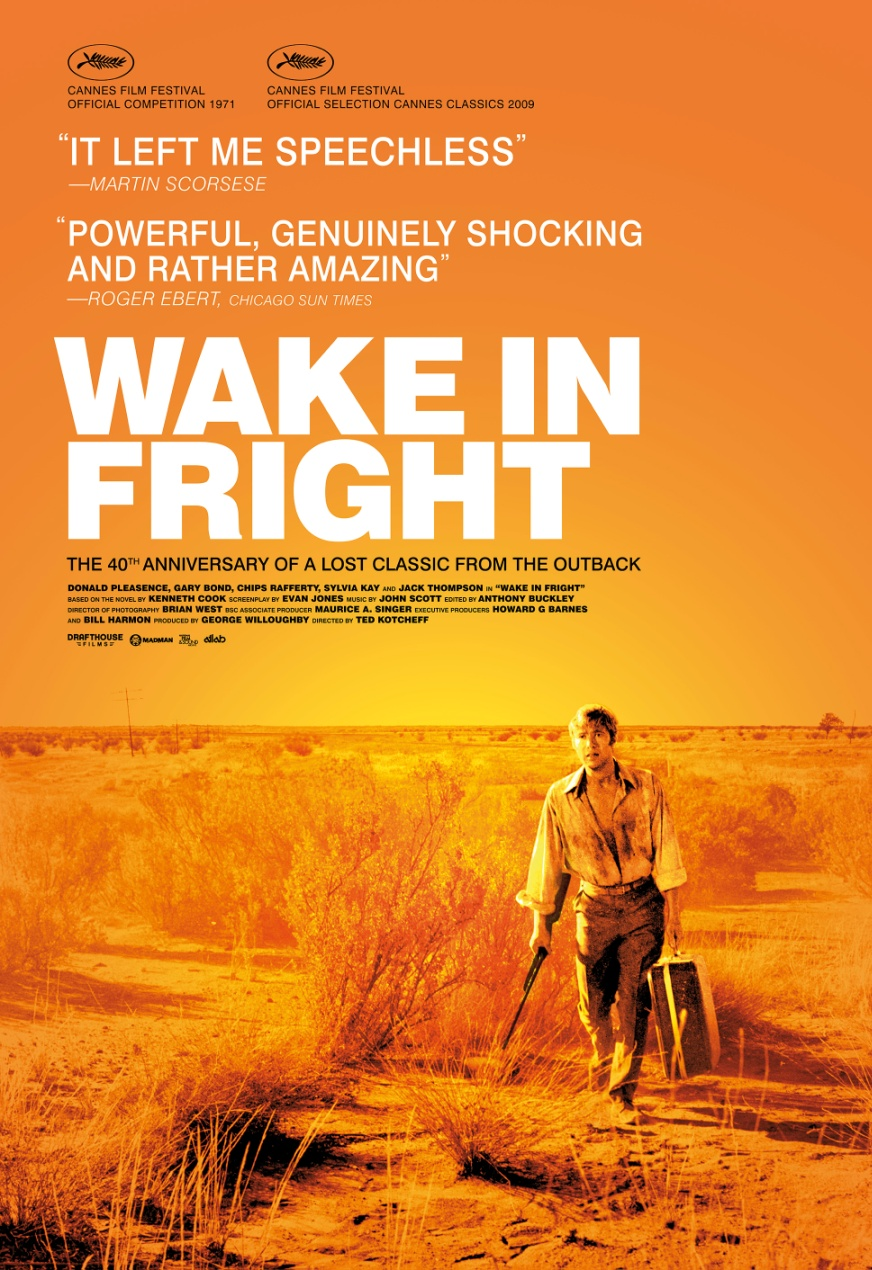
Wake in Fright (1971)

wake in fright 3

By Richard Winters

My Rating: 8 out of 10

4-Word Review: The middle of nowhere.

To an extent this is a one of kind film that is handled in such a raw and unpretentious way that it is like no other film you have ever seen before. The opening shot alone is amazing. You see a birdseye view of an isolated schoolhouse in the outback where our main character teaches. The camera then turns at a full circle and you see that there is absolutely nothing for miles in any direction. The desolation is mind boggling and it’s isolation at its purest.

Not only does this very inspired shot get its point across, but it also becomes the essence of what the film is about by trying to get you to understand the ruggedness of its characters by immersing you into their environment. It’s an uncompromising film full of startling images.

The story deals with a British schoolteacher John Grant (Gary Bond) who, through a loss in gambling, becomes trapped in the isolated outback town of Bundanyabba. He is cultured and educated and his sensibilities can’t mesh with the raw simplistic elements of the people in it.

It’s a highly intriguing viewpoint that not only captures man’s ever daunting task at dealing with nature, but also the overall reality of his existence and even himself. It makes you feel you are right there experiencing the same onslaught with him. There are also some interesting low key scenes proving that one of the biggest hurdles one must fight when in these places is actually just the boredom.

I do have to warn readers that the film has a very prolonged brutally explicit kangaroo hunting scene that features the actual killing of the animals. It even shows the men physically beating up on some wounded kangaroo’s and then viciously slashing their throats in a mocking fashion. Although I do feel that these scenes leave the viewer with the intended strong, raw impact and I like the lighting during the nighttime hunt that allows for a surreal element I still admit this may be a very difficult watch for some and may turn them off from viewing the film altogether. Apparently there were quite a few people that walked out of the film during this scene when it was shown at the Cannes, so be prepared.

Star Bond is excellent. You can relate to his anger and defiance at being somewhere he doesn’t want to be as well as feeling his desperation, exhaustion, and eventual surrender.

For many years this film sat in almost virtual obscurity, but after an exhaustive worldwide search a print of the film was finally found in the back of a Pittsburgh warehouse in a canister with a ‘to be destroyed’ label on it. Fortunately the print was saved and the restoration process is fantastic with colors that are bright and vivid. Director Ted Kotcheff captures the region in all of its rustic, desolate glory including the incredible crystal blue sky.

Reportedly many Aussies dislike the film as they feel it creates a negative stereotype. However, I don’t see it that way. I love the county and people and consider this more of a portrait of what happens when people are stuck in an isolated environment, which technically could be anywhere.
wake in fright 2

My Rating: 8 out of 10

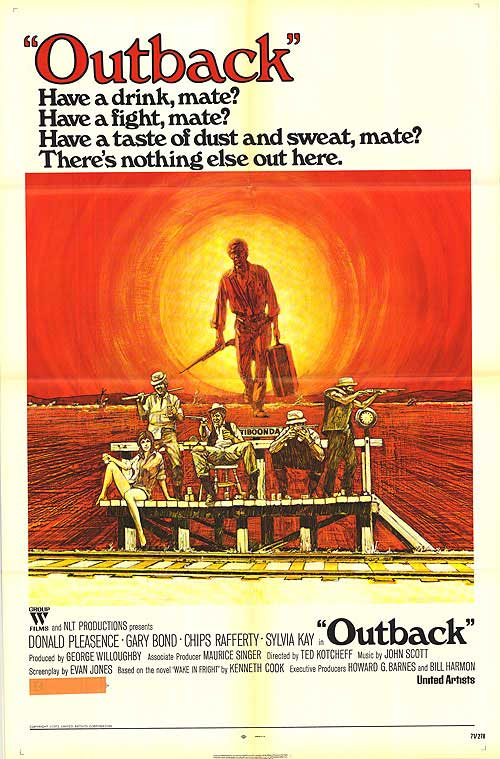
Alternate Title: Outback

Released: October 13, 1971

Runtime: 1Hour 49Minutes

Rated R

Director: Ted Kotcheff

Studio: United Artists

Available: DVD (Region 1 & 2) Blu-ray, Amazon Instant Video
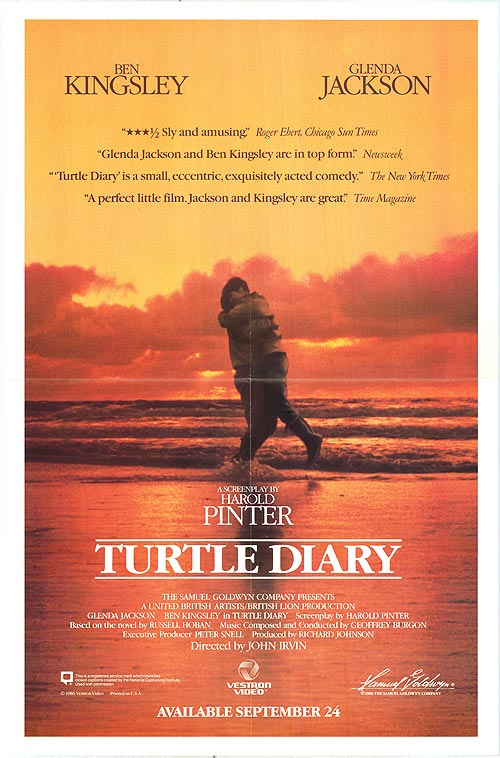
Turtle Diary (1985)

turtle diary 1

By Richard Winters

My Rating: 5 out of 10

4-Word Review: They free the turtles.

William (Ben Kingsley) becomes fixated with the idea of freeing the sea turtles at the London Zoo and returning them to the ocean. Neaera (Glenda Jackson) starts to have the same dream. The two get together and with the help of the kindly zookeeper George (Michael Gambon) begin to execute their plan.

Although well received by the critics at the time of its release I felt the film never seemed to gel. The plot is too thin and there is no explanation as to why William got so worked up about the turtles being in captivity. I felt there needed to be something shown in his history or character to explain this motivation. After all there are thousands and thousands of people that go to this zoo each year and none of them seemed to get worked up about the same idea. Also, why just the turtles? If William’s problem is seeing an animal that is not in their natural habitat then why not free all the species in the complex.

The plan also goes off way too seamlessly. What are the odds that the zookeeper would be in agreement with them and pretty much do all the work for them in setting it up to the point that all they end up doing is driving the turtles to the ocean. The story would have been a lot funnier and exciting had they somehow had to do it all themselves and behind the scenes. As it is here it becomes almost a non-event that barely holds any interest. Also, I have never heard of a zoo that decides not to press charges when they find that the turtles have been stolen or not firing the employee when they find that he had something to do with it.

The way Neaera and William get together is equally uninspired. They seemingly just keep bumping into each other and through sheer circumstance find out they have the same motivations. I was expecting something a little more creative and humorous. Neaera’s attempts at getting William’s address is particularly forced and contrived. In fact almost all of the conversations that they have with the exception of one where Neaera describes a weird dream that she had is very ordinary. The dialogue they have while traveling to the ocean is the blandest and none of it reveals much about the characters who end up being pretty forgettable.

Watching them carry the turtles to the open water has no emotional impact at all. It is not even the climatic sequence as it happens with 30 minutes left of the film. The rest of the movie concerns William’s dealings with the other people in his flat, which is mainly pointless.

The screenplay was written by celebrated writer Harold Pinter, who has an amusing cameo as one of the customers at William’s bookstore. Pinter was famous for his cutting edge and provocative plays of the 50’s, 60’s, and 70’s many of which I found to be quite fascinating, but this thing seems to be the polar opposite. The story and execution is standard while lacking any flair or pizazz. I can handle low-key and subtlety and many times relish it, but there still needs to be something more to it. More quirkiness and humor was needed as well as some tension. The film as it is here is flat and seems to waist a potentially unique idea as well as its cast.

My Rating: 5 out of 10

Released: September 10, 1985

Runtime: 1Hour 37Minutes

Rated PG

Director: John Irvin

Studio: The Samuel Goldwyn Company

Available: VHS

The Split (1968)

the split

By Richard Winters

My Rating: 5 out of 10

4-Word Review: Robbery during football game.

Since today is Superbowl Sunday I wanted to come up with a film from the 60’s with some sort of football theme and decided to dig this one out of the obscure pile that has just recently been released onto DVD through the Warner Archive label. The film has two special distinctions. For one it is the first movie to ever get an R rating under the MPAA’s then new rating system. It also shows scenes from two actual football games. The first one is a game between the Los Angeles Rams and the Atlanta Falcons that was played on December 3, 1967 and won by the Rams 20 to 3. The second game shown was one played a week later between the Rams and the Green Bay Packers where the Rams also prevailed by a score of 27 to 24.  Both games were played at the L.A. Coliseum with the plot of this movie taking place at another part of the stadium during these games although it is clear that the scenes involving the actors was done on a studio soundstage.

The story, which is based on a novel by the prolific Donald E. Westlake, involves a group of criminals who pull of a daring robbery during the football game, but when it comes to splitting up the money things go awry and they are soon turning on each other.

The crime itself isn’t all that interesting and tends to be a bit plodding with a minimum of suspense. Having things go wrong at the end and the group start turning on each other is redundant since they had been bickering amongst themselves from the very beginning. The characters are all unlikable making it hard for the viewer to get wrapped up into the plight of which of them gets the dough and which doesn’t. Personally I was hoping they would all just get killed off and no one would get any money because their constant yelling and fighting quickly becomes tedious and tiring.

The film’s one main highlight is a fight between Jim Brown and Ernest Borgnine, which carries the novelty of the fact that the two had a similar type of confrontation just a year earlier in the film Ice Station Zebra. Here, like in that film, Borgnine seems to get the best of Brown, which doesn’t make any sense because Brown was athletic, muscular and twenty years younger. There is also a scene where Borgnine puts his fist through a picture on the wall and shatters the glass. However, not only does he not wince in pain, which would be expected, but it somehow doesn’t even cause him to bleed.

Brown can sometimes be good in certain supporting roles, but as a leading man he can’t carry the picture. His facial expressions make him look like he is almost bored and just walking through the role. I know he was a great Hall of Fame running back, but that doesn’t mean he will turn into a great actor and casting him in lead roles of major studio pictures seemed awfully risky.

Warren Oates is terrific as always in a supporting role as one of the group’s henchmen. Donald Sutherland is also really good as another member of the group. I loved his Cheshire cat-like grin as well as his bowl haircut that gives him a creepy look. Julie Harris also sports a different style of hairdo from her usual short cut and she looks attractive as well as being near perfect in her part as an icy cold bitch that has no qualms about torturing a man to death in order to find her money.

SPOILER ALERT!

One of the biggest problems I had with the film was a plot twist that should have made it more interesting. It involves the James Whitmore character who plays the landlord of Diahann Carroll who is Brown’s girlfriend and hiding the stolen money in her apartment. Whitmore enters her place when she is alone and tries to rape her. Seeing an old wrinkled guy attacking a hot young black woman is wild in itself, but he also finds a machine gun in her dresser and holds it like he is masturbating with it and spews its bullets into her body like it is his ejaculation, which I found to be edgy and cool. He also finds the money and takes it for himself while making an anonymous phone call to the police to implicate Brown as the killer. However, when the police detective played by Gene Hackman investigates the case they quickly find out it was the landlord who did it, but it was never explained or shown how they came this conclusion as well as the fact that they end up killing him, which is completely glossed over and mentioned just briefly when the other characters read about it the next day in the newspaper. To me this created a major plot hole that needed to be filled.

The film also has a twist ending that doesn’t work and is very confusing. It happens as Brown is walking through the airport at the end with his share of the money and he hears what sounds like Diahann Carroll’s voice calling his name and he turns around with a shocked expression before the frame freezes and cuts to the credits. However, Carroll’s character was clearly killed and Brown saw the dead body, so how did she come back to life? Some viewers have stated that they think the voice was all inside Brown’s head, but that still needs to be explained and would normally prove frustrating to the viewer, but since the film is so bland it really doesn’t matter.

I feel I am being very generous in giving this picture 5 points, but the direction is fast paced and nicely compact and the jazzy Quincy Jones score is groovy. However, it certainly isn’t worth missing the big game for, nor any other game for that matter.

My Rating: 5 out of 10

Released: November 4, 1968

Runtime: 1Hour 30Minutes

Rated R

Director: Gordon Flemyng

Studio: MGM

Available: DVD (Warner Archive), Amazon Instant Video

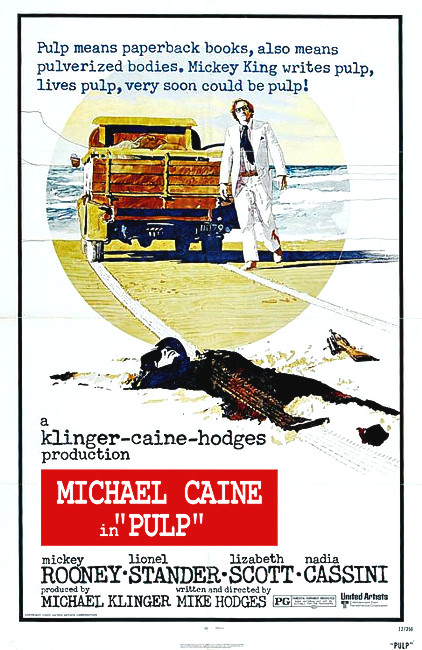
Pulp (1972)

pulp

By Richard Winters

My Rating: 6 out of 10

4-Word Review: Running for his life.

Michael Caine and director Mike Hodges teamed up again one year after doing the gritty classic Get Carter with this breezy oddity dealing with a pulp fiction writer Mickey King (Caine) who is hired to pen the autobiography of ex-Hollywood star Preston Gilbert (Mickey Rooney) who is now living in exile in Malta. The problem is that Gilbert has ties to the underworld and Mickey soon finds himself running for his life while meeting up with a barrage of oddball characters along the way.

The movie has a wonderfully quirky sense of humor with a few memorable laugh-out-loud sequences especially at the beginning. I got a real kick out of the man with a weak bladder who says a prayer to God to open up a locked bathroom door when he can’t get into it. The scene in the bus where we hear the different thoughts going on inside each of the passenger’s heads is great as well. The opening sequence featuring a row of lady typists writing up King’s latest manuscript is cute, but the one thing that holds it all together is Caine’s wry voice-over narration that remains consistently amusing.

Rooney though manages to steal the whole thing with his hilarious send-up of an aging actor. In fact this may be one of the funniest roles of his entire career. Even the scene showing him shadow boxing in his underwear is engaging although thankfully the camera doesn’t stay on it for too long. I was a bit disappointed that the character didn’t last through the film’s duration, but his death scene is so funny that it almost makes up for it.

It is nice to see Lizabeth Scott in her last film to date and first since 1957 when she was essentially blacklisted from Hollywood purportedly for her lesbian leanings. Although only 50 at the time her aging face looked like she was almost 70 and her deep, raspy voice sounded similar to the demon’s in The Exorcist. I thought she could’ve been given more to do and played a character that was more integral to the story as her screen time is much too brief.

The on-location shooting done on the island nation of Malta is another asset. The sunny weather has a nice exotic feel and the old architecture of the buildings helps give the film a visual distinction. The melodic piano soundtrack is pleasing and I wished it had been heard a little bit more.

The story is full of a lot of unexpected twists and turns that manages to be engaging for a while, but I felt it runs out of steam by the end. During the final 15 minutes I found myself a bit bored and no longer caught up in it. While I do like the scene where the gunmen gets run over by a pick-up and shown from the point-of-view of the driver I still felt that the ending lacked the finesse and quirkiness of the beginning. The offbeat ideas that writer/director Hodges showers into the film become dried up with a finish that lacks any payoff and unfortunately sullies what is otherwise an offbeat gem waiting to be discovered.

My Rating: 6 out of 10

Released: August 4, 1972

Runtime: 1Hour 35Minutes

Rated PG

Director: Mike Hodges

Studio: United Artists

Available: DVD, Amazon Instant Video

Nice Girls Don’t Explode (1987)


By Richard Winters

My Rating: 1 out of 10

4-Word Review: Love meets spontaeous combustion.

April Flowers (Michelle Meyrink) has a serious problem. Whenever she goes out on a date with a guy and gets even the slightest bit aroused by him she starts inadvertently setting off fires. Smoke comes popping out of nowhere and before her dates know what is happening their clothes are on fire or worse her date’s fancy cars. April is always sure to bring along protection and in this case that means a small fire extinguisher, but they can’t always put out all the fires that she creates. What April doesn’t know is that it is really her mother (Barbara Harris) who is setting the fires. She buys the explosive ingredients from a pyrotechnic (Wallace Shawn) secretly follows April on her dates and then at just the right moment she uses her remote control to set them off, but now April is dating Andy (William O’Leary) who is on to what the mother is doing and determined to expose her shenanigans to April.

Had this film stayed with the idea that April had some sort of ability to start these fires herself it might have worked as there are a plethora of different and interesting avenues that the story could have taken. Having the plot take the avenue that it does brings up more questions and loopholes and doesn’t really make any sense. Are we to believe that April has now grown into young adulthood and never once suspected that her mother is following her around everywhere and doing what she is doing? And what would compel a mother to torment her daughter in such a way and does she actually believe that she can go on achieving this bizarre stunt for the rest of her daughter’s life and never get caught? None of these questions get answered or even touched upon and instead we are given corny humor that becomes increasingly cartoonish as it progresses until is insulting to anyone with any resemblance of an intellect.

The movie is basically a bad example of a one-joke idea getting stretched out farther than it can or should. After the first five minutes the novelty wears off and has nowhere to go and limps along until it becomes excruciatingly boring and mindless.

Harris gives it her all and to some extent succeeds. I have always enjoyed her work no matter how bad the script, but this one really pushes it. I found it surprising why a woman who was nominated twice for the Academy Award, won several Tonys on Broadway, and was Alfred Hitchcock’s last leading lady would have to settle for this low-grade silliness simply to make a living. Unless of course screenwriter Paul Harris was in some way related to her, so she decided to do it as a favor, but that has never been confirmed.

Meyrink is appealing. She has a geeky quality, but still pretty with a good comic delivery and it is a shame that she did only one more movie after this before dropping out of the business completely. Shawn is also fun as the fire expert, but everyone else is either dull, or has no ability to act.

Someone really should have set fire to this script. Filmed on-location in Lawrence, Kansas this may be the only film in history that lists a stunt double for a cat.

My Rating: 1 out of 10

Released: February 22, 1987

Runtime: 1Hour 28Minutes

Rated PG

Director: Chuck Martinez

Studio: New World Pictures

Available: VHS

The Night of the Following Day (1969)

night of the following day 4

By Richard Winters

My Rating: 4 out of 10

4-Word Review: Kidnappers can’t get along.

A teenage girl (Pamela Franklin) is kidnapped by a group of professional killers who then demand a large ransom from her rich father (Hugues Wanner). Things deteriorate as the criminals begin fighting amongst themselves and eventually it all goes awry, which leads to ironic results.

Writer/director Hubert Cornfield creates a picturesque setting and a certain new wave look that subtly runs through it. The music has a new age sound, which helps to create a kind of metaphysical mindset. There are also some good camera angles and interesting edits, so it takes you awhile before you realize that this is just a lot to do about nothing.

The caper itself is too general and formulaic and in the end makes it a lame excuse for a movie. The infighting by the criminals is not that interesting. The characters are so one-dimensional that you really don’t care what happens to them. The twist ending is not that clever and in many ways simply signifies what a waste of time this really is.

Marlon Brando overacts with a part that doesn’t require it. He uses the hip lingo of the day like ‘freaky’ and ‘man’, which doesn’t really mesh with the middle-aged man that he was. His blonde wig looks awful and his trendy clothes including his big belt buckle gives him too much of a kitschy appearance. The attempts at making him a sort of anti-hero that is brave, sensitive, and concerned for his victim’s welfare despite being one of the perpetrators doesn’t work and makes the character a cliché like everything else in the movie.

Franklin is wasted. She goes through all the expected emotions of a kidnap victim, but barely utters a word in the process.

The neighboring policeman is put in to help create some tension, but ends up being annoying instead. However, Jess Hahn as Wally is quite good playing the film’s only believable character. He has very much of an average Joe type of looks and seems at the start to have an insignificant role, but ends up being the only one that holds it up together while the rest become whacked out.

Despite an interesting cast that also includes Rita Moreno and Richard Boone I found this to be a very cardboard thriller that runs out of gas after an okay beginning.

My Rating: 4 out of 10

Released: February 19, 1969

Runtime: 1Hour 33Minutes

Rated R

Director: Hubert Cornfield

Studio: Universal

Available: VHS, DVD

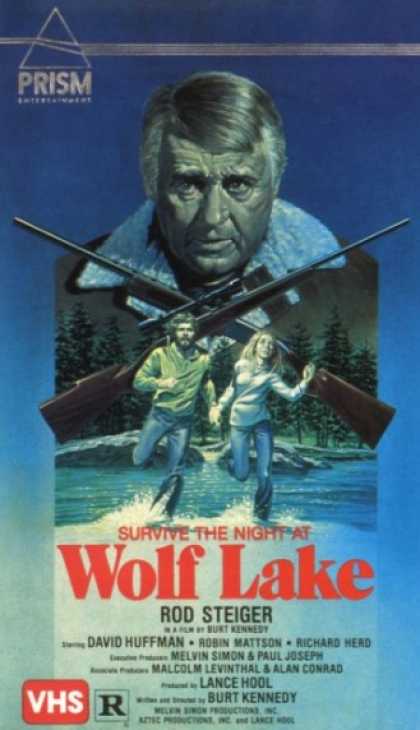
Wolf Lake (1978)

wolf lake 1

By Richard Winters

My Rating: 2 out of 10

4-Word Review: He doesn’t like deserters.

Charlie (Rod Steiger) is a hard-bitten conservative man who lost his 23-year-old son in the Vietnam War. He likes to vacation with a couple of his middle-aged buddies Wilbur (Jerry Hardin) and George (Richard Herd) at a remote Canadian hunting lodge. However, this time when they arrive they find that the regular lodge owner is not there and instead it is being run by a young man named David (David Huffman) and his pretty girlfriend Linda (Robin Mattson). Charlie and David almost immediately are at odds as they both share a wide variance in age and political leanings. What is worse is the fact that David is a war deserter and once Charlie finds out about this he flies into a rage of psychotic proportions, which culminates in a violent night of terror for both David and his girlfriend.

The film was written and directed by the normally reliable Burt Kennedy who is better known for doing westerns. After watching this I think he should have stayed in that genre as this film is too formulaic and one-dimensional. There seems to be too much emphasis to conform to the horror movie/slasher style formula of that era with a plot set-up that is too brief and character development that is almost non-existent. The story shows its cards too quickly and then proceeds to just plod on and on until it climaxes with a predictable and boring finish.

Charlie and David’s arguments and confrontations fail to elicit any type of tension. Their shouting matches are rhetorical and redundant and their points-of-view are handled at a superficial level that allows for no new insight, or intellectual debate. Charlie is so limited in his stubbornness that he becomes annoying instead of threatening, or scary.

The final 25 minutes when the two sides wage a proverbial war between their two cabins is the only time that there is any action. However, by then I was completely bored with the proceedings and so emotionally detached from the third rate material that it was a strain just getting through it. The film’s ultimate message is heavy-handed and done so much better in other films on the same subject that it renders this excursion as pointless.

Steiger is wasted. The character he plays is poorly defined and doesn’t allow him to take full advantage of his acting abilities. He gets stuck with another one of his many wigs this one looking like the same type of gray haired rug that actor Ray Milland used to wear in his later years. The producers should have just allowed him to appear bald as it would have fit this type of part better and even made him look creepier and more menacing.

Huffman is the best thing about this movie and it is a shame that his life and career were cut short when he was murdered in 1985 while trying to chase down a suspected purse snatcher. His performance here is nicely understated, which helps carry the picture as he is the only character that is multi-faceted.

Although the story takes place in Canada and the landscape certainly looks Canadian I was surprised to learn that it was actually filmed near the city of Creel in Chihuahua, Mexico, which due to its high elevation has a climate that is more similar to the North’s.

SPOILER ALERT

There are actually two different versions of this film. There is this one and another one entitled The Honor Guard. In that one there are no flashback scenes like there are here and in the end Charlie ends up killing David and his girlfriend while in this version Linda shoots Charlie before falling over dead herself. I actually liked the flashbacks that are used as it gives the film what little suspense it has and also shows a bit of cinematic flair. However, the scene where Linda miraculously comes up with a gun and killing Charlie before keeling over looked cheesy and clichéd and I might actually have voted for the alternate ending.

My Rating: 2 out of 10

Released: May 3, 1978

Runtime: 1Hour 25Minutes

Rated R

Director: Burt Kennedy

Studio: Melvin Simon Productions

Available: VHS

Welcome to Woop Woop (1997)

welcome to woop woop 2

By Richard Winters

My Rating: 6 out of 10

4-Word Review: Oh those crazy Aussies.

Teddy (Johnathon Schaech) is a rather clumsy con man from New York who tries to escape a murder rap by going to the most remote place possible, the Australian outback. However, after coming into close contact with the eccentric people and lifestyles, he decides what he really needs is an escape from there!

This is the type of offbeat comedy that should give all other offbeat comedies a bad name. It takes all the same ingredients from all those other films, meshes them together, and then spits them out in a mechanical fashion. Unlike director Stephan Elliot’s earlier feature Priscilla Queen of the Desert there is nothing deep here to help balance the quirkiness. The film is just made to be silly and at times goes overboard with it. The pace is also too fast. The viewer is never allowed to soak anything in or even take a breath.

Schaech is not good in the leading role. He gives too much of a breezy performance, acting as if the whole thing is a joke. He never once even for a second displays the angst, anxiety, and basic overall exhaustion that anyone else stuck in the same situation would feel.

The portrayal of the Australian people is terrible. They take all the stereotypes of the down under folks and then play it up to the extreme. Here they are not just slightly eccentric people of a rugged and hearty nature. Instead they are complete Neanderthals who live like animals and have no level of sophistication. Yes, it does try to be somewhat fair by showing that Americans may have some primitive defects as well. Specifically in an opening sequence in New York City where every pedestrian is seen shooting at some birds flying by. Still the Australian segments are needlessly overdone and a bit insulting.

The one pleasant surprise is the appearance of Rod Taylor. He plays completely against type here. He’s Daddy-O a self-imposed, self-styled dictator of the town. His performance is gruff, campy, energetic, over-the-top, and hilarious all at the same time. His appearance here may actually be his career pinnacle.
Overall the film is similar in tone to all those formulaic bid budgeted Hollywood actioners, except here it’s aimed at the offbeat crowd. Everything is perfectly packaged to its core audience and overblown all at the same. It’s so forced at points that it almost becomes ridiculous. Yet some of the humor is funny, it has a feel good attitude, and it is without question LIVELY.

Watch for a real fun cameo by Tina Louise at the beginning.

My Rating: 6 out of 10

Released: May 13, 1997

Runtime: 1Hour 37Minutes

Rated R

Director: Stephan Elliot

Studio: Goldwyn Entertainment Company

Available: VHS, DVD

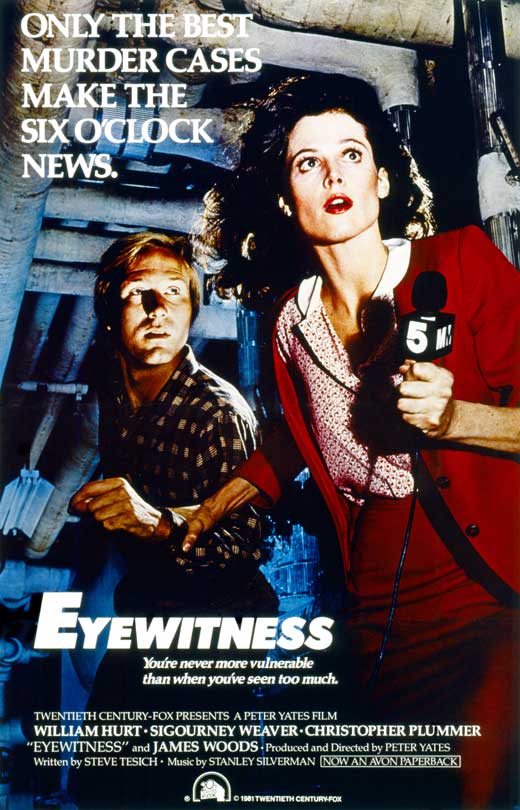
Eyewitness (1981)

eyewitness

By Richard Winters

My Rating: 4 out of 10

4-Word Review: Janitor loves news reporter.

Daryl (William Hurt) is a nighttime janitor at a large Manhattan office building. He spends his otherwise lonely existence obsessing over a local news reporter Tony Sokolow (Sigourney Weaver) and records every news broadcast she is in and watches them each night when he gets home. Then a murder occurs in his office building and Tony covers it for her program. Daryl tries to use his inside knowledge to get closer to Tony, but is reluctant to tell her all the information he knows since he fears that it was his friend Aldo (James Woods) who committed the crime.

Hurt, who usually plays the intellectual type, does well here in the low-key role. Weaver is also excellent doing what she does best which is playing a tenacious no-nonsense woman who can take care of herself. My favorite part with her is when she is accosted by a couple of men with guns, but doesn’t scream, keeps her composure, and manages to get away.

The romantic angle is the film’s strong point. Tony’s on-camera interview with Daryl when she tries to get more information out of him, but he instead gushes about his undying love for her is funny. It is refreshing that when Daryl tells Tony about how he obsesses over her she doesn’t freak out and consider him a stalker, but instead is charmed by it. The two use each other for their own purposes, but the viewer is giving the impression that these are genuinely nice people who just have very contrasting personalities and approaches, which is what makes the budding relationship interesting. However, having them go to bed together and confirm their affections for each other seemed anti-climactic as it was more intriguing wondering if Tony really was starting to have feelings for Daryl, or just using him to get information and the film should have stayed at this level until the very end.

The mystery portion gets lost in the shuffle. The film is slow with very little tension. There are a few good action moments, but there needed to be more. The scene where Daryl almost gets crushed in a trash compactor had definite potential, but needed to be played-out longer. The part where he and Tony are attacked by a dog is very intense, but the climatic sequence where Daryl is chased by the killer through some horse stalls is certainly slick and well-shot, but it comes too late and I had already become bored and detached with it. The identity of the killer was a definite surprise, but it is also a bit preposterous and a little too convenient in the way it somehow manages to tie all the characters into it especially Tony.

Director Peter Yates does some excellent on-location shooting of New York City especially with the crowded streets and neighborhoods as well as Central Park, but the musical score is sparse and lacking. There is a pleasing jazzy score near the beginning that has a nice easy going beat to it, but then outside of a few tense moments there is nothing. This creates a film that is too quiet. Adding an urgent score could’ve helped make it more compelling, or at the very least given it more energy and personality.

There are a lot of familiar faces in supporting roles, but the majority of them are wasted. Morgan Freeman and Steven Hill as the police investigators who banter endlessly
with each other are dull and useless. Kenneth McMillan as Daryl’s handicapped father is dynamic, but pointless to the story as a whole. Christopher Plummer is always reliable, but he has done better. James Woods is good because he is a master at playing unhinged characters and I liked the casting of Irene Worth as Tony’s mother simply because she looked almost exactly like what Sigourney would end up looking when she reaches that age. This is also a great chance to see Pamela Reed in an early role as Daryl’s fiancée.

The film ends up biting off more than it can chew and the idea of mixing a cutesy romance with a murder mystery doesn’t gel and leaves a sterile effect in both areas.

My Rating: 4 out of 10

Released: February 13, 1981

Runtime: 1Hour 43Minutes

Rated R

Director: Peter Yates

Studio: 20th Century Fox

Available: VHS, DVD, Netflix streaming

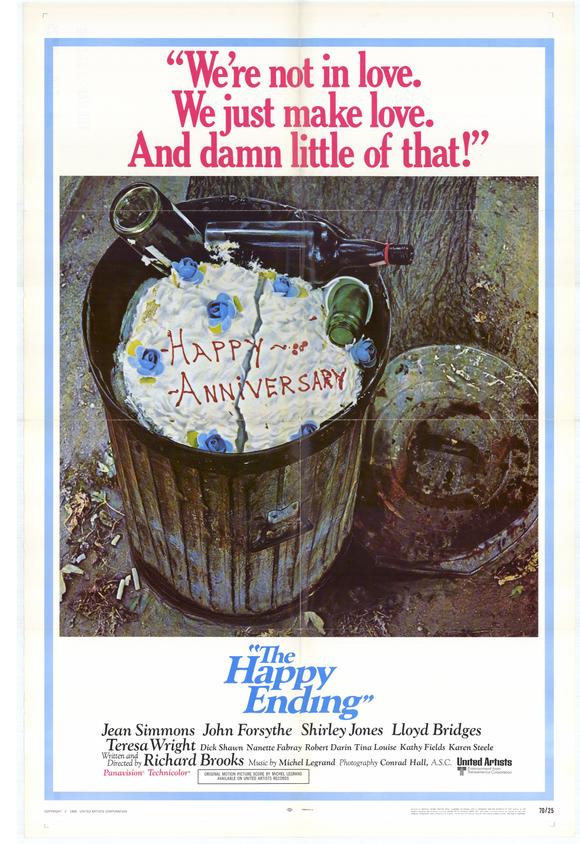
The Happy Ending (1969)

happy ending

By Richard Winters

My Rating: 4 out of 10

4-Word Review: The problems of marriage.

If there was ever a film with a misleading title it is this one. There is no happy ending here and in fact there is nothing in its entire 117 minutes that is happy as the film examines every negative and depressing thing it can think of about the institution of marriage and then rhythmically beats it into the viewer like a victim in a bar fight being pummeled by a brawler. The format works like a boring college professor lecturing endlessly about some tepid subject while tirelessly pinpointing every monotonous detail and not knowing when to stop.

The story is about Mary (Jean Simmons) who at one time was madly in-love with Fred (John Forsythe) and had extremely high ideals in regards to love and marriage when she married him. Now after fifteen years of living in a relationship that no longer has any passion she has turned into a depressed and disillusioned alcoholic looking for any way to escape the confines.

The film itself is intelligently done and well executed and makes some good hard-hitting points. The dialogue and conversations between the characters are realistic and well written and it is nice having adults acting and talking like real people. The only real issue is the question of why the filmmakers would think anyone would actually want to sit through something that is so endlessly downbeat. Sometimes these types of things work better in a satire format where they can still make the same points, but allow the viewer a few laughs as well. As it is the film is in desperate need of some levity and none is ever offered.

I also felt that film was too one-sided. I realize that there are a lot of unhappily married people out there, but there has got to be some couples that are happy with it. By never balancing it out and showing no other viewpoint makes the film come off like one long and unending rant.

Writer-director Richard Brooks infuses certain directorial touches that are novel to some extent, but heavy-handed as well. Showing clips of famous old romantic movies like It Happened One Night and Father of the Bride during Mary’s wedding is creative, but too obvious as is the segment when Mary is on a beach and a young couple asks her to take a picture of them and inside the camera’s viewfinder Brooks inserts an image of Mary and Fred when they were a young and in-love. There is also too much footage of Casablanca shown, which does nothing but make the viewer want to watch that over this dreary thing.

Simmons gives a strong performance and looks as beautiful as ever. She is also straddled with a few difficult scenes but does them well including a harrowing segment where she is rushed to an emergency room after swallowing some pills and has a hose stuffed down her throat in an attempt to vomit them out. Tina Louise is great in support as is Dick Shawn in a rare dramatic turn. Shirley Jones is also good as Mary’s jaded friend Flo and she is given some of the film’s best lines.

Forsythe is okay as the husband, but not too exciting though he never usually is. He should have had the big mole in the center of his forehead surgically removed as my eyes always seemed to fixate on it every time he was shown in a close-up. I got to admit I was amazed his character did not kill his wife on the spot when he found out that she had run up his credit card in one day on $11,421 worth of charges on clothes. This was 1969 dollars and I have no idea what astronomical figure that would be for today, but it would be beyond outrageous nonetheless. Of course he was caught fooling around, so I suppose this was her way of getting back at him and boy did she ever.

The film does have a few powerful scenes that I did like. The part where Fred defends Mary after she has run out on them and their daughter Marge (Kathy Fields) feels that her mother no longer loves her is really good as is the final conversation between Fred and Mary as well as Mary’s conversation with her mother (Teresa Wright) about the happiness of her mother’s own marriage. The moment when the very cynical Flo becomes all teary-eyed and excited when the married man that she has been fooling around with decides to divorce his wife and propose to her despite the fact that she has spent the rest of the movie considering the idea of marriage to be over-rated is savvy.

Like with the sappy and over-played Michael Legrand song ‘What Are You Doing the Rest of Your Life?’ the film goes on too long and there are just not enough good things about it to justify sitting through.

My Rating: 4 out of 10

Released: December 21, 1969

Runtime: 1Hour 57Minutes

Rated PG

Director: Richard Brooks

Studio: United Artists

Available: VHS, Amazon Instant Video, Netflix streaming