Tag Archives: Renee Taylor

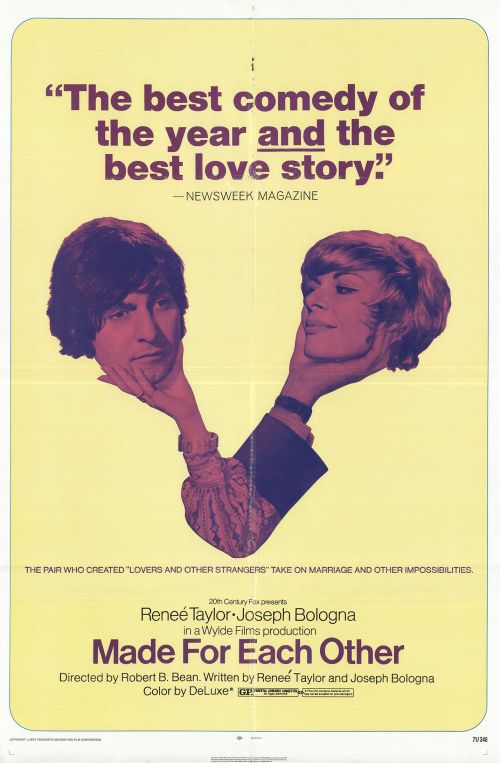
Made for Each Other (1971)

made

By Richard Winters

My Rating: 7 out of 10

4-Word Review: Couple argues a lot.

Pandora (Renee Taylor) is an out-of-work actress still clinging to her dreams that she’ll one day become famous something she has hoped for since she was a child. Gig (Joseph Bologna) suffers from not being able to find a stable relationship and guilt-ridden over sending the last one into attempted suicide. Both Pandora and Gig attend a group therapy session and this is where they meet. Initially though things are rocky. Gig does not like Pandora’s stand-up act, something she’s been working on for years, and openly tells her it’s awful. They then break-up, but Pandora eventually returns telling him that he was right and she’s worked out the ‘kinks’ from her act, so it’s now improved. To celebrate Gig takes her to his parents (Paul Sorvino, Olympia Dukakis) for Thanksgiving. The parents though don’t approve of Pandora since she’s Jewish and they’re Catholic and they eventually drive her out of their apartment. Gig and Pandora continue to argue once they’re back in the car, but find, strangely, that no matter how the other one annoys them they still like each other’s company.

After the runaway success of Lovers and Other Strangerswhich Bologna and Taylor wrote initially as a play, but then turned it into a movie, Hollywood studios were interested in them trying another script and gave them upfront money to do so. The first film had been based on their real-life experiences of dealing with all of their in-laws during their wedding, which occurred in 1965, and so they decided to base this one on their lives as well, namely what brought them together. Like with their first project the script is quite broad and focuses in on many different people including the parents of each character who have quite a bit of screentime, particularly Sorvino and Dukakis, and who are quite funny. The film also shows the leads when they were infants and many of their childhood experiences, which gets shot in black-and-white, that is also both insightful and amusing.

Unlike with most movies the scenes are quite extended and seemed better primed for a stageplay. The elusive Robert B. Bean gets credited as director, but he never did anything else, which seems a bit curious and there’s been rumors that he was just a pseudonym for Bologna who took over as the actual director. The long takes though are effective and enhance the comedy. The scene inside Gig’s parents house where the tension builds when they slowly realize that Pandora is ‘not their kind’ is quite good and not unlike what could happen in many families homes of that era who closely identified with their particularly religions and not privy to having their kids marry outside of it. Gig’s inability to appreciate Pandora’s stage act and his blunt assessment of it while at a late night cafe is comically on-targe too as any fledgling artist will tell you sometimes family members, friends, and even those really close to them won’t always connect with their artistic endeavors and regrettably become their biggest critics.

Sorvino scores as the abrasive no-nonsense father though ironically he was actually 5-years younger than Bologna who plays his son and for that reason his hair should’ve been made more gray. Dukakis is equally on-target as the super religious mother whose strong faith amounts to a lot of rituals and ends up inadvertently harming her child psychologically like when she catches him masturbating and informs him that if he continues his ‘little thing will fall off’. Helen Verbit as Pandora’s mother is equally amusing playing the over-protective type who wants so hard to shield her daughter from harsh reality that she tells her that her stage act is ‘brilliant’ when it really isn’t and that because she’s her mother that somehow makes her opinion ‘objective’.

The film’s one drawback is the yelling, which there is a lot of. Sometimes confrontational comedy can be quite amusing and this one works most of the way, but how much the viewer will enjoy is up to each individual. Bologna’s shouting is particularly loud and abrasive. It’s meant to funny and done only out of aggravation, but it does tend to get extended especially by the end. Had Taylor shouted back then it would’ve seemed like a ‘fair fight’, but having her run away and cry takes humor out of it and may ultimately ingrate on the audience. The intent is for there to be an offbeat charm, but not everyone may see it that way and thus this thing won’t be for all tastes.

My Rating: 7 out of 10

Released: December 12, 1971

Runtime: 1 Hour 41 Minutes

Rated GP

Director: Robert B. Bean

Studio: 20th Century Fox

Available: DVD-R (Fox Cinema Archives)
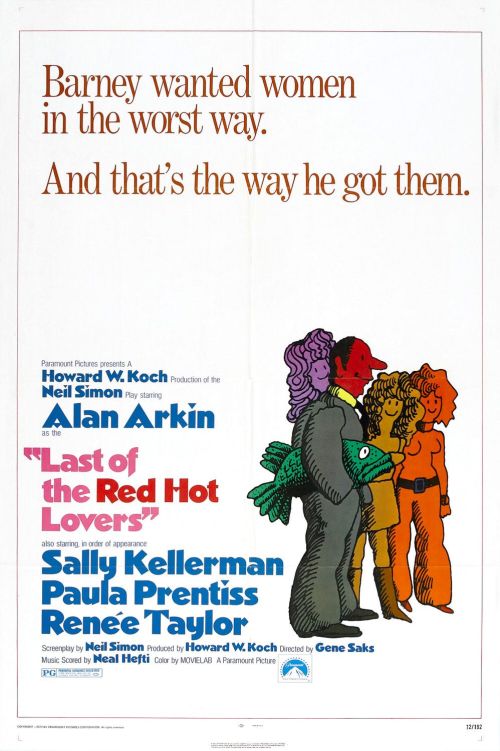
Last of the Red Hot Lovers (1972)

last1

By Richard Winters

My Rating: 4 out of 10

4-Word Review: Married man wants fling.

Barney (Alan Arkin) is a middle-aged man, who after 22-years of marriage, has decided he’d like to fool-around for the first time. He doesn’t want an actual affair, just a quickie sex fling with indiscriminate women while inside his elderly mother’s apartment, which he has access to during the day while she’s away. The problem is that while he’s able to get attractive women into the place he can’t quite get any action leaving him feeling more sexually frustrated than when it began.

The film is based on the Neil Simon play that opened on Broadway in 1969 and ran for 706 performances. The play starred James Coco in the pivotal role who I felt was much better suited for the part than Arkin. Arkin is okay, but his comedic style can be quite frantic in tone that can sometimes border on creepy. He also had a full head of hair at the time even though the role called for a balding man, so he shaved the top of his head to appear semi-bald, but it looks tacky. Coco on the other-hand had a lovable loser quality that made you want to like him even when he did naughty things and he was naturally bald, so his appearance wouldn’t have looked as fake as Arkin’s. I can only presume that because Arkin was at the time an established film star and Coco was still just considered a fledgling character actor that’s why he got the offer while Coco didn’t, but it’s one of the main reasons the story doesn’t translate as well on film as it did onstage.

The directing by Gene Saks isn’t bad particularly the opening sequence where we things entirely from the point-of-view of Barney as he wakes-up and gets out of bed and starts his daily routine, which I found rather inventive cinematically. In fact it’s these moments where we hear the thoughts going on inside Barney’s head as he tries to get the nerve to break-the-ice with other women that he meets, which are the funniest. Unfortunately the scenes done inside the apartment don’t work as well as the place is too cramped and appearing more like a jail cell, which becomes visually static.

The three rendezvous that Barney has with three different women aren’t as clever or creative as they could’ve been. The first segment has Sally Kellermen, who is excellent, playing an Italian women, who comes up to his place, but then just proceeds to argue with him before leaving. My main problem with this scene was the motivation as she spots Barney working inside his restaurant, which precipitates the meet-up, but why would this incredibly hot woman get turned-on by this dopey looking guy to the point that she’d want to have casual sex with him? There were plenty of other men in the place, so why does Barney excite her over the others? The conversation that the two have inside the restaurant is never shown, which I found to be a cop-out and hurt the character development. Had she been portrayed as being a prostitute then it would’ve made more sense, but this is never confirmed, which makes this whole first segment quite weak.

The second segment deals with Paula Prentis as a struggling actress who Barney meets in a park. She borrows some money from him and then agrees to pay him back later at the apartment. However, when she arrives she seems like a completely different person. At the park she came-off as quiet and shy, but at the apartment she’s a babbling idiot that seems to be on acid. The dialogue during this sequence in which the characters basically talk-over each other the whole time quickly becomes annoying. The scene fades-out with the two getting high off of marijuana, but it never shows her leaving the place, so we don’t know for sure if they ended-up having sex or not.

The third and final segment has Renee Taylor playing a middle-aged woman, who is also married, coming-up to Barney’s mother’s place, but immediately getting cold-feet, which kills the intrigue as we know right from the start how it’s going to go. This scene also has a rapey vibe to it as Barney, now feeling frustrated at having struck out twice before, behaves in a much more aggressive manner by blocking her from leaving and then while half-naked jumping on top of her and pinning her to the bed while she yells for him to get off, which is cringy and not funny.

Having a film deal with all the strike-outs a person may face when it comes to having sex with others is an interesting idea. Too many other movies just show the ones that work-out, but in reality, especially with average looking people, there can be more misses than hits, so I appreciated the story in that regard. However, random sex with strangers where the women goes to a strange man’s place without worry or concern has become a thing of the past in this day and age of stalkers and self-protection making the theme here quite dated and out-of-touch.

My Rating: 4 out of 10

Released: August 17, 1972

Runtime: 1 Hour 38 Minutes

Rated PG

Director: Gene Saks

Studio: Paramount

Available: DVD, Amazon Video, PlutoTV, YouTube