Tag Archives: Peter Boyle

The Friends of Eddie Coyle (1973)

eddie

By Richard Winters

My Rating: 4 out of 10

4-Word Review: Gunrunner tries avoiding sentencing.

Eddie (Robert Mitchum) is an aging gunrunner living in Massachusetts whose career in crime has taken a toll on his family. He feels his life in and out of jail has caused him to lose connection with his kids and wants to avoid a repeated stint in the slammer. Another sentencing is likely as he’s been charged with hijacking a truck, so he works with special agent Dave Foley (Richard Jordan) to help reduce his pending time, or get it cleared altogether, by agreeing to give him tips of other crooks he’s worked with, of planned crimes that are about to take place including a string of bank robberies that have been occurring throughout the area and being carried out by people Eddie knows. While Eddie is able to give Dave some help it’s not enough and he continues to be squeezed to offer more names and when he does his former associates become convinced, he’ll sell-out on them, so they devise a plan that’ll quiet him once and for all. 

The film is based on the 1972 novel of the same by George V. Higgins that won numerous accolades including by such famous authors as Norman Mailer and Elmore Leonard who called it the ‘best crime novel ever written’. While the film does closely follow the story in the book, and received equally positive reviews, it did very poorly at the box office. A lot of the problem is that while the actions is captured in a gritty and unglamourous way, the idea behind the film was to give a harsher viewpoint of those working in the criminal underworld as The Godfather had been deemed at the time as being too romanticized, the characters are not people to get emotionally vested in and the plot fails to garner any momentum. The crimes get carried out in too much of a methodical way and lack tension. The viewer doesn’t care what happens to these people and thus the movie ends up lacking much of a point.

There were certain things that I did like. The gray and brown late autumn landscape helps accentuate the cold, soulless lives of the characters. The bank robberies are captivating for a while as it focuses on the intricacies of carrying out such daring heists and the planning though I felt seeing one of these was enough and having to go through two of them made it redundant and unnecessary. 

Mitchum gives an excellent performance and certainly appears and acts like someone who’s been beaten down enough by the system that’s he’s willing to do whatever he can to self-preserve. His attempts at a New England accent aren’t bad either. However, I would’ve liked to see some interaction with him and his kids as this is the whole motive for why he turns informant as he wants to spend more time with the family and not go to jail, but we never see any actual communication that he has with them albeit a brief moment with his wife. Had there been more family moments where the viewer could actually feel the character’s quandary on an emotional level than they might’ve been more wrapped-up in seeing him get through it, but by the way it gets done here there’s very little if any of that. He’s also not in it enough and there’s long stretches where we see Steven Keats, a fellow gunrunner, who’s more adept at showing the anxiety and paronia that goes into someone living the fringe lifestyle that he does and thus it would’ve been a more captivating film had it focused on him instead. 

Spoiler Alert!

The ending is the biggest letdown. While it’s the same one as in the book it’s too uneventful to be riveting or impactful. It features Eddie getting invited to a hockey game by Peter Boyle, a fellow hood, and another man who after the game take a drunken Eddie out for the ride where he passes-out and thus gives them the opportunity to conveniently shoot him, which they do. While I did enjoy close-up footage of an actual hockey game as it features players in an era where they didn’t have to wear helmets, I did find the way Eddie falls prey to the men to be too easy. This was a career criminal, so he should’ve in the back of his mind been well aware that his ‘friends’ may start to suspect him of being the snitch that he is and put on a more defensive mind set. I was fully expecting him to be faking passing out and at the last second jumping out of the car and trying to get away, which could’ve led to an exciting climactic foot chase, but stupidly falling into their trap without a peep of a fight isn’t an adequate payoff. He might as well had just shown up to the event with a bullseye tattooed to his forehead that said ‘shoot me’ as it ends-up playing-out in pretty much the same way. 

My Rating: 4 out of 10

Released: June 26, 1973

Runtime: 1 Hour 43 Minutes

Rated R

Director: Peter Yates

Studio: Paramount Pictures

Available: DVD, Blu-ray (The Criterion Collection), Amazon Video

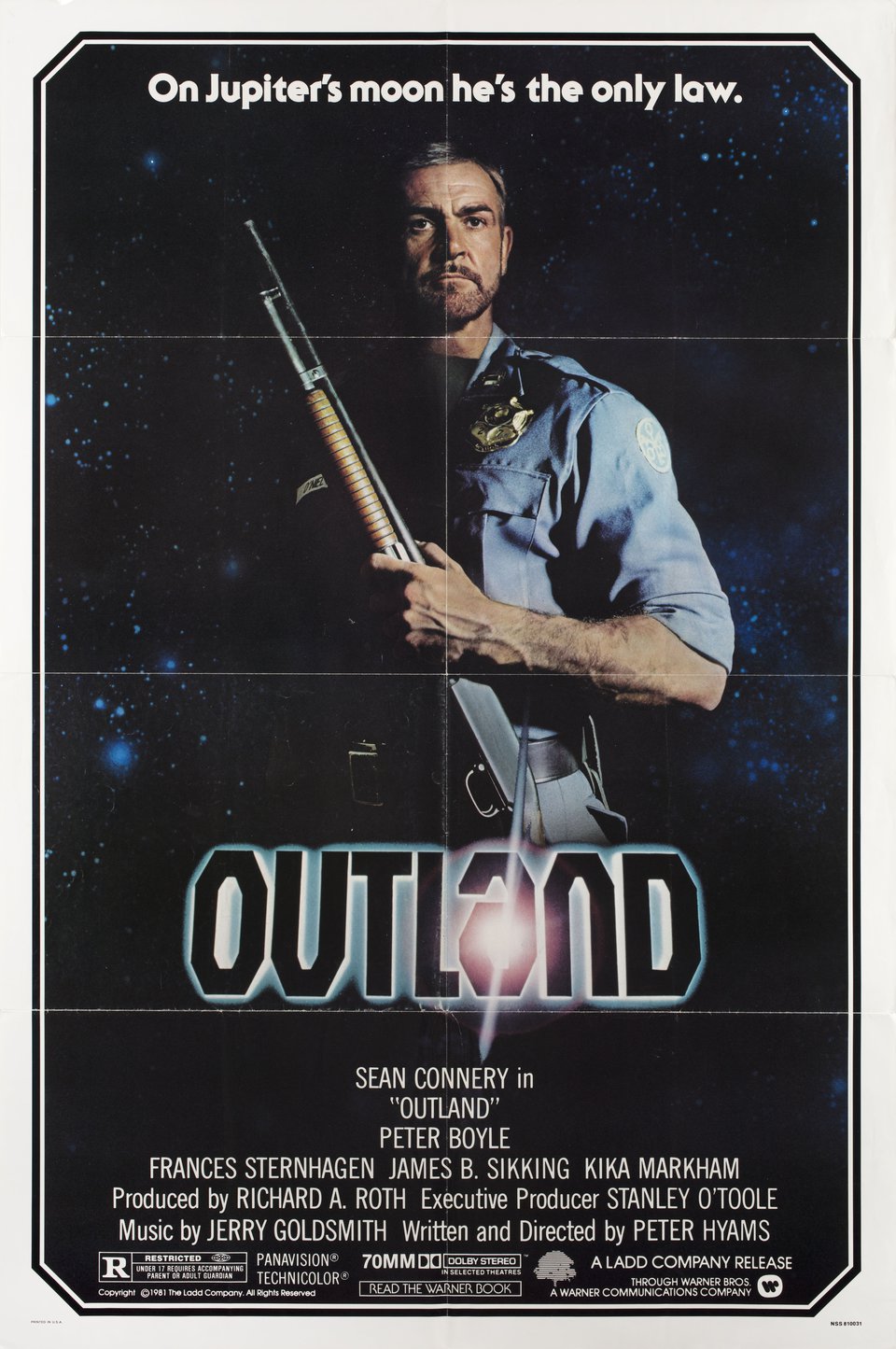
Outland (1981)

outland

By Richard Winters

My Rating: 6 out of 10

4-Word Review: Deaths at mining outpost.

William (Sean Connery) is a federal marshal assigned to an isolated mining outpost on one of Jupiter’s moons. The outpost, known as Con-Am 27, is supervised by Mark Sheppard (Peter Boyle), who boasts a high productivity from his miners, but this comes at a cost as they seem to be steadily dying-off after suffering from bizarre psychotic episodes. William brings a blood sample of one of the latest victims to Lazarus (Frances Sternhagen), a nurse stationed at the outpost, who runs it through some tests and learns that he had been taking a powerful drug that can allow the men to work long hours at a high rate, but they will eventually burn-out and be driven crazy after about 10-months of use. William learns that Sheppard is fully aware of the drug use and allows it since it helps his workers achieve high results while also paying-off the police authorities to keep quiet. William refuses to go along with this and openly challenges the status quo of the space station causing Sheppard to call-in two assassins who’ll arrive on the latest shuttle and dispose of William unless he’s able to kill them first.

The film was inspired by writer/director Peter Hyams’ desire to make a western, but was advised by studio execs that westerns were no longer profitable, but sci-fi movies dealing with outer space were, so he decided to switch the setting of High Noon, a famous western starring Gary Cooper, to that of a space station, but otherwise kept many of the story elements from that one intact. The response by critics at the time was mixed with some labeling the effort as ‘trite’ while others, like critic Desmond Ryan of the Philadelphia Inquirer calling it ‘scarier than Alien, which I found funny since that one has gone on to be a timeless classic while this is largely forgotten.

The film does score when it approaches the human factor like greed and the way management can and will exploit the workforce if it’s able and the resentment and apathy workers can have towards their jobs, which even if it’s in some distant future could still most likely be reoccurring elements that will go on no matter what the time period. The look of the space station, particularly from the outside, is cool and I enjoyed the way the film replicates the ominous silence of space especially at the beginning.

Some other futuristic effects don’t work as well like the way the computers feel the need to make little beepy noises every time it prints out a word, or message, which may have seemed high tech at the time, but is now antiquated. The television screens display the old tube models while today we have the flat HD variety making this ‘future’ seen here seem more like the past. There’s also plentiful shots of people openly smoking in meeting rooms, but since second-hand smoke was proven to cause lung cancer and outlawed now, more people vape anyways, then why would it have been brought back in the future?

Connery shouldn’t have to explain why he’s going up against this evil conglomerate when no one else will help him, as the viewer should be able to surmise this on their own, which shows how poorly fleshed-out his character is. Having him rebuff his son’s and wife’s request to come back to earth with them because he has something to ‘prove’ unintentionally works against his likability as it makes him seem selfish versus noble. Would’ve been better had his wife left him on bad terms, maybe because for example he was an alcoholic, or too focused on his job, and thus with nothing else to lose he decides to prove to himself he can do at least something right by taking down the bad guys since he’s essentially failed at everything else. The audience would’ve been more emotionally invested in his quandary if he had nowhere else to turn, instead of here where he technically does have an option.

Sternhagen is an interesting choice for the female lead in that she’s not the proverbial young and attractive heroine like viewers have come to expect in Hollywood action flicks. Had she been more romantically enticing that might’ve made the viewer dislike William, particularly if he acted upon his emotions, since he was already married, so to avoid any possible conflict they made the lady character older and sarcastic and thus not somebody to typically fall in love with. While I appreciated the concept of having two people work together without it leading into a sexual escapade, which becomes a cliche in itself, I still felt it was hard to fathom that she’d be the only one at this outpost that would offer him assistance. The work crew wasn’t real happy with management especially finding out that they were fed a drug meant to ultimately kill them, so I’d think there would be some of them who would want to help William take down their oppressive employer, which would’ve also helped it add a wrinkle to the High Noon formula, which it otherwise follows too closely to the point that it becomes predictable and redundant.

While I did like the shoot-out that happens in the giant greenhouse, which visually is impressive due to its vast largeness, I did feel overall the assassins weren’t interesting. We barely see their faces and they come-off as being no different than the other workers already at the station and this lack of distinction makes them forgettable. Initially I thought William wouldn’t be able to know which ones coming off the shuttle, as there are quite a few people who disembark it, were the killers, so there would be added suspense of him being unclear of who exactly was after him, but this quickly gets answered when William can see via circuit cameras the two men taking out their weapons, which ruins what could’ve been an added mystery. Ultimately, I felt the assassins shouldn’t have been human, but instead an indestructible killer robot, which would’ve kept it more in the space age realm and given it added excitement and special effects.

My Rating: 6 out of 10

Released: May 22, 1981

Runtime: 1 Hour 49 Minutes

Rated R

Director: Peter Hyams

Studio: Warner Brothers

Available: DVD, Blu-ray, Amazon Video, YouTube
Crazy Joe (1974)

crazy1

By Richard Winters

My Rating: 4 out of 10

4-Word Review: Gangster’s rise and fall.

Loosely based on the real-life exploits of a New York gangster named Joe Gallo (Peter Boyle) the story centers on Joe’s rise in the underground criminal world and his challenging of Mob Boss Falco (Luther Adler) as well as Don Vittorio (Eli Wallach) the head of all crime families. When Joe and his brother’s agree to carry out a hit for Falco, but are only paid $100 each for the crime they feel rebuffed and plot revenge by storming Falco’s mansion and taking member’s of his family hostage. Through Don, who acts as an intermediary, they’re able to settle the dispute, but later Joe finds that he’s been double-crossed, which sends him to jail during a sting operation. While in prison he makes friends with Willy (Fred Williamson) an African American. The two form an uneasy alliance where he agrees to help Joe settle his score once they both get out.

With all of the gangster movies that came out during the early and mid 70’s it gets harder and harder to tell them apart, or have much in the way to say about them since they all tend to be alike with very little variation. This film is a clear example to cash-in on the Francis Ford Coppola classic by quickly producing this cheapie, which was shot in the U.S. with American actors by an Italian production company, which in essence makes it a foreign film. While the plot and action lack anything original I did find the opening sequence where they carry-out the hit by shooting a man and his cronies while inside a restaurant to be captivating. The action itself isn’t what’s interesting, but seeing the men singing and joking around inside the car, both as they drive-up to the place and then again as they leave it, to be fascinating in a disturbing sort of way where no matter how viscous the act they feel no guilt and happily go back to being their playful selves almost instantaneously.

Boyle’s performance helps a lot. He was in another film just 4 years earlier with a similar title called Joe where he played a violent right-wing extremist and he got so turned off by the fan mail he received with people telling him how much they enjoyed watching the ugly acts that his character did and said in that movie that he vowed never to appear in another violent film again and yet just a few years later that’s exactly what he did, but I’m glad. He exudes a great amount of energy and liveliness into the role and helps keep the movie entertaining to the point that it’s only interesting when he’s in it and a complete bore when he’s not. Effort is made to humanize him as it see-saws between moments where he’s killing people and then other points when he’s saving them particularly when he goes into a burning building to help some children get out.

The supporting cast is strong especially the always reliable Wallach and Williamson whose angry gaze melts right through the screen. I also really enjoyed Adler as the arrogant crime boss who feels he’s ‘all-powerful’, but physically is quite old and frail and eventually into the helpless position of being put inside an iron lung while still callously giving out all the orders and demanding full compliance. Louis Guss is equally amusing as a tough guy killer who when kidnapped immediately folds by wetting his pants and begging for his heart medication.

Unfortunately Henry Winkler, in his film debut, is not as effective as his demeanor is too refined and gentile and does not reflect the savagery of the others almost like he walked in on the completely wrong film set. Rip Torn is badly miscast as well. While the other actors appear to be genuinely Italian and speak with authentic accents Torn doesn’t. Instead he keeps his Texas draw intact, which is totally out-of-place, and while a good supporting player in other movies sticks out as a completely sore thumb here.

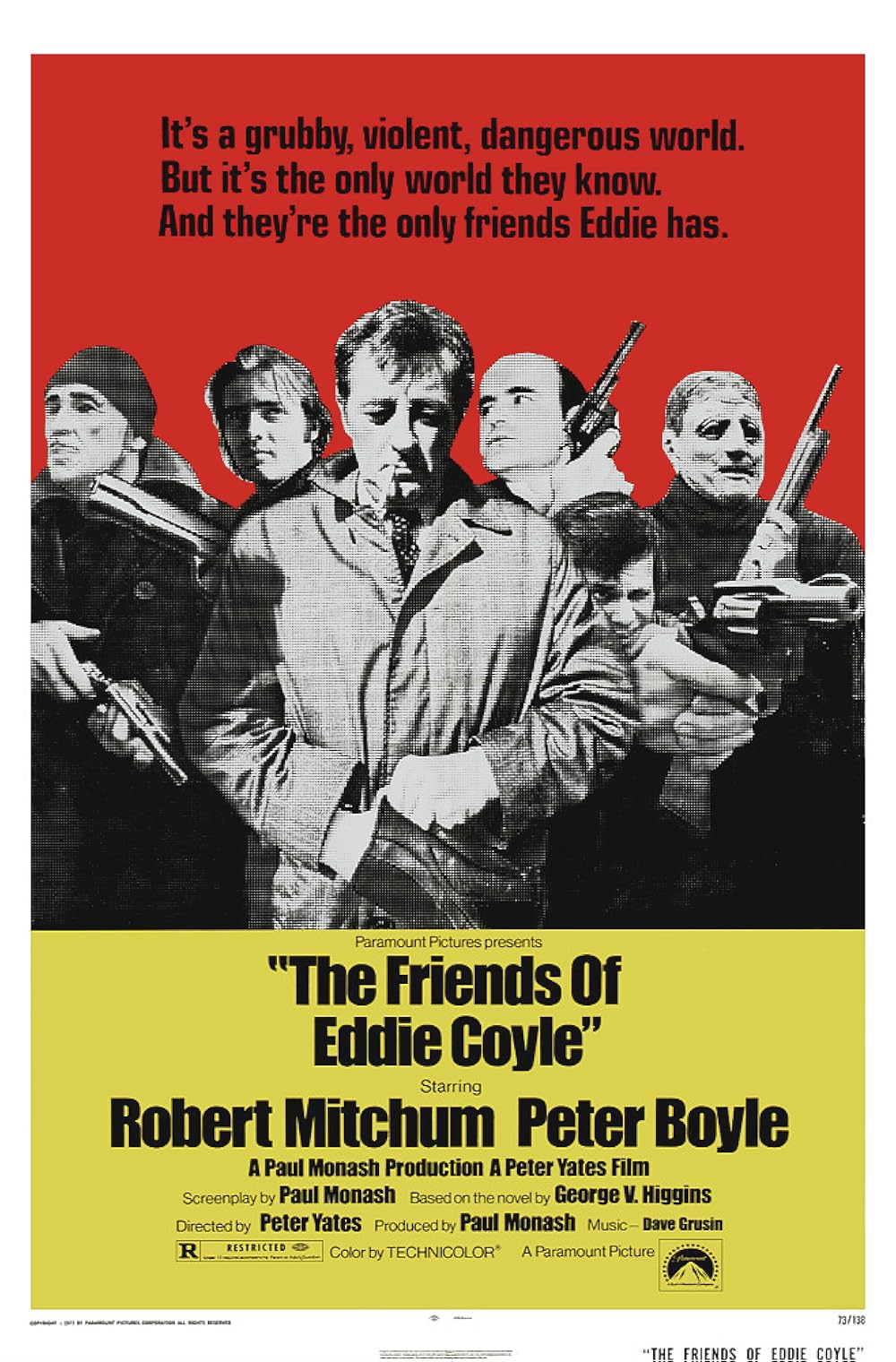
Ultimately though the poor production values sink it. To some extent it helps on the violent end as the killings are done in a more graphic and raw way, much like an Italian horror film, which makes it more real than The Godfather where it was handled in a lyrical fashion, but the plot has nowhere much to go. You know where it’s headed right from the start with an ending that’s completely predictable and has no impact. Doesn’t particularly help either that the film’s promotional poster gives away the final scene.

My Rating: 4 out of 10

Released: February 8, 1974

Runtime: 1 Hour 40 Minutes

Rated R

Director: Carlo Lizzani

Studio: Columbia Pictures

Available: Available through Non-Standard DVD (Public Domain).

Speed Zone (1989)

By Richard Winters

My Rating: 2 out of 10

4-Word Review: Another cross-country race.

A collage of wacky characters convene to a countryside inn, which will be the starting point of another illegal cross-country race known as the Cannonball Run that will have people driving their cars from Washington D.C. to Santa Monica, California in record time with the winner receiving $1 million. Many attempts have been made in the past to stop it, but to no avail. However, this time Police Chief Spiro T. Edsel (Peter Boyle) makes a commitment to stymie the race any way he can, but as usual the participants are able to complete it without much hassle.

This is the fifth attempt at making a movie dealing with the real-life race called Cannonball Baker Sea-to-Shining Sea Memorial Trophy Dash that would start on the east coast in either New York or Connecticut and finish at the  Portofino Inn in Redondo, California. The race was run 5 times during the 70’s with the last one occurring on April 1, 1979. 4 other movies had already been made on this same subject and include: The Gumball RallyCannonball!, The Cannonball Runand Cannonball Run IIWhile those films featured some exciting stunt work the comedy elements and characters were usually quite lame and cartoonish and the box office receipts, particularly for Cannonball Run II, had slowed completely after an initially good first weekend making it seem that producers would realize that this theme had run its course, but Hollywood being Hollywood stubbornly decided to resurrect the idea and even offering Burt Reynolds a big sum of money to reprise his role, but he refused.

Initially I thought this one might be a bit of an improvement as it starts out right away with a Lamborghini, driven by John Schneider, being chased down the highway by a bunch of cops, which if you’re going to do a movie like this is the way it should be done. Keep the emphasis on the action and car stunts while minimizes the comedy and dialogue. Unfortunately this unravels pretty quickly by first having the Lamborghini skip across a lake, which was proven on the Myth Busters TV-show not to be possible, and then deviates to the cartoonish characters standing around interacting with one another, which is not funny and not what people who came to watch a car race movie want to see.

Outside of Jamie Farr, who reprises his role as an Arab sheik, but is fortunately only seen at the beginning, the rest of the cast is made up of new faces not seen in any of the previous ones, but having a new set of people playing the same campy roles doesn’t help. Boyle gets listed as having a lead role, but his character really doesn’t do much and is so ineffective at impending the race you wonder why they even bothered to write-him into the script. Tim Matheson too plays a character that isn’t funny and I can only imagine that he took the part, much like the Smothers Brothers who also appear here, simply for the money, but certainly this cannot be anything they’d want to highlight on their resumes.

I did like John Candy who unlike the rest actually seems more like a real person and not just a buffoonish nut. Unfortunately he gets paired with Donna Dixon as his driving partner who speaks in an affected Brooklyn accent, which I found quite annoying. They should’ve had his SCTV-alum partner Eugene Levy ride with him as the constant bickering the two shared along with their contrasting personalities would’ve been amusing.  Alyssa Milano has a good bit as a student driver being instructed to pass all cars that are foreign made. I really liked Brooke Shields appearance too where she plays herself working as a flight attendant so she doesn’t have to settle for ‘bit parts in movies’. In fact her part is so funny it’s the only reason I’m giving this otherwise stupid dreck 2-points.

My Rating: 2 out of 10

Released: April 21, 1989

Runtime: 1 Hour 34 Minutes

Rated PG

Director: Jim Drake

Studio: Orion Pictures

Available: VHS

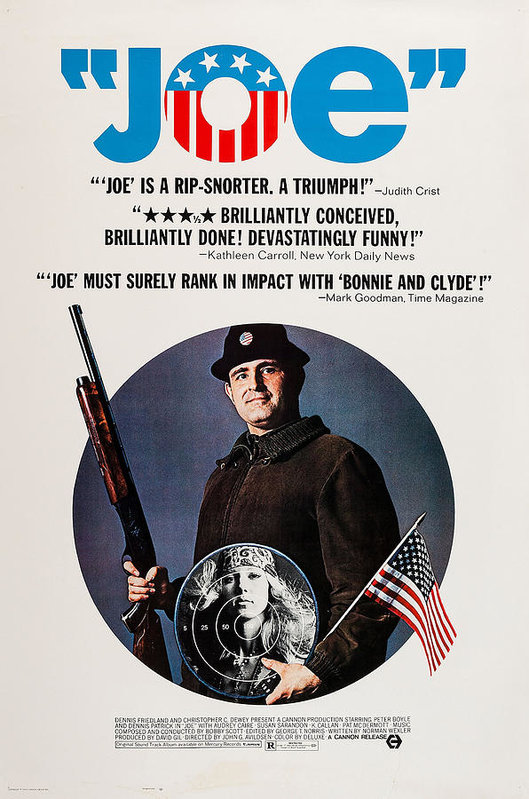
Joe (1970)

By Richard Winters

My Rating: 6 out of 10

4-Word Review: Bigot befriends successful businessman.

Joe Curran (Peter Boyle) is an unhappy factory worker who feels the blacks, liberals, and hippies are ruining the country and doesn’t mind telling all the patrons at his local bar exactly what he thinks. One night while going on another one of his racist rants he meets Bill (Dennis Patrick) a successful businessman who’s the father of Melissa (Susan Sarandon) who was put into the hospital for a heroin overdose. Earlier that day in a fit of rage Bill had killed her live-in boyfriend Frank ( Patrick McDermott) who was the one that got Melissa hooked on the drug. Now, as he sits at the bar in a drunken state he admits to Joe what he did and Joe uses this newfound knowledge to become friends with Bill and find out how the other half lives. Bill initially dislikes Joe and only stays friends with him because he’s afraid Joe will go to the police otherwise, but after awhile the two men start to share a weird bond, which eventually leads them both to the dark side.

Norman Wexler’s script manages to bring out the paradox of the American social hierarchy quite well and in many ways far better than most other better known dramas of the same subject. While the role was originally intended for Lawrence Tierney, who would’ve been a better choice due to being more age appropriate, Boyle, in his first starring role, shines as a younger version of Archie Bunker and manages to do it in a way that still keeps him human and dryly humorous.

The film’s major defect though is with Dennis Patrick’s character who is too bland and one-dimensional and walks around with the same nervous look on his face throughout. Having him become the main character and receive the biggest story arch does not help since he’s too transparent causing his personality change to be uninteresting and there needed to be a backstory in order to give him more depth. I also felt his relationship with his wife (Audrey Caire) needed fleshing-out and the scene where he admits to the murder to her and her reaction to this news needed to be shown.

While John G. Avildsen’s direction has some flair his selection of music for the soundtrack, which includes a droning, melodic piece by Jerry Butler during the opening credits, was too low key and doesn’t reflect the edgy, angry tone of the story. The scene where several people get shot inside an isolated home is poorly handled because no special effects get used. The victims just immediately collapse to the ground after being shot, almost like children pretending to get killed while playing cops-and-robbers, with no blood splatter or gun smoke, which makes it too fake looking and weakens the overall emotional effect.

Having Patrick able to kill the boyfriend so easily is unconvincing too. The boyfriend was far younger and bigger than Patrick, so having him die by simply getting the back of his head hit against a wall without putting up any fight comes off as pathetic and the struggle should’ve been much more prolonged and played-out. I also didn’t like the editing effects were the film repeats the shot of the head hitting the wall, which is too stylized in a film that otherwise was trying to be gritty and realistic.

The twist ending though is nifty and almost makes it worth sitting through. It’s also a great to see Susan Sarandon in her film debut. She looks pretty much the same as she does now, but her eyes for some reason look bigger here and more pronounced on her face. She gives a good performance as always and even jumps fully naked into a bathtub with her boyfriend to start things off.

My Rating: 6 out of 10

Released: July 15, 1970

Runtime: 1 Hour 47 Minutes

Rated R

Director: John G. Avildsen

Studio: Cannon Film Distributors

Available: DVD, Blu-ray, Amazon Video

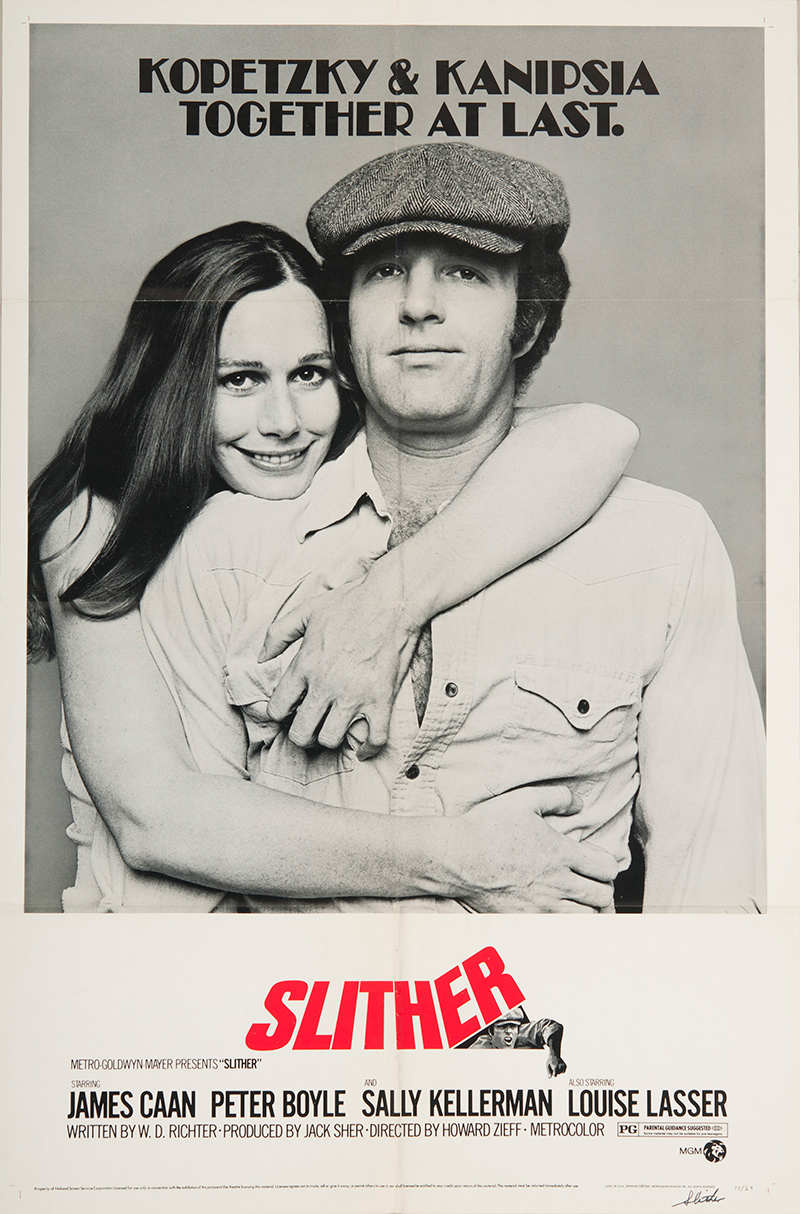
Slither (1973)

By Richard Winters

My Rating: 5 out of 10

4-Word Review: Searching for embezzled money.

Dick Kanipsia (James Caan) is a former car thief who has just been released from jail and is now trying to go straight. While in prison he started up a friendship with Harry Moss (Richard B. Shull) and decides to go to his rural home for a visit. It is there that Harry suddenly gets shot by a mysterious gunmen, but just before he dies he informs Dick about a secret stash of stolen money that can only be retrieved by contacting his former partners in crime: Barry Faneka (Peter Boyle) and Vincent Palmer (Allen Garfield). Dick then goes on a road trip trying to find these two men while also coming into contact with a lot of oddball characters and situations along the way.

When I first saw this film over 20 years ago I really loved it and was impressed with W.D. Richter’s offbeat script that relies heavily on quirky scenarios and dryly humorous non sequiturs to help propel it. A theme he later polished to perfection in his most famous film the cult hit The Adventures of Buckaroo Banzai Across the 8th Dimension While I still enjoy the engaging set-up I’ve found that during subsequent viewings the unsatisfying ending ruins everything else that comes before it and ultimately hurts the movie as a whole, but first lets go over what I did like.

The chase element that gets incorporated into the story is cool and has a strong connection to the one in Duel. The idea of having these large black vans driven by a person we cannot see constantly chasing after our protagonist no matter where he goes is intriguing and helps create an interesting mystery angle. The unique design of the vans, which was a 1973 Dodge Rectrans Discover 25R,  featured no front doors, which coupled with its all-black exterior gives them a very threatening presence that is almost creepier than the truck used in Duel.

Caan’s detached persona helps separate him from all the nuttiness around him and makes him likable in the process. Boyle is amusing as his eventual cohort and Louise Lasser is surprisingly restrained as Boyle’s wife. You also get to see  film director Paul Thomas Anderson’s real-life mother, Edwina Gough, in a small role during a scene at a bingo tournament.

The only character though that I didn’t care for was Sally Kellerman’s who plays this semi-crazy lady that proceeds to just slow-up the pace of the film with every scene that she’s in. I admit the part where she robs a diner at gunpoint is kind of fun, but I’ve never been a fan of her breathless delivery and didn’t feel there was any need for her reappearing after her character was pretty much dropped from the story and forgotten and there’s never any explanation for how she was able to successfully track Caan down after he abandoned her.

Laszlo Kovac’s cinematography is good although it would’ve been nice had this been a genuine road movie where our main character would’ve been required to travel to highly varied settings/landscapes  in his quest to find the hidden money. I realize this would’ve upped the budget, but having to constantly stare at the dry, brown landscape of Stockton, California, where the majority of the shooting took place, is kind of depressing.

As I stated earlier it’s the ending that hurts the film more than anything. To sit through what is otherwise a creative plot only to find that it all just leads to nothing is a big letdown. I know that during the 70’s it was trendy to have anti-climactic movie finishes, but here there needed to be more of a payoff . Movies should also have the main character change in some way from what they were at the beginning, which doesn’t occur. Caan just quietly walks away from the chaos around him like everything he’s just went through was nothing more than a blip on his life’s radar and ultimately that’s the way the movie becomes with the viewer as well. Goofy enough to hold your attention, but never memorable enough to stay with you.

My Rating: 5 out of 10

Released: March 7, 1973

Runtime: 1 Hour 37 Minutes

Rated PG

Director: Howard Zieff

Studio: MGM

Available: DVD-R (Warner Archive), YouTube

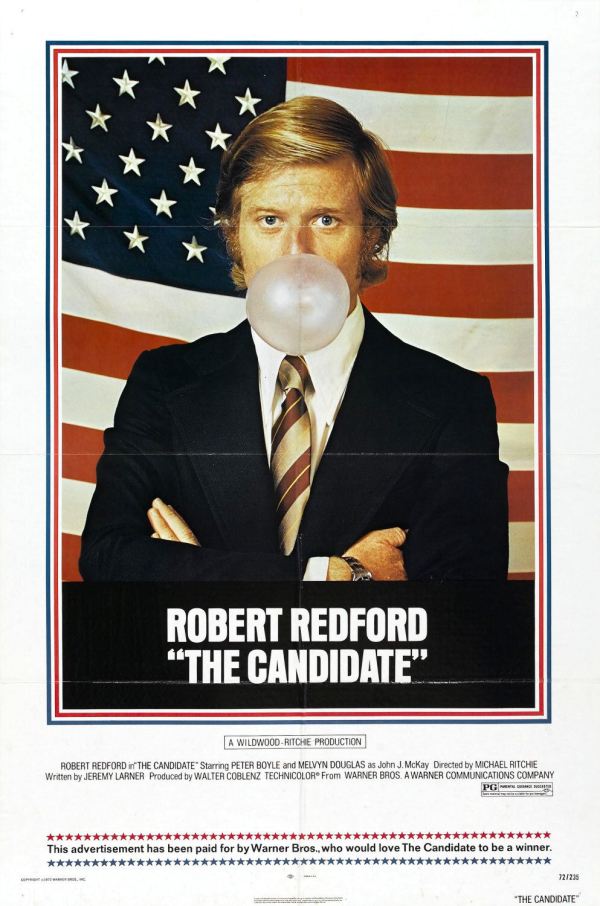
The Candidate (1972)

By Richard Winters

My Rating: 8 out of 10

4-Word Review: Robert Redford for President.

In commemoration of Election Day and the fact that all the campaigning and political punditry will finally be coming to a merciful end we present a rare Tuesday post here at Scopophilia. Although done 40 years ago this wry look at the inner-workings of the political campaign trail is as incisive and timely as ever and hasn’t lost any of its punch. The story deals with Bill McKay (Robert Redford) a young lawyer from California who is persuaded to run for senate against the incumbent Crocker Jarman (Don Porter). McKay represents the youthful idealism while Crocker is very entrenched with the establishment.

The film was directed by Michael Ritchie who may not be a household name, but he is the creator of his own genre. He took the examination of competition and how embedded it is in American culture to new heights. Through his various movies he showed how it infiltrates every aspect of our society and no one is immune to it. From Smile to The Bad News Bears and Downhill Racer he showed how even the most unlikely of individuals can become fiercely competitive when driven. He also made his characters strangely endearing no matter how sordid or ugly the competition made them become.

This film works along those same lines only it shows it from a political perspective. It is smart, fast, cynical, funny, dramatic, revealing, and entertaining all at the same time. This should rank as one of the best movies made about political campaigning. It’s still timely and cutting edge and works almost like a documentary. The quick editing creates a seamless style. The film makes interesting observations without taking away from the flow of the story. In fact one of the reasons it is so captivating is because it is downright educational. When the film is over you feel much wiser to the business of politics and as exhausted as the candidate himself.

Redford is terrific. He has a real gift for underplaying everything to the point that it looks like he isn’t even acting at all. He plays off his pretty boy looks, but doesn’t stay trapped to a heroic image. He harbors a lot of idealistic traits one would want in a candidate and yet he is still quite human. There are some definite shades of John F. Kennedy here. He has a troubled marriage and is even caught fooling around with an admiring female supporter. Although he has honorable ideas he is far from having all the answers. Probably the most interesting insight of this movie is the fact that he ends up getting as sucked into the mechanics and compromises of the political machine as his ‘old school’ foe. It perfectly illustrates how immense and encompassing the political machine is and how no one is really going to change it.

This is an excellent and well-crafted picture that not only hits the bulls- eye, but does it many times over. I love Redford’s final line and Boyle, as his campaign manager, has never been better.

My Rating: 8 out of 10

Released: June 29, 1972

Runtime: 1Hour 50Minutes

Rated PG

Director: Michael Ritchie

Studio: Warner Brothers

Available: VHS, DVD, Amazon Instant Video