Tag Archives: Martin Balsam

Psycho (1960)

psycho

By Richard Winters

My Rating: 9 out of 10

4-Word Review: Don’t take a shower.

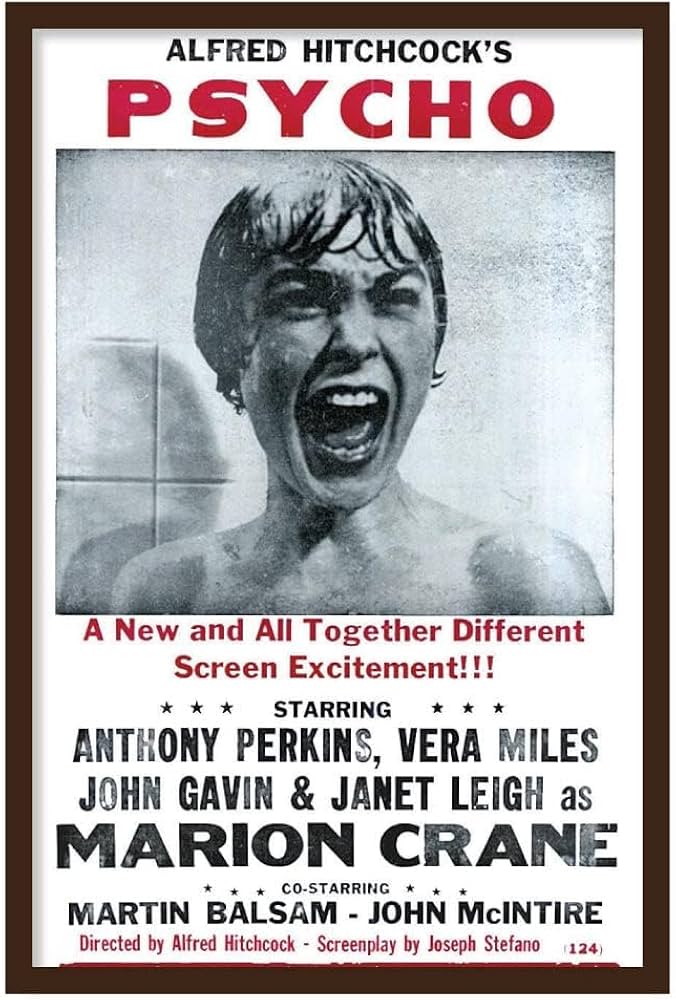
Marion Crane (Janet Leigh), who works as a secretary at a real estate firm, steals $40,000 in cash from her boss (Vaughn Taylor), who trusted her to take the money to the bank, in order to help her boyfriend Sam (John Gavin) pay off his debts. As she’s traveling to where he lives she encounters a rainstorm causing her to take the nearest exit. There she drives into the lot of a isolated lodge called Bates Motel, run by a young man named Norman (Anthony Perkins) who’s still living with his mother in an old rundown house that sits ominously on a hill behind the hotel rooms.  Norman becomes immediately smitten to the woman, who signs the hotel ledger under an assumed name, and invites her to have dinner with him in the hotel office. Marion, who sees him as a awkward, but otherwise harmless guy who’s still dominated by his mother, agrees. After they eat she departs back to her room and takes a shower when what appears to be his mother, who considers all women to be ‘whores’, stabs and kills her. Norman then cleans-up the evidence by submerging the dead body and her car in a nearby swamp. Soon a private detective named Arbogast (Martin Balsam) begins investigating the case and what he finds out leads Marion’s boyfriend Sam and her sister Lila (Vera Miles) to the property where they’ll unravel a shocking secret.

The film, which at the time was considered ‘too tawdry and salacious’ to be made into a movie and thus the studio refused to give director Alfred Hitchcock the required funding and forcing him to use his own funds and crew to produce it, was based on the novel of the same name by Robert Bloch. Bloch began writing it in 1957 when coincidentally in the neighboring town not more than 35 miles from his came to the light the criminal activities of Ed Gein who killed two people while also digging up dead bodies and then skinning them in an effort to create a ‘woman suit’ he could wear so he’d ‘become his dead mother’ who had dominated him for the majority of his life. Rumors were that Gein’s crimes had inspired the book, but Bloch insisted that he had almost finished with the manuscript before he became aware of the real-life case and then became shocked with how closely it resided with his story.

While the film follows the book pretty closely there are a few differences. In the book the Marion character dies from decapitation while in the movie it’s from stab wounds. The Norman character is described as an overweight man in his 40’s while in the movie he’s thin and in his 20’s, which I felt was an improvement as it made more sense why Marion would feel less guarded around him and put herself in a more vulnerable position than she might otherwise as she still viewed him as a ‘wet-behind-the-ears’ kid. It also helps explain why Norman blunders his interview with the detective and virtually incriminates himself because he was too sheltered and not worldly-wise enough to handle pressure situations.

The film is full of a lot of firsts. It was the first to show a toilet or use the word transvestite, but what I really liked though is that it takes a different spin on the character of the victim. Typically, even today, victims are portrayed as being virginal and angelic beings particularly women, but here it works against that. Right away with the opening scene in the hotel room we see she’s definitely no virgin and what’s more she’s having sex outside of wedlock in an era where ‘good girls saved themselves for marriage’. Having her then be susceptible to corruption by stealing from her employer, or not feel frightened initially by Norman and even superior to him further works against the grain of the ‘sweet, fragile damsel in distress’ cliche and makes her seem more human since she’s not perfect and vulnerable to the same vices as everyone else, which in-turn gives the more an added darker dimension.

The film’s hallmark though is its memorable camera work from a close-up of the victim’s unblinking eye, still not sure how Leigh could’ve kept her eyes open for as long as she does, to the interesting way the house gets captured from the ground looking upward on a hill towards the sky with the creepy night clouds floating behind it.  My favorite one though is the tracking shot showing Norman walking into his mother’s room and then having the camera stop right at the top of the door frame and then spin around towards the hallway as he then leaves the room and carries his mother down the stairs. The only shot that I didn’t care for is when the Martin Balsam character gets stabbed at the top of the stairs, but instead of immediately falling over backwards and then rolling down the stairs, which is what would happen 99% of the time, he instead somehow ‘glides’ down an entire flight of stairs backwards while remaining upright and only finally falling to the floor once he hits the bottom, which goes against the basic laws of physics and to me looks fake and goofy, but other than that it’s a classic and still holds-up amongst the best horror movies made.

My Rating: 9 out of 10

Released: June 16, 1960

Runtime: 1 Hour 49 Minutes

Director: Alfred Hitchcock

Studio: Paramount

Available: DVD, Blu-ray, Amazon Video, YouTube
Catch-22 (1970)

catch 22 2

By Richard Winters

My Rating: 8 out of 10

4-Word Review: The insanities of war.

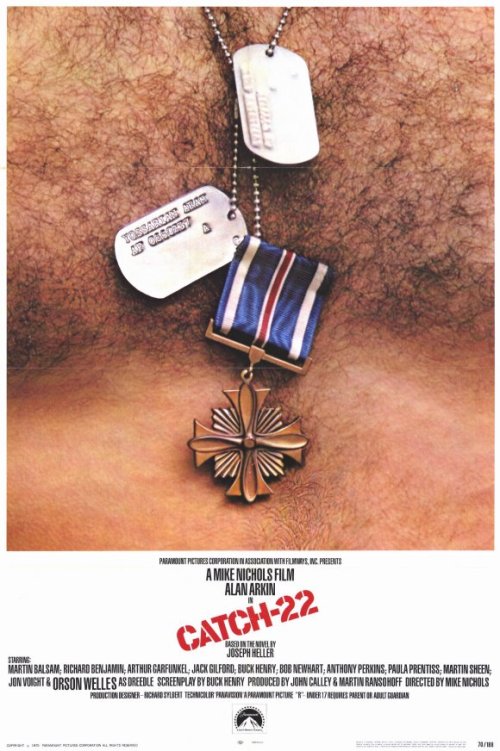
Having to fly numerous combat air missions has sent Word War II fighter pilot John Yossarian (Alan Arkin) to the brink of insanity. He goes to his unit’s psychiatrist Dr. Daneeka (Jack Gilford) asking him if he can be sent home. The doctor admits that anyone who feels that they are going crazy shouldn’t be flying, but there’s a problem known as ‘Catch-22’, which states that anyone who no longer wants to fly combat missions isn’t crazy but normal and therefore John’s request is denied and he is forced to remain while observing how utterly ridiculous everyone else is, particularly his military superiors, even though they’re considered to be the ‘normal’ ones.

The film is based on the best-selling novel by Joseph Heller, who started writing his novel in 1953 and would only spend 1-hour each day working on it until finally completing it 8 years later. The story is very loosely based on some of his experiences and emotions that he had as a fighter pilot during the war and it’s always nice watching something that was done, no matter how satirical, from an insider’s perspective and his numerous potshots at the nonsense that makes up the military hierarchy could easily be parlayed to anyone who has had to deal with bureaucracy at any level.

Certain changes were made in the novel’s transition to the big-screen, but overall screenwriter Buck Henry does well in bringing the fragmented narrative vibe of the book to the film. I was really impressed with the aerial sequences, which used the B-25 Mitchell and took 6 months to film. The cinematic style was years-ahead-of-its-time as well including having things occur in the background of a scene that has no connection to what the characters in front of the camera are discussing and at times even oblivious to.

The film features many laugh-out-loud segments with my favorite being the part where Yossarian attends a military award ceremony and accepts his medal while being, to the shock of the military brass that is handed out the medal, stark naked. Anthony Perkins, who plays the hopeless chaplain, is also quite funny in a rare, but interesting turn in a comedic role.

One of the things that I didn’t like about the film, although it didn’t bother me quite as much as it did when I first saw the movie many years ago, is the way the tone shifts from being quirky and hilarious at the beginning to somber and serious towards the end. I realize that the novel works in the same way, but the first half of the film successfully balanced the line of exposing the absurdities of war in a comedic vein while still showing the serious consequences without ever getting overwrought, so it’s a shame that the second half couldn’t have worked the same way instead of leaving the viewer with a gloomy, depressed feeling when it’s over and almost forgetting completely about the comedy that came before it. I also believe this is why this film failed at the box office while the similar M*A*S*H succeeded simply because that movie remained funny all the way through.

Arkin, in the lead, is miscast and seems too old for the part. His nervous, hyper persona doesn’t work and would’ve been more effective had it been toned down by being played by a younger actor who was more emotionally detached. The rest of the supporting cast though is great including Martin Balsam who makes cinematic history by being the first actor to ever appear sitting on a toilet in a movie.

My Rating: 8 out of 10

Released: June 24, 1970

Runtime: 2Hour 2Minutes

Rated R

Director: Mike Nichols

Studio: Paramount

Available: DVD, Amazon Instant Video, YouTube

Silver Bears (1978)

By Richard Winters

My Rating: 6 out of 10

4-Word Review: Investing in Silver Mine.

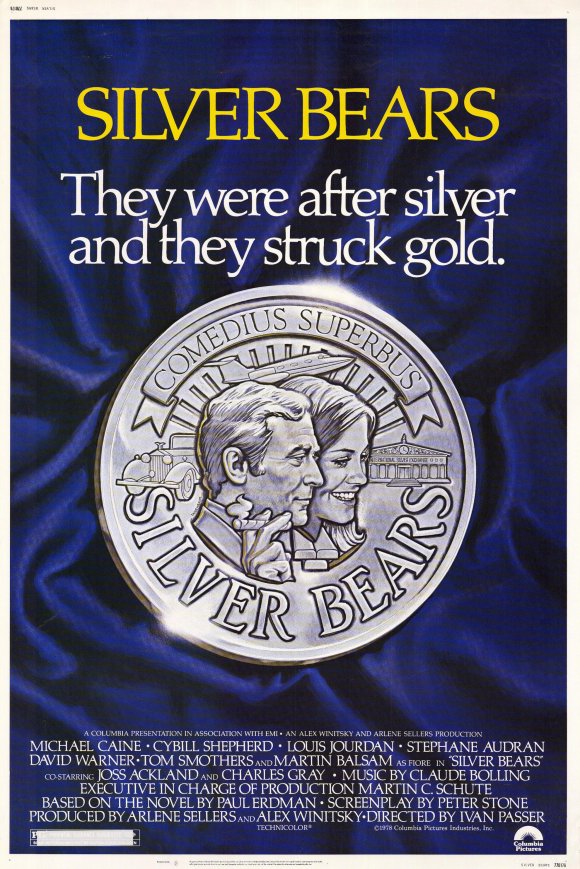
This is an engaging, lighthearted look at the complex inner-workings of financial institutions and markets and how a group of con-men try to exploit it. The plot is elaborate and although it is easy to follow as you are watching it, as long as you are paying close attention, it is hard and even convoluted to explain, but I will try my best.

The basic premise works like this: Doc Fletcher (Michael Caine) is hired by underground kingpin Joe Fiore (Martin Balsam) to open a phony bank which they can use as a front for their laundered money. When they get there they find that the building is some rundown offices on top of a restaurant. Prince di Siracusa (Louis Jourdan) then tells them of a silver mine in Iran that is run by his distant cousins Agha (David Warner) and Shireen (Stephanie Audran).  Doc decides the bank can invest in the mine and use the money to create a better building premises as well as attracting rich investors. The silver in the mine begins to flood the market causing a drop in value at the London Stock Exchange and forces Charles Cook (Charles Gray) to decide to buy out the bank that is funding the mine in order to then close the mine. To do this he contacts the President of the First National Bank of California (Joss Ackland) who is looking to expand his business in Europe. The bank president sends Donald Luckman (Tom Smothers) out to negotiate a sale of the bank with Doc, but without telling Doc the true reason why. This makes Doc suspicious and to find out their true motives he decides to seduce Donald’s beautiful and free-spirited wife Debbie (Cybil Shepard). Once she divulges their secret things really get going in a high-spirited fashion.

The catalyst of the comedy comes through the many different ‘negotiating’ sessions that take place throughout the film all of which prove to be quite amusing. The first is when Doc negotiates with Agha about a suitable deposit Agha must give to the bank in order to obtain a bank loan even though the bank has no money to give. The second is when Donald tries to bargain with Doc on a selling price for the bank and the third is when Doc tries to intimidate Crime boss Joe into not accepting Donald’s offer. The final one at the end is where all the characters chase Charles around his mansion in order to get settlements to their deals, which have by then soured.

The characters are charming and delightful. Caine is superb as always playing a man who would like to be a lot more ruthless and intimidating if he weren’t surrounded by a bunch of incompetents. Jourdan is suave as the Prince and the two leads share very contrasting personalities and styles, which makes their conversations and budding friendship interesting.

This movie is also a great chance to see Jay Leno in a rare acting role. I’d say being a talk show host is more his repartee, but he is energetic enough here to remain amiable and seeing him with a big mop of curly black hair is almost worth the price itself. Shepard is fantastic and the one thing that gives the film some zest. She is best known for her bitchy roles of which she is very good, but her she plays a fun-loving hippie type and is hilarious. Although this movie is a bit hard to find fans of Shepard should really seek this out as they won’t be disappointed.

Smothers is okay as the meticulous accountant who thinks he has all the bases covered until he gets an unsettling surprise at the end. Usually he is stuck playing characters on the dim-witted side, so it was nice to see him in something that was a slight change of pace. Although Balsam’s screen time is brief I still got a kick out of the way he would look at pictures showing the bloody corpses of the victims he had ordered killed while he ate his breakfast.

The film was shot on-location in such places as Switzerland and Morocco and although it does show some of the exotic topography of the regions it wasn’t enough and I wanted to see more. The musical score is terrible and resembles a show tune from the big band era that does not fit with the mood, or action of the story. I also didn’t find it enticing to have the film begin by focusing the camera onto the naked rears of a bunch of fat, middle-aged men as they get into a hot tub.

For those looking for a diverting, original comedy that emphasizes the subtle and dryly humorous exchanges between business partners then this little known gem should hit the spot.

My Rating: 6 out of 10

Released: April 21, 1978

Runtime: 1Hour 53Minutes

Rated PG

Director: Ivan Passer

Studio: Columbia Pictures

Available: VHS