Tag Archives: Margot Kidder

Superman IV: The Quest for Peace (1987)

By Richard Winters

My Rating: 3 out of 10

4-Word Review: Fighting for nuclear disarmament.

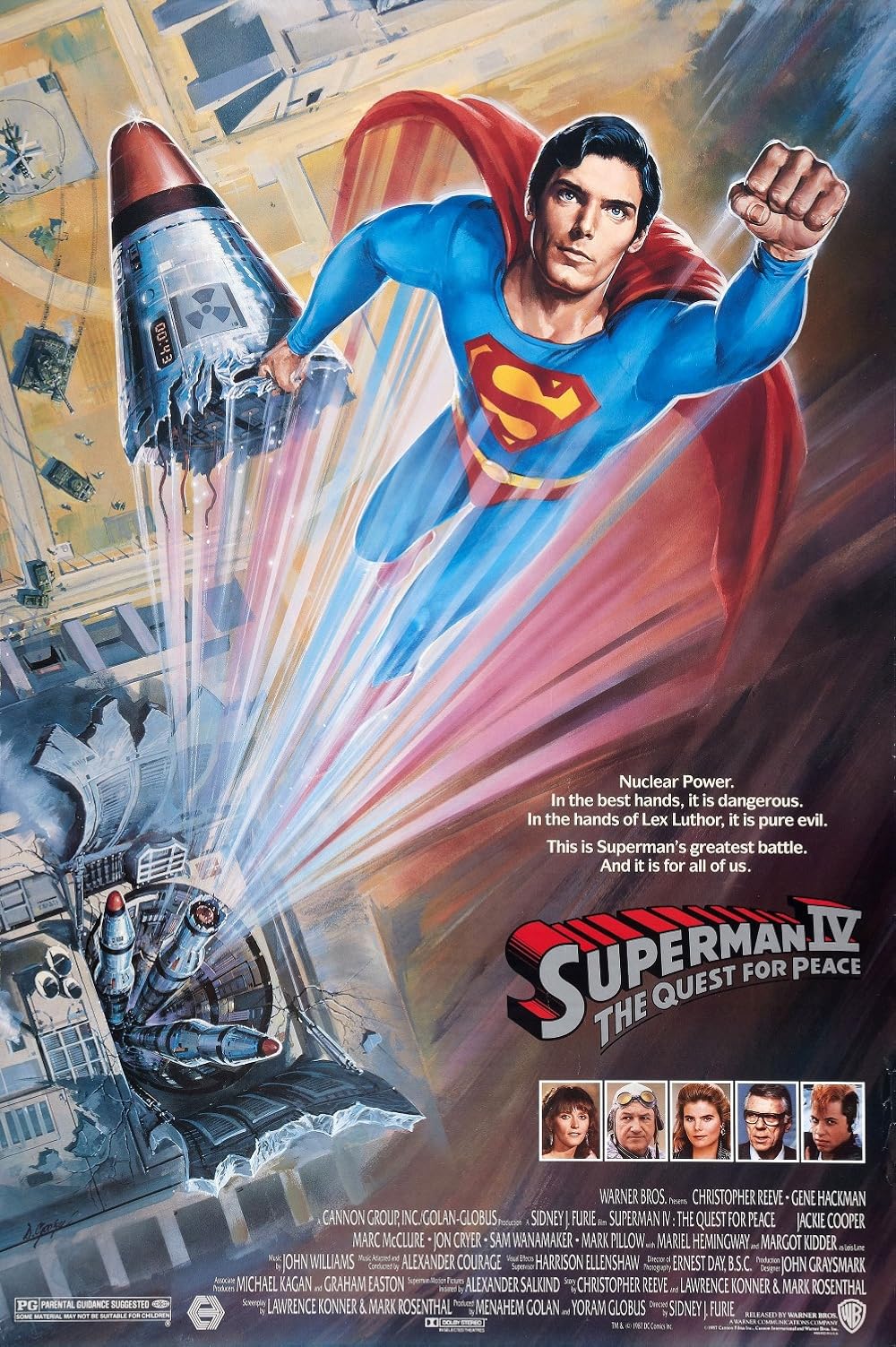
Lex Luthor (Gene Hackman) escapes from prison with the help of his nephew Lenny (Jon Cryer). He is then able to create a powerful villain named Nuclear Man (Mark Pillow) by stealing a strand of Superman’s hair from a museum and using its code to create a genetic matrix. Nuclear Man has many of the same powers as Superman, but, unbeknownst to Superman, he’s only powerful when he’s in sunlight and without that he becomes weakened. Meanwhile Clark Kent is having battles of his own when the newspaper he’s working for, The Daily Planet, gets taken over by a rich tycoon named David Warfield (Sam Wanamaker) who degrades the paper’s integrity by insisting only stories with a salacious bent get printed. David’s daughter Lacy (Mariel Hemingway) takes a liking to Clark and the two soon become an item.

The fourth installment was the first not to be produced by the Salkinds who decided to give up on the franchise after the box office flop of Supergirl and sold the rights to the Cannon Group who were suffering financial strain, which caused the budget for this one to be cut from $36 million down to $17 million. Many have complained that the result of this compromised the special effects though I didn’t find the drop-off to be quite a bad as I feared. The biggest drawback are the flying scenes where it clearly looks like Superman is matted in front of a greenscreen and isn’t nearly as slick looking as the first two. The opening bit though that takes place on a Russian space station I thought was alright, but I did wonder how Superman was able to know that the cosmonauts were in trouble, as he appears to the rescue out of nowhere, and what would tip him off that they were in danger?

The dumbest addition is the Nuclear Man. In the 45-minute deleted footage there were actually two with the first one being portrayed by Clive Mantle and resembling the comic book villain Bizarro. This one gets defeated by the Man of Steel prompting Lex to create a another one. The second creation is the only one shown in the studio cut version and this one looks like a male model wearing a tacky get-up stolen from Clash of the Titans. He speaks with Lex’s voice and I’m not sure why it was done this way outside of actor Mark Pillow, who plays the second incarnation, not having any acting experience, so they had his lines dubbed by Hackman, but the explanation that he has Luthor’s voice because Luthor made him doesn’t make sense. Why just stop at the voice? If he’s going to replicate his creator then he should have the same eyes, ears, and body as Luthor as well.

I was happy that Margot Kidder gets more screentime as in Part III she was relegated to being not much more than a cameo appearance. However, having her Lois Lane character constantly getting into extreme danger, this time on a subway train where the driver passes out, causing the car she’s riding in to accelerate to dangerous speeds, starts to get a bit overbaked. How many times statistically can one person accidentally walk into a life-threatening situation? Once sure, could happen to anyone, but even just twice would be a stretch. However, this lady inadvertently falls into a scary mess seemingly every other day making her more like a walking-talking bad luck charm that everyone else should stay away from for their own protection.

The scenes that she shares with Superman are stupid as he takes her on a flight with him into the night sky, but this was already done in Part I, so why redo it? Then when they land back at her apartment after revealing to her that Clark is really Superman, he does something that makes her forget that, but why even bother to let her know about his secret identity if he’s just going to make her lose her memory of it right after?

Initially I liked the addition of Hemingway as the new love interest as I thought the bratty persona of her character would lend some spice. Unfortunately, she loses her entitled attitude right away becoming benign and boring like everything else. The scene featuring her getting kidnapped by Nuclear Man, who takes her into space with him, is ridiculous because she’d never be able to survive outside of the earth’s atmosphere as there would be no oxygen, which along with the frozen temperature, would’ve had her dead instantly.

I really liked Hackman recreating his role as Luthor, who adds a much-needed campy charm. Cryer isn’t bad either as his young henchman and he does have the film’s one and only funny line. The story isn’t as political and preachy as I thought it was going to be either, which is good, but everything else falls flat. The initial runtime was supposed to be over 2-hours, but I was thankful it got cut down to a mere 90-minutes and even then, it was a drag to sit though. The franchise came to a merciful end after this, and I feel it was for the best.

My Rating: 3 out of 10

Released: July 24, 1987

Runtime: 1 Hour 30 Minutes

Rated PG

Director: Sidney J. Furie

Studio: The Cannon Group

Available: DVD, Blu-ray, Amazon Video, YouTube
Superman III (1983)

By Richard Winters

My Rating: 2 out of 10

4-Word Review: Computer whiz corrupts Superman.

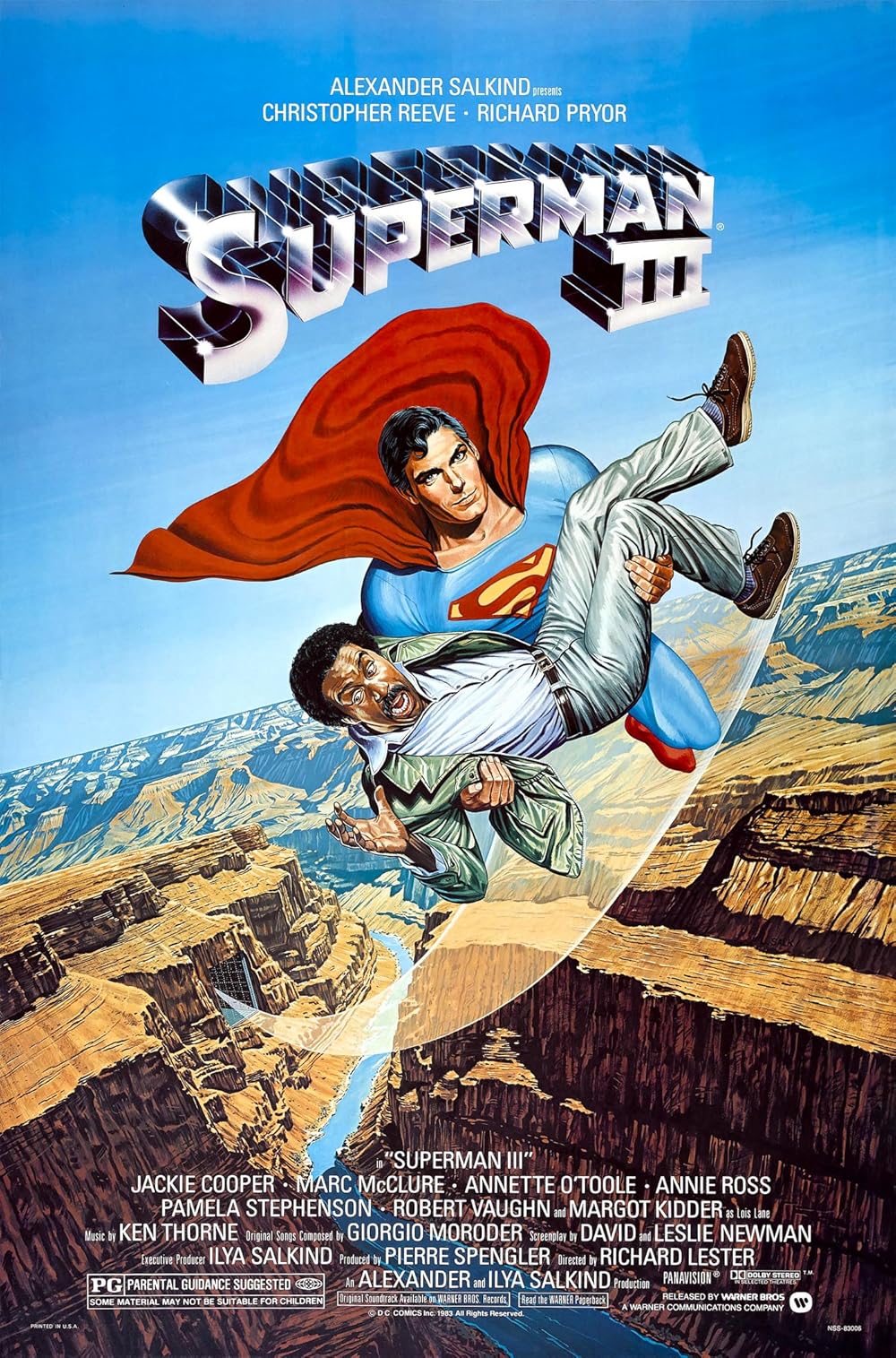
August ‘Gus’ Gorman (Richard Pryor) is an unemployed man looking for a job and comes upon the idea of training to become a computer tech when he sees it advertised on the back of a book of matches. Much to his surprise he excels as a student and is soon able to use his newfound computer knowledge to hack other programs including the payroll department at his company where he’s able to give himself a large, unearned monetary bonus. Ross Webster (Robert Vaughan), the company’s CEO, becomes aware of what Gus is doing, but is so impressed by his computer skills that instead of firing him he hires him to hack a weather satellite that will cause a rain storm in Columbia that will destroy the coffee crops and allow Webster to corner the market, but Superman intervenes and tempers the storm, so it isn’t as bad. This causes Webster to realize how detrimental to his plans Superman is and orders Gus to come create some synthesized Kryptonite in order to impair Superman’s ability. Gus researches the elements that make up Kryptonite on his computer and finds all of them except for one, so he arbitrarely adds tobacco in it for good measure. Instead of weakening Superman it turns him into an uncaring, sinister person who ‘drops-out’ of the hero saving lifestyle and becomes an anti-social person who shows no concern for others.

When Richard Donner, who had directed the first installment and 75% percent of the second one, got fired, he was replaced with Richard Lester. Lester had a far different vision for the Superman films. He disliked what he considered the ‘dark tone’ that Donner had given the first two and wanted a humorous quality put in. While I don’t mind some campiness Lester clearly goes overboard including the segment done over the opening credits that features unending slapstick that makes a mockery of the Superman franchise and drives the whole thing down to such a silly level that I wouldn’t have blamed anyone if they had walked out of the theater and demanded their money back.

Pryor was a big fan of the first two Superman movies and said as much when he was a guest on the ‘Tonight Show’. The Salkinds, who had proved already to have an unhealthy proclivity to the so-called ‘star power’ by casting Marlon Brando in the first film and paying him an outrageous sum even though his acting was subpar and a lessen known actor could’ve done a better job at half the price. No one ever came to a Superman movie simply to see Brando nor any other big-name actor, but for whatever reason the Salkinds didn’t understand this, so when they heard Pryor was interested in being in one of their films and he was a trop draw at the box office at the time, they admittedly signed him up.

Pryor, for his part, is highly engaging, but his schtick is out of place here. The script centers too much on his character making Superman seem like he’s only a co-star in his own movie. The character he plays makes no sense either as he’s portrayed initially as being a dumb guy who can’t hold down any job and then suddenly becomes a super genius with computers. However, there needed to be something shown in his background that would connect this, like he was really good with math, or coding, but instead it’s never explained. The movie makes it seem like it’s ‘dumb luck’ that he’s such a programming whiz and even he himself doesn’t understand it, which is just plain ridiculous especially as he continues to become more and more sophisticated with it.

While I liked the gaudy set design of Webster’s penthouse, and his rooftop ski slope, as a villain he’s a complete bore and seems too similar to Lex Luthor and his ditzy lady friend Lorelei, played by Pamela Stephenson, coming-off as being simply a younger version of Luthor’s main squeeze Miss Tessmacher. Webster’s evil sister Vera, played by Annie Ross, is equally dull and I have no idea why she was even put into the story as she adds little and doesn’t play-up her domineering persona enough to be even remotely interesting or amusing. Her character shows the same flaw as Pryor’s where she becomes really good at running a complex computer system too easily and too quickly.

The Lois Lane character gets minimized to the extreme where we see her briefly at the start and then quickly at the end. Supposedly this was due to a falling out that Margot Kidder had with the producers, but the Salkinds insisted it was more because they wanted to explore Superman’s romance with someone else, but Lois and Clark Kent’s relationship had gotten quite intense during Part II, so there needed to be some explanation with why now they were in the ‘friend zone’ like maybe perhaps she had found another boyfriend. The film though never bothers to come-up with any answer making it feel like there was no story cohesion between this one and the other two. Annette O’Toole, who plays the new love interest Lana Lang, is benign and the romantic chemistry between her and Kent is nil. 

David and Leslie Newman’s script lacks understanding in regard to technology and extreme naivety with the way Pryor’s character is able to use his computer to hack into other programs. Viewers today, who are much more sophisticated about the topic, will find the stuff here to be quite antiquated. The way the giant supercomputer gets completed is absurd too as it’s never shown who builds it. Was it done by just the four villains single-handedly, or by a large crew? Even if a crew did do it, it would take months if not years to construct and yet here it’s done in seemingly a day, or two. When Gus and Webster create an economic crisis by redirecting oil tankers you’d think the U.S. government would certainly get involved and investigate and would have computer experts on hand to trace back how and where the hacking occurred and at some point the two would eventually, at the very least, come under suspicion and yet here that never happens, nor even gets touched upon.

Spoiler Alert!

Some have complimented Reeve’s performance as the evil Superman, which is good, but the giant showdown that he and Clark Kent have in which they use they’re individual superpowers to try and take the other down, is too reminiscent between Zod’s gang and Superman from part II and thus comes off as redundant instead of exciting. 

I didn’t agree with Pryor’s character getting off-the-hook at the end either. Yes, he did ultimately save Superman’s life, but he also stole money and got involved in nefarious projects that broke many laws, so instead of being transported to a new location where he could get another job and ‘start fresh’ he should’ve been taken to a prison to serve his debt to society. Even if he was at heart ‘a nice guy’ he still did some wrong things and should’ve had to pay some sort of consequence. 

My Rating: 2 out of 10

Released: June 17, 1983

Runtime: 2 Hours 5 Minutes

Rated PG

Director: Richard Lester

Studio: Warner Brothers

Available: DVD, Blu-ray, Amazon Video, YouTube
Superman II (1980)

By Richard Winters

My Rating: 8 out of 10

4-Word Review: Superman loses his powers.

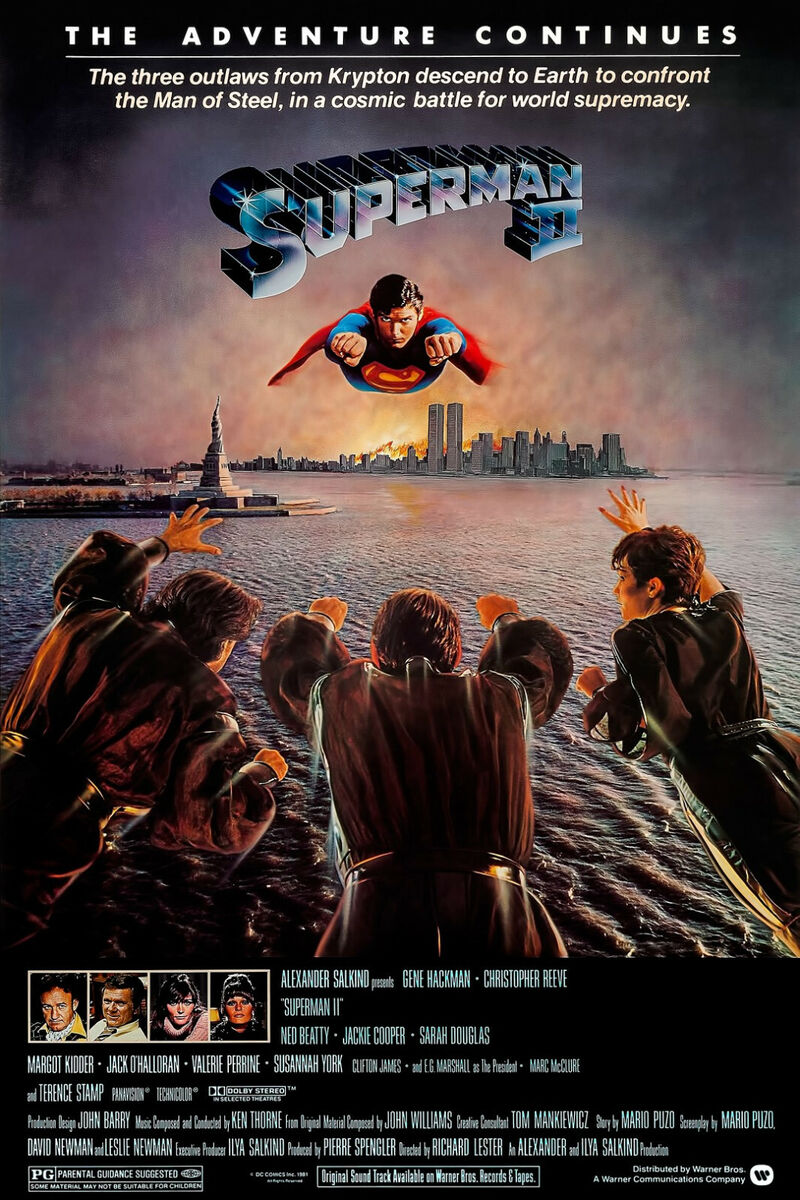
Superman (Christopher Reeve) flies to Paris in an attempt to save Lois Lane (Margot Kidder) who was assigned to go there to cover terrorists who’ve taken over the Eiffel Tower and threatening to detonate a hydrogen bomb unless their demands are met. Superman manages to take control of the bomb and lift it into outerspace where it goes off, but unbeknownst to him the explosion also releases Zod (Terrence Stamp), Ursa (Sarah Douglas) and Non (Jack O’Halloran) from their imprisonment inside the phantom zone. The three now fly towards earth planning to take it over with the superpowers they’ve been given from the sunlight. Meanwhile Clark falls in love with Lois and admits to her that he’s Superman. He takes her to the artic to see his Fortress of Solitude and it’s there that he listens to a past recording of his mother Lara (Susannah York) advising him that if he wishes to marry Lois that he will then have to enter a crystal chamber where he’ll then lose his powers, which he does. Now that Zod and his evil associates have taken over the country by invading the White House he becomes powerless to do anything about it as he desperately searches for a way to regain what he gave up.

The production had many behind-the-scenes upheaval including run-ins between director Richard Donner and the producers who insisted that he was going over budget. Initially it was deemed necessary to film both the first segment and the sequel at the same time, but due to money concerns they stopped filming part 2 with 75% of it already completed in order to finish the first part and get it out to theaters. During the pause the producers then fired Donner and replaced him with Richard Lester. Lester was known more for his zany comedies and had a different directorial style than Donner. His approach was to insert campiness into the story and move it away from the dark elements. This caused several scenes to be refilmed some of which without the original cast including Hackman who refused to come back to do reshoots causing a few of his scenes to be dubbed while Brando had sued the producers for his share of the gross profits causing all of his scenes to be taken out completely and replaced mostly with York who ended up speaking the lines that he would’ve and for the most part does a far better job of it.

While the Donner version was released onto DVD in 2006 and is a bit different this review will stick with the one that was shown in the theaters and I felt is quite well done. Unlike with part 1 this one gets right to the action without the stagy back story from the first, which I found boring. The showdown between Superman and the evil three done on the streets of Metropolis as well as the massive destruction that the villains cause the small redneck town of East Houston are very exciting with great special effects that should please anyone. The comedy bits that Lester inserted I didn’t feel went that over-the-top and in some ways were helpful as it released some of the tension as these were some really nasty bad guys, who caused massive destruction, so inserting a campy chuckle here and there I didn’t feel was that out of order.

The script doesn’t have as many plot holes like in the first one. The only major issue to quibble about is when Superman goes into the chamber that sucks away his powers. Why though is it necessary that he should have to give up his powers just because he wants to get married is a whole different discussion that’s worth questioning, but I get that there needed to be a dramatic conflict, so we’ll roll with it. However, it’s never explained how Clark and Lois get themselves out of the artic and back to civilization as they ‘flew’ into the Fortress using his flight powers, but once he was made mortal, they couldn’t rely on that on the way out and without any other mode of transportation I wasn’t sure how they were able to travel and nothing gets shown, but should’ve.

Spoiler Alert!

His long trek back to the Fortress in an attempt to retrieve the powers is equally problematic as he is shown doing it completely on foot, which could take many weeks, or longer to do. He’s also shown wearing nothing more than a light jacket while he does it without any head covering, which now that he’s human, wouldn’t be enough to shield him from the brutal elements and frigid cold and he most likely would’ve died before he got there from either frost bite, or pneumonia. How he’s able to get the powers back aren’t sufficiently explained either. Supposedly it’s because of a green crystal that Lois dropped and is still there when he returns, but if the control module was already destroyed then how would this get it to work again?

End of Spoiler Alert!

The acting is again what really makes it fun. Hackman is once more excellent as Luthor as here he plays it both ways as the ‘middleman’ between Zod and Superman where one minute he’s arrogant and confident and then the next he’s nervous and pleading. It’s a shame though that Perrine and Beatty, his cohorts in crime, aren’t in it as much as I felt the three together had a great chemistry. Gotta love Kidder as a brash Lois who manually squeezes oranges for Vitamin C as she’s become a self-described ‘health nut’ all the while a cigarette dangles from her mouth. Stamp is really good too as the main villain and his intense performance is what keeps the tension going, which again is why the comedy bits aren’t a problem here, though in Part III this does become a major issue, which will be discussed in the next review.

My Rating: 8 out of 10

Released: December 4, 1980

Runtime: 2 Hour 7 Minutes

Rated PG

Directors: Richard Donner, Richard Lester

Studio: Warner Brothers

Available: DVD, Blu-ray, Amazon Video, YouTube
Sisters (1972)

sisters

By Richard Winters

My Rating: 7 out of 10

4-Word Review: Model has evil twin.

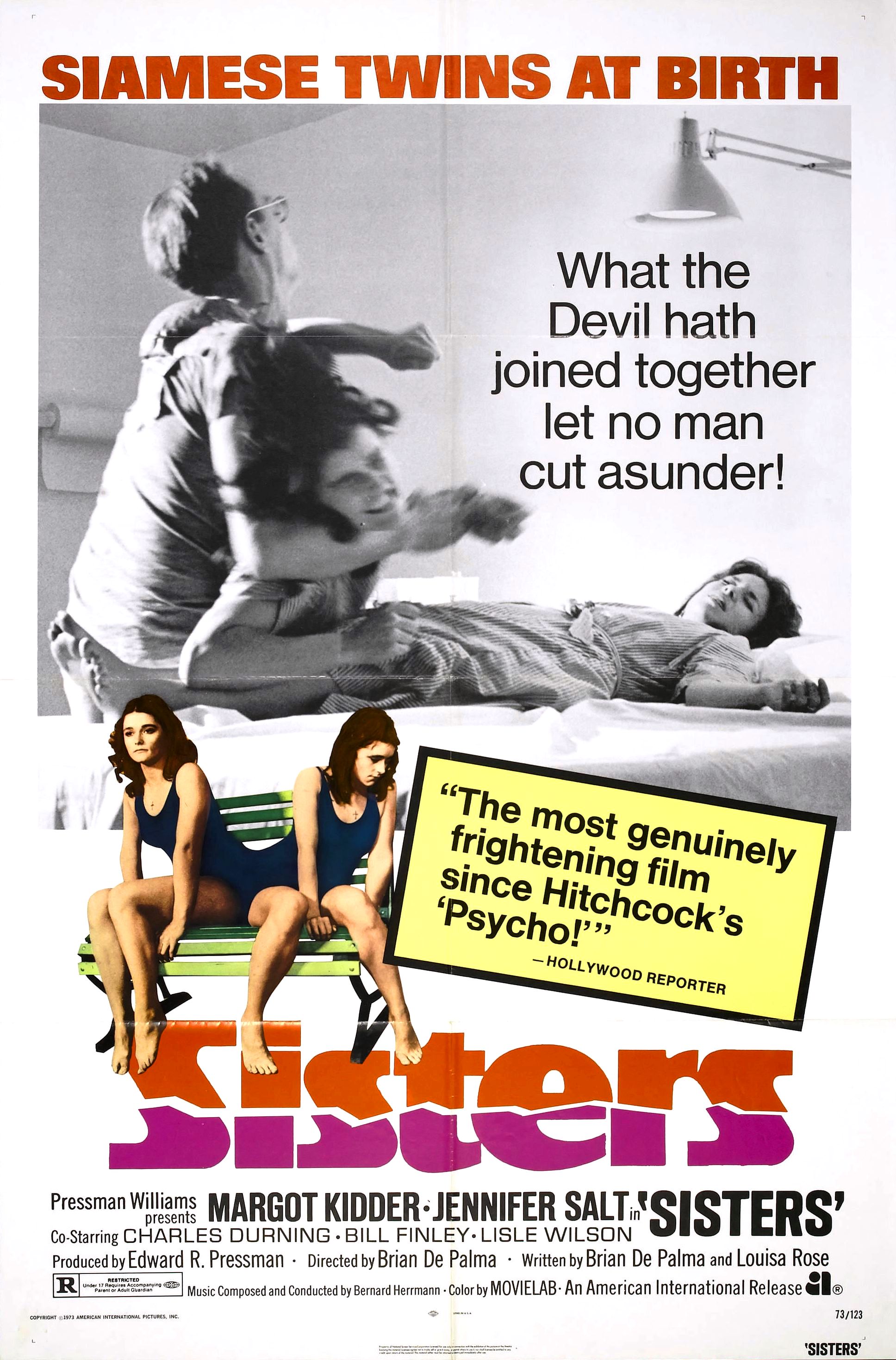
Danielle (Margot Kidder) is a young French-Canadian women from Quebec who aspires to be a fashion model and actress. She takes part in a TV-show styled after ‘Candid Camera’ where unsuspecting people find themselves caught up in a prank, which is where she meets Phillip (Lisle Wilson). The two go out on a date, but while at the restaurant she gets harassed by Emil (William Finley) her ex-husband. Then when they get back to her apartment Phillip overhears her arguing with another woman, which Danielle says is her twin sister Dominque. Since it is both of their birthdays Phillip decides to go out to get them a cake, but when he returns he gets viciously stabbed by the psychotic Dominque, but just before he dies he’s able to scribble the word ‘help’ onto the window with his own blood that Grace (Jennifer Salt), a journalist that resides across the street, sees. She immediately calls the police, but when they arrive into Danielle’s apartment there’s no sign of a body, or a struggle and Grace gets written-off as being a kook whose been imagining things, but she refuses to relent and begins her own investigation where she uncovers some dark details about Danielle and her sister who were once conjoined.

This was writer/director Brian De Palma’s first attempt at horror after completing many successful comedies that had gained a cult following. The story was inspired by real-life conjoined twins Masha and Dasha Krivoshlyapova who’s sad upbringing where they were taken away from their mother and had abusive medical experiments done on them at a secret hospital in the Soviet Union, and which was chronicled, much like in the movie, in a story in Life Magazine in 1966, which after reading it De Palma couldn’t get out of his head. Visually it’s excellent with great use of editing and superior score by the legendary Bernard Herrmann, who was semi-retired at the time, but enjoyed the script so much that he agreed to be the composer.

Many of De Palma’s famous directorial touches are apparent including his use of the split-screen. While it’s been used, and some may say overused, in many films from that era, it gets worked to perfection as we get to see Danielle and her ex busily cleaning-up the crime scene while Grace gets held up by the detectives and they’re not able to go into the apartment right away. My only complaint here is that with the blood splatter all over I’m just not sure they would’ve been able to wipe it all away in such a short time frame, basically about 8 to 10 minutes, which should’ve more likely taken them several hours. Not showing the clean-up and having Grace and detectives arrive to find the place spotless with no body would’ve actually added more intrigue and thus in this case the use of the split-screen, while done adequately, I don’t think was needed.

Spoiler Alert!

The script leaves open a fair amount of loopholes, for instance we see Danielle walk into a bedroom and the shadow of her head on the wall along with another one, which is supposed to represent Dominque’s, but we learn later that Dominque died years early during the surgery to separate them, so we’ve should’ve only seen one head shadow and not two. Also, Danielle is told point-blank by Grace that she’s been spying on them from across the street, so you’d think later that she and Emil would make damn sure to close the blinds on their windows when they try to remove the sofa, which has the dead body inside, but instead they continue to leave the shades wide open and allow Grace, now back in her own apartment, to continue to peer in while the couple show no awareness to the possibility and don’t even bother to look out the window to see if they can catch Grace looking in. Another head-scratcher is why there was no blood splatter on Danielle’s clothing, since she ultimately is the one that killed Phillip, when Emil walks into the apartment.

The most confusing thing though is the ending in which Grace becomes hypnotized while inside a mental hospital and begins to see herself, through a long dream sequence, as being Dominque and attached to Danielle. When I first saw this, back in the 90’s, I thought it meant that Grace was the long lost twin and that they had been separated years earlier. While Grace doesn’t look exactly like Danielle most twins don’t, and she was still around the same age, hair color, and body type, so it seemed like a legitimate explanation and I wouldn’t blame anyone else who came to this same conclusion. Apparently though that’s not the case as Grace comes back out of it only convinced, through the hypnotism, that she didn’t see the murder of Phillip, but I felt they should’ve taken it one step further by convincing her that she was Dominque, whether it was true, or not, and then brain washed to take credit for all the murders while Danielle could then get off scot-free and this would’ve then been the ultimate twist.

Granted Grace’s character is shown as having a mother (Mary Davenport), but the script could’ve been rewritten to have her taken out and Grace could’ve instead been portrayed as being an orphan, or adopted, which could’ve left open the possibility. In either case the dream segment, which is creepy and stylish done, would’ve had more of a payoff then it does had it taken this route.

My Rating: 7 out of 10

Released: November 18, 1972

Runtime: 1 Hour 33 Minutes

Rated R

Director: Brian De Palma

Studio: American International Pictures

Available: DVD, Blu-ray (Criterion Collection), Amazon Video

Quackser Fortune Has a Cousin in the Bronx (1970)

By Richard Winters

My Rating: 7 out of 10

4-Word Review: He learns to adapt.

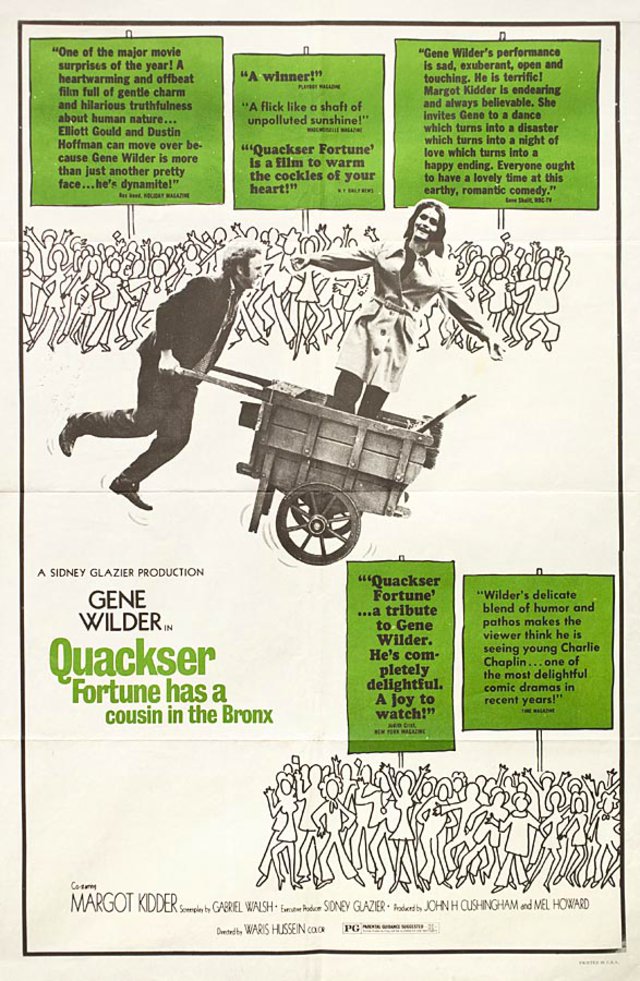
Quackser (Gene Wilder), a nickname given to him as an infant because he would make noises that sounded like a duck, enjoys his life working an alternative job that has him scooping up horse manure from the streets of Dublin, Ireland and then reselling it as fertilizer. His parents (May Ollis, Seamus Forde), of which he still lives with, feels this is not a suitable long term profession as it will never pay enough for him to live on his own, but Quackser refuses to work at the refinery where everyone else in his neighborhood does. He then meets Zazel (Margot Kidder) an American college student who’s studying abroad. He hopes to start up a relationship with her, but finds this to be a challenge when the milk company replaces all of their horse drawn carriages with trucks, which takes all the horses off of the streets. With no horses there’s no manure forcing Quackser to consider other ways to make  an income.

The script, by Gabriel Walsh, has a wonderfully unpretentious quality to it as it tells a story about a simple man living a simple life and on that level it succeeds and even stands out as so many other films seem to feel the need to jazz things up, but this one doesn’t. I particularly liked the on-location shooting done in Dublin that nicely captures Quackser’s humble economic settings and the starkness of his blue collar neighborhood and yet later in the film we see him inside a luxurious hotel, which is also inside the same city. I found this fascinating as it shows how close in physical proximity Quackser is to the more affluent area, but economically, and educational-wise, he was still a long way from ever getting there.

Wilder plays his part quite well if you can get past his thick Irish accent, which is off-putting at first. I liked how he approaches the character as not being this one-dimensional simpleton, but someone who, despite being an overall nice person, can have his angry and even arrogant side to him. Kidder is at her peak of youthful beauty and their quasi-romance allows for an interesting dynamic although I did find it put a strain on the plausibility.

My biggest complaint was that I couldn’t understand why this attractive young woman from a completely different socio-economic background would find this poor, less educated individual so fascinating, or why she’d want to bother to get to know him better. As a quant little friendship it might’ve possibly worked, but as a relationship, even a potential one, it was just too much of a stretch especially with such a drastic 15-year age difference. Sharing a passing kiss during a random moment is as far as this thing would’ve gotten in real-life, but to have her later on go to bed with him, not so much because she loves him, but more as a ‘pity-fuck’ before she leaves, is something that only happens in movieland. It’s also never clear whether she genuinely likes the guy, or has a secret cruel streak and enjoys setting him up for humiliation as there are times when it could easily be seen as going either way.

Spoiler Alert!

The twist ending where Quackser inherits a load of money from his cousin in the Bronx, which he uses to buy a bus in order to be a tour guide when he realizes he can no longer collect manure, doesn’t work. For one thing why did this cousin just out-of-the-blue give the money to Quackser not the other family members as well especially since the two shared no special relationship, or correspondence? Having him go to the Bronx like he was initially going to do and maybe get a job recycling trash would’ve been more of a connection to what he had done in the past. Even having him working in the refinery, which he dreaded, but finding it not as bad as he feared, or that he could do some function there different than the others, which would make him feel ‘special’ would’ve been a better ending, but either way it’s still a cute movie perfect for those looking for a working class ‘kitchen-and-sink’ drama without any of the fashionable dressings.

My Rating: 7 out of 10

Released: July 13, 1970

Runtime: 1 Hour 30 Minutes

Rated PG

Director: Waris Hussein

Studio: Universal Marion Corporation

Available: DVD, Amazon Video

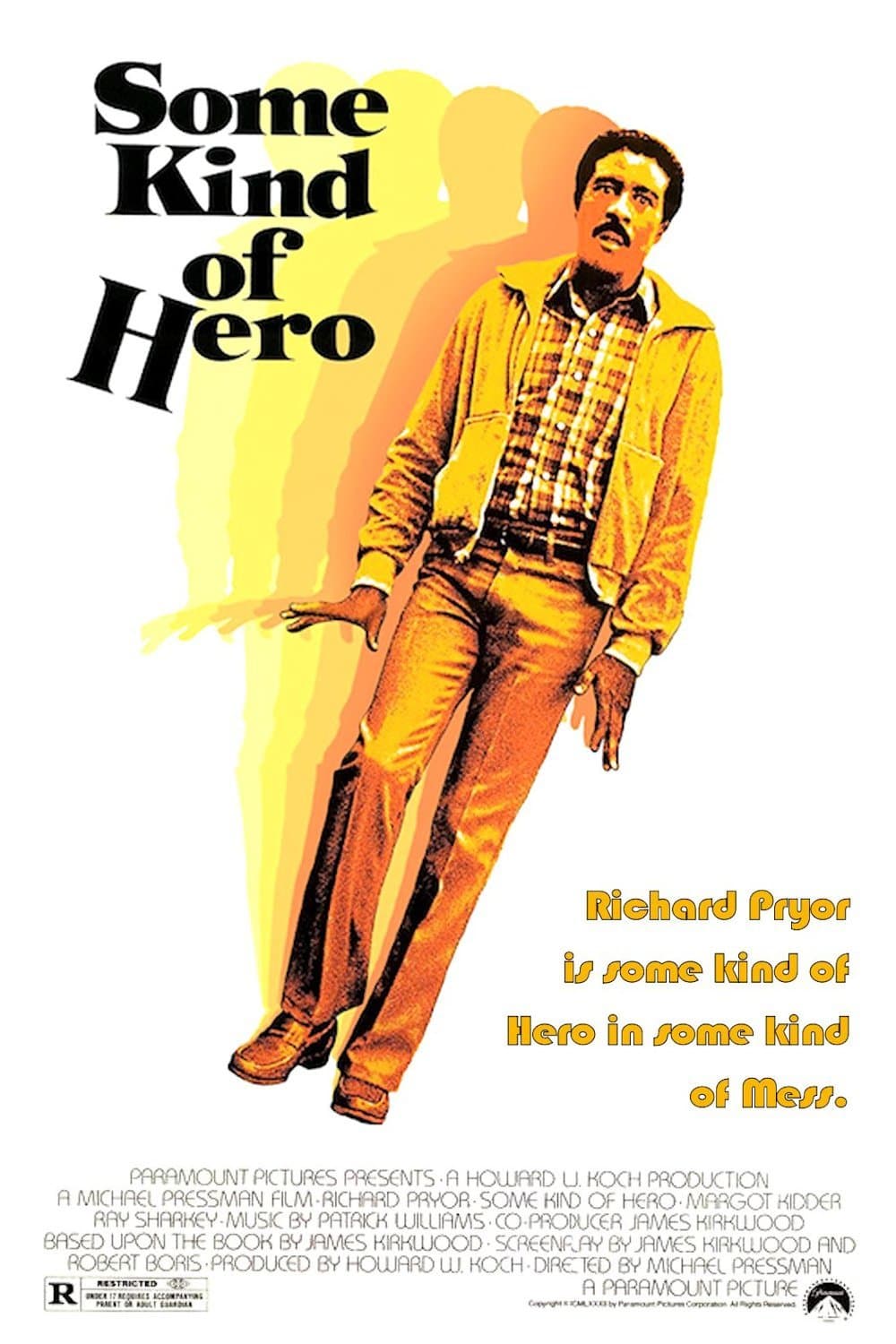
Some Kind of Hero (1982)

By Richard Winters

My Rating: 4 out of 10

4-Word Review: Soldier returns from Vietnam.

Eddie (Richard Pryor), who spent years as a prisoner of war in Vietnam, finally returns home, but finds that things have passed him by while he was gone. His wife (Lynne Moody) has fallen in love with another man and his mother (Olivia Cole) is in a nursing facility after having suffered a stroke. Because he was forced to sign a ‘confession’ to war crimes while under duress at the prison camp the army decides to withhold his veteran’s benefits and having no other source of income he decides to rob a bank, but things don’t go as planned.

The film, which is based on the book of the same name by James Kirkwood Jr., was meant to be a drama, but when Pryor signed on it was rewritten with comedy scenes added. Initially I thought Pryor wouldn’t be a good choice for the part as he is so well known as a funnyman, but it is actually his strong performance that helps carry the film through its rough spots.

The story starts out strong and despite having so many other movies that came out during that period that dealt with the same topic it is still quite gripping and revealing. The scenes dealing with Pryors’ incarceration and the harsh realities that he faces afterwards in civilian life all ring true and helps to make this an excellent movie for the first 45 minutes.

The film though starts to lose its footing with the introduction of Margot Kidder’s character. She plays a high-priced call girl who decides to go to bed with Pryor without charging him any money, but why? A sex worker isn’t going to make much of a living if she sleeps with guys for free and then getting into a relationship with him afterwards is even more farfetched. What’s so special about this guy that she falls in love with him compared to all the other men that she has already met through her line of work? Things get even dumber when Pryor insults her during an argument while visiting her apartment, but instead of throwing him out she leaves while saying she hopes he’ll ‘be gone’ when she gets back, but how can she trust he’ll not angrily tear up the place while she’s away? If it’s her apartment she should be in control and not the one who goes running.

Pryor’s character is confusing too. He becomes extremely nervous about robbing a bank to the point that he pees in his pants, but you would presume being a veteran and having seen the horrors of war he would find bank robbing to be not as tough. He also manages while bartering with some hardened gangsters to find the tenacity to turn them down when they give him a lowball monetary offer on some bank bonds that he has stolen, but how does he find the ability to be brazen in that situation, which many people would find equally intimidating, but not the other?

Also, Olivia Cole looks too young to be playing his stroke-victim mother and in fact was Pryor’s exact same age. I was expecting to see an old, withered woman with gray hair, but instead we get shown a black-haired woman looking around 40. Certainly there had to have been an older African American actresses available that would’ve been more age appropriate, so why not cast them?

Spoiler Alert!

What really kills it though is the ending where Pryor steals a briefcase full of bonds and uses that to get a large sum of money. Tacking-on such a fanciful-like ending where he is able to pull off a robbery that had long odds of succeeding minimizes all of the real world issues that came before it. Having a film start off by exploring realistic issues only to write-it-all-off with a ‘feel-good’ ending discredits the subject matter by taking a complex problem and then ‘solving it’ with a very unrealistic solution.

My Rating: 4 out of 10

Released: April 2, 1982

Runtime: 1Hour 37Minutes

Rated R

Director: Michael Pressman

Studio: Paramount

Available: DVD, Blu-ray, Amazon Video, YouTube
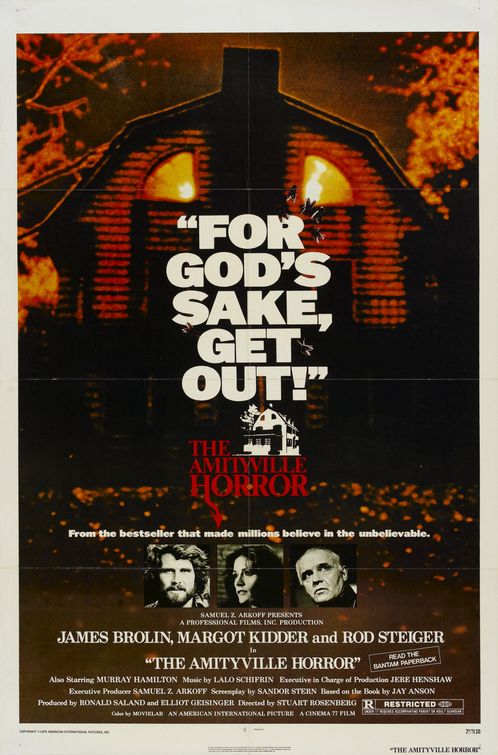
The Amityville Horror (1979)

By Richard Winters

My Rating: 1 out of 10

4-Word Review: Their house is haunted.

Kathy and George Lutz (Margot Kidder, James Brolin) move into a large home that just a year earlier was the place of a gruesome homicide of six people. Though the idea of living where these murders occurred is unsettling they cannot beat the home’s price, so they take the offer. Soon there are bizarre occurrences and George begins to behave like he is becoming possessed convincing the young family that the place is haunted and they need to move out before it is too late.

The film is based on the Jay Anson novel, which was centered on the supposedly true events of the Lutz family who moved into a home known as ‘High Hopes’ that had previously been occupied by the DeFeos who were slaughtered at the hands of their oldest son Ronald in November of 1974. The Lutzs lived in the home from December of 1975 until they ‘abandoned’ it in January of 1976. Since that time many other people have lived there and none have reported any paranormal activity. The home, which was built in 1924, had no unusual events occur in it for the 50 years previous to the DeFeo tragedy either making me and many others speculate that the Lutzs made it all up because why else would they be subjected to the hauntings and none of the others.

(The actual house as it appeared in 1974)

In either case the movie isn’t very good and at many points is quite laughable. The film would’ve worked better had it been structured as a pseudo-documentary where interviews with the characters could’ve be spliced into the reenactments, which would’ve avoided it from seeming so mechanical and coming off like a formulaic scare-a-minute like it does here. The so-called frights are over-the-top from the start and there’s such a barrage of them that by the time you get to the finale, which should be the scariest point of the film, it becomes almost anti-climactic.

The overblown facial reactions of the actors had me laughing out loud at many spots particularly Brolin’s feeble attempts to channel a Charles Manson-like persona and Amy Wright getting locked in a closet. She plays a teen babysitter who walks around wearing one of those garish dental headgears and made me believe that the spirits locked her in there simply because they felt she looked too stupid. Kiddor’s constant shocked expressions at Brolin’s increasingly edgy responses becomes tiring and the part where Brolin shouts at the evil spirts that “This is my house!” had me thinking the spirits should’ve responded with “No it isn’t, it’s the banks!”

Rod Steiger’s priest impression is the Achilles heel. I realize there was a priest in the book, but since then that same priest as disputed the events described in the story, so it should’ve gotten downplayed. I didn’t like the supernatural events occurring outside of the home like when Steiger and Don Stroud are driving in their car and having it mysteriously breakdown. The house is the centerpiece and all scares should take place there otherwise it ceases to be a haunted house film at all and instead just another pedestrian story dealing with evil spirits that can manifest anywhere.

How some could find this scary is a mystery. I first watched it 30 years ago and thought it was tacky then and consider it even more so now. Just because it has managed to spawn a lot of sequels doesn’t make it ‘a classic’ and I feel it would be better suited for rifftrax of Mystery Science Theater.

My Rating: 1 out of 10

Released: July 27, 1979

Runtime: 1 Hour 58 Minutes

Rated R

Director: Stuart Rosenberg

Studio: American International Pictures

Available: DVD, Blu-ray (Region A/1, B/2) Amazon Video, YouTube

The Reincarnation of Peter Proud (1975)

the reincarnation of peter proud

By Richard Winters

My Rating: 4 out of 10

4-Word Review: Reliving a past life.

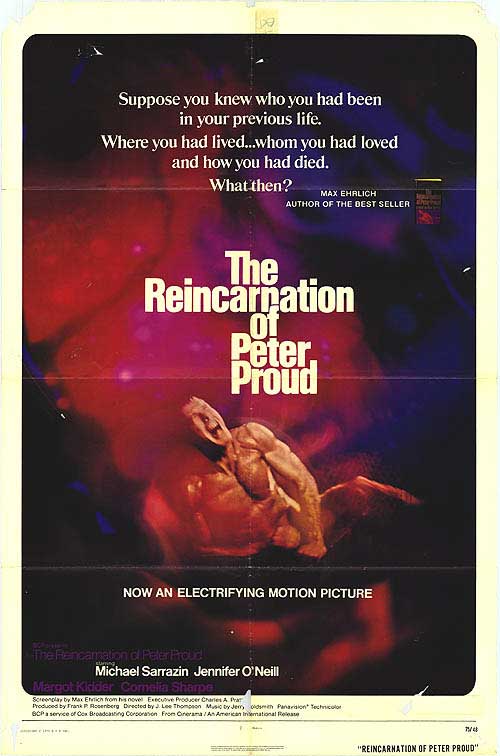
College professor Peter Proud (Michael Sarrazin) starts having reoccurring dreams where he sees himself living a past life somewhere in a small New England town and killed by a woman (Margot Kidder) while out on a lake. The dreams become so strong that they interfere with his job and even his relationship with his girlfriend Nora (Cornelia Sharpe). He travels to Massachusetts in search of the place and finally finds it and even starts a relationship with Ann (Jennifer O’Neill) who may be his daughter from the previous incarnation. He also meets her mother Marcia who is the same woman who he sees killing him in a past life during his dreams. As the three get to know each other tensions and dark secrets eventually begin to surface.

The idea has some potential, but director J. Lee Thompson gives the material a very standard treatment making it seem almost like a pedestrian drama. The dialogue is dull and corny, the characters cardboard and the storyline is predictable and formulaic. For what is supposed to be a horror movie/mystery it is not very compelling or intense. The visions that Peter sees in his dream are quite ordinary and generic and eventually become redundant. In fact the film’s only twisted moment, which is when Peter makes love to Ann, who is technically his daughter from a past life, gets treated like a sweet romantic scene instead of the underlying perverse act that it really is.

The story also gets farfetched including having Peter drives through every town in Massachusetts until he finds the one he is looking for. The character of the dream researcher, which is played by actor Paul Hecht, gets overly enthusiastic about Peter’s statements regarding experiencing reincarnation and becomes almost wide-eyed at the idea of writing a book about it and making millions even though a true researcher would be much more reserved about what Peter was saying and realize it would entail much more years of study before it could even be termed a reality. I also thought it was strange that when they put Peter into a sleep study the machine is unable to read the dreams that Peter is having about his past life. Supposedly this is because they are not dreams, but ‘visions’ of some sort, but wouldn’t that still create brain activity in order for Peter to see them and thus still get recorded on the machine?

Jennifer O’Neill is always great to watch simply because of her beautiful face and Cornelia Sharpe has a few choice nude scenes as Peter’s sarcastic girlfriend, but Margot Kidder is miscast as O’Neill’s mother. For one thing she is the same age as O’Neill and although they try to make her look older by putting some gray streaks in her hair her skin is still quite smooth and in need of some age lines in order to look more authentic. However, the scene where she masturbates while naked in a tub isn’t bad.

The ending is terrible and makes having to sit through this thing a complete waste of time.

My Rating: 4 out of 10

Released: April 25, 1975

Runtime: 1Hour 45Minutes

Rated R

Director: J. Lee Thompson

Studio: American International Pictures (AIP)

Available: VHS

Gaily, Gaily (1969)

gaily gaily

By Richard Winters

My Rating: 5 out of 10

4-Word Review: Naive fellow becomes wise.

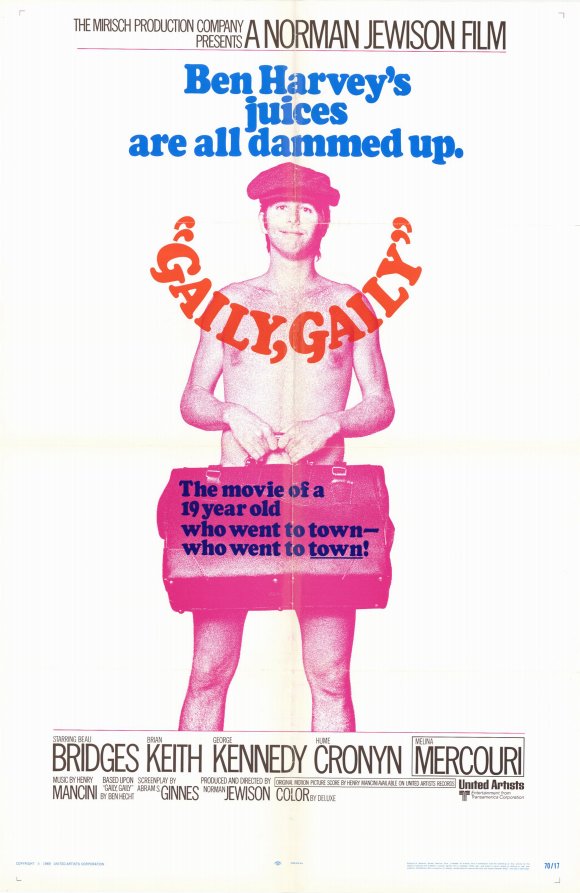
Ben Harvey (Beau Bridges) is a sheltered young man who decides to leave the safe confines of his humble little town and make a go of it in the big city of Chicago in 1910. However, soon after arriving he is robbed of all of his money and then taken in by Lil (Melina Mercouri) a Madame at the local brothel. Ben then gets a job at the city newspaper, but finds corruption at every turn and when he tries to stop it he ends up falling victim to its allure like everyone else.

The first hour is engaging. It features just the right mix of Americana and whimsy. The pace is quick with a wonderfully quirky sense of humor that comes flying fast and furiously. Opening the film by having Ben dreaming of topless women and featuring some very old turn-of-the-century black and white porno pics is funky. I also liked the scene where Ben manages to make all the prostitutes at the bordello he is staying at teary-eyed after reading them a sad story that he had written. The look at Lil’s face when he tells her that his life’s ambition is to ‘change the world’ is a hoot.

Unfortunately the second half deteriorates badly. The scenes become stretched out too long and the attempts are farcical humor lack any cleverness. The side-story about the attempts of a mad scientist Dr. (Charles Tyner) at using a serum he has invented to revive the dead is stupid. The slapstick like chase sequence gets overblown and the whole thing ends on a flat and boring note, which is a shame. The sets and costumes recreating the period atmosphere are wonderful, but put to waste by the silly script. I felt the film could have been more interesting had it taken a more realistic and dramatic route.

Bridges is actually pretty good. He has played the wide-eyed idealist so many times that it becomes a bit annoying, but here he seems to be making fun of it and it works to an extent. However, his extreme naivety at not catching on that the women he is living with are prostitutes is just too over-the-top and makes you almost want to hit him on his head in order to drive some sense into it.

Brian Keith does well playing the type of gruff, brash character that he excels at. George Kennedy though seems stiff and out of place in the setting and does not appear to be particularly adept at comedy.

Mercouri looks to be having a lot of fun here and her singing isn’t bad either. Margot Kidder is fantastic in her film debut and one of the best things about the film. She plays one of Lil’s prostitutes who takes a liking to Ben and I enjoyed how her character goes from being jaded to idealistic and rather naïve. Melodie Johnson is great simply because she is gorgeous to look at. She is now a successful novelist and judging from the pictures on her website is still looking quite attractive.

My Rating: 5 out of 10

Released: December 16, 1969

Runtime: 1Hour 47Minutes

Rated R

Director: Norman Jewison

Studio: United Artists

Available: Amazon Instant Video, Netflix streaming

Black Christmas (1974)

black christmas 1

By Richard Winters

My Rating: 8 out of 10

4-Word Review: He’s in the attic.

It’s Christmas time at the sorority house, but as the girls celebrate the season they continue to get harassing phone calls from a strange man who speaks in different and frightening voices. Unbeknownst to them the man has snuck into the attic of their house and the calls are coming in from another room. As the night progresses the girls begin to disappear forcing the lone survivor to fight off the killer by herself.

I have not seen the remake of this film and due to negative response that I have heard I don’t think I want to either. This review pertains to the original only. If you have seen the remake and disliked it you should still give this film a try.  Despite its low budget it is quite effective and it slowly builds up the tension in a nice compact style with a great twist ending.

Of course one of the things that make this movie so good is the humor. I loved Marian Waldman as the alcoholic house mother Mrs. McHenry who stashes bottles of whiskey in all sorts of goofy places. The vulgar Santa who swears even as the kids are sitting on his lap is a hoot and a nice precursor to Bad Santa, but my favorite is the poster of a sweet old lady giving the finger.

One of the best moments on the terror end is the part where the killer’s eyeball can be seen looking through a small crack in the doorway, which is memorable. The scene where the camera pans from each girl’s nervous and frightened face as they listen to the weird voices emanating from the phone receiver is very well done although it would have been even stronger had the Christmas music not have been playing in the background.

The performances are top rate and I liked the fact that the girls all have distinct personalities from one another. Margot Kidder as the vulgar and obnoxious sorority sister Barb is a scene stealer and I’d say this is the best performance of her career. I loved when she calls one of the more conservative members of the group a ‘professional virgin’, or has the audacity to call her own mother a ‘gold-plated whore’. The part where she gets a young kid drunk and even swears in front of him is also funny as is her conversation about a species of turtle that can have sex for three straight days without stopping. Yet through all of her outrageousness director Bob Clark still manages to create a three-dimensional character by showing her as also being lonely, moody, and suffering from asthma, which is good.

Olivia Hussey as Jess is terrific. She is poised, confident, intelligent, and sweet and the type of character the viewer can immediately connect with and care about. Her face has a wonderful fragility about it as well a natural beauty. The look of terror coming from her eyes seems genuine and the horror is made more effective because she responds to it in a believable and relatable way.

Keir Dullea is good as Jess’s high strung boyfriend Peter. I had to chuckle a bit seeing him here as it brought back memories of what playwright Noel Coward once said about him “Keir Dullea gone tomorrow”, which seemed to have some credence since he was starring in the masterpiece 2001: A Space Odyssey just a few years earlier and now delegated to a supporting role in a low budget horror film. I always felt that his reserved and emotionless delivery can work when given the right role and for the most part it clicks here despite the fact that he was pushing 40 at the time and not quite looking college age.

I read one review where the critic complained that he did not feel it was believable for a killer to be hiding in an attic and no one else in the house aware of it, but the house was a big old building and for me it seemed possible especially since it was only for a short period of time. Overall I felt this was a very plausible premise that is handled in a realistic fashion without all the glaring loopholes, which is one reason I continue to enjoy it no matter how many times I’ve seen it.

However, there are a few quibbles. One is the policeman who gets his throat slashed while sitting in an unmarked police car just outside of the sorority home. I would think a seasoned office would be able to spot someone sinking up on him while he is inside a car especially since it was otherwise not a busy street and since it was wintertime I think it would be highly doubtful that he would be sitting there with the driver’s side window rolled down. I also had to roll my eyes at the scene where Jess is trying to get out of the house as she is being chased by the killer and yet for some inexplicable reason the front door conveniently jams even though no had a problem with it before.

Bob Clark shows what a talented director he is and it is too bad his career and life was cut short in a car accident in 2007. It is one thing to have a big budget and access to all the state-of-the-art special effects, but it is another to make a memorable movie on a shoestring. Despite its low budget it doesn’t seem hampered by many of the limitations that other similar films suffer.

Some may prefer lots of gore, which this one has very little of, and a bigger-than-life monster or bad guy, but the reason this is a classic is because they go with the philosophy that less is more. Any self-respecting horror fan should see this film and most likely appreciate it.

My Rating: 8 out of 10

Released: October 11, 1974

Runtime: 1Hour 38Minutes

Rated R

Director: Bob Clark

Studio: Warner Brothers

Available: VHS, DVD (Special Edition), Blu-ray