Tag Archives: Laurence Olivier

Inchon! (1981)

inchon1

By Richard Winters

My Rating: 3 out of 10

4-Word Review: Turning point in war.

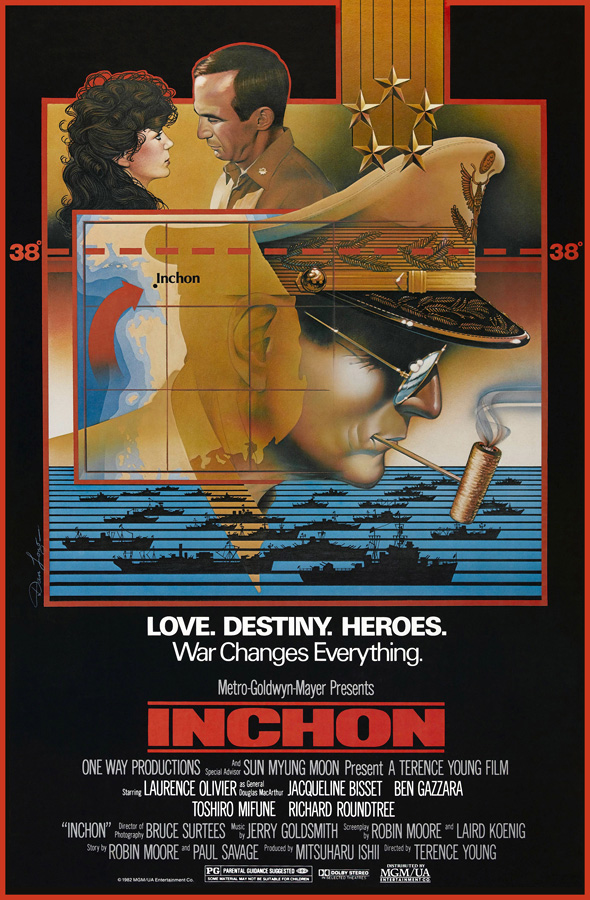
Inspired by actual battles during the Korean War the film centers on the Battle of Inchon, which many consider the pivotal turning point that allowed American forces to achieve victory and was lead by General Douglas MacArthur (Laurence Olivier). While he exudes great outwardly confidence to others he does confide to his wife Jean (Dorothy James) that his age is creeping up on him and he fears he may no longer have the energy or mental acuity to take on the same types of challenges like he had done in the past. The film also has several side stories including that of Barbara (Jacqueline Bisset) whose husband Frank (Ben Gazzara), a Major in the U.S. army, is openly having an affair with a Korean woman (Karen Kahn). When the war fighting breaks-out near her she quickly tries to hitch a cab ride to get out, but soon finds herself straddled with some young Korean children who want to use her car to escape from the war with her.

The film is notorious for having been financed in large part by Reverend Sun Myung Moon who was head of the ‘Moonie’ cult that hit it’s peak during the 70’s and 80’s and gets credited with being the film’s ‘Special Advisor’ during the opening credits. He even used the help of psychic Jeanne Dixon who said she spoke with General MacArthur’s spirit and this spirit reiterated that he approved of the production, which was enough to get Moon put down a whooping $46 million to get it produced, but the film failed badly when it was released and was savaged by the critics. It was shelved for a year and then rereleased in a much shorter 105 minute version, which did not improve things and audiences stayed away causing them to only recoup of meager $5.2 million and turning it into a huge financial loss.

Overall the original 140-minute cut is the better version, if you can find it, and the movie wasn’t quite as bad as I had feared going in. The scenario dealing with Bisset and the kids is the best and I found the children to be genuinely appealing. I liked how well behaved they were and respectfully bow their heads when coming into contact with adults and won’t eat their dinner, despite being really hungry, until Bisset is sitting at the table with them. While this storyline does have a lot of similarity to The Inn of the Sixth Happiness, and in fact the hotel they stay at is named this, I still felt it was engaging enough to keep me semi-involved and had the film centered solely on this it would’ve done better though it’s still filled with some incongruities like having Bisset shoot and kill a man right in front of them where she’s not concerned about the psychological effects this may cause them, but then later when they come to a battlefield with dead soldiers laying about she warns the kids to ‘shield their eyes’, but if they’ve already witnessed one dead body and gotten through that what’s the harm of seeing a few more?

The drama dealing with her husband Gazzara and his affair is a bore and her conversations with him about it goes nowhere and slows the pace up badly as it offers up no spark and I found Gazzara’s constant smirking no matter what situation he was in to be annoying and wished someone else had been cast in the part. Olivier’s moments as MacArthur are equally cringey and should’ve been a source of complete embarrassment. However, he was at least honest about it and admitted in interviews he was only doing it for the money, so that his family would have something to keep them comfortable after he died, which he felt was coming soon and thus ‘nothing was beneath him’ as long as the ‘price was right’, which in this case was a payout of $1.5 million and included a $250,000 signing bonus.

Much of the problem with his part is with the ghoulish looking make-up that was put on and took 2 and a half hours each day to apply, but makes him look like some wax figure, his hair literally shines off his head every time it comes into any light. The effect makes him look like a walking dead person, or a strange alien from another planet and his moments come-off as either creepy, or laughable. His attempts at replicating MacArthur’s accent, which he had been informed sounded like W.C. Fields, is ineffective especially when you hear the real MacArthur speak during archival footage that appears near the end.

David Janssen as a crotchety and cynical news reporter, whose scenes were entirely cut in the abbreviated prints, is terrific and gives the movie a much needed sense of brashness and I wished his character was in it more though due to his death during filming he’s not in it as much. Everything else though unfortunately falls flat including the battle scenes that become quite redundant and surprisingly uninteresting to watch. The finale that deals with the illumination of a lighthouse and MacArthur’s reliance of banking on the ‘spirit of God’ to get it lighted was fabricated making it corny and forgettable.

My Rating: 3 out of 10

Released: May 4, 1981

Runtime: 2 Hours 20 Minutes (Original Cut) 1 Hour 45 Minutes (Reissue)

Rated PG

Director: Terence Young

Studio: MGM/UA

Available: DVD-R
Nicholas and Alexandra (1971)

nicholasandalexandra1

By Richard Winters

My Rating: 9 out of 10

4-Word Review: The last Russian Tsar.

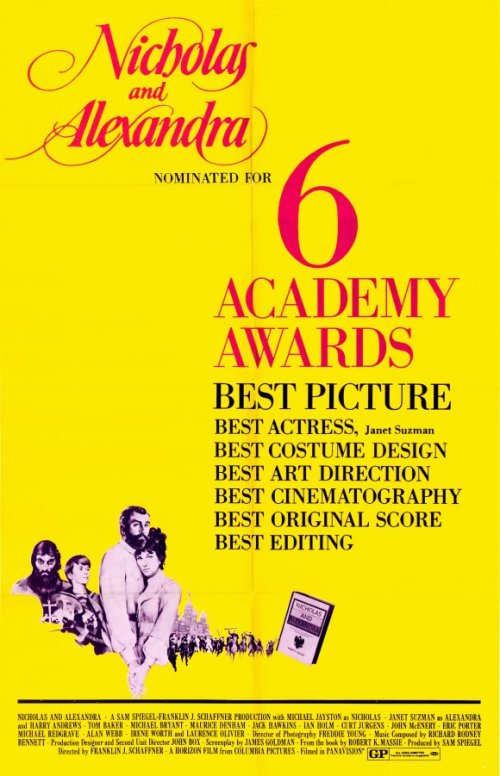
This film chronicles the life of Tsar Nicholas II (Michael Jayston) of Russia and his marriage to Alexandria (Janet Suzman). Based on the novel by Robert K. Massie it examines the height of his power and his apathy to the poverty of his people and his reluctance to listen to their needs, or consider a more democratic form of government. It also looks at his personal life including the birth of his son Alexei (Roderic Noble) who is diagnosed with hemophilia and his wife’s over-reliance on Grigori Rasputin (Tom Baker) a man pretending to have divine connections who ultimately uses his influence on Alexandra to take control over her political affairs when her husband is away. The film also portrays Russia’s involvement during WWI as well as the Tsar’s downfall and eventual exile in Siberia with his family.

The film is basically split up into three parts with the first hour looking at Nicholas’ family life while intercutting with scenes showing the discontent of the Russia people and the efforts of Vladimir Lenin (Michael Bryant) to create a revolutionary form of government. The second hour examines Russia’s war involvement and the many warnings that Nicholas is given not to get involved in it, but foolishly decides to anyways, which ultimately creates massive upheaval. The third hour looks at his abdication of power and the family’s exile and virtual imprisonment at the Ipatiev House in Yekaterinburg where they nervously await their fate.

Initially I thought the third hour would be the weakest as we all know they get shot and killed execution style, but to my surprise it is actually the strongest part of the film. To an extent tearing the characters away from their plush surroundings and forcing them to exist in bleak, squalor-like conditions actually humanizes them and allows the viewer to empathize with them particularly the four daughters who had nothing to do with their father’s harsh policies and just wanted a chance to grow up and live a normal life. The scene where the family is herded into the basement of the home in the early morning hours and forced to sit silently while awaiting their executioners is quite possibly one of the most intense moments ever captured on film.

The performances are uniformly strong particularly Suzman’s as well as Baker as the evil Rasputin who’s drawn out death scene may be one of the longest in movie history. Laurence Olivier in a small, but pivotal bit as the Prime Minister gets two commanding moments including his speech after the Bloody Sunday massacre and later his strong misgivings about the country’s war involvement.

The film is full of brilliant cinematography, direction, costumes and set pieces and is certainly something that must be watched on the big screen to be fully appreciated. I enjoyed the lavish interiors of the Winter Palace especially their walks down the elegant hallways that are lined with Royal guards, but found it equally interesting when Nicholas returns there after the war and forced to walk down these same hallways, which are now darkened and rundown. The many long distance shots of the flat and majestic landscape is also impressive particularly a view of a rolling sunflower field.

Although this film has never attained the well-known classic status of Doctor Zhivago, and in fact this was producer Sam Spiegal’s answer to that film when he was blocked from working on it, I still found it to be every bit as compelling and well directed.

My Rating: 9 out of 10

Released: December 13, 1971

Runtime: 3Hours 8Minutes

Rated GP

Director: Franklin J. Schaffner

Studio: Columbia Pictures

Available: DVD, Blu-ray, Amazon Instant Video


The Boys from Brazil (1978)

exorcist

By Richard Winters

My Rating: 4 out of 10

4-Word Review: Mad doctor clones Hitler.

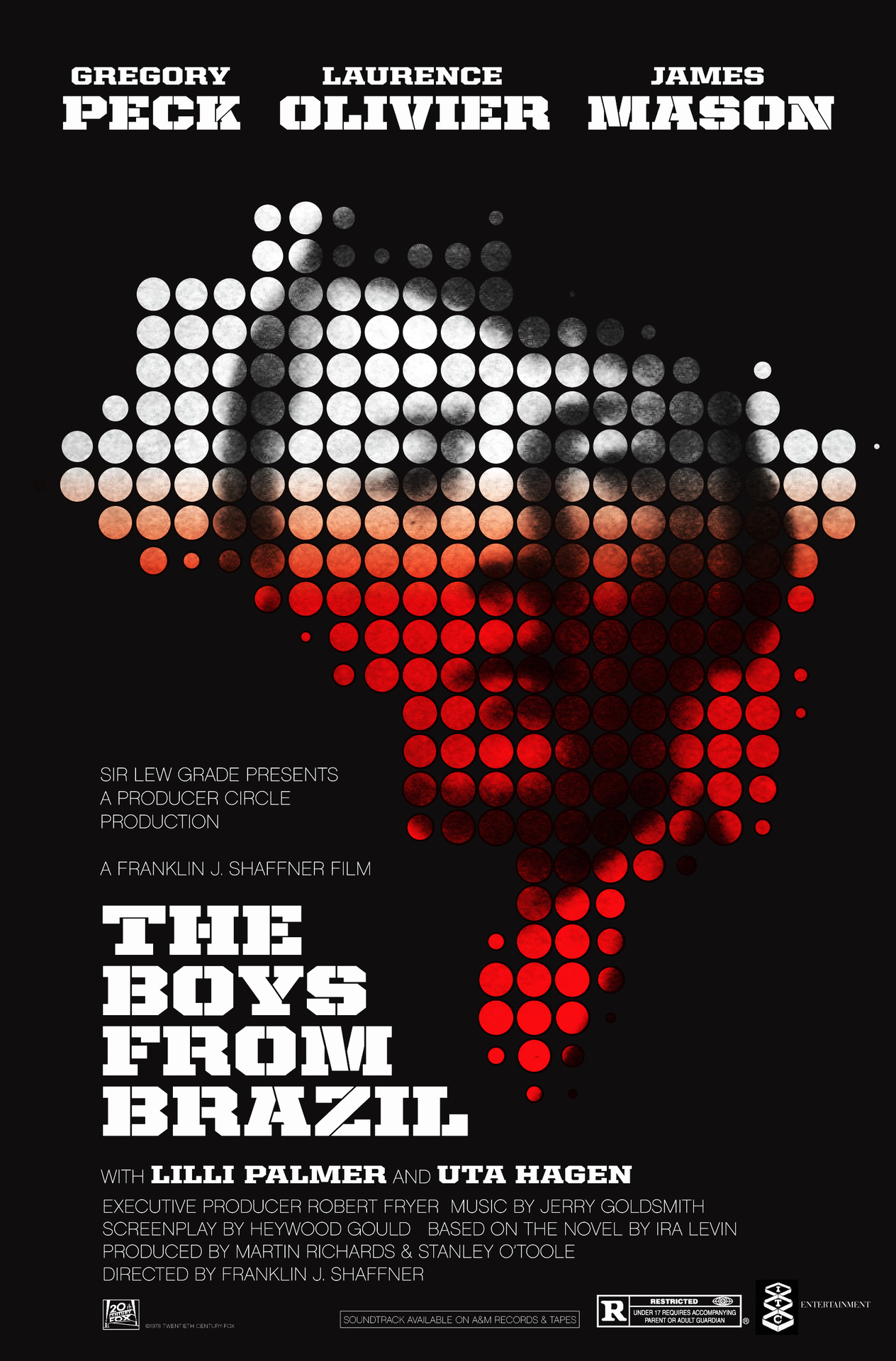
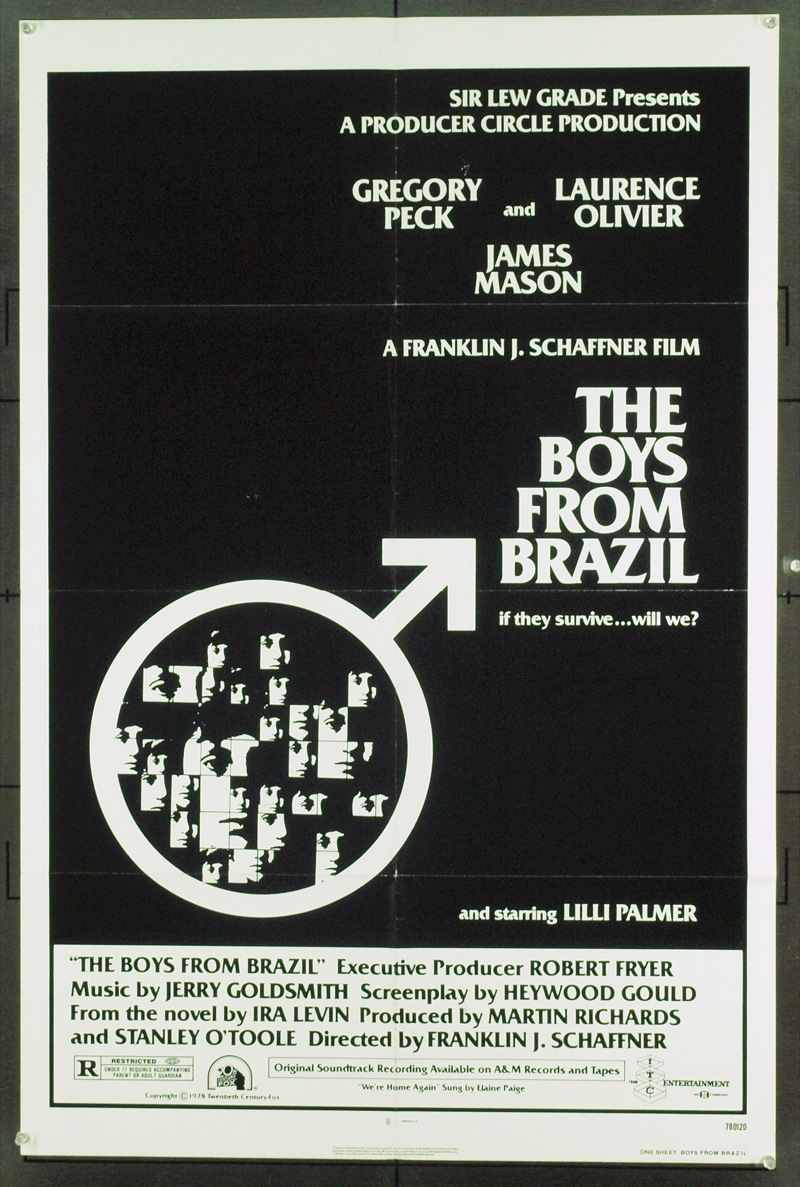
Based on the best-selling novel by Ira Levin the story details an elaborate plan devised by the elusive Josef Mengele (Gregory Peck) who has been hiding out in the jungles of Paraguay and has a secret meeting with several Third Reich war criminals that is overheard by novice Nazi Hunter Barry Kohler (Steven Guttenberg) and relayed to Ezra Lieberman (Laurence Olivier). The plan calls for these war criminals to go out and murder 94 65-year-old men who are living in various parts of the world as Mengele has saved a sample of Hitler’s DNA and impregnated 94 women with it at a Brazilian clinic. These Hitler clones have now grown to adolescence and need to be put in the exact same environment as the real Hitler had been in order to bring out the same personality traits, so it’s important that their fathers die at the same time as Hitler’s real father had. At first Lieberman cannot believe such an outrageous plot, but as the evidence mounts he realizes it is true and he may be unable to stop it.

The film has two great scenes which includes an eye popping death from a steep mountain bridge and a graphic moment where we see in close-up Mengele place the ovum with Hitler’s DNA into the women. Outside of these two moments the film is rather flat and cheesy with certain segments bordering on camp. The plot is intricate enough to keep you involved, but highly implausible and the characters take a long time to realize things that the viewer has already figured out long before.

It is fun seeing Peck playing a bad guy and this was his first villainous role since Duel in the Sun and although he does well in the part the character is so one dimensionally evil that it ultimately makes him boring. Olivier is not effective in the lead and comes off as frail and sickly with certain comical overtones given to the character that don’t work. The final confrontation between he and Peck in which the two roll around on the floor while grappling for a gun looks more pathetic than exciting and apparently the scene had to be reshoot several times because both actors kept breaking out into laughter over the absurdity of it. I did feel though that Guttenberg was perfectly cast as a wide-eyed schmuck that was in way over-his-head.

Spoiler Alert!

My biggest problem with the film though is the ending that turns out to be a big letdown. For one thing it takes place at a remote farmhouse, which seems too similar to a scene in Marathon Man, which came out just two years earlier, had a similar theme and also starred Olivier. It features nine Doberman pinchers with four of them that surround the farm’s owner (played by actor John Dehner) at all times. He uses them for protection as he is convinced someone is out to get him, which could’ve created quite an interesting scenario when Mengele travels to the home to kill him. However, the owner puts the dogs into another room the second Mengele tells him that they make him uncomfortable, which then allows Mengele to shoot the man without any problems, but why have the dogs for protection if you’re just going to put them away the minute some stranger doesn’t like them and if the character is so paranoid why even allow a stranger into your home without at least demanding some form of identification first?

End of Spoiler Alert!

The conclusion is unsatisfying as it leaves open a ton of unanswered questions. Not only is the plot full of loopholes, but it seems like only a springboard to a much more fascinating story, which is trying to hunt down all these Hitler clones that the film fails to realize.

the boys from brazil 1

My Rating: 4 out of 10

Released: October 5, 1978

Runtime: 2Hours 3Minutes

Rated R

Director: Franklin J. Schaffner

Studio: 20th Century Fox

Available: VHS, DVD, Blu-ray, Amazon Instant Video, Netflix Streaming