Tag Archives: Jeff Goldblum

Thank God It’s Friday (1978)

By Richard Winters

My Rating: 1 out of 10

4-Word Review: A night at discotheque.

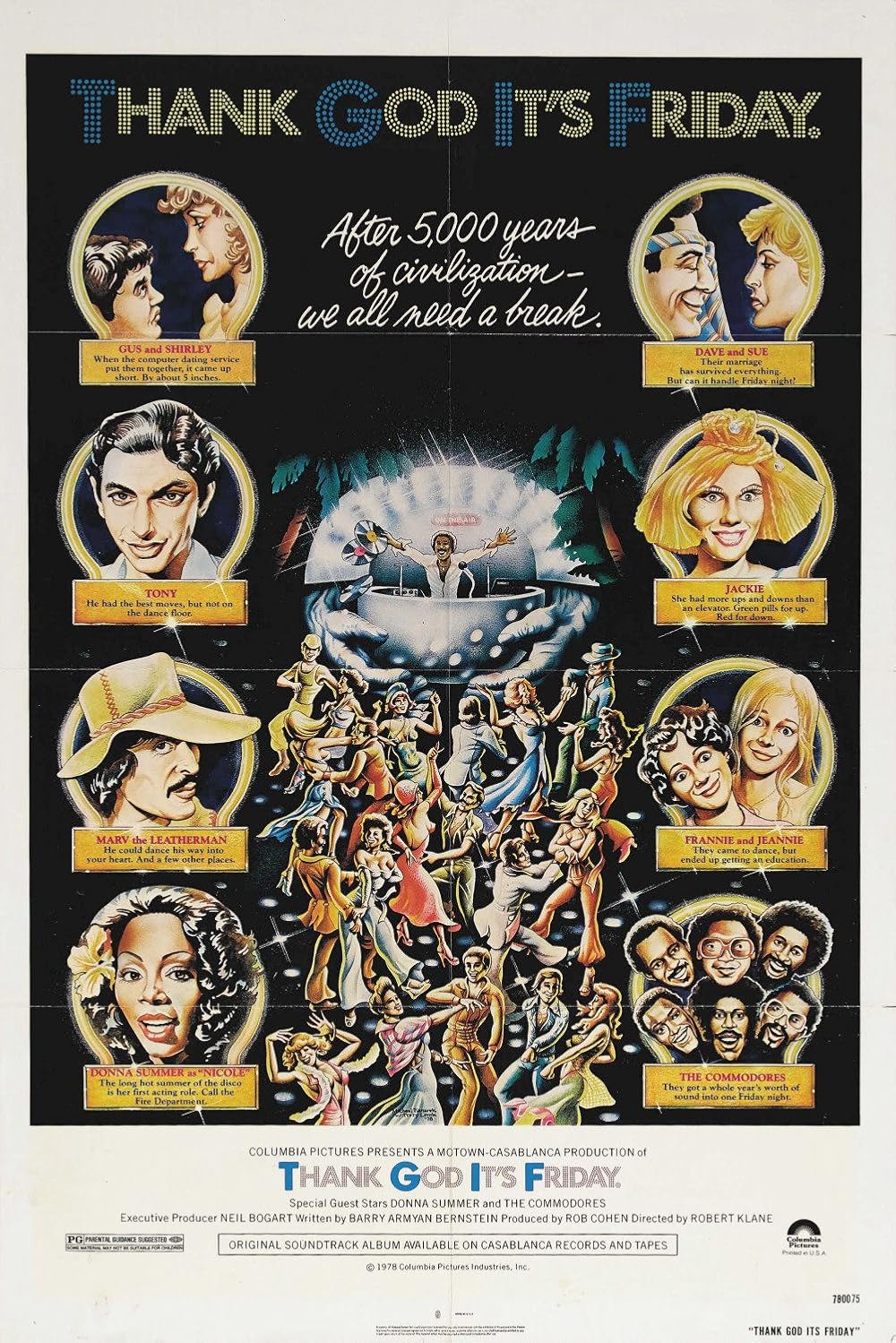
This film was requested for review and was a part of the disco craze that permeated pop culture during the mid to late 70’s. It was released just 6 months after Saturday Night Fever but was nowhere as good and didn’t have the same staying power. The plot revolves around several people who decide to spend their Friday evening at a local L.A. discotheque and the various conversations and ‘adventures’ that they have while inside the place. The main cast is Donna Summer who plays a character named Nicole who tries to ger her ‘big break’ by singing one of her songs while everyone is on the dance floor, but the club DJ (Ray Vitte) goes to great lengths to prevent that. There’s also two underage friends (Valerie Landsburg, Terri Nunn) who sneak into the club in order to win a dance contest, and a married couple (Mark Lonow, Andrea Howard) who go to the club on a lark, but then have their marriage challenged when club owner Tony (Jeff Goldblum) begins aggressively hitting-on the wife while the husband gets side-tracked by a ditzy patron named Jackie (Mayra Small) who gives him drugs that makes him behave erratically.

The biggest shock was that this lame thing was directed by Robert Klane, who burst onto the scene in the early 70’s with the dark comedy classic Where’s Poppa? that was both edgy and inventive and based on his book of the same name, but this has none of that. The dialogue and situations are quite stale, and it was like he was just selling out his career, which did eventually recover when he wrote the script for Weekend at Bernie’sbut this is definitely a black mark.  What’s even more perplexing is that the screenwriter for this, Armyan Bernstein, was able to sell six more screenplays after this one, even though this one displays no writing talent at all and his subsequent scripts that were made in the 80’s all bombed at the box office, but I guess this kind of shows how it’s more who you know in Hollywood that proves who gets the breaks and who doesn’t.

The concept of having an entire movie take place inside one location has a certain appeal, but Klane captures the proceedings in a flat sort of way. It was shot inside an actual club, that has since been torn down and was described by those who went there as a ‘labyrinth’, but I didn’t get that feeling while watching it. Most of it is shot in and around the dance floor, which quickly becomes boring visually. The various ‘dramedies’ of the characters fail to elicit any interest. To some degree you could say this was a realistic look at the club scene as I remember going out to dance clubs in the 90’s in Chicago hoping to pick-up some action, or meet ‘cool new friends’ but coming away disappointed and feeling like it was all overrated and on that level that’s exactly what you get here. The characters come in anticipating way more excitement than they actually receive, but the film still needs to convey this in some sort of compelling way, and it doesn’t.

A good example of this is the married couple, which has some potential, but the characters don’t learn anything, or change. In a good movie/script the main people are supposed to go through a character arch and end up in a different spot, either in an emotional, or intellectual way, or in their situation in life, then they were at the beginning, but the couple leaves the place returning to their ‘happy married’ mindset. However, since the wife was so quick to consider the advances from the club owner and the husband with the young punk girl, that it should’ve rattled them and they should’ve left seriously contemplating whether their marriage was really all that strong.

The same goes for Donna Summer’s character. She spends the entire evening trying to aggressively get her chance to sing. It might’ve worked better had the movie had a parent, or friend being the one that was pushy while Summer stood shyly back and thus made her seem a little less narcissistic. Either way when she finally sing and the crowd loves it, it doesn’t mean much because it wasn’t in front of a record producer, so therefore there was no contract and thus just a fleeting moment in time.

I did like Goldblum and it’s easy to see why out of the entire cast he was the one that had a long a distinguished career though it’s a little confusing why he hits so hard on another man’s wife when he has a plethora of hot women that he has slept with, or willing to sleep with him, so why get so fixated on the one? Debra Winger is an absolute delight too mainly because of her exquisite beauty, which is at the absolute peak here and makes watching the movie more than worth it just for that. In fact, that’s the only reason why I decided to give this one point.

Out of the entire runtime there’s only four mildly diverting moments that stands out. The first is when the lady holding the torch in the Columbia Pictures symbol breaks out into a disco dance. The second, in a scene that the producers strongly considered cutting, is when a guy asks if he can but into a dance that Debra Winger is having with another guy, but instead of continuing the dance with her he goes on with the other guy. The third is a nice dance routine that Marv Gomez has on the rooftops of some parked cars while the fourth consists of Goldblum’s car, a prized possession of his, that falls completely apart.

My Rating: 1 out of 10

Released: May 19, 1978

Runtime: 1 Hour 29 Minutes

Rated PG

Director: Robert Klane

Studio: Columbia Pictures

Available: DVD, Blu-ray, Amazon Video, Tubi, YouTube


Beyond Therapy (1987)

By Richard Winters

My Rating: 3 out of 10

4-Word Review: Therapists nuttier than patients.

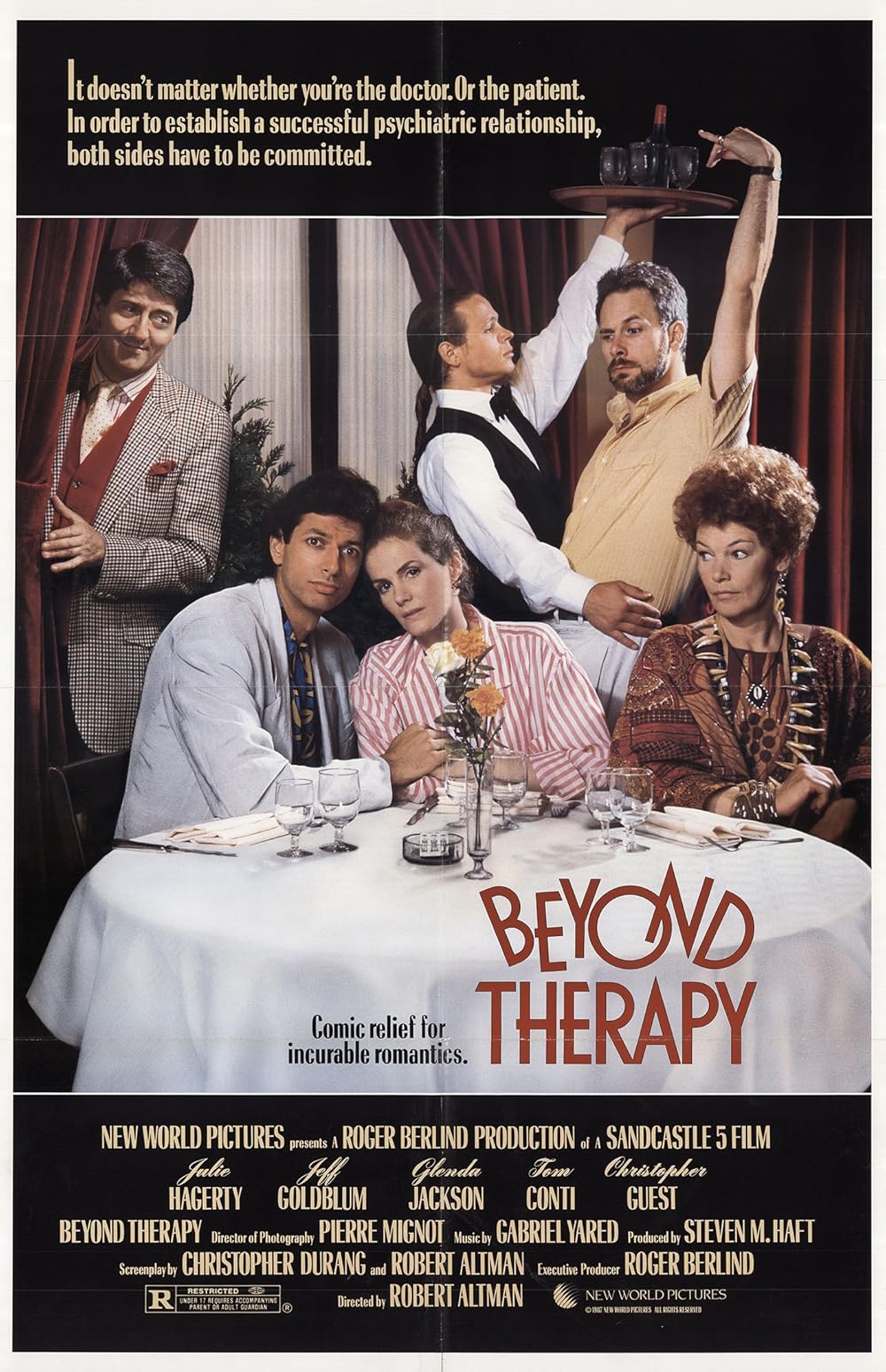
Bruce (Jeff Goldblum) is a bisexual who’s tired of his relationship with Bob (Christopher Guest) and thus decides to place a singles ad looking for a female companion. Prudence (Julie Hagerty) answers and the two meet-up at a restaurant, but they find there’s too many differences between them and fail to hit-it-off. Bruce then goes to Charlotte (Glenda Jackson), his therapist, while Prudence visits Stuart (Tom Conti) who’s her therapist and works in the next room beside Charlotte’s. After some counseling, and at Charlotte’s suggestion, Bob places another ad, but changes some of the personal details, causing Prudence to again answer it thinking it’s a different person. They meet at the same restaurant, but this time things click and they agree to go out again, but Bob and his meddling mother Zizi (Genevieve Page) don’t like the fact that Bruce is seeing somebody else and become determined to ruin the potential relationship as does Stuart, who once had a fling with Prudence, and wants to rekindle the old flame, but only if he can get Bruce out of the way.

The film is based on the hit stage play of the same name by Christopher Durang and while that one got rave reviews this version falls off its hinges right away and a lot of the blame should be pointed at director Robert Altman who rejected the screenplay that Durang had written and instead revised it severely causing Durang to feel that very little of his original work was left and lamenting in later interviews that his experience working on this project was an unhappy one. The story is supposed to be set in New York City, but because Altman was living in Paris at the time he choose to shoot it there, but New York’s ambience, where the single’s scene is quite strong, would’ve helped accentuate the theme and allowed for a more vibrant backdrop versus here where everything takes place in a bland cafe, or in the therapists office, with the exception of a few scenes done in Bruce and Bob’s pad, that hampers the visual flair and makes the production look stagnant and cheap. It also ends with a bird’s eye shot of the Paris skyline, but since everyone was speaking in English and without a French accent it makes it off-kilter, and they should’ve at least pretended it was New York even if it wasn’t.

Goldblum comes off as too detached and thus isn’t effective for this kind of role. Hagerty has her moments and at least gets some laughs, but her open disdain for gay people, along with some of her character’s other quirky hang-ups, may not go over well with viewers. Guest plays the gay lover role in too much of a cliched way making him seem like a walking-talking parody, while Page, as his overprotective mother, is excessively hammy and her exaggerated behavior gets in the way and doesn’t add much.

Jackson is a big disappointment though it’s not all her fault as Altman insists on shooting the majority of her scenes through the window of her office making the viewer feel cut-off from her and like she’s intended to be a caricature. Her confusion over words is more disconcerting than funny. Having a therapist that’s a bit daffy is okay and might even be good enough for a chuckle or two, but here she seems genuinely nuts to the extent that you wonder why Bruce would continue to see her. How she’s able to pick-up words said by Stuart in the other office is never made clear, they also seem to have sporadic sexual rendezvous in the room that’s in-between their offices, but this only gets implied and never actually shown though it should’ve been. Conti’s performance is annoying as he speaks in this fake sounding Italian accent, which he finally drops near the end, but should’ve done way sooner.

There are a few in-jokes in regard to Jackson that I did like. One is a refence where her son, played by Cris Campion, asks her to cry, which she does in a comic sort-of way and I think this was alluding to her performance in A Touch of Classwhere the script asked for her character to cry, but she refused insisting that crying was just something she didn’t do, so here you finally get to hear her do it, which is fun. Later there’s another bit where Bob talks about the movie Sunday Bloody Sundaya film that Jackson was in, though here he describes her as being ‘that English actress’, which is amusing, but would’ve been even funnier had, when he later meets her, he could’ve said ‘you look exactly like the English actress in that movie.’

Spoiler Alert!

While the film does become semi-engaging even with its rough, awkward start it manages to blow it up with a dumb conclusion, which has Bob shooting at Bruce with a toy gun while inside the restaurant. We already know it’s a toy because he tried to use it on Charlotte earlier, so having this extended slow-motion sequence where all the customers duck for cover, doesn’t work and becomes overdrawn instead of funny, or suspenseful. Having the group then remain in the restaurant afterwards and even get served food was equally ridiculous as anyone that would’ve caused that much of a melee would most certainly be asked to leave or arrested by the police for causing a disturbance.

My Rating: 3 out of 10

Released: February 27, 1987

Runtime: 1 Hour 33 Minutes

Rated R

Director: Robert Altman

Studio: New World Pictures

Available: DVD, Blu-ray, Amazon Video, YouTube

Next Stop, Greenwich Village (1976)

nextstop

By Richard Winters

My Rating: 7 out of 10

4-Word Review: He dreams of stardom.

In 1953 Larry (Lenny Baker), a young man in his early 20’s, decides to move out of his home in Brooklyn that he still lives in with his parents (Shelley Winters, Mike Kellin) and into an apartment situated in the artsy district of Greenwich Village. Larry dreams of becoming a movie star and feels the way to start his career is by living with fellow artists. He also wants to get away from his meddling mother, but finds no matter where he goes she always comes to visit many times at the most inopportune moments including when he’s holding wild parties, or making-out with his new girlfriend Sarah (Ellen Greene).

The film is loosely based on writer/director Paul Mazursky’s early life as a struggling artist, which is fine, but how much one likes this movie hinges almost completely on how much they can stand the main character. For me he wasn’t so likable. While I admit his mother was annoying she was still well-meaning and the way he constantly lashed-out at her seemed too angry and aggressive. I would’ve thought someone who had been raised in that type of overbearing environment all of his life would’ve figured out a more subtle way to placate his mom that wouldn’t have needed to be so abrasive. When he tells his neighbor lady (Rachel Novikoff) that he’s moving to Greenwich Village to ‘become a big star’ like it was going to be some automatic thing seemed a bit too deluded and you’d think by that age he would’ve been a little bit better grounded.

The friends that he makes, which include some early performances by Christopher Walken, Antonio Fargas, and Dori Brenner, are a bit off-kilter as well. For instance they visit a fellow artist friend named Anita (Lois Smith) at her apartment only to find her sitting inside the bathroom with her wrists slit and talking about how she wants to die. They manage to get her patched-up, but then return to the apartment a couple of weeks later with the same carefree spirit that they had the first time, but you’d think after what they witnessed they’d approach the place cautiously, or maybe never want to go there again, for fear that she’d try it again and this time succeed forcing them to witness a tragic sight and yet this bunch acts like for some reason the whole suicide thing will never reoccur only to be shocked when it does even though I as a viewer was completely expecting it.

The story is rather rudimentary and involves basic elements that seemed to be analyzed in a lot of coming-of-age films during the 70’s including having Larry’s girlfriend get pregnant and require an abortion, which wasn’t exactly a unique twist. I did though enjoy the scenes inside Larry’s acting class and the way his teacher (Michael Egan, who was portraying the legendary acting coach Herbert Berghof) challenged his students after his each performance that they gave in the class and requiring them to analyze why they portrayed a certain character the way they did. Not enough other movies capture the technical side to acting, so I felt these scenes stood out in a good way and were quite introspective to the craft. I also liked the dream sequence where Larry imagines himself as a successful star, but then this quickly turns into a nightmare where he sees himself booed by the audience and even has pies thrown in his face, which I felt brought out the insecurity many artists, especially actors, harbor, even the successful ones, where they secretly fear never being quite good enough.

Spoiler Alert!

My biggest complaint though was with the ending where for some inexplicit reason Larry gets hired to play a part in a movie and whisked off to Hollywood even though I didn’t see what was so great about his audition, or why this scrawny guy stood out to the casting directors from all of the other men that were also vying for the role. I realize that Mazursky was basing this on his own life as he was able to escape to Hollywood after getting the starring role in the Stanley Kubrick drama Fear and Desire, but this only occurs to a small handful of people and the vast majority who move to Greenwich Village never really leave it, or if they do it’s most likely to the suburbs where they’re forced to get ‘real jobs’, or maybe even back home to their parents after they run out of money. If the movie has Greenwich Village in its title then that’s where it should’ve stayed as most people who live there probably ultimately wouldn’t like Hollywood as it’s a completely different vibe and sometimes it’s better being a big fish in a small pond, which I felt is the message that the film should’ve conveyed as the Hollywood twist seemed too dreamy.

End of Spoiler Alert!

Either way the film is helped immensely by Shelley Winters, who plays the overbearing mother to a T and comes complete with realistic crying spells. This should’ve netted her a third Oscar and for all purposes was her last great role as the parts she got offered after this were virtually all of the B-movie variety. Baker on the other-hand, whose only starring vehicle this was as he died, at the young age of 37, less than 6 years after this film came out, is an acquired taste. I don’t know if it was his extreme skinniness that got to me, he was 6’0, 145 pounds, but I just couldn’t really ever warm up to him and felt that Harvey Keitel, who had been considered for the part, would’ve worked better. You do though get to see Bill Murray, in his live-action, feature film debut, as a party guest as well as Jeff Goldblum as a humorously obnoxious struggling actor doing whatever he can to stand out and get noticed.

My Rating: 7 out of 10

Released: February 4, 1976

Runtime: 1 Hour 51 Minutes

Rated R

Director: Paul Mazursky

Studio: 20th Century Fox

Available: DVD, Blu-ray

Invasion of the Body Snatchers (1978)

invasion of the body snatchers 3

By Richard Winters

My Rating: 8 out of 10

4-Word Review: Aliens create human clones.

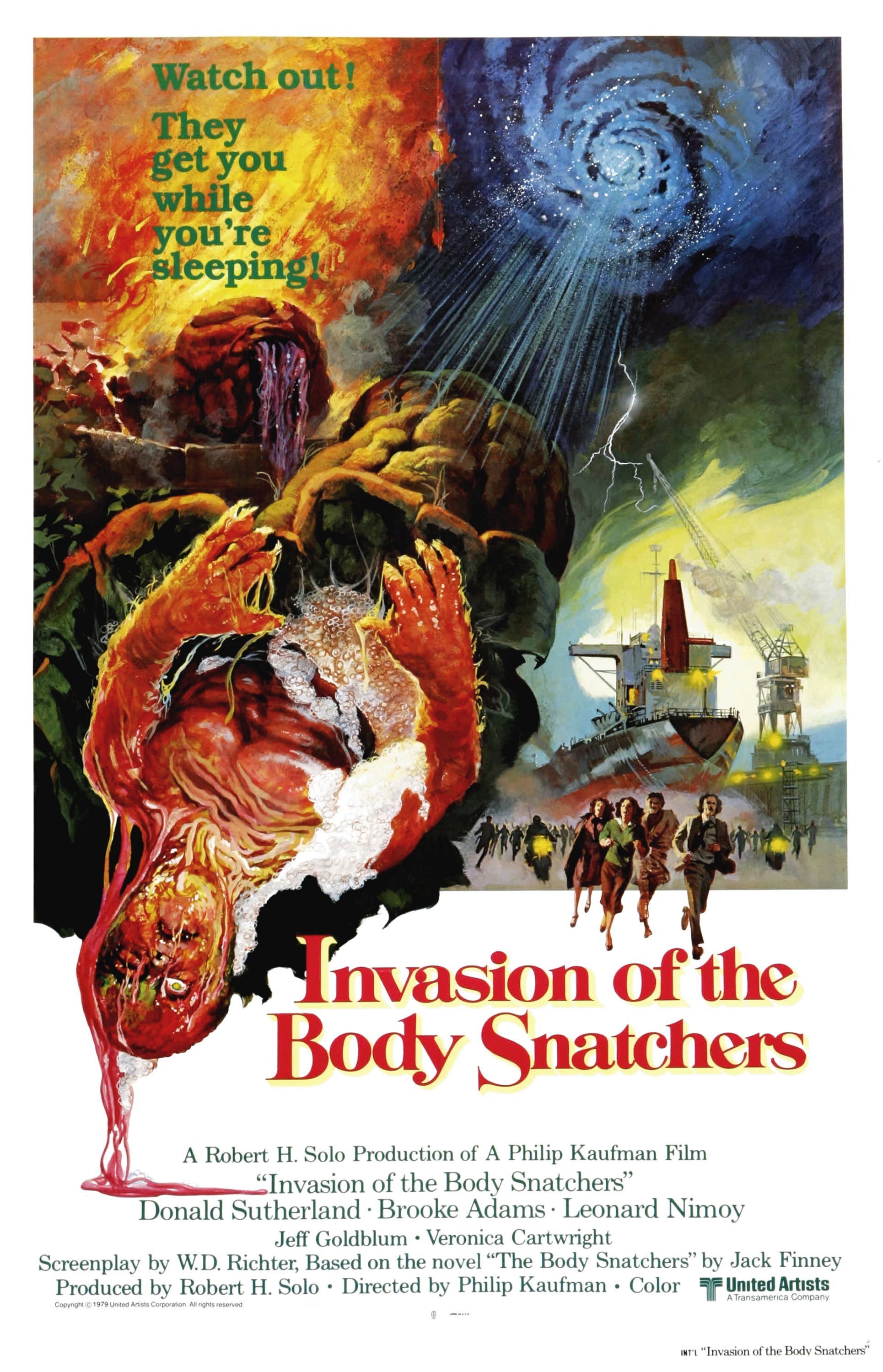
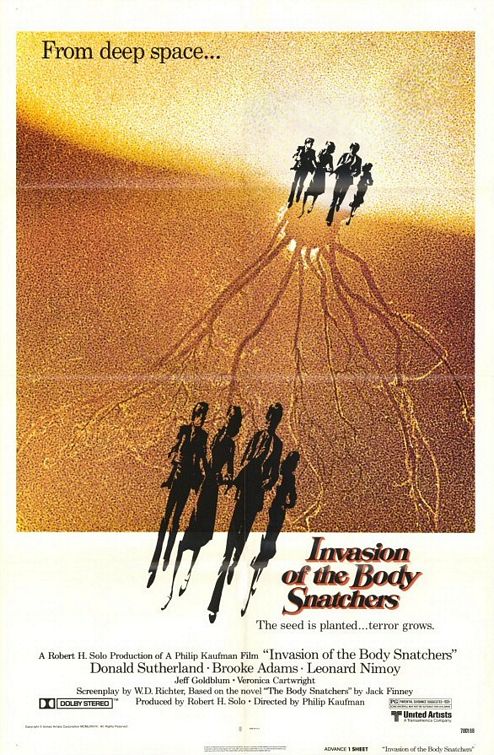
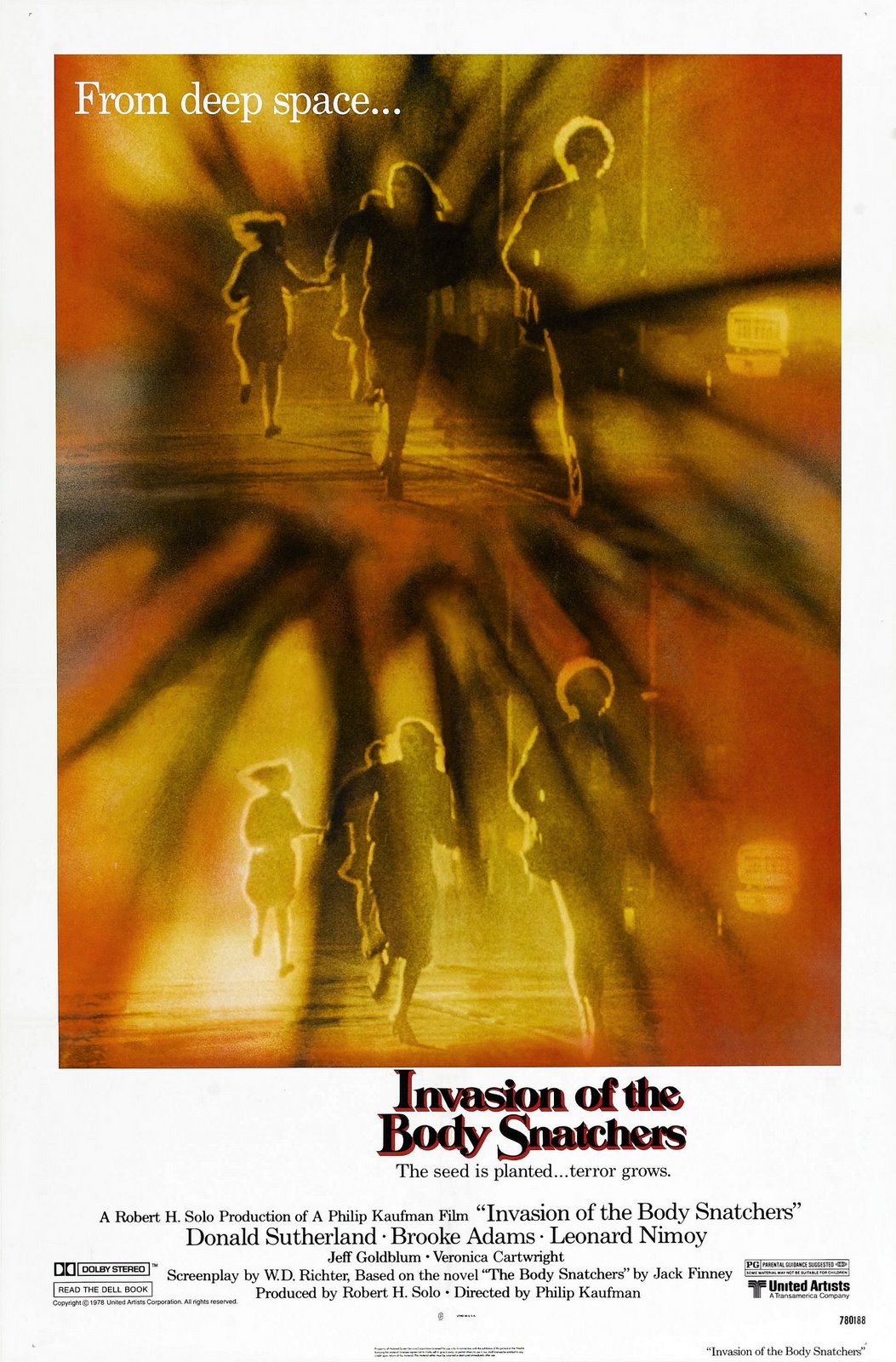
Matthew Bennell (Donald Sutherland) is a public health inspector who finds that people around him are beginning to behave strangely. It starts with his friend Elizabeth (Brooke Adams) who insists her boyfriend Geoffrey (Art Hindle) has somehow ‘changed’. Soon other people are saying the same thing and they slowly realize that human clones are being created from alien pods while the people sleep. These clones look exactly like the people they have replaced, but are devoid of any emotion. Matthew and Elizabeth along with married couple Jack and Nancy (Jeff Goldblum, Veronica Cartwright) try to escape, but find themselves increasingly outnumbered in this creepy remake of the 1956 classic.

Talented director Philip Kaufman who has never gotten enough credit does a masterful job of weaving an updated version of the tale with more contemporary sensibilities. The balance between sci-fi, thriller and drama really works. The story is perfectly paced and the characters and situations remain believable throughout. Transferring the setting from a small town to San Francisco was inspired. Kaufman captures the sights, sounds and everyday ambience of the city better than just anybody who has done a film there and I really loved the shot of an early morning fog settling in on the top of the Transamerica Pyramid.

The special effects are fantastic. The opening sequence showing the alien spores raining down on the city and hitting onto plant and tree leaves where they form into flowers is very authentic looking and nicely captured. The coolest part though is watching the clones of the humans form out of the pods particularly the sequence showing Bennell’s clone coming to life while he sleeps. Seeing a dog with a human head is wild and Bennell’s destruction of a pod factory is also quite exciting. Denny Zeitlin’s electronic music score is distinctive, but not overplayed and effectively used at key moments although I did feel that there should have been some music played over the closing credits instead of just dead silence.

invasion of the body snatchers 2

Sutherland is good, but his 70’s style afro isn’t. The part where he tries in vain to warn various city officials of the impending invasion, but can make no headway is a perfect portrait of government bureaucracy and almost a horror movie in itself. Adams is beautiful and the way she can somehow make her eyeballs quiver has to be seen to be believed. Goldblum is fun as a brash struggling writer who never seems to know when to stop talking and has a conspiracy theory about everything. Cartwright plays a panicked woman better than anybody and Leonard Nimoy is solid in a sort of Spock-like role where the character believes everything must have a logical conclusion.

There are also some neat cameo appearances as well. Robert Duvall can be spotted at the beginning swinging on a swing. Kevin McCarthy who starred in the original steps into where he left off in the first one as a man running into traffic and warning motorists of the invasion. Don Siegal who directed the first film plays a cab driver and famous cinematographer Michael Chapman can be seen briefly as a janitor. Director Kaufman casts himself in a bit part as a man banging on the glass of a phone booth while Sutherland is making a call.

This movie is smart and stylish and in a lot of ways I liked it better than the original. The only real drawback is the fact that it becomes increasingly clear that these people aren’t going to escape and the drawn out chase sequence becomes more depressing and defeating than exciting.

invasion of the body snatchers 1

My Rating: 8 out of 10

Released: December 20, 1978

Runtime: 1Hour 55Minutes

Rated PG

Director: Philip Kaufman

Studio: United Artists

Available: VHS, DVD

Into the Night (1985)

into the night 2

By Richard Winters

My Rating: 4 out of 10

4-Word Review: Insomniac gets into espionage.

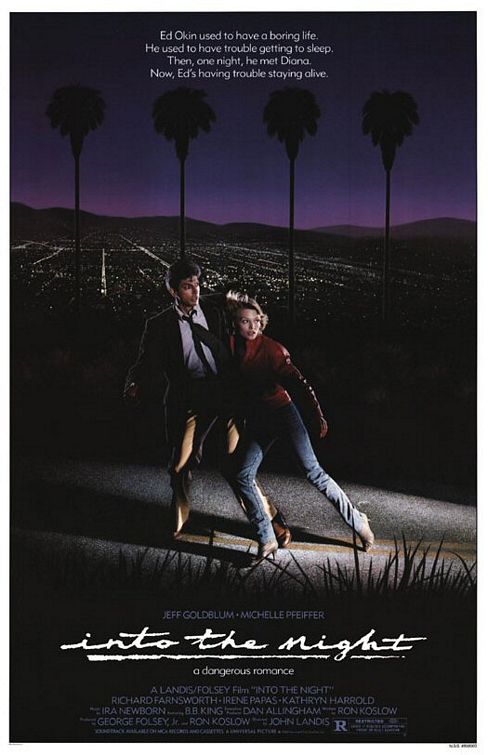
Ed Okin (Jeff Goldblum) is an insomniac, who has a boring job and an unfaithful wife and is unexpectedly thrown into espionage and intrigue when a beautiful jewel smuggler named Diana (Michelle Pfeiffer) literally lands on his car in the middle of the night while he is out taking a drive.

If you are expecting the surreal, cult-like comedy of Martin Scorsese’s After Hours then you can forget it. This thing actually tries to play it straight and does it in a low key way that makes for a lot of slow stretches intermingled with some slight comedy and action.

It’s a pedestrian caper with some ‘novelties’ thrown into to try to get you to forget how pedestrian it really is. The novelties are director John Landis’s casting fellow directors in cameo roles. Sure it’s nice to put faces to names, but the cameos really aren’t that interesting or funny. Only French director Roger Vadim gets anything remotely flashy. In fact it’s Landis who gets the best part casting himself as a crazed gunman with a large scar on the side of his face.

Goldblum is a solid everyman, but he underplays it and eventual becomes too dull. He doesn’t even react when a loaded gun is put into his mouth!! Pfeiffer is beautiful, but there really isn’t any chemistry between the two so having them end up ‘falling in love’ shows just how contrived this whole thing is.

David Bowie and Dan Aykroyd have very little screen time and are badly wasted.

My Rating: 4 out of 10

Released: February 22, 1985

Runtime: 1Hour 55Minutes

Rated R

Director: John Landis

Studio: Universal

Available: DVD

Between the Lines (1977)

between the lines

By Richard Winters

My Rating: 6 out of 10

4-Word Review: Newspaper get corporate takeover.

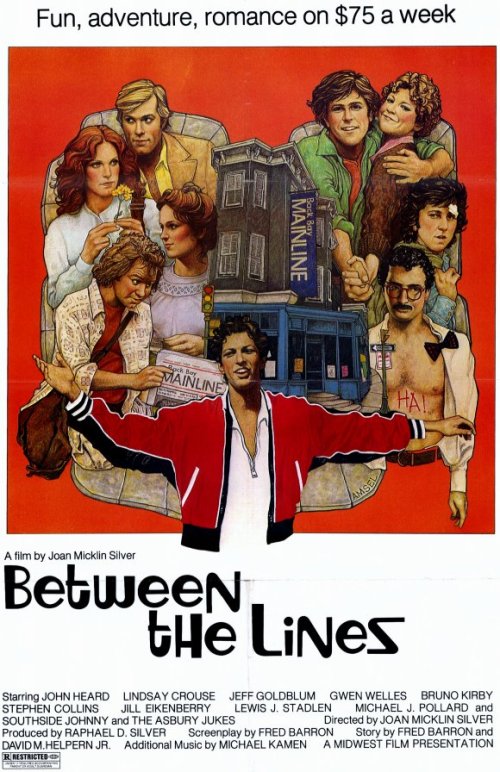
This is a look at an underground/counter-culture newspaper staff and the conflicts and concerns that they have at being taken over by a no-nonsense corporate owner (Lane Smith).

The film almost immediately takes you back to the bygone era of the late 70’s. The attitudes and conversations are realistic for that period and anyone who lived through it will most assuredly feel nostalgic .John Heard, Jeff Goldblum, and Bruno Kirby are engaging in their respective parts as is most of the cast. Stephen Collins is good also, but in an unusual role for him as he usually plays nice sensitive types, but here is a more driven, intense, and confrontational. This also works as a good unofficial statement to the death of the counter-culture movement and the eventual rise of materialism.

The story starts out well as it looks at the inside workings of an underground newspaper, but then spends too much of the middle part focusing on the relationships of some of the characters. Only at the end when the new owner takes over does it get back to the newspaper angle. Unfortunately it concludes just as things are getting interesting and we never get to see how the characters survive and adjust to the takeover. The film would have been much stronger and original had it stuck to scenarios involving the newspaper business and scrapped the relationship stuff, which tended to be derivative. Jon Korkes and Michael J. Pollard’s characters are seen too little and needed more screen time.

Also, when the film deals with the relationships there seems to be too much of a feminist bias as the men are always shown to be the ones at fault due to their ‘insensitive and selfish natures’ while the women come off the ones who are ‘reasonable and unfairly neglected’. This could be a product of the fact that it was directed by a woman as well as the era where men were somehow supposed to feel guilty simply because they were men.

This is fun as a time capsule as well as a great chance to see young stars in the making. However, the story does not take advantage enough of its original concept and ends up dealing with a lot of the same old scenarios and story lines that we’ve all seen before. Director Joan Micklin Silver and John Heard teamed up again two years later for Chilly Scenes of Winter, which I felt was better.

My Rating: 6 out of 10

Released:  April 27, 1977

Runtime: 1Hour 41Minutes

Rated R

Director: Joan Micklin Silver

Studio: Midwest Films

Available: DVD (MGM Vault)