Tag Archives: Jacqueline Bisset

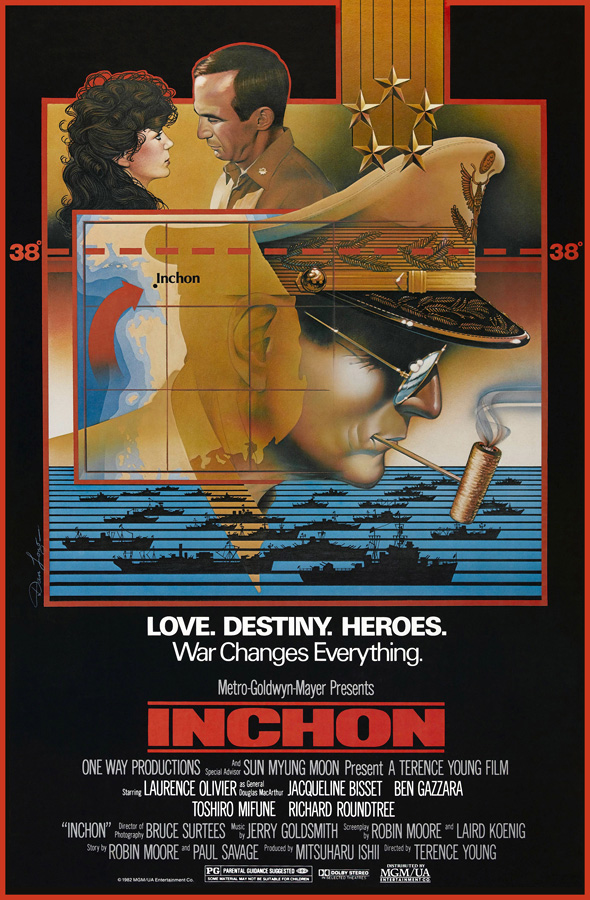
Inchon! (1981)

inchon1

By Richard Winters

My Rating: 3 out of 10

4-Word Review: Turning point in war.

Inspired by actual battles during the Korean War the film centers on the Battle of Inchon, which many consider the pivotal turning point that allowed American forces to achieve victory and was lead by General Douglas MacArthur (Laurence Olivier). While he exudes great outwardly confidence to others he does confide to his wife Jean (Dorothy James) that his age is creeping up on him and he fears he may no longer have the energy or mental acuity to take on the same types of challenges like he had done in the past. The film also has several side stories including that of Barbara (Jacqueline Bisset) whose husband Frank (Ben Gazzara), a Major in the U.S. army, is openly having an affair with a Korean woman (Karen Kahn). When the war fighting breaks-out near her she quickly tries to hitch a cab ride to get out, but soon finds herself straddled with some young Korean children who want to use her car to escape from the war with her.

The film is notorious for having been financed in large part by Reverend Sun Myung Moon who was head of the ‘Moonie’ cult that hit it’s peak during the 70’s and 80’s and gets credited with being the film’s ‘Special Advisor’ during the opening credits. He even used the help of psychic Jeanne Dixon who said she spoke with General MacArthur’s spirit and this spirit reiterated that he approved of the production, which was enough to get Moon put down a whooping $46 million to get it produced, but the film failed badly when it was released and was savaged by the critics. It was shelved for a year and then rereleased in a much shorter 105 minute version, which did not improve things and audiences stayed away causing them to only recoup of meager $5.2 million and turning it into a huge financial loss.

Overall the original 140-minute cut is the better version, if you can find it, and the movie wasn’t quite as bad as I had feared going in. The scenario dealing with Bisset and the kids is the best and I found the children to be genuinely appealing. I liked how well behaved they were and respectfully bow their heads when coming into contact with adults and won’t eat their dinner, despite being really hungry, until Bisset is sitting at the table with them. While this storyline does have a lot of similarity to The Inn of the Sixth Happiness, and in fact the hotel they stay at is named this, I still felt it was engaging enough to keep me semi-involved and had the film centered solely on this it would’ve done better though it’s still filled with some incongruities like having Bisset shoot and kill a man right in front of them where she’s not concerned about the psychological effects this may cause them, but then later when they come to a battlefield with dead soldiers laying about she warns the kids to ‘shield their eyes’, but if they’ve already witnessed one dead body and gotten through that what’s the harm of seeing a few more?

The drama dealing with her husband Gazzara and his affair is a bore and her conversations with him about it goes nowhere and slows the pace up badly as it offers up no spark and I found Gazzara’s constant smirking no matter what situation he was in to be annoying and wished someone else had been cast in the part. Olivier’s moments as MacArthur are equally cringey and should’ve been a source of complete embarrassment. However, he was at least honest about it and admitted in interviews he was only doing it for the money, so that his family would have something to keep them comfortable after he died, which he felt was coming soon and thus ‘nothing was beneath him’ as long as the ‘price was right’, which in this case was a payout of $1.5 million and included a $250,000 signing bonus.

Much of the problem with his part is with the ghoulish looking make-up that was put on and took 2 and a half hours each day to apply, but makes him look like some wax figure, his hair literally shines off his head every time it comes into any light. The effect makes him look like a walking dead person, or a strange alien from another planet and his moments come-off as either creepy, or laughable. His attempts at replicating MacArthur’s accent, which he had been informed sounded like W.C. Fields, is ineffective especially when you hear the real MacArthur speak during archival footage that appears near the end.

David Janssen as a crotchety and cynical news reporter, whose scenes were entirely cut in the abbreviated prints, is terrific and gives the movie a much needed sense of brashness and I wished his character was in it more though due to his death during filming he’s not in it as much. Everything else though unfortunately falls flat including the battle scenes that become quite redundant and surprisingly uninteresting to watch. The finale that deals with the illumination of a lighthouse and MacArthur’s reliance of banking on the ‘spirit of God’ to get it lighted was fabricated making it corny and forgettable.

My Rating: 3 out of 10

Released: May 4, 1981

Runtime: 2 Hours 20 Minutes (Original Cut) 1 Hour 45 Minutes (Reissue)

Rated PG

Director: Terence Young

Studio: MGM/UA

Available: DVD-R
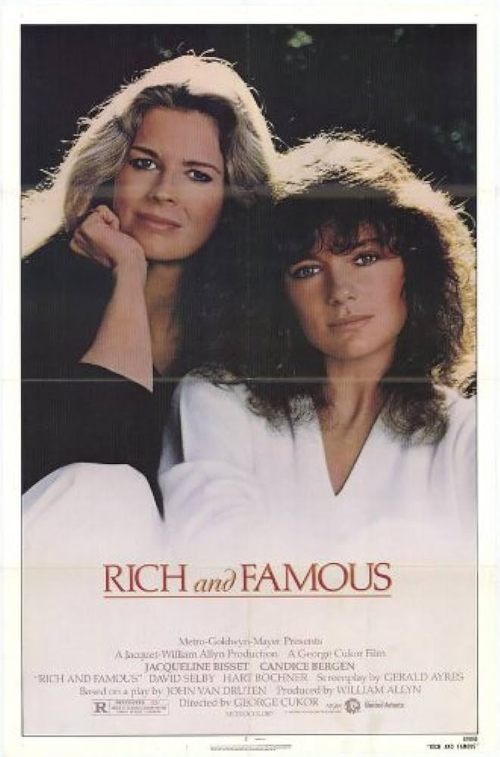
Rich and Famous (1981)

rich2

By Richard Winters

My Rating: 0 out of 10

4-Word Review: College friends become writers.

Liz (Jacqueline Bisset) and Merry (Candice Bergen) meet while attending college and become best friends. After graduation Liz achieves accolades for writing a novel and Merry, despite being married and living in posh Malibu, becomes jealous. She strives to write her own novel based on real-life experiences of her rich southern California acquaintances where only the names are changed. One night while Liz is visiting  Merry digs the first draft of her book out and reads it to her. Liz does not care for it, but promises the pleading Merry she’ll run it by her publisher (Steven Hill) convinced he won’t like it and nothing with come of it. To her surprise it does get published  and becomes a best seller. Now she’s the one seething in jealousy since her writing career has crested from writer’s block. While this is going on Merry’s husband Doug (David Selby) begins to come-on to Liz behind-the-scenes and openly wanting to have an affair with her, which Liz finds tempting since the two had a fling during college.

This is a remake of Old Acquaintances, which came out in 1942 and starred Bette Davis and Miriam Hopkins. Bisset spent 2 years working on the script and getting it funded as she was determined to play a ‘real person’ for once and not just the proverbial beauty. However, the movie, which was the last to be directed by legendary filmmaker George Cukor, bombed badly at the box office and it’s easy to see why. The storyline is out of touch with the decade that it’s in. What gets used as fashionable status symbol like having Merry stay at the Waldorf Astoria hotel might’ve been considered glitzy back in the 40’s, but for the 80’s generation would be looked upon as passe. Nothing is hip or trendy. The characters and their conflicts are of a soap opera variety, which is where this tepid storyline should’ve stayed.

My biggest beef was the whole friendship thing, which didn’t make a lot of sense. The two characters are about as different as you could get with Merry coming-off, particularly with her annoying southern twang, as dim-witted particularly when compared with Liz who’s clearly more sophisticated and articulate. Why these two opposites would bond is a complete mystery. There’s no backstory given, only a brief scene during their college days is shown, but nothing displaying what lead to the friendship blossoming, or what they had in common that they’d enjoy each other’s company. For the relationship to work it needs to be believable and organic, and the viewer able to buy into it, but instead it’s quite shallow and forced. Merry is incredibly annoying painfully insecure, emotionally needy, and grossly self centered. She’s the type of person most people would want to quickly dump as a friend and you wonder why Liz, who could easily find new friends more her intellectual equal, doesn’t do just that.

Merry’s marriage to Doug has the same issue. Why would he marry someone that had such a contrasting personality to his? The film fleetingly intimates that it was Liz he was truly after, he went to their same college, and only married Merry as an attempt to stay close to Liz, though the film relies on the viewer reading into this and should’ve instead fully confirmed it.

Merry’s ascent into the writing world is equally ridiculous. From the opening three paragraphs that she reads out loud to Liz gave more than enough reason that it was poorly written and should never see the light-of-day and yet somehow it becomes an immediate best-seller. In a better movie this might get used as satire showing how bad the American Public’s taste in literature is, but the film here has the audacity to show her winning awards for her writing, which just makes it all the more absurd and laughable. It also makes it seem like writing a book is easy and simply requires someone to sit down and throw some words on a page and walah it gets published when it reality it takes many drafts and polishing before it’s even potentially considered publish ready, but the movie glosses over this part completely.

I enjoyed Bisset who’s clearly the stronger actress, but Bergen makes an utter fool of herself particularly her attempt at a southern accent. Normally she’s good at playing the snarky type, which best reflects her personality. Trying to portray a simpleton isn’t her best suit and the film digresses every time she’s in it to the point her sporadic appearances start to seem almost like unintentional comic relief.

Had the film ended with some bitter, knockout cat fight I might’ve forgiven it and even gave it a few points. Not everyone is meant to get along and in real life these two would be a bad match. It’s one of those friendships that ultimately fizzles because the two just don’t have enough in common to keep it going and in a lot of ways ingrate on each other’s nerves. A nasty bitch session would’ve been just what the doctor ordered, and they do have a little bit of one, but then immediately make-up, which just cements the film’s profound shallowness.

My Rating: 0 out of 10

Released: September 23, 1981

Runtime: 1 Hour 57 Minutes

Rated R

Director: George Cukor

Studio: United Artists

Available: DVD, Amazon Video, YouTube

Believe in Me (1971)

believe

By Richard Winters

My Rating: 6 out of 10

4-Word Review: Couple addicted to drugs.

Remy (Michael Sarrazin) is a medical student at a New York hospital, who finds himself increasingly addicted to speed and other drugs available to him through his job. Pamela (Jacqueline Bisset) is the beautiful new girlfriend he meets through his friend and fellow intern Alan (Jon Cypher) who’s also Pamela’s brother. The two hit-it-off and soon move into together, but the romance doesn’t last when Pamela becomes aware of Remy’s addiction. He convinces her that he can handle it and even gets her to try some of it despite her reluctance. This then leads to her becoming hooked as well and their lives quickly spiral out-of-control as they both lose their jobs, their money, and ultimately their dignity.

The early 70’s was  a peak era for drug culture movies with most getting a bad rap from the critics, which included this one. Certainly it does start out cringey with a sappy love song sung by Low Rawls that not only gets played over the opening credits, but also about 30-minutes in, which practically kills the whole thing with its heavy-handed melody and lyrics. The title is not so great either as it seems to imply a totally different type of movie like have someone sticking with another person through thick-and-thin, which really doesn’t happen here and in fact its the complete opposite.  ‘Speed is of the Essence’, which was the working title as well as the title of the New York Magazine article by Gail Sheehy of which the film was based was far more apt and should’ve been kept.

However, what I did like are that the characters aren’t teen agers, or a part of the counter-culture movement, which is where all the other drug movies from that period had. The blame in those films was always the same too: peer pressure and bad influences, but here that all gets reversed. Remy and Pamela are well educated and with Remy’s background is well aware of the dangers of drugs and essentially ‘knows better’ and yet becomes a victim to them anyway. Because he’s at such a high standing initially and not just played-off as being some naive kid, makes his downfall and that of his equally smart girlfriend all the more stark and gripping.

The performances are good too. Sarrazin and Bisset met while filming The Sweet Ride, that started a 6 year relationship and this was the one project that they did together. Sarrazin has been blamed as being too transparent an actor who’s instantly forgettable and melts into the backdrop. While I’ve usually found his acting credible he does have a tendency to be passive and lacking an imposing presence, but here he’s genuinely cranky and snarly. Even has some moments of anger, which is why the movie mostly works because the character is believable. There’s good support by Alan Garfield as his dealer who gets the final brutal revenge on Remy when he can’t pay up as well a Cypher whose advice to his sister when she’s down-and-out and asking for money is shockingly harsh.

Spoiler Alert!

The film has a few strong moments particularly when it focuses on the couple’s teenage friend Matthew (Kurt Dodenhoff) who also becomes hooked and goes through a scary mental and physical decline, but the ending lacks punch. It has Remy sitting outside his apartment saying he’s ‘lost his key’ (not sure if this was meant as a code word for them being evicted, but probably should’ve been). Pamela then leaves him there while she walks to a clinic in order to get sober, which for me was too wide-open. For one thing there’s no guarantee that Pamela would’ve been able to cleanly kick-the-habit as many people enter into drug recovery suffer many relapses. Leaving Remy alone doesn’t offer any finality. Either he dies from his addiction, or finds a way out, but we needed an answer one way, or another like seeing his lifeless body lying in the gutter, which would’ve given the film the brutal final image that it needed. The movie does give an honest assessment of the situation most of the way, so why cop-out at the end and become vague? The viewer had invested enough time with this that they should’ve been given a more complete and concrete character arch.

My Rating: 6 out of 10

Released: December 8, 1971

Runtime: 1 Hour 26 Minutes

Rated R

Director: Stuart Hagmann

Studio: MGM

DVD-R (dvdlady.com)

The Greek Tycoon (1978)

greek

By Richard Winters

My Rating: 4 out of 10

4-Word Review: Marrying a rich man.

Originally intended as a fact based bio of Aristotle Onassis and his marriage to Jacqueline Bouviar Kennedy where Jackie was offered $1 million to play herself, but when she turned it down the producers decided to turn it into a ‘fictional’ story where the names of the characters were changed, but many of the elements remained the same. The plot deals with a Greek shipping tycoon named Theo Tomasis (Anthony Quinn) who is known to fool-around on his wife Simi (Camilla Sparv). One day while hosting a posh party on his yacht he sets his sights on Liz (Jacqueline Bisset) who is the wife of a politician James Cassidy (James Franciscus) who’s running for the democratic nomination for the U.S. Presidency. While Theo and Liz are able to get away from the rest of the guests and talk he’s unable to admit how smitten he is with her due to her marriage. Liz returns to the states with her husband and he’s elected President, but then is assassinated. Now widowed she decides to return to Greece and meets-up with Theo. Theo in-turn leaves his wife, who was tired of his philandering ways, and marries Liz though their marriage ends-up being a rocky one as well as Theo is unable to change his old habits making Jacki feel she’s just another ‘notch-on-his-belt’.

Producer Nico Mastorakis is probably better known for having directed the controversial horror film Island of Death, which to this day remains one of the most notorious movies ever made, but before he got into filmmaking he was a reporter, who under the guise of being a musician for a rock group, gained access to Onassis’ yacht the Christina while Aristotle was hosting a party with guests Jackie and Ted Kennedy. He hid a small camera inside the his guitar and was able to take pictures of the event before having the negatives confiscated by Ted Kennedy’s security detail. Nico though remained fascinated with Onassis and his experiences while on the his yacht convinced him he’d make a perfect subject for a movie. Quinn, met with Onassis just months before his death where he reportedly gave him blessing to play the role, so Quinn initially agreed to do it only to back-out later when he spoke with Jackie who asked him not to do it. However, months later, she then publicly snubbed him at a restaurant, which got him so angry that he changed his mind and called Nico to tell him he wanted to go through with it and play the part, of which he was paid the handsome figure of $500,000.

As a soap opera, which is all this amounts to, it’s watchable with the biggest asset being the exotic European locales. The plot moves along breezily enough to keep it mildly compelling though no effort is made to make it conform to the early 60’s time period when it all began making it seem instead like it could’ve all occurred during the 70’s. The assassination is especially surreal as James gets shot as he and Jackie are walking along the beach, but no sniper is ever seen. The camera pans over to where the shots were fired and all we see are trees like some phantom gunmen came out of nowhere to kill him and then just disappeared into thin air with no explanation for who did it, or why.

Quinn’s acting though is really impressive and one of the few reasons to watch it. Quinn has always had a magnetic energy that grabs the viewer into  his characters and makes you fascinated enough in them to keep you engrossed though the dark glasses he’s seen constantly wearing was a distraction. He wears them all the time even while inside and at night, which seems weird and makes him appear almost like he’s gangster. There’s a few times when the glass lenses inside the frames are clear and not darkened, but no explanation for why, or how they changed. His propensity for Greek line dancing only succeeds in reminding viewers of another more famous movie that he was in, Zorba the Greek, and for that reason alone it should’ve been avoided altogether.

Bisset on the other-hand doesn’t have much of a presence. Normally she’s a great actress, but her character here isn’t fleshed-out enough to make anything that she says or does interesting. It’s a transparent composite of what one might deem a First Lady to be, but with nothing unique, or distinct added into it and thus making her time onscreen seem quite blah. She does have one energetic moment when she gets into a fight with him after he embarrasses her in front of a few men and even proceeds to attack him physically, but other than that her performance, like the rest of the movie, is sterile with very little to recommend.

My Rating: 4 out of 10

Released: May 12, 1978

Runtime: 1 Hour 47 Minutes

Rated PG

Director: J. Lee Thompson

Studio: Universal Pictures

Available: DVD, Blu-ray

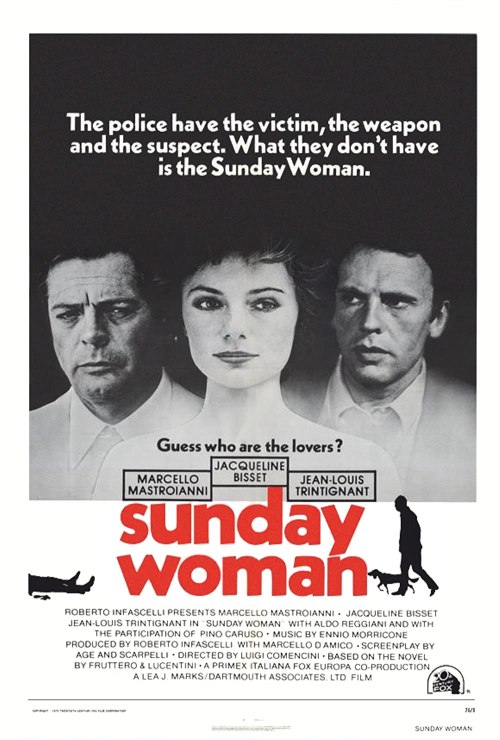
The Sunday Woman (1975)

sundaywoman

By Richard Winters

My Rating: 6 out of 10

4-Word Review: Murdered by phallic object.

Based on the novel of the same name by Carlo Fruttero and Franco Lucentini, the story centers on the investigation of the murder of Mr. Garrone (Claudio Gora). Garrone is found bludgeoned to death inside his apartment by a giant penis statue. Garrone was a well known architect and a lecherous ladies man who couldn’t help but make unseemly passes at every woman he came by. Commissioner Santamaria (Marcello Mastroianni) is put in charge of the case, which has many suspects. Two of the biggest ones are Anna Carla (Jacqueline Bisset) and her platonic male friend Massimo (Jean-Louis Trintignant). Anna had written a note, found by her hired help the next day, stating her desire to ‘eliminate’ Garrone. Anna, who’s quite wealthy, insists that it was all a innocent misunderstanding and Massimo backs her up, but Massimo, who has an alibi, is reluctant to divulge it because it would require him to admit that he’s gay and at Lello (Aldo Reggiani) his lovers’ house. Santamaria begins looking into other potential suspects as does Lello who wishes to get his boyfriend cleared, but the deeper Santamaria gets into the case the more he connects with Anna and despite their age difference they begin to have a romantic relationship all while she remains at the top of his suspect list.

The film, on the technical end, is well done. Director Luigi Comencini nicely captures the visual beauty of the Italian landscape and the posh older homes of Turin a city in northwest Italy where it was filmed. The soundtrack by Ennio Morricone has a nice bounce that keeps the film moving along even while not a lot is happening. There’s an array of suspects and enough red herrings to keep it intriguing and impossible to guess who’s the true culprit.

The story has its share of offbeat moments though it’s disappointing that the funniest character, Garrone, ends up getting killed as he was amusingly sleazy enough to have kept things consistently comical. While the death by giant penis statue, if memory serves me correctly, had already been used in A Clockwork Orange, it’s still a novel idea and it’s funny how Santamaria visualizes each suspect he meets bashing Garrone over the head with it as he interviews them. Traveling to the shop where the statues are made and being surrounded with hundreds of them is certainly good for a chuckle, but outside of this there wasn’t all that much that stood out, or made this any better than any other murder mystery. The ingredients are good enough to keep sufficient interest, but nothing the makes it really memorable.

I was most disappointed that Bisset wasn’t in it more. She’s fabulous, as she is in most of her movies, and though I suspect that her voice, where she speaks fluent Italian, is dubbed, I still felt she gives a spectacular performance. Mastroianni on the other hand looks tired and worn-out and like his peak years of being a international sex symbol had passed. Yet when he’s together with Bisset it clicks and Jacqueline’s superior acting camouflages their extreme age difference making them seem more like a perfect couple than it should. The two should’ve investigated the case together and become a team, as every second Bisset is not seen it flatlines. Had the two shared the screen this might’ve been special, but ultimately it misses-the-mark and never fully gels.

My Rating: 6 out of 10

Released: December 16, 1975

Runtime: 1 Hour 45 Minutes

Rated R

Director: Luigi Comencini

Studio: Fox-Lira

Available: DVD-R (dvdlady.com) (Italian w/English subtitles), Amazon Video (English subtitles)

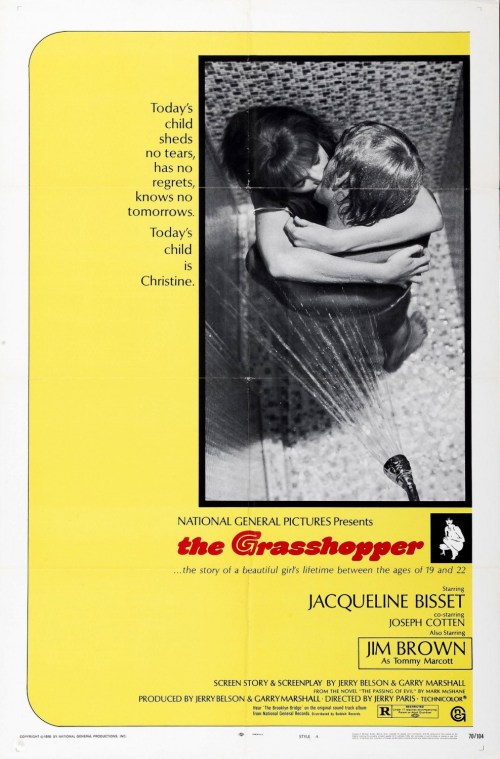
The Grasshopper (1970)

By Richard Winters

My Rating: 6 out of 10

4-Word Review: Runaway becomes  a showgirl.

Christine (Jacqueline Bisset) is a 19-year-old who’s bored with her life living in rural British Columbia and decides one morning to run away from home and meet up with her fiance Eddie (Tim O’Kelly). He gets her a job as a bank teller, but she finds this boring too, so she runs away from him and moves in with a Vegas comedian (Corbett Monica) who gets her work as a showgirl, but Christine’s inability to ever settle down and her impulsiveness leads her to spiral downhill until she’s eventually forced into prostitution.

Initially I was leery about this one as it was directed by Jerry Paris an actor-turned-director who mainly directed episodes from TV-shows as well as the infamous sequels to the Police Academy franchise and for awhile this thing did not look much better than those, but just when I thought it would be nothing more than a sanitized TV sitcom-like foray into the runaway scene it improved. The second-half has some genuinely gritty moments and the behind-the-scenes look of the showgirl lifestyle is well handled and realistic.

Bisset is excellent and her performance pretty much makes the movie, but she’s not completely right for the part either. For one thing she doesn’t look anything like 19 and was in fact 25 when she did this. She also wears too much make-up. I had no problem with this when she became a showgirl as it’s expected, but initially she should’ve had more of a plain look, which would’ve made her transition into the jaded world more visually striking.

On the flip-side I enjoyed her character and found it refreshing that she wasn’t portrayed as being so completely innocent, but in many ways her own worst enemy. The scenes where she goes out on the Vegas runway with her teeth painted black shocking some in the audience as well as handing a bank customer a note pretending that the place is being robbed reveals some intriguing self-destructive tendencies. It also makes her seem very much like a grasshopper, which was a far better title than ‘The Passing of Evil” that was used for the Mark McShane novel that the film is based on.

Jim Brown, who traditionally plays intimidating characters comes off as surprisingly gentile and sympathetic one here and the inter-racial marriage that he has with Bisset was way ahead-of-its-time. Ramon Bieri gets a great role in his film debut as a rich, arrogant tough who always expects to get his way and watching him chow down on his food is memorable. This also marks the film debut of Ed Flanders, who wears a wig here and looks far older than he did in the ‘St. Elsewhere’ TV-show that he starred in 12 years later.

The ending in which Bisset talks a airplane pilot (William Callaway) into writing ‘Fuck It’ in the sky, is funny, but the film’s overall impact is light. Adding in scenes of Bisset’s home-life growing up and during more innocent times might’ve made her transition stronger, but overall despite a few good moments it never quite comes together as a fluid whole.

My Rating: 6 out of 10

Released: May 27, 1970

Runtime: 1 Hour 36 Minutes

Rated R

Director: Jerry Paris

Studio: National General Pictures

Available: DVD-R, Amazon Video, YouTube

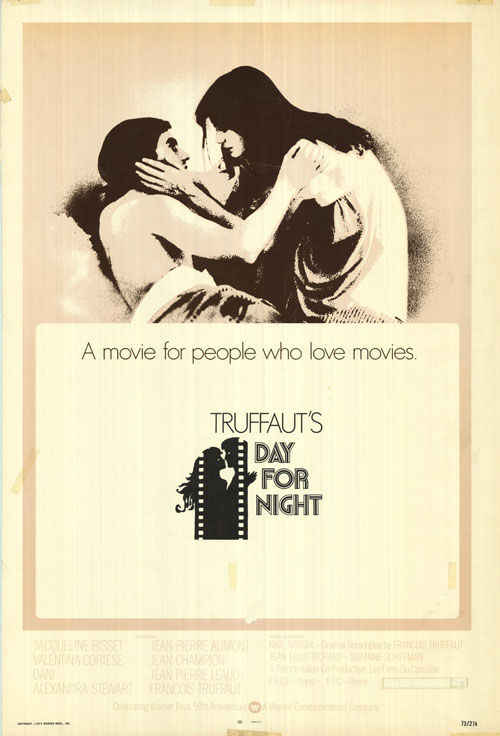
Day for Night (1973)

By Richard Winters

My Rating: 7 out of 10

4-Word Review: Movie within a movie.

Director Ferrand (Francois Truffaut) is trying desperately to complete his latest film project, but faces many challenges in the process. His young star (Jean-Pierre Leaud) is threatening to drop-out due to his recent break-up with his girlfriend, so his co-star Julie (Jacqueline Bisset) decides to sleep with him out of pity and in an effort to get the film completed, but in the process gets in trouble with her husband. Ferrand also faces issues with his other leading lady Severine (Valentina Cortese) who is an alcoholic  and with the sudden death of his male lead Alexander (Jean-Pierre Aumont).

What was once an innovative idea now seems rather antiquated. No where is this more apparent then in the scene where Severine constantly forgets her lines and opens up the wrong door during each take. At one point this might’ve seemed funny as behind-the-scenes bloopers really didn’t come into vogue until Hal Needham started showing them during the mid-70’s in the closing credits of his films. However, actor screw-ups are now no longer fresh and instead seem almost sad and pathetic especially here where you begin to wonder if the woman is suffering from severe psychological disorder. I was also surprised that the rest of the crew and director put up with it as most Hollywood productions would have the actress quickly fired and replaced.

Truffaut may be a great director, but his onscreen presence isn’t much and he hardly ever seems to be directing anything anyways, but more overwhelmed by the people and problems that surround him almost like he really isn’t in control. Perhaps this was the point, but a stronger actor with a more definitive personality would’ve hit the idea home better. I was also confused why he constantly wore an earplug that seemed to be connected to what looked like a transistor radio in his shirt pocket. Initially I thought it was to help relay messages/signals to his co-director/cinematographer or vice-versa, but then he is shown wearing it even when he was not on the set making it seem like it might be a hearing aid, but in either case it never gets properly explained, but should’ve.

Bisst is beautiful and I’ll give Truffaut credit as he certainly knows how to capture her exquisite blue eyes better than any other director.   Hearing her speak fluid French is at first surreal, but then kind of fun and watching her climb a tall ladder without hesitation in order to get onto a elevated set was impressive too as I’m not sure I would’ve been quite so brave.

The behind-the-scene romantic/sexual scenarios that occur between the cast members are quite funny, but I wished they had jumped into them sooner as I found them to be more interesting than the filmmaking stuff, which to me didn’t come off as all that revealing or insightful. I also felt the antics got resolved too quickly and easily. Again I presume this was the humorous intent by showing how no matter what the problem or issue somehow, someway they find a way to get the film completed, but the story would’ve been more captivating had these side-dramas been more played-out. It’s still an entertaining watch, but a reboot with the setting in a Hollywood production should be in order as I suspect some of the on-set politics there would be handled much differently.

My Rating: 7 out of 10

Released: May 24, 1973

Runtime: 1 Hour 55 Minutes

Rated PG

Director: Francois Truffaut

Studio: Warner Brothers

Available: DVD, Blu-ray

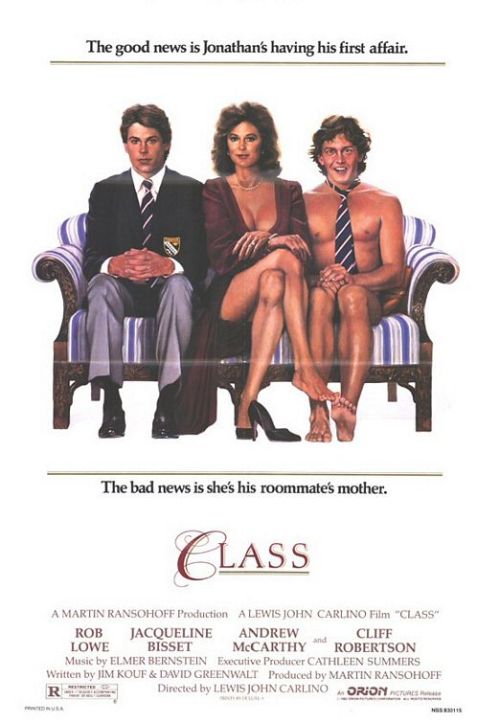
Class (1983)

By Richard Winters

My Rating: 3 out of 10

4-Word Review: Teen fucks friend’s mother.

Jonathan (Andrew McCarthy) is a new student at a prep school who rooms with Skip (Rob Lowe) and almost immediately gets mocked by the other students for being geeky. To help bolster Jonathan’s reputation Skip has him sent off to Chicago where he can meet-up with a woman, have sex with her, and then bring back her panties as a souvenir. Jonathan does that when he hooks-up with the beautiful middle-aged Ellen (Jacqueline Bisset) whom he meets at a bar and the two begin a relationship. The problem is that Ellen is also Skip’s mother.

The film was written and directed by Lewis John Carlino who had done several highly acclaimed films previously both as a writer and director so having him churn out what amounts to being just another crude ‘80s teen T&A flick is genuinely shocking. My belief is that Carlino wanted to do something that had a little more depth to it, but due to the success of movies like Porky’s the studio pressured him to incorporate raunchy humor, which creates an awkward narrative that jumps precariously from broad comedy to clumsy drama.

The film’s low point comes when Virginia Madsen, in her film debut, gets her blouse torn off and has her breast exposed that has nothing to do with the main plot and just a shameless excuse to throw in some nudity. Madsen has described her experience on this film as being unpleasant and if anything despite some ‘serious’ moments later on this scene really cements the movie as being mindless lowbrow tripe at its worst.

My biggest beef though was with Bisset’s character. It’s never explained why this sexy middle-aged woman would become attracted to a boyish guy that was young enough to be her son. Just saying she was in an unhappy marriage wasn’t enough. She could’ve attracted many eligible men that were her age, so why does she end up going to bed with a teenager that looks like he isn’t even old enough to shave?

Bisset complained in interviews that the film cut out many crucial scenes that would’ve given her character’s actions more subtext. One included having Lowe visit her after she checks herself into a hospital. This scene was needed as the film essentially has her ‘disappear’ and only mentions in passing where she’s gone while seeing a scene with Lowe visiting her would’ve given the characters and movie better closure.

I also thought it was weird that Lowe and McCarthy continue to room together even after the awful revelation of the affair comes to light. I would think that the awkwardness of the situation would have both boys clamoring to be transferred to a different dorm room. They also end up getting into a physical altercation, which gets pretty extended and one of the film’s best moments, but I sided with Lowe, which I’m not sure was the filmmaker’s intention, as I felt McCarthy deserved to get his ass kicked since he continued to have sex with Bisset even after he knew she was Lowe’s mother.

The film only works when Lowe and McCarthy are together and in fact Lowe’s engaging performance is a highlight, so a better scenario would’ve had both boys going to Chicago for a road trip and to get laid. At a bar they’d meet an attractive middle-aged woman and bring her back to a hotel room for a threesome. Afterwards both boys would compete for her affections only to later realize that she was the wife of the principal of their school. This situation would’ve allowed for more consistent comedy while not seeming like a poor rip-off of Summer of ’42 and The Graduate, which is essentially what this movie becomes.

The plot, as dumb as it is, can’t even sustain the film’s entire runtime as the third act consists of Stuart Margolin  investigating students cheating on their SAT’s that goes nowhere and put in solely as filler. Overall the film is a pointless excursion and worth seeing only if you’re into Bisset or for catching John Cusack, Lolita Davidovich, or Virginia Madsen in their film debuts.

My Rating: 3 out of 10

Released: July 22, 1983

Runtime: 1Hour 38Minutes

Rated R

Director: Lewis John Carlino

Studio: Orion Pictures

Available: DVD, Blu-ray, Amazon Video, YouTube

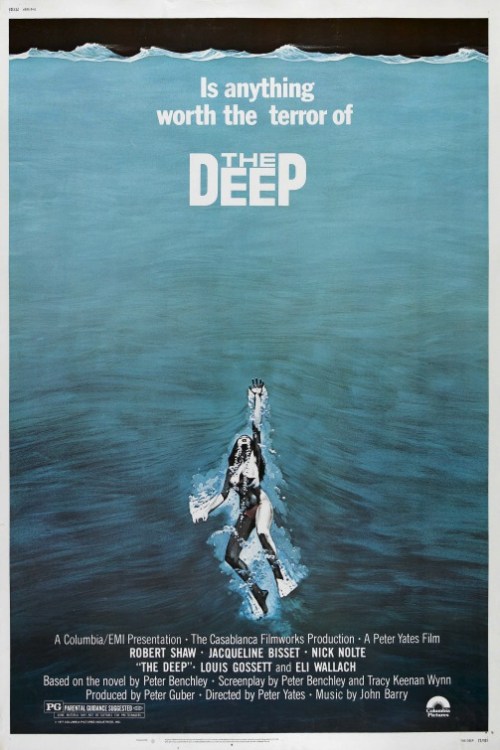
The Deep (1977)

By Richard Winters

My Rating: 3 out of 10

4-Word Review: Couple finds sunken treasure.

David (Nick Nolte) and Gail (Jacqueline Bisset) are a couple scuba diving off the Bermuda coast when they come upon a shipwreck and some artifacts left from it. They meet with treasure hunter Romer (Robert Shaw) who tells them it is a part of a Spanish treasure and works with them to try to unearth the rest of it. Problems arise when a shipwreck from World War II, the Goliath that had carried a cargo of medicinal morphine rests right next to it. To get at the Spanish shipwreck they must also go through the Goliath. Cloche (Louis Gossett Jr.), a local drug kingpin, wants to get his hands on the morphine, which could be worth a tidy sum of money and he tries to scare away Romer and the couple from continuing their diving activities, so Romer makes a deal with Cloche, but it backfires and turns the expedition into an intriguing game of underwater double-cross.

The film is based on the novel of the same name by Peter Benchley, who because of the success of his first novel Jaws, was given an almost immediate green light to turn this book into a movie. The inspiration for the story was based on the real-life shipwreck of the Constellation, which occurred off the coast of Bermuda in 1942. Great effort was put into the underwater footage, which lasted for 153 days and consisted of 8,895 dives.

Unfortunately despite the title and underwater storyline the film lacks depth where it counts, which is with the characters. The movie starts out immediately with the couple scuba diving and finding the treasure before we have any idea who these people are or why they are even there and no suitable backstory is ever given, which makes them come off as bland people lacking any real distinction and that you care little about. Character development is still an integral part of moviemaking and the main ingredient that gets the viewer hooked into a story and yet this film completely lacks it.

I’ll give credit to both Nolte and Bisset for doing their own diving and Nolte looks great with his bleach blonde hair almost like he’s a surfer dude, but his presence really wasn’t needed. Bisset, despite the extreme limitations of the weak script, still gives a far better performance and I felt she could’ve easily carried the film without him and I’m not just saying that because she looks great in her skimpy underwater gear, which was purportedly the whole reason why this film did well at the box office. Sure she’s beautiful, but she’s also quite talented.

Shaw should’ve added an extra boost in support, but he doesn’t. Normally his strong personality literally eats up the screen in any movie that he is in, but he’s stifled by the benign characterization and unable to rise above it. In retrospect he should’ve never have accepted the part until he had actually read the script, but because he was offered $625,000 plus a percentage of the profits, he took the role before the script was even written and hence the whole problem.

Gossett is weak as the bad guy and is not seen enough to create any genuine feeling of menace. The segment where he and his cronies try to ‘terrorize’ Bisset by performing some very clichéd type of black magic voodoo on her is almost laughable. The only actor that is actually good here is Eli Wallach and it is a testament to his superior thespian abilities that even though he was straddled with a pointless, bit role he was still able to own every scene that he is in anyways.

The film’s only interesting moment, which apparently took 1,080 hours to shoot, is when a pack of grey sharks converge for an eating frenzy and get tangled up in the air hoses of the crew, but even this becomes unintentionally funny because every time one of the sharks move an air hose the crew is forced to suddenly jump up in the water making them look quite literally like a puppet on a string.

The script desperately needed some added element as the concept is too basic and one-dimensional.  Watching one dull group of people trying to get at a treasure while another equally dull group of people try to stop them does not make for a riveting cinematic experience.

My Rating: 3 out of 10

Released: June 17, 1977

Runtime: 2Hours 4Minutes

Rated PG

Director: Peter Yates

Studio: Columbia Pictures

Available: DVD, Blu-ray, Amazon Video, YouTube

Airport (1970)

By Richard Winters

My Rating: 8 out of 10

4-Word Review: Terror in the skies.

During a major snowstorm at Chicago’s Lincoln International Airport manager Al Bakersfield (Burt Lancaster) must scramble to keep the place open while trying to get a disabled jet plane that is stuck in the snow off the runway. Meanwhile on a flight headed for Italy there’s the mentally unhinged Guerrero (Van Heflin) sitting with a bomb in his briefcase set to go off and explode the airplane and killing everyone inside, so that his family back home can collect on the insurance money.

The film is based on the best-selling novel by Arthur Hailey and despite some critics, like Pauline Kael, hating it for its soap opera-like dramatics I still came away feeling it was perfect crackerjack entertainment. The characters on the plane are quite diverse with unique problems and personalities making them seem like real people that the viewer becomes genuinely concerned for. The special effects, particularly those done inside the plane, are effective and the film has a nice dramedy balance.

The only drawback, and I hesitate to bring this up as I think they did the best they could’ve done under the circumstances, are the special effects dealing with the snow storm. It was shot at the Minneapolis/St. Paul airport during the winter of 1969, but unfortunately the whole time the film crew was there the weather remained sunny forcing them to eventually have plastic snow shown falling while the in the background the sky remains crystal clear and sunny. The snow shown falling during the nighttime scenes is equally problematic. I resided for many years in the North Country and I know that when it snows at night the sky gives off a bright white glow and it’s never pitch black like it is here.

The film was considered innovative at the time for its use of the split-screen particularly when it would show people talking on the phone to each other. Director George Seaton wisely doesn’t overplay this and uses the device sparingly for the most part however the segment where Lancaster is shown in one square talking to his wife, who is in another square along with their two daughters who each pop-up in their own individual squares it starts to resemble the opening to ‘The Brady Bunch’.

The acting by the female performers is quite strong. I was really impressed with Jean Seberg, her career started back in 1958 when she beat out 18,000 other applicants to get the starring role in Otto Preminger’s Saint Joan despite her lack of acting experience and although her performance in that film was lambasted by the critics I felt here she was solid and she could’ve easily carried the film during the scenes at the airport without Lancaster’s presence, who plays her boss, being needed at all.

Jaqueline Bisset is equally good as the stewardess who knows how to think on her feet.  I liked how this role didn’t take advantage of her looks or sexiness and instead kept it focused solely on her dramatic acting ability and I loved her shoulder length hair cut here as opposed to her really long hair style that she usually sports. Helen Hayes is hammy as the old lady stowaway, which netted her an Oscar, but Maureen Stapleton, who was also nominated for best supporting actress, is quite good too. Her talents lie more in her expressive face particularly the moment when she looks out the airport window and witnesses the plane carrying her husband, who she knows has a bomb, take off.

Dean Martin is excellent on the male end. Typically he comes off as tipsy and laid-back, but here he surprisingly takes the reins and helps propel the picture. George Kennedy is also surprisingly strong. Most of the time his presence amounts to nothing more than token supporting parts, but here he plays the gruff, brash airline mechanic to great effect and could help explain why his character was the only one to appear in all four airport movies.

The film does come off like it was released in the ‘50s instead of the 70s by having a cast that was mostly past their prime, but it’s by far the best disaster flick from the ‘70s, and there were a lot of them, as well as better than any of the three sequels that followed it.

My Rating: 8 out of 10

Released: March 5, 1970

Runtime: 2Hours 17Minutes

Rated G

Director: George Seaton

Studio: Universal

Available: DVD, Blu-ray, Amazon Video