
By Richard Winters
My Rating: 3 out of 10
4-Word Review: From newsboy to gangster.
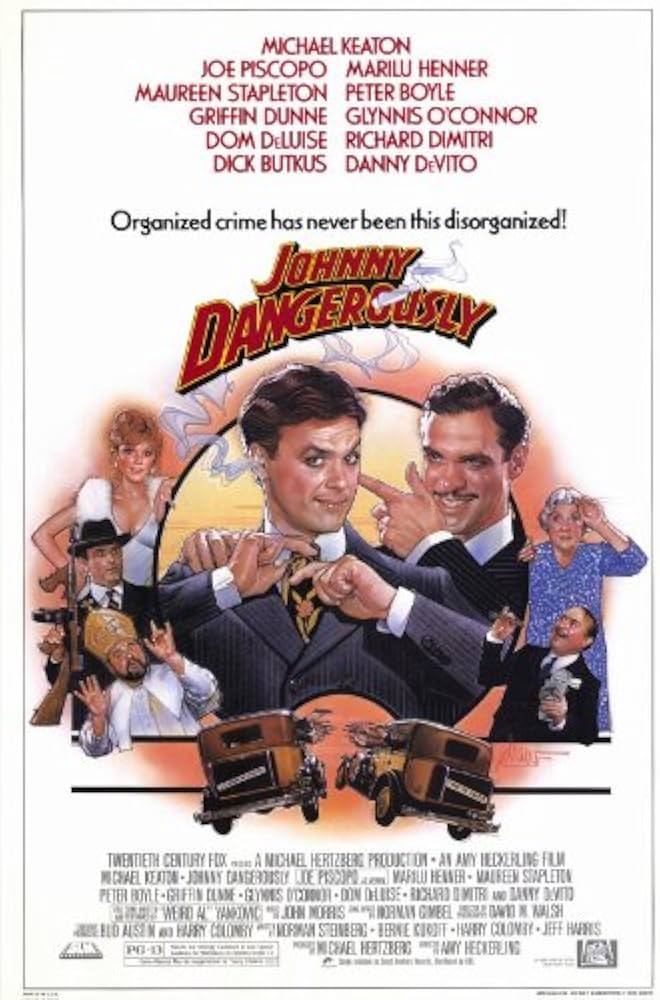
Young Johnny (Byron Thames) must find some income to help his mother (Maureen Stapleton) with her medical expenses. He catches the eye of Jocko (Peter Boyle) a notorious gangster who offers him odd crime jobs to do part-time and Johnny takes him up on it but feels guilty. The years pass and a grown-up Johnny (Micheal Keaton) finds that his mother’s health hasn’t improved, and the bills continue, so he decides to get into the gangster business full-time and even takes over as head of the gang once run by Jocko. The money is so good that it not only covers everything his mother could need but also helps his younger brother Tommy (Griffin Dunne) get through law school. However, once Tommy graduates, he gets a job at the D.A. office where becomes committed to stamp out corruption and put all criminals behind bars even if it would mean his older brother.
The pace and structure are modeled after the more successful Airplane movies in which the light plot works as a platform for a barrage of rapid-fire jokes and pratfalls mostly satirizing gangster movies from the ’30’s. While Airplane came off as fresh and funny as it poked fun of all the disaster movies from the ’70’s this thing seems old and tired before it’s barely even begun. The biggest issue is that gangsters had already been parodied for many years both in TV and on the big screen. By the time this movie came-out most of the jokes had already been used many times over and the comedy fails to create anything inventive. The characters are nothing more than walking-talking cliches that mouth banal one-liners and not much else. Almost all the jokes fall flat, nothing sticks and has no edge to it. It’s something that could’ve easily been made for TV and it should be no surprise that the writers were two men who helped create the ‘Different Strokes’ TV-show.
What surprised me most is that it wasn’t even dirty, or at least not that much. It’s directed by Amy Heckerling who had just gotten done doing Fast Times at Ridgemont High, which seemed to have bawdiness and sexual innuendoes in almost every frame and yet here there’s surprisingly very little. Yes, there’s an animated segment dealing with victims of enlarge scrotums, which doesn’t have much to do with the story, but is kind of amusing, but that’s about it. Some more sex and even nudity could’ve helped enliven things, or at the very least given something more to laugh it. The malapropisms by the gangster character Moronie, played by Richard Dimitri, where he uses a lot of colorful language that sounds like curse words, but really aren’t I didn’t find to be clever at all. Today words like fuck and fucking are used liberally in social media and even casual daily conversations. I even hear young neighborhood kids saying it, so for a movie to think that it’s ‘pushing the envelope’ by having someone use phrases the sound like the F-word but aren’t makes the movie seem quite dated.
I didn’t care for Keaton. He comes-off like some smart ass who’s phoning in his performance with a pasted-on smile that never leaves his face. It’s like he isn’t even acting or trying to create any type of character. He just casually walks on, makes a semi-amusing remark, and then walks-off. Thames who played the younger version of Johnny was better and the movie could’ve been more engaging had Johnny remained a kid the whole way and then watching an innocent teen take down the gangsters and even ultimately become their leader would’ve had some original spin that’s otherwise lacking.
Joe Piscopo, who plays Johnny’s criminal rival, is quite good and as opposed to Keaton, seems to be making some sort of effort to play a role and I thought he should’ve been in it more, or even just given the reins and taken over completely. The film’s promotional poster makes it seem like the two will have equal screentime, but that’s shockingly not the case and Joe’s presence amounts to a few walk-ons, which is a shame.
The rest of the supporting cast are equally wasted. Marilu Henner sings a nice dance number but otherwise doesn’t do or say anything else that’s interesting. Stapleton looks way too old for the role of a mother and would be more suited as a grandmother. At one point she even refers to herself as being ’29’ despite having gray hair. Don’t know if this was meant to be a ‘funny joke’, but it doesn’t work and is dumb like most everything else. Dunne is miscast as well. He’s supposed to be this young idealist but appears much more like someone already in their 30’s and would’ve been more authentic had they gotten a college aged student with a wide-eyed, clean-cut image versus Dunne who’s always had more of a weary and beaten down impression. Dom Deluise though is the most out-of-place in a part that amounts to being a cameo as the Pope who appears inexplicably on a city sidewalk for some strange reason that misses-the-mark completely in a gag that like everything else gets thrown-in with little thought, or care.
I did do enjoy Danny DeVito who amazes me how even when given small roles still manage to steal the proceedings especially with his impromptu hosting of a game show send-up. I’ll even give a few props to the ‘pass the secret message’ segment done inside a jail where one prisoner whispers something into another prisoner’s ear, who then passes it along to yet another guy and so forth down the line until it gets to the last one where the initial message has now become completely distorted, which got me to laugh, but honestly that was the only time during the whole viewing that I did.
My Rating: 3 out of 10
Released: December 21, 1984
Runtime: 1 Hour 30 Minutes
Rated PG-13
Director: Amy Heckerling
Studio: 20th Century Fox
Available: DVD
 Scopophilia