
By Richard Winters
My Rating: 7 out of 10
4-Word Review: Small town quits smoking.
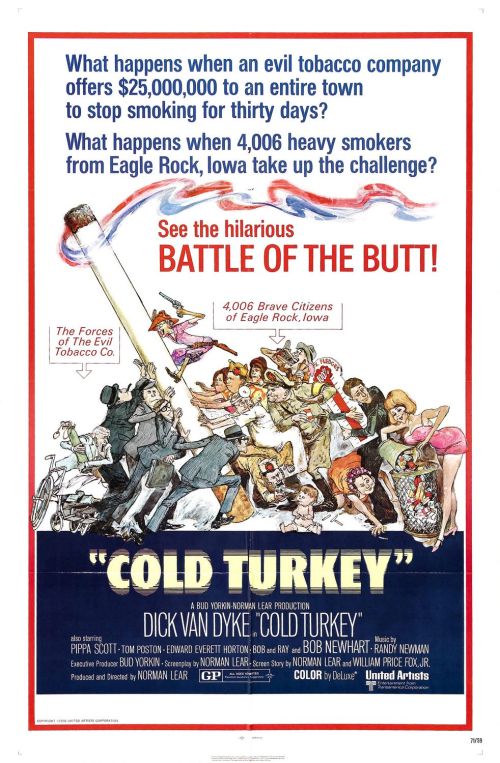
To commemorate the passing of Norman Lear last week at the ripe old age of 101 we decided to review the one film that he directed and was shelved for two years by the studio who didn’t think it would be a hit with any audience and only decided to eventually release it once Lear had success with the classic ‘All in the Family’ sitcom. The story revolves around a small town in Iowa named Eagle Rock. The Reverend Clayton Moore would like a bigger congregation in a more prestigious area as he feels trapped in what he considers a ‘dying’ town with limited employment opportunities. He then hears about a contest that a giant tobacco company is sponsoring where they try to see if there’s a town in America that will make a pledge to agree to quit smoking for 30-days and if they succeed will be awarded $25 million. Merwin Wren (Bob Newhart), who works for a tobacco company, bets that there isn’t a place that would be able to make this pledge, but Clayton, figuring this may be his ticket out and onto greater things, pushes the citizens to sign the pledge, which will then put Eagle Rock on the map.
The location of the film shoot was Greenfield, Iowa, which I traveled to in 2009 and was amazed how similar it still looked after 40 years. The opening sequence showing the town from the south end still had many of the same buildings and the courthouse along with the gazebo in which the reverend makes his fiery speech are all still there and looking almost untouched.
The town itself is really the main star. Lear does a terrific job of showing the people who live there as they really are versus in some idealistic, or romanticized way. Too many other Hollywood productions seem to suffer from the Mayberry effect where the citizens are portrayed as simple and content ‘God Fearing’ folk who are devoid of any complex personality. Here they are frustrated individuals who secretly dream of moving away, or ‘hitting it big’ in some way, but because they don’t have the means to achieve this ultimately find themselves stuck and just trying to make the best of it. The people are no more immune from temptation, or corruption, than the ones living in a big city and if anything are even more susceptible since they haven’t been put in that situation much, but when they are, as evidenced when the place gets spoken about all over the media and everyone from all over descends on it including Lottie (Gloria Leroy) a prostitute under the guise of being a masseuse who services all married men.
Beyond the on-target satire the film also scores with its fabulous ensemble of character actors, many of whom would later star, or guest star, in many of Lear’s TV-shows. Each actor plays a distinct personality from Barnard Hughes the fidgety and nervous doctor who resorts to lollipop sucking, or Graham Jarvis the head of a far-right organization, who preaches about the evils of ‘big government’, but then readily accepts for his group, which is mainly made up of senior citizens, to become a voluntary gestapo-like militia that arrests those who are caught smoking and forcibly search all in-coming vehicles. Pippa Scott though, as Clayton’s much put-upon wife, was my favorite. She encompasses what I think a lot of small town people can feel especially those that weren’t originally from the area, who are stuck in a dead-end marriage and perennially forced to ‘put on a happy face’. Her primal scream, which happens during a dream-like segment on the rooftop of one of the houses while neighbors stand around watching I felt was one of the film’s defining moments.
In the lead roles Dick Van Dyke is terrific mainly because he plays against type. Part of what I felt killed his movie career was that he took too many roles that were just an extension of his Rob Petrie persona in his famous TV-show. Here though he’s the opposite playing an egotistical, narcissists who cares about nothing other than his own career ascension, but manages to do it in a way that’s quite amusing. Newhart plays an unusual role for him as well. Typically he’s a buttoned down, strait-laced guy commenting on the insanity around him, but here he is the nutty one and does a trick with his eyes that gives him a psycho appearance.
Spoiler Alert!
The one flaw is the ending in which all three leads (Van Dyke, Newhart, Hughes) get shot in the middle of a crowd of people standing in the town center. The shootings look fake as they show no bullet hole in their clothing, or blood even just a little bit for authenticity. One shot shows people in the crowd holding the heads of the victims as they lay there in an effort to comfort them, but then in the next shot has the three lying all alone as the crowd essentially abandoned them, which seemed unrealistic that absolutely no one would care. Having an ambulance driver trying to drive-in through the mob, but then maybe stopping to run out and grab the cigarettes that rain down on the town from a helicopter, would’ve been amusing and better explanation for why the three didn’t get the help that they needed.
There’s also one shot showing Newhart sitting up and laughing, but what is he laughing about and why would he be doing this when he’s been injured with a bullet? There’s no answer to this, which makes it come-off as a cop-out ending and like Lear had written himself into a hole that he couldn’t get out of.
My Rating: 7 out of 10
Released: January 20, 1971
Runtime: 1 Hour 41 Minutes
Rated GP
Director: Norman Lear
Studio: United Artists
Available: DVD, Blu-ray, Amazon Video, Tubi
 Scopophilia