Tag Archives: Entertainment

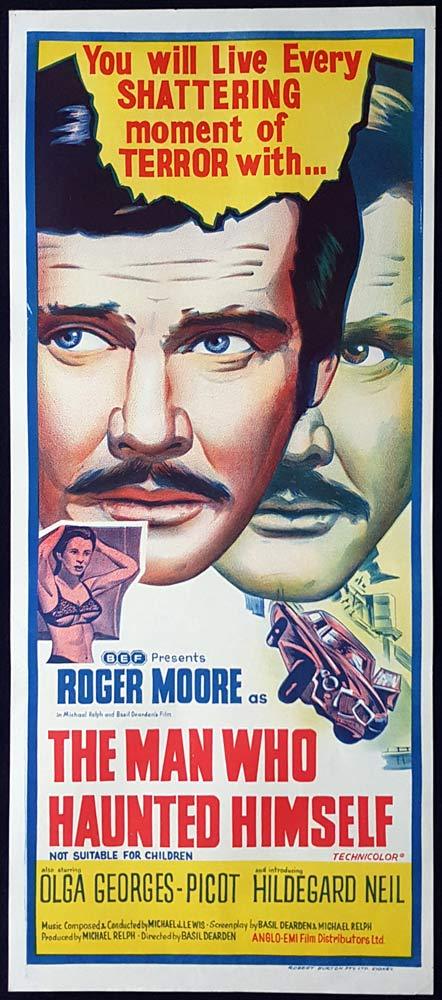
The Man Who Haunted Himself (1970)

man3

By Richard Winters

My Rating: 3 out of 10

4-Word Review: His doppelganger takes over.

Pelham (Roger Moore) is a conservative, staid businessman who is married with two kids and for all practical purposes leads a predictable life. One day he goes out driving and begins to pretend he’s a race driver in a sports car. He removes his seat belt and accelerates the vehicle before getting into an awful crash. The doctors at the hospital are able to save him, but as he returns to his normal way of doing things he keeps hearing about another man who looks just like him appearing all over town. The man associates with many of his same friends and eventually moves into his home and has relations with his wife while he’s not there. Pelham tries putting at stop to it only to find that his friends and family prefer the new Pelham over the old one.

While the concept has intriguing elements the way it gets handled is a letdown. Supposedly his doppelganger represents his more reckless side that he keeps oppressed, but then having him immediately give into his wild impulses through his driving doesn’t seem like dual personalities, but more like it’s all-in-one. His recovery, especially after such a life threatening accident, happens too quickly and the idea that he can just go back to normal and continue to drive the same car that he totaled (he buys a new one, but the same model) seemed dubious as I’d think in reality his license would’ve been suspended for causing a crash that put both him and others at extreme risk.

The movie makes clear through flashback that there really is a double versus keeping this aspect a mystery and allowing in the idea that it might be a person disguising himself as Pelham. There’s very little difference between the two, so having them both walking around adds nothing. If the twin is supposed to represent his wild side then this needs to be shown through his attire, hairstyle, and speech pattern. The only real difference is that one drives a flashy sports car, but that’s it. You’d also think that those around him, especially his family, would sense something was off instead of having the real one become the odd man.

Moore has stated in interviews that his was his favorite role, but I don’t know why because outside of having a perpetual confused look on his face his character has little else to do. The production values, for what it’s worth, are excellent, but the story is too thin for feature length. The second act gets especially boring as Pelham is constantly hearing from others about his double over and over again until it becomes redundant. It takes too long for the protagonist to become aware of something that the viewer catches onto early on. The ending is vague and offers no suitable conclusion or answers. Normally I’d say this is the type of story, which was based on the novel ‘The Case of Mr. Pelham’ by Anthony Armstrong, that would’ve been better as an episode for an anthology series, but in this instance that’s actually what occurred as 15 years earlier it was a first season episode of ‘Alfred Hitchcock Presents’. with Tom Ewell playing the part of Pelham and the compact 25-minute runtime did a far superior job with the concept than the 94-minutes does here.

My Rating: 3 out of 10

Released: July 18, 1970

Runtime: 1 Hour 34 Minutes

Rated GP

Director: Basil Dearden

Studio: EMI Films

Available: DVD
Freeway (1988)

freeway1

By Richard Winters

My Rating: 5 out of 10

4-Word Review: Killer in a car.

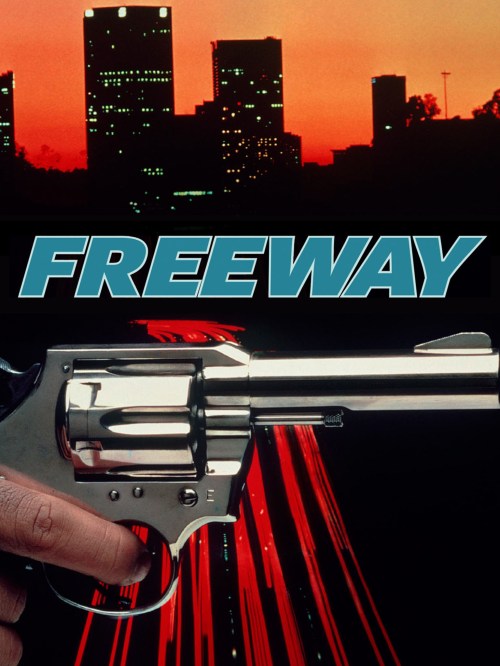
Sunny (Darlanne Fluegel) is an emergency room nurse still grieving over the senseless death of her fiancee at the hands of a highway killer (Billy Drago) who drove-up beside them one late night and shot him through their car window. Sunny is constantly hassling the police for updates on the case, but the police sergeant Lt. Boyle (Michael Callan) is aloof and put-off. Frank (James Russo) is an ex-cop who left the force when a drug gang he was investigating annihilated his whole family. He senses Sunny’s despair and the two team-up to find the killer along with radio talk show host David Lazuras (Richard Belzer) whose show gets calls from an unhinged man, who quotes Bible verses and claims to be the one they’re looking for.

The story has some intriguing elements and I liked how initially we don’t know the identity of the assailant, but the concept, which is based on the novel of the same name by Deanne Barkley, is poorly thought-out. This freeway shooter makes headlines for having killed many people, so Sunny wouldn’t be the only one getting on the police about finding the culprit as the entire city, which would be gripped with panic, would also be and if the city’s force wasn’t doing enough then federal agents would be brought-in.

The car that the killer drives, which is an older model with a broken front grill, is similar to the haunted vehicle used in the cult-classic The Carbut because it has a distinct appearance the guy wouldn’t be able to get away with his crimes for too long as surely other people on the very busy L.A. freeways would’ve spotted him and had his license plate, or general whereabouts, called-in. Some drivers would likely have tailed him and even cornered his car with theirs until the police got there. The car also smashes into several other vehicles, and since it was an old clunker, it would need body work, and thus pique the suspicions of the auto repairman who would likely alert authorities. In either event having the killer get away with as much as he does and with only one person emotionally vested into finding him doesn’t gel.

While the leads are bland the supporting cast is interesting. Callan, who was a semi-star during the 60’s before his career cratered, does well as the non-nonchalant police chief and still looking good despite some weight gain around the face. Clint Howard has a fun bit as a porn obsessed mechanic, who agrees to let Sunny drive his prized sports car while he gets her’s fixed. While allowing some random chick to take his car, which no auto mechanic in the history of the world would do, or feel obligated to do, I was willing to accept it using the rationale that he was hoping it might help him score with her later, but the fact that she keeps this ‘loaner’ for days, even weeks, without returning it gets ridiculous.

Country music legend Roy Clark is listed in the part of a CHP officer, but I didn’t spot him. I had a feeling it was played by someone with the same name, I know when I lived in Indy there were 7 other men in the phone book with my name, and since Roy and Clark are both quite common, it seems reasonable that it was somebody else, so listing it in Roy’s filmography on IMDb is a mistake.

The tension isn’t strong and weakens quite a bit by the third act, which is when it should’ve been the strongest. Director Francis Delia, who before this worked on music videos, tries hard to give the proceeding a stylistic touch, which might’ve fared better had the story and characters been thoroughly fleshed-out.

My Rating: 5 out of 10

Released: September 2, 1988

Runtime: 1 Hour 31 Minutes

Rated R

Director: Francis Delia

Studio: New World Pictures

Available: DVD, Blu-ray

Street People (1976)

street1

By Richard Winters

My Rating: 5 out of 10

4-Word Review: Betrayed by his nephew.

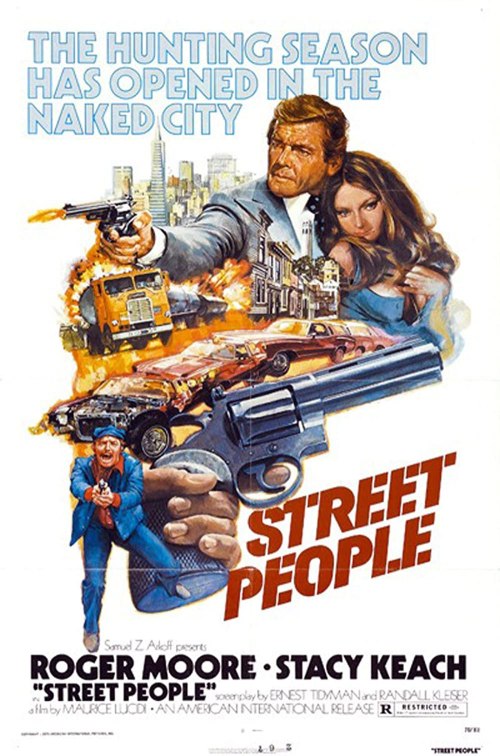
Salvatore (Ivo Garrani) is a crime boss residing in San Francisco who orders a specially made cross to be shipped from Italy to his church as a gift. Inside it is a stash of pure heroin, which leads to a crime hit and several deaths. Padre Frank (Ettore Manni), the priest at the church that was to receive the cross, thinks Salvatore was aware of the hidden heroin and used the cross as a ruse to get the drugs passed customs and thus he ex-communicates him from the church. Salvatore insists he had no knowledge of the heroin and hires his nephew Ulisse (Roger Moore), who is half Sicilian, to investigate and find out who the real culprit is. Ulisse asks his Grand Prix racing driver friend Charlie (Stacy Keach) to help him out, but the deeper into the case they go the more it leads them to believe that Salvatore was the mastermind behind it.

This unusual endeavor was produced by an Italian production company, but filmed in the U.S. with a British star and American actor and yet the supporting cast is made-up entirely of Italian performers straight from Italy. The Italians have their voices dubbed and share a high number of scenes only amongst themselves, while Moore and Keach speak in their regular voices and appear the majority of their screen time together. The result is a haphazard effect that cuts back and forth between what seems like two completely different movies spliced together. Casting Moore as someone who is ‘half-sicilian’ despite his very thick British accent, and pale skin, is one of the more ludicrous casting decisions ever made and the script, which Moore stated both he and Keach couldn’t make any sense out of even after watching the final print, goes all over the place and will be confusing to most.

The film does have some good points. Moore plays his part in a terse,no-nonsense style and I wished this was how he had approached the Bond role instead of the detached, humorous way that he did. Keach is highly engaging and watching the two trying to work a case despite having such opposite personalities is enjoyable, but there’s no explanation for how they ever met, or would even want to work together as they don’t get along. There needed to be at least one scene showing a genuine friendship in order to make their buddy relationship make sense instead of just the constant bickering.

The special effects are decent if not exceptional and for those just looking for some action and don’t mind a flimsy storyline then this should do. The scene where Keach takes a member of the mob’s car for a ‘little drive’ and then proceeds to recklessly smash it up before their very eyes is a delight. The car chase sequence gets riveting and the look of sheer panic in Moore’s eyes, as he was the passenger with Keach driving, makes it seem authentic and it’s nice to see people wearing seat belts, or at least putting them on once the ride gets dangerous, as that’s something you don’t always see in other movies. The foot chase that takes place over the rooftops of San Francisco’s business buildings is good too.

It’s unclear though what the film, which had six writers and two directors, was hoping to achieve. Maybe they just wanted to make a cheap, mindless action flick and for that you could say it’s a success, but there are some weird moments. The cross that gets shipped-in is unusual looking particularly the Jesus figure making me wonder if they were trying to go for something more like spoof, but either way it ultimately ends-up being an inept drama with few car smash-ups for diversion.

My Rating: 5 out of 10

Released: March 30, 1976

Runtime: 1 Hour 32 Minutes

Rated R

Director: Maurizio Lucidi, Guglielmo Garroni

Studio: American International Pictures

Available: DVD, Blu-ray

Over the Brooklyn Bridge (1984)

over1

By Richard Winters

My Rating: 3 out of 10

4-Word Review: Hoping to buy restaurant.

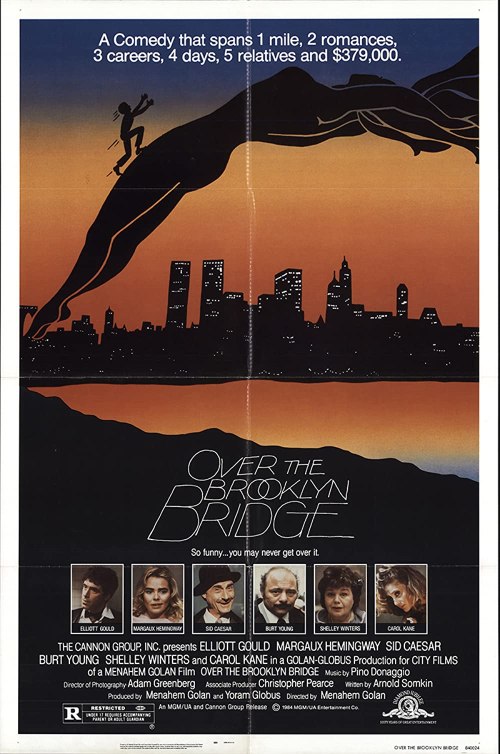
Alby (Elliot Gould) is tired of slaving away as a cook at a small Brooklyn diner run by both he and his mother (Shelley Winters). He dreams of owning a swanky restaurant in downtown Manhattan and finds the perfect place, but he needs help with the financing. He goes to his rich uncle Benjamin (Sid Caesar), who at first is reluctant to loan him the needed money, but eventually agrees. However, it comes with one big stipulation; Alby can get the money, but only if he ends his relationship with his live-in girlfriend Elizabeth (Margaux Hemingway), who his uncle has never liked since she’s not Jewish.

From the outset I internally groaned when I saw that it was produced by Cannon Pictures, which was notorious for making a lot of cheesy action flicks during the decade, but this one is approached differently. The script, by Arnold Shulman, who died at the young age of 48 before filming of his screenplay had even begun, is much more personal than the usual Cannon fodder as it delves into the close-knit, extended Jewish family who can be both a source of great support and hindrance.

I was happy too, at least initially, to see Hemingway get another shot at a co-starring role. She was a model, and granddaughter of Ernest Hemingway, who broke into the movie scene with the controversial hit Lipstickwhere she played a rape victim, which was too demanding of a part for someone with so little acting experience. This role here was more reasonable, but without sounding too harsh, I couldn’t stand her voice. Her famous sister Mariel has a very pretty sounding one, so why Margaux got stuck with such an unusually raspy one that belied her otherwise young age I didn’t understand. I know when I watched Lipstickwhich was released 8 years earlier, her voice was only slightly raspy making me believe her smoking caused it to get worse and in my opinion the reason why her onscreen career never took-off.

Gould’s presence doesn’t help either. During the 70’s he was a cinematic counter-culture hero taking it to the establishment, but by the 80’s that persona was no longer in vogue, so he had to settle for benign, nice-guy parts, which is clearly not his forte. He tries hard, and at one point tells-off a few people in semi-classic Gould-style, but for the most part he’s quite boring. His attempt to portray a 36-year-old even though he was actually 45 doesn’t quite work and there’s no explanation for why this frumpy guy with a limited income is able to snare such a young, good-looking babe.

Winters, who seems born to play the meddling, overly-protective Jewish mother, which she did to great success in Next Stop, Greenwich Village, but here her character is too subdued making her presence transparent. Ceasar is a surprise. After his work in the 50’s TV-show ‘Your Show of Shows’ his later parts couldn’t quite match his unique talents, but he scores both on the comedy and drama end here. Carol Kane is a delight as she courts Gould and talks breathlessly about philosophy as she hurriedly walks in a New York subway and then later at her place reveals some very bizarre sexual fetishes. Burt Young has some very funny scenes too as Gould’s cynical friend who doesn’t shy away from expressing his low opinion of marriage.

The story though is too simple for such an a relatively long runtime and by the second-half becomes strained. The idea that Gould had such a great relationship with Hemingway as the movie wants us to believe is dubious as she immediately dumps him the second his uncle tells her to leave him and then callously throws Gould out of the apartment instead of being honest and telling him about her meeting with the uncle and then talking it out like a truly close couple would. Later when Gould, who still doesn’t understand why the break-up happened, calls her to get an explanation and try to make amends, she coldly hangs-up making it seem like he was way more into her than she was into him and thus causing this to be a weak romance instead of a strong one.

My Rating: 3 out of 10

Released: March 2, 1984

Runtime: 1 Hour 43 Minutes

Rated R

Director: Menahem Golan

Studio: Golan-Globus Productions

Available: VHS, DVD-R

That Lucky Touch (1975)

lucky

By Richard Winters

My Rating: 4 out of 10

4-Word Review: Journalist and arms dealer.

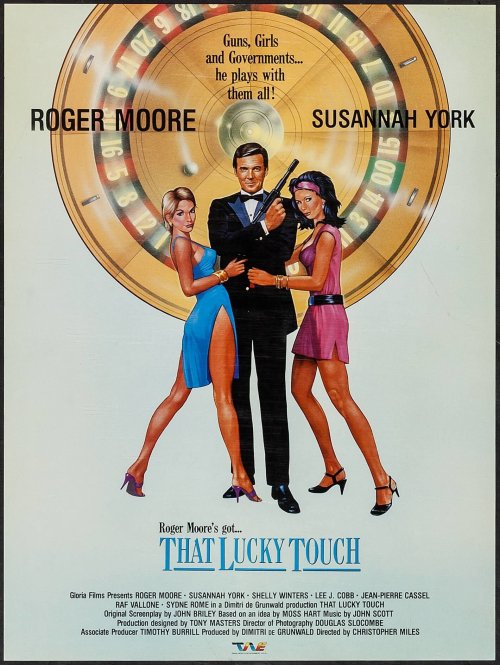
Michael (Roger Moore) is an arms dealer who travels the globe looking for state-of-the-art weapons that he can sell. Julia (Susannah York) is a journalist who writes articles that abhors men who are into guns. The two reside in the same building, but have never met. One night Julia holds a party and while she is seeing her guests out her front door accidentally closes causing her to become locked-out of her apartment. Michael, who is on the outs with his ditzy, live-in girlfriend Sophie (Sydne Rome), decides to use this opportunity to put the moves on Julia. He invites her into his place, so she can call the landlord, but then unplugs the phone, so she’ll think it’s out-of-order and be forced to spend the night. Julia though turns-the-tables by ordering him out on the ledge and into the rainy night while demanding he get into her apartment through an open window. This then begins their love-hate cycle where every time they start to bond one of them finds out something about the other that they hate and thus begin to fight.

While the premise has potential the scenario is poorly plotted and hard to get into though the middle part does have some funny moments. The scene where Lee J. Cobb, who plays an army general, thinks he’s getting an important call from the President, as his red phone is blinking, but instead it’s from his scatterbrained wife, delightfully played by Shelley Winters, is hilarious. The segment dealing with Moore and York trying to get into her apartment is quite good too, but doesn’t get played-out enough as they take a trip to her landlord’s to get the key, but this part is never shown. However, so much time is spent with them trying to find every other way to get inside that I felt we should’ve included this part instead of suddenly cutting away and only implying what happened later.

What I didn’t like was the beginning where the scenes cut back-and-forth between Moore testing out some guns and York typing away without having any idea what they were doing, or why. It’s not until 15-minutes in that it gets revealed that these two live across from each other, which should’ve been established right away. The ending gets botched too as the second-half is spent on the couple, but ends by focusing solely on the secondary characters in an ill-advised screwball finale.

Moore’s acting helps. The glib way that he conveys his acerbic lines are amusing and I came away thinking he was much better in comedy and missed his calling by not doing more of them. York though seems miscast. She’s great in drama, but her comic timing is missing and she’s too hostile to the extent that you start to wonder why Moore’s character would have any interest in her at all. The part was originally intended for Sophia Loren, who would’ve been better and more age appropriate since there was only a few years difference between her and Moore versus the over 10-year gap that he had with York.

The supporting cast is solid especially Winters and Rome, but Cobb is the surprise as he spent his whole career doing dramas, but manages to be the funniest one here and it’s just a shame that this marked his final film appearance, he actually suffered a heart attack during the production. The soundtrack is pleasing too, but the flat script needed better fleshing-out.

My Rating: 4 out of 10

Released: August 7, 1975

Runtime: 1 Hour 33 Minutes

Rated PG

Director: Christopher Miles

Studio: Allied Artists Pictures

Available: DVD (Region 2 Import) DVD-R (dvdlady)

Mortuary Academy (1988)

mortuary

By Richard Winters

My Rating: 4 out of 10

4-Word Review: Two brothers inherit mortuary.

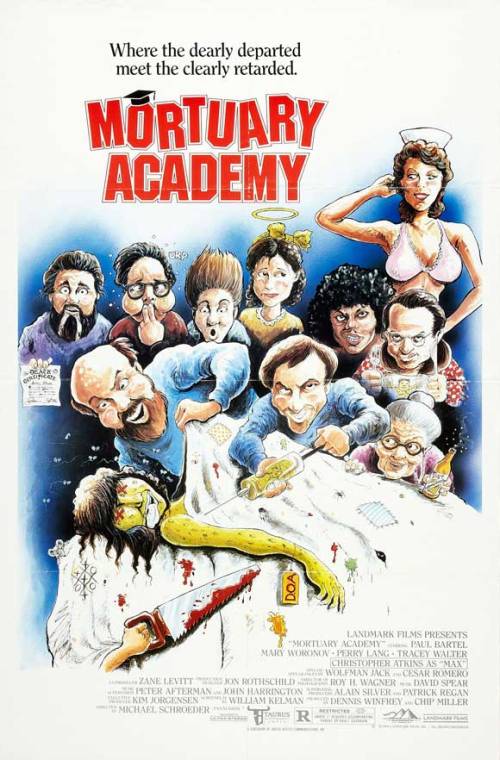
Max (Christopher Atkins) and Sam (Perry Lang) are brothers who inherit a mortuary from their dead uncle. At first they’re not happy as neither one of them wanted to go into that business, but when they realize how much money they can make they change their minds, but there’s one small catch: they must pass the rigorous mortuary course. This won’t be easy as it’s taught by Mary (Mary Woronov) who’s the lover of Paul (Paul Bartel) who are both aware that they’ll lose the place should the brothers take over, so they try to make the course as hard as possible to ensure that they both fail. Meanwhile, Paul has other issues as he’s into necrophilia and wants to have sex with the latest dead body that has been sent in, Linda Hollyhead (Cheryl Starbuck), a teen who died while chocking on popcorn.

The film was clearly trying to capitalize on the earlier success of the cult hit Eating Raoulwhich also starred Bartel/Woronov and both were scripted by Bartel, but the edginess and satirical elements from that one are missing here. Probably the only surprising thing to take away from this is Atkins who proves he can actually act. He started out as a male model and then got into show business simply for his looks and starring in the hit film Blue Lagoon with Brooke Shields, but his effort to broaden his resume by appearing other movies like The Pirate Movie with Kristy McNichol proved downright embarrassing and like he was just another pretty boy face in-over-his-head, but here he’s his funny facial expressions and inability to kiss women got me chuckling. I came away feeling there was no need for two leads especially since the brothers agree on everything making them seem like one person and without Lang, who’s dull, Atkins would’ve had more of a chance to play-up his goofy nervous looks even more.

The supporting cast, with exception of elderly actress Nedra Volz who’s rants about having her last period 50 years ago are a riot, is what really destroys it. One reviewer on IMDb labeled this as a Police Academy- wanna-be and that’s exactly right. The other students aren’t like real people, but instead stereotyped, benign losers saying and doing dumb things simply for a cheap laugh. The biggest travesty is the appearance of Anthony James, who because of his hawk-like facial features gets once again stuck with a role of a would-be psycho-nut and it’s no surprise that he eventually got sick of the type-casting and left the business for good in order to focus his efforts on artistic paintings some of which were quite impressive.

Bartel and Woronov help a bit playing the exact opposite of the couple they did in Eating Raoul where they killed-off those that were into kink, but here they’re the kinky ones. Unfortunately it doesn’t quite work. Bartel’s attempts at sex with a dead body, particularly the scenes at a beach we he momentarily loses her via the incoming tide to a group of frat boys, are funny, but some of their other shenanigans fall flat. Woronov is amusing when she plays a nefarious person, but when she transitions to a good guy and becomes a part of the team, she gets boring.

The biggest issue is the humor, which isn’t dark enough and far too good-natured. The script is gag driven and the special effects poor and tacky. Some would say that because this was a comedy it shouldn’t be gory, but that’s the old-way of thinking as movies like Shaun of the Dead and Evil Dead have proven over-the-top effects actually make it funnier, which is what this film should’ve done. Instead it takes a middle-ground approach making its edgy premise lose all of its zing and only half as good as it could’ve been.

My Rating: 4 out of 10

Released: May 20, 1988

Runtime: 1 Hour 27 Minutes

Rated R

Director: Michael Schroeder

Studio: Taurus Entertainment Company

Available: DVD

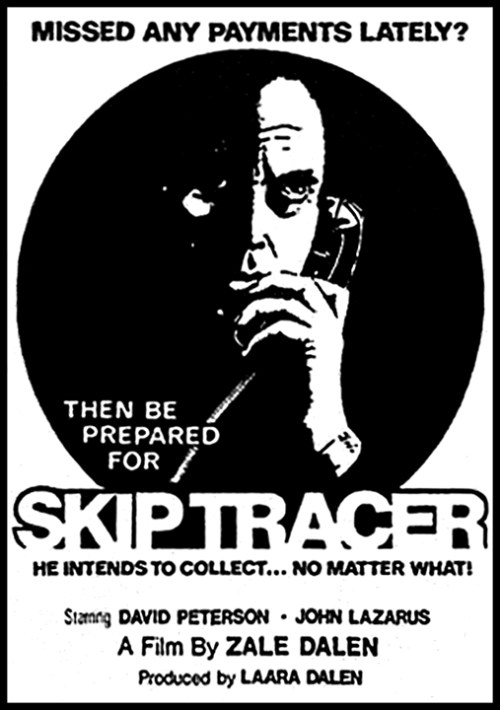
Skip Tracer (1977)

skip1

By Richard Winters

My Rating: 7 out of 10

4-Word Review: Highly motivated debt collector.

John (David Petersen) enjoys his job working for a collection agency and going after people who are delinquent with their loan repayments. He has achieved ‘Man of the Year’ honors at the company and is motivated on attaining that title again. Brent (John Lazarus) is a young trainee who’s having a hard time getting the hang of it. He asks John for guidance by following him around and observing how he gets things done. John is reluctant at first, but eventually agrees. However, as their partnership evolves John starts having second thoughts about the ugly side of the business.

I worked briefly in the bill collecting business and can say first-hand this film gets it right. Director Zale Dalen must’ve worked in it himself in order to recreate it so accurately and what makes this film so good is the way it reveals the business to those who aren’t familiar with it to the extent that it’s like you’re not viewing it, but instead visiting it. The script smartly stays away from jazzing-up the storyline for the sake of drama and keeps everything on a believable level, which makes the graphic ending all that more startling. Even though it was made 45 years ago it’s still quite accurate to what could easily occur in collections offices today with the only difference being that there would be computers on the desktops now versus typewriters.

Petersen, in his film debut, is excellent, I’ve personally known people just like his character and their obsession with rising up in the company overshadows everything else even if it means becoming a complete jerk. What I didn’t get, and the one element that hurts this otherwise strong film, is that he lives in a rundown apartment and drives a beat-up car. If money is his drive and he’s won Man of the Year honors then I’d think he be living in a far ritzier place. Having the company demote him by taking away his office didn’t jive either. This seems like the type of guy who’d be arrogant enough to walk out of a company that didn’t show him the respect he felt he deserved and with his debt collection skills he could easily find another position at another collection agency, so watching him put up with the abuse from his boss undermines the character.

Spoiler Alert!

The film’s shocking ending is strong and comes as a complete surprise, but I wanted to see more of a transition to the character. He essentially walks away from the job and down the street, but no idea where he ultimately ends-up. I would’ve preferred seeing him begin a new job, something that was much different than bill collecting, in order to make the transition complete because what’s to say he doesn’t just get another job, especially if his experience is in that area, that isn’t much different than the one he left? Keeping things as wide-open as it does isn’t as satisfying as seeing him working some lowly position even at lower pay, which would hit-home to the viewer that no matter how bad things were now we’d know he’d still never go back to his old ways.

End of Spoiler Alert!

This is one of the better films to come-out of Canada when it tried to jump-start its fledgling movie industry back in the 70’s. For his efforts Petersen won the Best Actor award at the 1977 Canadian Film Awards and Dalen won it for Most Promising Newcomer. The film also manages to achieve the amazing feat of making Vancouver, one of the rainiest and gloomiest cities in the world, look sunny and inviting.

My Rating: 7 out of 10

Released: August 17, 1977

Runtime: 1 Hour 35 Minutes

Rated PG

Director: Zale Dalen

Studio: International Film Distributors

Available: Blu-ray

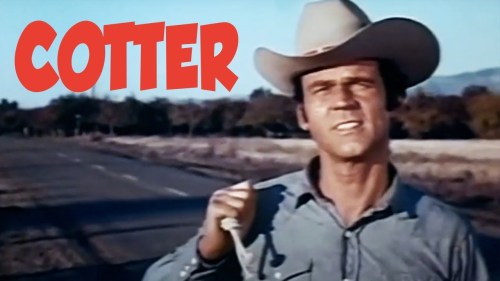
Cotter (1973)

cotter2

By Richard Winters

My Rating: 1 out of 10

4-Word Review: Rodeo clown seeks redemption.

Art Cotter (Don Murray) is a Sioux Indian who works as a rodeo clown, but when his alcoholism causes the tragic death of a rodeo rider he leaves his hometown in shame. Years later he returns hoping to make amends. He meets up with his old friend Roy (Rip Torn) and Roy’s wife Leah (Carol Lynley) and begins living with the two while trying to find work, but before he can fully turn things around tragedy strike again. This time it’s in the form of murder when wealthy rancher Wolfe (Larry D. Mann) turns-up dead with a large bag of money that he was carrying missing. Cotter was the last person to see him alive, so suspicions are cast on him almost immediately. Roy offers to let Cotter hide-out from the mob in his pump shed out back, but Roy has ulterior motives as he believes Cotter committed the crime and begins hassling him for the whereabouts of the cash. Even Leah, who had shown a liking for Cotter earlier, begins to use her sensual appeal, at her husband’s request, to get him to talk leaving Cotter with the harsh realization that nobody, even his friends, believe in him.

This was one of the last of a string of films that were released in the early 70’s dealing with modern-day rodeo stars. Many of those were hits at the box office, so it was a surprise why this one, which was meant to be released to the theaters, couldn’t find a studio to distribute it, so ultimately it ended up becoming, on April 4, 1973, the first movie to ever premiere on cable television, which at the time was still very much in its infancy.

On the surface I was surprised, given the success of the other rodeo movies, that it had to settle for direct-to-cable, but after watching it it’s pretty easy to see why. For one thing the script, which was written by actor-turned-writer William D. Gordon, doesn’t have much to do with the rodeo world. It’s just used as a set-up at the beginning, but seems much more like it should be put into the murder mystery genre instead of a modern day western, or character study. The mystery itself isn’t intriguing and gets wrapped-up too quickly making it flimsy entertainment no matter which category you put it into.

Casting Murray in the lead was another problem as he’s a white guy who doesn’t resemble an Indian at all. In fact the viewer has to keep reminding themselves that his character is one as you’ll forget otherwise. They do give him some make-up to make his skin appear redder, but this just makes him seem more like a white guy with a sunburn. There were plenty of genuine American Indian actors out there at the time, like Ned Romero, that could’ve played the part and made the character more authentic, which Murray’s presence doesn’t.

I was also disappointed that despite what Leonard Maltin states in his review, or whoever wrote it for him, the movie does not give one a good feel for the Midwest and it become painfully clear to this former Midwesterner that it wasn’t even filmed there in the first place. The Midwest has farm fields, which aren’t seen anywhere, and the towns always have a strong city center usually with the courthouse sitting on one block and then the rest of the downtown shops surrounding it. The downtown here has no distinction just a bunch of nondescript buildings plopped in a row and built on a Hollywood studio black-lot, which makes the setting as bland as the rest of the film.

Outside of Murray there are some good performances particularly by Torn and Lynley, but the script is unfocused and in need of dynamic direction. If its motive was to show the plight of the American Indian and racism then an actual Indian should’ve been cast while also bringing in a Native American as a consultant, which might’ve helped the script seem less generic.

My Rating: 1 out of 10

Released: April 4, 1973

Runtime: 1 Hour 34 Minutes

Not Rated

Director: Paul Stanley

Studio: Gold Key Entertainment

Available: DVD

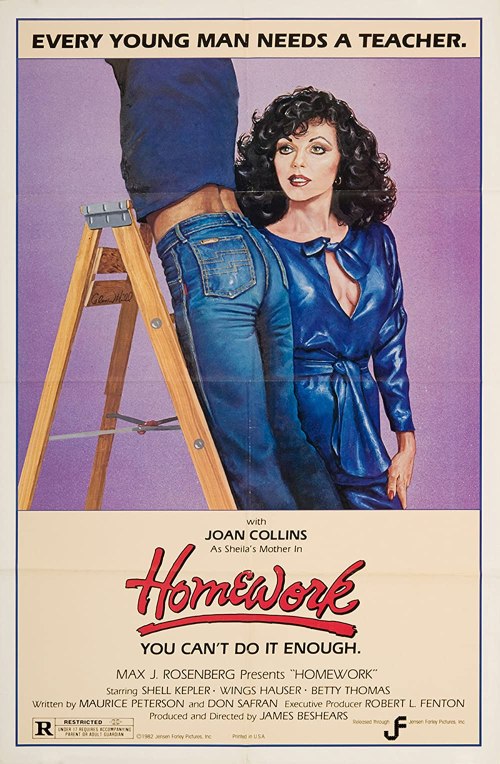
Homework (1982)

homework

By Richard Winters

My Rating: 2 out of 10

4-Word Review: Mother seduces daughter’s friend.

Tommy (Michael Morgan) is a blonde haired teen who hasn’t yet had sex and feels embarrassed about it. To make-up for it he decides to start-up a rock band with his friend Ralph (Lanny Horn). He wants the lead singer to be Sheila (Erin Donovan), but Sheila is too busy working-out in the pool, so she can be a part of the swim team, so he gets Lisa (Shell Kepler). Lisa though is not as talented and seems more interested in getting the attention of rock singer Reddog (Wings Hauser) who would prefer bedding her instead of hearing her sing. Sheila’s mother Diane (Joan Collins) has issues of her own as she’s stuck in a dead-end marriage and feels like the best sex she had was during her younger years. Then Tommy agrees to help her hang a picture in her living room and his youthful body reminds her of the boys she had sex with during her adolescence and she makes a move on Tommy who’s all too happy to oblige.

The most interesting aspect about this production is what occurred off-screen as Collins and her co-stars Lee Purcell and Carrie Snodgrass, as well as Betty Thomas, who has a brief part as Reddog’s secretary, all sued to have their names removed from the credits as they felt the story had been doctored during post production changing the theme in an attempt to become more like Private Lessons and My Tutorwhich had been hits around the same time and both had plots dealing with older women and adolescent boys. Collins though was most upset about the fact that a body double, played by Joy Michael, was brought in to do nude scenes.

For the most part Collins doesn’t really have much to offer except talk to what’s supposedly her husband, who’s never seen and only briefly heard. At one point she calls him George and then later-on she refers to him as Warren. These segments gets mixed-in with scenes of her when she was younger, again played by Joy Michael, and her getting-it-on with guys in the backseat of cars, but despite the nudity these moments are rather boring and don’t add much other than showing how sexually repressed she is now.

Snodgrass barely has any screen-time playing Tommy’s school counselor, which to me seemed a little weird as I would think most guys wouldn’t feel comfortable, nor would women for that matter, talking about their sexual hang-ups with a member of the opposite sex and therefore the part should’ve been played by a man. Purcell is funny as a nervous French teacher, but having her invite male students to her home for after-hours tutoring was ridiculous. The film plays it like she has only innocent intentions, but what kind of sensible grown woman would invite 16 and 17-year-old guys with notoriously raging hormones into her place and not be concerned that they might get the wrong idea, or take advantage of the situation make a move on her, since she lives alone.

The film’s weakest link though is Morgan, who’s too good-looking. This role should’ve been played by a scrawny geek, or a chubby one, with bad acne and thus making his inability to approach women make more sense. Instead with the male model features of Morgan most of the girls would be approaching him and not ignoring him like they do here. His character’s naivety is played-up too much like when he states that by the time kids reach the age of 12 most of them are sexually active, or his belief that his friend Ralph became sexually active at age 7, which is just too dumb to believe anyone would actually think that.

There are a few funny lines, but the story is unfocused and the plot poorly paced. Even with the brief runtime and sexually charged fantasy segments the film still gets quite draggy. The teens are the biggest issue as they’re broad composites rather than three-dimensional people. It’s been awhile since I’ve been in high school, but I don’t remember the kids of the day being quite this wide-eyed. Instead of going-off of their middle-aged presumptions of adolescence the filmmaker’s should’ve interviewed actual high school kids and got their input, which might’ve helped avoid the flat and unconvincing characters that we end-up getting.

My Rating: 2 out of 10

Released: August 27, 1982

Runtime: 1 Hour 29 Minutes

Rated R

Director: James Beshears

Studio: Jensen Farley Productions

Available: VHS

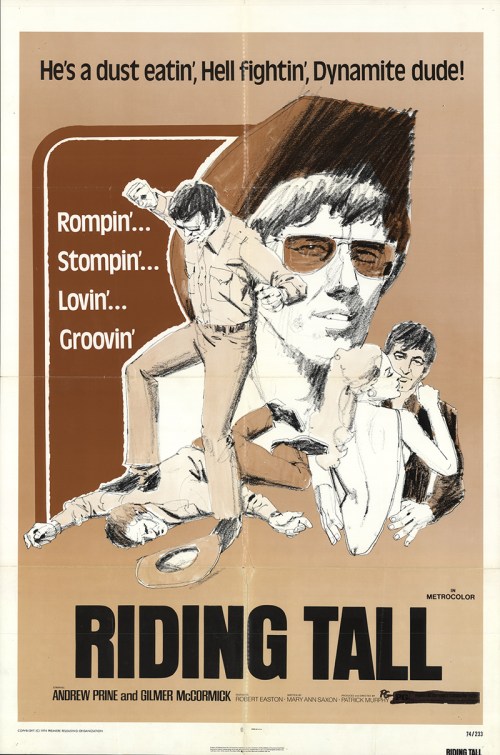
Riding Tall (1972)

riding1

By Richard Winters

My Rating: 4 out of 10

4-Word Review: He can’t stop losing.

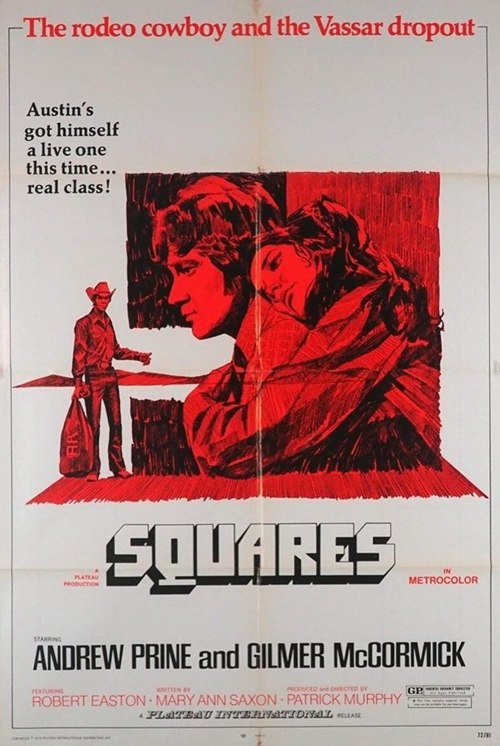
Austin Ruth (Andrew Prine) is a rodeo star who hasn’t won a contest in a long while. He’s so down-on-his-luck that the fans routinely boo him as he leaves. He’s so short on cash that he must siphon gas from trucks and drives in a car that forces other passengers to sit on literal springs since he’s too poor to afford seat cushions for his backseat. When his car breaks down he begins walking on the side of the road where he almost gets hit by Chase (Gilmer McCormick) who fell asleep at the wheel. Chase is the preppy daughter from the affluent suburbs who’s running away from her family and their pretensions while also trying to find herself. She has little in common with Austin, but since they’re both alone decide to forge a relationship, but their differing lifestyles, and Austin’s insecurities about his failing life put a damper on their union ever becoming permanent.

This film was released during a period where stories about the modern day rodeo circuit where in seemingly high demand and while some of them like J.W. Coop and Junior Bonner where met with critical praise and box office appeal this one, despite having a CBS Network television broadcast in 1980, has fallen into complete obscurity. Today it’s only known for having been written by Mary Ann Saxon, who was the wife of the late actor John Saxon.

Initially it had a potential. I really like McCormick. Normally I find films that force in a romance that comes out of nowhere to be annoying, but since this guy was having everything working against him I thought he deserved a break and was genuinely interested in seeing the relationship evolve. McCormick is young and cute, but not in the plastic Hollywood sort of way. She also has a great snarky personality, but her character is poorly defined. At one point she angrily snaps at a traffic cop (William Wintersole) and I thought it would be later revealed when she’d be so unusually angry at him, but it never gets explained and seems to simply play-off the fact that because she was young and in college she’d just naturally hate cops, but this is too broad and makes her more of a caricature than a person.

Prine is dull. Granted his character is run-over by life, so it would be expected that he’d mop around, but he still needs to do this in an interesting way, like a good actor would, but he doesn’t. He’s also never shown actually riding a bronco, until the very end. Even if a stunt double needed to be edited in seeing the character actually on an animal riding it, or attempting to stay on it, is needed instead of just a close-up shot of him being bucked high in the air, which was clearly done by having him sit on top of a mechanical bull and looks fake.

There were a couple of amusing moments like when they try to get a hotel room, but the clerk doesn’t want to give them one because she thinks they aren’t married. When Chase states they are the clerk says she doesn’t believe them at which point Chase replies “Why, because we don’t look miserable enough?”. Overall though it just doesn’t click. Not enough happens. A leisurely pace is okay, but there still needs to be some dramatic moments and they never come making this an uneventful and unmemorable viewing experience.

riding2

Alternate Title: Squares

Released: January 17, 1972

Runtime: 1 Hour 32 Minutes

Rated GP

Director: Patrick J. Murphy

Studio: Plateau International

Available: None