Tag Archives: Entertainment

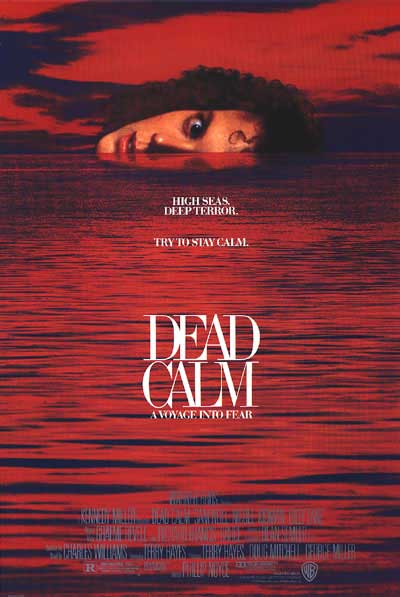
Dead Calm (1989)

By Richard Winters

My Rating: 8 out of 10

4-Word Review: Psycho on a boat.

Rae and John (Nicole Kidman, Sam Neill) are a young couple who in an attempt to get over the death of their child go on a cruise along the coral reef in their own private yacht. After many days at sea they come upon a boat with only one survivor. The man (Billy Zane) comes aboard their ship and almost immediately begins to behave strangely. Tensions slowly rise until it becomes obvious that this man is a full blown psychotic who has killed everyone on the first boat and plans to do the same to them.

In many ways this is a foundation to a perfect thriller. The two main characters are sensible and intelligent people who just happen to be at the wrong place at the wrong time. Like with every thriller there are a few minor loopholes, but overall the situations are done in a believable fashion with no extreme jumps in logic. The script is tight and the suspense consistent. The action comes naturally through the scenarios and is not forced or played out too long. Having it take place at sea gives it a distinct flavor and the setting limitations makes the story more creative. It also hits on one of the main ingredients of fear which is isolation.

The only minor liability is the Zane character. At certain points he seems very human and a fascinating psychotic who is definitely no machine-like slasher. There are times when he is calm and complacent and his disturbed traits only surface sporadically thus giving him a much more multi-faceted personality. Unfortunately he is also careless and amazingly dumb, which hurts the tension because it seems to be telegraphing his own demise. Either way Zane is convincing in the role.

The Neill character makes a good counterpoint. He is savvy and no-nonsense. He takes action into his own hands and doesn’t fall into the helpless victim mode like in other thrillers. The Kidman character is another refreshing change of pace. She is not the standard ‘screaming lady in a bikini’, but instead shows equal resourcefulness.

The film does resort to the modern day slasher trend of having a ‘double’ ending. Yet everything else is so slickly handled that you can almost forgive it. For thriller fans this should be a real treat.

My Rating: 8 out of 10

Released: April 7, 1989

Runtime: 1Hour 36Minutes

Rated R

Director: Phillip Noyce

Studio: Warner Brothers

Available: VHS, DVD, Blu-ray, Amazon Instant Video
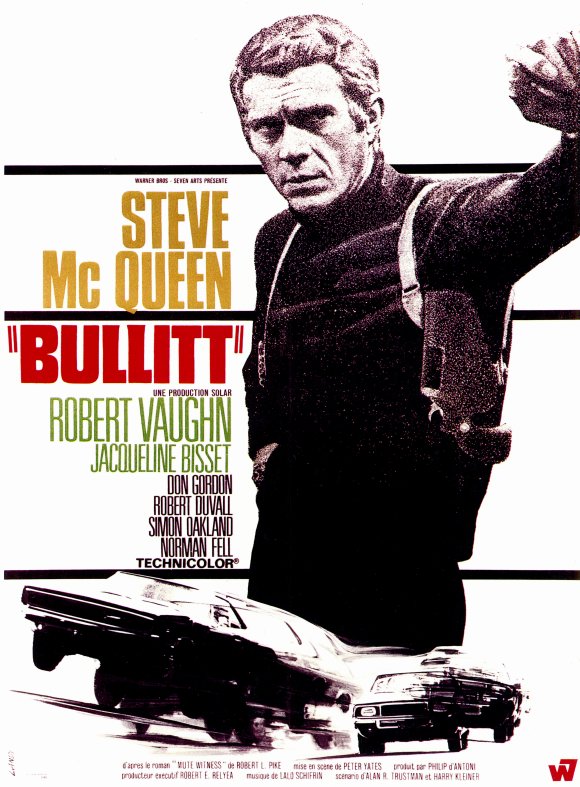
Bullitt (1968)

By Richard Winters

My Rating: 8 out of 10

4-Word Review: A great car chase.

    A police detective by the name of Bullitt (Steve McQueen) is hired to protect a state witness who is set to testify against the mob. Problems ensue when the witness is killed and Bullitt makes it his personal mission to find the killers even if it means bending the rules.

    A renegade cop going against the system may seem like an old formula now, but here it is fresh and convincing. McQueen is gritty and authentic in his role and you find yourself caught up in his mission. The mystery is intriguing and even a bit complex. The car chase is incredible and still holds up today against any other car chase out there. You are made to feel like you are in the car with him and as it goes down the steep San Francisco hills you start to think you are on a roller coaster. The camera work and cinematography is excellent and the entire production is slick from beginning to end.

    Robert Vaughan who plays Chalmers is one of the prissiest characters you will ever see and expounds a vocabulary that you won’t likely ever hear in real life. The character is incredibly pretentious and you look forward to his comeuppance, which he eventually receives although I wished it had been a little bit more.

     Jacqueline Bisset as Bullitt’s girlfriend Cathy is unnecessary and almost like an intrusion. Her little ‘speech’ that she gives along a roadway after witnessing a crime scene does nothing but bog the movie down. Supposedly she was put in to ‘humanize’ the Bullitt character and show his softer side, but he’s an outstanding character without it.

      As mentioned the slick camera work is very good, but it does start to resemble another great McQueen picture that came out around the same time The Thomas Crown Affair. The film also loses its momentum after the car chase and the climatic foot chase along an airport runway is not as exciting.

     This is still a terrific cop thriller that set the standard for all others. McQueen is always great and here he really delivers. The car chase alone is worth watching and shouldn’t be missed by any self- respecting action fan.

My Rating: 8 out of 10

Released: October 17, 1968

Runtime: 1Hour 54Minutes

Rated PG

Director: Peter Yates

Studio: VHS, DVD, Blu-ray, Amazon Instant Video
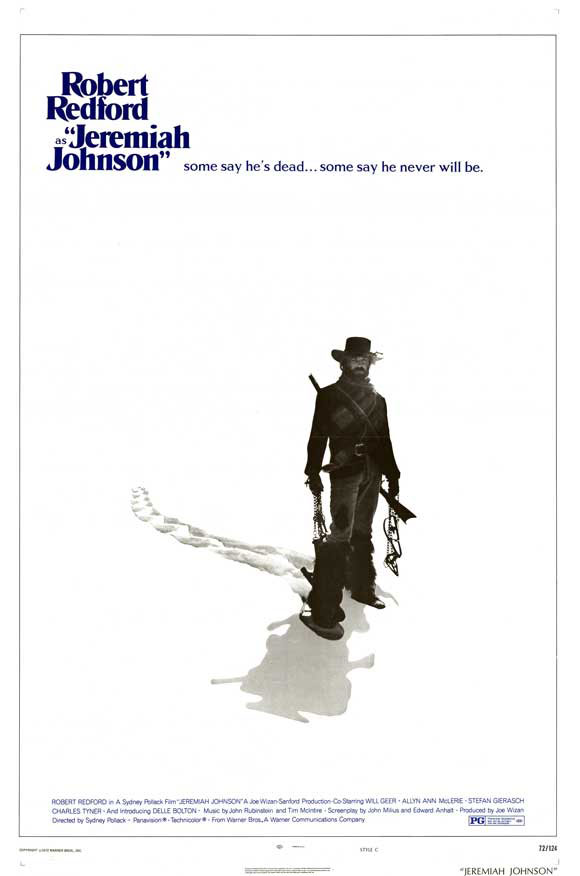
Jeremiah Johnson (1972)

By Richard Winters

My Rating: 6 out of 10

4-Word Review: Man in the wilderness.

            Jeremiah Johnson (Robert Redford) is a man who wishes to live life alone in the snowy mountains. His peaceful existence comes to an end when after riding through a sacred burial ground of the Crow Indian he becomes the target of young male warriors who attack him one-by-one when he is not expecting it to avenge his ‘desecration’. Jeremiah manages to defeat every warrior that challenges him turning him into a legend among the native tribes.

The film’s on-location shooting is outstanding and one of the chief assets in watching the movie. It was shot entirely in the state of Utah and there are many majestic long-shots where all you hear is the wind blowing and makes you feel like you are outdoors yourself alongside the character. The barren, empty winter landscape is well captured and while watching Jeremiah trudge all alone through the snow it was hard for me to imagine that there was actually a film crew present. The ambience of the natural surroundings is breathtaking and grabbed me immediately. I enjoyed the slow, quiet pace at the beginning and wished there had been more of it. One of the most enjoyable scenes is watching Jeremiah trying to catch fish with his hands out of a river, which could have been more entertaining had it been extended.

The story is loosely based on the real life exploits of fur trapper John Johnston who was known to cut out and eat the liver of every crow warrior that he defeated. There is nothing like that here and in some ways that is part of the problem. The ruggedness and reality seem to have been compromised by 70’s sensibilities with too many quirky scenarios and characters thrown in making the film’s structure reminiscent to Little Big Man, which was released just a few years earlier. That film seemed refreshingly cerebral, but here it becomes imitative and derivative.

Robert Redford is high in the looks department, but so-so in acting. He has always had too much of a detached presence and his range of emotions is limited. In some films this may work, but here the part needed more charisma and flair. The character was more like a modern day, touchy-feely male transplanted from Hollywood and into the wild than an actual 18th century hermit. For a man living off the land far from civilization he has to have the whitest most straightest teeth I have ever seen.

The supporting cast fares better. I loved Will Geer as the aging fur trapper Bear Claw. This guy has all the panache that Redford lacked and the movie would have been better had it made him the focus. Allyn Ann McLerie has a small, but riveting role as ‘the crazy woman’ who is unable to cope, or accept the fact that her family has been slaughtered by an Indian attack.  Stefan Gierasch has his finest hour as Del Gue a fur trapper that Jeremiah comes upon. During the first half you see him as bald only to have him return in the second half with a full head of hair. The scene where he is shown buried in sand up to his head is amusing and disconcerting at the same time.

My biggest issue with the film is when Jeremiah starts to fight off all the Indian warriors who attack him. I just could not believe that one man would be able to defeat and kill so many of them. I could understand maybe a few, but eventually odds would have to catch up with him. There is never any special skill shown for why Jeremiah seems to always get the upper hand during these battles. The fights themselves are not exciting as they are much too brief and edited in a way that it is hard to follow the action. It seems like it takes only a few seconds from when the Indian jumps him to when Jeremiah already has him on the ground dead. Jeremiah is also the only person I know of who can have a large spear pierce his body and all he does is pull it out and go on living without any noticeable injury.

The first half is more compelling than the second, which had me feeling bored. The side-story of having him take on an Indian bride as well as a young boy who does not speak has potential, but doesn’t go far enough with it. For an adventure story there is very little action outside of the Indian battles that to me seemed phony. The best sequence is a wolf attack that is nicely edited and graphic. The Crow Indian burial scene is effectively moody and starkly photographed.

The screenplay by John Milius and Edward Anhalt was written using material from two different novels and the lack of cohesion shows. Part of it wants to be a gritty nature drama while the other half plays like a mystical fantasy, but this uneasy mixture never gels, or works.

My Rating: 6 out of 10

Released: December 21, 1972

Runtime: 1Hour 56Minutes

Rated PG

Director: Sydney Pollack

Studio: Warner Brothers

Available: VHS, DVD, Blu-ray, Amazon Instant Video
The Odd Job (1978)

By Richard Winters

My Rating: 2 out of 10

4-Word Review: Hired to kill him.

            Arthur Harris (Graham Chapman) comes home one day to celebrate his wedding anniversary only to find that his wife Fiona (Diana Quick) is leaving him. He becomes so despondent that he decides to kill himself. He has a lot of problems doing it, but then he receives a knock on his door by a man (David Jason) looking for some ‘odd jobs’. Arthur decides to hire him to be his killer, but when his wife decides to come back Arthur is thrown into a state of panic trying to avoid being killed.

Normally I love British comedies and this one seemed to have all the ingredients to being a hilarious one, but it never gels. The opening bit where the couple is arguing and Arthur insists that they are ‘happily married’ even if she doesn’t think so is full of great English wit, but everything after that falls into a lull. The jokes become long and elaborate where so much time is spent building the set-up that getting to the punch-line becomes trying. The restaurant scene is particularly drawn-out and unfunny. The ‘zany’ chase sequence in the zoo is derivative and flat.

Quick was not a good casting choice as the spouse. She is too young and beautiful a wife for such a nebbish man. A good comic character actress who was more frumpy and dowdy would have been a better fit. Quick doesn’t show any comic ability, or timing as her affected responses and facial expressions become annoying and tiring. There is also no motivation for why the character decides to come back to her husband and although this is absurd comedy there still needed to be one otherwise the writing comes off as forced and sloppy, which it is.

Chapman doesn’t completely work in his role either.  It seemed strange that he would want to kill himself when a super-hot lady neighbor is more than willing to go to bed with him and even strips off your clothes and hops into the sack before he goes running off in fright. There is also the issue that killing oneself because your wife as left you seems extreme. Most men would probably celebrate if this happened to them and it is hard to relate to a protagonist that seems so pathetic. A stronger motivation, like having him killed in a staged murder, so his family could collect on some life insurance money would have been more effective. There is another part where the police become aware that someone is trying to kill him and for some reason Arthur does not tell them of the bizarre scenario when they ask him about it even though to me it made more sense to let them try to apprehend the man instead of continuing to live in fear of being killed.

The music, which is soft and melodic, was a terrible choice as it does not fit the quirky theme, nor complement the fast-paced comic scenarios. The tacked on ‘surprise ending’ is horrible and pretty much cements the film as a misfire. During his Monty Python days Chapman was famous for walking onto the screen and telling the audience that the sketch they were doing had become too absurd and would now end and I wish he had done that here.

My Rating: 2 out of 10

Released: September 3, 1978

Runtime: 1Hour 27Minutes

Rated PG (Brief Nudity)

Director: Peter Medak

Studio: Columbia-EMI-Warner

Available: VHS

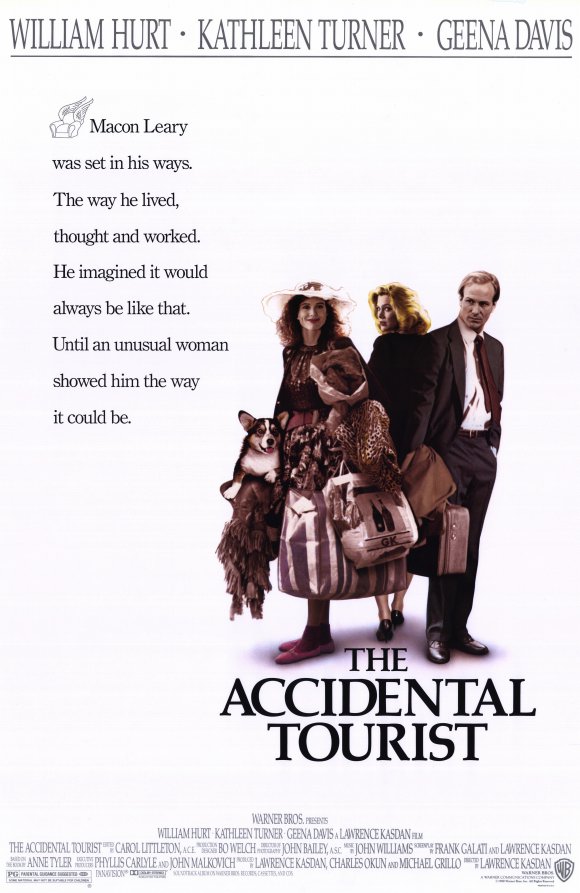
The Accidental Tourist (1988)

By Richard Winters

My Rating: 6 out of 10

4-Word Review: Introverts need love too.

            Macon Leary (William Hurt) is an introvert who writes travel books for a living despite the fact that he dislikes traveling. His marriage to Sarah (Kathleen Turner) ends after the untimely death of their son. His wife used to babysit his dog Edward while he was away, but now he decides to drop him off at the local animal shelter that is run by Muriel Pritchet (Geena Davis). She is colorful and talkative and his complete opposite and eventually a romance begins to blossom.

The film, based on the novel by Anne Tyler, takes its time in telling its story.  In some ways the leisurely pace is refreshing. Trying to get an introvert to be more extraverted is never easy and the way Macon is initially reticent towards Muriel’s advances was realistic. Yet it does drag at certain parts and seems to go on too long. The second hour, in which Sarah comes back in the picture and Macon is forced to choose between the two, is much more interesting and compelling. The side-story where Macon’s publisher Julian (Bill Pullman) romances Macon’s sister Rose (Amy Wright) was unnecessary and does nothing but make a slow movie even longer. I also didn’t find the eccentricities of Macon’s family to be all that amusing as they were exaggerated and portrayed introverts as being freaks instead of people who simply function better independently instead of within groups.

The Muriel character is a bit over-blown as well. She comes on too aggressively towards Macon before she even knows him. There is nothing shown for why she found this man immediately attractive especially when he constantly responds to her in a cold and distant way. Later on we learn that she is poor and possibly found Macon to be well-off financially and a good stable father for her son, but even so her behavior seems a bit too forward and bordering on being shameless. Her outfits are over-the-top. I realize they are supposed to accentuate her kooky personality, but they come off as gaudy and garish and like they are being worn by someone who has no sense of style or taste.  The part where she quietly hugs Macon when he explains to her about the death of his son is moving and the first moment when I began to like the character. However, director Lawrence Kasdan ruins it by then having her strip of his clothes and climb into bed with him, which took things too far. In film sometimes the strongest statements can be made with the simplest of images and it seemed like here they had it and then lost it.

Turner is okay as the ex-wife, but I initially felt the character was unnecessary. I didn’t like it at the beginning when they are breaking-up and she goes into great detail about his character faults sounding almost like she was analyzing him for a psychological assessment. It seemed to me like she was being used to help ‘explain’ his character to the viewer when in a good film the viewer should be able to come to these deductions themselves without the help of an on-screen ‘tutorial’. Later on as she fights to get Macon back the character becomes stronger and better fleshed-out. I even ended up feeling sorry for her as her own insecurities and jealousies do her in.

Hurt is solid in the lead playing an atypical role. I wanted more of an explanation about the death of their son. It takes quite a while before it gets explained and then we are told that it was during some botched robbery at a burger joint, but it was still unclear to me why he was there and not the parents, or how it all played out. Having a flashback with a news report involving the incident would have helped. The film has many other flashbacks, some of them quite good, so another in this area would have been nice.

The music score is pleasing, but too reminiscent of ones used in other films from that era. It also has a bit too much of a whimsical quality that is not fitting for a drama such as this. The Muriel’s eight year old son is cute, but a bit too cute. I found the scenes where Macon bonds with the kid to be touching, but when films seemed compelled to only show children spewing out cutesy, innocuous comments I find it a bit annoying.

Overall this is a quality production made probably more for the female viewer looking for an intelligent, sensitive romance.

My Rating: 6 out of 10

Released: December 23, 1988

Runtime: 2Hours 1Minute

Rated PG

Studio: Warner Brothers

Director: Lawrence Kasdan

Available: VHS, DVD, Amazon Instant Video, Netflix Streaming

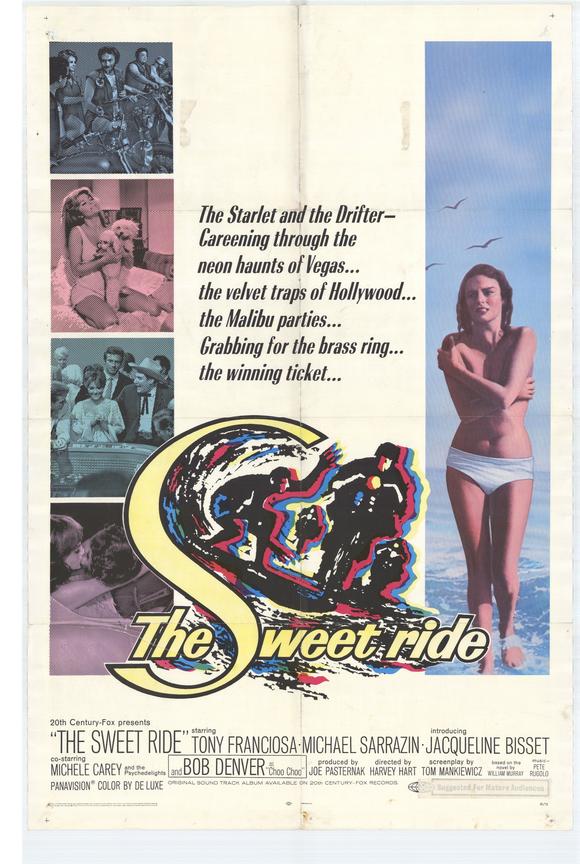
The Sweet Ride (1968)

By Richard Winters

My Rating: 4 out of 10

4-Word Review: Bachelor pad on beach.

This is an obscure and ponderous film dealing with three bachelors(Anthony Franciosa, Michael Sarrazin, Bob Denver) who live in beach house and one day come upon a beautiful woman named Vickie Cartwright (Jacqueline Bisset) swimming in the ocean. They all make a play for her yet it is Denny (Sarrazin) who she falls for. Eventually though her erratic behavior and secret past become too much for him.

The theme is similar to that of Petulia, which came out around the same time. That film proved more successful because of its intricate, stylish narrative and deeper intellectual understanding. Technically this is well directed, but the color is washed out and there seems to be an ugly brownish tone permeating every shot. Some of the sets look cheesy especially the ones used for the indoor bar scenes. The story is too pedestrian and stretched too thin. It starts with some nice interplay between the three men, but that quickly evaporates and by the second hour it has become really boring. There’s some action at the end, but it’s standard and pointless. The resolution itself is too convenient and the relationship between Denny and Vickie is unexciting.

The story does offer some potentially intriguing undertones, but the film never pursues them. The girl herself is an interesting element. We come to realize through the course of the story that she lives a very, very sad existence. The film could have been meatier had it a given us a wider scope of her life and not just the little tidbits that it does. It also could have shown us more of a background to her character and examined how she came to being the way that she was.

The film’s chief asset is the bachelor pad itself, which is a dream for the single male. It’s well designed and sits right on Malibu beach with a terrific view of the ocean. There is beer and liquor everywhere as well as beautiful women coming in and out. The constant sound of the crashing waves in the background give off a soothing effect and the setting allows this film more points than it might otherwise deserve.

Some credit must also go to Franciosa an actor that never really attained much stature. His role here may actually be his finest moment. He plays the eldest of the three men and is as tan, muscular, and good looking as any forty year old can get. He’s as flippant a character as you’ll ever see and adds zest to each scene that he is in. Some of his sardonic comments about his bachelorhood add insight as to why some people are single and want to stay that way.

Dusty Springfield belts out the opening song and really gives it her all.

My Rating: 4 out of 10

Released: June 12, 1968

Runtime: 1Hour 50Minutes

Rated NR (Not Rated)

Director: Harvey Hart

Studio: 20th Century Fox

Availability: None

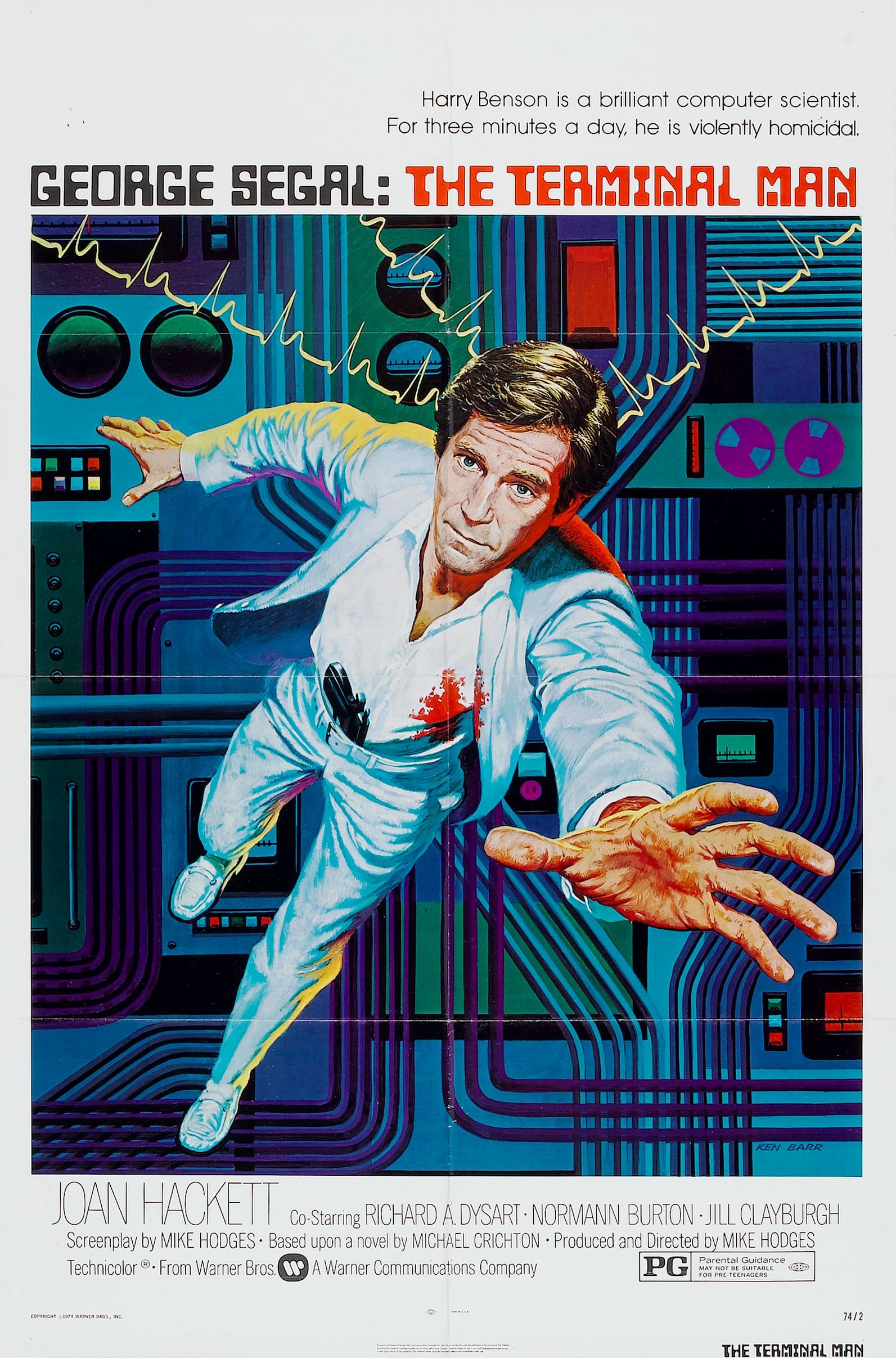
The Terminal Man (1974)

By Richard Winters

My Rating: 7 out of 10

4-Word Review: Can’t control his impulses.

            Harry Benson (George Segal) is a brilliant computer scientist who begins to suffer from blackouts after receiving a head injury in a car accident.  During these blackouts he goes on terrifying violent sprees, which includes the abuse of his own wife and children. To help control the condition a group of doctors come up with an experimental procedure of implanting a computer chip inside his brain that will set off a signal that will alleviate these compulsions when they begin.  Unfortunately things do not go as planned and Harry’s condition becomes frighteningly worse in this cinematic realization of the Michael Crichton novel.

Director Mike Hodges visualization is the stand-out here. Every scene and camera shot fits together into a seamless whole. The first hour is filled with sets and backdrops showing a square, gray, futuristic –like surroundings while the second half features more white interiors while still maintaining the modernistic look.  Hodges shows a terrific awareness of every little sight and sound making each one an integral part of the story. From a visual perspective it is brilliantly handled and a masterpiece in need of more attention.  His use of classical music by Johann Sebastian Bach is equally effective. One particularly unique scene has Harry violently stabbing someone to death during one of his seizures, but instead of hearing the expected pounding music we instead hear the soft strains of Bach while the victim’s blood creates a red pattern on the white tiles of the floor.

The operating sequence and build-up to it is especially captivating and takes up most of the runtime.  I appreciated how a great deal of care was taken to make everything follow a very believable logic. The intricate procedure itself becomes fascinating and riveting to watch as they drill small holes into the patients head and use tiny metal tubes to literally shoot the mechanical pellets into strategic spots in the brain.

Segal, mostly know for light comedies, takes a nice break into drama here. He does a terrific job at getting the viewer to see him as a human being and feel empathy for his situation and when he has his head shaved he looks exactly like Howie Mandel . The part where he screams “Make it stop! Make it stop!” as he goes through another of his violent outbursts is especially moving and disturbing.

The supporting cast is strong as well although I didn’t particularly care for Donald Moffat and his put-on Irish accent, which was too strong and distracting and completely unnecessary.  Richard Dysart is memorable as the surgeon conducting the operation. He has two of the film’s best lines. One is when he is putting the computer chips into the brain and he states “This is the one job that can be both boring and nerve-wracking at the same time.”  Another great line of his occurs when a reporter asks him he if considers this procedure to be a type of mind control and he responds “What do you call compulsory education through high school?”

Joan Hackett gives her usual solid performance as Janet Ross the one doctor who is more concerned with the welfare of the patient then the implications of the experimental procedure. Jill Clayburgh, in an early role, plays against type here as Harry’s ditzy blonde girlfriend and the change of pace is interesting.

The film certainly makes a strong statement at the potential dangers of medical science and how the medical staff can be highly intelligent in one area, but very dense, immature and selfish in others.  The dehumanization element is pounded home to the viewer and in that respect it succeeds magnificently, but I couldn’t help but feel that it was being a bit unfair. In the years since this film was released the advancements in the medical field have improved the life and health of the patients and society as a whole. The film’s negative slant seems to conform too much to the pessimistic sentiments of its era and its unrelentingly doomful outlook is unnecessary.

My Rating: 7 out of 10

Released: June 19, 1974

Runtime: 1Hour 47Minutes

Rated PG

Director: Mike Hodges

Studio: Warner Brothers

Available: VHS, DVD (Warner Archive), Amazon Instant Video

Macaroni (1985)

By Richard Winters

My Rating: 3 out of 10

4-Word Review: He writes love letters.

            Due to a business trip Robert Traven (Jack Lemmon) finds himself returning to Italy after four decades. He hadn’t set foot on their soil since World War II. He is old, tired, and grouchy and looking like an extension of the character Lemmon played in Avanti! , which was also took place in Italy.  When he arrives he meets Antonio (Marcello Mastroianni) who tells him he is the brother of Maria, a woman Robert had a relationship with during the war.  Robert decides to go and meet her despite the fact that she is now married. When he gets there he finds that everyone acts as if they already know him. Robert then finds out that Antonio has been writing ‘love letters’ to Maria all this time, but pretending to be Robert. The letters are filled with wild stories and conquests making Robert a cult-hero to the local people.

This movie is high on the charm, but not much else. Mastroianni is engaging and endearing. I wasn’t too crazy about his mustache and I don’t think it was needed, but he otherwise sparkles in every scene he is in and gives the film much needed energy. Lemmon is fun too, but he seems old and tired here. The camera stays locked on his worn, emotionless face during his entire cab ride from the airport to his hotel, which was too much and the main problem with the film in that director Ettore Scola’s scenes are too long. However, together with Mastroianni these two legendary actors make for an interesting duo. The way their friendship blossoms and slowly progresses is natural and pleasing. The best shot of the whole film is watching the two walking along a shore of rocks from a bird’s-eye-view.  Lemmon also plays a bouncy piano piece and I wished they had let him play more of it.

The film gives one a nice sense of Italian city life.  The on-location shooting makes if feel and look authentic. There is a lot of focus on Italian food and desserts that will make one hungry by the time it is over. The soft, melodic music is relaxing and peaceful and perfectly reflects the easy-going nature of the script, but ends up getting a bit over-played.

The film’s main issue is that there is just not enough story here. It is almost a one-joke script dealing with Antonio’s fabricated letters, which is funny for a while  especially when Robert argues with him about some of the lies in the letters and how he would have preferred that they’d be exaggerated differently, but nothing else.  The film takes too long to get there and they tack on a very formuliac and contrived ending dealing with Antonio trying to avoid the mob who is after him for some unpaid debts and Robert’s attempts to save him.  There is also the fact that Maria, who Robert supposedly was in-love with at one time, never speaks a word of dialogue. In fact the two never share much of any type of conversation, which seemed odd. The other family members and friends appear too naïve for believing all of the wild scenarios that Antonio wrote in the letters that would make anyone else skeptical.  By portraying them as being so gullible makes them stereotypes and is unrealistic.

I’m surprised that these two actors of such high stature agreed to take on this limp material, or didn’t demand for more changes when they did. Even if you are fans of these leading men it still isn’t worth seeking out even for a slow night.

My Rating: 3 out of 10

Released: October 24, 1985

Runtime: 1Hour 44Minutes

Rated PG

Director: Ettore Scola

Studio: Paramount

Available: VHS

Hopscotch (1980)

By Richard Winters

My Rating: 6 out of 10

4-Word Review: Matthau goes globe trotting.

            Veteran CIA Agent Miles Kendig (Walter Matthau) is angered when his boss Myerson (Ned Beatty) decides to demote him to a desk job due to a technicality. Miles decides to get his revenge by threatening to write a book about his past exploits and divulge top secret information. He does this while traveling the globe and making it almost impossible for the government agents to find him, or keep up with him.

Matthau’s character is very similar to the one he played in Charley Varrick where we’re given someone who looks very much like an average Joe and is unwisely underestimated by those around him only to get the last laugh when he proves how very shrewd he really is. The concept is great and it is a fantastic role for Matthau, but in Charley Varrick we at least had some tension and intrigue because the bad guys where really nasty and Matthau’s cunning was a necessity for survival. Here the bad guy is nothing more than a pompous ass and Miles’s exploits, while clever and slick, are done for his own ego and to have an excuse to show-off. Without having any real threat this charade becomes derivative and redundant.

The idea to cast Glenda Jackson as his love interest and confidant is a strange one. In House Calls the two worked well because they had such contrasting personalities and styles, but here that never plays out and for much of the movie they are not even seen together. Her character is given very little to do and the sparring that made them a hit in their first feature is nowhere to be found here. However, their wine conversation that the two have near the beginning deserves a few points.

The Myerson character is over-the-top enough to get a few cheap laughs. The best moment in the whole film is when Miles hides out at Myerson’s own home and when the FBI surrounds it in order to get him out Myerson has to watch helplessly as all the windows in his place get shot out with bullets. Herbert Lom as the Russian spy Yaskov is appealing simply because after spending years playing a cat and mouse game with Miles the two end up finding a mutual friendship with the other.

SPOILER WARNING!!

            The biggest issue I have with the film is the ending. Supposedly Miles has been able to rig an old plane to be remote controlled and then when the agents track it down with a helicopter he blows it up making it look like he went down with it and thus freeing him from being chased anymore. However, aside from the fact that rigging a plane to be remote controlled should prove to be quite complex and beyond the scope of Miles, who may be smart but most likely not that smart there is also the fact that the men in the helicopter can see him on the ground running towards the plane like he was going to get into it. Of course he doesn’t, but instead somehow runs back to a shed where he controls the plane with his remote and then eventually explodes it with a press of a button. My question is, and it is the same one that I had twenty-five years ago when I first saw it, is how is he able to run back to the shed without being detected? It was an open field without any bushes, or trees, which should have made him highly visible to anyone once the plane left the ground. To me this is a cop-out ending done because screenwriter Brian Garfield had exhausted all of his clever ideas and didn’t know how else to finish it, but it is never good when a movie ends with a big loophole.

END OF SPOILER WARNING

Matthau’s laid-back charm is always entertaining even with the weakest of scripts, but he seems to be almost sleepwalking through this one. The musical score is filled with some classical works, which helps.

My Rating: 6 out of 10

Released: September 26, 1980

Runtime: 1Hour 46Minutes

Rated R (Due to a plethora of ‘F-Bombs’ said by the Ned Beatty character)

Director: Ronald Neame

Studio: AVCO Embassy Pictures

Available: VHS, DVD (The Criterion Collection), Netflix streaming, Amazon Instant Video

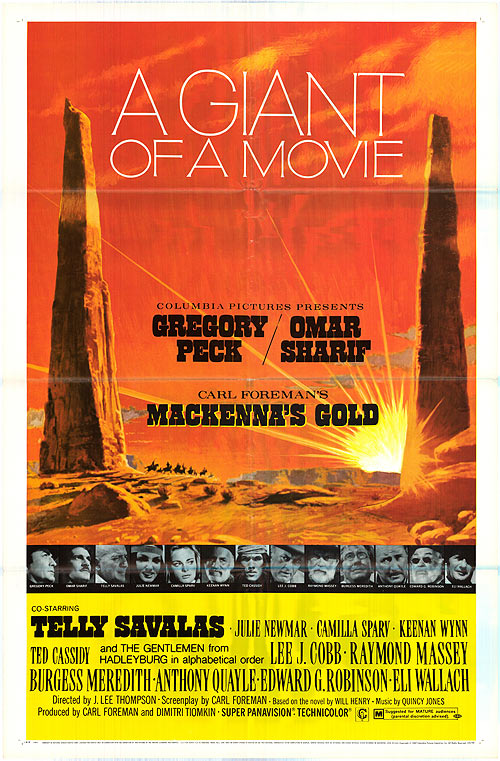
Mackenna’s Gold (1969)

By Richard Winters

My Rating: 4 out of 10

4-Word Review: They all want gold.

This is a sterile western with some irrelevant offbeat elements thrown in for good measure. The story consists of Mackenna (Gregory Peck) coming upon an old Indian man with a map showing the whereabouts to some gold. Feeling that the map is meaningless he burns it and tries to move on. He becomes entangled with outlaw Colorado (Omar Sharif) who feels that the map was legit, and since Mackenna was the last one to see it, forces him to come along with him and use his memory to show him the location. Ultimately they meet a wide assortment of other characters all searching for the same thing.

The cheap special effects are one of the main drawbacks. They are awful and help bring down the whole movie. The scene involving Peck being tied to the back of a horse and then lead across an old rickety bridge has to rate as the worst as the wide shots clearly shows a miniature bridge with a toy man and toy horse. The climactic sequence involving the cataclysmic destruction of an entire valley is so tacky that it is almost painful to watch. There are also other shots spliced in throughout that were done on a different film stock and this difference in grain is obvious and distracting. Even simple shots of Peck riding his horse are laughable as it becomes obvious that he is not on a real horse, but instead one of those mechanical ones that bop him up and down in perfect rhythm.

Only when the film features its stellar supporting cast does it get interesting. Unfortunately this legendary line up was only given about ten minutes of screen time a piece and then very quickly killed off one by one in ways that are particularly gruesome and demeaning.

Peck is okay in the lead and acts as a sort of stabilizer. This was the film where he starts to look elderly with some gray hair showing and a handle bar stomach. He was also not as agile as his younger costar Sharif.

Julie Newmar as Indian lady Hesh-ke is a stand out and even sexier than she was as Catwoman on the TV-show ‘Batman’. She also displays a real vicious side and this probably rates as her best performance despite the fact that she never says a single word. Camilla Sparv as Inga is almost as sexy and the two share a fun ongoing rivalry.

The film is watchable and has some nice, even exciting, aerial shots. However as a whole it is pretty ordinary. Things added to make it seem unique really end up hurting it. Jose Feliciano’s singing is out of place and the music score overall is bad. Victory Jory’s narrative is unnecessary and a feeble attempt to make the production seem like an epic, which it definitely isn’t and the mystical ending just doesn’t work.

My Rating: 4 out of 10

Released: May 10, 1969

Runtime: 2Hours 8Minutes

Rated M (Brief Nudity)

Director: J. Lee Thompson

Studio: Columbia Pictures

Available: VHS, DVD, Amazon Instant Video