Tag Archives: Entertainment

Coogan’s Bluff (1968)

By Richard Winters

My Rating: 4 out of 10

4-Word Review: Cowboy in the city.

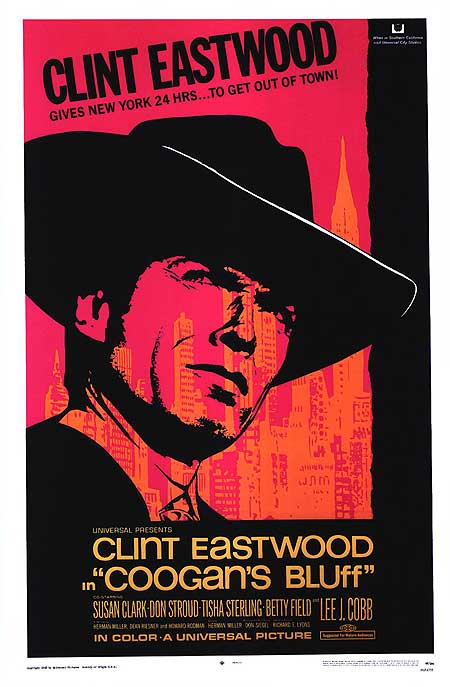
            Coogan (Clint Eastwood) is an Arizona Sheriff sent to the Big Apple to extradite a convict back to the desert. The story focuses on the western lawman’s difficulties at adjusting to the big city ways.

One cannot help but compare this film to Dirty Harry. There are vast similarities, but the problem is that Dirty Harry is way better. This film lacks the edge is just plain bland and formulaic. The bad guy here (Don Stroud) doesn’t have the intriguing menacing quality of Andrew Robinson the memorable villain in the Harry film. The villain character is also poorly fleshed out and panics too easily and conveniently. The supporting characters are equally uninteresting and the whole thing seems too much of a showcase for Eastwood and nothing more.

The opening sequence where the viewer is given a bird’s eye view of the majestic desert as Coogan tries to ferret out a renegade criminal is by far the best part of the whole film. One almost wishes that the action had been kept here and not transplanted to the big city as the change of venue really doesn’t create enough intriguing situations.

Tisha Sterling’s performance helps as she does have a few good moments as the deceptive and conniving girlfriend of the convict. David Doyle is also memorable even though his part is quite small. His green corduroy pants is an amusing eye sore and when he unwisely thinks he can beat up Coogan in a barroom brawl it is pretty funny.

I overall like Eastwood and think he has made many superb films in his legendary career, but this one is his most undistinguished and it is easy to see why. It borrows too many elements from his other films without adding anything new in the process. It’s a tired formula the whole way.

My Rating: 4 out of 10

Released: October 3, 1968

Runtime: 1Hour 33Minutes

Rated PG

Director: Don Siegel

Studio: Universal

Available: VHS, DVD, Amazon Instant Video
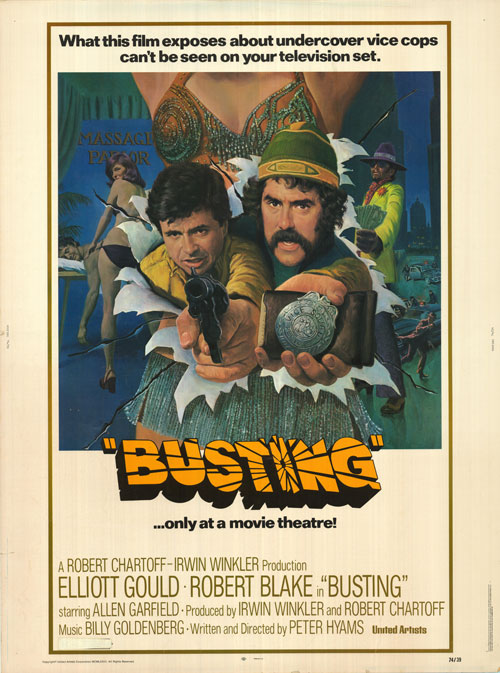
Busting (1974)

By Richard Winters

My Rating: 7 out of 10

4-Word Review: Cops on a mission.

            Michael (Elliot Gould) and Patrick (Robert Blake) are two vice cops hauling in prostitutes and drug dealers only to find that are being let go without being charged. They eventually realize that local crime boss Carl Rizzo (Allen Garfield) has an inside influence with the police department allowing these criminals to get off. Michael and Patrick decide to turn-the-tables, but this proves dicey as Rizzo’s influence is strong and could cost the two not only their jobs, but also their lives.

The film has a gritty style that nicely captures the rugged street life of its characters. Director Peter Hyams uses his background as a news producer and documentary filmmaker to give the film an authentic quality. His tendency for natural lighting is perfect for this kind of material. The film lacks music at least at the beginning, which is effective as it gives you the feeling that you watching some sort of underground police video especially during the opening sequence. The pounding soundtrack during the chase scenes is okay, but what impressed me was the haunting melody used in some of the other parts that sounded like something you might hear in a thriller, or horror film, but it works because it is an unusual sound for a cop picture. The dialogue is great as it manages to be acerbic and insightful while still remaining realistic.

The first half is hampered by the two’s preoccupation with nabbing a prostitute. I remember watching the old ‘Cops’ TV-show where there would be many episodes detailing elaborate stings that the police would use to nab some otherwise harmless schmuck who was simply looking for a little action. Most who are arrested will go right back to doing it again after being given a light fine, or jail sentence, which to me always seemed wasteful both to the law enforcement’s time and the taxpayer’s money when there are far more serious crimes out there. When the Carl character mocks the two with the line ‘You arrest ten-dollar hookers and think you are Captain Marvel’ I had to laugh and agree. What is even worse is when Michael is off-duty he ends up paying for the services of a call-girl meaning I guess that when he is in the mood himself then it is alright.

The film improves during the second half and includes an exciting foot chase at night inside a sprawling inner-city fruit market. Hyams use of tracking camera shots helps build the tension and I found it interesting that an innocent bystander ends up getting shot and killed as I don’t think I’ve seen that happen in any other police movie. Another chase that happens at the end and involves two ambulances careening down city streets is equally well done.

The cat and mouse game that they play with the crime boss was intriguing enough to keep this viewer interested. Garfield plays the part with his usual hyper-style that makes the character both repellent and human at the same time. The best thing about the film though is that fact that it chooses a somber tone and then sticks with it. Too many times ‘statement movies’ with a downbeat message end up selling-out and become an audience pleaser at the most unlikely moment, but this film doesn’t. I’m not saying that it ends on a depressing note, but it does effectively hit home the fact that police are hampered by a lot of bureaucracy that limits their effectiveness. It also examines the boredom and monotony that can come with the job, which other police dramas rarely if ever touch on.

The film was controversial because of its over-reliance on gay stereotypes during a barroom scene. I was a bit surprised by this because the scene itself is short and the stereotypes shown weren’t too different from other films of the period dealing with the same topic. Michael does refer to them by using the derogatory ‘F-word’, but I am pretty sure that a lot of cops in 1974 used that very same word and since this film was intended to show how things were I was able to go with it. The two also get ganged up on and viciously beaten by the gay patrons that I found to be amusing.

I also have to mention Cornelia Sharpe a former model who had a brief 10 year film career in mostly grade B exploitation pictures. She looks her best here not only during a nude scene that she has with a doctor at his office where she pretends to be one of his patients while really being a prostitute, but also during her appearance in court where she wears a pink hat and dress. I also liked that despite being a hardened hooker she still gives a warm smile to a lonely child sitting in the waiting room.

My only real complaint with the film is that it features one of the tackiest make-up jobs in the history of movies and seriously affects the film’s realism. The scene I refer to is when Michael and Patrick get beat-up by some of Carl’s thugs. The ‘injuries’ to Patrick’s face clearly look like it was smeared on in two seconds with some light red paint.

My Rating: 7 out of 10

Released: February 27, 1974

Runtime: 1Hour 31Minutes

Rated R

Director: Peter Hyams

Studio: United Artists

A Passage to India (1984)

By Richard Winters

My Rating: 7 out of 10

4-Word Review: Unjustly accused of rape.

An older woman (Peggy Ashcroft) and her son’s fiancée Adele (Judy Davis) travel to India to visit him as he works as a British Magistrate there. During the course of their visit they come upon the harshness of British rule, the unusual climate, and a rather unexpected criminal trial.

Like with most of Lean’s films the gargantuan approach cannot equal the story. You sit through two hours and forty five minutes only to feel slighted when it is all over. The story plays a lot like To Kill a Mockingbird only it is stretched out more and has a different location. That is not to say it isn’t entertaining, because it is, but only in the most general of ways.

The first hour is downright breezy. It does hit on certain inhumanities and inequalities, but it is all handled with kid gloves. It also seems very similar to Gandhi, which came out only a year earlier. The second half, which involves the court trial, seems almost jarring when compared to the first. It does get more intense and multifaceted, but just when it seems to be getting intriguing it fizzles with a wrap up that is too neat and tidy.

Lean’s films have always had a sort of running theme involving the characters coming to terms with the full scope of their personalities. Yet here their changes seem too abrupt and severe. Adele starts out as a very interesting person. She is independent and idealistic and then having her turn into a confused and bullied woman without any real explanation doesn’t mesh. The same can be said for Aziz (Victor Banjeree) the man she accuses of rape. His character is so benign and affable at the beginning that having him turn so angry and vindictive in the second half seems overdone understandable to some degree, but still overdone. Of course everyone can have these traits at times, but here it gets heavy- handed.

The two best characters consist of Mrs. Moore (Ashcroft) and Fielding (James Fox). Ashcroft is compassionate and strong and it is nice to have an older character where their age isn’t completely embedded into their persona. Fielding is strong and stalwart as well and his very proper sensibilities help keep the whole thing stabilized.

Legendary actor Sir Alec Guinness is badly miscast. Although some of his dispensed wisdom is fun he never completely comes off as a native and the part should have been played by an actual native of the country.

Out of all of Lean’s films this may actually be his weakest. The cinematography is okay, but it is not as sumptuous as some of his others. I wanted to be shown more of India and given a broader perspective of the region. There also could have been a little more action and the characters placed in a little more physical danger. The part where Adele is chased by some wild monkeys is unconvincing especially when you never see her or the monkeys in the same shot.

My Rating: 7 out of 10

Released: December 14, 1984

Runtime: 2Hours 45Minutes

Rated PG

Director: David Lean

Studio: Columbia Pictures

Available: VHS, DVD, Blu-ray, Amazon Instant Video

Johnny Cool (1963)

By Richard Winters

My Rating: 7 out of 10

4-Word Review: Top of crime world.

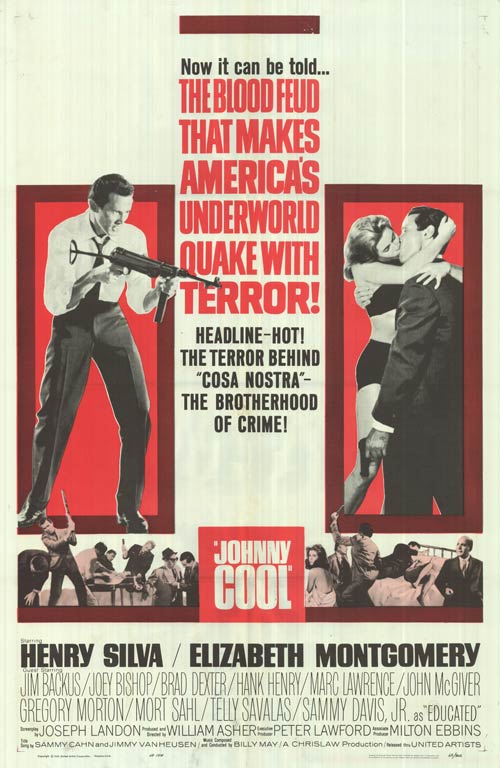
                Johnny Cool (Henry Silva) is really Giordano a man who grew to mythical proportions as an outlaw in a small Italian village after killing off some soldiers who tried to rape his mother. His exploits come to the attention of  Colini (Marc Lawrence) who has been exiled to Sicily because of his gangster past. He stages a fake assassination of Giordano in order to kidnap him and train him to go back to the United States and kill off the men that ordered his downfall. Johnny does this, but then becomes even more powerful than Colini was and soon he is both feared and hunted by the crime world.

The film, which was directed by William Asher, is nicely paced. I liked the fast, gripping action, the pounding music, and raw approach. The black and white photography nicely accentuates the gritty subject matter. Although it may seem a bit tame by today’s standards I still found most of it to be intense and uncompromising especially the ending.

Lots and lots of famous faces pop up everywhere, which is fun for a bit, but then takes you out of the story as it seems to become more like ‘spot the star’. Some of the cameos are small and pointless while others are more interesting. Sammy Davis Jr. has a tense scene playing a man with an eye patch who must role a specific number with the dice or be blown away by Johnny’s gun, which is aimed directly at his temple. Joey Bishop is funny as a fast talking used car salesman and his feeble attempts at making a play at the beautiful Dare (Elizabeth Montgomery). John McGiver is equally fun as a perplexed store manager who brings in a woman to his office after finding that she has been writing a lot of bad checks. The exchange he has with her is a perfect example of why sexual innuendos where a lot more interesting and creative back in the old days when the standard didn’t allow them to be as crass and vulgar as they are now. Here the lady states “I can make those bad checks good.” And McGiver responds after eyeing her figure “Yes, I think you can!”

Telly Savalas is wasted. The man is a great character actor especially as a villain. Playing a tough crime boss from Brooklyn is his forte and he could have really gone with it had they given him a bigger part. Marc Lawrence is equally evil as Colini and showing him only in one scene and then disappearing was disappointing. Jim Backus’s appearance was a mistake. A funny, talented man for sure, but I didn’t like that he did his Mr. Magoo laugh several times here as it did not fit the gritty mood.

Henry Silva has proven to be a great villain throughout his career, but in this role it just doesn’t work. His eyes have a weird type of stare that makes it look like he has been drugged. He delivers his lines in a monotone fashion. The character becomes overblown and some may find his use of the karate chop to be a bit cheesy. He kills a man on an escalator amidst a crowded airport and is able to get away. There are several other scenes where he is able to somehow get into a secure area and kill off people without any explanation for how he was able to do it.

Elizabeth Montgomery, who was at the time the wife of the director, is fantastic. She plays a brunette and does well with a multi-faceted character that goes from helpless victim to conniving double-crosser. She is shown in several scenes wearing no make-up and I liked the naturalistic quality. My only quibble is the scene where she gets roughed up by some gangsters, but the only mark left on her is a bruise on a shoulder even though a few bruises, scratches, and cuts on the face would have been not only more believable, but visually more effective.

My Rating: 7 out of 10

Released: October 2, 1963

Runtime: 1Hour 43Minutes

Rated NR (Not Rated)

Director: William Asher

Studio: United Artists

Available: DVD, Netflix streaming

Silver Bears (1978)

By Richard Winters

My Rating: 6 out of 10

4-Word Review: Investing in Silver Mine.

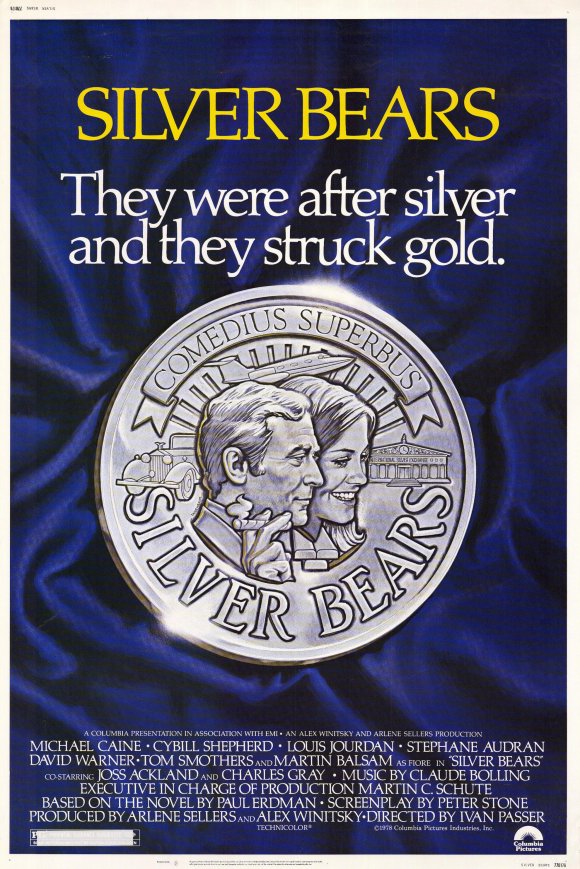
This is an engaging, lighthearted look at the complex inner-workings of financial institutions and markets and how a group of con-men try to exploit it. The plot is elaborate and although it is easy to follow as you are watching it, as long as you are paying close attention, it is hard and even convoluted to explain, but I will try my best.

The basic premise works like this: Doc Fletcher (Michael Caine) is hired by underground kingpin Joe Fiore (Martin Balsam) to open a phony bank which they can use as a front for their laundered money. When they get there they find that the building is some rundown offices on top of a restaurant. Prince di Siracusa (Louis Jourdan) then tells them of a silver mine in Iran that is run by his distant cousins Agha (David Warner) and Shireen (Stephanie Audran).  Doc decides the bank can invest in the mine and use the money to create a better building premises as well as attracting rich investors. The silver in the mine begins to flood the market causing a drop in value at the London Stock Exchange and forces Charles Cook (Charles Gray) to decide to buy out the bank that is funding the mine in order to then close the mine. To do this he contacts the President of the First National Bank of California (Joss Ackland) who is looking to expand his business in Europe. The bank president sends Donald Luckman (Tom Smothers) out to negotiate a sale of the bank with Doc, but without telling Doc the true reason why. This makes Doc suspicious and to find out their true motives he decides to seduce Donald’s beautiful and free-spirited wife Debbie (Cybil Shepard). Once she divulges their secret things really get going in a high-spirited fashion.

The catalyst of the comedy comes through the many different ‘negotiating’ sessions that take place throughout the film all of which prove to be quite amusing. The first is when Doc negotiates with Agha about a suitable deposit Agha must give to the bank in order to obtain a bank loan even though the bank has no money to give. The second is when Donald tries to bargain with Doc on a selling price for the bank and the third is when Doc tries to intimidate Crime boss Joe into not accepting Donald’s offer. The final one at the end is where all the characters chase Charles around his mansion in order to get settlements to their deals, which have by then soured.

The characters are charming and delightful. Caine is superb as always playing a man who would like to be a lot more ruthless and intimidating if he weren’t surrounded by a bunch of incompetents. Jourdan is suave as the Prince and the two leads share very contrasting personalities and styles, which makes their conversations and budding friendship interesting.

This movie is also a great chance to see Jay Leno in a rare acting role. I’d say being a talk show host is more his repartee, but he is energetic enough here to remain amiable and seeing him with a big mop of curly black hair is almost worth the price itself. Shepard is fantastic and the one thing that gives the film some zest. She is best known for her bitchy roles of which she is very good, but her she plays a fun-loving hippie type and is hilarious. Although this movie is a bit hard to find fans of Shepard should really seek this out as they won’t be disappointed.

Smothers is okay as the meticulous accountant who thinks he has all the bases covered until he gets an unsettling surprise at the end. Usually he is stuck playing characters on the dim-witted side, so it was nice to see him in something that was a slight change of pace. Although Balsam’s screen time is brief I still got a kick out of the way he would look at pictures showing the bloody corpses of the victims he had ordered killed while he ate his breakfast.

The film was shot on-location in such places as Switzerland and Morocco and although it does show some of the exotic topography of the regions it wasn’t enough and I wanted to see more. The musical score is terrible and resembles a show tune from the big band era that does not fit with the mood, or action of the story. I also didn’t find it enticing to have the film begin by focusing the camera onto the naked rears of a bunch of fat, middle-aged men as they get into a hot tub.

For those looking for a diverting, original comedy that emphasizes the subtle and dryly humorous exchanges between business partners then this little known gem should hit the spot.

My Rating: 6 out of 10

Released: April 21, 1978

Runtime: 1Hour 53Minutes

Rated PG

Director: Ivan Passer

Studio: Columbia Pictures

Available: VHS

Young Doctors in Love (1982)

By Richard Winters

My Rating: 5 out of 10

4-Word Review: He tastes the urine.

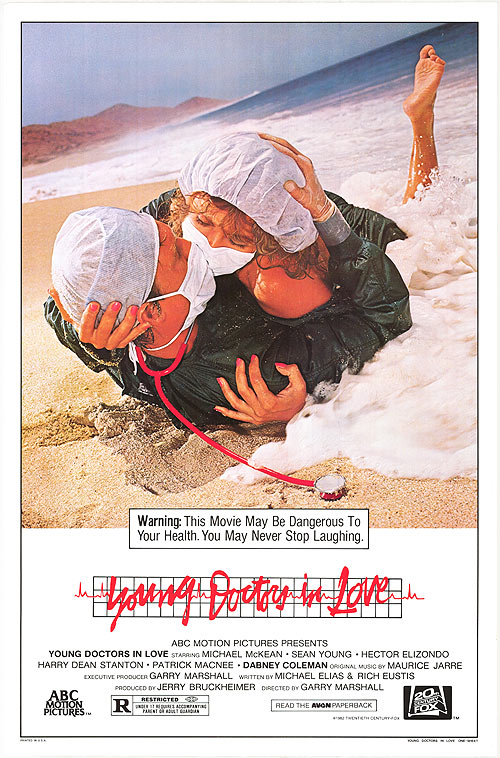
This is pretty much what you would expect from Gary Marshall, Penny’s brother, and creator of such loud comedies as the TV-show ‘Laverne and Shirley’. Here though the majority of the jokes actually work. Yes it’s still juvenile and crude with nothing real amazing, but if you come in with moderate expectations you might be pleasantly surprised.

There are of course the expected bombs sprinkled throughout. The worst bit features Michael Richards as a hit man going after another patient who is a member of a crime family. Richards is always funny, sometimes just when he is standing there, however the gag gets stretched out too far. It becomes redundant and cartoonish almost like a poor man’s version of a Wiley E. Coyote cartoon.

The worst thing is that the comedy has no edge to it. It’s modeled after Airplane, but doesn’t have the same satirical jabs. It should have done to old medical TV-shows what Airplane did to disaster movies. Here it just tries to be cute with a vaudeville mindset that becomes too soft, good- natured, and one-dimensional and ends up leaving you with an empty feeling. This is too bad because old shows like ‘Marcus Welby M.D.  are just begging to be made fun of.

Michael McKean and Sean Young look much, much younger and make for a cute couple. This is before all of Young’s troubles and dismal direct to video movie roles. She was still considered the promising up and coming starlet and she looks pretty and has a terrific figure to boot.

Harry Dean Stanton is a real surprise. Usually he is given low key roles, but here he is a wacky guy that is hilarious especially in a very funny ‘urine tasting’ segment. Hector Elizondo is also in rare form playing a man disguised as a woman and just seeing him in a dress is amazing.

Dabney Coleman though is wasted. He is well cast, but having him go completely bonkers at the end seems dumb. The worst travesty is with former ‘Avengers’ star Patrick Macnee. At first it seems like inspired casting to have such a proper English gentlemen in the middle of complete chaos. However, after the first few minutes he pretty much disappears and this is a shame because they could have done a lot more with his character.

My Rating: 5 out of 10

Released: July 16, 1982

Runtime: 1Hour 36Minutes

Rated R

Director: Garry Marshall

Studio: 20th Century Fox

Available: VHS, DVD

4 for Texas (1963)

By Richard Winters

My Rating: 4 out of 10

4-Word Review: Frank and Dino vehicle.

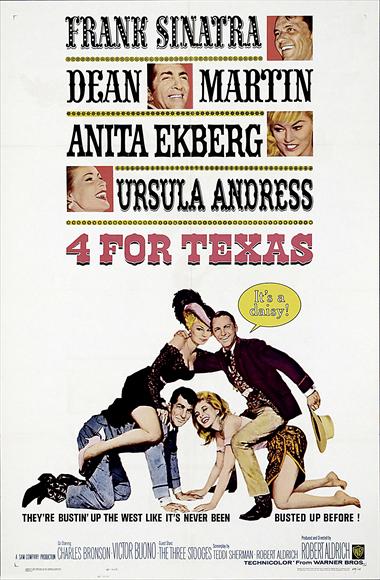
            Sharp-shooter Zack Thomas (Frank Sinatra) and Joe Jarrett (Dean Martin) fight over a cache of money they come upon after fighting off Matson (Charles Bronson) and his gang from a stage coach attack. Eventually Jarrett takes the money and makes his way to Galveston were the two meet up again and continue their bickering. When Joe fixes up an old riverboat and proceeds to turn it into a casino Zack tries to take it over, but not until Matson tracks him down to seek revenge.

The movie opens nicely with a snappy segment between the quarreling Zack and Joe trapped all alone in the middle of the desert. Their banter is great and it makes the most of each star’s appeal. However, after this the movie proceeds to die and very long, slow death. Absolutely nothing gels and the fragmented story lacks any type of singular voice, or vision. The film is also devoid of much action. There is a fistfight that Zack and Joe have at the end, but from the longshots it is clear that stunt doubles are being used for both men, which kind of takes the fun out of it. There is some potential when the two decide to combine their forces to take on Matson and his gang, but this finale moves along too hastily and the action is as uninspired as the rest of the film.

Martin is engaging and he is one of the film’s few bright spots. Sinatra though is stiff and out-of-place and shows no flair for lighthearted comedy. Apparently director Robert Aldrich and Sinatra did not get along at all and it shows.

The female co-stars don’t fare much better. Anita Eckberg who plays Zack’s love interest Elya amounts to not much more than a tired walk-on. The character has little to say or do and minimal connection to the main plot. Ursala Andress as Joe’s girlfriend Maxine fares better simply because she looks great. I’d say she is more striking here than she was in her most famous role in Dr. No.  Her low-cut dress is tantalizing and her tan, curved features have never looked better. The problem though is that there are a few drawn-out romantic scenes between both couples that makes a slow movie drag even more.

Talented character actor Victor Buono is excellent as bank president Harvey Burden. I was impressed with how he managed to hold his own with the rest of the cast despite the fact that he was much younger than all of them. Bronson is effective in the bad guy role and he makes a more interesting villain than he ever did as a good guy.

The Three Stooges appear in a cameo and do their predictable shtick that is strained and forced. Jack Elam who is a veteran support player in many westerns and has a very distinctive cross-eyed gaze is shockingly killed off right at the beginning, which was stupid.

This movie is a perfect example of a big Hollywood production relying too heavily on the star power of its two leads without first having an interesting script for them to work with. The production values are high and it is watchable, but plays itself out in a meandering and pointless fashion.

My Rating: 4 out of 10

Released: December 25, 1963

Runtime: 2Hours 4Minutes

Rated NR (Not Rated)

Director: Robert Aldrich

Studio: Warner Brothers

Available: VHS, DVD, Amazon Instant Video
 

The Telephone Book (1971)

By Richard Winters

My Rating: 7 out of 10

4-Word Review: She likes obscene calls.

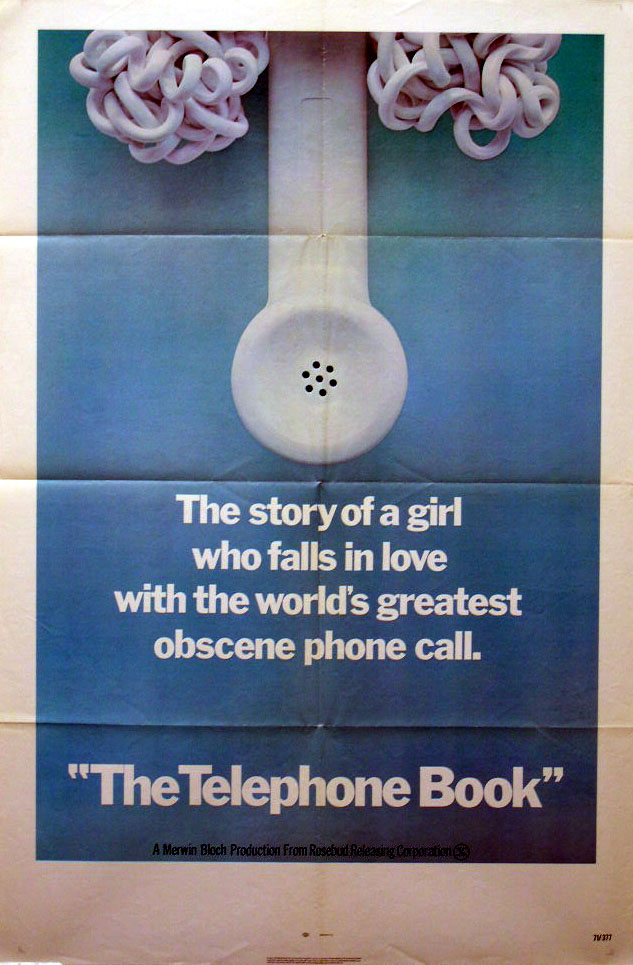
            Due to the recent death of writer/director Nelson Lyon on July 17th I felt it was time to dig up my old copy of this bizarre underground cult flick and give it another view. I stated in another review I made about this film that I considered it The Gone with the Wind of underground moviemaking and I still stand behind it. The film is hampered by its low budget and black and white photography, but I was impressed with it creative camera angles, editing, set design and music. Lyon showed a genuine vision and made the most out of what little resources he had. Even the content, which could be seen as pornographic by some, is presented in such a quick paced and diverting style that it becomes engaging and amusing.

The basic premise deals with Alice (Sarah Kennedy) an over-sexed young blonde living alone in an apartment with walls lined with wall paper that has hundreds of pictures of people in various sex acts. One day she gets a call from an obscene phone caller and she falls in love with him because it was the ‘most sweetest and most beautiful dirty call’ she had ever received and although she had received other obscene calls in her life this one ‘had class’. She becomes obsessed with meeting the man. He tells her that his name is John Smith and that he is ‘in the book’.  She goes through the telephone book to call him up, but because she lives in New York City she realizes there are a lot of John Smiths. The rest of the film deals with her encounters of all the various John Smiths that she meets as well as her climatic meeting with the real John Smith and the very weird conversation that she has with him.

The film’s structure is basically made up of a lot of vignettes all dealing with various forms of perversity. Some famous character actors appear in cameos and some of which prove to be quite outrageous and funny. Barry Morse best known for playing Lieutenant Gerard in the 1960’s TV-series ‘The Fugitive’ has one of the film’s best moments playing Har Poon ‘the greatest stag movie actor of all-time’. He has a scene where 10 naked ladies, at least that is how many I was able to count, all jump on top of him and begin sucking on his various body parts. There is Roger C. Carmel as a psychiatrist who enjoys exposing himself to ladies on a subway train, but when Alice decides to do the same thing in return he becomes shocked and repulsed. Character actress Lucy Lee Flippan makes her film debut here as a ‘reformed’ obscene phone caller who describes how when her husband was away at work and her kids where at school she would call up men at their jobs and talk dirty to them while masturbating  with a banana. There is also William Hickey playing a man suffering from a permanent and incurable erection.

The best appearance though comes from Norman Rose famous for narrating many films. Here he appears wearing a mask of a pig and playing the actual obscene phone caller. He describes how he calls 4 different women a night every week of the year except for two when he goes on vacation to ‘get out of the grind’. He also explains how he has perfected his obscene phone skills to the point that he could seduce the president of the United States if he wanted to, but doesn’t because he has ‘no political ambitions’. The conversation gets weirder including telling Alice about his foray into becoming an astronaut while he seductively washes her hair, but Lyon’s use of imagery during this segment keeps it interesting and even memorable. My only complaint would be that I wished he had taken off the mask so we could have seen what he really looked like.

The film ends with an eye popping animation segment dealing with a giant headless naked woman who squats down and has sex with a sky scrapper that needs to be seen to be believed. This is also the only part of the film that is in color.

Despite the fact that it was all done on a shoestring budget and with no character development I had few complaints although I didn’t understand how the obscene caller was always able to call up Alice and get a hold of her even when she was not at home and at someone else’s place. This was of course before cellphones, but I suppose demanding logic from a film that otherwise revels in the absurd would prove futile. The film did not do well on its initial run, but was rereleased in 2011 to much more positive reviews both here and in Europe. Through word of mouth it is expected to gain the cult following it deserves and maybe eventually a DVD or Blu-ray release.

Kennedy is delightful in the lead, but her appeal may depend on one’s personal tolerance. She looks and acts almost exactly like Goldie Hawn and was her replacement on the ‘Laugh-In’ show when Hawn left to concentrate on her movie career. I enjoyed Kennedy’s giddiness and child-like enthusiasm to all the perversions around her, but her voice sounds like she has sucked in helium and could prove annoying to some.

My Rating: 7 out of 10

Released: October 3, 1971

Runtime: 1Hour 24Minutes

Rated X

Director: Nelson Lyon

Studio: Rosebud Films

Available: VHS, DVD, Blu-ray 

Batman (1989)

By Richard Winters

My Rating: 6 out of 10

4-Word Review: Where is Adam West?

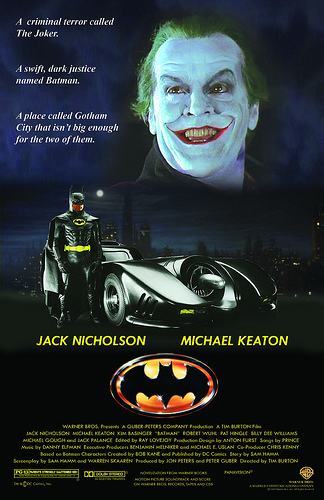
The attempt at moving the Batman theme from the campiness of the TV series to a darker edge proves successful. Director Tim Burton’s vision of Gotham is terrific. It has a sort of weird mixture of the 1940’s and the modern day and the look is original. It is so gray and dark it seems almost like purgatory and having the citizens celebrate its 200th anniversary may be the best joke of the film.

The story nicely starts out showing how Bruce Wayne (Michael Keaton) became acclimated with this Batman character and how initially he wasn’t perceived as being a good guy. It also explains how as a little boy he witnessed his parent’s murder. Yet it doesn’t go far enough and questions still abound. Like who built the Batmobile and that very immense bat cave? Are we to believe that Bruce Wayne and his kindly butler Alfred (Michael Gough) did it all by themselves?! It would have also have been nice if they had shown what specifically inspired him to take the identity of the bat. Still it’s good that some actual bats are shown and in a brief frame even come flying right at you!

The story is slick, but nothing spectacular. Such a big budgeted and much hyped movie almost cries for a more expansive storyline. Something along the lines of a James Bond plot with some megalomaniac aspiring for world domination or destruction. Having the Joker (Jack Nicholson) simply kill people with his toxic make up seems both silly and tacky. The climatic finale in the bell tower borrows too many elements from other showdowns and is too rehearsed.

Keaton looks uncomfortable in the lead. He shows no energy or charisma and is absolutely stiff in his Batman costume. Nicholson has a little more spunk and in a way seems to be a perfect fit. Yet Cesar Romero from the TV series had a much better laugh and Nicholson’s laugh seems forced. Kim Basinger makes a nice addition as the love/sex interest. She creates a nice balance between the two adversaries. It is interesting to note though that while everyone else refuses to wear make-up (including the newscasters) because of the Jokers toxins she is still seen with plenty of it on.

Overall this is a nice attempt at keeping the theme more true to its comic book origins. It doesn’t come together completely though and is in desperate need of a more singular voice. The second feature in this series Batman Returns is far better.

Watch for Lee Wallace as the mayor of Gotham as he looks like an absolute shoe-in for former New York Mayor Ed Koch especially from a distance. Also William Hootkins has absolutely the best voice for any big city policeman character.

My Rating: 6 out of 10

Released: June 23, 1989

Runtime: 2Hours 6Minutes

Director: Tim Burton

Studio: Warner Brothers

Available: VHS, DVD, Blu-ray, Amazon Instant Video

Harper (1966)

By Richard Winters

My Rating: 9 out of 10

4-Word Review: New-age private eye.

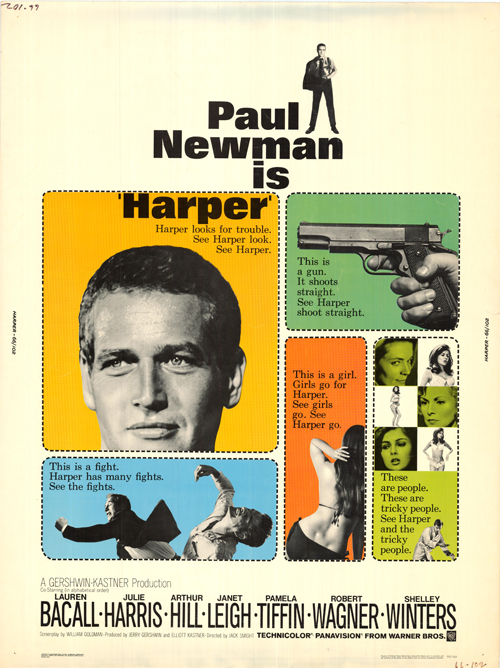
            Detective Lew Harper (Paul Newman) is hired by Mrs. Sampson (Lauren Bacall) a rich woman whose husband has gone missing. She wants a private eye to find him instead of the police due to the fact that her husband was involved in certain illegal business activities, which she doesn’t want to come to light. Harper finds himself immersed in a complex web of intrigue dealing with an array of shady characters, twists, and danger.

Newman is terrific and the Harper character is the perfect private eye for modern audiences. Watching him get out of bed in his dingy, cluttered apartment at the beginning and get ready for the day is excellent and builds characterization in a visual, subtle, and believable way. His cool, laid-back, and detached demeanor is a great contrast to the hyper, jaded, high-strung L.A. types that make up the assortment of suspects. His cynical style attaches the viewer to him right from the start and the banter that he has with everyone is marvelous.

The supporting characters are superb as well and very well-defined. Bacall gets one of her better later career roles as the bitchy eccentric wife. She gets quite a few quotable zingers particularly between her and her step daughter Miranda (Pamela Tiffin) that are close to classic. I also got a kick out of Shelley Winters playing a parody of herself as a way past her prime Hollywood star who is now overweight and an alcoholic. Harper’s attempts to get information out of her by pretending to be a hick who is totally mesmerized by her is quite amusing.

Director Jack Smight is at his directorial peak here. The on-location shooting is splendid. I particularly enjoyed the modernistic building that fronts as a church, but is really used as a cover for criminal activity. It sits out on a sandy hilltop and leaves a strong visual impression as does Harper and Miranda’s car ride along a very winding desert highway to get there. I also liked his ability to capture an abandoned airplane hangar making it almost as evocative to the eye as the foot chase that happens in it. The whole production is consistently slick with color schemes, set design and editing that are all top notch.

William Goldman’s script, which is based on the novel by Ross Macdonald is sensational and one of his best in his already legendary career. The dialogue is sharp one can view it for the lines alone and might need to re-watch it again simply to pick-up on all of them as there are so many your liable to miss some. The mystery is also intriguing and nicely layered to the point that it will keep you guessing and impossible to figure out and fortunately there is a minimum of loopholes. I saw this before and knew the outcome, but still found it an enjoyable and involving ride.

My complaints are few and fortunately do not taint the quality of the picture, which is otherwise high. I didn’t like that Harper had an ex-wife Susan (Janet Leigh) who he is constantly trying to win back. The woman seemed a bit cold and snippy and not the type I would think Harper would fall for, or want to put up with. Having him act so needy to win back her affections hurt the ruggedness of the character who is appealing because of his independent and self-assured nature. There is another scene where a man is shot dead and Harper goes through his coat pockets in order to get some clues to his identity. He finds a matchbook listing a nightclub, which Harper goes to in order to ask questions from the patrons, but I kept thinking it would have been much easier had he just went through the victim’s pants pocket and taking out his wallet and looked at his driver’s license.

If you are looking for a nifty mystery done in the best crime noir tradition then they don’t come much better than this.

My Rating: 9 out of 10

Released: February 23, 1966

Runtime: 2Hours 1Minute

Rated NR (Not Rated)

Director: Jack Smight

Studio: Warner Brothers

Available:  DVD, Amazon Instant Video