Tag Archives: Entertainment

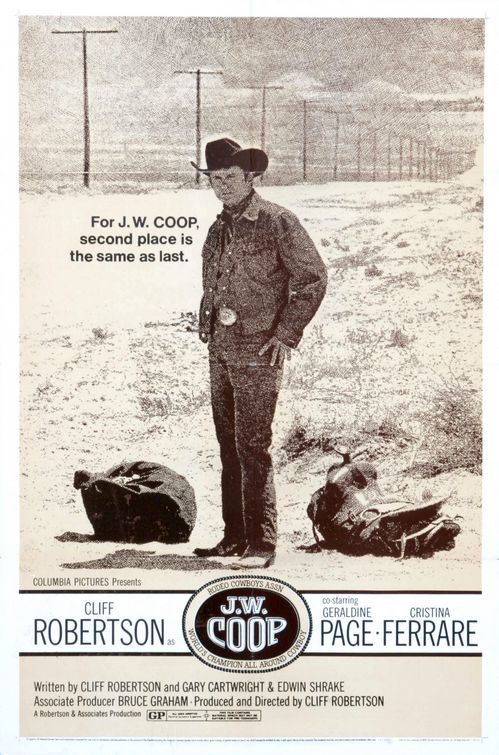
J. W. Coop (1971)

jw 2

By Richard Winters

My Rating: 8 out of 10

4-Word Review: Rodeo star makes comeback.

J.W. Coop (Cliff Robertson) has just spent 9 years in prison. After finally being released he finds that the world has changed quite a bit. He’s no longer the big rodeo star that he once was and younger, more educated men have now taken his place. There’s also the new hippie movement that he isn’t quite sure what to make of. With his mother (Geraldine Page) growing senile and no other friends to turn to he decides to take one last stab at the rodeo circuit and determined to beat the odds and become the champion because for him second place is the same last.

The film has a wonderfully gritty quality to it that fully immerses the viewer into the western rodeo landscape and lifestyle. The rugged characters and conversations seem authentic without ever being condescending. The film reveals a lot about the inner toughness needed to survive in that environment as well as the competiveness and eventual loneliness.

Robertson’s stab at directing is flawless and convinced me that he should’ve done more movies behind the camera. He uses several techniques that make the rodeo experience vivid for the viewer including filming a point-of-view shot from on top of the bronco as well as even more impressively showing one taken from underneath a horse as it is running. I also liked the shot where the screen gets split into four squares with each of them showing some of the many hotels that he stays at during his travels on the circuit, which visually hits home how exhausting life on the road can be. There’s also a haunting segment shot late at night at a lonely oil rig that is brief, but quite memorable.

Former model Cristina Ferrare, who is probably best known as being the ex-wife of automaker John DeLorean as well as host of ‘Home and Family’ gets a rare turn at acting playing a hippie who falls in love with Coop.  Her performance is solid even though I found it hard to believe why such a young woman would fall for a man who is so much older, less educated and having not much more money than she does. Their relationship goes on far longer than I realistically would expect, but I still liked the idea of how two people from two very different backgrounds and generations can still manage to connect. Robertson’s performance is equally good and the film also has the novelty of casting Page as his mother even though in real-life she was actually one year younger than he was.

The segment where a throne of teen girls jump out of a trailer and beg for Coop’s autograph as well as the ending in which Coop, with his leg in a cast, attempts to ride a bull are the only two times that it overreaches in a film that is otherwise quite honest and uncompromising and particular good at mixing subtle comedy with stark drama.

My Rating: 8 out of 10

Released: October 3, 1971

Runtime: 1Hour 52Minutes

Rated PG

Director: Cliff Robertson

Studio: Columbia Pictures

Available: DVD, Amazon Instant Video
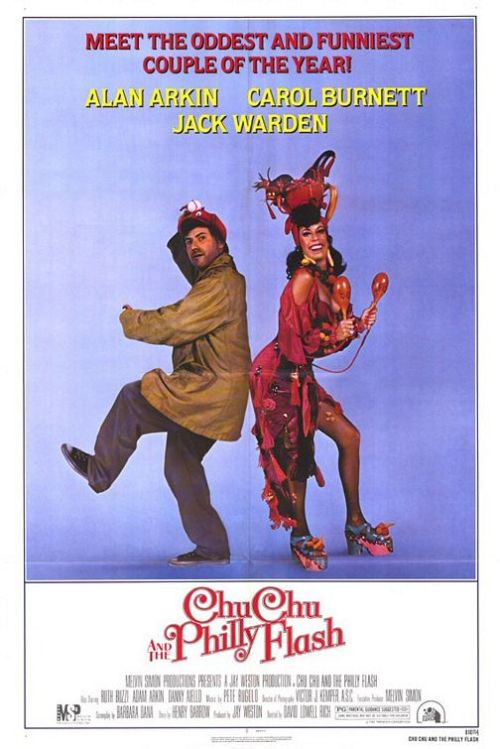
Chu Chu and the Philly Flash (1981)

chu chu 4

By Richard Winters

My Rating: 3 out of 10

4-Word Review: Goofy couple steals briefcase.

Flash (Alan Arkin) is a former big league pitcher who is washed up while living on the city streets selling stolen watches that don’t work. Emily (Carol Burnett) is a former dance instructor who is equally down-and-out and now makes a meager living doing dance routines on the streets while wearing a Carmen Miranda outfit. The two inadvertently meet one day while coming into contact with a briefcase that has stolen government documents. They agree to give it back to the men who are demanding it, but only for a price, which only helps to get them into more and more trouble.

This offbeat comedy, which was written by Barbara Dana who at the time was married to Arkin, has a few funny, dry humored moments at the beginning that makes it somewhat passable, but it’s unable to sustain any type of momentum and does not have enough action or comedy to keep it engaging. The middle half is slow and boring and the ending, which takes place at an amusement park, is too full of forced humor and sloppy slapstick to be considered either funny or entertaining. The film also never explains what specifically these secret plans are, or who these men are that are chasing after it, which only proves how poorly thought out and threadbare the plot really is.

The relationship between the two main characters doesn’t work either. They seem to let their guards down too easily for people that have been living alone and on the skids for so long and having them share more of a bickering and distrustful chemistry would’ve made it more realistic and edgy. The whole middle half is spent hearing them telling each other about their woeful pasts, which is neither compelling nor insightful and only bogs the film’s already slow pace down even further. These are the type of wacky character who can only be effective if put into comically frantic scenarios of which there needed to be much more of.

Arkin manages to give a pretty good performance playing a surprisingly subdued character that does not go off on hyper rants like the characters in some of his other film roles do, which is a good thing. However, Burnett is completely wasted despite seeing her in a Carmen Miranda outfit, which is a definite hoot. The only one who is genuinely funny is Danny Aiello as the exasperated bad guy.

Danny Glover can also be spotted in an early role as a homeless person trying to spy on Burnet and Arkin to see what they’re up to, but his part is one of the corniest ones in the movie and should’ve been dropped completely. The San Francisco setting may remind one of the classic comedy What’s Up Doc?, which also took place in that city and had a similar storyline dealing with a misplaced briefcase, but that film was far more consistently funny and took more advantage of the bay area locales while this one only focuses on the rundown areas of the city.

My Rating: 3 out of 10

Released: August 28, 1981

Runtime: 1Hour 32Minutes

Rated PG

Director: David Lowell Rich

Studio: 20th Century Fox

Available: VHS

Slacker (1991)

slacker

By Richard Winters

My Rating: 8 out of 10

4-Word Review: A movie about nothing.

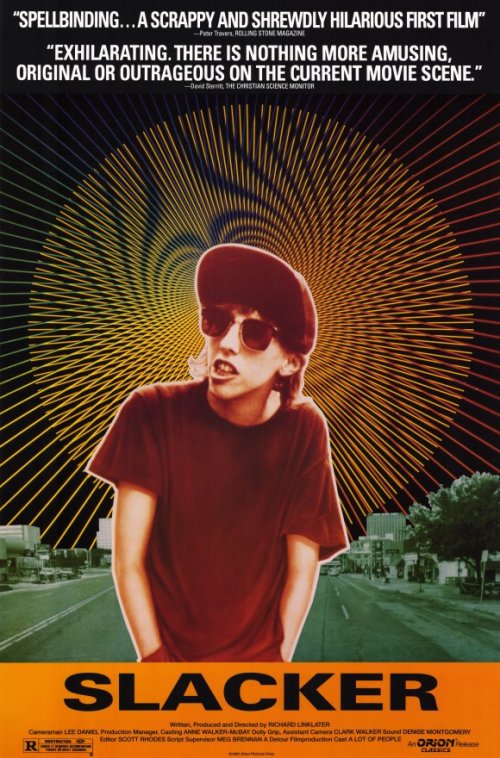
A look at a day-in-the-life of society’s left behinds that filter the streets, bars and coffee shops of Austin, Texas. The viewer hears a wide variety of weird topics, theories and extreme political points-of-view from the detached 20-something crowd as the camera winds its way from one conversation to the next and never stopping on any one person for longer than a few minutes.

This was considered at the time of its release to be a major breakthrough for the independent film movement and one that remains an inspiration for many indie filmmakers today. It succeeds because it proves you don’t need a big budget, state-of-the-art effects or even a compelling story to work. It washes all those things away and gets down to the very essence of why we watch movies, which is because we are all secretly voyeurs intrigued with seeing how the ‘other half’ lives without having to get our own feet wet in the process. The characters, as offbeat as they and their conversations may be, have a definite element truth to them and this film manages to convey reality far better than 95 percent of the other movies out there.

Some of my favorite conversations, which seem mostly ad-libbed, involved the one with the guy who was obsessed with the JFK assassination and his ‘shocking’ new revelations involving Jack Ruby’s dog. There are also the two young men inside a bar who talk about the ‘subliminal messages’ of the Smurf cartoons and the film’s director Richard Linklater who opens the film with a discussion on how every choice that we don’t make continues off and has a reality of its own. I also liked the anarchist (Louis Mackey) who talks about the man who assassinated President McKinley simply because all you ever hear about are the Kennedy and Lincoln assassinations and never anything about anything about the other two.

I also liked Teresa Taylor, who was the former drummer for the Butthole Surfers, playing a woman trying to sell a vial containing singer Madonna’s Pap smear and the guy who locks himself inside a room with what seems like hundreds of TV’s that run all day and night. However, I was a bit disappointed that during this scene we get shown a video of a man who supposedly shots the camera with his rifle and although he does indeed aim his gun at the lens he never fires it, which I found to be a letdown.

Some may consider these characters, in our very job oriented culture, to be ‘losers’ simply because they ‘aren’t working’ and being ‘productive members of society’, but director Linklater takes a different perspective by stating in an interview that he feels slackers are instead a ‘step ahead’ and ‘rejecting the social hierarchy before it rejects them’.

To some extent I agree as I was pretty much the same way at that age, but I also couldn’t help but think what these same characters were doing now 20 years later. It’s easy to be detached when you’re younger, but when a person reaches middle-age and the financial responsibilities become stronger, it’s not, so I kept wondering if these same people may have now ‘sold-out’ or even ‘grown up’. I also wondered how they may have evolved in other ways for instance the guy who was so into the conspiracies of the JFK assassination may now have crossed over to ones involving 9/11 and the young man that was really into TV’s may now be a Blu-ray player nut instead. If anything this is a movie crying out for a sequel and one that could easily be just as fascinating as the first one especially if it involved the same people.

My Rating: 8 out of 10

Released: March 22, 1991

Runtime: 1Hour 37Minutes

Rated R

Director: Richard Linklater

Studio: Orion Classics

Available: VHS, DVD, Blu-ray (Criterion Collection), Amazon Instant Video


Roxanne (1987)

roxanne

By Richard Winters

My Rating: 7 out of 10

4-Word Review: His nose is big.

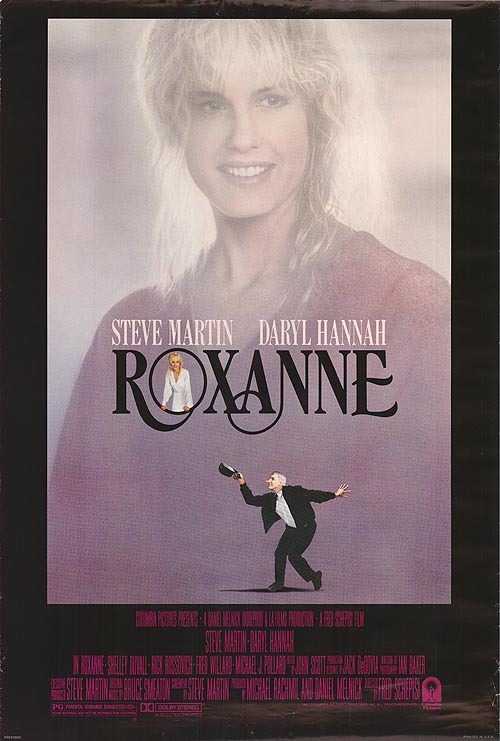
Charley (Steve Martin) runs the local fire department and just happens to have a really long nose, which at times causes him to be the butt of jokes. Roxanne (Daryl Hannah) is a beautiful student of astronomy who is spending the summer in the small town of Nelson studying a comet. Charley becomes smitten with her, but doesn’t dare ask her out due to his fear that she will reject him. Chris (Rick Rossovich) is the good looking guy who moves to the area and immediately catches Roxanne’s eye. The problem is that he is very shy with women, so Charley helps him out by writing letters to her while pretending that they were done by Chris, which captures Roxanne’s heart without her realizing that the man she is really in love with is Charley.

There have been many remakes old movies and in this case an old stage play named Cyrano De Begerac and for the most part they fail and only help to make the viewer long for the original, but this is the rare case where the updating of the story actually works. One of the main reasons is that it doesn’t try, in an effort to be ‘hip’, to go for the crude angle like a lot of modern remakes do and instead keeps it charming and breezy while having a main character with a sense of humor and not drowning in self-pity.

The on-location shooting, which was done in the small town of Nelson, British Columbia, helps as well. The hilly, green landscape gives the film a serene feeling and the quirky supporting characters seem very much like people you’d bump into when passing through one of these places. The humor is also top notch particularly the running gag involving the incompetent fire department.

Martin remains the film’s biggest selling point particularly the scene where he tries to use eye shadow to help darken his nose and make it less conspicuous or the moment when he lets a parakeet perch itself on it. His best part though comes when tries to come up with 20 insults to say to someone with a big nose.

Hannah is stunningly beautiful to the point of being breathtaking and fortunately this was years before she had her ill-advised plastic surgery, which now makes her looks far less appealing. Rossovich is also quite good and tends to be overlooked due to Martin’s presence, but manages to be quite funny as well especially the scene where he tries to meet Roxanne in person while having Charley telling him what to say through a radio transmitter.

Shelley Duvall, Michael J. Pollard and Fred Willard also deserve mention for their supporting work here and this marks the film debut for Kevin Nealon who appears in an early bit as a bully who tries to make fun of Charley’s nose, but learns the hard way that he shouldn’t.

My Rating: 7 out of 10

Released: June 19, 1987

Runtime: 1Hour 47Minutes

Rated PG

Director: Fred Schepisi

Studio: Columbia Pictures

Available: VHS, DVD, Blu-ray, Amazon Instant Video, YouTube

Dear Heart (1964)

dear heart 3

By Richard Winters

My Rating: 7 out of 10

4-Word Review: Love at a convention.

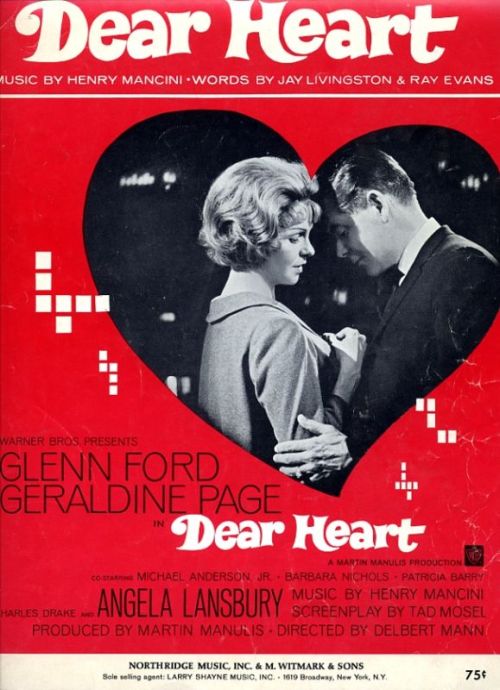
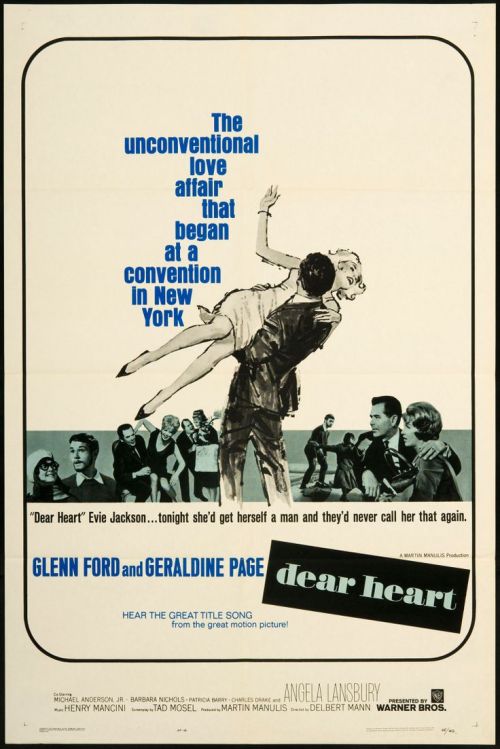
Harry Mork (Glenn Ford) is a greeting card salesman traveling through New York on business when he bumps into the quirky and very lonely Elvie (Geraldine Page) who’s attending a convention there and eyes Harry as a potential catch. Harry though is already engaged to Phyllis (Angela Lansbury) a woman he has only known through correspondence, but is starting to have second thoughts about when he meets her grown son (Michael Anderson Jr.). Elvie tries putting on some moves, but Harry keeps backing away unsure at age 48 if he even wants to settle down at all as he has at times still feels the itch for the occasional fling.

One of this film’s crowning achievements and something that becomes like a third character are the crowd scenes. This may sound inconsequential, but many films have a hard time getting background extras to behave like people amidst large groups of strangers do, but here for whatever reason it gets it right and seeing the dizzying stream of people going back and forth leaves a strong impression and helps accentuate the loneliness and isolation of the main characters particularly Elvie.

I also liked the way the characters hemmed and hawed with each other during the beginning stages. At times Elvie seems more into Harry than he is with her and then other times it gets reversed. Both characters at different points put up an array of defenses and it takes a while for either of them to trust the other and come out of their shells and move into an actual relationship, which is far more realistic than most movies that usually jumps ahead too quickly and never shows the awkward phase that most anyone else goes when testing the waters with someone that they’ve just met.

Page is excellent as always playing the eccentric type of character that she’s proven to be quite adept at, however her myriad of strange quirks got a bit ridiculous and overdone.

Ford is equally good especially with this type of comedy where he plays nervous characters unsure of how to deal with some of the offbeat people around him. I was disappointed though that there was a long drawn out sequence where he tries to get a clerk at the gift card shop (Barbara Nichols) up to his hotel room for a fling, but the film then cuts away and never follows through with what occurred once they got up to the room even though it is later intimated that things didn’t go too well.

The supporting cast of familiar faces lends great comic support, but the most memorable thing about the film is that it features both actresses who went on to play the Mrs. Kravitz character in the ‘Bewitched’ TV-Show. There’s Alice Pearce, who played Mrs. Kravitz for the first two seasons before she died of cancer and then Sandra Gould who replaced her and there’s even a surreal moment where the two have a bit of a confrontation, which I found to be pretty cool.

dear heart 2

My Rating: 7 out of 10

Released: December 2, 1964

Runtime: 1Hour 54Minutes

Not Rated

Director: Delbert Mann

Studio: Warner Brothers

Available: VHS, DVD (Warner Archive), Amazon Instant Video

Serpico (1973)

serpico

By Richard Winters

My Rating: 8 out of 10

4-Word Review: A cop fights corruption.

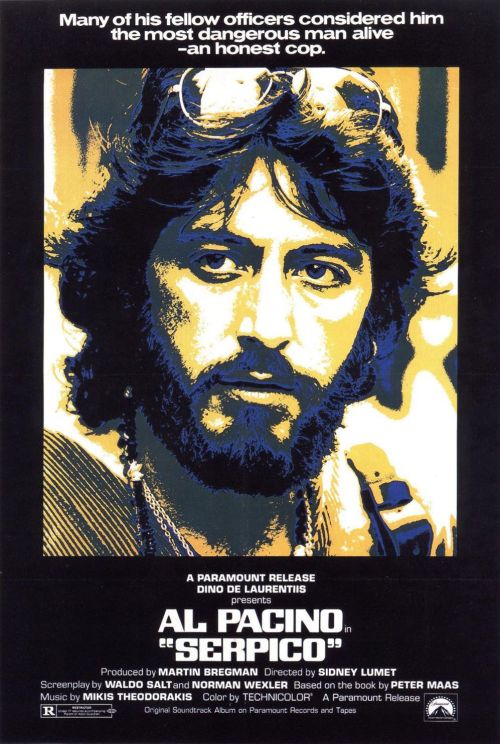
One of the followers of this blog has requested that I review this movie, so today we take a look at Frank Serpico (Al Pacino) a policeman who fought against corruption that plagued New York’s police department during the ‘60s. Even though many of his partners on the force would accept under-the-table payouts from criminal elements in exchange for ‘looking-the-other-way’ he wouldn’t and when he would tell his superiors about it nothing would get done. Instead they would transfer him to other precincts only for him to find the same problems there. It was only when he decided to report the issue to the New York Times that people started to take action, but in the process he also made himself a mark and vulnerable to having his unhappy comrades set him up to be shot while on-duty.

The film is based on the Peter Maas novel, which in turn recounts the life of the actual Frank Serpico and the events he went through while working on the force between the years of 1959 to 1972. Not only does he remain alive today, but according to recent reports is even considering, at the ripe old age of 79, a run at political office. Equally interesting is that he and Pacino roomed together during the summer that this was filmed and became close friends.

It’s been years since I’ve read the novel, but I felt this film sticks closely to what actually happened and the always reliable Sidney Lumet manages to keep things exciting and insightful. The dialogue is sharp and the on-location shooting, which was done in every borough of New York except Staten Island, gives the viewer an authentic feel of the city as well as the police environment.

The film also does a successful job at showing the drawbacks of accepting bribes without ever getting preachy or heavy-handed. One might think, like many of Serpico’s partners do, that taking some kickbacks isn’t that big of a deal, but then the film shows in one brief moment a policeman shoving another man’s head into a toilet when he doesn’t ‘pay up’, which hits home how the police become no better than organized crime who would notoriously demand ‘protection money’ from business owners.

The only thing I didn’t like was the music, which was too loud and jarring. Fortunately it’s put in only sparingly, but its melodic quality takes away from the grittiness and the film works far better by simply relying on the ambient sounds of the locations that the scenes are in. In fact this is one movie that could’ve done fine without any music at all.

Pacino is fantastic and I loved how the character starts out as this clean shaven, boyish looking fellow only to grow into a bearded, long haired guy as the story progresses, which symbolically connects with the way he becomes savvier to the system. The character also sports earrings long before it became vogue for males to wear them.

Tony Roberts does well as one of the few cops that sides with Serpico and tries to help him in his fight and F. Murray Abraham can be spotted near the end as a member of a vice squad who tries setting Serpico up to be killed. This movie also marks the film debuts of character actors Alan Rich and Kenneth McMillan. In my mind this is also the debut of Judd Hirsh. Some sources state that his first onscreen appearance is in Jump, which came out two years earlier, but I watched that film and couldn’t spot him anywhere, but her I was able to spot him right away.

My Rating: 8 out of 10

Released: December 5, 1973

Runtime: 2Hours 10Minutes

Rated R

Director: Sidney Lumet

Studio: Paramount

Available: VHS, DVD, Blu-ray, Amazon Instant Video, YouTube

A Zed & Two Noughts (1985)

zed 3

By Richard Winters

My Rating: 6 out of 10

4-Word Review: They’re really into decay.

Oswald and Oliver (Brian and Eric Deacon) are twin brothers working at a zoo who become devastated to learn that both of their wives have died in the same freak accident in a car driven by Alba (Andrea Ferreol) who survives, but without her leg. Initially the brothers’ are angered with her, but this slowly grows into a strange attraction, which eventually forms into a ménage a trois. To help with their grief they begin doing time-lapse photography of the decaying process. They start with dead animals before deciding on a human subject with Alba as their chosen ‘star’.

From a completely visual level this film can be considered a great success. This was the first of ten projects that Director Peter Greenaway and cinematographer Sacha Vierny collaborated on and the result is stunning. The vivid contrasting colors, lighting and symmetrically designed sets make each and every shot look like its own painting. This is also one of the few films that completely transcend its era. Usually one can tell what decade a movie is from by watching it for only a few minutes, but this film is unlike any other ‘80s movie made, which is an achievement unto itself.

The best part of the movie is its depiction of the real-life decaying process captured in time-lapse form. I realize this may sound extremely morbid and ‘sick’, but it’s a natural process of the world we live in and if taken from a purely scientific perspective quite an interesting and fascinating phenomenon to watch. It gives the film a unique one-of-a-kind edge and something I wished had been shown even more.

The film’s drawbacks are the characters that come off as too weird and twisted, which is an issue in a lot of Greenaway’s movies that are always technically brilliant, but lacking in emotion or empathy. A good movie, no matter how ‘artistic’ it may be still needs relatable characters to help propel it and instead this movie has what amounts to mouth pieces in disguise as people who are simply used to relay a concept, but in no way connected to anyone you’d ever meet in real life. This results in leaving the viewer cold and making the film more of an ‘Avant-garde experiment’ than an actual story.

My Rating: 6 out of 10

Released: October 4, 1985

Runtime: 1Hour 55Minutes

Not Rated

Director: Peter Greenaway

Studio: British Film Institute

Available: VHS, DVD, Blu-ray

Harrad Summer (1974)

harrad summer

By Richard Winters

My Rating: 6 out of 10

4-Word Review: Bringing sexual liberation home.

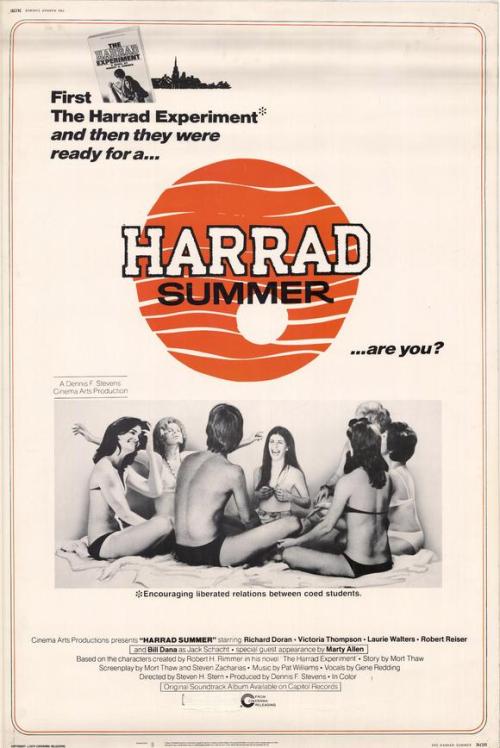
The school year is over and now the students of Harrad, which is the college that teaches and promotes open sexuality, go home for the summer and put what they’ve learned into action in their everyday lives. Like in the first film this sequel focuses on just four of the students who find that their parents and friends are not as broad minded as they are, which causes friction in not only their relations with them, but with each other as well.

This film for the most part works surprisingly well. Director Steven Hilliard Stern takes more of a playful approach to the material and mixes in some funny moments that overall are quite entertaining. The wide variety of locales elevates the stagnant feeling that the first one had and it also manages to address a wider variety of issues.

The story is broken up into three segments with each one focusing on the student’s home lives as they visit each of their parents for 2-weeks at a time as a group. The first part, which deals with Stanley’s (Robert Reiser) folks isn’t too interesting and is fortunately pretty brief. The visit to Harry’s (Richard Doran) is the most comical and the film’s highlight while Stanley’s conflicts with Sheila’s (Laurie Walters) father (Walter Brooke) during their visit to her folks seem contrived and pointless. The film never manages to get to Beth’s (Victoria Thompson) parents, which is probably just as well.

The film’s biggest drawback is that neither Don Johnson nor Bruno Kirby, who were so good in the first film, reprises their roles here and their absence is sorely missed as  Reiser and Doran don’t have the same acting talents and are quite weak in comparison. Thompson, who was blonde in the first film, now has, with no explanation, jet black hair, which makes her look exactly like her sister and fellow actress Hilary Thompson. Also, Emmaline Henry, who was best known for playing Mrs. Bellows in the ‘60s show ‘I Dream of Jeannie’ replaces Tippi Hedren who was unavailable for the sequel and James Whitmore’s role gets taken out completely.

The supporting cast is what gives the film its spark. Comedian Marty Allen, whose hair looks like the ultimate bird’s nest and usually gets more attention than his comic ability, is fun as a drunken party guest. However, Pearl Shear, who plays his wife, is the real scene stealer as an overweight middle-aged woman, who in Mrs. Roper-like fashion, eagerly wants to get involved with the kids and their new found sexual liberation and even takes part in a nudist session with them.

Bill Dana, famous for creating the Jose Jimenez character, is quite good as well playing Harry’s staunchly conservative father who can’t deal with the open sexuality of the younger generation only to surprisingly come around to it at the very end. He also gets the film’s best line when after denying to Harry that he ever had any affairs finally admits “Maybe I did a couple (women) in Vegas and a few in Cleveland, but what else is there to do in Cleveland.”

My Rating: 6 out of 10

Alternate Title: Love All Summer

Released: August 6, 1974

Runtime: 1Hour 43Minutes

Rated R

Director: Steven Hilliard Stern

Studio: Cinerama Releasing Corporation

Available: DVD

Hamburger: The Motion Picture (1986)

hamburger

By Richard Winters

My Rating: 1 out of 10

4-Word Review: Receiving a hamburger education.

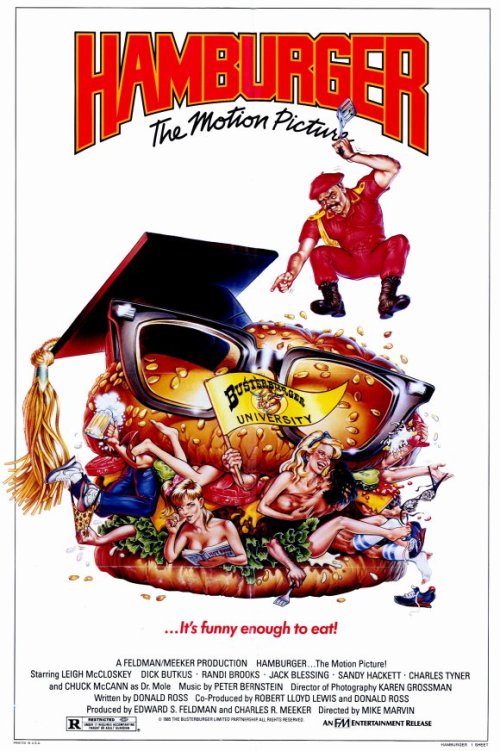
Russell (Leigh McCloskey) has flunked out of several colleges and has no future plans while being deemed a failure by his parents (Robert Hogan, Lillian Garrett). Then he meets a franchise owner of Busterburger who tells him about how much money he can make as an owner of one of their restaurants, which convinces him to train to become a franchisee. The problem is that he must attend Burger U, which is run by the no-nonsense Drootin (Dick Butkus) who has strict rules and won’t even allow the students to leave the campus during the school semester. They are forced to sleep in beds that look like giant hamburgers and if they do get into trouble they are locked into cells made to resemble giant pickles and sprayed with hot sauce.

There are schools out there that train people on how to own their own fast food franchise and had this film toned down the silliness and keep it solely on a satirical level it might’ve worked. The opening 10 minutes has an over-the-top campy quality, which isn’t bad, but then it devolves into the crude, cartoonish mindset that drags the thing down until it becomes a forgettable waste of time.

The film was written by Donald Ross who penned many teleplays for TV-series from the ‘70s through the ‘90s. He is also the husband of Patti Deutsch a red haired, nasal voiced woman who was a quirky contestant on game shows during the ‘70s including ‘Match Game’, which is my favorite. They also appeared together as a couple on ‘Tattletales’ and in those instances he came off as a reasonably intelligent person, so I was expecting a little bit more from this than what I got.

Unfortunately there’s nothing funny about it and just proceeds to get dumber and dumber as it progresses. It’s also insulting to overweight people as it includes a highly offensive and gross scene where a busload of them come into a restaurant and eat everything in sight like they’re animals instead of humans and then proceed to all have a flatulence attack, which ultimately blows the whole place up.

Former Chicago Bears linebacker Butkus is alright and the one highpoint of both the film and his otherwise unimpressive acting career. Chuck McCann, who is almost unrecognizable as an eccentric professor, is okay too, but star McCloskey is dull and looks more like a man in his 30’s, which he was, than a college aged student while the rest of the cast of characters are too exaggerated to be either interesting or funny.

Clearly the producers were trying to tap into the Police Academy formula, but it doesn’t work and is a complete embarrassment to all those involved.

My Rating: 1 out of 10

Released: January 14, 1986

Runtime: 1Hour 29Minutes

Rated R

Director: Mike Marvin

Studio: Busterburger Limited Partnership

Available: VHS

The Leather Boys (1964)

leather boys 1

By Richard Winters

My Rating: 6 out of 10

4-Word Review: Befriending a gay biker.

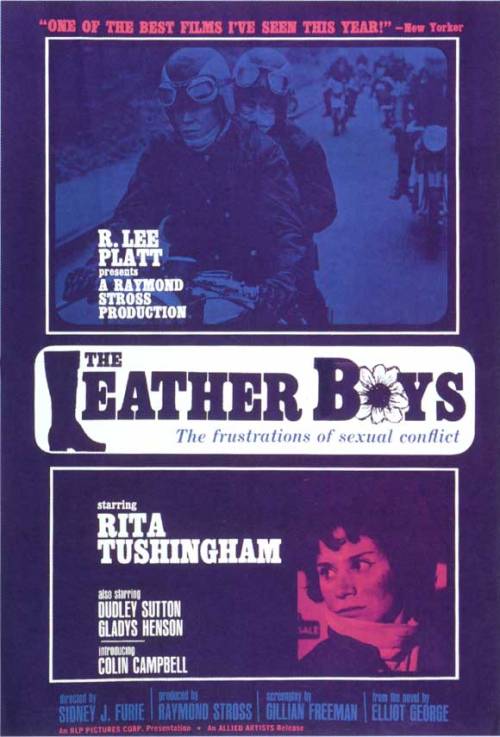
Reggie and Dot (Colin Campbell, Rita Tushingham) are young and in love, at least they think they are. They want to rush off and get married, but Reggie’s father (Lockwood West) feels that they ‘don’t know the meaning of the word’ and he gets proven right as immediately after they tie the knot they are at odds with each other. Reggie begins looking for companionship elsewhere and meets up with a fellow biker named Pete (Dudley Sutton). Pete and Reggie quickly become best friends and begin hanging out together, but Pete is secretly gay and has more of an interest in Reggie than just a friendship.

Director Sidney J. Furie, whose career has now spanned 6 decades, has done a lot of duds in his time, but this isn’t one of them. The stark black-and-white photography helps bring out the bleak working class existence of the characters and the variety of locales used including a nicely captured cross country motorbike race make the story captivating and believable.

The performances are outstanding. Tushingham is especially good at displaying a genuinely nasty side to her character at the most unexpected times. Gladys Henson, who plays the widowed grandmother, is also excellent and the scene where the others argue while right in front of her about how they consider her to be ‘an elderly inconvenience’ who needs to be sent away to a retirement home is downright heart wrenching. Sutton though is the most dynamic in a risky role that helped jettison him to stardom. His distinctive facial features galvanize the viewer’s attention and the ambivalent expressions that he makes particularly when in the presence of Dot are priceless.

Spoiler Alert!

The film though takes too long to get to its obvious conclusion as we have a pretty good idea from the beginning that Pete is gay, so having to wait until the very end for this to finally get revealed seems to be stretching the story out longer than necessary. Most likely Pete would’ve made some sort of pass at Reggie at some point earlier anyways especially since the men shared the same bed. The film also ends with Reggie walking away from Pete and essentially ‘abandoning’ him once he realizes that he is gay. The music that is played over the scene conveys the idea that this is the ‘right’ thing to do and parlays the conventional attitude of the time that there is something ‘wrong’ with Pete, which doesn’t make this as much of a landmark movie as it’s widely considered since its ultimate message is still entrenched with the biases and bigotry of that era.

End of Spoiler Alert!

My Rating: 6 out of 10

Released: March 8, 1964

Runtime: 1Hour 48Minutes

Not Rated

Director: Sidney J. Furie

Studio: Allied Artists

Available: DVD, Amazon Instant Video