Tag Archives: Ed Lauter

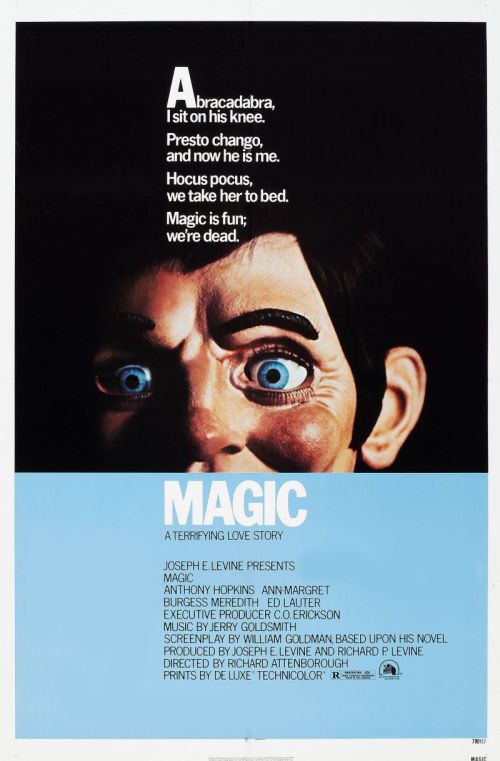
Magic (1978)

magic

By Richard Winters

My Rating: 7 out of 10

4-Word Review: Ventriloquist has split personality.

Corky (Anthony Hopkins) is an aspiring stand-up magician who’s finding it hard to play in front of live audiences. After a particularly disastrous effort he comes upon the idea of adding in a ventriloquist dummy named Fats into his act. The addition helps him become a top act and soon gets him the attention of well known agent Ben Green (Burgess Meredith). Ben wants to get Corky a TV contract, but first Corky must undergo a health physical, which Corky refuses to do. Ben insists that Corky has no other option, so Corky leaves the city and drives via a cab to the Catskills where he grew up and rents a lakeside cabin from his former high school sweetheart Peggy (Ann-Margaret). The romance between the two quickly renews, but then Ben finds out where Corky is staying and catches Corky alone in his cabin having an animated argument with his dummy convincing Ben that Corky has mental issues. Ben tells Corky that he’s going to get him psychiatric care, but Corky fears that if it gets out that he’s mentally ill he’ll never get another job offer and thus resorts to drastic action in order to keep Ben quiet.

The film is based on the novel of the same name by William Goldman who also wrote the screenplay. The novel was unique in that it was told through the voice and point-of-view of the dummy. While there had already been several stories and movies dealing with the ventriloquist/dummy persona including the film Dead of Night starring Michael Redgrave and a famous episode of ‘Twilight Zone’ where actor Cliff Robertson played a ventriloquist that gets tormented by his dummy. This film takes a slightly different approach where upfront the protagonist is clearly shown as having a major personality disorder and thus he’s the real threat while the dummy only symbolizes his inner turmoil between the ego and the id.

The film definitely has some creepy moments especially the dummy, whose spooky appearance is what makes it worth catching. It was modeled after Hopkins with oversized blue eyes, head, and mouth gives it an almost monstrous presence. Supposedly when it was completed and Hopkins first took it home to rehearse he got unnerved by it in the middle of the night and called Goldman to come over and pick-it-up or he was going to destroy it. The placid, gray setting of the isolated cabin, which was actually filmed in California despite it looking like northern New York, is perfect for this type of story and the serenity helps accentuate the suspense.

I really liked too the opening bit where a sweating Corky is seen bombing on stage in front of a apathetic crowd, which realistically hits home how nerve-wracking being up onstage for the first time can be though I wish we could’ve heard what Corky angrily shouted at the audience instead of having the sound of this blotted out by a voice over. It is though hard to believe that a man in his 40’s would get so addicted to his dummy, something he hadn’t used before then, that he couldn’t communicate without it and would have to take it everywhere he went. For a relationship to become this deep seated I’d think he’d have to have been doing a ventriloquist act from childhood on and thus the alter-ego of the dummy became meshed with his own as he grew older.

The acting is excellent by not only Hopkins, but also the supporting cast. Meredith is especially enjoyable playing the caricature of a Hollywood agent, which was modeled after the real-life one of Swifty Lazar, with his best moments coming whenever he takes out one of his expensive cigars, which are each separately incased inside a glass cannister. When he pulls the cigar out he then flings the cannister away, which can then be heard shattering onto the floor. Ann-Margaret known for her beauty and flair plays down her looks here as she wears no make-up and takes on a more earthy persona. Ed Lauter is also interesting playing her husband. Normally he’s a tough guy/bully and I thought this was going to come-out when he takes Corky out on a boat in the middle of a lake where he was going to threaten him to stay away from ‘his girl’, but instead he surprisingly displays a more vulnerable side and makes an emotional appeal to Corky to leave Peggy alone versus a strong-armed one.

Spoiler Alert!

The pacing is slow and the suspense builds very gradually though ultimately there are a few good spooky moments including a brief moment when Fats begins moving itself without the help of an operator and when Corky’s face suddenly begins to resemble the wooden dummy’s. Yet I felt it could’ve gone farther. The segment which has Corky crawling on the floor doing whatever the dummy tells him is certainly unnerving, but could’ve been accentuated more by showing it from Corky’s perspective where the dummy’s head would’ve grown to giant size as it looks down on the meek Corky as it gives him the orders.

The ending, at least when I first saw it, had me confused. The film climaxes with Corky returning to his cabin having stabbed himself and bleeding to death where he and Fats then slowly die together, but outside of the cabin Ann-Margaret appears telling Corky she has now changed her mind and wants to go away with him. Initially though it had been made to seem like Corky had killed her, so seeing her reappear as she does comes-off as almost dream-like. She also begins to speak in the dummy’s voice making it seem like his spirit had transferred to her.

Upon the second viewing many years later I came to the conclusion that this scene was meant to only be ironic. That if Corky had simply held-out longer Peggy would’ve agreed to go with him and thus him killing himself was a horrible waste, but in retrospect since he was suffering from such severe mental issues it was unlikely a long lasting relationship would’ve happened, so having her come back the way she does doesn’t really make much sense since she had been deeply offended by what he had said earlier, via the dummy. It would’ve been more horrifying had he chased her around the house and then killed her and the viewer seeing that get played-out.

My Rating: 7 out of 10

Released: November 8, 1978

Runtime: 1 Hour 47 Minutes

Rated R

Director: Richard Attenborough

Studio: 20th Century Fox

Available: DVD, Blu-ray, Amazon Video, YouTube
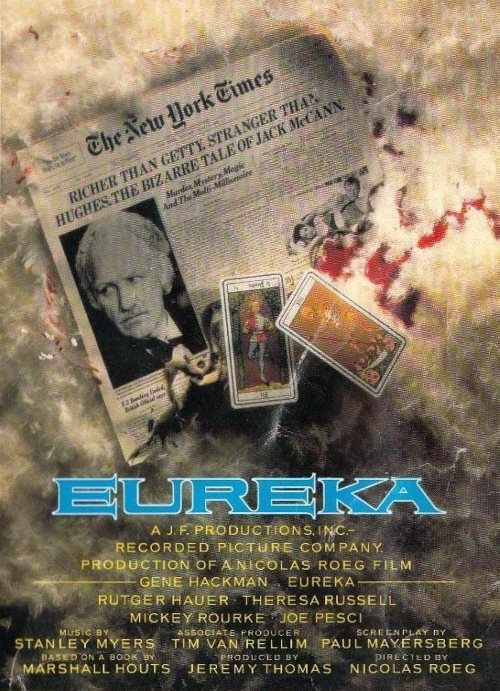
Eureka (1982)

eureka1

By Richard Winters

My Rating: 6 out of 10

4-Word Review: He discovers some gold.

Jack (Gene Hackman) has been searching the Yukon for over 15 years in the hopes of one day coming upon some gold. Then one day he finds it and becomes super rich. 20 years later he’s living on his own island, married, and with a grown daughter named Tracy (Theresa Russell). Jack though has grown ornery through the years and has managed to alienate most of his family including Tracy’s husband Claude (Rutger Hauer) whom Jack can’t get along with and the two regularly argue to the point that it also affects his relationship with his daughter. Jack is also at odds with the local mobsters headed by Mayakofsky (Joe Pesci) who wanted to open a casino on the island and are willing to resort to any violent means necessary in order to get that done.

The film is based loosely on the life of Sir Harry Oakes who, like with the main character here, scoured many countries looking for gold for 15 years before finally laying claim to a fortune. He then retired to the Bahamas and ultimately was found murdered in 1943 in a crime that has remained unsolved. The studio though did not know what type of audience to aim the film to and thus shelved it for a year only to release it to limited theaters where it managed to recoup a paltry $123,572 out of its initial $11 million budget making it one of the biggest box office bombs in history.

As a visual exercise, given its director, its a spellbinding ride. Director Nicholas Roeg approaches it as a fable-like tale and creates the artic in a surreal type of way giving it an almost outer-worldly look and feel. To an extent this works and there’s a few memorable scenes including a barefoot man lying in the cold who blows his head-off, via a loaded gun, in one very unexpected, shocking moment that’s very realistically grisly. The death by blowtorch, which happens a bit later is effectively vivid as well. However, there’s other metaphysical elements like a mysterious stone that gets handed to Jack that alludes a bit too much to a magical quality and takes away that this is actually based on a true story and instead makes it seem like it’s all just a made-up metaphorical fable, which starts to have a pretentious quality.

The plot is too thin and the second act labors badly. Joe Pesci is a dynamic actor, but here his part is boring and he doesn’t come-off as threatening enough to give his scenes the proper tension. There’s also no insight given to why the gangsters choose to pick-on Jack, as this is a man who is quite rich and could hire his own protection and enforcers and not someone you’d think could be easily intimidated. So why bother with him at all and just find another island to build a casino on? In the real-life incident Harry Oakes went out of way to try to ban casinos from the entire island nation as he did not approve of gambling and thus caused the ire of the criminal underworld, but the movie doesn’t bother to explain this and thus makes the motivations of the bad guys confusing.

Acting-wise its a joy to watch especially Hackman. He has played so many heroes in his film career that it’s fun seeing him be a jerk and he does it well particularly when he gets on his alcoholic wife about ‘laying off the sauce’. Ed Lauter, who’s usually a heavy, is entertaining with this constant nervous look on his face as he ends up being the reluctant middle-man who gets played by both sides. Rutger Hauer is brilliant as usual giving each of his moments a creepy finesse as only he can do. Two of his more memorable bits are when he swallows a small piece of gold while in Jack’s presence and when he has a meltdown at a formal dinner party and angerly, even frighteningly, demands they all must go home.

Of course being that she’s the director’s wife you get ample visuals of Theresa Russell with and without clothes on. The two became a couple while filming Bad Timing a few years earlier and despite a nearly 30-year age difference got married. I’ve often think it’s odd though when a husband directs a movie in which she’s in bed naked with another man, in this case Hauer, who’s also sans clothes. Don’t know if many other husbands would like that idea as the erotic scenes weren’t necessarily needed though I kind of wonder if it’s not another case of the trophy wife syndrome where the old guy wants to brag to the world: look at this hot little number I get to go home to and you don’t and thus the nude scenes are just there to make all the other guys jealous.

Spoiler Alert!

The climactic court room scenes, in which Hauer is placed inside a cage during the proceedings, aren’t effective. Mainly because he acts as his own lawyer and questions Russell on the stand who goes on a long, teary-eyed, rant about her father and his perceived psychological motives, that ceases to be the proper question/answer decorum that would be expected in a regular court setting. It’s unlikely that any judge would let this go on the way it does, or that the jury, or other attorneys would be so captivated as they are and not begin rolling their eyes after awhile, or objecting to the histrionics. Having Hackman killed off doesn’t help things as he was the guy the viewer most connected with while Hauer was a creepy guy who behaved erratically and expecting the audience to suddenly emotionally side with him at the end was an overreach.

Released: May 20, 1983

Runtime: 2 Hours 10 Minutes

Rated R

Director: Nicholas Roeg

Studio: United Artists

Available: DVD-R, Blu-ray

Loose Shoes (1978)

loose1

By Richard Winters

My Rating: 3 out of 10

4-Word Review: Lame parody of movies.

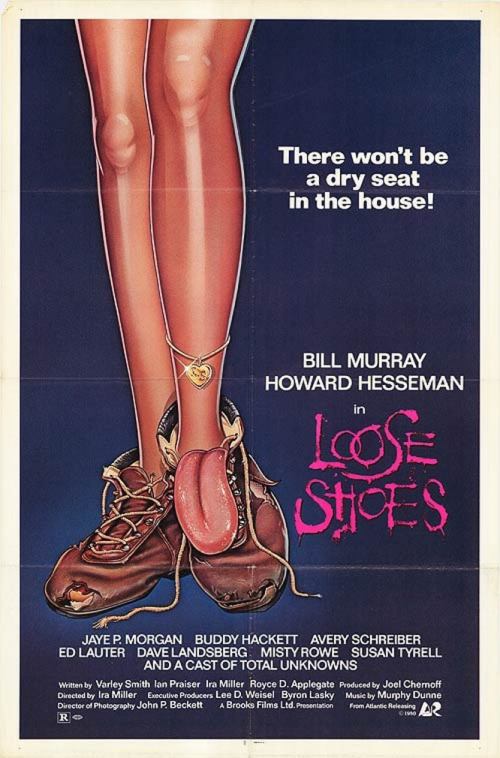
In 1967 an improv group, which Chevy Chase was an early member, began that called themselves Channel One, who performed improvisational skits making fun of current events and TV-shows. Instead of doing them on stage in front of audience they filmed it and then played them on three different TV screens at a theater in Greenwich Village. When these proved successful the collection of filmed skits were then toured around the country at college campuses and got a favorable reaction, so the producer decided to turn it into a feature length film. At the time this was considered a novelty as the movie, which was called The Groove Tube, would have no plot and just be a collection of skits, but it proved popular enough that it gave others the same idea. From this came Tunnelvision, American Raspberry, and probably the most famous one Kentucky Fried Movie. 

In 1977 Ira Miller, who had worked with Mel Brooks on his projects and was a member of Second City during the 60’s, became inspired to do his own version of this. He financed it using most of his own money. The concept was for it to be a parody of recent movies and structured similar to movie previews one would see at theaters before the main feature would begin. The working title was Coming Attractions and to keep costs low he cast young, unknown talent like Bill Murray, who agreed to work for a small fee in order to get the exposure, or B-actors that he knew who as a favor would work at below scale for a day in order to help him out. Initially it got such a bad reaction from test audiences that it was shelved for several years, but then after Meatballs was released, which made Murray a star, it was re-released under its new title in order to capitalize on his fame.

The film suffers from production values that are so cheap I’ve seen high school projects that were done better and it doesn’t help that the DVD issue looks like it was copied straight off of a VHS tape. Both IMDb and Wikipedia list the original runtime as 84 minutes, which is incorrect as it was actually 74 minutes, but the DVD version only goes 69 minutes and cuts out several segments including ‘Jewish Star Wars’, which is alright as even with the abbreviated runtime it still felt like it was never going to end and adding in the stuff that was edited out would’ve just prolonged the agony. It would’ve helped had there been some consistent characters like a family going to the theater to see a feature and becoming increasingly annoyed at the ongoing previews. After each skit it could’ve cutback to their reaction, which would’ve given it some minimal structure and focus that otherwise is sorely lacking.

Some of the segments had potential like the ‘Invasion of the Penis Snatchers’, but Miller approaches the material too much like a gag writer where he’s more interested in the punchline instead of playing out a funny scenario. The skit that has Jaye P. Morgan doing a send-up of Nurse Ratched needed to be extended as she could’ve done it hilariously. The segment that spoofs the Woody Allen film Play it Again Sam isn’t exactly funny, but David Landsburg’s impression of Allen is so spot-on that it’s entertaining nonetheless. Murray’s segment where he plays a prisoner on death row is okay and you even get to see him at one point with his head shaved. I also liked the bit with Susan Tyrrell as a woman stuck in the boonies only here the hicks are open-minded and even features a virtually unrecognizable Ed Lauter as a free-spirited, cocaine sniffing, redneck sheriff.

The best moment ‘Dark Town After Dark’ comes at the very end and features a send-up of a Cab Calloway dance number with the song ‘Loose Shoes’ being sung. The lyrics of which came from a comment made by President Gerald Ford’s Secretary of Agriculture Earl Butz. He was on a plane flight to California with entertainers Sonny Bono and Pat Boone. Boone asked him why republicans weren’t able to attract more blacks. He responded by making a comment that forced him to resign once it got out: “I’ll tell you what coloreds want. It’s three things: first, a tight pussy, second, loose shoes, and third, a warm place to shit.”

My Rating: 3 out of 10

Released: September 1, 1978 as Coming Attractions. Re-released August 1, 1980 as Loose Shoes

Runtime: 1 Hour 14 Minutes (Original Cut). 1 Hour 9 Minutes (DVD Version).

Rated R

Director: Ira Miller

Studio: Cinema Finance Associates

Available: DVD, Amazon Video

The Last American Hero (1973)

lasthero

By Richard Winters

My Rating: 7 out of 10

4-Word Review: He follows his dream.

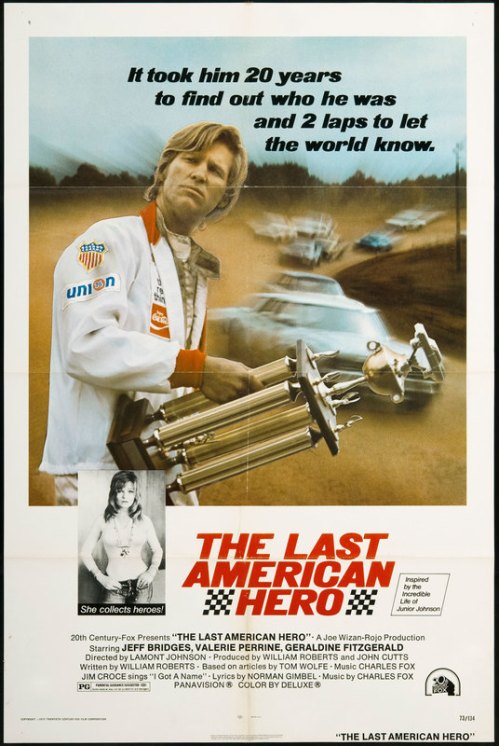
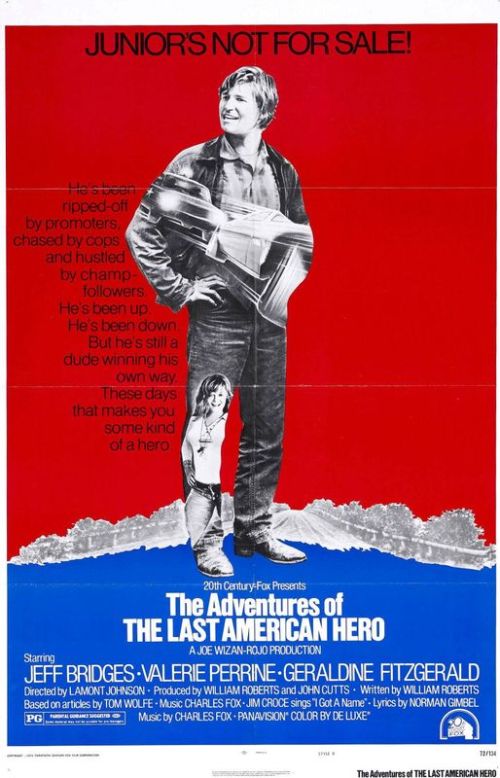
Junior Jackson (Jeff Bridges) works in his family’s moonshine business as a driver who transports the liquor and uses his superior driving skills especially his patented ‘bootlegger-turn’ in which to avoid capture he gets the vehicle to make a 180-degree turn by using the emergency brake, which then allows his car to go speeding off in the opposite direction. However, the authorities are able to catch-up with his father (Art Lund) and they throw him in jail for 11-months. With no moonshine business Junior is forced to find other means for an income, so he decides to try and turn his driving skills into a profit venture by entering into a demolition derby run by Hackel (Ned Beatty). He does well in this and eventually moves up to the higher levels and makes enough money for him to decide on turning it into his career, but his family does not approve as they feel it’s too dangerous. Junior is also forced to buy his own race car and pay for his own pit crew, which causes him to go back into the bootlegging business as a runner all to the disapproval of his father who feels it will just lead Junior into the same prison that he was in.

Overall this is one of the best bio’s out there and impeccably filmed and edited by actor-turned-director Lamont Johnson, who appears briefly as a hotel clerk. Johnson’s directing career was a bit spotty, he also did notorious clunkers like Lipstick and Somebody Killer Her Husbandbut this one is virtually flawless and there’s very little to be critical about on the technical end. The racing footage is both intense and exciting and one of the few racing movies where I was able to follow the race as a whole and not just be bombarded with a lot of jump cuts. I also appreciated how it captures the pit stops and the different conversations that the driver has with his crew during these moments and how sometimes this can be just as intense in its own way. The on-locations shooting done in and around Hickory, North Carolina as well as some of the neighboring race tracks during the fall of 1972 helps bring home both the ambiance and beauty of the region.

For me though what really stood out was Junior’s relationship with his family and how they were not supportive, at least initially, to his dreams as a racer and forcing him to have to pursue it on his own. Many times people who have ambitious goals don’t always have their friends and family on the same page with it and the road to success can definitely have its share of loneliness while also testing one’s own inner fortitude. One of my favorite scenes, that goes along with this theme, is when Junior is inside a K-mart and comes upon a recording booth that allows him to make a voice tape message that can be sent via the mail to one’s family or friends. Junior conveys into the microphone what he wants to say to his family, but ultimately seems to be talking more to himself than them, as a kind of self therapy to release the inner tensions that he’s been feeling, and subsequently never actually sends it out.

The acting is top-notch particularly by Bridges. Normally he’s good at playing mellow, level-headed characters, but here does well as someone who at times is quite volatile and caustic. There’s great support by Beatty as an unscrupulous race track owner, Ed Lauter as a highly competitive owner of a competing racing teams as well as Valerie Perrine as a woman who enjoys bed-hopping between different men, sometimes with those who are friends with each other, and yet completely oblivious with the drama and tensions that this creates. William Smith is good as a competing racer and while his part is small the scene where he walks in on Junior sleeping with his girl (Perrine) and the response that he gives is great. I thought Geraldine Fitzgerald, who plays Junior’s mother, was excellent and her Irish accent somehow effectively made to sound southern, but she should’ve been given more screen time.

The story is based on an Esquire article written by Tom Wolfe that was entitled ‘The Last American Hero was Junior Jackson. Yes!’, which in turn was based on NASCAR racing champion Junior Jackson (1931-2019) who also served as the film’s technical advisor. The movies pretty much stays with the actual account, but does change one pivotal point in that it has the father going to jail when in reality it was Junior who was sentenced to 11-months in 1956. Why this was changed I don’t know, but it usually helps the viewer become more emotionally connected to the protagonist when they see them going through the hardship versus someone else, so having Bridges spend time in the slammer would’ve made more sense. The film is also famous for its theme song ‘I Got a Name’ sung by Jim Croce, but this song has been played so much on oldies radio that one no longer connects it with the film and in fact when it does get played it takes you out of the movie because it reminds you of somewhere else where you’ve first heard it, which most likely wasn’t this movie.

lasthero2

My Rating: 7 out of 10

Released: July 27, 1973

Runtime: 1 Hour 35 Minutes

Rated PG

Director: Lamont Johnson

Studio: 20th Century Fox

Available: DVD, Amazon Video, YouTube

Finders Keepers (1984)

By Richard Winters

My Rating: 2 out of 10

4-Word Review: Stolen loot inside coffin.

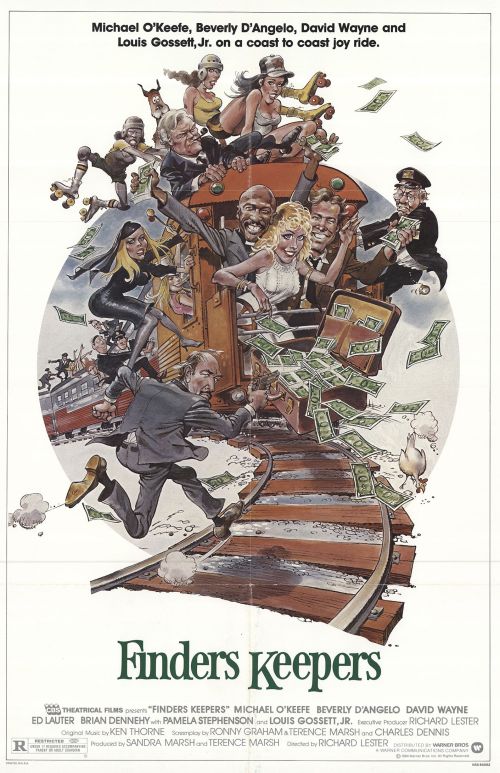
Based on the 1974 novel ‘The Next-to-Last Train Ride’ by Charles Dennis, the story centers on Michael Rangeloff (Micheal O’Keefe) who is a con-man on the run from a women’s roller derby team by hiding out as a U.S. Army General. He boards a train that has a coffin on it with millions of stolen dollars hidden inside. Once he becomes aware of this he tries to hatch a plan with a kooky actress (Beverly D’Angelo) that he meets along the way in helping him to get the money out of the coffin and off the train without being detected.

This is the type of film that gives comical farces a bad name. I’m all for comedies with a hyper-frantic pace and mistaken identities, but it still needs to have some grounding in what’s possible. This thing relies way too heavily on coincidences and random events to hold it together. The whole scenario that leads Michael getting onto the train is too much of an overreach. A more sane and less dizzying premise would’ve had Michael working on the train as a conductor from the start and then coming onto the money by chance, which would’ve been far less protracted.

His relationship with D’Angelo is dumb too. The women immediately comes-off as a babbling nutcase, even admits to suffering from mental health issues, and the type of person who usually gets thrown off of trains and planes for their disruptive behavior. Most people would be glad to be away from her the first chance they had and yet here the two end up going to bed together and profess their undying love for each other within 24-hours of first meeting.

The original concept was to use this as a vehicle for Dudley Moore, but that idea got nixed when the studio decided they wanted to make it an ensemble comedy instead, which was a big mistake. O’Keefe plays the role admirable, but he doesn’t have enough finesse that a comic star would. The supporting cast doesn’t help either. David Wayne’s portrayal of the world’s oldest conductor relies too heavily on the stereotype that every person who gets elderly must also be senile and it’ hard to imagine how anyone could hold done a job being as forgetful and out-of-touch as his character is. Ed Lauter, who wears a wig here, does not have the needed comic flair to make his bad-guy role either interesting or amusing. Oh, and Jim Carrey appears briefly too, but it’s a small bit that isn’t anything special.

Richard Lester directed many good comedies in his career, but the stylish quality that made up so much of his films from the 60’s is completely missing here. Everything gets captured in a flat, uninspired way and I didn’t like the Canadian province of Alberta being substituted for Nebraska as its flat wheat fields look nothing like the rolling prairie of the Midwest and the bleak late autumn topography complete with leafless trees gives off a chilly, depressing feel.

The scene where D’Angelo and Lauter find themselves inside a house while it is being trucked down a highway is kind of cool and outside of the low budget 80’s flick Mind Trapthe only time I’ve seen this done on film. Watching the house then end up losing its roof, after it goes under a low hanging overhead sign, and going down the road with skeletal frame exposed is fun too, but everything else is a bore that tries too hard to be frantic when it wasn’t necessary.

I was also confused why the setting of the story had to be in the year 1973 as it doesn’t play-up the 70’s era enough to make it worth it. My only guess was that with the Vietnam War still raging that it fit into the storyline of having dead soldiers returning home in coffins. However, since the US continually gets involved in foreign conflicts all the time this same scenario could easily work in any time period and sadly wasn’t unique just to that decade.

My Rating: 2 out of 10

Released: May 18, 1984

Runtime: 1 Hour 36 Minutes

Rated R

Director: Richard Lester

Studio: Warner Brothers

Available: VHS