Tag Archives: Dry Humor

The Late Show (1977)

By Richard Winters

My Rating: 6 out of 10

4-Word Review: Quirky couple solve mystery.

Ira Wells (Art Carney) is a crusty, old-fashioned detective from a bygone era who has settled down into retirement while renting out a small bedroom in the house of a sweet old lady (Ruth Nelson). One night he is visited by his old friend and fellow detective Harry Reagan (Howard Duff) who has been shot and dies before he can tell him the identity of his killer. Ira makes it a pledge to avenge the death of his friend and bring the killer to justice.  At the funeral he meets a flighty, free-spirited woman by the name of Margo Sperling (Lily Tomlin). She tries to hire Ira to get him to find out who has kidnapped her pet cat and holding him for ransom. Ira initially refuses until he finds out that his friend Harry had been investigating the case before he was shot.

Although billed as a comedy this is really much more of a gritty crime-drama molded as a modern day film noir. I think this is what threw me off when I first saw the film as well as audiences of the time.  With those two leads I was expecting a lot of zaniness especially with the pairing of such divergent characters. There is some subtle humor at times and one instance where Margo drives a van throw the front yards of some houses while escaping the bad guys, but overall the emphasis is really on the characters and the mystery. On this end it is okay. The mystery is intriguing enough to keep you involved and has a few nice twists and an array of weird suspects. Eugene Roche is the most amusing as Ron Birdwell, a man who is constantly trying to sell merchandise that he has stolen and has cluttered throughout his house.

The two lead characters propel the film and are well developed. Both actors play their parts well. I thought this was quite possibly Lily Tomlin’s best performance. It is also one that mostly closely resembles her true personality.  I enjoyed how at first both disdain the other, but then quietly come to appreciate each other and even grow a certain fondness and attachment.  However, I was disappointed that the film did not go further with this.  I thought the characters were highly believable and would have liked to have seen more conclusion as to what happens with their budding friendship. Personally I would have liked the first hour of the movie dealt with the initial case and then had them team up to solve an even more complex one in the second hour. A sequel or series would have been even better as it is certainly a potent premise.

One thing that really impressed me was writer-director Robert Benton’s keen eye for detail even with the little things. Although not always consciously noticed by the average filmgoer, the little things such as lighting, set decoration, and staging can having a very strong effect as to whether the film succeeds, or not.  A good director will always pay close attention to this while the poor one will overlook it, or cut corners. One example of this is Ira’s bedroom, which had the cluttered look most people’s homes have, but most movies fail to effectively recreate, as well as pictures and artifacts from years past that helped explain the character in a visual way. There is also a scene where Ira is doing his laundry at the local Laundromat while Margo talks to him about the case. I thought this was a nice touch as usually movie characters are never shown doing mundane daily tasks even though it is something most regular people have to spend a lot of their time doing. I noticed that he put in his clothes first and then the detergent, which I thought was a mistake. I presumed it was because actor Carney was just going through the motions and not paying attention, but then Margo mentions the error. This might have been an ad-lib on Tomlin’s part, but it is nice that they left it in as it helps accentuate the reality and shows even further how meticulous the detail was. I appreciated the scene involving actor Bill Macy who plays a bartender. Being a recently trained bartender I can attest that he mixed and served the drinks in the correct way, which isn’t always the case in other movies.

The Ira character also wears a hearing aid as did actor Carney in real life. There is one scene where Ira aims his gun and gets ready to shoot at a fleeing suspect, but just before he does he takes out his hearing aid. This makes sense as the loud sound from the blast at such short range would probably destroy the mechanism. The scene is so unusual that they added it into the film’s trailer and actress Tomlin even mentions it when she is interviewed about the film on the Dinah Shore show, which is part of the DVD’s special features. The only quibble I had here was that on the very next shot Ira has the hearing aid back in his ear and I thought it would have been too quick for him to have done that.

The only area where this film fails is in the use of the blood, which is a problem in a lot of movies. Blood is always a very dark red and yet here it is a bright red and looking almost like cherry syrup. When Ira investigates a murder scene he finds a long streak of this bright red stuff going along the carpet that looks quite evident that it was put on with a paint brush.

If you like a mystery that closely resembles the feel and pace of an old Phillip Marlowe case than you may enjoy this. It is technically well made in just about every aspect, but I still went away feeling that the films from the 30’s and 40’s end up doing it better.

My Rating: 6 out of 10

Released: February 10, 1977

Runtime: 1Hour 33Minutes

Rated PG

Director: Robert Benton

Studio: Warner Brothers

Available: VHS, DVD

Charley Varrick (1973)

charley

By Richard Winters

My Rating: 7 out of 10

4-Word Review: Charley outsmarts them all.

Charley Varrick (Walter Matthau) is a crop duster and former stunt pilot who in order to make ends meet robs small banks in and around the state of Nevada. He does this with the help of his girlfriend Nadine (Jacqueline Scott) as well as a young, quick tempered man named Harmen Sullivan (Andrew Robinson). Unfortunately the latest bank that they rob was a front for the mob and the money they take was already stolen cash and the mob is soon hot on their trail as are the police. Worse is the fact that Charley and Harman don’t seem to see eye to eye on anything, which leads to a lot of intense confrontations and intrigue at every turn.

Initially I felt Matthau may have been miscast. We are so used to seeing him in comedies that watching him in a movie that features gritty violence seems almost unsettling. However, as the movie wears on and the story gets more intricate I started to really enjoy Matthau’s character and felt he was a perfect fit. I loved how he is so laid back and unassuming and yet in his own subtle way still manages to outwit everyone, even the dangerous mob. The film definitely feeds off of the confrontations between Charley and Harman who are diametrically different in every aspect. The fact that Charley manages to get the upper hand on the otherwise violent prone, out-of-control young man makes it all the more pleasing.

Robinson again gives another outstanding performance. The guy is an amazingly intense actor, who has never been given his just recognition. The guy stole the film in his most famous part as the killer Scorpio in Dirty Harry and he practically does it here as well.

Woodrow Parfrey another unfairly over-looked character actor gives a delightful performance as the timid bank manager stuck between the mob and the police. The conversation that he has with the mob boss Maynard Boyle (John Vernon) out near a cow pasture where they ascertain that the cows may have it better in life than the humans is memorable.

The only actor that didn’t quite hit the mark with me was Joe Don Baker as the mob hit man named Molly. I liked the character who was this extremely cold, calculating killer smoldering underneath his calm façade with a nasty penchant for violence and sadism as well as an odd moral code. Baker seems to be having a lot of fun with the part, but I would have liked the character to have been bigger physically and a few more scenes showing just how mean and threatening he really was. Although politically incorrect to the extreme the scene where he ‘convinces’ the Sheree North character to go to bed with him is amusing.

The cinematography seems to be lacking. Nevada can be a scenic desert state if captured right, but that wasn’t done here. The majority of the action takes place in a dusty trailer park, which is expectedly bland visually. The bank that was chosen for the opening sequence was very ordinary as was the locale. I think they should have scouted around for something a little more exotic as the opening shot should always be something that should grab the viewer in and that certainly didn’t happen. Despite being directed by the legendary Don Siegel this whole thing had a little too much of a TV-movie look.

Another beef I had with the film is the segment where Charley goes to bed with a woman named Sybil Fort (Felicia Farr) who is the secretary of the mob boss that Charley wants to get into contact with. Charley barges into her apartment after disguising himself as a flower delivery man and then threatens to harm her if she screams. Then, just a little while later they go to bed together and she behaves like she has suddenly gotten really ‘in’ to him. I know in the post-sexual revolution 70’s and in Hollywood’s effort to always seem ‘sophisticated’ and ‘relevant’ it was common for characters of the opposite sex to go to bed together even if they had just met. Sometimes though this ritual seemed to border on the absurd and this scene here was a perfect example. This woman had no idea who this man was and who had threatened her just a short while before. Also, Matthau does not have the face or physique that most women are going to get the ‘hots’ for. My only guess is that this was meant to be an inside joke since Farr in real-life was the wife of Jack Lemmon and therefore they thought it would be fun to have Matthau go to bed with his best friend’s wife and also possibly live out a private fantasy. Either way it came off as dumb and forced.

Despite all of this it is an entertaining and fun movie especially for those who enjoy a story that emphasizes a clever battle of wits. A remake wouldn’t be a bad idea if it could give it a little more visual flair and a slightly better choreographed action.

My Rating: 7 out of 10

Released: October 19, 1973

Runtime: 1Hour 51Minutes

Rated R

Director: Don Siegel

Studio: Universal

Available: VHS, DVD, Amazon Instant Video

11 Harrowhouse (1974)

11

By Richard Winters

My Rating: 6 out of 10

4-Word Review: Cockroaches come in handy.

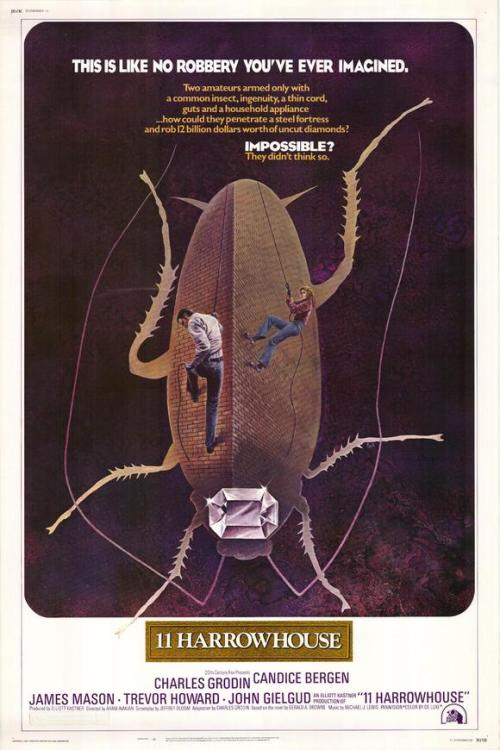
Heist films are usually a dime a dozen and it seems to becoming increasingly difficult to find a new spin on the genre. However, this film, based on the novel of the same name by Gerald A. Browne, is rather ingenious and deserves more attention. The plot revolves around Howard R. Chesser (Charles Grodin, who also co-wrote the screenplay) as a small-time diamond merchant who gets the chance to supervise the purchase and cutting of a large diamond that will be named after its wealthy owner Clyde Massey (Trevor Howard). The diamond ends up being stolen and stored inside the vaults of a large diamond conglomerate called ‘The system’ that is located at 11 Harrowhouse.  With the help of an inside man named Charles (James Mason) who works at the vault and has become unhappy with the company, Howard and his daredevil girlfriend Maren (Candice Bergen) pull off a daring heist.

The robbery itself is quite unique and a highpoint. Howard and his girlfriend manage to break into the electrical system of the building and put cockroaches with different colored stripping along their backs down through the piping that houses the building’s electrical wiring. They do this to find out which ones lead to the underground vault. Once Charles reports to them which cockroach came through the vaults electrical outlet, Howard pulls out the wiring and replaces it with a long thin hose. The hose is connected to a powerful vacuum, which sucks up the diamonds and places them into a large truck sitting outside the building and driven by Maren.

When the crime has been completed Howard learns that they’ve been doubled-crossed and a wild car chase inside the sprawling estate of an English mansion ensues. The chase sequence features some funny voice-over commentary by the Howard character as well as some excellent stunt driving.

Howard’s relationship with his girlfriend has a twist to it as well, which I enjoyed. Instead of Howard being the macho one it is actually Maren. She likes to drive her flashy sports car at high speeds, which scares Howard. During the robbery she is the one who does all of the dangerous stunts while Howard looks on with awe. She is also loaded with money and helps support Howard during the lean times. I thought this role-reversal was refreshing and nicely reflective of the 70’s era.

The supporting cast is filled esteemed British actors that inject the film with energy and class. I have always felt that Trevor Howard was an incredible talent. Here his screen-time is unfortunately limited, but he still makes the most of it. Sir John Gielgud as the director of ‘The system’ is splendid as well. His character is snippy and acerbic and this comes to a hilt when he finds out they’ve been robbed, which is highly amusing. James Mason is equally brilliant as Charles. I have always found him to be a superior actor, but was impressed with how he managed to steal every scene he is in despite playing someone who is rather meek and passive.

If anyone comes off poorly it is actually Grodin.  I find the man to be a very talented actor-writer, but he goes a bit overboard in his portrayal of someone who is detached and malcontent. Most of the time Grodin seems to be almost sleepwalking through the part as he shows no energy and becomes almost transparent. His running narrative though is quite funny and one of the best elements of the film. There are two versions of this movie, one with the narrative and one without. I would recommend the one with the narrative as it gives the story a slightly added dimension.

The film did not do well upon its initial release and Grodin has said in later interviews that the reason for this was because the audiences at the time ‘didn’t get it’. His intention was not to make a crime-caper at all, but instead use the story to take potshots at big business and the establishment. The satirical elements are there, but it is much too soft. For satire it needed a lot more of a punch and payoff. For light entertainment it is kind of clever and works pretty well on a slow afternoon although I did find the first half to be a bit slow-going and did not become engaged with it until the actual execution of the robbery.

My Rating: 6 out of 10

Released: September 26, 1974

Runtime: 1Hour 34Minutes

Rated PG

Director: Aram Avakian

Studio: 20th Century Fox

Available: Amazon Instant Video